
Our readers keep the lights on and my morning glass full of iced black tea. As an Amazon Associate, I earn from qualifying purchases.
Specs are compiled from manufacturer listings and verified buyer reviews and can change over time — please confirm the key details on the product page before buying.
You want a camera that captures the mood you want, keeps shadows clean, and fits how you actually work — on a gimbal, in a studio, or at a live event. The wrong choice means fighting your gear instead of trusting it. Megapixels matter less than sensor quality, dynamic range, and recording format.
I’m Min — the founder and writer behind Gadgets Feed. This guide is built by comparing the manufacturers’ published specifications and the patterns across verified customer reviews, so you get each pick’s real strengths and trade-offs instead of marketing spin.
We focus on cameras that shoot 4K or higher with professional codecs like ProRes or Blackmagic RAW, and we cut through the hype to highlight what each model actually delivers for real filmmaking. This is your honest, spec-focused roadmap to the right camera for cinematography.
Quick Picks
- Blackmagic Design Pocket Cinema Camera 6K G2 — Best Overall
- Canon EOS R5 C Mirrorless Camera — The Hybrid Beast
- Sony FX3 Full-Frame Cinema Line Camera — Low-Light Legend
- Canon EOS C70 Cinema Camera — The Cinema Workhorse
- Blackmagic Design Pocket Cinema Camera 4K — Budget Entry Point
- Blackmagic Design Micro Studio Camera 4K G2 — The Specialist
How To Choose The Best Camera For Cinematography
Matching the sensor, the lens mount, and the recording format to your projects separates a smart buy from a regret. Here are the four specs that matter most.
Sensor Size and Dynamic Range
The sensor is the heart of the image. Super 35 is the cinema standard — it gives you that filmic depth-of-field and works with a huge range of cine lenses. Full-frame sensors (like the one in the Sony FX3) offer even shallower depth-of-field and better low-light performance. Dynamic range (measured in stops) tells you how much detail the camera holds in shadows and highlights — 13 stops is good, 15+ stops is excellent.
Lens Mount Ecosystem
The mount determines your lens options. EF mounts (Blackmagic 6K G2) give you access to a massive library of Canon and third-party glass. RF mounts (Canon C70, EOS R5 C) are newer and optically superior but have fewer budget lens options. MFT mounts (Blackmagic 4K, Micro Studio 4K G2) are smaller and lighter but use a crop sensor.
Recording Codecs and Bit Depth
A camera that shoots 10-bit or 12-bit video and a log profile (like Blackmagic RAW, ProRes, or Canon Log) lets you color grade without banding or crushing shadows. Avoid cameras that only shoot 8-bit internal — you’ll fight the footage in post.
Built-in ND Filters and Audio
Internal ND filters (like the Canon C70 has) are a massive time-saver on set — you can adjust exposure without swapping screw-on filters. For audio, mini-XLR inputs (Blackmagic Pocket cameras, Sony FX3 handle) give you professional-level sound without an external recorder.
Quick Comparison
| Model | Best For | Sensor | Max Resolution | Dynamic Range | Amazon |
|---|---|---|---|---|---|
| Blackmagic Pocket 6K G2 | Versatile cinema work | Super 35 | 6144 x 3456 | 13 stops | $2,269.00Amazon |
| Canon EOS R5 C | Hybrid photo/cinema | Full-frame | 8K/60P | 16+ stops | $2,930.00$3,899.00Limited time dealAmazon |
| Sony FX3 | Low-light & long shoots | Full-frame | 4K | 15+ stops | $6,757.74Amazon |
| Canon EOS C70 | Dedicated cinema work | Super 35 DGO | 4K | 16+ stops | $3,499.00Amazon |
| Blackmagic Pocket 4K | Budget entry point | 4/3″ | 4096 x 2160 | 13 stops | $1,139.00Amazon |
| Blackmagic Micro Studio 4K G2 | Live production & crash cam | 4K Sensor | 4K | 13 stops | $1,179.00Amazon |
In‑Depth Reviews
1. Blackmagic Design Pocket Cinema Camera 6K G2

The Super 35 powerhouse that gives you cinema looks without the studio price tag.
You get a native resolution of 6144 x 3456 — that is 6144 x 3456 versus the Pocket 4K’s 4096 x 2160, which means you have genuine 6K to crop, stabilize, and reframe in post without losing quality. The 13 stops of dynamic range hold detail in bright skies and dark corners, so your grade has room to breathe. Its EF/EF-S lens mount opens the door to decades of Canon glass, from budget nifty-fifties to high-end cinema primes.
Buyers report the major con is terrible battery life — the included NP-F570 lasts about 60 minutes. The fix, owners note, is adding a vlock battery for hours of shooting, which turns this into a set-ready workhorse. The 5-inch tilting LCD is bright enough for most indoor setups, and you record to SD, CFast 2.0, or USB-C SSD. Unlike the Canon R5 C, the Pocket 6K G2 doesn’t overheat during long takes, making it more reliable for narrative shoots.
It ships with a DaVinci Resolve Studio activation key, so you can start grading 12-bit Blackmagic RAW right away. This is the single pick that balances resolution, lens flexibility, and post-production workflow better than anything near its price tier.
The Grade-Ready Edge
- 6K Super 35 sensor for reframing headroom (6144 x 3456).
- 13 stops of dynamic range for rich shadow/highlight detail.
- EF mount compatible with Canon and third-party lenses.
- Includes DaVinci Resolve Studio for post-production.
The Battery Catch
- Battery life is roughly 60 minutes — nearly unusable without a vlock upgrade.
- No continuous autofocus — requires manual focus discipline.
- LCD is dim (~250 nits) in direct sunlight, hard to see outdoors.
Best for narrative and commercial shooters who want 6K room to reframe and grade in DaVinci Resolve without spending pro-level money.
Look elsewhere if you need reliable autofocus for run-and-gun or event work — this camera demands manual focus discipline and a battery upgrade.
2. Canon EOS R5 C Mirrorless Camera

The hybrid that shoots 8K/60P RAW internally and 45MP stills in one body.
This is the rare camera that genuinely does two jobs. You get a 45-megapixel full-frame CMOS sensor for photography — shooting at up to 20 fps with electronic shutter — and a cinema-grade video pipeline that records 8K/60P internally in 12-bit RAW. The built-in cooling fan vents heat continuously, so you don’t hit the overheat wall like the regular R5. The ISO range of 100-51200 (expandable to 102400) means you can shoot in near-darkness and still pull clean shadows.
Owners mention the autofocus is lightning-fast, with Dual Pixel CMOS AF II and Eye/Face/Head detection that locks onto moving subjects — a real advantage over the manual-focus Blackmagic Pocket 6K G2. The 8K oversampling gives you 4K footage with less moiré and false color. Reviewers mention the battery is the main weakness; a V-Mount battery solves it, and the mini HDMI port needs a cable clamp for secure rigging.
It records in XF-AVC and MP4 for broadcast compatibility, plus simultaneously records two independent files. If you need one camera for high-end video and professional stills, this is the strongest option on the list.
The Dual-Duty Advantage
- 8K/60P internal 12-bit RAW recording with active cooling.
- 45MP stills at 20 fps with full AF tracking.
- Dual Pixel CMOS AF II — fast, reliable autofocus.
- Dual 4:2:2 10-bit oversampled 4K from 8K sensor.
The Compromise
- Battery life is poor — plan for a battery grip or V-Mount solution.
- No internal ND filters — you’ll need matte box or screw-on filters.
- Mini HDMI port is less sturdy than full-size HDMI.
Made for hybrid shooters who need one system for both photography and cinema work without swapping bodies.
Not for you if you only shoot video and don’t need the photo side — the Canon C70 gives you more dedicated cinema features for less money.
3. Sony FX3 Full-Frame Cinema Line Camera

The compact full-frame body that sees in the dark and never overheats.
The FX3 is built around a full-frame sensor that pushes ISO sensitivity to 409600 with 15+ stops of dynamic range — that means you can shoot candle-lit scenes and still pull usable shadow detail. A professional videographer reviewer confirmed the internal fan prevents overheating during long shoots, making it a reliable pick for events, documentaries, and all-day gimbal work. The top handle includes XLR inputs for professional audio, so you skip the external recorder for sound.
Customers note it’s more flexible in post than the Blackmagic Pocket 6K G2, with 10-bit S-Log and HDR recording, plus 16-bit RAW output via HDMI if you want an external recorder. It shoots cinematic 4K with precise autofocus that tracks faces and eyes — a strong advantage over the manual-focus Blackmagic cameras. One reviewer called it “a beast in a small package” after using it on a 30-day trek in Asia, noting it works perfectly on a gimbal.
The bundle includes a Sony FE 24-70mm f/2.8 GM II lens, a 128GB memory card, a spare battery pack with a USB-C port, and an 82mm filter kit. This is the most complete ready-to-shoot package in this guide.
The Low-Light Ace
- ISO up to 409600 — shoots in near darkness.
- 15+ stops dynamic range for flexible grading.
- Internal fan prevents overheating during long takes.
- XLR handle for professional audio built in.
- Compact and lightweight — gimbal-friendly.
The Restriction
- 4K only — no 6K or 8K for reframing headroom.
- No internal RAW recording like Blackmagic Pocket models.
- S-Log requires more grading effort than Blackmagic RAW.
Ideal for event and doc shooters who need reliable all-day recording with professional audio and exceptional low-light performance in a compact body.
Skip it if you need 6K+ resolution for cropping and reframing — the FX3 is locked at 4K.
4. Canon EOS C70 Cinema Camera
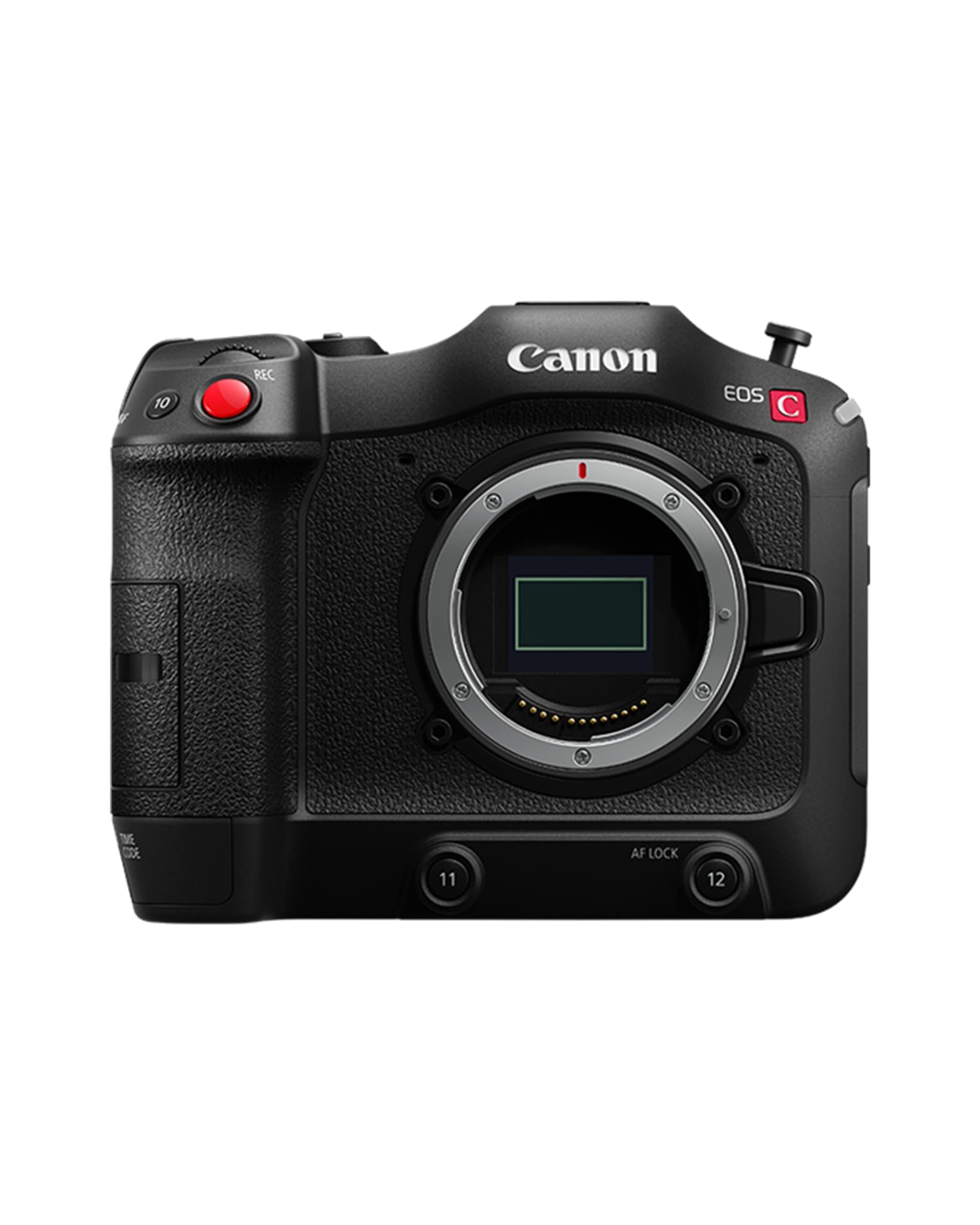
Canon’s dedicated cinema body with a Dual Gain Output sensor that rivals ARRI-level dynamic range.
The C70 uses a Super 35 Dual Gain Output (DGO) sensor with 16+ stops of total dynamic range — that means you get exceptional shadow detail without blowing out highlights, similar to high-end cinema cameras. It’s paired with the DIGIC DV7 image processor and Dual Pixel CMOS AF for consistent focus. The RF mount gives you access to Canon’s latest lenses, including electronic stabilization that works with the body’s coordinated image stabilization for smooth handheld shots.
Reviewers point out the built-in ND filters are a huge advantage — you dial in exposure in seconds without a matte box. The dual SD card slots let you record simultaneously in XF-AVC and MP4, and it supports Long-GOP compression for extended recording times at 4K 60p. An owner mentioned the LCD screen hinge can feel loose after a few uses, and another noted the lack of an EVF. It is approved for use in Netflix productions, confirming its professional credibility.
Compared to the Sony FX3, the C70 offers more dynamic range and built-in NDs, but the RF mount limits your lens options to Canon’s ecosystem unless you use an adapter.
The DGO Difference
- 16+ stops dynamic range from DGO sensor — top-tier shadow/highlight detail.
- Built-in ND filters for quick exposure control.
- Dual Pixel CMOS AF with face/eye detection.
- Approved for Netflix productions.
- Vertical shooting support for social media content.
The Downsides
- RF mount limits lens selection without adapter.
- No EVF — rely on the LCD screen.
- Some shoppers say LCD hinge loosens over time.
- Higher price — premium tier investment.
Best for dedicated cinema shooters who prioritize the highest dynamic range and built-in NDs for efficient on-set workflow.
Not the right pick if you need a hybrid photo/video camera — the C70 is pure cinema with no stills mode.
5. Blackmagic Design Pocket Cinema Camera 4K

The gateway to professional codecs and 13 stops of dynamic range at an entry-level price.
This is the camera that democratized cinema-quality video. Its 4/3-inch sensor delivers a native resolution of 4096 x 2160 with 13 stops of dynamic range and dual gain ISO up to 25,600 — so even in low light, you get usable footage with minimal grain. The active MFT lens mount works with a wide range of compact and vintage lenses, which one reviewer praised for the “beautiful texture” it produces with older glass.
Buyers report it’s “still amazing in 2020; 4K not obsolete” — the image quality holds up years after release. It records to SD/UHS-II, CFast 2.0, or USB-C SSD in Apple ProRes or 12-bit Blackmagic RAW, and comes with a DaVinci Resolve Studio key. The 5-inch bright LCD eliminates the need for an external monitor, though owners mention the screen is nearly unreadable in direct sunlight (~250 nits). The main trade-off is no continuous autofocus, no IBIS (in-body image stabilization), and a ~30-minute battery life — so you will need a battery grip or external power for serious shoots.
Compared to the Pocket 6K G2, this camera has a smaller sensor and lower resolution, but it costs significantly less and gives you the same 12-bit RAW workflow.
The Value Promise
- 13 stops dynamic range and dual gain ISO up to 25,600.
- 12-bit Blackmagic RAW and ProRes recording.
- USB-C SSD recording — cheap storage solution.
- Includes DaVinci Resolve Studio license.
The Limits
- No continuous autofocus or IBIS — manual focus only.
- ~30-minute battery life — needs external power.
- MFT sensor is smaller than Super 35 — less shallow depth-of-field.
- Screen is hard to see in bright sunlight.
Best for budget-conscious filmmakers who want professional codecs and 12-bit RAW without spending over a thousand dollars on the body.
Not for you if you need autofocus, IBIS, or run-and-gun capability — this camera demands careful manual operation and external power.
6. Blackmagic Design Micro Studio Camera 4K G2

The miniaturized studio cam built for multicamera rigs and crash cam positions.
This is a specialized tool, not a general-purpose camera. It is designed as the perfect studio camera for ATEM switchers, with built-in color correction, tally, and remote camera control over 12G-SDI. The 4K sensor goes up to ISO 25,600 with 13 stops of dynamic range, and it shoots Blackmagic RAW or ProRes. Customers note it’s “designed for multicamera or crash cam” and note that with a 2TB drive and NP battery, it works as a compact cinema camera shooting 12-bit RAW.
The body is tiny — lighter than the Pocket 4K — making it ideal for mounting on cars, drones, or tight spaces where a full-size camera won’t fit. It has an MFT lens mount, 1 x HDMI output, 1 x 12G-SDI input, 1 x 12G-SDI output, and a USB-C port for recording. However, reviewers warn of inconsistent color matching with other Blackmagic cameras and occasional freezing that requires a reboot — so it’s best used with a backup in critical roles. The LP-E6n battery lasts less than 30 minutes, and the Micro SDI cable cost adds up.
Unlike the Pocket 4K, this camera lacks a built-in screen and LCD menu, making it awkward as a standalone cinema camera. It shines in a controlled studio environment where you control it remotely via ATEM.
The Dedicated Role
- Ultra-compact — fits in tight spaces for crash cam or gimbal work.
- 12G-SDI I/O for professional broadcast workflow.
- Blackmagic RAW recording in a tiny package.
- Built-in color correction and tally for live production.
The Drawbacks
- No built-in screen — must be controlled remotely or with monitor.
- LP-E6n battery lasts less than 30 minutes.
- Color may not match other Blackmagic cameras exactly.
- Some users report freezing during extended use.
- Micro SDI cables are expensive.
Best for live production and multicamera rigs where small size and SDI connectivity matter more than a built-in screen.
Not the primary camera for narrative filmmaking — it lacks the usability and reliability for solo run-and-gun work without a monitor and backup.
Understanding the Specs
Dynamic Range (Stops)
This number tells you how much detail a camera holds in the brightest highlights and deepest shadows at the same time. Every extra stop is a big deal — it means you can expose for a bright window and still see the face in the shadows without the image looking fake. For cinematography, 13 stops is the entry point, and 15 to 16+ stops (like the Canon C70) is what pro cinema cameras deliver.
Bit Depth (8-bit vs 10-bit vs 12-bit)
Bit depth controls color smoothness in your video. 8-bit gives you 256 shades per color channel — fine for web video but banding appears in skies and gradients. 10-bit (1024 shades) is the minimum for professional color grading. 12-bit (4096 shades) is raw-level — you get maximum flexibility to push and pull colors in post without breaking the image. All cameras on this list shoot 10-bit or 12-bit.
FAQ
What is the difference between Super 35 and full-frame sensors for cinematography?
Does the Blackmagic Pocket 4K still hold up for pro work years after release?
Do I need an external recorder for these cameras?
Which camera is best for low-light cinematography?
Can I use Canon EF lenses on the Blackmagic Pocket 6K G2?
How important is 12-bit RAW for color grading?
Is the Blackmagic Micro Studio 4K G2 a good choice for a beginner?
Which of these cameras has the best autofocus?
Can the Canon EOS R5 C handle long 8K recording without overheating?
How do I fix the battery life on a Blackmagic Pocket Camera?
Final Thoughts: The Verdict
For most buyers, the best camera for cinematography is the Blackmagic Design Pocket Cinema Camera 6K G2 because it offers a Super 35 sensor (a sensor size close to APS-C, giving a film-like look), 6K resolution at 6144 x 3456, 13 stops of dynamic range (the range from darkest shadow to brightest highlight it can capture), and the EF lens ecosystem (Canon’s widely available lens mount) — all at a price that delivers cinema quality. If you need the best low-light performance and a compact gimbal-friendly body, the Sony FX3 is your pick. And for hybrid shooters who need both 8K video and 45MP stills in one body, the Canon EOS R5 C is the top choice.
How We Picked
We do not accept paid placement. Every pick is matched to a real buyer and a real use-case; we do not hands-on test units.
Sources & Methodology
Specifications: manufacturer listings and product documentation. Review insights: verified customer reviews, as of July 2026. Pricing: not shown on this page (it changes often); check the current price via the retailer link.
As an Amazon Associate, Gadgets Feed earns from qualifying purchases. This does not affect which products we feature.
Related Guides
Product prices and availability are accurate as of the date/time indicated and are subject to change. Any price and availability information displayed on Amazon at the time of purchase will apply to the purchase of this product. As an Amazon Associate I earn from qualifying purchases.
CERTAIN CONTENT THAT APPEARS ON THIS SITE COMES FROM AMAZON. THIS CONTENT IS PROVIDED "AS IS" AND IS SUBJECT TO CHANGE OR REMOVAL AT ANY TIME.
Amazon and the Amazon logo are trademarks of Amazon.com, Inc. or its affiliates.