
Our readers keep the lights on and my morning glass full of iced black tea. As an Amazon Associate, I earn from qualifying purchases.
Specs are compiled from manufacturer listings and verified buyer reviews and can change over time — please confirm the key details on the product page before buying.
That first blast of warm air from a car’s vent is a sinking feeling, especially when you know it means your A/C system has a hole somewhere. Refrigerant leaks slowly drain your system, turning a freezing cabin into a sweaty waiting room, and the cost to have a shop chase down the pinhole repair can run into thousands of dollars. An auto AC stop leak offers a far cheaper path, but the results range from “miracle fix” to “failed in 10 days,” so choosing the right formula and application method is everything.
I’m Min — the founder and writer behind Gadgets Feed. This guide is built by comparing the manufacturers’ published specifications and the patterns across verified customer reviews, so you get each pick’s real strengths and trade-offs instead of marketing spin.
If you have a slow leak in your car’s air conditioner and want to avoid a shop bill, a carefully chosen auto ac stop leak might plug that pinhole for good with a simple DIY treatment.
Quick Picks
- Nu Calgon 4050-08 EasySeal Direct Inject — Tech’s Choice
- A/C Pro AC Super Seal R-134a Stop Leak – 3oz — Florida-Proof
- Leak Saver Direct Inject Ultimate 3-in-1 — Triple Threat
- BlueDevil Products Red Angel 49496 A/C Stop Leak – 2 Ounce — Chemical Weld
- ERRECOM Extreme Ultra – 6 mL — Universal Dose
- Leak Saver Direct Inject Small System (Up to 1 Ton) — USA Made
How To Choose The Best Auto AC Stop Leak
Choosing an AC stop leak requires more than grabbing the cheapest can. The wrong formula can turn your compressor into a sludgy mess, while the right polymer-free option can plug a pinhole for years. Here are the essential things to check before you inject anything.
Polymer-Free vs. Particle-Based Formulas
The biggest dividing line among formulas is the type. Many old-school stop leaks use solid particles that clump together at the hole. The risk is that those particles can clump inside your expansion valve or condenser coil, causing blockages. Safer options today use polymer-free organosilane formulas. These chemically react with moisture in the air at the leak site to form a permanent seal. They do not just clog a hole; they create a chemical bond and will not gunk up internal parts.
System Compatibility (Refrigerant Type and Oil)
You must match the stop leak to the refrigerant in your car. Most stop leaks list compatibility with R-134a and R-1234yf, and some even cover R-12 for older vehicles. The product also needs to be safe for the lubricant oil inside your compressor, whether it is PAG, POE, or mineral oil. The data on the can should explicitly state its compatibility. If you are working on a residential HVAC unit or a mini-split, you need a product rated for R-410A as well.
Leak Size and System Charge Loss
Stop leaks are designed for slow leaks where you lose the full refrigerant charge over a week or more. If your system loses all pressure in a day, the hole is too large for a chemical seal, and you need to replace the part. Check the product’s spec for the maximum leak size it can handle; for example, the ERRECOM product seals leaks up to 0.3 mm. For a pinhole that drains refrigerant over a couple of months, a stop leak is the perfect first attempt.
Quick Comparison
| Model | Best For | Formula Type | Weight | Max Leak Size | Amazon |
|---|---|---|---|---|---|
| Nu Calgon 4050-08 EasySeal | Professional-grade HVAC & Auto | Concentrated Liquid | — | — | Amazon |
| A/C Pro AC Super Seal R-134a | DIY car A/C quick-fix | Pressurized Can with Push Button | 8.4 ounces | — | Amazon |
| Leak Saver Direct Inject Ultimate 3-in-1 | Multi-function DIY for HVAC & Auto | Organosilane + UV Dye | 3.2 ounces | — | Amazon |
| BlueDevil Red Angel 49496 | Permanent seal on condensers & o-rings | Chemical Weld (No Solids) | 1.76 ounces | — | Amazon |
| ERRECOM Extreme Ultra | Small leaks in fridges & auto | Polymer-Free | 6 Grams | 0.3 mm | Amazon |
| Leak Saver Direct Inject Small System | Small HVAC and auto systems | Direct Inject Sealant | 2.39 ounces | — | Amazon |
In‑Depth Reviews
1. Nu Calgon 4050-08 EasySeal Direct Inject

A professional-grade hit that uses a tiny tube of concentrated liquid so a little goes a long way.
This pick treats your A/C system like a medical patient. The Nu Calgon EasySeal uses a concentrated formula, meaning a very small amount of material goes into the system. The packaging includes a clear tube so you can see the sealant moving through the line as you inject it, giving you visual confirmation that the application is actually happening. It is designed for split systems, heat pumps, microchannel coils, packaged units, and mini splits, and the manufacturer says you do not need to pump down R-410A units before using it.
One buyer fixed their daughter’s central AC with it that needed a recharge every three weeks. After two months, the system was running and the output temperature was actually 2°F cooler than before. Another reviewer used it on a 3.5-ton R22 system that was losing 2-3 pounds of refrigerant per year and reported zero refill needed after a full year. There is a clear catch, though: the success rate feels inconsistent, as one customer saw no improvement after nine days. This seems to work best on small tube and line leaks rather than major compressor failures.
Perfect For: The home AC owner or car DIYer who wants a professional-grade, low-volume injection that keeps the system clean and fixes slow line leaks.
Only If: Your leak is confirmed as small (loss over several weeks), and you accept a roughly one-in-three chance that it might not seal a tricky micro-leak immediately.
Grab this if: You are comfortable using a manifold gauge set and want a trusted professional concentrate from a brand (Nu-Calgon) with decades of HVAC industry reputation.
Look elsewhere if: You need a pressurized can with a simple push-button dispenser; this product requires a manifold gauge or injection kit to push it in.
2. A/C Pro AC Super Seal R-134a Stop Leak – 3oz
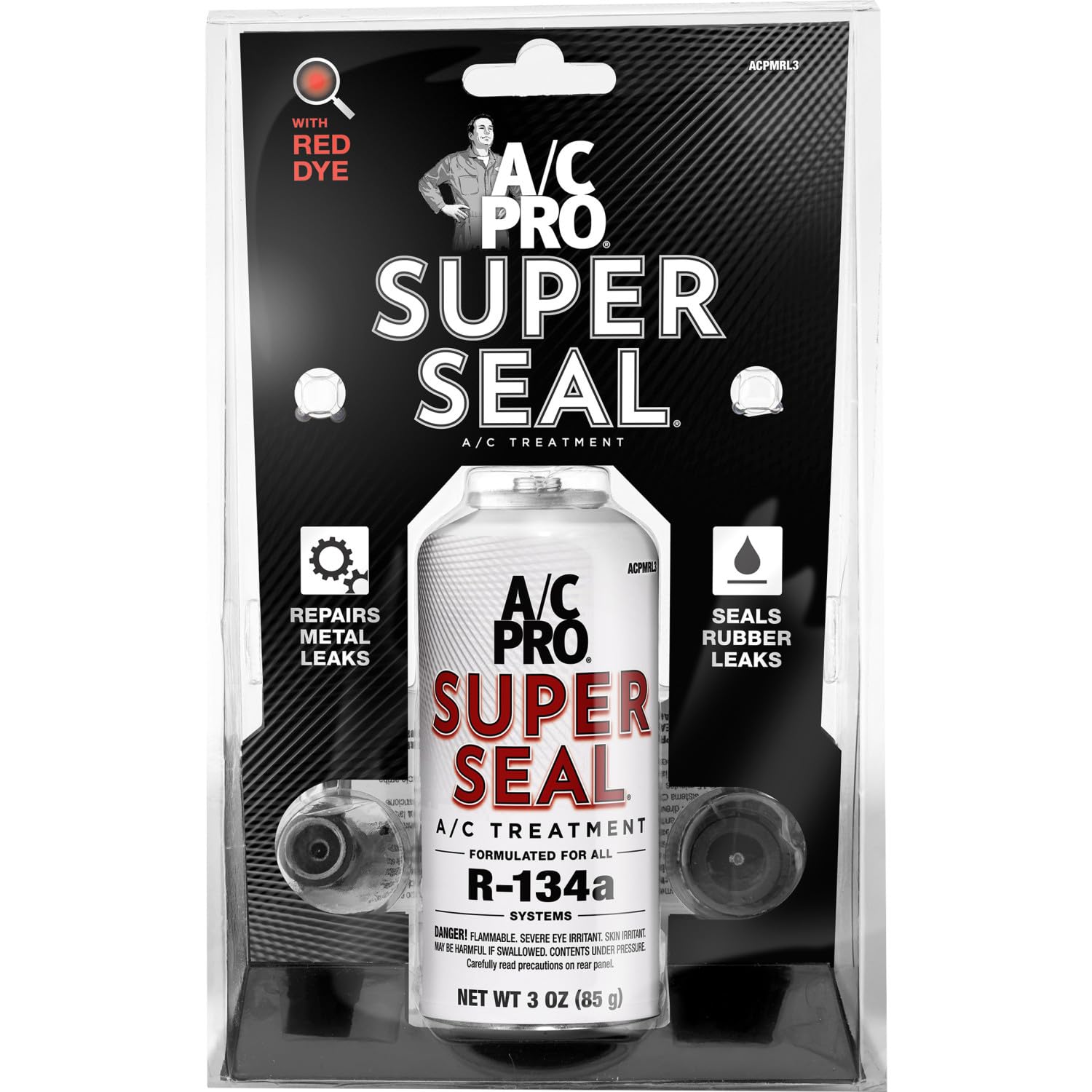
The easiest way to treat a car’s A/C leak without needing any tools beyond this single can.
At 8.4 ounces, this is the heaviest can in the lineup, but that weight is because it comes pre-charged as a complete system treatment. The A/C Pro Super Seal uses a pressurized can with a push-button dispenser, so you do not need a manifold gauge set, a syringe, or any additional equipment. The instruction is simple: attach the can to the low-side service port, push the button, and let the sealant flow in as the system pulls it. It is designed to seal both metal and rubber leaks and works with common AC system lubricants.
Buyers report extremely long-term success. One owner used it on a 2012 BMW 135i with a leaking evaporator, a notoriously difficult location to fix. That car is still blowing cold after 5.5 years of Florida summer heat. Another reviewer put it in a 30-year-old Land Cruiser where the compressor was leaking and reported the longest hold that vehicle has ever had. A/C Pro is notably heavier than the BlueDevil Red Angel, which weighs just 1.76 ounces, but the A/C Pro includes the refrigerant carrier gas in the same can, making it a one-step process.
Why It Stands Out
- Comes in a complete can with push-button dispenser; no hoses or gauges needed for basic use
- Multiple owners mention holding for years in hot climates (Florida, summer temps)
- Handles evaporator leaks, which are usually a dashboard-out repair
Heads-Up
- At 8.4 ounces, it is the heaviest product; the can is large to handle
- One mechanic reviewer notes it can turn to sludge and cause blockages (though this is disputed by long-term user reports)
Reach for this if: Want a one-can tool-free fix for a slow leak in your car that you can apply in your driveway in under five minutes.
Look elsewhere if: You are working on an R-1234yf system (this can is R-134a only) or are concerned about introducing too much material into a very small automotive system.
3. Leak Saver Direct Inject Ultimate 3-in-1 for HVAC Up to 5 Tons

An all-in-one system treatment that seals leaks, removes moisture, and adds UV dye for diagnosis.
This is a three-functions-in-one bottle from Leak Saver. It combines the leak sealant (an organosilane formula), a moisture remover to dry out any water from the system, and a UV dye so you can use a blacklight to spot active leaks later. It is rated for HVAC systems up to 5 tons, which covers most residential central air units, and it is also compatible with automotive systems (R-134a and R-1234yf). At 3.2 ounces, this product is just slightly lighter than the Leak Saver small system bottle.
One reviewer noted a tiny HVAC leak that professional tools could not find. After injecting this product, they waited 11 days; the leak sealed and the UV dye revealed the exact location at the coil. Another reviewer used it after being quoted for a repair on a slow A/C leak, and they are waiting to see if the seal holds over the next few months. The manufacturer reports over 4,000,000 units of their sealant formula sold since 2015.
Multi-Tool Perk: The inclusion of a moisture remover and UV dye in the same tube means you do not need to buy three separate products. This is especially helpful if you are trying to locate a large leak that the sealant itself cannot close.
Watch Out For: This product requires a manifold gauge set or a Leak Shot injection kit to install. It is not a push-button can like the A/C Pro.
Best for: The DIY homeowner or car enthusiast who already owns manifold gauges and wants a single product that seals, dries, and helps find the leak.
Not for: Anyone looking for a quick tool-free fix — you will need the proper hoses and adapters to get this into the system.
4. BlueDevil Products Red Angel 49496 A/C Stop Leak – 2 Ounce

The smallest bottle that punches far above its weight, sealing condensers and evaporators with a chemical bond.
You get a permanent seal without clogging your system, thanks to the BlueDevil Red Angel’s formula. It weighs just 1.76 ounces and measures 0.9 x 2 x 3.9 inches, and it contains no solid or particulate matter, so it will not clog your A/C system or harm a recovery unit. Instead, it forms what the manufacturer calls a “chemical weld” — it reacts with the metal and rubber surfaces at the leak point to seal permanently. The manufacturer guarantees the sealant works. It works on both R-12 and R-134a systems, so it suits older car owners who still run the original R-12 refrigerant.
Customers note stunning results. One owner said four dealers quoted over for a core replacement, and this product solved the problem completely. Another reviewer, using it on an old car, evacuated the system, put the product in quickly to avoid air intrusion, and reported that after six months in a Florida summer the system was still leak-free and working well. The only downside is its sheer size means you have to be careful not to lose the small syringe or bottle during application.
The Strong Points
- Chemical weld formula with no solids means zero risk of clogging expansion valves
- Works on both R-12 and R-134a systems, covering two generations of cars
- Extremely compact at 1.76 ounces and 0.9 x 2 x 3.9 inches
Consider This
- At 1.76 ounces, versus the A/C Pro Super Seal at 8.4 ounces, you need to be precise with the dosage
- Some users reported that a pinhole evaporator leak still showed a small loss after one year, so very slow leaks may need a second application
Pick this for: The older car owner (R-12) or anyone who wants a safe, no-particle sealant that forms a real chemical bond without risking a sludge disaster in the compressor.
skip it if: You want a tool-free application; the BlueDevil needs you to inject the liquid into the system via a hose and gauge, not a push-button can.
5. ERRECOM Extreme Ultra – 6 mL
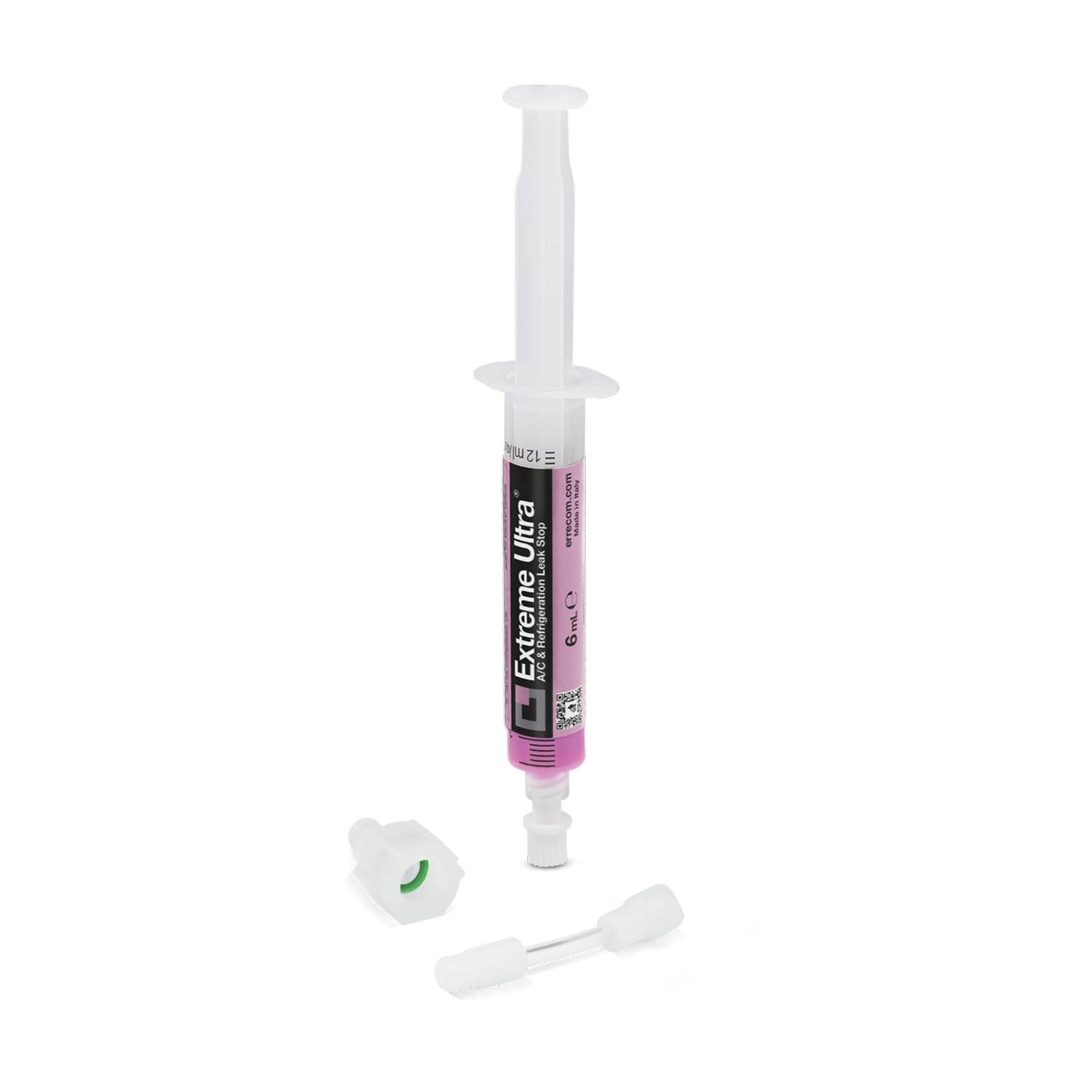
A tiny syringe that delivers a universal dose for small leaks on both fridges and car AC systems.
The ERRECOM Extreme Ultra is the lightest product in this list at just 6 grams, but the data says it is designed for something specific: sealing refrigerant leaks up to 0.3 mm in size. The manufacturer states that 6 mL is the universal dose for systems up to 21 kW (or 700 mL of compressor lubricant), which covers a huge range of appliances from residential fridges to automotive AC systems. The polymer-free formulation is compatible with any refrigeration lubricant and any refrigerant gas excluding ammonia (R717), and the box includes a reusable 5/16 SAE adapter for R-410a and R-32 systems.
One buyer mentioned an incredible outcome: they saved by using a single cartridge of this product to fix a dead 16-year-old KitchenAid 40-cubic-foot fridge. The issue was a refrigerant leak, not a control panel failure. The reviewer cleaned the coils, injected the product, and the fridge came back to life. Not every review is that dramatic, of course — some buyers said it did not solve their problem at all. The catch is the extremely small dose. At 6 grams, you get one shot, so you must be certain the leak is 0.3 mm or smaller.
Best Value: This is the most affordable entry point that covers both car AC and large residential fridges, and it includes the 5/16 SAE adapter for newer systems.
Be Careful: One dose is all you get at just 6 mL. If your system has a larger leak, you will need a different product entirely.
Grab this if: Need a simple, single-dose injection for a very small pinhole in a fridge, freezer, or mini-split.
Not for: Larger automotive AC leaks where you want a pressurized can to push the sealant through — this is a manual injection with a syringe.
6. Leak Saver Direct Inject Small System (Up to 1 Ton)

A direct inject sealant that is over 4 million units strong, made for small HVAC and auto systems.
The Leak Saver Direct Inject is the smaller sibling to the Ultimate 3-in-1 above. This version is designed for small systems up to 1 ton, which covers window AC units, small mini-splits, refrigerators, and many automotive systems. The formula reacts with air and moisture at the leak site to permanently seal the hole, and the manufacturer claims it is safe for all manifold gauges, hoses, expansion valves (TXVs, TEVs, capillary tubes, etc.), and Schrader valves. At 2.39 ounces and with product dimensions of 0.7 x 4.8 x 6.7 inches (compared to the BlueDevil Red Angel’s 0.9 x 2 x 3.9 inches), it is small enough to stow in a toolbox but requires some knowledge to inject. The product is proudly made in the USA.
Some reviewers point out it works well on DIY mini-split leaks, but one owner reported it failed to fix a slow coolant leak in a wine fridge after two applications, with the leak persisting and temperature lost over three days. Another reviewer called it a standout for their AC refrigerant leak, successfully fixing the problem and avoiding an expensive unit replacement — their AC worked perfectly even in 90°F weather. The injection is straightforward but requires a manifold gauge set (a tool that measures pressure in the system).
What Works
- Made in the USA with a massive track record of 4 million+ units sold
- Compatible with all refrigerants: R-410A, R-22, R-134a, R-1234yf, R-404A, R-290, R-600a
- Safe for all service tools, expansion valves, and Schrader valves
What Holds It Back
- Not a pressurized can; it requires a basic manifold gauge set to inject
- One customer observed failure after two applications on a wine fridge, so success is not guaranteed for every system type
Best pick for: The intermediate DIYer who has a small system (window AC, small fridge, car) and already owns a gauge set.
Not for: Those wanting a single-step injector can or who are dealing with a leak larger than a slow pinhole — the product states it works when the charge is not lost within 7 days.
Understanding the Specs
Leak Size Limit (0.3 mm)
This is the single most important spec a stop leak product can list. The ERRECOM Extreme Ultra, for example, states it can seal leaks up to 0.3 mm. For context, 0.3 mm is about the thickness of a human hair. A hole of this size causes a slow leak that drains your refrigerant over weeks or months. If your leak is larger, maybe a visible crack or a damaged o-ring, a stop leak will not hold. You would need to replace the physical component instead.
Weight / Dosage (grams vs. ounces)
Weight tells you how much product is going into your system, but it is not a simple bigger-is-better metric. A heavy can like the A/C Pro at 8.4 ounces includes the propellant and extra carrier fluid. A tiny syringe like the ERRECOM at 6 grams delivers a very concentrated dose. For car systems, a heavier can is fine. For a small mini-split or fridge, too much material can cause blockages. Always match the product size to the system’s capacity, measured in tons for HVAC (1 ton = 12,000 BTU) or in pounds of compressor lubricant (e.g., 700 mL limit for the ERRECOM).
FAQ
Will an auto AC stop leak work on R-1234yf systems?
Can I use the same stop leak on my car and my home AC?
How long does it take for an AC stop leak to work?
Can a stop leak damage my AC compressor?
What size leak is too big for an AC stop leak?
Do I need special tools to apply an AC stop leak?
How much stop leak should I use for my car’s A/C?
Does an AC stop leak work on fridge or wine cooler leaks?
Final Thoughts: The Verdict
For most buyers, the auto ac stop leak winner is the A/C Pro AC Super Seal R-134a because a pressurized can with a simple push-button dispenser makes the fix truly tool-free, and reviewers report it lasting over five years in tough Florida heat. If you want a professional-grade solution for both cars and home HVAC systems, grab the Leak Saver Direct Inject Ultimate 3-in-1 for its built-in UV dye (a fluorescent dye that glows under a UV light to show the leak) and moisture remover. And for a tiny pinhole in a fridge or older R-12 car system, the compact chemical-bonding power of the BlueDevil Products Red Angel is your best bet.
How We Picked
We do not accept paid placement. Every pick is matched to a real buyer and a real use-case; we do not hands-on test units.
Sources & Methodology
Specifications: manufacturer listings and product documentation. Review insights: verified customer reviews, as of July 2026. Pricing: not shown on this page (it changes often); check the current price via the retailer link.
As an Amazon Associate, Gadgets Feed earns from qualifying purchases. This does not affect which products we feature.