
Our readers keep the lights on and my morning glass full of iced black tea. As an Amazon Associate, I earn from qualifying purchases.
Specs are compiled from manufacturer listings and verified buyer reviews and can change over time — please confirm the key details on the product page before buying.
You are hauling a heavy trailer, and the rear of your truck dips an inch. Or you have got train horns in the bed, and you need them loud without waiting for the compressor to catch up. The right air ride management system fixes both problems. A weak pump leaves you sitting there, watching the pressure gauge rise — never fast enough. The three systems here handle that differently. One packs dual compressors for serious volume, and the other two use a smart phone app for convenience. Choose based on your air volume needs and refill speed requirements.
I’m Min — the founder and writer behind Gadgets Feed. This guide is built by comparing the manufacturers’ published specifications and the patterns across verified customer reviews, so you get each pick’s real strengths and trade-offs instead of marketing spin.
Your air usage volume determines which system fits. A big 5-gallon tank fed by twin compressors refills fast. A compact wireless controller you program from your phone is simpler but slower. Here is which system fits your rig.
Quick Picks
- Vixen Air VXO4852DB — Top Performer
- Air Lift 74000 (2nd Gen) — Smart Controller
- Air Lift 74000EZ (2nd Gen) — Reliable Upgrade
How To Choose The Best Air Ride Management System
The compressor’s airflow rate (CFM) is the core spec of any air management kit. Buyers prioritize CFM (cubic feet per minute) for refill speed and PSI (pounds per square inch) for pressure headroom. Higher CFM recharges the tank faster after dumping air from bags. Higher PSI supports stiffer suspension for heavy loads or tall vehicles. Tank size (gallons) determines reserve air volume before the compressor activates, but larger tanks occupy more under-vehicle space.
Compressor Airflow (CFM) and Duty Cycle
The compressor’s CFM rating (cubic feet per minute) tells you how fast it replenishes the tank. A 1.8 CFM compressor refills a 5-gallon tank noticeably faster than a 1.03 CFM unit — buyers report the Vixen’s twin compressors “fill 5-gal tank in minutes.” That speed matters if you frequently adjust ride height or run air tools. Duty cycle is the percentage of time the compressor can run in an hour without overheating. A 9% duty cycle means the pump should run for about 5.4 minutes every hour — enough for occasional correction but not continuous use. If you plan heavy towing with constant load-leveling, a higher-duty compressor or dual-compressor setup helps avoid waiting.
Maximum Pressure (PSI)
PSI (pounds per square inch) is the maximum air pressure the compressor can build. A 200 PSI system gives more headroom than a 120 PSI unit, which is especially useful for tall suspension lifts that need higher base pressure to keep the vehicle level under load. The 200 PSI rating allows the tank to store more usable energy, so your system is less likely to run short on a long incline or when airing up large tires. However, most air spring bags handle well below 150 PSI, so 120 PSI is adequate for normal towing and load leveling — the higher ceiling is for those pushing the envelope.
Control Method: Wireless vs. Hardwired
Modern systems let you adjust air pressure from the driver’s seat via a handheld remote or a phone app — no need to run air lines through your cab. A wireless controller with an LCD screen and programmable presets (typically 3 user-defined presets) means you set one pressure for highway, one for loaded towing, and one for unloaded cruising, then switch with a button. The trade-off: wireless connectivity can occasionally drop (one reviewer noted failure to connect “about 1 in 5 times”), and a handheld remote is easy to forget on a bumper. App-based control on iOS and Android gives you the same presets from your phone, so you do not need to carry a separate device.
Quick Comparison
| Model | Best For | Air Flow (CFM) | Max Pressure (PSI) | Tank Size | Amazon |
|---|---|---|---|---|---|
| Vixen Air VXO4852DB | High-volume air demand & fast refill | 1.8 CFM (dual compressors) | 200 PSI | 5 gallons | Amazon |
| Air Lift 74000 | Wireless app control & brand-agnostic fit | 1.03 CFM | 120 PSI | — | Amazon |
| Air Lift 74000EZ | EZ mounting plus long-term reliability | 1.03 CFM | 120 PSI | — | Amazon |
In‑Depth Reviews
1. Vixen Air VXO4852DB

This dual-compressor system refuels your tank in minutes, not forever — so you stay moving.
You get fast refills with the Vixen because its twin compressors push 1.8 CFM each, and it builds pressure up to 200 PSI. That is 75% more airflow and 67% more pressure headroom than either Air Lift unit. Owners mention the “compressors fill 5-gal tank in minutes,” and the 5-gallon steel tank gives you 9 ports for suspension, a horn, and a bumper quick-connect all at once. The sealed, oil-less design needs no future lubrication (the brand claims the rubber seals are permanently grease-free), and the remote filter kit moves the intake away from road salt and mud. Reviewers praise the setup time — one owner installed the tank, compressors, and wiring in about an hour on a 350Z, noting it fits under a truck frame or over a wheel well.
The catch: the pressure switch ships with the kit, and a couple of buyers noted it can fail if damaged during install. One reviewer ordered a replacement and it worked fine, so budget a little extra caution during the wiring step. At 11″L x 32″W x 17″H, the Vixen footprint is noticeably larger than the compact Air Lift systems — it takes up real space under your bed or chassis. If you just need occasional load-leveling for a daily driver, the dual-compressor capacity may be overkill. But for anyone who wants to run a horn bank, fill truck tires, and constantly adjust ride height without waiting, this is the one that keeps up.
Who this fits: Truck owners running heavy loads, air tools, and train horns who need fast tank refill without babysitting a single compressor.
The trade-off: The 11″L x 32″W x 17″H footprint requires generous mounting space, and the pressure switch may need careful handling during install.
Reach for this if: you want the highest airflow (1.8 CFM) and pressure ceiling (200 PSI) for nonstop air demand — Vixen is the volume king of this group.
Look elsewhere if: space is tight under your vehicle or you only need modest load leveling for occasional towing.
2. Air Lift 74000 (2nd Gen)
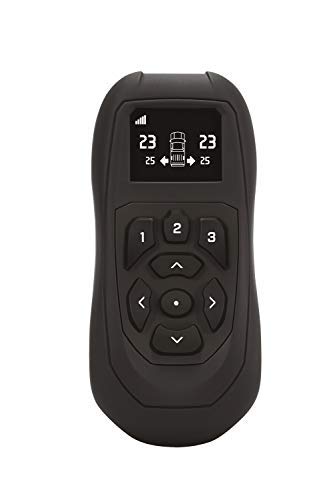
This compact wireless controller works with any brand of air springs — you control pressure from your phone.
Air Lift’s 2nd Gen system shifts focus from raw volume to smart control. You pair a handheld LCD remote with a free iOS/Android app to dial in pressure on each bag independently. The dual-path manifold lets you fill left and right bags to different pressures, which helps when hauling a top-heavy load like a camper. You store up to three user-defined presets: one for unloaded cruising, one for towing a fifth wheel, one for hookup/disconnect. Reviewers on a Ford Transit found installation straightforward, and one owner praised Air Lift’s customer support after his “remote failed after 2 years 3 months (3 months out of warranty)” — the company sent a replacement. At 8.6 pounds and 11.5″L x 9.13″W x 7.5″H, the kit is much smaller and lighter than the Vixen, tucking into tight spaces under a van or SUV.
But the 1.03 CFM compressor (9% duty cycle) is a significant step down from the Vixen’s output — you will wait longer between adjustments if you dump air often. The maximum pressure is 120 PSI, fine for most bags but less headroom for tall suspension lifts. Some buyers reported wireless connectivity issues: it “fails to connect about 1 in 5 times,” regardless of whether you are inside or outside the truck.
What owners value
- Easy installation on vans and trucks with common tools — one reviewer called it “zero air leaks” with decent instructions
- Dual-path independent control for uneven loads, plus three programmable presets via remote and app
- Lightweight 8.6-pound kit fits in small spaces where the Vixen cannot
Where it falls short
- 1.03 CFM compressor refills slower than the Vixen, especially if you dump air frequently
- Wireless connection drops “about 1 in 5 times” per one long-term user
- Known manifold failure risk after two years — replacement costs over
Best for: owners of vans (Ford Transit), SUVs, or trucks who want app-controlled convenience and independent left-right pressure without a huge tank in the way.
Not for: frequent air tool users or anyone who needs rapid cycle refill — the 9% duty cycle and 1.03 CFM pump will keep you waiting.
3. Air Lift 74000EZ (2nd Gen)
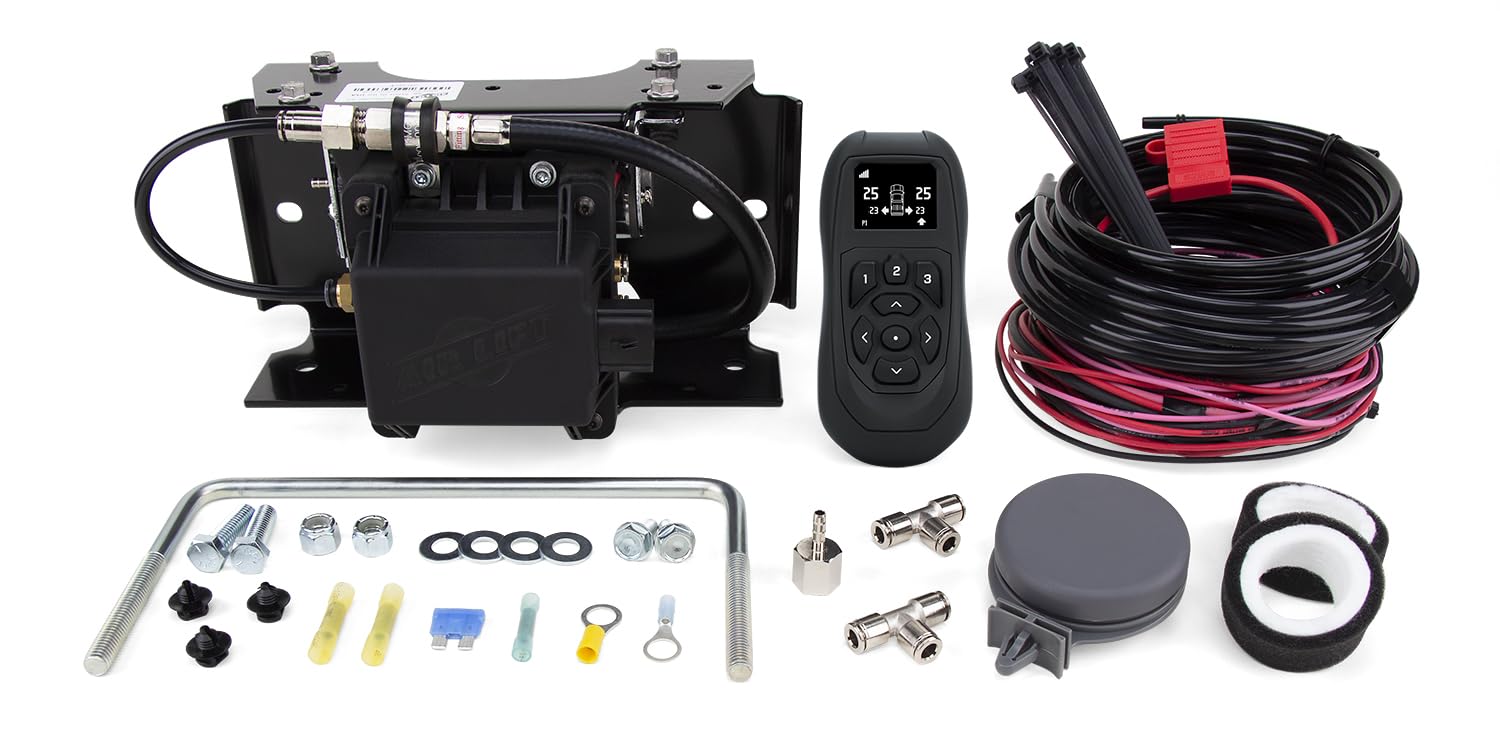
The same app-smart controller as the 74000, but with a mount kit that locks everything in place — less fuss under the truck.
On paper the 74000EZ shares the same core specs as the standard 74000 — the same 1.03 CFM compressor, the same 120 PSI max, the same dual-path wireless controller and three-preset app — but it adds the EZ Mount system. That pre-assembled bracket bolts the compressor and manifold to one tray rather than floating each part. One reviewer who tows a fifth-wheel toy hauler with an F250 reported the “auto air compressor is awesome and worth the upgrade,” and another owner confirmed the “compressor still working after 3.5 years.” The dimensions are 14″L x 10″W x 8″H versus the 74000’s 11.5″L x 9.13″W x 7.5″H, so check your space. The same wireless presets let you set a hookup pressure and a driving pressure, then switch without leaving the cab — useful when you level a camper at the site then air up for the highway.
The downsides mirror the standard 74000: the compressor is not fast (1.03 CFM) and the max pressure stays at 120 PSI. Several reviewers flagged installation difficulty — one straight up said “Not an easy install,” and another who called it “Fairly easy” had to route the air intake into the cab to avoid dirty air. The handheld controller is easy to “forget on the bumper,” per one owner, though the app works as a backup. The 2-year warranty means you are on your own beyond that window. Buyers reporting the “compressor still working after 3.5 years” is a good sign of longevity, but the manifold could still be a weak link past the warranty.
Your best bet if: you value an all-in-one mounting tray that keeps the compressor and manifold tidy, plus the proven 3.5-year reliability that real owners have experienced.
One honest note: the 1.03 CFM compressor will not win any speed contests, and the installation is harder than the marketing suggests — budget a few hours with wiring and air-line routing.
Reach for this if: you want the wireless app convenience and the clean EZ Mount install, and you have a mid-duty towing profile (fifth wheel, camper) that does not demand fast tank refills.
Compare to: the 74000 if you want the same controller but need a smaller 11.5″ x 9.13″ x 7.5″ footprint; the Vixen if you need twice the airflow.
Understanding the Specs
CFM — Cubic Feet per Minute
This measures how much air the compressor pushes out each minute. Higher CFM means the tank refills faster after you dump air from your bags or horns. The Vixen runs two 1.8 CFM compressors (total output is 1.8 CFM per pump), while the Air Lift units are single 1.03 CFM pumps. If you need to air up tires, run air tools, or frequently adjust ride height, go with the higher CFM — otherwise the slower pump is fine for occasional load leveling.
PSI — Pounds per Square Inch
The maximum pressure the compressor can build in the tank. 200 PSI lets you store more energy per gallon, which is important for tall suspension lifts or systems that run air springs near their upper limit. 120 PSI is adequate for most aftermarket air bag kits used on standard towing and daily driving setups. The trade-off: a higher PSI compressor typically costs more and demands a stronger power supply.
Duty Cycle
This tells you what percentage of an hour the compressor can run without overheating. A 9% duty cycle means the pump should run for about 5.4 minutes per hour maximum. If you correct pressure more often than that (e.g., frequent dump-and-fill for off-road articulation), you may overheat the compressor and trigger the thermal overload shutoff. Systems with dual compressors or larger tanks reduce how often the pump actually runs, effectively stretching the duty cycle.
Dual-Path Control
A dual-path manifold lets you fill your left and right air springs to different pressures independently. This matters for uneven loads like a camper hanging off one side, or for leveling a vehicle parked on a side slope. The Air Lift 74000 and 74000EZ both support dual-path control from the wireless remote and app, while the Vixen relies on separate pressure switches per side if you add them.
FAQ
Can I run train horns and air bags from the same tank?
How long does a 1.03 CFM compressor take to refill a 5-gallon tank?
What does a 9% duty cycle mean in practice?
Will the Air Lift controller work with my existing bags?
How often do I need to maintain the compressor?
What is the difference between the Air Lift 74000 and 74000EZ?
Can I use a 200 PSI system on 120 PSI rated bags?
Does the wireless controller work through the truck cab body?
How much current does a 1.03 CFM compressor draw?
Do these kits include the air line and fittings for the bags?
Final Thoughts: The Verdict
For most people, the best air ride management system is the Vixen Air VXO4852DB because its dual 1.8 CFM compressors and 5-gallon tank cover the widest range of uses — from air bags and train horns to tire inflation — with the fastest refill of this group. If you want wireless app control and compact sizing for a van or SUV, grab the Air Lift 74000EZ — its EZ Mount and three-user presets make load adjustment easy from the driver’s seat. And for the same controller in a slightly smaller footprint at the best value for basic towing, the Air Lift 74000 still gets the job done, even if it trails on airflow and long-term part reliability.
How We Picked
We do not accept paid placement. Every pick is matched to a real buyer and a real use-case; we do not hands-on test units.
Sources & Methodology
Specifications: manufacturer listings and product documentation. Review insights: verified customer reviews, as of July 2026. Pricing: not shown on this page (it changes often); check the current price via the retailer link.
As an Amazon Associate, Gadgets Feed earns from qualifying purchases. This does not affect which products we feature.