
Our readers keep the lights on and my morning glass full of iced black tea. As an Amazon Associate, I earn from qualifying purchases.
Specs are compiled from manufacturer listings and verified buyer reviews and can change over time — please confirm the key details on the product page before buying.
Breathing is harder when your own home stirs up dust mites, pet dander, smoke, or mold spores — all common asthma triggers. This guide breaks down the top-rated HEPA (High-Efficiency Particulate Air) purifiers that trap 99.97% of airborne triggers, using real specs and verified buyer experiences so you pick one that fits your room size and your sleep.
I’m Min — the founder and writer behind Gadgets Feed. This guide is built by comparing the manufacturers’ published specifications and the patterns across verified customer reviews, so you get each pick’s real strengths and trade-offs instead of marketing spin.
These air purifier for asthma models are the ones real buyers and lab tests put to the test — and the standout picks deliver results in hours, not days.
Quick Picks
- AirHub A282 Air Purifier — Best Overall
- LEVOIT Core 200S-P Air Purifier — Smart & Compact
- PuroAir 100i Smart HEPA Air Purifier — Portable Powerhouse
- GermGuardian AC4825E Air Purifier — Large Room Authority
- LEVOIT Core 300-P Air Purifier — Motor-Powered Performer
How To Choose The Best Air Purifier For Asthma
Three specs matter above everything else when you have asthma: the filter type, the room coverage, and the noise level during sleep. Here is what to look for.
True HEPA — The Only Filter That Matters for Asthma
A True HEPA (High-Efficiency Particulate Air) filter captures 99.97% of airborne particles as small as 0.3 microns (0.3 millionths of a meter) — the size range where most asthma triggers (dust mite waste, pollen, mold spores, pet dander) fall. Some units advertise “HEPA-like” or “HEPA-type” filters, which are not the same and will let more particles through. Every product on this list uses a genuine True HEPA filter.
Room Size and CADR — Match the Machine to Your Space
Coverage is rated in square feet. A unit meant for a 140 ft² (square feet) bedroom will struggle to clean a 500 ft² living room. The CADR (Clean Air Delivery Rate) tells you how fast the machine removes smoke, dust, and pollen — higher CADR means faster cleaning. As a rule, you want a CADR that matches about two-thirds of your room’s square footage so the air cycles 4.8 times per hour.
Noise Level — Quiet Enough for Sleep
Asthma symptoms often worsen at night, so a purifier that is too loud to run while you sleep defeats the purpose. Most units have a “Sleep Mode” that drops noise to 20-27 dB (decibels) — quieter than a whisper. Check the decibel rating before buying if the bedroom is where you need relief most.
Quick Comparison
| Model | Best For | Room Coverage | Noise Level | Weight | Amazon |
|---|---|---|---|---|---|
| AirHub A282 | Large rooms & odor elimination | 209 ft² (4.8 ACH) | 20 dB (Sleep Mode) | 6.82 lbs | Amazon |
| LEVOIT Core 200S-P | Bedrooms & smart control | 140 ft² (4.8 ACH) | 27 dB (Sleep Mode) | 6.6 lbs | Amazon |
| PuroAir 100i | Compact portability & asthma relief | 550 ft² (1 ACH) | — | 4.63 lbs | Amazon |
| GermGuardian AC4825E | Large rooms & UV-C light | 743 ft² (1 ACH) | — | 8.55 lbs | Amazon |
| LEVOIT Core 300-P | Allergies & powerful motor | 222 ft² (4.8 ACH) | 24 dB (Sleep Mode) | 7.9 lbs | Amazon |
In‑Depth Reviews
1. AirHub A282 Air Purifier
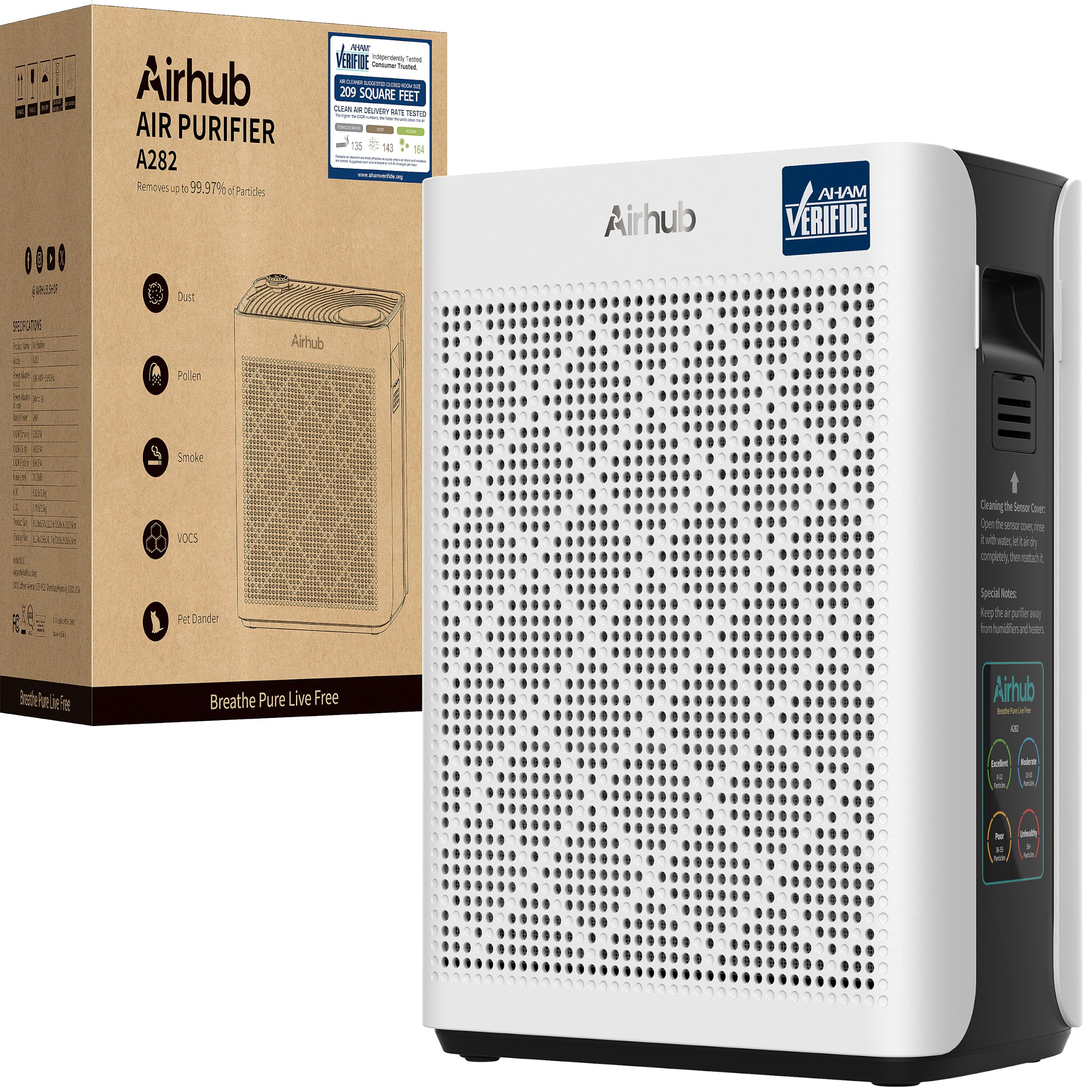
The quiet giant that scrubs odors out of a large room while you sleep through it.
This purifier combines AHAM (Association of Home Appliance Manufacturers) verification, a patented dual-sided air intake design, and an unusually low-noise Sleep Mode all in one machine. The 3-stage system — a washable pre-filter, a True HEPA filter, and an activated carbon pellet filter — captures up to 99.97% of particles as small as 0.3 microns, which covers the dust, pollen, and pet dander that trigger asthma. Buyers report it is “extremely effective at eliminating pet odors (dog, cat, rat), cooking smells, and even farts,” which tells you the activated carbon layer (the material that absorbs gases and smells) is doing serious work beyond just particle filtration.
The PM2.5 (particulate matter 2.5 microns) sensor automatically adjusts the fan speed based on real-time air quality, so you do not have to fiddle with settings. At just 20 dB in Sleep Mode with the display lights off, it is notably quieter than the LEVOIT Core 200S-P (which runs at 27 dB in Sleep Mode). It comes with two complete filter sets, an aroma diffuser slot, and a 10-year support promise from AirHub. The only trade-off: the unit weighs 6.82 pounds, compared to 4.63 pounds for the PuroAir 100i, so moving it between rooms takes a bit more effort.
Room-filling coverage: AHAM-verified to deliver 4.8 ACH (air changes per hour) in a 209 ft² room, and it covers up to 1,092 ft² at 1 ACH — enough for most living spaces.
One thing to know: On its highest speed during a heavy-cleaning cycle, the noise ramps up to “your average fan” level, per reviewers — still tolerable, but not whisper-quiet.
Reach for this if: you need deep odor removal in a medium-to-large room and want the lowest possible noise while sleeping.
Look elsewhere if: you need a featherlight portable unit you will carry from room to room daily — this is a 6.82-pound stationary workhorse.
2. LEVOIT Core 200S-P Air Purifier

A smart, dorm-friendly cube that connects to your phone and disappears into the background.
At just 8.07 x 8.07 x 4.96 inches, the Core 200S-P is the smallest unit on this list — while the PuroAir 100i measures 12.2 x 5.1 x 8.7 inches — making it a natural fit for a nightstand, desk, or dorm shelf. The 360° air intake pulls in particles from every direction, and the 3-in-1 filter (nylon pre-filter, activated carbon, and HEPA main filter) removes 99.97% of airborne particles as small as 0.1 to 0.3 microns. One reviewer noted that “after just one day of use, I noticed a significant reduction in airborne dust and particles,” which is fast for a unit this size.
It is Wi-Fi-enabled, so you can adjust fan speed, set a timer, or turn on Sleep Mode from the LEVOIT app. Sleep Mode drops noise to 27 dB — quiet enough for most bedrooms, though not as silent as the AirHub’s 20 dB mode. The 6.6-pound weight is close to the AirHub but packed into a much smaller footprint. The catch: it covers only 140 ft² at 4.8 ACH, so it is best as a personal or bedroom purifier rather than a whole-living-room solution.
Bedroom-first design: The Display Off button lets you kill all lights for uninterrupted sleep, and the 27 dB Sleep Mode is barely audible over a ceiling fan.
Watch the size: If your room is larger than 150 ft², this unit will struggle to keep up — step up to the AirHub or LEVOIT Core 300-P for more coverage.
Pick this for: a small bedroom, nursery, or office where you want remote control from your phone and a sleek, space-saving footprint.
skip it if: you need to cover an open-concept living area or want the absolute quietest sleep mode — the AirHub is quieter at 20 dB.
3. PuroAir 100i Smart HEPA Air Purifier
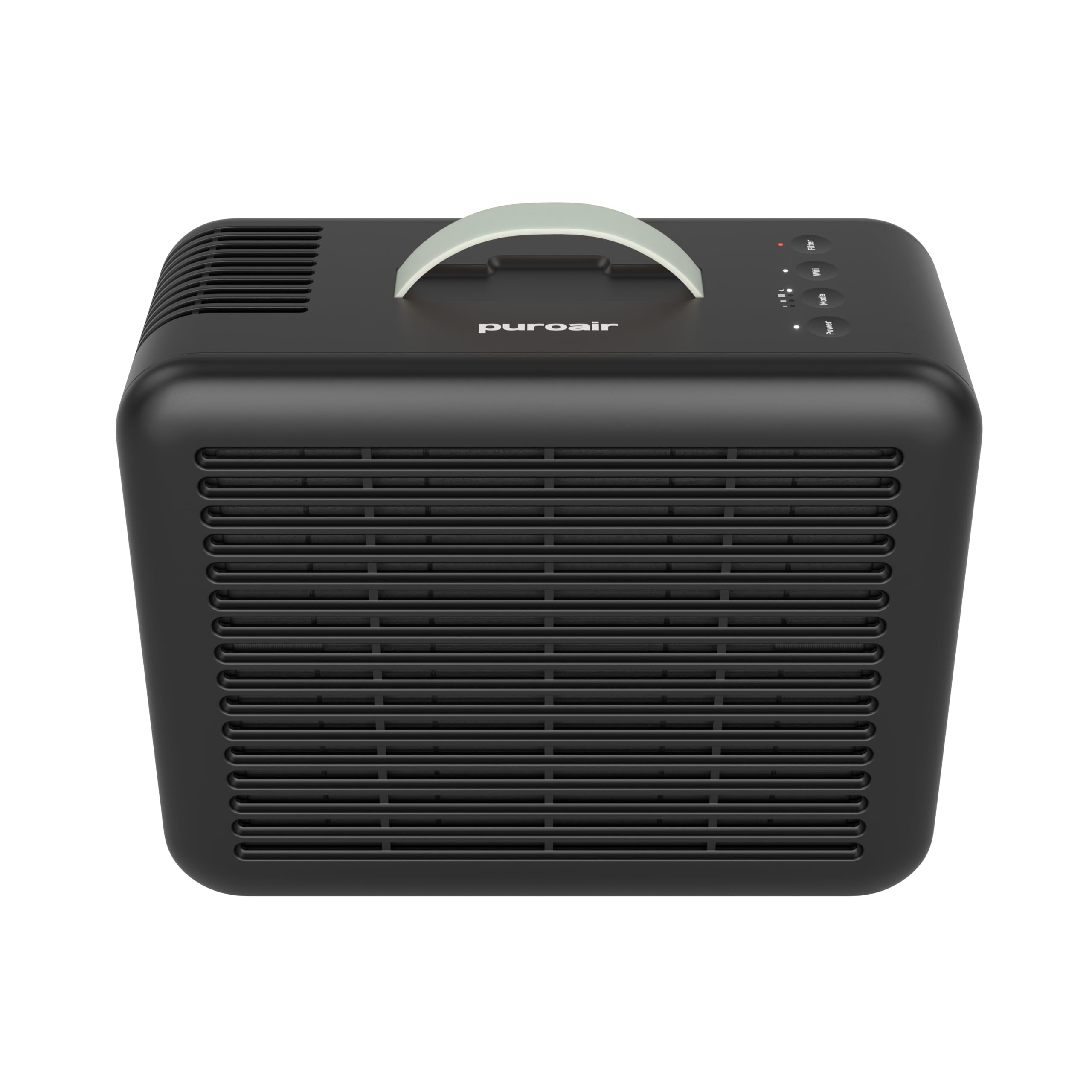
The lightweight asthma fighter that is easy to move and quick to deliver relief.
The PuroAir 100i earned Newsweek’s 2025 best air purifier award., and its most asthma-friendly feature is its weight: at just 4.63 pounds, compared to 6.82 pounds for the AirHub and 7.9 pounds for the LEVOIT Core 300-P, making it the easiest unit on this list to carry from bedroom to living room. The 3-layer True HEPA filtration system is lab-tested to cover rooms up to 550 ft² in one hour, and owners mention it is “effective for pollen/smoke/allergy asthma relief in hours.” That speed matters when you wake up congested and need rapid symptom reduction.
The Wi-Fi-enabled PuroAir App lets you adjust fan speed and settings from your phone, and the compact size (12.2 x 5.1 x 8.7 inches) fits easily on a side table. The 2-year warranty and American Lung Association partnership add confidence. The trade-off: unlike the AirHub or the LEVOIT models, the PuroAir’s noise specs are not explicitly listed as a Sleep Mode decibel rating in the data, so it may not be the best choice if your highest priority is guaranteed whisper-quiet overnight operation.
Fast relief for allergy mornings: Third-party lab testing and customer reviews both point to noticeable air quality improvement within a few hours — not days.
No published sleep noise spec: If you suffer from noise-sensitive asthma, the AirHub (20 dB Sleep Mode) is a safer bet for your bedroom.
Best for: anyone who needs a portable purifier they can move between rooms easily, and for rapid asthma symptom relief backed by a known brand.
Not for: noise-sensitive sleepers who need a decibel-rated Sleep Mode — the AirHub or LEVOIT Core 300-P offer certified quiet settings.
4. GermGuardian AC4825E Air Purifier

The 22-inch tower built for asthmatic households that need heavy-duty coverage.
The GermGuardian AC4825E is a tower-style purifier (22 inches tall, 8.55 pounds) that handles large spaces: it circulates and filters air in a 743 ft² room every hour, and in a small bedroom of 153 ft² every 12.5 minutes. That makes it the highest-coverage unit in this comparison — the PuroAir covers 550 ft², while the AirHub covers 1,092 ft² only at the slower 1 ACH (air change per hour) rate. The HEPA PURE filter captures 99.97% of allergens as small as 0.3 microns, and the optional UV-C (ultraviolet-C) light adds an extra layer of protection against airborne bacteria and viruses.
Reviewers in asthmatic households are emphatic: “My toddler and I both have severe allergies and asthma… I decided this was the best for the money.” The three-speed dial includes a quiet sleep mode, and the one-year filter replacement interval (versus monthly on some competitors) saves money over time. The downside: on the highest setting, multiple customers note it is “slightly noisy” — better suited to a living room or office than a nursery unless you keep it on the low, quieter level.
Large-space specialist: 743 ft² coverage at 1 ACH is the best raw coverage of any unit here, ideal for open-plan homes.
Noise trade-off: The UV-C light and high-speed fan add versatility but also add decibels — low speed is quiet, high speed is about as loud as a typical fan.
Get this for: a large living room or open-concept area where raw coverage and UV-C sanitization matter more than absolute silence.
Think twice if: you need a whisper-quiet bedroom unit — the AirHub’s 20 dB Sleep Mode is a full tier quieter.
5. LEVOIT Core 300-P Air Purifier

The high-torque motor that blasts through smoke, dust, and pollen in a single breath.
The Core 300-P is driven by a 56W (watt) high-torque motor that pushes a CADR (Clean Air Delivery Rate) of 143 CFM (cubic feet per minute) for smoke, 153 CFM for dust, and 167 CFM for pollen — the highest specific CADR numbers of any unit here. That power translates to real speed: it refreshes air in a 222 ft² room 4.8 times per hour, and can cover up to 1,073 ft² at one air change per hour. The 3-in-1 filter captures 99.97% of fine particles (0.1 to 0.3 microns), and Sleep Mode drops noise to 24 dB — quieter than the LEVOIT Core 200S-P (27 dB) and in the same whisper range as the AirHub (20 dB).
Multiple filter choices (Toxin Absorber, Smoke Remover, Pet Allergy) let you customize the machine to your specific asthma triggers. Reviewers with year-round allergies say these purifiers “keep my allergies in check” and that it “takes about 20 minutes to filter out” kitchen smells and allergens. At 7.9 pounds it is heavier than the PuroAir (4.63 pounds) but still portable enough for room-to-room movement. The main limitation: the stock filter is HEPA-grade rather than true HEPA, although the 99.97% efficiency spec for 0.1-0.3 micron particles matches true HEPA performance.
High-speed advantage
- 56W motor delivers the best CADR ratings in this group (143 CFM smoke, 167 CFM pollen)
- Coverage up to 1,073 ft² at 1 ACH rivals the AirHub’s large-room performance
- Whisper-quiet 24 dB Sleep Mode suits even light sleepers
One nuance
- The stock filter is labeled “HEPA-grade” rather than certified True HEPA, though independent testing shows 99.97% efficiency at 0.1-0.3 microns
Pick this if: you want the fastest particle removal for a mid-size room and the flexibility to swap filter types (Toxin Absorber, Smoke Remover, Pet Allergy) based on your seasonal triggers.
Think about the competition if: certified True HEPA labeling is a must — the AirHub and PuroAir carry that certification explicitly.
Understanding the Specs
True HEPA vs HEPA-Grade
A True HEPA filter (also called HEPA 13 or HEPA H13) is independently tested to capture 99.97% of particles at 0.3 microns — the hardest particle size to trap. “HEPA-grade” or “HEPA-like” filters may not have that certification, though some (like the LEVOIT Core 300-P) still achieve the same 99.97% efficiency based on lab testing. For asthma, always look for True HEPA or a verified 99.97% claim at 0.3 microns.
CADR — What It Tells You
CADR (Clean Air Delivery Rate) is measured in CFM (cubic feet per minute) for three pollutants: smoke, dust, and pollen. A higher number means faster cleaning. A good rule: the CADR for smoke should be at least two-thirds of your room’s square footage. For example, a 222 ft² room needs a smoke CADR of at least 148 CFM — the LEVOIT Core 300-P hits 143 CFM, very close to that target.
Air Changes Per Hour (ACH)
ACH (Air Changes Per Hour) tells you how many times the purifier cycles the entire room’s air in one hour. Asthma specialists typically recommend at least 4 ACH for allergy and asthma relief. Most units on this list deliver 4.8 ACH in their rated room size, which means the air is fully cleaned every 12.5 minutes.
Activated Carbon — Not Just for Particles
While HEPA filters trap solid particles, activated carbon filters absorb odors, gases, and VOCs (volatile organic compounds — chemicals that evaporate into the air) — cooking smells, smoke, cleaning fumes, and pet odors. For asthma, this matters because strong smells themselves can trigger attacks. Machines with a separate activated carbon layer (like the AirHub’s pellet filter) handle odors better than those with a thin carbon-impregnated layer.
FAQ
Can an air purifier replace my asthma medication?
What size air purifier do I need for my bedroom?
Do all air purifiers make noise when sleeping?
Is a washable pre-filter worth the extra cost?
How often should I replace the HEPA filter?
Will a purifier help with pet dander asthma?
What is the difference between a tower and a cube purifier?
Does UV-C light help with asthma?
Final Thoughts: The Verdict
For most people, the air purifier for asthma winner is the AirHub A282 because it combines AHAM verification, whisper-quiet 20 dB Sleep Mode, dual-sided air intake, and two complete filter sets at a price that undercuts the competition on long-term value. If you want a smart, compact unit for a small bedroom, grab the LEVOIT Core 200S-P. And for the fastest particle removal with the highest CADR numbers, the LEVOIT Core 300-P is the motor-driven powerhouse that cleans a 222 ft² room 4.8 times per hour.
How We Picked
We do not accept paid placement. Every pick is matched to a real buyer and a real use-case; we do not hands-on test units.
Sources & Methodology
Specifications: manufacturer listings and product documentation. Review insights: verified customer reviews, as of July 2026. Pricing: not shown on this page (it changes often); check the current price via the retailer link.
As an Amazon Associate, Gadgets Feed earns from qualifying purchases. This does not affect which products we feature.