
Our readers keep the lights on and my morning glass full of iced black tea. As an Amazon Associate, I earn from qualifying purchases.
Specs are compiled from manufacturer listings and verified buyer reviews and can change over time — please confirm the key details on the product page before buying.
If you have ever tried to start a car, run a radio off a deep-cycle battery, or troubleshoot a solar setup and gotten a “seems fine” reading from a cheap voltmeter (a meter that only measures electrical pressure, not energy), you already know the problem: voltage alone tells you very little about how much life your battery actually has left. An amp hour battery tester solves that by measuring the real capacity and energy stored, so you can tell if a battery is truly dead, needs a charge, or is still good for another season.
I’m Min — the founder and writer behind Gadgets Feed. This guide is built by comparing the manufacturers’ published specifications and the patterns across verified customer reviews, so you get each pick’s real strengths and trade-offs instead of marketing spin.
Whether you work on vehicles, run a camper, or manage batteries for electronics projects, finding the right amp hour battery tester means picking a tool that gives you the exact measurements you need — from simple capacity checks to professional-grade diagnostics with cloud reporting.
Quick Picks
- BT90 PRO 2-360Ah Battery Tester — Best Overall
- ANKG 200A Power Analyzer with Digital LCD — Best Value
- DROK Battery Monitor, Amp Volt Power Watt Meter — Best for Monitoring
How To Choose The Best Amp Hour Battery Tester
Picking a battery tester depends on matching the tool to the kind of batteries you work with and the level of detail you need. A simple watt meter is great for hobbyists, while a professional analyzer is necessary for a shop that needs to diagnose starting and charging systems. Here are the three things to look at first.
Match the Voltage and Current Range to Your Batteries
Every tester has a maximum voltage and current it can handle. For car and small RV batteries, a range up to 60 volts and 200 amps covers most needs. If you work with larger 24-volt systems or high-capacity battery banks, you need a tester that explicitly supports those levels — like the BT90 PRO that works with 6V, 12V, and 24V systems.
Decide Between a Basic Monitor and a Diagnostic Tool
A simple in-line watt meter, like the DROK panel monitor, tracks voltage, current, power, and accumulated amp-hours (Ah, the measure of energy storage capacity) in real time. That is perfect for monitoring a battery bank during use or checking capacity after a charge. A professional tester, on the other hand, also measures cranking amps (CCA), internal resistance (IR, the internal opposition to current flow), and state of health (SOH, how much capacity the battery has lost) — giving you a full picture without needing to discharge the battery first.
Check for Chemistry Support and Extra Features
Modern batteries come in many types — flooded lead-acid (traditional car batteries), AGM (absorbent glass mat, common in start-stop cars), EFB (enhanced flooded battery), gel, and lithium. A generic tester may misread an AGM or lithium battery because the charging and discharging curves are different. Look for a tester that explicitly lists support for your battery chemistry, and consider extras like a clear display, data logging, and whether the tester can remember measurements after you disconnect it from power.
Quick Comparison
| Model | Best For | Voltage Range | Current Range | Ah Measurement | Amazon |
|---|---|---|---|---|---|
| BT90 PRO | Full vehicle diagnostics | 6V / 12V / 24V | 30–3800 CCA | 2–360Ah | $59.99Amazon |
| ANKG 200A Power Analyzer | Hobbyist capacity checks | 0–60V | 0–200A | 0–65Ah | $34.99Amazon |
| DROK Battery Monitor | Real-time system monitoring | 0–300V | 0–200A | Percentage / Ah | $39.99Amazon |
In‑Depth Reviews
1. BT90 PRO 2-360Ah Battery Tester with Cloud Printing
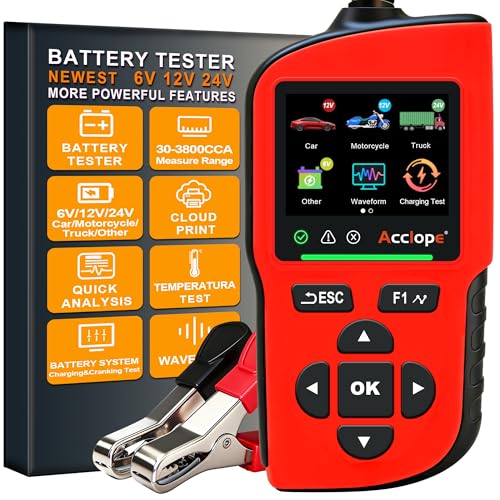
Gives you a full diagnostic report with a cloud link to share, not just a single number — so you know exactly which part is failing.
The BT90 PRO delivers four key metrics — state of health (SOH, the battery’s remaining usable capacity), state of charge (SOC, how full it is), internal resistance (IR, the internal opposition to current flow), and voltage — in one test. It works on 6V, 12V, and 24V systems, handles batteries from 2Ah to 360Ah, and supports a huge CCA range (cold cranking amps) of 30 to 3800 CCA across SAE (Society of Automotive Engineers), EN (European Norm), IEC (International Electrotechnical Commission), CA (cranking amps), and MCA (marine cranking amps) standards. It tests flooded lead-acid, AGM (absorbent glass mat), EFB (enhanced flooded battery), gel, and lithium batteries, using chemistry-specific algorithms so you do not get a false “bad battery” reading on a start-stop AGM or a lithium pack.
The cloud print feature is the standout trick here. Scan the on-screen QR code and you get a shareable report that includes voltage, resistance, cranking results, and charging system checks — complete with real-time ambient temperature readings that correct for cold or hot bias. Buyers report it is “very easy to use, plenty of info” and that it confirmed a battery needed replacement based on CCA and type. Unlike the ANKG 200A Power Analyzer below, which is a simple in-line watt meter, the BT90 PRO is a full diagnostic tool that pinpoints whether the fix is a charge, a load, or a replacement.
It even handles cranking voltage drop (how much voltage sags during starting) and alternator output in one test flow, so you can quickly tell if the battery is fine but the alternator is failing. Firmware is updatable via micro-USB (a small rectangular connector), making it a tool that can improve over time. It is powered by the battery under test, so no extra batteries are needed.
Why It Stands Out
- Full 4-metric diagnosis (SOH, SOC, voltage, resistance) gives context, not just a single number
- Cloud-published reports with ambient temperature correction prevent misdiagnosis in winter or summer
- Covers a huge range of battery chemistries and voltages — from small 6V motorcycle batteries to heavy 24V truck packs
A Couple Caveats
- Overkill if you only need a simple amp-hour reading for hobby electronics
- At 0.33 kg (about 0.7 pounds), it is noticeably heavier than basic monitors
Reach for this if: you work in a shop, manage a mixed fleet, or need to give customers time-stamped, shareable proof of battery health.
Look elsewhere if: you only need to track amp-hours on a single DIY battery bank — a basic meter will cost less and weigh less.
2. ANKG 200A Power Analyzer with Digital LCD
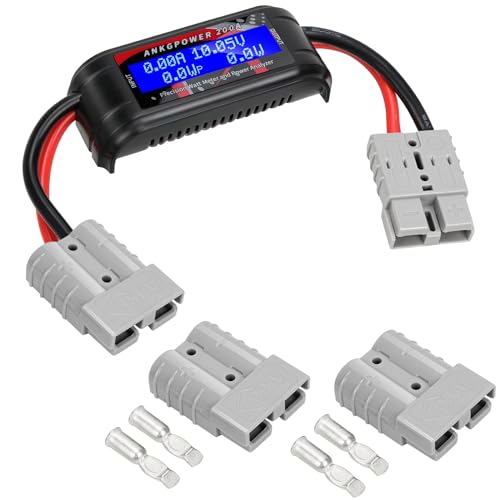
A compact, affordable watt meter that tracks amp-hours and peak values for hobbyists and small projects, no soldering required to start.
The ANKG analyzer gives you 8 electrical readings: Current (A), Voltage (V), Watts (W), Amp-hours (Ah), Watt-hours (Wh), Peak Amps (Ap), Minimum Volts (Vm), and Peak Watts (Wp). It measures from 0 to 200 Amps with a resolution of 0.01 Amps (meaning changes as small as 0.01 amps appear), and from 0 to 60 volts with a resolution of 0.01 volts. For amp-hours, it reads from 0 to 65Ah with a resolution of 0.001Ah — which is precise enough to check the state of a small 12V battery or a lithium pack.
The unit comes pre-wired with two sets of 50A power connectors on both ends and has internal metal contacts, so no soldering is required to get started. Owners mention it “works well for current draw/battery capacity testing after soldering own connectors,” but note that the high-precision measurement comes with a trade-off: some units produce “an annoying high-pitched whine” when connected to a 12V battery. The seller replaced a defective unit for one reviewer, and the new unit worked fine. Another buyer points out that the tester will not remember capacity test results if you disconnect the auxiliary power — a 9V li-ion battery (a small rechargeable battery for powering the meter) lasted only one test for them — so plan for that if you need to log data over multiple sessions.
Unlike the DROK monitor that mounts permanently in a panel, this is a portable pass-through tool you plug in between the battery and the load. For ham radio operators running POTA (Parks on the Air) or battery-powered radios, customers note it is a “good value for go kits” because it tracks voltage and Ah used. It is straightforward, affordable, and accurate enough for most hobby-level work, though it lacks the advanced chemistry support or cloud features of the BT90 PRO.
Bottom Line on Precision: You get 0.01-amp resolution and 0.001-amp-hour resolution for under forty dollars, which beats most basic multimeters for battery capacity work.
Grab this for: checking battery capacity after charging, testing current draw of RC equipment or radios, and verifying charger operation.
skip it if: you need a permanent installation that logs data over weeks, or if the high-pitched whine would annoy you in a quiet workshop.
3. DROK Battery Monitor, Amp Volt Power Watt Meter DC 0-300V 200A STN LCD
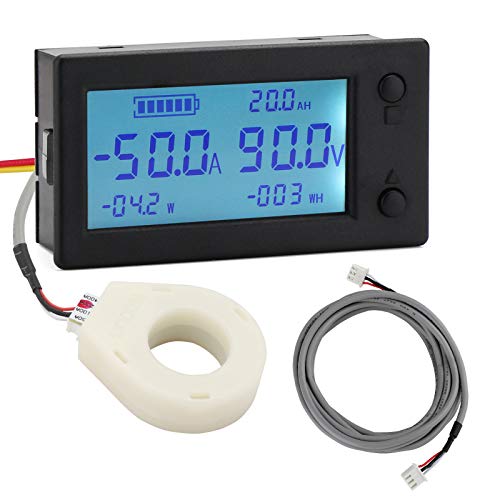
A permanent panel meter that watches over your battery bank and tracks energy in and out — all in one glance, even in direct sunlight.
The DROK measures DC voltage from 0 to 300V and DC current from 0 to 200A, and calculates power, accumulated amp-hours, and remaining battery capacity as a percentage. The Hall effect sensor (a device that measures current by sensing magnetic fields without touching the wire) provides isolated, contactless current measurement, which is safer than shunt-based monitors. Reviewers point out that “it is easy to install” and “the display is easy to read even with the backlight off.” One buyer who uses it to monitor a lead-acid battery says “it seems to work well and has the features I needed,” especially the ability to track current going in and out to show the overall state of charge.
The STN LCD screen (Super Twisted Nematic liquid crystal display) is a key advantage here: it remains clear even in direct sunlight, unlike basic LCDs that wash out. The backlight can be toggled on or off, and it stays on permanently when turned on, which some users appreciate. The meter also stores data when power is cut, so you do not lose your accumulated readings. However, because the Hall sensor is sensitive to nearby magnetic fields, you may see stray readings if the sensor is placed near other current-carrying wires. One reviewer points out you need to zero the unit occasionally by pressing a button with no current flowing, which can be a minor hassle depending on your setup.
At just 0.13 kilograms (about 0.3 pounds), this is by far the lightest tester here — it is a small circuit board module, not a handheld tool. It also supports both two-wire and three-wire connections, giving you flexibility depending on your voltage. The built-in alarm function will flash and sound if voltage or current goes outside preset limits or if battery capacity is low. Some buyers mention the programming can be inconsistent — one user could not set Ah values other than “200” — so check the wiring diagram sticker on the back and the helpful instructions posted by other buyers online.
Stuff It Does Well
- Clear, sunlight-readable STN LCD panel with permanent backlight option
- Hall sensor makes installation safer and easier than shunt-based meters
- Bidirectional current sensing shows both charging and discharging in real time
Stuff to Keep in Mind
- Hall sensor needs occasional zeroing — and you need to shut off current to do it correctly
- Some shoppers say programming quirks, and instructions are minimal (only the wiring diagram on the sticker)
Choose this when: you want a permanent, clean install that shows your battery’s state at a glance — in an RV, off-grid cabin, or boat.
Pass on it if: you need a portable tester you can carry from battery to battery, or if you must log precise amp-hour data without occasional manual zeroing.
Understanding the Specs
Amp-Hours (Ah)
Amp-hours measure the battery’s energy storage capacity — think of it like the size of your gas tank. A 50Ah battery can theoretically deliver 1 amp for 50 hours or 5 amps for 10 hours. An amp hour battery tester measures how many Ah actually go in or come out, which tells you if your battery is holding its rated capacity or is worn out.
State of Health (SOH) vs State of Charge (SOC)
SOC is how full the battery is right now — like a fuel gauge. SOH is how much total capacity the battery has lost due to age and wear — like knowing your gas tank has shrunken to 80% of its original size. Professional testers measure both, while basic meters only track SOC.
Internal Resistance (IR)
This is the internal opposition to current flow inside a battery. A high IR value usually means the battery is sulfated (in lead-acid types, where sulfur crystals form on the plates) or aging (in lithium types), and it is a strong early warning that the battery will struggle to deliver high current for starting.
CCA (Cold Cranking Amps)
CCA tells you how many amps a battery can deliver at 0°F (-18°C) for 30 seconds while staying above 7.2 volts. A tester that measures CCA helps you decide if a car battery can survive winter starting, even if the voltage at rest looks fine.
FAQ
Can I use an amp hour battery tester on lithium batteries?
What is the difference between a battery monitor and a battery tester?
How do I know which voltage and current range I need?
Do I need to solder my own connectors on these testers?
What does a Hall effect sensor do in a battery monitor?
Can a simple watt meter really measure battery capacity?
Why does my battery tester show different CCA values than the battery’s label?
How do I interpret a “Good / Recharge / Replace” result?
Can I leave a panel meter like the DROK connected 24/7?
Is a cloud-printing battery tester worth the extra cost?
Final Thoughts: The Verdict
Across the board, the amp hour battery tester winner is the BT90 PRO because it combines full vehicle diagnostics, cloud reporting, and support for every common battery chemistry in one rugged tool. If you want a permanent monitor for a camper or off-grid system that tracks energy in and out at a glance, grab the DROK Battery Monitor. And for a simple, affordable way to check the capacity of hobby batteries or radio gear, the ANKG 200A Power Analyzer gives you the most precision per dollar with 0.001Ah resolution.
How We Picked
We do not accept paid placement. Every pick is matched to a real buyer and a real use-case; we do not hands-on test units.
Sources & Methodology
Specifications: manufacturer listings and product documentation. Review insights: verified customer reviews, as of July 2026. Pricing: not shown on this page (it changes often); check the current price via the retailer link.
As an Amazon Associate, Gadgets Feed earns from qualifying purchases. This does not affect which products we feature.
Related Guides
Product prices and availability are accurate as of the date/time indicated and are subject to change. Any price and availability information displayed on Amazon at the time of purchase will apply to the purchase of this product. As an Amazon Associate I earn from qualifying purchases.
CERTAIN CONTENT THAT APPEARS ON THIS SITE COMES FROM AMAZON. THIS CONTENT IS PROVIDED "AS IS" AND IS SUBJECT TO CHANGE OR REMOVAL AT ANY TIME.
Amazon and the Amazon logo are trademarks of Amazon.com, Inc. or its affiliates.