
Our readers keep the lights on and my morning glass full of iced black tea. As an Amazon Associate, I earn from qualifying purchases.
Specs are compiled from manufacturer listings and verified buyer reviews and can change over time — please confirm the key details on the product page before buying.
Good glass costs serious money — unless you know where to look. Plenty of affordable first-focal-plane (FFP) scopes cut corners on clarity at high zoom, leaving shooters guessing at longer ranges. The real trick is finding ED (extra-low dispersion) glass and a bright, daylight-visible reticle without overpaying for a brand name.
I’m Min — the founder and writer behind Gadgets Feed. This guide is built by comparing the manufacturers’ published specifications and the patterns across verified customer reviews, so you get each pick’s real strengths and trade-offs instead of marketing spin.
The best budget ffp lpvo gives you crisp magnification, a reliable zero, and a reticle that stays accurate at every power setting for under half what premium optics cost.
Quick Picks
- Sig Sauer Tango-MSR FFP 1-6X24mm — Best Overall
- Vortex Optics Venom 3-15×44 FFP — Precision Pick
- Monstrum Archangel ED 1-6x FFP LPVO — Best Value
- Athlon Optics Ares ETR 1-10×24 FFP — Max Reach
How To Choose The Best Budget FFP LPVO
You want a first focal plane scope for the way the reticle stays true at every magnification, but you do not want to spend as much as a used car. The key is to balance three things: optical glass quality, turret precision, and the reticle’s real-world usability. Here is what actually matters when you are shopping on a tighter budget.
Extra-Low Dispersion (ED) Glass
This is the single biggest indicator of image quality in a budget scope. ED glass cuts down on chromatic aberration (that purple or green fringe you see along high-contrast edges) and keeps colors sharp and contrast high. Without it, a 6x or 10x zoom often turns muddy at the top end. If the product data lists “ED” or “extra-low dispersion glass,” that is a very good sign for a budget pick.
Reticle Illumination and Daylight Brightness
An FFP reticle shrinks when you dial down to 1x, which can make the crosshairs hard to pick up against dark targets. That is why you want a reticle that hits true daylight-bright levels — especially at the highest setting — so you can see the dot or center against a sunlit background. Budget scopes often skimp here, so check reviews that specifically mention the illumination being usable outdoors.
Magnification Range and Your Shooting Distance
Knowing the typical range you shoot helps you pick the right zoom. A 1-6x LPVO gives you fast target acquisition up close and enough magnification for 300-400 yard shots. A 1-10x LPVO stretches that out past 500 yards with the same 1x bottom end for close work. A 3-15x scope (like the Vortex Venom) leans harder into precision and longer distances but loses that true 1x picture for rapid transitions.
Turret Quality and Zero Retention
In the budget tier, you want turrets that give you audible, tactile clicks and a reliable zero stop. Mushy or vague clicks mean you will lose your setting after a bump or a hard recoil. The best budget scopes have capped windage and exposed elevation — so you can dial on the fly without accidentally spinning the side knob.
Quick Comparison
| Model | Best For | Magnification | Weight | Reticle Type | Amazon |
|---|---|---|---|---|---|
| Sig Sauer Tango-MSR FFP 1-6x24mm | Best All-Around Budget LPVO | 1 – 6x | 2.27 lbs | MSR BDC-6 Illum. | Amazon |
| Vortex Optics Venom 3-15×44 | Long-Range Precision on a Budget | 3 – 15x | 1.8 lbs | EBR-7C | $449.00Amazon |
| Monstrum Archangel ED 1-6x | Best Value for ED Glass | 1 – 6x | 2.25 lbs | CM8/Morpheus FFP | $229.99Amazon |
| Athlon Optics Ares ETR 1-10×24 | Highest Top-End Zoom Under | 1 – 10x | 26.9 oz | ATMR2 FFP IR MOA | $524.99Amazon |
In‑Depth Reviews
1. Sig Sauer Tango-MSR FFP 1-6X24mm
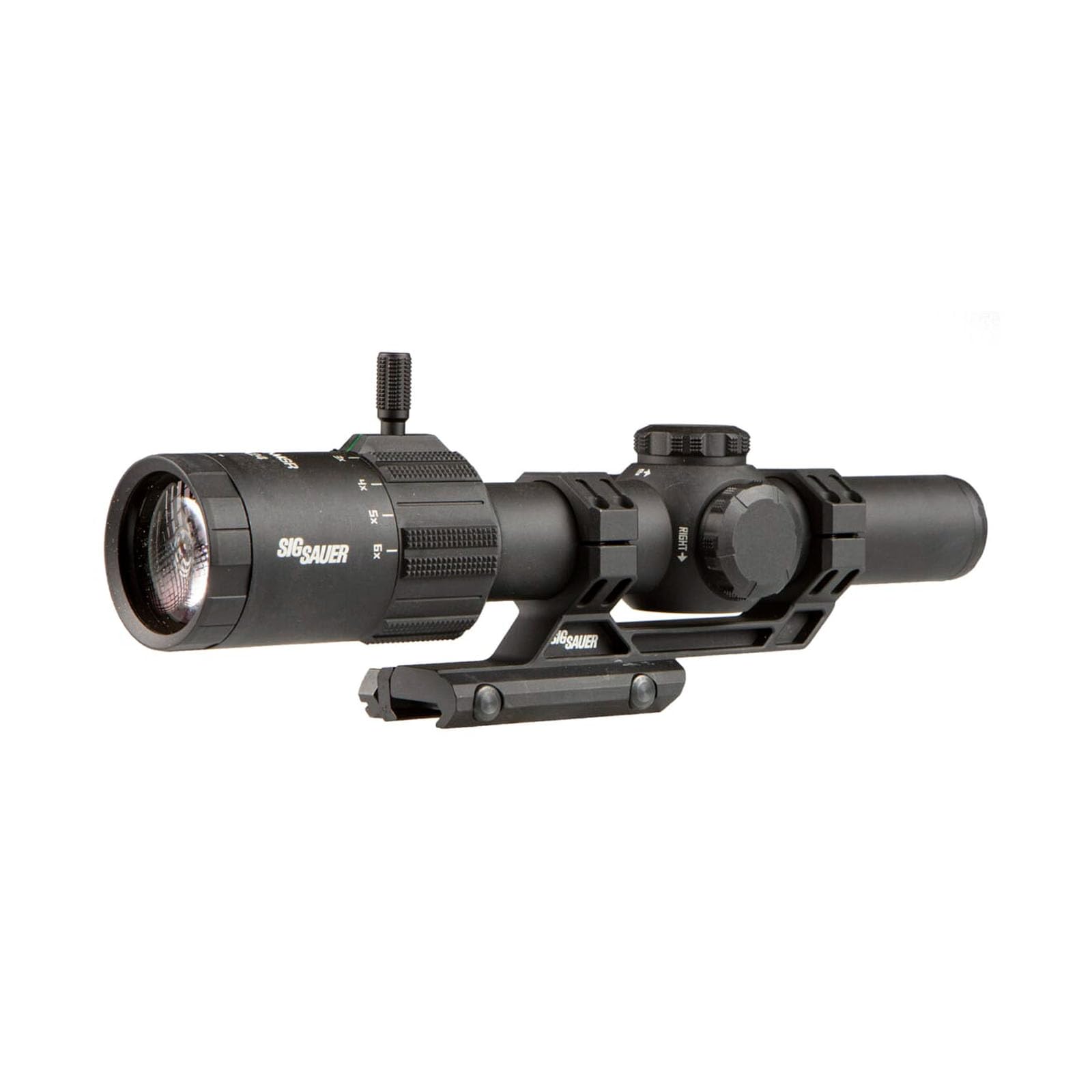
A rugged, proven FFP LPVO that balances glass clarity with a ready-to-mount cantilever design.
That free-floating center dot in the MSR BDC-6 reticle makes target acquisition snappy at 1x while the pyramid of hash marks gives you holdover points for bullet drop and wind drift as you dial up to 6x. You get low-dispersion glass that delivers a crisp sight picture with high light transmission — so the edges stay clean even when the light gets soft. It arrives with an ALPHA-MSR one-piece aluminum cantilever mount, which means you torque it onto your Picatinny rail and head to the range without buying extra parts.
You can hunt or shoot in rain without fogging up inside, thanks to waterproof and fog-proof lens coatings. One reviewer confirmed this by reporting that on an AR he got a 3-inch grouping at 50 yards using this scope — which tells you the zero holds and the glass is clear enough for small groups. It is heavier than the Vortex Venom (2.27 pounds vs 1.8 pounds), but that heft comes from a bombproof aluminum build and the included mount.
Decisive trade-off: The bright illuminated reticle and included mount make this the best turnkey budget LPVO, but it weighs noticeably more than the Vortex Venom above — something to consider if you plan to hike with it.
Reach for this if: you want a trusty, mount-and-shoot FFP LPVO with proven accuracy and solid low-dispersion glass at a mid-range price.
Look elsewhere if: every ounce matters for lightweight hunting or you need more than 6x magnification for longer-range shots.
2. Vortex Optics Venom 3-15×44 FFP
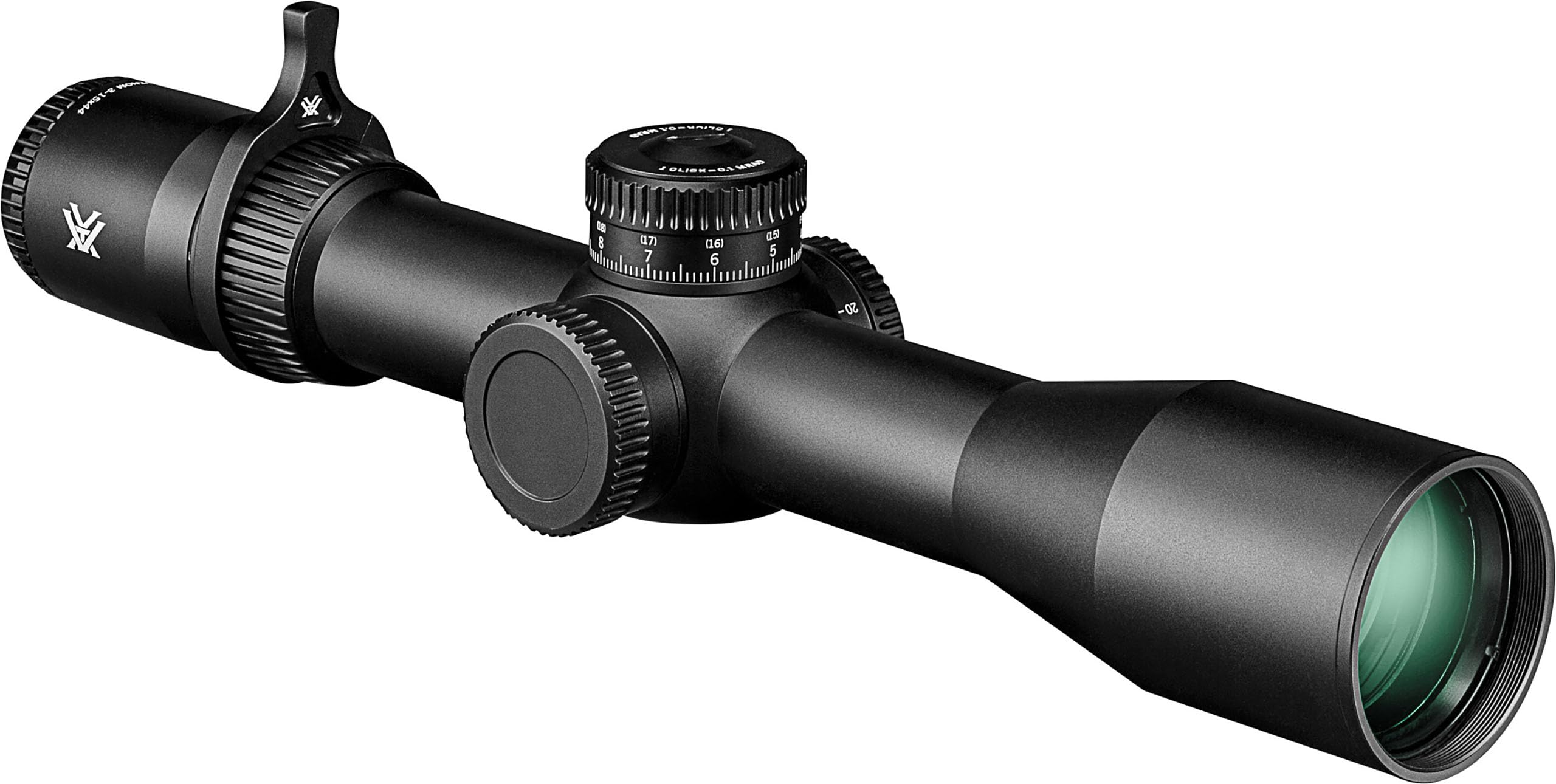
A long-range FFP scope built for dialing elevation, with a 34mm tube and RevStop Zero System.
This is the only scope on this list that starts at 3x magnification instead of 1x, which means it trades close-quarters speed for real reach — the 5x zoom range goes all the way to 15x, and the 34mm shockproof tube gives you generous turret travel for dialing out to longer distances. The exposed elevation turret with the RevStop Zero System lets you dial up, crank back down, and hit your original zero every time without counting clicks. The EBR-7C reticle is etched on glass and stays proportional at every magnification, so your holdovers and ranging marks are valid whether you are at 3x or 15x.
Reviewers who shoot NRL22 say the glass is clear and the side parallax is fast — one buyer called it “great for NRL22; clear glass, fast side parallax.” Unlike the Strike Eagle (which buyers report has “squishy” turrets), the Venom uses tactile, audible clicks that give you positive feedback. At 1.8 pounds, it is the lightest scope here, which is impressive for a 34mm tube. It comes with a sunshade, throw lever, tethered lens covers, and a lens cloth.
Why it wins for precision
- Lighter than the Sig (1.8 lbs vs 2.27 lbs) despite a larger tube
- RevStop Zero System for reliable return to zero
- Ample elevation travel with a 20-30 MOA base for.22LR long-range
- Backed by Vortex’s unlimited, unconditional, lifetime VIP Warranty
The catch
- No illuminated reticle — you pay more for the Strike Eagle if you need light
- 3x minimum magnification means it is not a true 1x LPVO for close-quarters
Strongest for: target shooters and hunters who want a light FFP scope with a zero stop and clear glass past 500 yards, without paying premium-tier money.
Not for: anyone who needs a 1x bottom end for rapid close-range transitions or a bright illuminated dot for low-light use.
3. Monstrum Archangel ED 1-6x FFP LPVO

Extra-low dispersion glass at an entry-level price — the kind of optics usually reserved for scopes costing much more.
The single biggest reason to consider the Archangel is its ED (extra-low dispersion) glass. That is the same type of lens element found in high-end camera lenses and binoculars, and it cuts chromatic aberration hard, delivering sharper contrast and more accurate color than you expect at a sub- price point. The CM8 (or Morpheus) FFP reticle is etched on glass, so ranging marks stay valid at every zoom level — 1 MOA hashmark equals 1 MOA whether you are at 1x or 6x. The illumination hits daylight-bright levels at the highest setting, and there are multiple lower brightness intensities for low-light use.
Owners mention the scope “holds zero, accurate 50-300 yards, FFP reticle well-designed, built like a tank, clear glass, excellent value.” That is a strong vote of confidence for a budget-tier scope. Two caveats worth knowing: it is heavy at 2.25 pounds (the same weight class as the Sig Tango-MSR), and a small number of reviews mention a canted or crooked reticle, which is a quality-control risk on a budget Monstrum product. The windage and elevation adjustments click at 1/2 MOA (on the MOA version) or 0.2 MIL (on the MIL version), giving you precise dialing options.
Value verdict: The ED glass and daylight-bright illumination give it optical performance that punches well above its price bracket, but the heavier weight and occasional QC miss mean you should inspect the reticle alignment as soon as it arrives.
Pick this if: you are on a tight budget but refuse to compromise on glass clarity — the ED lenses make a real difference in image sharpness at max zoom.
Skip this if: you want the confidence of a known brand warranty (Monstrum’s returns depend on Amazon’s policy, not a lifetime guarantee).
4. Athlon Optics Ares ETR 1-10×24 FFP
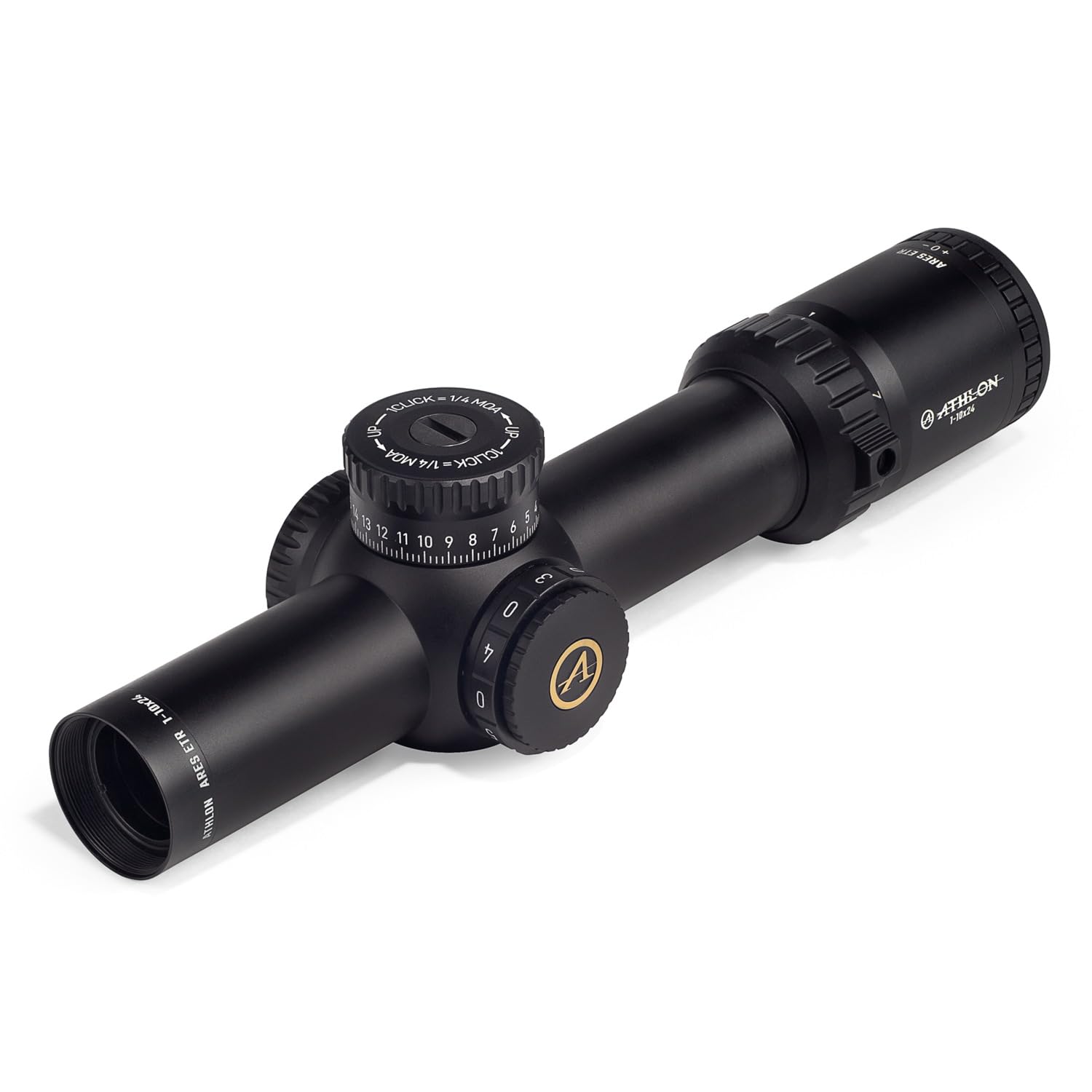
A 1-10x LPVO that stretches your effective range without losing the close-quarters 1x view.
This is the widest zoom ratio in the group: you get a true 1x bottom end for fast target acquisition and a 10x top end for shots past 500 yards — all in a first focal plane package where the reticle shrinks and grows with the target. The extra-low dispersion (ED) glass reduces chromatic aberration and delivers a bright, sharp image, as one reviewer described: “The glass is so clear you can see 22 caliber bullet holes in a splatter target at 50 yards allowing you to quickly sight in your rifle and shoot great groups.” The illuminated reticle gives you better visibility during dusk and dawn, which is helpful for hunting scenarios.
At 26.9 ounces (about 1.68 pounds), it is actually the lightest scope here by weight — noticeably lighter than the Sig Tango-MSR and the Vortex Venom. The locking elevation turret is a nice touch: you dial in your range, lock the turret, and it will not spin if you brush it against gear. The scope includes a throw lever and flip caps. A few reviewers pointed out that it is heavy for its size compared to other 1-10x options, and it lacks a parallax adjustment, which may matter for precision shooting at longer distances.
Top strengths
- 1-10x FFP zoom — 10x top end without losing the 1x close view
- ED glass for true-color, low-aberration image quality
- Locking elevation turret prevents accidental dial changes
- Proven durability on.338 Lapua per buyer reports
Limitations
- No parallax adjustment — a feature you might want at 10x for precision
- Multiple reviews call it heavy for its size, despite the low pound-number
Best fit: shooters who want the widest usable zoom range in one scope — ideal for the range where you transition from close-up to distant shots without swapping optics.
Hard pass if: you prioritize low weight or need a parallax knob for dialing precise distances at high magnification.
Understanding the Specs
First Focal Plane (FFP) Reticle
In an FFP scope, the reticle sits in front of the magnification assembly. That means as you zoom in or out, the reticle grows and shrinks with the target — so the hashmarks and holdover points stay true at every magnification level. For a budget shooter, this is the biggest advantage: you zero once and your ranging marks are valid whether you are at 1x or 10x, with no math or conversion needed.
Extra-Low Dispersion (ED) Glass
ED glass is a special lens element that bends light more evenly across the color spectrum, significantly reducing chromatic aberration (the purple or green fringing you see along high-contrast edges). In a budget LPVO, ED glass is the spec that separates a muddy image at 6x from one that stays crisp and clear. If you see “ED” in the product name or specs, it is a strong signal that the scope will hold up optically at the top of its zoom range.
FAQ
What does FFP mean in a rifle scope?
Is a 1-6x or 1-10x LPVO better for a budget build?
Will a budget FFP LPVO hold zero on a heavier recoil rifle?
What is the difference between MOA and MIL in a scope?
Do budget FFP LPVOs have daylight-bright illumination?
What does 1 MOA at 100 yards actually mean?
Can I use a budget LPVO for hunting in the rain?
What is a zero stop and why should I care?
Does reticle weight matter for a lightweight hunting rifle?
What is the difference between capped and exposed turrets?
Final Thoughts: The Verdict
For most shooters, the budget ffp lpvo winner is the Sig Sauer Tango-MSR 1-6x24mm because it combines a bright illuminated reticle, low-dispersion glass, and an included one-piece mount at a price that undercuts many competitors. If you want more reach for precision dialing and longer distances, grab the Vortex Venom 3-15×44. And for the widest zoom range that still fits a tight budget, the Athlon Ares ETR 1-10×24 is the scope that stretches your options while staying affordable.
How We Picked
We do not accept paid placement. Every pick is matched to a real buyer and a real use-case; we do not hands-on test units.
Sources & Methodology
Specifications: manufacturer listings and product documentation. Review insights: verified customer reviews, as of July 2026. Pricing: not shown on this page (it changes often); check the current price via the retailer link.
As an Amazon Associate, Gadgets Feed earns from qualifying purchases. This does not affect which products we feature.
Related Guides
Product prices and availability are accurate as of the date/time indicated and are subject to change. Any price and availability information displayed on Amazon at the time of purchase will apply to the purchase of this product. As an Amazon Associate I earn from qualifying purchases.
CERTAIN CONTENT THAT APPEARS ON THIS SITE COMES FROM AMAZON. THIS CONTENT IS PROVIDED "AS IS" AND IS SUBJECT TO CHANGE OR REMOVAL AT ANY TIME.
Amazon and the Amazon logo are trademarks of Amazon.com, Inc. or its affiliates.