
Our readers keep the lights on and my morning glass full of iced black tea. As an Amazon Associate, I earn from qualifying purchases.
Specs are compiled from manufacturer listings and verified buyer reviews and can change over time — please confirm the key details on the product page before buying.
A dead battery at a campsite ends a trip fast. The real question is which 12-volt battery delivers power you can count on without failing off-grid. This guide covers four different options, from a 320Ah single-unit replacement to a compact Bluetooth-equipped battery, so you can match chemistry and capacity to your RV’s energy needs.
I’m Min — the founder and writer behind Gadgets Feed. This guide is built by comparing the manufacturers’ published specifications and the patterns across verified customer reviews, so you get each pick’s real strengths and trade-offs instead of marketing spin.
The list below covers four distinct takes on a 12 volt rv battery. Each one aims at a different travel style, power budget, and tolerance for maintenance.
Quick Picks
- HumsiENK 12V 320Ah LiFePO4 Battery — Top Performer
- Battle Born 100Ah 12V LiFePO4 Battery (BB10012) — Premium Pick
- Litime 12V 100Ah LiFePO4 Battery Bluetooth — Best Value
- Dumfume 12V 150Ah LiFePO4 Deep Cycle Battery — Budget Champion
How To Choose The Best 12 Volt RV Battery
Picking a new house battery for your RV depends on matching capacity to your typical usage. The three specs that matter most are total amp-hours, the quality of the built-in Battery Management System (BMS — the circuit board that guards against overcharging and overheating), and if you need Bluetooth monitoring to check charge levels from inside the rig.
Capacity — Amp-Hours and Your Daily Draw
Amp-hours (Ah) tell you how much energy the battery stores. A 100Ah battery holds roughly 1,280 watt-hours of usable power. To figure out what you need, add up the wattage of your fridge, lights, water pump, and any inverter loads, then multiply by the hours you run them between charges. If you camp off-grid without solar, you will likely want 200Ah or more, so your fridge stays cold and your lights stay on all night.
BMS — The Brain That Keeps the Battery Alive
The Battery Management System (BMS — a small circuit board inside) prevents overcharging, over-discharging, short circuits, and overheating. A good BMS also includes low-temperature cut-off, which stops the battery from charging below freezing. That is critical for winter camping — charging a cold LiFePO4 cell permanently damages it, so the BMS saves you from ruining the battery in cold weather.
Bluetooth Monitoring — Nice-to-Have or Essential?
A battery with built-in Bluetooth lets you check state of charge, voltage, and sometimes individual cell balance from your phone. This is very useful if your battery sits in a hard-to-reach compartment. It also helps you spot a failing cell early, before it leaves you stranded.
Quick Comparison
| Model | Best For | Capacity | Weight | BMS | Amazon |
|---|---|---|---|---|---|
| HumsiENK 12V 320Ah Bluetooth | Massive single-battery power | 320 Ah | 58.7 lbs | 250A | Amazon |
| Battle Born 100Ah LiFePO4 | Premium long-life reliability | 100 Ah | 31 lbs | Internal BMS | Amazon |
| Litime 100Ah Group 24 Bluetooth | Best value with smart monitoring | 100 Ah | 21 lbs | 100A | Amazon |
| Dumfume 12V 150Ah LiFePO4 | Entry-level mid-capacity workhorse | 150 Ah | 28.6 lbs | 100A | Amazon |
In‑Depth Reviews
1. HumsiENK 12V 320Ah LiFePO4 Battery with Bluetooth
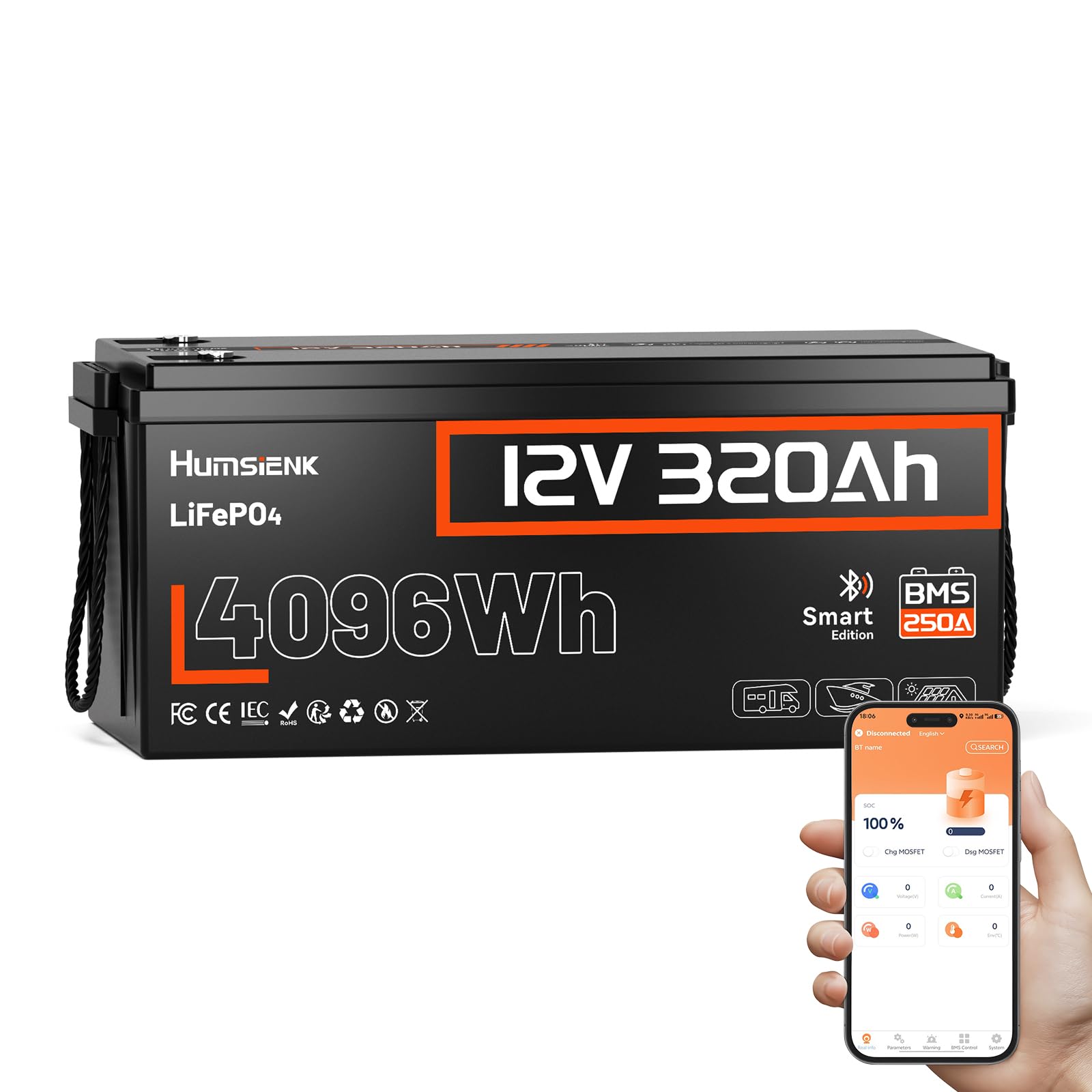
A 320Ah single-unit monster that replaces three standard 100Ah batteries with cleaner wiring and less space.
This battery delivers a huge 4096Wh of stored energy. You can run an RV fridge, lights, inverter, and even a small air conditioner for hours without hitting a low-voltage cutoff. It weighs 58.7 lbs, remarkably light for this capacity. The built-in 250A BMS (Battery Management System) handles a peak output of 3200W, enough to start a heavy inverter load without tripping protection.
The HumsiENK app lets you monitor real-time state of charge, voltage, current, and cell temperature from your phone. Buyers report that the Bluetooth range is roughly 5 feet on some units, so you will need to stand near the battery bay to connect. But the app itself is simple and works once paired. The smart BMS also includes a low-temperature cut-off that stops charging below 32°F, protecting the EV-grade cells during winter camping.
You can expand the system up to 4S4P configuration — that is a 51.2V 1280Ah (65.5kWh) bank if you ever build a home power wall. For most RV owners, a single 320Ah unit already eliminates the complexity and extra cabling of parallel wiring.
Why it wins
- Enormous 320Ah capacity in a single box — no messy parallel connections
- 250A BMS handles heavy inverter loads up to 3200W
- Built-in Bluetooth monitoring for real-time battery status
- Low-temp cut-off protects cells in freezing weather
The trade-offs
- Bluetooth range is short — you need to be near the battery to connect
- Some users saw SOC % differences between units in a series setup
- Massive upfront investment compared to smaller batteries
Ideal for: RV owners who want one battery to do the job of three, with room to expand later.
Reality check: If you only camp with full hookups, a 100Ah battery is cheaper and simpler — this much capacity is for boondockers and off-gridders.
2. Battle Born 100Ah 12V LiFePO4 Battery (BB10012)
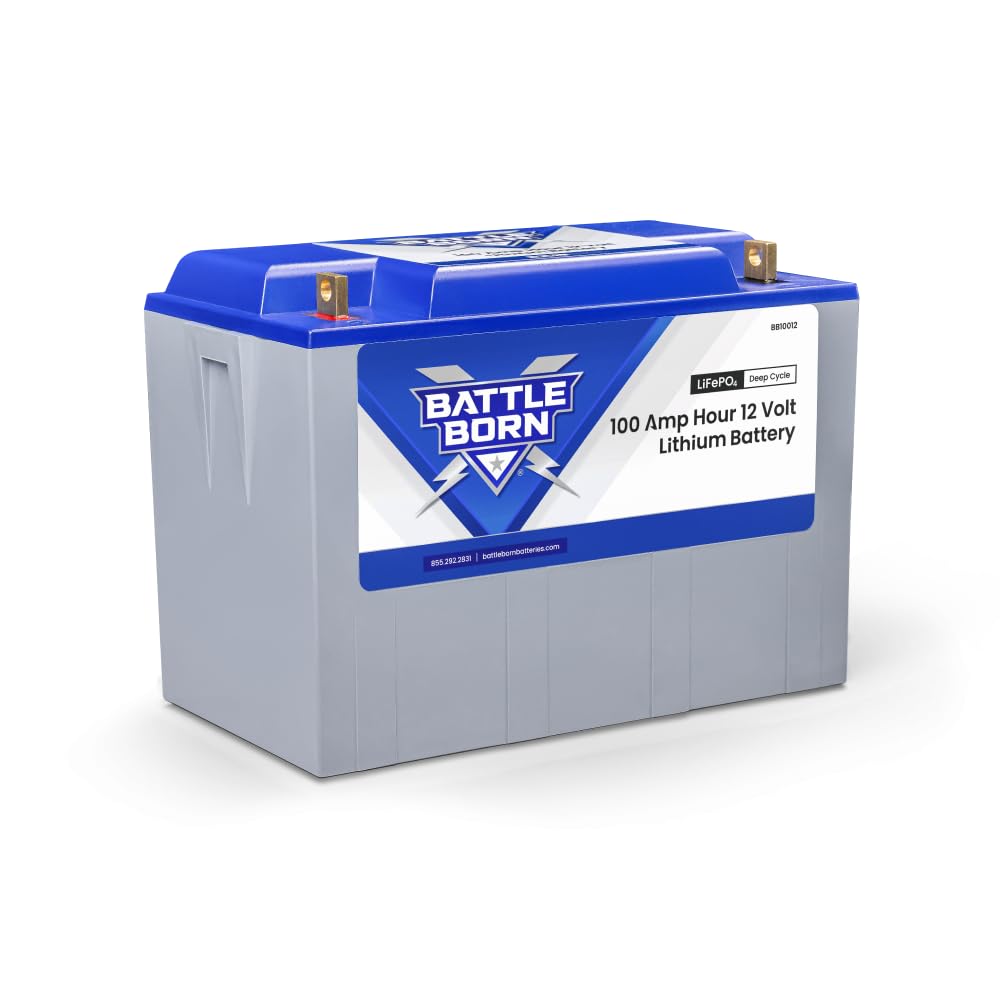
The battle-tested industry standard that owners trust for 10-plus years of service.
Battle Born has a reputation for rugged, drop-in replacement batteries. This 100Ah unit is a direct fit for Group 27 and 31 battery trays, weighs 31 lbs — much lighter than the 60+ lbs of a comparable lead-acid battery — and mounts in any orientation. The internal BMS covers low-temperature protection, over-voltage, and short circuits, so you can install it and forget it for years.
Buyers consistently report that this battery is a straightforward upgrade for RVs. One owner noted that they ran a 450W space heater for 1.5 hours on a single charge, raising the interior temperature from 55°F to 67°F. The main complaint? The 10-year warranty process can be slow, and some users found the company’s support policies frustrating when a battery failed. Still, the overwhelming majority of owners describe it as reliable and maintenance-free.
Because it is a 100Ah unit, it pairs naturally with a solar setup or a second battery in parallel. If you are new to lithium and want a well-documented, widely-supported product, this is a safe starting point. Unlike the Litime, though, it lacks Bluetooth — you cannot check charge from your phone without an external shunt (a separate monitor wired in-line).
What stands out
- Rugged build quality with side-post terminals for secure connections
- 10-year warranty from a well-known brand
- Can be wired in series or parallel for flexible system design
What to watch for
- Premium price tag — costs more per Ah than many competitors
- Warranty claims can be slow and require detailed documentation
- No built-in Bluetooth — you cannot monitor SOC from your phone without an external shunt
Buy it if: You want a proven, long-lasting battery with a 10-year warranty and don’t need phone-based monitoring.
skip it if: You are on a tighter budget or need Bluetooth visibility — the Litime below gives you that for less.
3. Litime 12V 100Ah LiFePO4 Battery Bluetooth (Group 24)
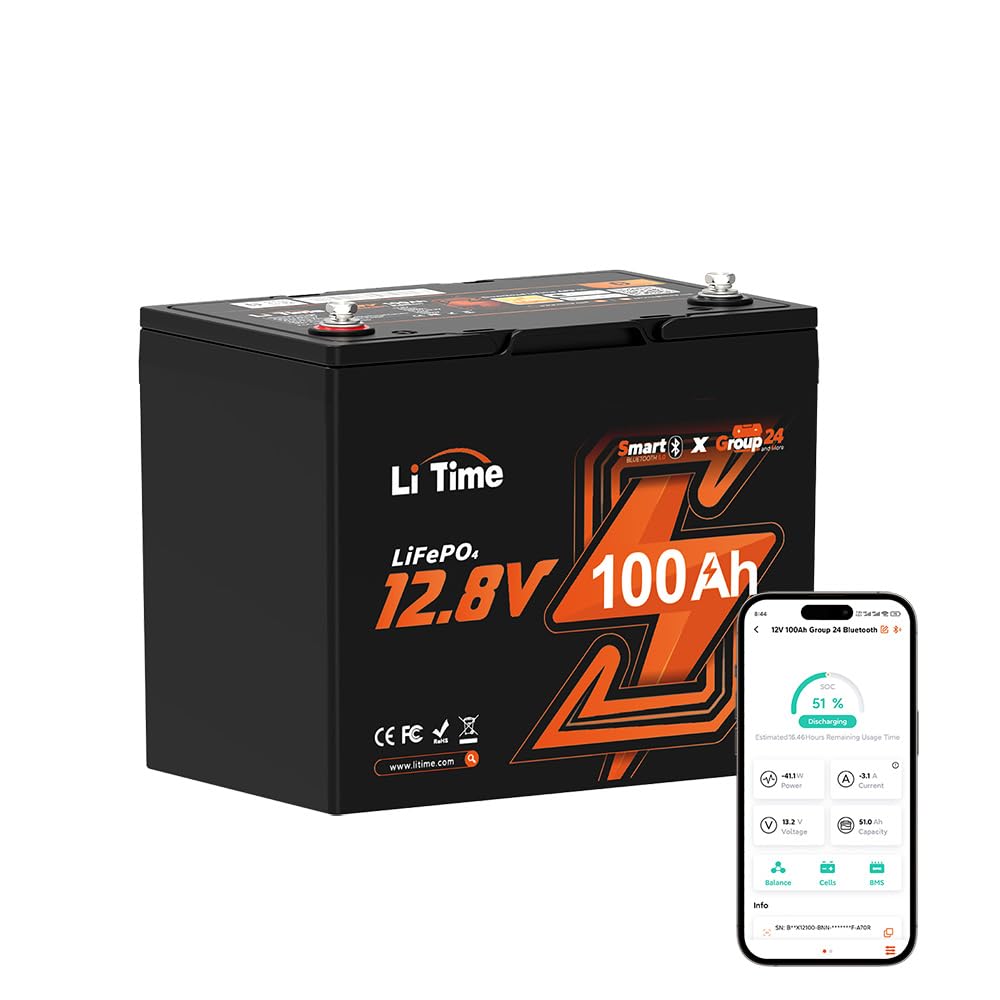
A compact Group 24 battery with Bluetooth monitoring at a price that makes lithium accessible.
This Litime battery packs 100Ah and a 100A BMS into a Group 24 footprint that measures just 10.24 x 6.61 x 8.3 inches. It weighs only 21 lbs, so you notice the difference every time you lift it. The Bluetooth 5.0 module connects to the LiTime app via QR code, letting you check state of charge, discharge rate, and voltage from anywhere in your RV.
Owners mention the app is genuinely useful — one owner said “the app is actually worth the download” and uses it to monitor the battery on a trolling motor. Another reviewer noted that after 10 months of constant use powering a fridge, the BMS showed only 18 cycles, which suggests a long useful life. The 100A BMS includes 20+ safeguards, including low-temperature cut-off that stops charging in freezing conditions. Compared to the Battle Born, this one gives you phone monitoring at a lower price, but you lose the 10-year warranty and Battle Born’s long track record.
The main catch is that converting an RV from lead-acid to lithium often requires upgrading the converter or charge controller. One buyer cautioned that their auto-detect inverter struggled to recognize the lithium profile, meaning you might spend extra on a compatible charger. Unlike the HumsiENK above, this is a single 100Ah unit — if you need 200Ah or more, you will wire two in parallel.
Strong points
- Compact Group 24 size fits standard battery trays
- Bluetooth 5.0 pairs fast and gives you real-time data
- Very light at 21 lbs — easy to move and install
- 5-year warranty and 24/7 support
Weak points
- 100Ah capacity may be too small for heavy off-grid use
- May require a charger upgrade if your RV’s converter does not support lithium profiles
Best for: RV owners who want a lightweight, smart battery with Bluetooth and a manageable price.
Not ideal for: Heavy boondockers — you will likely need two in parallel or a higher-capacity unit like the HumsiENK.
4. Dumfume 12V 150Ah LiFePO4 Deep Cycle Battery
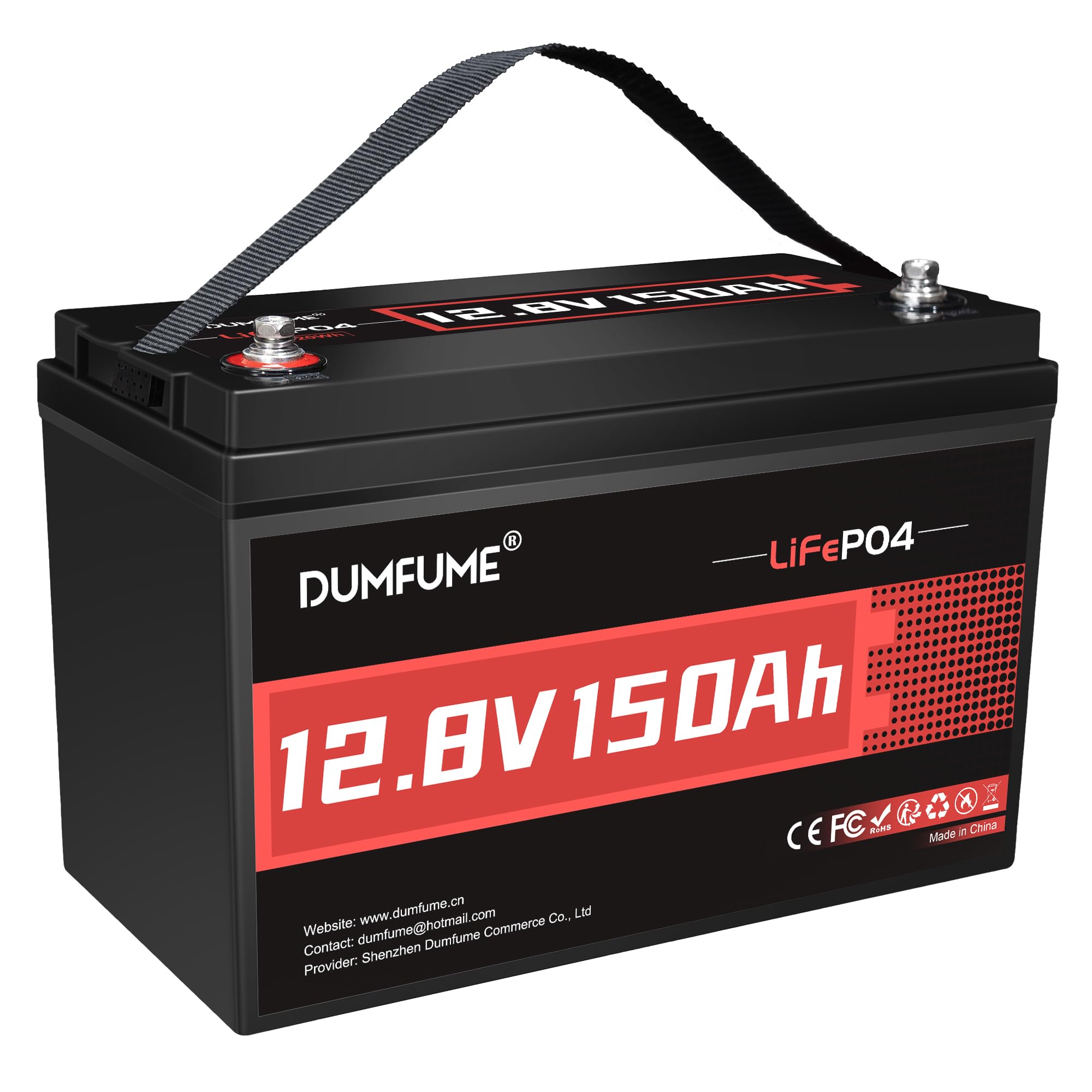
A 150Ah budget-friendly workhorse that delivers more capacity than its price suggests.
This Dumfume battery offers 150Ah of capacity and 1920Wh of stored energy at a very low price. It is a Group 31-size battery with a built-in 100A BMS that protects against overcharge, over-discharge, and short circuits. The manufacturer claims over 4,000 cycles to 80% capacity, which for many RV owners translates to a decade or more of weekend use.
Buyers have mixed experiences. One owner ran a 1200W inverter with an 8000 BTU air conditioner and reported that the battery handled a 35% load without issue. Another reviewer praised the build quality, noting the ring terminals and screws rather than soldered connections. However, one reviewer noted that after just over one year, the battery “started failing to supply any kind of useful power” in a campervan, gradually losing capacity until it went dead under a 3.5-amp fridge draw. This raises a real durability concern for long-term users. Unlike the Litime, this battery has no Bluetooth monitoring, so you cannot spot a failing cell early from your phone.
The battery supports parallel and series connections up to 4S4P, so you can expand later. Just note that it requires a full maintenance cycle every 6 months during extended storage, and the manufacturer warns that return shipping for low-temperature charging issues is not covered.
What you get
- 150Ah capacity at a low price — good value per watt-hour
- 1920Wh of usable energy for lights, fridge, and small appliances
- 5-year warranty provides some confidence
Where it falls short
- Mixed reliability reports — some units fail within a year
- Requires periodic full maintenance charge during storage
- No Bluetooth monitoring — you cannot check SOC from your phone
Reach for this if: You need a large capacity on a tight budget and are comfortable with some DIY troubleshooting.
Look elsewhere if: You want a hands-off, guaranteed-reliable battery — the longer track record of Litime or Battle Born is safer.
Understanding the Specs
Amp-Hours (Ah) — How Much Energy You Can Use
Amp-hours measure the total charge a battery can deliver at its rated voltage. A 100Ah battery at 12.8 volts holds 1,280 watt-hours. To know if that is enough, add up the wattage of your RV fridge (about 60W), lights (10W each), water pump (50W when running), and any inverter loads, then multiply by the hours you need them. A safe rule for most RV owners is to aim for at least 200Ah for a weekend off-grid, though the HumsiENK’s 320Ah gives you days of autonomy.
BMS and Low-Temperature Cut-Off
The Battery Management System (BMS — the circuit board inside) prevents the battery from overcharging, over-discharging, or shorting out. The most important feature for RVers is low-temperature cut-off: it stops the battery from accepting a charge when the cell temperature drops below freezing (32°F). Charging a cold LiFePO4 cell causes permanent damage. All four picks here include low-temp cut-off, but check the fine print — some manufacturers add caveats about return shipping if you charge in cold weather.
FAQ
Can I replace my RV’s lead-acid battery with a LiFePO4 battery directly?
How many amp-hours do I need for weekend RV camping?
What does the BMS do in a lithium RV battery?
Is Bluetooth monitoring worth the extra cost?
Can I connect multiple LiFePO4 batteries in parallel or series?
How long does a LiFePO4 RV battery last compared to lead-acid?
What happens if I charge a LiFePO4 battery in freezing temperatures?
Can I use my existing RV battery charger with a LiFePO4 battery?
Which battery is the best value for a full-time RVer?
Final Thoughts: The Verdict
For most buyers, the 12 volt rv battery winner is the HumsiENK 12V 320Ah because it delivers massive single-unit capacity with built-in Bluetooth, eliminating parallel wiring complexity while still being light enough for most RV compartments. If you want proven reliability and a 10-year warranty without needing phone monitoring, grab the Battle Born 100Ah. And for the best balance of Bluetooth smarts and budget, the Litime 100Ah Group 24 gives you smart monitoring at a lower price than Battle Born.
How We Picked
We do not accept paid placement. Every pick is matched to a real buyer and a real use-case; we do not hands-on test units.
Sources & Methodology
Specifications: manufacturer listings and product documentation. Review insights: verified customer reviews, as of July 2026. Pricing: not shown on this page (it changes often); check the current price via the retailer link.
As an Amazon Associate, Gadgets Feed earns from qualifying purchases. This does not affect which products we feature.