
Our readers keep the lights on and my morning glass full of iced black tea. As an Amazon Associate, I earn from qualifying purchases.
Specs are compiled from manufacturer listings and verified buyer reviews and can change over time — please confirm the key details on the product page before buying.
Your speakers and amplifier might be top-notch, but a flimsy speaker cable can steal the clarity and bass punch you paid for. A properly-sized cable sends the full signal from your amp to your speakers without loss, so your system sounds its best. This guide cuts past the marketing to show you which cables actually matter for your setup, from a quick 3-foot guitar cab connection to a 500-foot whole-home theater install.
I’m Min — the founder and writer behind Gadgets Feed. This guide is built by comparing the manufacturers’ published specifications and the patterns across verified customer reviews, so you get each pick’s real strengths and trade-offs instead of marketing spin.
This guide walks you through the gauges (wire thickness), materials (like copper vs. aluminum), and connectors that determine sound quality and long-term reliability for your system.
Quick Picks
- WORLDS BEST CABLES 20 Foot — Audiophile Choice
- GEARit 12 Gauge Speaker Wire OFC — In-Wall Specialist
- ROCMUZZK 2 Pack 50ft 1/4 Inch — Pro Audio Workhorse
- InstallGear 14 Gauge Speaker Wire 100 ft, 14 AWG — Best Value
- Install Link 14 Gauge Speaker Wire — Flexible Runner
- Pig Hog PHSC3 High Performance 14 Gauge 1/4″ — Short & Sturdy
- NavePoint 500ft in Wall Audio Speaker Cable — Bulk Installer
How To Choose The Best Audio Speaker Cable
Picking a speaker cable is simpler than most people think. You only need to match the wire gauge to the distance of your run, decide on a conductor material that fits your budget and performance needs, and pick the right connector type for your gear. Here are the three specs that matter most.
Gauge (AWG)
Gauge is the thickness of the wire. A lower number means a thicker wire with less resistance, which matters over longer distances. For runs under 50 feet, a 14 AWG (American Wire Gauge) cable is usually enough. For longer runs, especially to large speakers or subwoofers, a 12 AWG cable is a smarter choice because it keeps the resistance low and delivers full power from your amp to the speaker.
Conductor Material
Most cables use either Copper Clad Aluminum (CCA) or oxygen-free copper (OFC). CCA is a cost-effective option that works fine for typical home theater or car audio setups. OFC has slightly better conductivity and resists corrosion better over time, which is why audiophiles and anyone running wire inside walls tend to prefer it. For everyday use, the practical difference is small, but for critical listening or permanent installations, OFC is the more reliable choice.
Connector Type
If you are using raw wire, you just strip the jacket and connect directly to the binding posts. For convenience, banana plugs plug straight into most modern receivers and speakers without any stripping. A 1/4-inch jack is what you need for a guitar amp head to cabinet connection. Choose the connector that matches your equipment — the cable itself is what carries the signal quality.
Quick Comparison
| Model | Best For | Gauge | Length | Material | Amazon |
|---|---|---|---|---|---|
| WORLDS BEST CABLES 20 ft WBC-GOLD-LOCAP-SPKR | Audiophile stereo rigs | 12 AWG | 20 ft (pair) | OFC | Amazon |
| GEARit 12 Gauge Speaker Wire 100 ft | In-wall installations & whole-home audio | 12 AWG | 100 ft | OFC | Amazon |
| ROC MUZZK 2 Pack 50 ft 1/4 Inch Male Cable | Pro audio PA & stage setups | 12 AWG | 50 ft (2-pack) | OFC | Amazon |
| InstallGear 14 Gauge Speaker Wire 100 ft | Home theater & car audio on a budget | 14 AWG | 100 ft | CCA | Amazon |
| Install Link 14 Gauge Speaker Wire 100 ft | Flexible long runs & DIY projects | 14 AWG | 100 ft | CCA | Amazon |
| Pig Hog PHSC3 14 Gauge Speaker Cable, 3 Ft | Guitar cab to amp head connections | 14 AWG | 3 ft | — | Amazon |
| NavePoint 500 ft in Wall Audio Speaker Cable | Large commercial or residential installations | 12 AWG | 500 ft | CCA | Amazon |
In‑Depth Reviews
1. WORLDS BEST CABLES 20 Foot WBC-GOLD-LOCAP-SPKR-12 AWG

A hand-assembled pair of 12 AWG cables built for listeners who hear the difference.
This is for the person who has already dialed in their turntable, amp, and speakers and now wants the link between them to be the last weak point. Each cable uses a total of 588 strands of 99.99% oxygen-free copper (OFC), each just 0.12mm fine, split between two 12 AWG cores laid out in an expanded dumbbell design. That extra space between the cores lowers capacitance and inductance — the maker claims these are among the lowest in the sub- price range — which means high frequencies stay crisp and uncolored. You get one cable for the left channel and one for the right, each 20 feet long.
Buyers report the banana plugs are molded solidly in place, with a fully insulated body to prevent accidental shorting. One reviewer noted they switched from another brand because of static in the left channel and felt these cables sounded stellar even before the burn-in period. They use a proprietary 4% silver solder blend and a nitrogen-assisted soldering process.
Compared to the InstallGear or Install Link CCA cables above, this is a different league: pure OFC, ultra-fine strands, and connectors built to last a lifetime. The catch is the price — this is the most expensive pick here, and you need gear good enough to hear the difference.
Why It Stands Out
- Ultra-low capacitance and inductance for clean high-frequency detail
- 588 fine OFC strands per cable for excellent flexibility and conductivity
- 24K gold-plated Eminence banana plugs with reinforced shaft
The Cost of Craft
- Premium price — overkill for basic home theater or short runs
- Requires equipment capable of resolving the difference
Built for Ears That Demand More: This is the cable for the dedicated stereo listener who has already boost their other components and wants the quietest, cleanest wire possible between them.
A Buyer Who Should Not Bother: If your system uses CCA wire and 14 AWG, you are not the audience — this investment only pays off with revealing speakers and an amp that is already a cut above.
2. GEARit 12 Gauge Speaker Wire OFC, UL CL2 Rated 100 ft
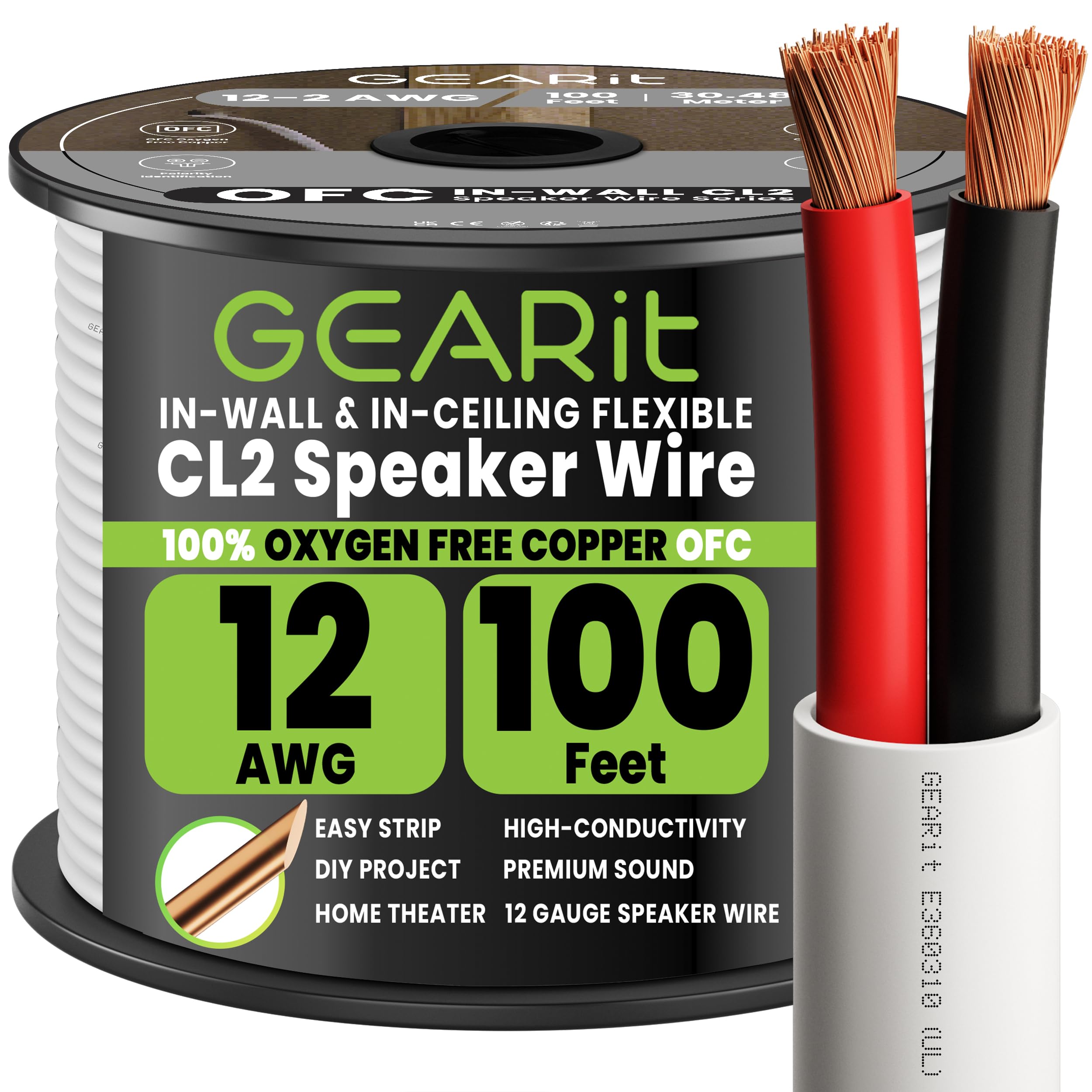
A UL-listed, CL2-rated pure copper wire made for hiding inside walls and ceilings.
If you are installing speakers in drywall, this is your wire. The GEARit cable is listed by Underwriters Laboratories (UL) and rated CL2, which means it meets the fire-safety code required for running inside walls in most residential and commercial buildings. It uses solid oxygen-free copper (OFC) rather than copper-clad aluminum (CCA), so you get better conductivity and a stable connection that should not corrode over the years inside a wall. Owners mention it is easy to cut and strip, and the jacket is flame-retardant yet flexible enough to pull through tight corners.
The wire has sequential foot markers printed along the jacket — a small detail that customers note saves a lot of time measuring. Each conductor is color-coded red and black for quick polarity identification. It comes in a 100-foot spool, and weighs 3.3 pounds.
Buyers do note a real annoyance: the cardboard spool is flimsy. One buyer mentioned the spool broke apart during a job, making the unspooling process messy. The wire itself is excellent — just be ready to handle the spool carefully or re-spool it onto something sturdier before you start a big project.
The Clear Choice for Permanent Installations: Between the UL listing, pure copper conductors, and printed foot markers, this is the most professional-grade bulk wire on the list for anyone wiring speakers into walls or ceilings.
Reach for This If: You are building a whole-home audio system, a commercial sound system, or any job where the wire needs to be hidden inside a wall and pass a safety inspection.
Look Elsewhere If: You just need a short terminated cable for a bookshelf speaker — a pre-terminated option like the WORLDS BEST CABLES will save you the hassle of stripping and connecting.
3. ROCMUZZK 2 Pack 50ft 1/4 Inch to 1/4 Inch Male Speaker Cable, 12 Gauge AWG

A two-pack of 50-foot 1/4-inch cables for PA speakers and stage runs that need thick wire.
At 12 AWG, this is one of the thickest terminated cables on the list, letting you run a full 50 feet per cable with minimal signal loss to a passive PA speaker or a guitar cabinet. The cables use oxygen-free copper (OFC) conductors wrapped in a Heavy Duty PVC-85P jacket that resists kinks and weather. Each cable ends in a 1/4-inch male connector, standard for pro audio gear like powered mixers and speaker cabinets. You get two cables per pack.
Buyers have mixed opinions on the construction. One reviewer pointed out that the 30-foot cable is only held by solder connections at the plug — there is no crimp or strain relief on the jacket, so you have to grab the barrel of the plug when unplugging, not the cable itself. Another reviewer who used them for a PA system said they worked fine but felt cheap for the price.
Compared to the InstallGear or Install Link raw-wire options, these cables give you a plug-and-play solution with connectors already attached. The trade-off is that the build quality may not survive years of heavy stage use — you are paying for the convenience of a pre-made 12 AWG terminated cable at this price.
What Works Here
- Thick 12 AWG OFC conductors for long runs
- Two cables included — good value per cable
- Flexible PVC jacket for routing on stage
The Weak Spots
- Solder-only connection at the plug — no strain relief
- Some reviewers question whether it is true 12 AWG vs 16 AWG
A Budget-Friendly Pro Option: If you need a pair of long 1/4-inch cables for a PA system, a practice space, or a short-term install where convenience matters more than road-warrior durability, this two-pack fits the bill.
skip it if You Gig Hard: Bands that load in and out every weekend should look for cables with crimped strain relief on the connector — this solder-only design is more likely to fail when tugged or stepped on.
4. InstallGear 14 Gauge Speaker Wire 100 ft, 14 AWG

Accurate 14 AWG gauge, a soft-touch jacket, and a price that undercuts the big-box stores by half.
This is the cable for anyone wiring a home theater, a pair of bookshelf speakers, or a car stereo system on a budget. It uses Copper Clad Aluminum (CCA), which keeps the cost low while still giving you a real 14 AWG conductor. The jacket is a soft-touch PVC that reviewers describe as easy to strip and flexible enough for tight routing behind a receiver. The blue and black color coding makes polarity identification simple. It comes in a 100-foot spool.
Reviewers point out the gauge is accurate — one reviewer compared it to wire from a hardware store and noted it was the same thickness. Another reviewer mentioned it survived speaker knock-overs over a year with no performance issues. One buyer cautions that because it is copper-washed aluminum, you should be careful when pulling the wire across metal edges or sharp corners, as the CCA core is less forgiving than pure copper.
Compared to the GEARit OFC wire, this is a CCA alternative at the same length and gauge. You give up the UL rating and pure copper conductivity, but for typical runs of 50 feet or less from an A/V receiver to surround speakers, most people will not hear a difference.
The Smart Money Pick: If your budget is tight and your run is under 50 feet, this cable does the same job as more expensive options for a fraction of the cost.
Grab This When: You are setting up a 5.1 home theater, wiring car speakers, or just want a solid spool of wire that you can trust to deliver full-range sound without overspending.
Pass On It If: You are running wire inside a wall and need a CL2 or UL rating for code compliance — you need the GEARit OFC wire for that job.
5. Install Link 14 Gauge Speaker Wire (White) for Car, Home or RV Audio, 100ft, CCA
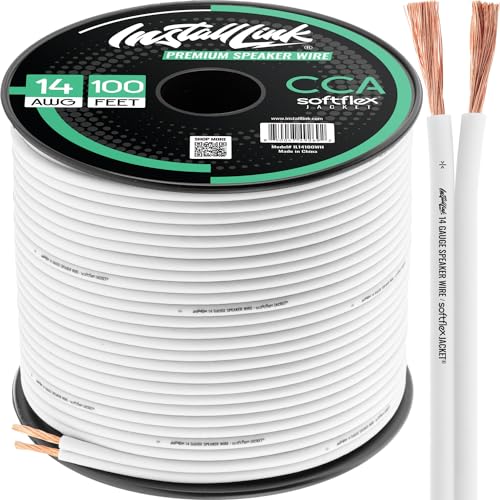
A white-jacketed spool that painters will love and DIY installers will find easy to route.
This is almost a direct competitor to the InstallGear wire above, but with one twist: the outer jacket is white instead of blue, which makes it much easier to hide against white baseboards or paint over. It uses the same CCA (Copper Clad Aluminum) construction with a 14 AWG gauge. The jacket is a SoftFlex material, so it bends easily around corners without holding a kinked shape. Like the InstallGear wire, it comes in a 100-foot spool.
Shoppers say the white jacket is a big plus for in-room routing, and several reviewers confirmed the gauge is accurate. One reviewer tested it for a home audio setup and noted that it is CCA, not pure copper — which is good to know, because CCA is slightly more brittle than pure copper when you strip it. Another reviewer used it in a car stereo build and said the insulation was flexible enough for the rough handling of a car installation.
Versus the InstallGear wire, this lacks the blue/black color coding — the Install Link uses a simple white jacket with polarity marking on the wire itself. For most people, the choice between these two depends on color. If you need white wire to blend in, this is your pick.
What Is Different
- White jacket for easy concealment and painting
- Soft, flexible insulation that is easy to strip
- Accurate 14 AWG gauge per buyer reports
Know This Before Buying
- CCA core is less durable than pure copper over repeated bending
- No UL or CL2 rating for in-wall use
Best for Visible Runs: If your wire runs along a white baseboard or will be painted, the white jacket saves you the work of hiding it.
Not For In-Wall Wiring: Like the InstallGear, this lacks a safety rating, so it should not go inside a wall if your local code requires CL2 or UL listed wire.
6. Pig Hog PHSC3 High Performance 14 Gauge 1/4″ Speaker Cable, 3 Feet

A thick-rubber-jacketed 3-foot cable built to survive life on stage and in the studio.
This is the cable you buy if you need to connect a guitar amplifier head to a speaker cabinet. It is 3 feet long, uses 14 AWG wire, and has a massive 9.2mm rubber outer covering that protects the cable from stomps, tugs, and gear cases. The connectors have heat shrink covering the joint, which keeps the jack from unscrewing — a common failure point on cheaper cables. Reviewers call it “thick and sturdy” and “solid.”
Buyers report the wrapped ends extend far down the cable, farther than on other brands with similar construction. One owner reported that the extra length of the heat shrink wrap makes the plug stick out a bit further from the amp jack. Another reviewer bought a used one and found a small cut on the sleeve of the jack, but noted it did not affect performance.
Compared to the ROCMUZZK 50-foot cables, this is a much more sturdy build for a short run. The 3-foot length is ideal for a head-to-cab connection — anything longer would just be cable to trip over. If you play guitar and want one cable that will not let you down, this is it.
The Guitarist’s Go-To: If you need a short, tough, no-compromise cable between your amp head and cabinet, the Pig Hog is purpose-built for that exact job.
Buy It If You Gig Or Record: The thick rubber jacket and heat shrink connectors are a step above most short patch cables, and the 3-foot length is perfect for sitting an amp head right on a cab.
pass on it if: You are wiring a home theater or a long speaker run — this cable is only 3 feet long and meant for musical instrument setups only.
7. NavePoint 500ft in Wall Audio Speaker Cable Wire CL2 12/2 AWG

A 500-foot box of 12 AWG CCA wire for pros who wire whole houses or commercial spaces.
This is the cheapest way to buy 12 AWG wire in bulk. The NavePoint cable uses Copper Clad Aluminum (CCA) with 102 strands of 0.16mm wire per conductor, wrapped in a white jacket. It comes in a convenient pull box that owners mention prevents kinks and tangles during long pulls through vaulted ceilings or crawl spaces. At 500 feet, it will wire a dozen or more speakers across a large home or a small commercial building.
Customers note that the outer shielding slides smoothly through tight spaces and that the wire strips and terminates easily, much like pure copper. One reviewer used it to re-run all the wiring for a whole home theater and said the sound quality is excellent. Another buyer noted that for long-term reliability, the CCA core might not last as long as pure OFC copper in humid environments.
Compared to the GEARit OFC wire, this is a different animal entirely. The GEARit is UL-listed, pure copper, and meant for critical installations. The NavePoint is a budget-friendly CCA solution for jobs where the cost of pure copper per foot would be prohibitive. For a large install where pure copper would be much more expensive, this cable gets the job done at a lower cost.
Bulk Buying Advantage
- 500 feet of 12 AWG wire in one box — lowest cost per foot for this gauge
- Pull box design prevents snags and kinks during installation
- CL2 rated for in-wall use in most residential codes
The CCA Trade-off
- CCA core may corrode faster than pure copper in high-humidity environments
- No UL certification — only CL2 rating
For the Large-Scale Installer: If you are wiring a house, a church, or an office, the NavePoint gives you 12 AWG wire at a budget-friendly price per foot that is hard to match.
Pass On It If: You only need 50 feet for a home theater — you will pay less overall for a smaller spool of OFC wire like the GEARit, and get better long-term reliability.
Understanding the Specs
Gauge (AWG)
American Wire Gauge is the standard for measuring wire diameter. A lower number means a thicker wire: 12 AWG is thicker than 14 AWG. The thicker the wire, the less electrical resistance it has, which matters when you run the wire longer distances. For a 50-foot run, 14 AWG is usually enough. For a 100-foot run, 12 AWG keeps the signal strong by reducing the voltage drop that can cause a loss of bass punch and overall volume.
OFC vs CCA
Oxygen-Free Copper (OFC) is refined copper with very little oxygen in it, which makes it a better conductor and more resistant to corrosion over time. Copper Clad Aluminum (CCA) is an aluminum core coated with a thin layer of copper. It is cheaper and works fine for typical home audio and car stereo uses. OFC is the better choice for permanent in-wall installations or high-end audio systems where every bit of conductivity matters.
FAQ
Is 12 AWG always better than 14 AWG?
Can I use CCA wire inside my walls?
What does a banana plug do that bare wire does not?
Will a better cable make my speakers sound louder?
What length of speaker cable do I need for a home theater?
Does the direction of the speaker wire matter?
Can I use a guitar cable as a speaker cable?
How long should a 12 AWG cable be before I hear signal loss?
Final Thoughts: The Verdict
Across the board, the best audio speaker cable winner is the GEARit 12 Gauge Speaker Wire because it combines UL-listed pure copper construction, a flexible jacket, and printed foot markers at a mid-range price that makes it the right choice for both permanent in-wall installs and everyday home theater. If you want plug-and-play convenience for a guitar rig, grab the Pig Hog PHSC3. And for a budget-friendly home theater setup where every dollar counts, the InstallGear 14 Gauge Speaker Wire delivers real 14 AWG performance without breaking your budget.
How We Picked
We do not accept paid placement. Every pick is matched to a real buyer and a real use-case; we do not hands-on test units.
Sources & Methodology
Specifications: manufacturer listings and product documentation. Review insights: verified customer reviews, as of July 2026. Pricing: not shown on this page (it changes often); check the current price via the retailer link.
As an Amazon Associate, Gadgets Feed earns from qualifying purchases. This does not affect which products we feature.