
Our readers keep the lights on and my morning glass full of iced black tea. As an Amazon Associate, I earn from qualifying purchases.
Specs are compiled from manufacturer listings and verified buyer reviews and can change over time — please confirm the key details on the product page before buying.
If you have a casement window (the kind that cranks out or slides side-to-side), you already know the struggle: standard window ACs won’t fit, and portable units are loud, leaky, and take up floor space. The fix is a purpose-built air conditioner that fits your narrow opening and actually cools without turning your living room into a sauna.
I’m Min — the founder and writer behind Gadgets Feed. This guide is built by comparing the manufacturers’ published specifications and the patterns across verified customer reviews, so you get each pick’s real strengths and trade-offs instead of marketing spin.
We’ve looked at three models that are truly designed for sliding and crank-out windows, ranking them on cooling power, efficiency, and real buyer experiences to help you find the best air conditioner for casement window that won’t leave you sweating over a bad fit.
Quick Picks
- Perfect Aire 10,000 BTU Casement Window Air — Best Overall
- Keystone 8,000 BTU Slider Window Air Conditioner — Best Value
- Durastar DRCAC101XNA1 10,000 BTU Casement Air — Pure Function
How To Choose The Best Air Conditioner For Casement Window
Buying a standard window unit for a casement window is like trying to fit a square peg in a round hole. These windows slide side-to-side or crank outward, so you need a unit built for that shape and opening. Here is what to check first.
Measure Your Window Opening Carefully
Your window width is the single most important number. Casement units are typically designed for a specific range — for instance, a minimum of 15.5 inches and a maximum of 16.3 inches. If your opening is narrower or wider than the unit’s specs, it simply won’t seal, so you’ll leak cool air and let in bugs and humidity. Always check the minimum and maximum width in the product details before you buy.
Match BTU to Your Room Size
BTU (British Thermal Unit — the measure of cooling power) matches how big a room your AC can handle. A room up to 350 square feet generally needs 8,000 BTUs, while a 450-square-foot room needs 10,000 BTUs. Oversizing (getting too many BTUs) can cause short cycling (the unit turns on and off constantly without removing humidity). Undersizing means the room never gets comfortable.
Check the Air Flow Efficiency
Measured in CFM per watt (Cubic Feet Per Minute per watt — how much air you get for each unit of electricity), a higher number means more efficient air delivery. This is different from the overall energy efficiency ratio (EER) and matters if your electric bill is a concern.
Quick Comparison
| Model | Best For | Cooling Power | Air Flow Efficiency | Max Room Size | Amazon |
|---|---|---|---|---|---|
| Perfect Aire 10,000 BTU | Premium quiet cooling | 10,000 BTU | — | 450 sq. ft. | Amazon |
| Keystone 8,000 BTU | Budget-friendly value | 8,000 BTU | 0.38 CFM/Watt | 350 sq. ft. | Amazon |
| Durastar DRCAC101XNA1 | Slider-only simplicity | 10,000 BTU | 0.33 CFM/Watt | 450 sq. ft. | Amazon |
In‑Depth Reviews
1. Perfect Aire 10,000 BTU Casement Window Air Conditioner
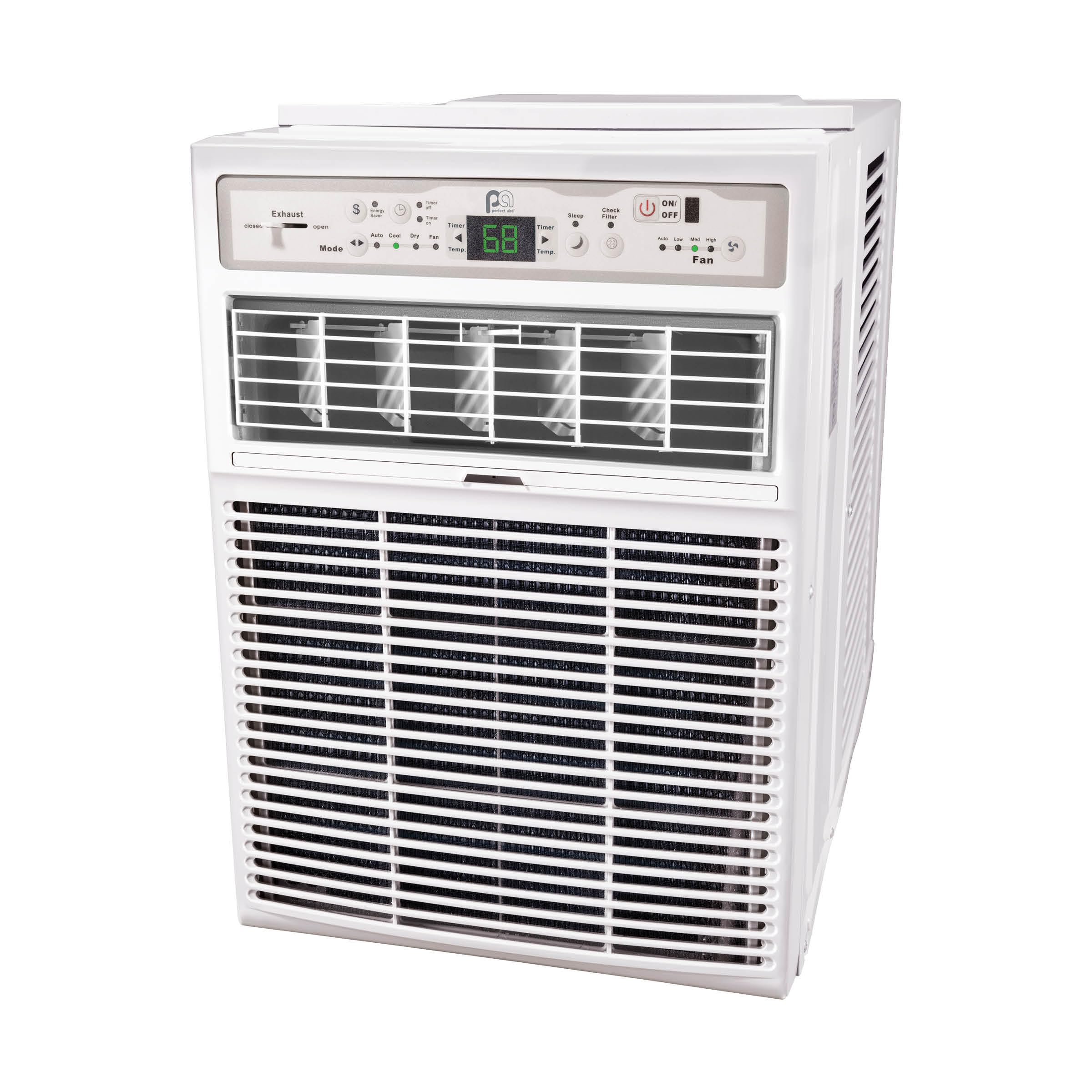
The quiet, feature-rich unit that finally makes casement windows feel normal.
The real standout here is the “Follow Me” remote (a portable thermostat in the remote): it senses the temperature exactly where you are, not where the unit is, using a 26-foot range. So your seat stays comfortable instead of you freezing near the AC while the rest of the room stays warm. The Perfect Aire 10,000 BTU covers 450 square feet, fitting both sliding and crank-out casement windows with a minimum width of 15.5 inches and a maximum height of 39.5 inches.
Buyers report that “it’s quieter than our last one and cools just as well.” But the catch is assembly — one reviewer noted they had to do “some slight window sill modification” to get it seated perfectly, and another said “it was kind of hard to install, mainly cause we had no clue what we were doing.” A few reviewers mention minor shipping damage to the box (one said “arrived with minor damage that I’m not too upset about but did take that one star away”), so inspect the packaging on arrival. The unit also needs to sit upright for 24 hours before first use to protect the compressor (the internal pump that circulates refrigerant).
Compared to the Keystone, the Perfect Aire is quieter and covers a larger room (450 vs. 350 square feet), but the Keystone is easier on a budget. This pick fits the widest range of casement setups.
What works
- Follow Me remote senses temp where you sit, not at the unit
- Quieter than many 10,000 BTU models, according to buyers
- Fits both slider and crank-out casement windows
Watch out for
- Installation may need minor window sill modifications, per one buyer
- Lacks a drain hole for water removal, according to one buyer
- Some units arrive with cosmetic box damage
Reach for this if: you want a quiet, feature-packed AC for a large casement room (up to 450 sq. ft.) and can handle a slightly involved install.
skip it if: you need a drop-in solution with zero modifications or you have a very narrow window under 15.5 inches.
2. Keystone 8,000 BTU Slider Window Air Conditioner
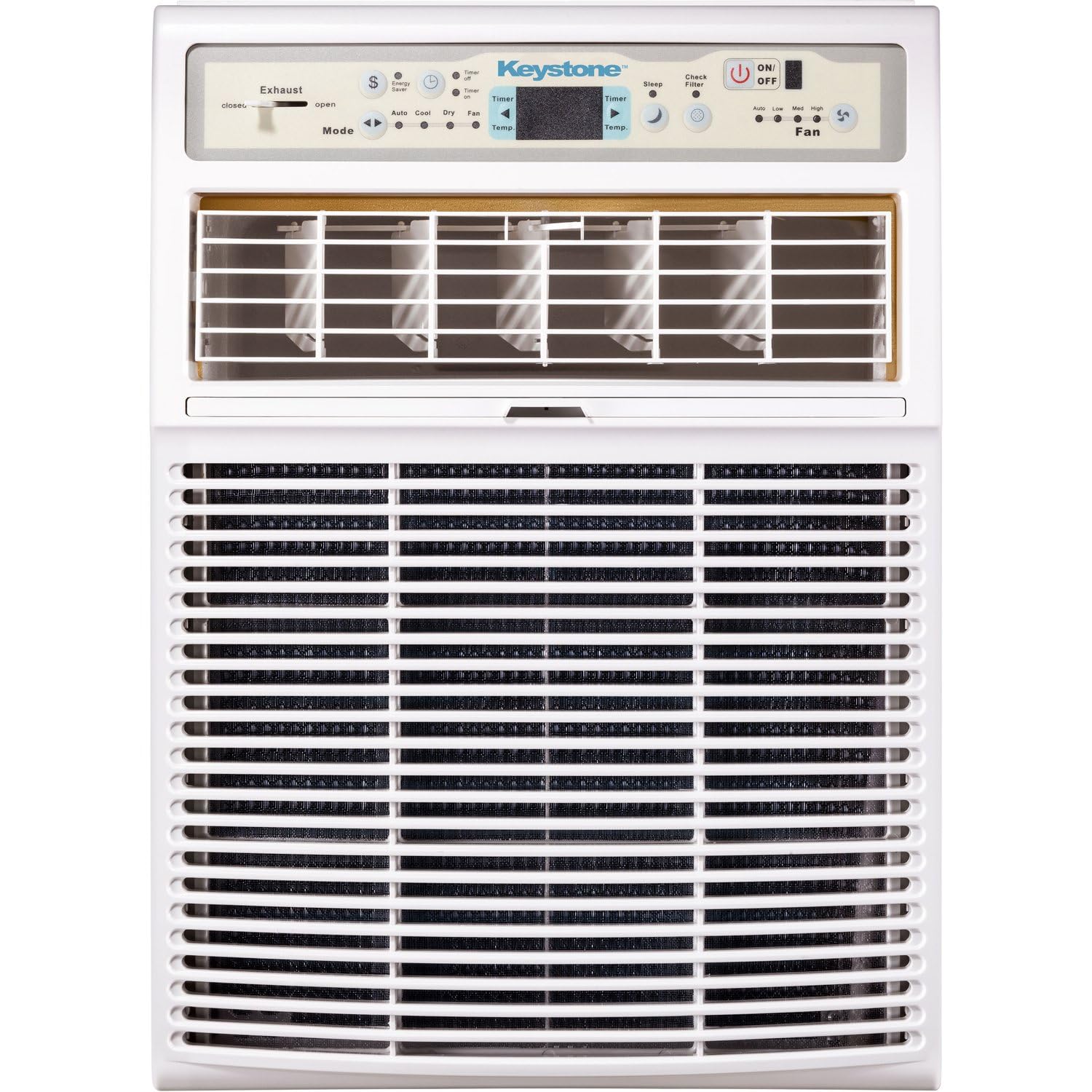
The budget-friendly unit that actually fits in a 14.5-inch casement opening.
This Keystone 8,000 BTU AC is built for rooms up to 350 square feet — think a bedroom or small living room. Its air flow efficiency (CFM per watt, measuring how much air you get per unit of electricity) is 0.38, which is 15% higher than the Durastar’s 0.33. That means you get more cooling for every dollar on your electric bill. It also removes 0.9 liters of moisture per hour from the air with its built-in dehumidifier (a system that pulls humidity out), so sticky summer days feel less swampy.
The minimum window width listed is 15.5 inches (max 16.3 inches), but one buyer confirmed it “fits in my 14.5 inch casement window,” meaning it handles slightly narrower openings than the specs say. Buyers also praise its “small room freezing performance.” The downsides are real though — several reviews mention units arriving in “bashed up box” packaging with missing parts or bent panels. One frustrated buyer said “it took 4 hours to install due to poor instructions.”
Compared to the Perfect Aire, the Keystone costs less and is more energy-efficient per watt of air moved, but it covers a smaller room (350 sq. ft. vs. 450 sq. ft.) and owners mention more packaging issues. Given the price point, you trade some build quality and a fussier install for strong energy efficiency and solid chilling performance in smaller rooms.
What you get
- Highest air flow efficiency in this roundup (0.38 CFM/Watt), meaning more airflow per electricity dollar
- Built-in dehumidifier at 0.9 liters/hour for less sticky air
- Fits narrower casement openings, as one buyer confirmed a 14.5-inch fit
Keep in mind
- Packaging and instructions are a frequent complaint among buyers
- Heavy unit — two-person install recommended
- Limited to 350 sq. ft. rooms
Perfect for: anyone cooling a small bedroom or office on a tight budget without sacrificing efficiency.
Not for: large open-plan rooms over 350 sq. ft. where 8,000 BTUs will struggle.
3. Durastar DRCAC101XNA1 10,000 BTU Casement Air Conditioner
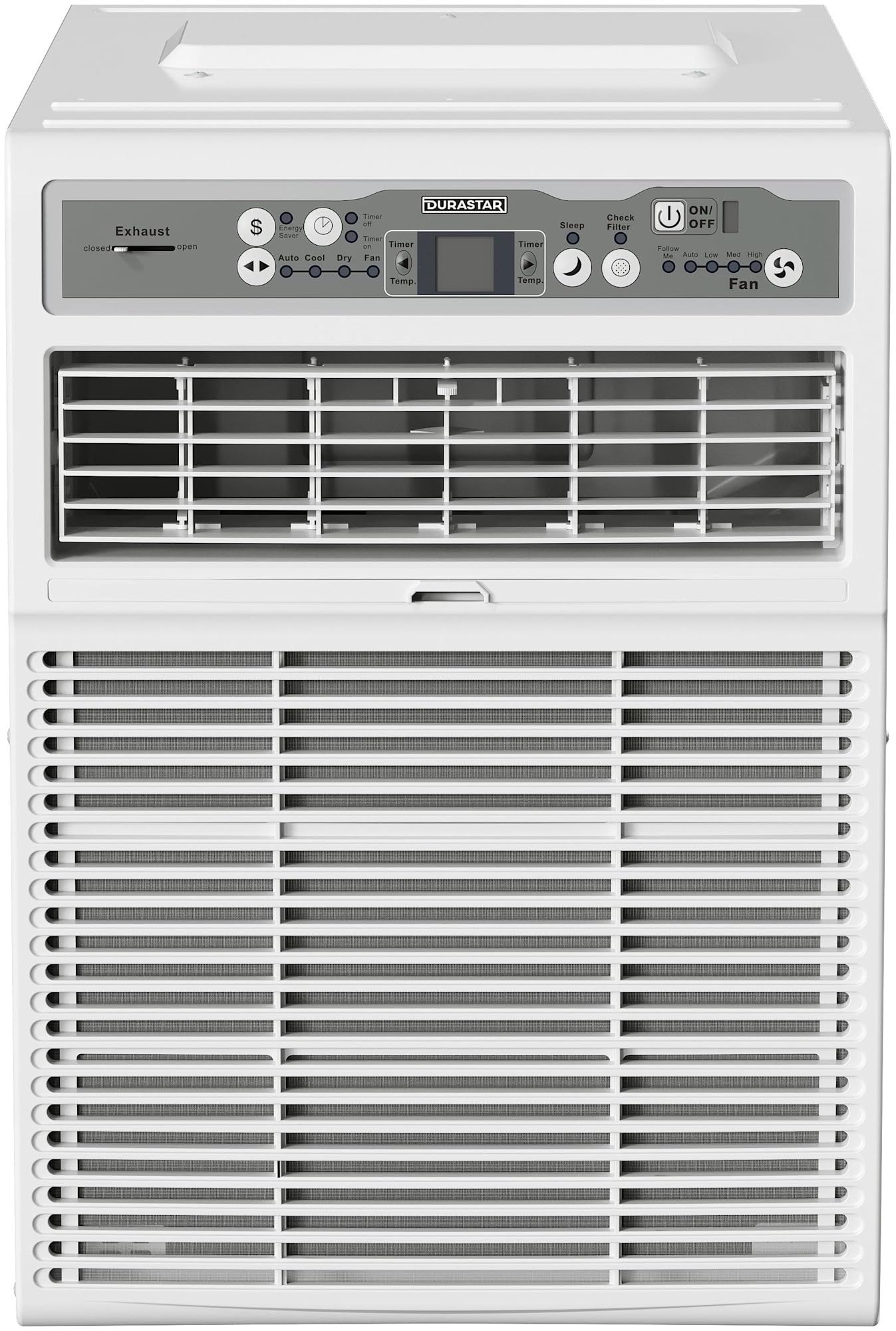
A straight-ahead 10,000 BTU AC designed exclusively for side-sliding windows.
This Durastar matches the Perfect Aire’s 10,000 BTU output, covering rooms up to 450 square feet, but it has a narrower focus — it is designed for left-to-right sliding (casement) windows only. It will not fit windows that slide up and down, so if you have vertical sliders, skip this one. Its air flow efficiency is 0.33 CFM per watt, noticeably lower than the Keystone’s 0.38, but it still delivers substantial cooling power thanks to its higher BTU rating (10,000 vs. 8,000).
The unit measures 23.5 inches deep, 14.56 inches wide, and 20.88 inches high, with a 16-foot remote control range. It includes three fan speeds, sleep mode, a dehumidifier, and an energy saver mode with an EER (Energy Efficiency Ratio) of 10.4 (a standard measure of cooling per watt). Some customers note it is “well made runs great,” while another experienced a worry: “lasted 8 months and locked up, yes I have power yes I reset it.” This durability concern, plus several reports of “busted all up” packaging with missing bracket pieces, means you should test it immediately upon arrival.
Compared to the Keystone, the Durastar offers more cooling power (covering 450 sq. ft. vs. 350 sq. ft.) but has lower air flow efficiency and reliability questions from buyers. Consider it if you find a significant discount and can inspect the box in-store rather than having it shipped.
The strengths
- Same 10,000 BTU output as the top pick Perfect Aire
- Includes energy saver and sleep modes
- Touch control and digital display
The risks
- Multiple reports of units arriving damaged or missing parts
- One buyer mentioned failure after 8 months
- Less efficient air flow than the Keystone (0.33 vs. 0.38 CFM/Watt)
Best suited for: a simple slider-only casement where cooling power (450 sq. ft.) is the top priority and you can accept some delivery risk.
Better to skip if: you want guaranteed longevity, a quieter room, or if your window cranks out rather than slides.
Understanding the Specs
BTU — British Thermal Unit
BTU (British Thermal Unit) is the standard measure of how much heat an AC removes from a room in one hour. More BTUs means more cooling power. For a casement window unit, match BTU to your room size: 8,000 BTUs for rooms up to 350 square feet, and 10,000 BTUs for rooms up to 450 square feet. Oversizing can cause short cycling (turning on and off too often) and poor dehumidification (not enough moisture removed).
Air Flow Efficiency (CFM/Watt)
This number tells you how much air (in cubic feet per minute) the unit moves for each watt of power it draws. A higher CFM per watt means you get more cooling air movement while using less electricity. Compare it if your electric bill is a top concern — the Keystone at 0.38 CFM/watt is more efficient than the Durastar at 0.33.
FAQ
Can I install a casement window air conditioner myself?
Will a slider AC fit a crank-out casement window?
What window width do I need for a casement AC?
Why is there a 24-hour upright wait time before first use?
How loud are casement window air conditioners?
What does the Follow Me remote actually do?
How often should I clean the filter on a casement AC?
Can I use a casement AC in a double-hung window?
Final Thoughts: The Verdict
For most people, the air conditioner for casement window winner is the Perfect Aire 10,000 BTU because it combines quiet operation, a smart Follow Me remote (a portable thermostat), and the flexibility to fit both sliding and crank-out windows. If you need to cool a smaller room (up to 350 sq. ft.) on a tighter budget, the Keystone 8,000 BTU offers the best energy efficiency per watt of air moved (0.38 CFM/Watt). And if you have a simple slider-only setup and want maximum cooling (10,000 BTUs for 450 sq. ft.) for the price, the Durastar 10,000 BTU gets the job done, provided you inspect the box thoroughly on delivery.
How We Picked
We do not accept paid placement. Every pick is matched to a real buyer and a real use-case; we do not hands-on test units.
Sources & Methodology
Specifications: manufacturer listings and product documentation. Review insights: verified customer reviews, as of July 2026. Pricing: not shown on this page (it changes often); check the current price via the retailer link.
As an Amazon Associate, Gadgets Feed earns from qualifying purchases. This does not affect which products we feature.