
Our readers keep the lights on and my morning glass full of iced black tea. As an Amazon Associate, I earn from qualifying purchases.
Specs are compiled from manufacturer listings and verified buyer reviews and can change over time — please confirm the key details on the product page before buying.
Getting into pottery means facing a choice that can kill the hobby before it starts: spend a fortune on a professional wheel you are not ready for, or gamble on a cheap one that wobbles, stalls, or breaks after a few weeks. The good news is that a solid, quiet, and consistent budget pottery wheel exists — you just need to know which specs actually matter and which ones are just marketing noise. This guide walks you through the real trade-offs so you can start throwing clay with confidence, not buyer’s remorse.
I’m Min — the founder and writer behind Gadgets Feed. This guide is built by comparing the manufacturers’ published specifications and the patterns across verified customer reviews, so you get each pick’s real strengths and trade-offs instead of marketing spin.
Understanding the differences between motor power, wheel size, and weight will help you find the right budget pottery wheel for your needs and skill level.
Quick Picks
- VEVOR 11in Pottery Wheel — Best Overall
- Alldeer 11-inch Pottery Wheel — Premium Pick
- National Geographic Hobby Pottery Wheel — Best for Beginners
- ZXMOTO 9.8″ Pottery Wheel — Best Value
- Pottery Wheel Pottery Forming Machine (SKYTOU) — Budget Champion
How To Choose The Best Budget Pottery Wheel
Buying a budget pottery wheel means accepting some trade-offs, but knowing where to compromise keeps you from making a costly mistake. Here are the three specs that separate a usable starter wheel from a frustrating one.
Motor Power: Wattage Tells You the Clay Limit
The motor’s wattage determines how much clay the wheel can handle without stalling. A 350W motor is the baseline you will see on many budget models, and it is strong enough for most beginner projects with up to around 7-8 pounds of clay. A 450W motor gives you a noticeable bump in torque, making it easier to center larger pieces and handle heavier loads without the wheel slowing down under pressure.
Wheel Head Size: Bigger Means More Options
The diameter of the wheel head directly limits the size of the pots and bowls you can throw. An 8-inch wheel head is good for small projects like cups and compact bowls, but it restricts your ability to work with larger, more ambitious forms. An 11-inch wheel head opens up the range significantly, allowing you to throw plates, larger vases, and wider vessels right from the start.
Weight and Stability: Heavy Is Your Friend
A heavier machine absorbs the vibrations created when you center clay, which is the most challenging part of learning to throw. Lighter wheels in the 11-12 pound range are easy to move but can skitter across a table during use, making centering much harder. A 27-28 pound wheel is a different experience — it stays planted, and that stability is what gives you the confidence to apply real pressure without fighting the machine.
Quick Comparison
| Model | Best For | Motor Power | Wheel Head | Weight | Amazon |
|---|---|---|---|---|---|
| VEVOR 11in Pottery Wheel | Best Overall | 450W | 11 inch | 27.9 lbs | $118.90Amazon |
| Alldeer 11-inch Pottery Wheel | Premium Pick | 350W | 11 inch | 21 lbs | $170.99$189.99Limited time dealAmazon |
| National Geographic Hobby Pottery Wheel | Best for Beginners | — | 8 inch | 11.5 lbs | $149.99$168.49Amazon |
| ZXMOTO 9.8″ Pottery Wheel | Best Value | 350W | 9.8 inch | 27.9 lbs | $85.99Amazon |
| Pottery Wheel Pottery Forming Machine | Budget Champion | 350W | 9.8 inch | 27.6 lbs | $119.99$139.99Amazon |
In‑Depth Reviews
1. VEVOR 11in Pottery Wheel
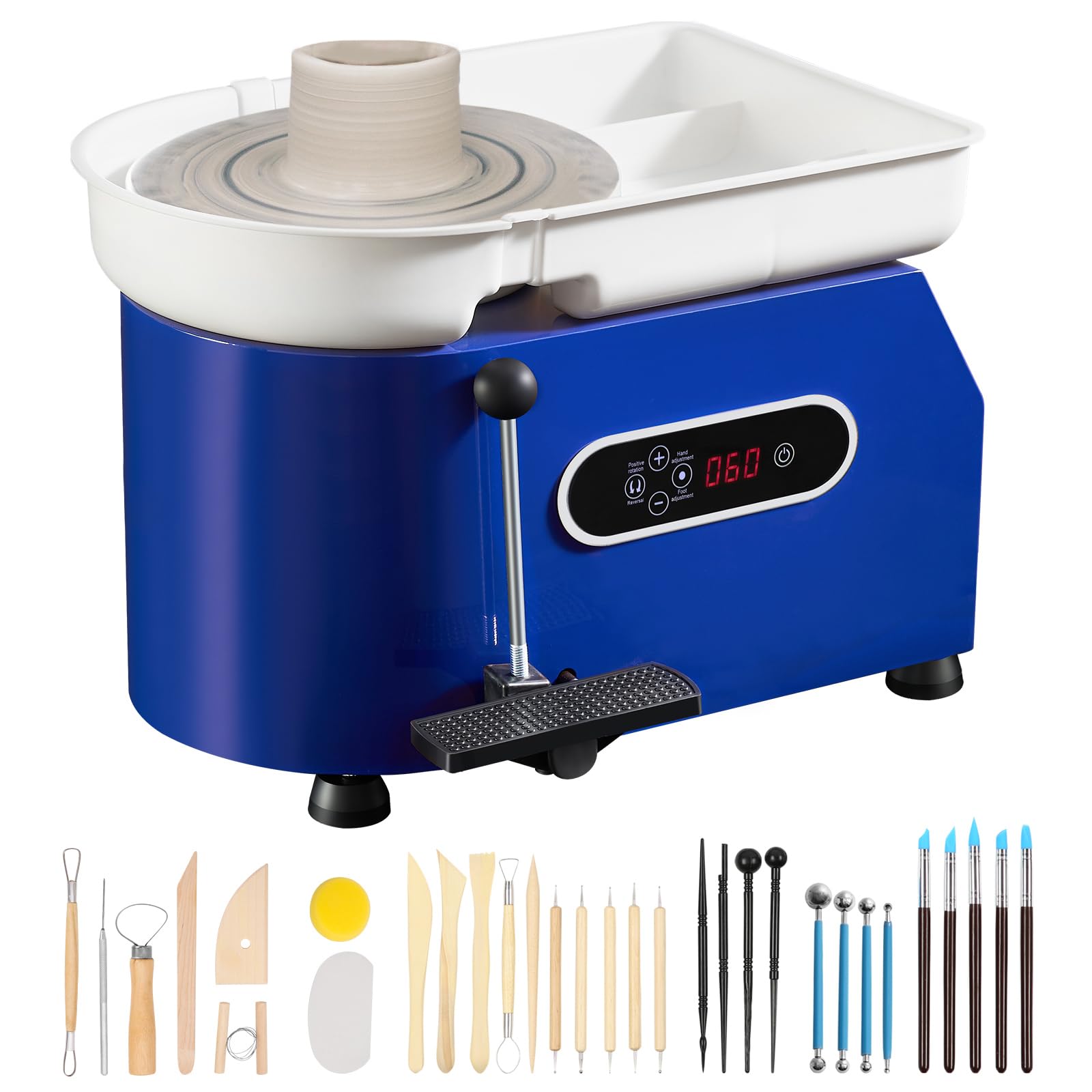
The heavy-duty powerhouse that handles 17.6 lbs of clay without breaking a sweat.
This wheel sinks its teeth into the hardest part of learning: centering. The 450W motor is noticeably more powerful than the 350W units found on the ZXMOTO and Alldeer models, giving you 450W versus 350W to push through stubborn clay without the wheel bogging down. That extra torque means you can load up to 17.6 pounds of clay on the 11-inch turntable, which opens up larger projects like plates and wide bowls that an 8-inch wheel simply cannot accommodate.
Buyers praise its smooth, wobble-free rotation and whisper-quiet brushless motor, but they also flag a few honest trade-offs. One reviewer noted it is “portable for demos; too fast for finishing; max 5-8 lbs clay; no batt pins.” The LCD touch screen and dual handle/foot-pedal control make speed adjustments easy, and the removable ABS basin simplifies cleanup. Just plan on setting it on a sturdy table or cinder blocks — at 27.9 pounds (27.9 pounds versus the National Geographic’s 11.5 pounds), it stays planted, but its short legs require you to raise the working height.
The included 32-piece tool kit (23 sculpting tools, 8 repair pieces, and a waterproof apron) adds genuine value for a beginner who does not yet own any equipment. The wheel head grooves can trap clay, and the lack of bat pins means you cannot quickly swap out pieces, but for the raw power and stability at this price, it is the most capable starter machine you can buy.
Why It Leads
- 450W motor handles heavier clay loads than any budget competitor
- LCD touch screen with precise 60-300RPM speed range
- Very quiet operation — no loud grinding or vibrations
- Comes with 32 pieces of tools and accessories
Known Limitations
- Short legs require propping up (cinder blocks or a low table)
- No bat pins — you must throw directly to the wheel head
- Grooves on wheel head are hard to clean between pieces
Grab this if: you want a stable, powerful machine that can grow with you from beginner projects to larger, more ambitious forms without stalling.
Hold back if: you have limited space and cannot accommodate a 27.9-pound unit, or you need a wheel with bat pins for production-style work.
2. Alldeer 11-inch Pottery Wheel
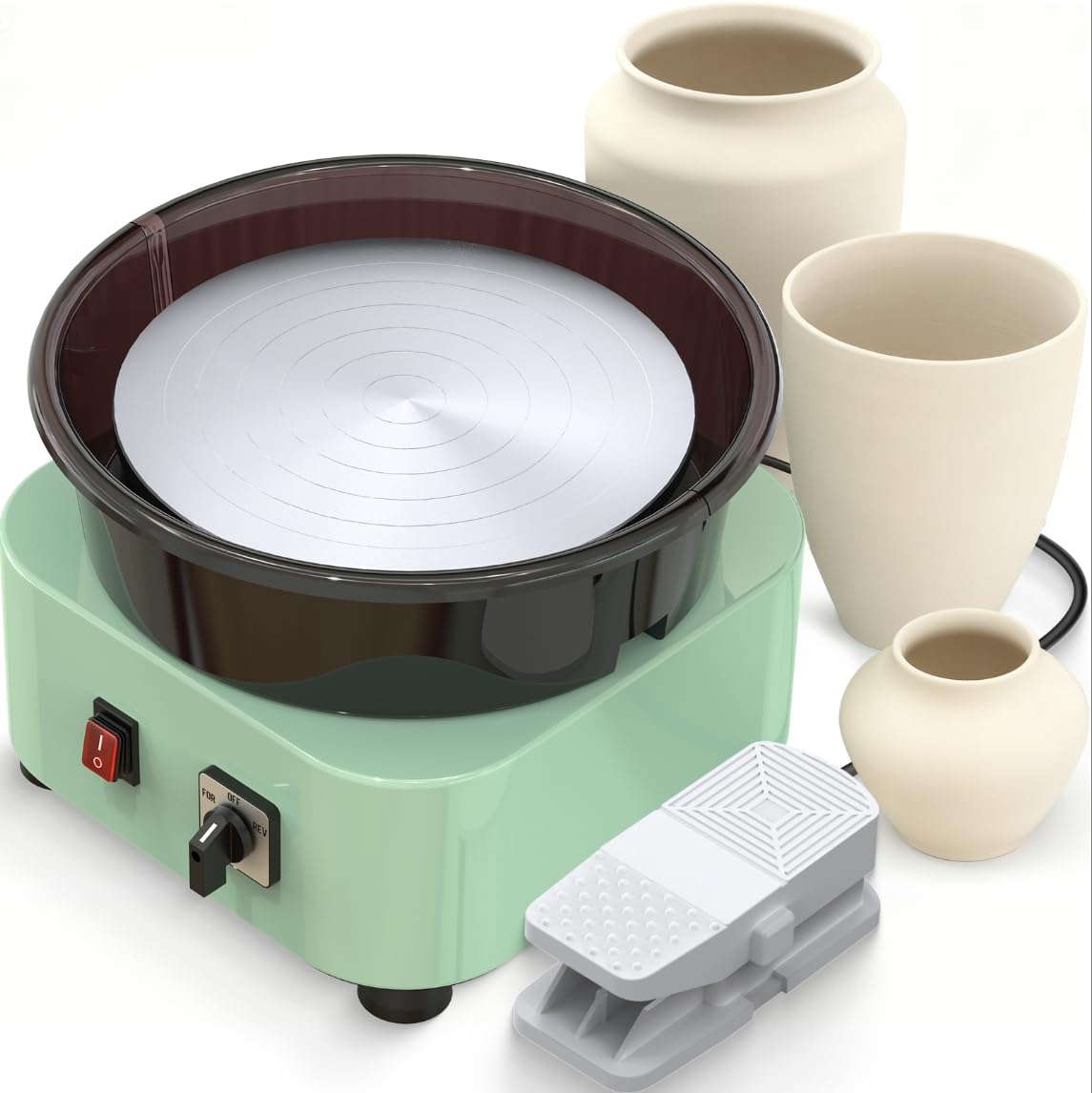
The modern starter wheel that sacrifices some torque for a vastly better cleanup experience.
Alldeer focused on the two things that frustrate beginners most: slow cleanup and a short machine lifespan. The 11-inch detachable splash tray removes in seconds, and the sealed design keeps clay dust out of the motor housing, which addresses exactly the kind of failure that some budget wheels suffer (one unhappy buyer reported their wheel stopped spinning after a month). While the 350W motor is less torquey than the VEVOR’s 450W — buyers report that “it does slow down a lot with any sort of pressure on the clay” — the foot pedal and handle controls give you a full 0-300RPM range for hands-free operation.
At 21 pounds, this wheel hits a balance: heavy enough to stay stable during centering but still light enough to move around your studio without a back strain. The package includes 19 professional tools, stainless steel trimmers, and ergonomic wood pieces, all ready for work right from the start. Reviewers consistently call it “a good quality starting wheel” and “a wonderful product for doing things with children,” pointing to the adjustable speed and reverse rotation as features that keep young creators engaged.
The main trade-off is the 350W motor’s tendency to lose momentum under heavy pressure, so if you plan to throw more than 5-6 pounds of clay regularly, the VEVOR’s 450W is the better call. But for a hobbyist who values quick cleanup, a modern sealed design, and a wheel that feels built to last through the learning curve, this is a compelling choice.
Smart Design Choices
- Detachable splash tray makes cleanup a 5-minute job
- 21 lbs strikes a good balance between stability and portability
- Includes 19 professional-grade tools, apron, and paint
- Reverse rotation and foot pedal control
Performance Caveats
- Motor slows noticeably when applying pressure to center clay
- At 350W, it has less torque than the 450W VEVOR
- Small footprint may feel cramped for larger hands
Reach for this if: you prioritize a fast, easy cleanup and a modern sealed motor design that resists clay dust, or you are buying for a teen or pre-teen who will use it frequently.
Look elsewhere if: you need consistent power for heavy clay loads above 5-6 pounds — the motor will struggle to maintain speed under pressure.
3. National Geographic Hobby Pottery Wheel

The lightweight, guided learning kit that includes everything but the experience.
National Geographic designed this wheel around the complete beginner — someone who has never touched clay and needs hand-holding, not raw power. The standout feature is the articulating arm tool, a clever attachment that helps you center, open, and shape clay with mechanical assistance, which removes the most frustrating hurdle for new potters. At only 60 decibels (quieter than comparable wheels), you can run it in a living room without annoying anyone, and the 8-inch wheel head with 2-way rotation accommodates both right- and left-handed users.
There is a clear trade-off between weight and stability here. At 11.5 pounds, this wheel is lighter than the 27.9-pound VEVOR, which makes it genuinely portable and easy to store. The included 3 pounds of air-dry clay, five wooden sculpting tools, sponge, and cut-off tool are functional for small projects but, as a reviewer put it, “are low quality, better suited for children’s projects or air-dry clays.”
A satisfied adult buyer summed it up: “It’s great for creating small to mid-sized plates and bowls.” The detailed instructions and links to video lessons are genuinely helpful for first-timers, but the lightweight build and smaller motor limit how far this wheel can take you. Think of it as a dedicated learning stage, not a long-term studio machine.
Perfect For Learning
- Articulating arm tool helps beginners center and shape clay easily
- Very quiet at 60dB — unobtrusive in a home setting
- Ultra-light at 11.5 lbs, easy to move and store
- Includes 2-way rotation for left- and right-handed users
Growth Limitations
- Lightweight build vibrates and shifts during centering
- Handles only 1.5-1.7 lbs of clay comfortably
- Included tools are basic and not suited for real pottery work
Choose this for: a complete newcomer, a teen, or a child who needs a guided introduction with video support and the arm tool to overcome the initial skill barrier.
Avoid this for: any adult who plans to throw more than small bowls or who wants a machine they will not outgrow in a few months.
4. ZXMOTO 9.8″ Pottery Wheel
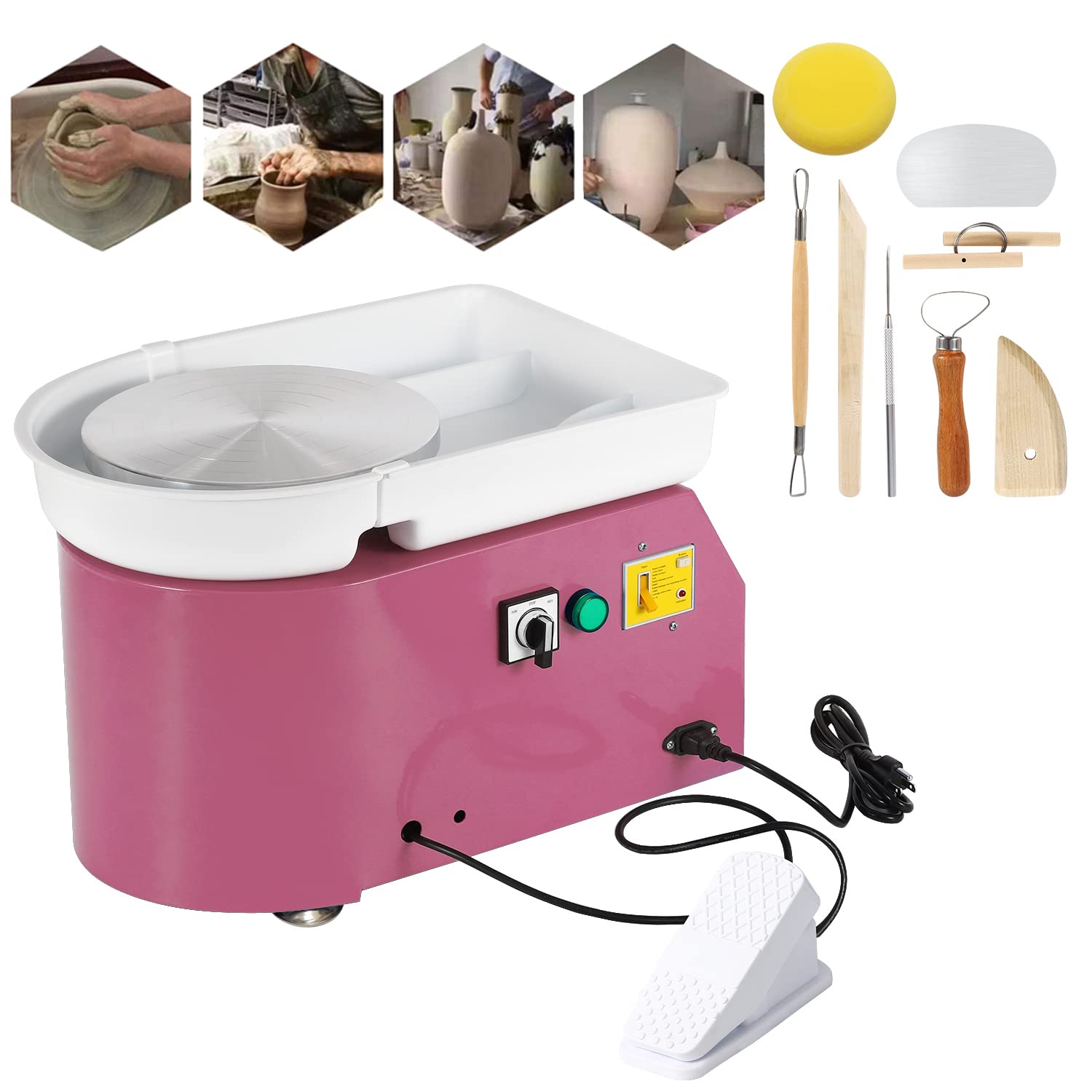
The rock-solid budget workhorse that has survived daily use since 2020.
If your main goal is to get a wheel that will not die on you while you learn, the ZXMOTO has the best long-term track record in this list. The machine comes with a 350W motor and an aluminum alloy turntable mounted on stainless steel feet, and at 27.9 pounds it shares the same heavy, stable foundation as the VEVOR. The package dimensions are practically the same (21.5 x 15.6 x 15.1 inches vs 21 x 17 x 14 inches for the SKYTOU), meaning both offer a similarly deep, stable footprint that absorbs vibration during centering.
One professional potter who learned on a Brent CXC wrote: “I bought this wheel in early 2020 and use it weekly! No real issues. The wheel head is too small for a bat system, but I’ve always thrown to the wheel head anyways.” That statement captures both the strength and the hard limit of this machine — it costs a fraction of pro gear and holds up, but the 9.8-inch wheel head rules out bat systems entirely, so you must cut every piece off the wheel head to remove it. The reverse function and electrical shutdown safeguard are rare features at this price, and buyers consistently call it “silent” and “really easy to use and assemble.”
The trade-off is a lower motor wattage (350W vs the VEVOR’s 450W) and a smaller throwing surface. The difference in power between 350W and 450W means the ZXMOTO will not muscle through large clay loads as easily — it is best for projects up to about 7 pounds. But for the price, you get a sealed, corrosion-resistant build that has proven its longevity over years of weekly use.
Long-Term Value
- Heavy 27.9 lb build provides excellent stability while throwing
- Reverse rotation and electrical shutdown safeguard included
- Very quiet operation suitable for home use
- Proven track record with years of weekly use from real buyers
Hard Limits
- 9.8-inch wheel head is too small for a bat system
- 350W motor is less torquey than 450W alternatives
- Some units arrive with minor switch defects
Go for this if: you want maximum value with a proven lifespan — a wheel that real buyers have run weekly for years without major failure.
skip it if: you need bat pins for efficient production work, or you want an 11-inch wheel head for larger forms.
5. Pottery Wheel Pottery Forming Machine (SKYTOU)

The low-cost entry point that one happy owner has kept running since 2022.
For the absolute lowest barrier to entry, the SKYTOU pottery wheel delivers a 350W motor, a 9.8-inch ABS basin wheel, and a 27.6-pound frame that stays put on any table. It is essentially the same heavy-platform formula as the ZXMOTO but at a cheaper price point, and like that machine, it includes a foot pedal and handle for speed control from 0-300RPM. The single-phase three-wire connection with earth leakage protection is a thoughtful safety addition for a home environment.
One buyer wrote a remarkable endorsement: “I bought this machine in 2022, and I gotta say, it’s still going in 2026.” That kind of longevity is rare at this price level, and other reviewers confirm it handles 7 pounds of clay quietly with smooth, continuous speed. However, the catch is the same one that shows up across multiple budget wheels: multiple buyers mention the lowest speed is still a bit fast, making delicate finishing work harder than it should be. The foot pedal is described as “rickety” and uncomfortable for adults, and some units develop a thumping noise after daily use (though one owner solved it by cleaning and sealing the wheel head).
Another serious concern: one buyer mentioned the wheel stopped working entirely after a month, with a clicking noise and no way to get a replacement or refund. The reviews are split between “great value” and “stopped working,” which is the risk of buying at the absolute bottom of the price range. If your budget simply cannot stretch further, this wheel can work well — but the VEVOR or ZXMOTO are safer bets for long-term reliability.
The Upside
- Heavy 27.6 lb base offers good stability for the price
- Quiet, smooth continuous speed motor
- Detachable splash pan is easy to clean
- One owner confirmed it has been running since 2022
The Risks
- Lowest speed too fast for delicate finishing work
- Some units fail completely within the first month
- Foot pedal feels rickety and uncomfortable for adults
- No bat pins; must cut pieces off the wheel head
Consider this for: an absolute rock-bottom budget where every dollar counts, especially for a child or teen who will use it occasionally for small projects.
Pass on it for: any scenario where consistent reliability matters — the failure rate in reviews is too high to recommend for a serious learning commitment.
Understanding the Specs
Motor Wattage: 350W vs 450W
The motor’s wattage directly determines how much clay you can center without the wheel bogging down or stalling. A 350W motor, found on most budget wheels, is enough for up to about 7-8 pounds of clay in the hands of a careful user. A 450W motor gives you more torque to push through larger or stiffer clay bodies without losing speed, making it better for learning the centering motion without fighting the machine. The difference between 350W and 450W is a power increase of 100W, which translates into a noticeably more forgiving experience when you are still developing your technique.
Weight: Why Heavy Matters
A pottery wheel’s weight is not about how hard it is to move — it is about how well it stays put when you are muscling a lump of clay into a centered cone. Light wheels (11-12 pounds) will shift, vibrate, and sometimes walk across a table, making centering much harder than it needs to be. Heavy wheels (27-28 pounds) absorb those forces and stay planted, which means you can apply real pressure without fighting the machine’s movement. If you have the floor or table space, the extra weight is the single biggest upgrade you can make to your learning experience.
FAQ
How much clay can a 350W pottery wheel handle?
Is a heavier pottery wheel always better for beginners?
What is the difference between an 8-inch and an 11-inch wheel head?
Can I use bats (remable plaster or wood discs) on a budget pottery wheel?
How noisy are these budget pottery wheels in a home setting?
Will a budget pottery wheel need repairs or replacement quickly?
What is a foot pedal and why does it matter?
Can a left-handed person use these pottery wheels?
What tools typically come with a budget pottery wheel kit?
Can I throw porcelain or stoneware on a budget pottery wheel?
Final Thoughts: The Verdict
If you want one dependable pick, the budget pottery wheel winner is the VEVOR 11in Pottery Wheel because its 450W motor, stable 27.9-pound frame, and 11-inch wheel head give you the room to grow from tiny cups to plates and bowls without needing an immediate upgrade. If you want a lightweight, beginner-focused kit with guided tools and video lessons, the National Geographic Hobby Pottery Wheel is the perfect introduction. And for the tightest budget where every dollar counts, the ZXMOTO 9.8″ Pottery Wheel offers the best proven longevity among the cheapest options.
How We Picked
We do not accept paid placement. Every pick is matched to a real buyer and a real use-case; we do not hands-on test units.
Sources & Methodology
Specifications: manufacturer listings and product documentation. Review insights: verified customer reviews, as of July 2026. Pricing: not shown on this page (it changes often); check the current price via the retailer link.
As an Amazon Associate, Gadgets Feed earns from qualifying purchases. This does not affect which products we feature.
Related Guides
Product prices and availability are accurate as of the date/time indicated and are subject to change. Any price and availability information displayed on Amazon at the time of purchase will apply to the purchase of this product. As an Amazon Associate I earn from qualifying purchases.
CERTAIN CONTENT THAT APPEARS ON THIS SITE COMES FROM AMAZON. THIS CONTENT IS PROVIDED "AS IS" AND IS SUBJECT TO CHANGE OR REMOVAL AT ANY TIME.
Amazon and the Amazon logo are trademarks of Amazon.com, Inc. or its affiliates.