
Our readers keep the lights on and my morning glass full of iced black tea. As an Amazon Associate, I earn from qualifying purchases.
Specs are compiled from manufacturer listings and verified buyer reviews and can change over time — please confirm the key details on the product page before buying.
You spent good money on a bucket of tennis balls, but chasing them across the court after every serve drill is a workout you did not sign up for. A tennis ball hopper solves this by gathering your balls in seconds and holding them at waist height so you can feed, serve, and practice without bending over. The trick is picking one that matches your court style — from a lightweight cart you wheel around to a foldable basket that fits in your trunk.
I’m Min — the founder and writer behind Gadgets Feed. This guide is built by comparing the manufacturers’ published specifications and the patterns across verified customer reviews, so you get each pick’s real strengths and trade-offs instead of marketing spin.
Whether you are a weekend player stocking a personal practice bucket or a coach wrangling 200 balls for a clinic, choosing the right tennis ball hopper boils down to capacity, portability, and how easy it is to actually pick balls up off the ground.
Quick Picks
- YooKoo Tennis Ball Hopper for 150 Balls — Best Overall
- Tourna Mini Ballport Tennis Ball Pick Up Hopper — Compact & Light
- Goplus Foldable Tennis Ball Hoppers — Multi-Sport Cart
- HEAD Tennis & Pickleball Ball Trolley — Premium Coach Cart
- HEAD Tennis Ball Basket – Holds 72 Balls — Simple & Sturdy
- YooKoo Sturdy Tennis Ball Hopper Holds 200 Balls — Max Capacity
How To Choose The Best Tennis Ball Hopper
The right tennis ball hopper is the one you actually bring to the court — not the one with the biggest number on the box. You want a hopper that loads balls easily, rolls or carries without fighting you, and keeps your balls at waist level so you can grab one without crouching. Here are the three specs that separate a time-saver from a frustration.
Capacity vs. Portability
A hopper that holds 150 balls saves you refills during a long drill, but an 11.6-pound model (like the largest YooKoo) is noticeably heavier than a 3.5-pound Tourna Mini. Think about how far you walk with it — if you are rolling it on wheels, weight matters less; if you are carrying it across a parking lot, every pound counts.
Pickup Mechanism
Some hoppers use roll bars at the bottom that lift balls into the basket as you push down. Others rely on a wide wire opening or a bag funnel. Roll bars are the most efficient, but they can jam if the hopper is already full and balls wedge together. A metal basket with a wide mouth picks up fast but does not stand on its own for serving.
Frame Material and Durability
Aluminum frames resist rust and stay light — a bonus if you store the hopper in a damp garage or car trunk. Polypropylene (PP) is lighter still and will never rust, but some plastic panels can warp under the screws over time. Steel wire baskets are bulletproof but add weight and can rust if the coating chips.
Quick Comparison
| Model | Best For | Capacity | Weight | Frame Material | Amazon |
|---|---|---|---|---|---|
| YooKoo 150-Ball | Everyday solo practice (Best Overall) | 150 balls | 8.5 lbs | Aluminum | Amazon |
| Tourna Mini Ballport | Portable solo serving drills | 36 balls | 3.5 lbs | Polypropylene (PP) | Amazon |
| Goplus Foldable | Pickleball & multi-sport use | 150 balls | 7 lbs | Aluminum | Amazon |
| HEAD Ball Trolley | Premium coaching on wheels | 120 balls | — | Aluminum, Nylon | Amazon |
| HEAD Wire Basket | Simple, no-frills court storage | 72 balls | 2.18 kg | Steel | Amazon |
| YooKoo 200-Ball | High-volume drills & teaching | 200 balls | 11.6 lbs | Stainless Steels | Amazon |
In‑Depth Reviews
1. YooKoo Tennis Ball Hopper for 150 Balls
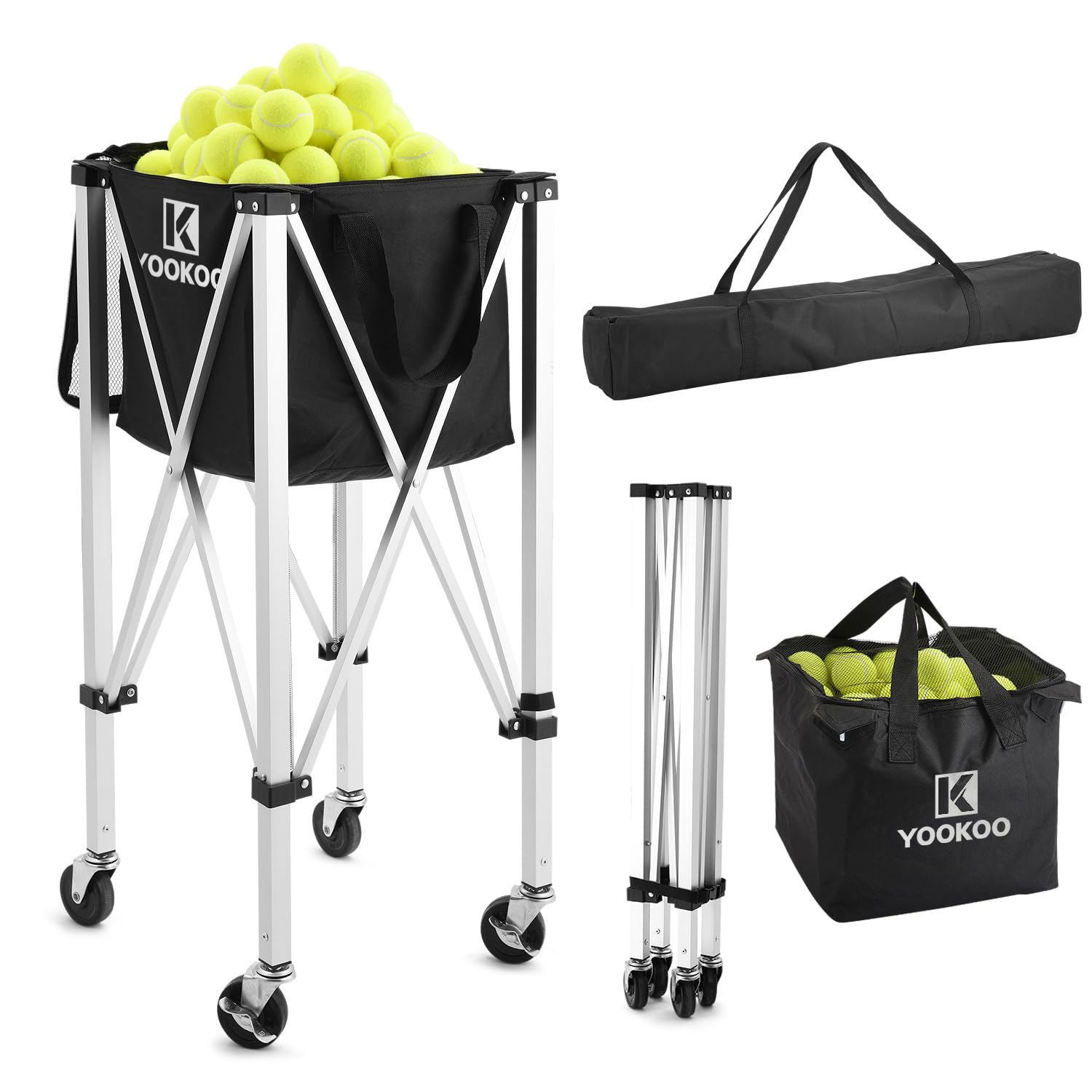
the just-right hopper that holds a serious 150 balls but does not feel like dead weight.
You get a foldable aluminum frame that stands at 35.8 inches tall — waist height for most players — so you can grab a ball for a serve without bending. The 8.5-pound weight is a middle ground: heavier than the Tourna Mini (8.5 pounds vs. 3.5 pounds), but still light enough to lift into a trunk. Two lockable wheels on the base let you roll it across the court and lock it in place when you are feeding.
Buyers report that the bag is durable and the wheels roll smoothly, and one reviewer noted filling it with 75 pickleballs without coming close to full. Unlike the Goplus, there is no detachable bag, but the zip closure and integrated frame mean you do not lose any parts. It arrives fully assembled — no tools, no setup.
A word on the catch: at 8.5 pounds, a five-foot 110-lb female reviewer found it “kinda heavy.” If you are smaller-framed or need to carry it long distances, the Tourna is lighter. But for the player who wants one hopper for both personal practice and sharing with a hitting partner, this is the most balanced pick.
Why it wins
- Folds flat without tools — no setup time
- Lockable wheels keep the cart steady during serves
- Holds 150 balls versus the HEAD wire basket’s 72 balls
One trade-off
- Slightly heavier than dedicated carry baskets; not ideal for carrying far
Reach for this if: you want a fold-and-go hopper with enough capacity for a full practice session and wheels that lock so it stays put.
Look elsewhere if: you need something under 5 pounds to carry frequently — try the Tourna Mini.
2. Tourna Mini Ballport Tennis Ball Pick Up Hopper

The 3.5-pound featherweight that slips into your bag and stands on its own legs.
At 3.5 pounds, this is the lightest hopper in the roundup — the YooKoo 150-Ball weighs 8.5 lbs. It uses roll bars at the bottom that lift balls in as you push down, and a pair of panels that fold down into legs so the basket sits at waist height for feeding. Owners mention the bottom roll bars worked fine with both pressureless tennis balls and regular pressurized ones, though a few noted that balls can jam if the hopper is already full and the balls wedge together.
Compared to the HEAD wire basket, the Tourna is all-plastic polypropylene (PP), so it will never rust and costs less. But a minority of reviewers report that the plastic panels can warp where the screws go in, which can cause the sliding top bars to stick over time. For casual players practicing alone, the 36-ball capacity is plenty — for a group drill, you will be refilling.
The real-world test: A 10-year-old assembled it in a few minutes. That is the single best sign of a no-fuss product.
Grab it if: you need the most portable option — one you can toss in a backpack and use for solo serve practice without wearing out your back.
Pass if: you need to hold more than 36 balls for group drills or worry about plastic screws under heavy use.
3. Goplus Foldable Tennis Ball Hoppers

A wheeled cart that does double duty — hold 150 tennis balls or 100 pickleballs, then unzip the bag and carry it separately.
The Goplus distinguishes itself with a detachable 600D Oxford cloth bag that lifts off the aluminum frame so you can haul balls by hand without the cart. It holds 150 tennis balls (or about 100 pickleballs, per buyers). Four universal wheels make it easy to roll, and two of the wheels have brakes to lock it in place when you are feeding. At 7 pounds, it is 1.5 pounds lighter than the YooKoo 150-Ball and 3 pounds lighter than the Tourna despite holding the same capacity.
Customers note the aluminum frame folds easily and the included carry bag keeps everything compact for storage. One buyer mentioned that the bag material feels thin near the frame bolts, so you want to be careful pulling the bag out over sharp edges. The wheel locks are stiff — you have to bend down to engage them, which is less convenient than the YooKoo’s lock design.
Smart move: If you switch between tennis and pickleball, the multipurpose design means you buy one hopper for both sports.
Best for: pickleball players and multi-sport coaches who want a lightweight cart that doubles as a carry bag.
Not for: those who want a permanent rigid basket — a detachable bag introduces more setup steps.
4. HEAD Tennis & Pickleball Ball Trolley
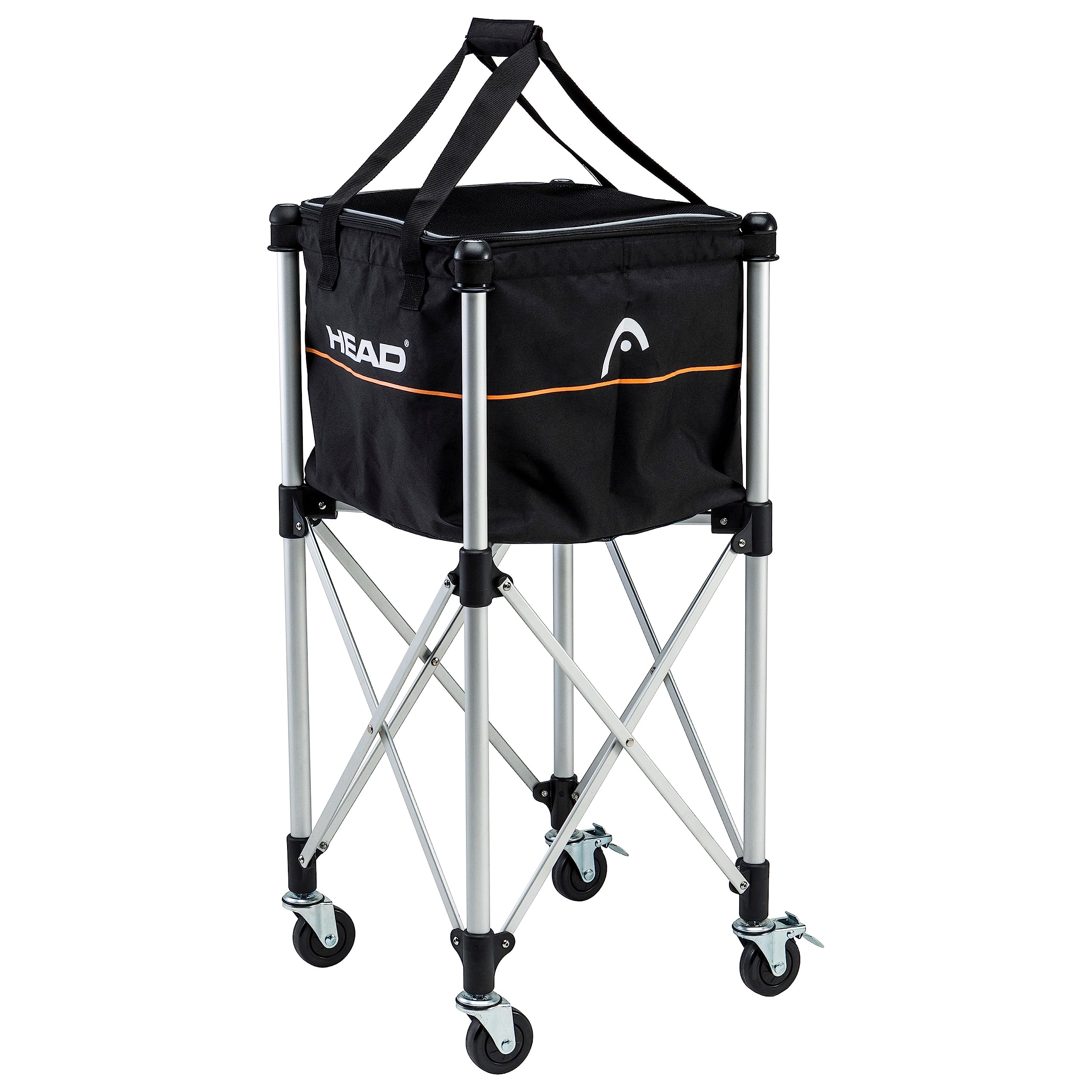
A pro-grade cart that assembles in seconds and rolls so smoothly you forget it is behind you.
The HEAD Trolley uses an aluminum and nylon frame with a detachable polyester bag that holds up to 120 tennis balls. The bag unzips completely and lifts off the frame so you can carry it as a standalone tote. Compared to the YooKoo 150-Ball, the HEAD has fewer capacity for 30 fewer balls, but it is designed specifically for coaches who are constantly moving between courts — the quick-release frame pops apart for storage in a minute.
Buyers in Spanish and English reviews consistently praise the smooth rolling on court surfaces. One noted the elastic strap that secures the poles felt a bit light, but that it remained functional. The 3-compartment bag has side pockets for keys and a phone, which the simpler wire baskets lack entirely.
Coach’s verdict: The Trolley is the lightest full-size cart you will find, and the detachable bag means you never leave balls on the court while you carry equipment.
Buy this if: you are a teaching pro or club coach who needs a fast-deploy cart that rolls easily and stores compactly.
skip it if: you only need a personal practice hopper — a cheaper foldable cart like the Goplus will do the same job for less.
5. HEAD Tennis Ball Basket – Holds 72 Balls

The no-frills wire basket that does exactly one job: hold 72 balls and never break.
If you want a basket that just works — no wheels, no fabric, no assembly — the HEAD wire basket is the durable steel option. It holds up to 72 balls (reviewers point out you can squeeze in 75 to 80), and the handles fold down to become a pickup tool. The steel frame means it is heavy at 2.18 kilograms (about 4.8 pounds), but it will not crack like plastic or tear like cloth. Compared to the Tourna Mini, the HEAD holds 72 balls versus the Tourna Mini’s 36 balls, though it is heavier by about 1.3 pounds.
One important buyer reality: it does not pick up balls on its own like a roll-bar hopper. You must bend and scoop the balls into the wide mouth. A reviewer who expected automatic pickup was disappointed, giving it one star. If you are fine with manual gathering, the wire basket is the most cost-effective and long-lasting option on the list.
What is great
- Zero assembly — take it from the start and use it
- Hardly wears out; metal construction lasts years
- Stand-up design for easy ball access during serving
The honest limit
- No pickup mechanism — you scoop by hand
- Can rust if left wet in a car trunk
Choose this if: you want a basket that will survive drops and rain without any fabric or plastic to fail.
pass on it if: you want a hopper that picks up balls for you — look at the Tourna Mini or a wheeled cart instead.
6. YooKoo Sturdy Tennis Ball Hopper Holds 200 Balls

The heavy lifter — 200 balls in a stainless steel frame that does not wobble under the load.
This YooKoo model is built for volume. The stainless steel frame (listed as “Stainless Steels”) and thick Oxford cloth bag handle the weight of 200 tennis balls without the bag sagging or folding, thanks to a support bracket at the bottom. The 35-inch height keeps balls at waist level, and the high-performance bearing wheels roll smoothly on hard courts. Two wheels have brakes to lock it in place.
Shoppers say that the basket is sturdy and easy to set up, and that the zipper closure lets you transport balls without spills. One owner reported that the bag zips shut and can be removed from the stand for transport — a feature not advertised by YooKoo but confirmed by owners. Compared to the HEAD Trolley, the YooKoo 200 holds 80 more balls for a lower investment, though the stainless steel frame is heavier than the HEAD’s aluminum.
Heads up: the same reviewer who praised the capacity also mentioned the wheels are smooth, but the hopper is heavy enough that you will not want to carry it far — roll it, do not lift it.
Reach for this if: you teach large groups or run clinics and need one trip to carry all your balls.
Pass if: you practice alone or have limited trunk space — the 200-ball cart takes up more room and is harder to lift into a car.
Understanding the Specs
Ball Capacity
This is the number of standard tennis balls the hopper can store without overstuffing. A 36-ball hopper is fine for a solo serve session. A 150-ball hopper lets a coach run a group drill without refilling. Pickleball players should check if the capacity is listed for tennis balls or pickleballs — pickleballs are smaller, so the same hopper holds more of them. For example, the Goplus holds 150 tennis balls but buyers report it fits about 100 pickleballs.
Weight and Portability
Weight matters because you carry or roll this thing to the court. A 3.5-pound hopper like the Tourna Mini slides into a sports bag. A 7-11.6 pound cart is manageable on wheels but awkward to carry up stairs or over grass. If your car trunk is small, a foldable cart (like the YooKoo 150-Ball or Goplus) packs down to a fraction of its open size.
Frame Material
Aluminum is lightweight and rust-proof, ideal for foldable carts. Polypropylene (PP) plastic is lighter still and rust-free, but can warp over time. Steel or stainless steel is heavy and durable but can rust if the coating scratches. For long-term outdoor storage, aluminum or PP is safer than plain steel.
Pickup Mechanism
Roll bars at the bottom of a hopper lift balls in as you push the basket over them — no bending required. A wire basket or cloth bag requires you to scoop balls by hand. If you practice alone often, a pickup mechanism (roll bars or a wide-mouth funnel) saves your back. The Tourna Mini uses roll bars; the HEAD wire basket and all cloth-bag carts require manual gathering.
FAQ
How many tennis balls will a hopper hold?
Will a tennis ball hopper work with pickleballs?
Do tennis ball hoppers pick up balls automatically?
Which tennis ball hopper is easiest to transport?
Are aluminum hoppers better than plastic ones?
Can I leave a tennis ball hopper outside?
What is the difference between a ball hopper and a ball cart?
How do lockable wheels help?
Will a hopper fit in my car trunk?
Final Thoughts: The Verdict
For most players, the tennis ball hopper winner is the YooKoo 150-Ball Cart because it balances a spacious 150-ball capacity with a foldable aluminum frame that weighs 8.5 pounds — heavy enough to feel solid, light enough to lift into a trunk. If you want the lightest possible carry basket for solo serve practice, grab the Tourna Mini at 3.5 pounds. And for a coach running high-volume drills who needs 200 balls in one trip, the standout is the YooKoo 200-Ball Cart.
How We Picked
We do not accept paid placement. Every pick is matched to a real buyer and a real use-case; we do not hands-on test units.
Sources & Methodology
Specifications: manufacturer listings and product documentation. Review insights: verified customer reviews, as of July 2026. Pricing: not shown on this page (it changes often); check the current price via the retailer link.
As an Amazon Associate, Gadgets Feed earns from qualifying purchases. This does not affect which products we feature.