
Our readers keep the lights on and my morning glass full of iced black tea. As an Amazon Associate, I earn from qualifying purchases.
Specs are compiled from manufacturer listings and verified buyer reviews and can change over time — please confirm the key details on the product page before buying.
A microchip cat door (a door that reads your cat’s unique ID chip or RFID tag) is the difference between a peaceful home and a nightly raccoon party. These doors read your cat’s unique microchip or RFID tag (a radio tag you attach to the collar) to let them in while blocking every other animal — so no more strays, no more possums stealing food, and no more midnight wake-up calls from neighborhood tomcats.
I’m Min — the founder and writer behind Gadgets Feed. This guide is built by comparing the manufacturers’ published specifications and the patterns across verified customer reviews, so you get each pick’s real strengths and trade-offs instead of marketing spin.
The right automatic cat door relies on microchip accuracy, door design, and battery reliability — and this guide walks you through exactly which models deliver on all three and which have hidden flaws you need to know about before cutting into your door.
Quick Picks
- SureFlap Microchip Pet Door Connect Without Hub — Top Performer
- SureFlap-Sure Petcare Microchip Pet Door — Best for Big Cats
- SureFlap – Sure Petcare Microchip Cat Flap — Compact Reliable
- Cat Mate Elite Microchip Cat Flap — Curfew King
- Cat Mate Microchip Activated Cat Flap (360) — Best Value
- Closer Pets Microchip Activated Cat Flap (360) — Budget Champion
How To Choose The Best Automatic Cat Door
Choosing a microchip cat door depends on three factors: microchip compatibility, flap stiffness, and lock durability in real-world conditions. Here is what actually matters.
Microchip Compatibility and Reading Range
Not all cat doors read every microchip. Some models only work with 15-digit ISO chips (the international standard format), while others also handle 9-digit (Avid Secure) and 10-digit (FDXA) formats. If your cat has an older 10-digit chip or one that includes letters, compatibility drops fast. Check with your vet before buying. Reading range also matters — a door that needs the cat’s chip right on the sensor will cause frustrating delays, as buyers of some models report when the signal pickup is weak.
Door Stiffness and Lock Noise
Flap stiffness and lock noise often determine whether a cat will use the door at all. A stiff flap combined with a loud ratcheting lock can terrify a cat and cause them to refuse the door entirely. Some models let you remove a magnet to reduce resistance, but others have no adjustment. If your cat is skittish or older, prioritize a door with a quiet lock mechanism or a training mode that lets the flap stay open up while the cat learns to push through.
Battery Life and Weather Sealing
Most microchip doors run on 4 AA or C batteries, with expected life ranging from months to over a year. But buyers of one model reported batteries draining in a week — a failure mode that makes the door useless. Look for models with a low-battery indicator and read real reviews for battery complaints. A fully brush-sealed flap with magnetic closure keeps out drafts and rain, which matters if the door faces an exposed exterior.
Quick Comparison
| Model | Best For | Chip Compatibility | Max Thickness | Battery Type | Amazon |
|---|---|---|---|---|---|
| SureFlap Microchip Pet Door Connect | Remote monitoring | 9/10/15-digit | — | 4 AA | Amazon |
| SureFlap Microchip Pet Door | Larger cats / small dogs | 9/10/15-digit | 125 mm | 4 C | Amazon |
| SureFlap Microchip Cat Door | Standard cat entry | 9/10/15-digit | 10 Inches | 4 AA | Amazon |
| Cat Mate Elite 355 | Curfew control | 15-digit ISO | 4 Inches | 4 AA | Amazon |
| Cat Mate 360 | Value microchip entry | 15-digit ISO / AVID | 3.35 Inches | 4 AA | Amazon |
| Closer Pets 360 | Budget-friendly chip door | ISO / AVID | 3.35 Inches | 4 AA | Amazon |
In‑Depth Reviews
1. SureFlap Microchip Pet Door Connect Without Hub

The smart door that lets you see exactly when your cat comes and goes — but you need a separate hub to make it work.
This model gives you real-time insight into your cat’s comings and goings through its app, but you will need to buy the SureFlap Hub separately to use that feature. The flap opening measures 6 11/16 inches wide by 7 inches high, which comfortably fits medium-sized cats and small dogs. It reads 9, 10, and 15-digit microchips and stores up to 32 pet identities, making it a strong choice for multi-pet households.
Buyers report that the door effectively keeps raccoons out while the cats learn to use it within a day or so. However, some owners note the door is too stiff for their cats, who refuse to push through — and there is no training mode to help them adjust gradually. The reliance on 4 AA batteries and the separate hub purchase also add to the overall setup cost.
Unlike the standard SureFlap door below, this Connect version adds the app layer for monitoring long-term activity. If remote control and confidence matter more than keeping the initial spend low, this door delivers that visibility — just be prepared for the extra hub expense and potential stiffness issues with smaller or less determined cats.
Smart Monitoring
- App control for remote lock/open up and curfew changes
- Works with 9, 10, and 15-digit microchip formats
- Flap opening fits medium cats and small dogs
The Limitations
- Hub sold separately, adding to the total cost
- No training mode for cats that find the flap stiff
- Some owners mention cats refuse to use it due to resistance
Reach for this if: you want to track your cat’s comings and goings from your phone and don’t mind picking up the separate hub.
Look elsewhere if: your cat is hesitant around new obstacles — the stiff flap and lack of training mode can be a dealbreaker.
2. SureFlap-Sure Petcare Microchip Pet Door

The microchip door that reads from a foot away and runs for years on one set of batteries.
This door stands out for its reading range — customers note it scans the microchip from about a foot away, so the cat doesn’t have to press right against the sensor. The flap opening is 6 11/16 inches high by 7 inches wide, noticeably larger than the standard cat-only SureFlap. That extra space matters for big tomcats or small dogs, and it runs on 4 C batteries instead of AAs, with owners saying batteries last over two years in real use.
Reviews highlight a common pro tip: remove one magnet at the bottom of the flap to reduce resistance, making it easier for smaller or older pets to push through. Some reviewers point out a clicking sound that scares their cat initially, though many cats adapt after a few days. The door scans on entry only, so any pet can exit freely — useful if you want to let indoor cats out into a secure yard but keep strays from coming in.
This is a step up in size and battery endurance compared to the standard SureFlap cat door below. The larger opening and C-cell batteries make it a better long-term pick for owners with bigger pets or those who want fewer battery changes. Just budget extra for the 4 C batteries and plan for a short training period with magnet adjustment.
Size and Stamina
- Larger flap fits bigger cats and small dogs
- Batteries last 2+ years in real-world use, per buyers
- One magnet can be removed to reduce flap stiffness
Setup Notes
- Clicking lock noise can initially scare some pets
- Installation tricky on thin metal doors
- Entry-only scanning; exit is unrestricted
Best for owners with: large cats, small dogs, or multiple pets who need the larger opening and battery longevity.
skip it if: your cat is extremely noise-sensitive and you can’t afford a training period with the clicking lock.
3. SureFlap – Sure Petcare Microchip Cat Flap

The original microchip cat door that set the standard, with compatibility across all major chip formats.
This door works with 9-digit (Avid Secure), 10-digit (FDXA), and 15-digit (FDXB) microchips — covering essentially every chip your vet might have implanted. The maximum compatible thickness is 10 inches, so it fits thick walls and doors where other models max out at 3 to 4 inches. The flap opening is 4 3/4 inches high by 5 5/8 inches wide, which is snug for larger cats but fine for average-sized felines. It runs on 4 AA batteries with an estimated life up to 12 months.
Shoppers say the chip programming is easy with the one-button setup, and the door keeps unwanted animals out effectively. One owner noted that the reflective flap scared their cat, which they fixed by applying tape to reduce the reflection. A common complaint is that the open up sound is loud enough to scare some cats — one reviewer noted their cat refused to use the door for a year until they taped the lock open. The door also scans on entry only, so another animal can potentially follow your cat inside before the flap locks.
Compared to the larger SureFlap Pet Door above, this one uses smaller AA batteries and has a more compact flap opening, making it best for standard-sized cats in average doors. The 10-inch thickness compatibility is a real advantage over the Cat Mate models if your door or wall is unusually thick. But the noise issue is real — if your cat is skittish, factor in a possible modification like removing a magnet or taping the lock temporarily.
Broad Chip Support
- Works with 9, 10, and 15-digit microchips
- Fits materials up to 10 inches thick
- One-button programming that buyers call easy
Known Issues
- open up sound scares many cats
- Small flap opening can be tight for larger cats
- Entry-only scan means a fast follower can sneak in
Choose this for: a straightforward chip door that fits very thick walls and works with almost any microchip type.
Think twice if: your cat is noise-sensitive or you have a larger breed that needs a roomier flap opening.
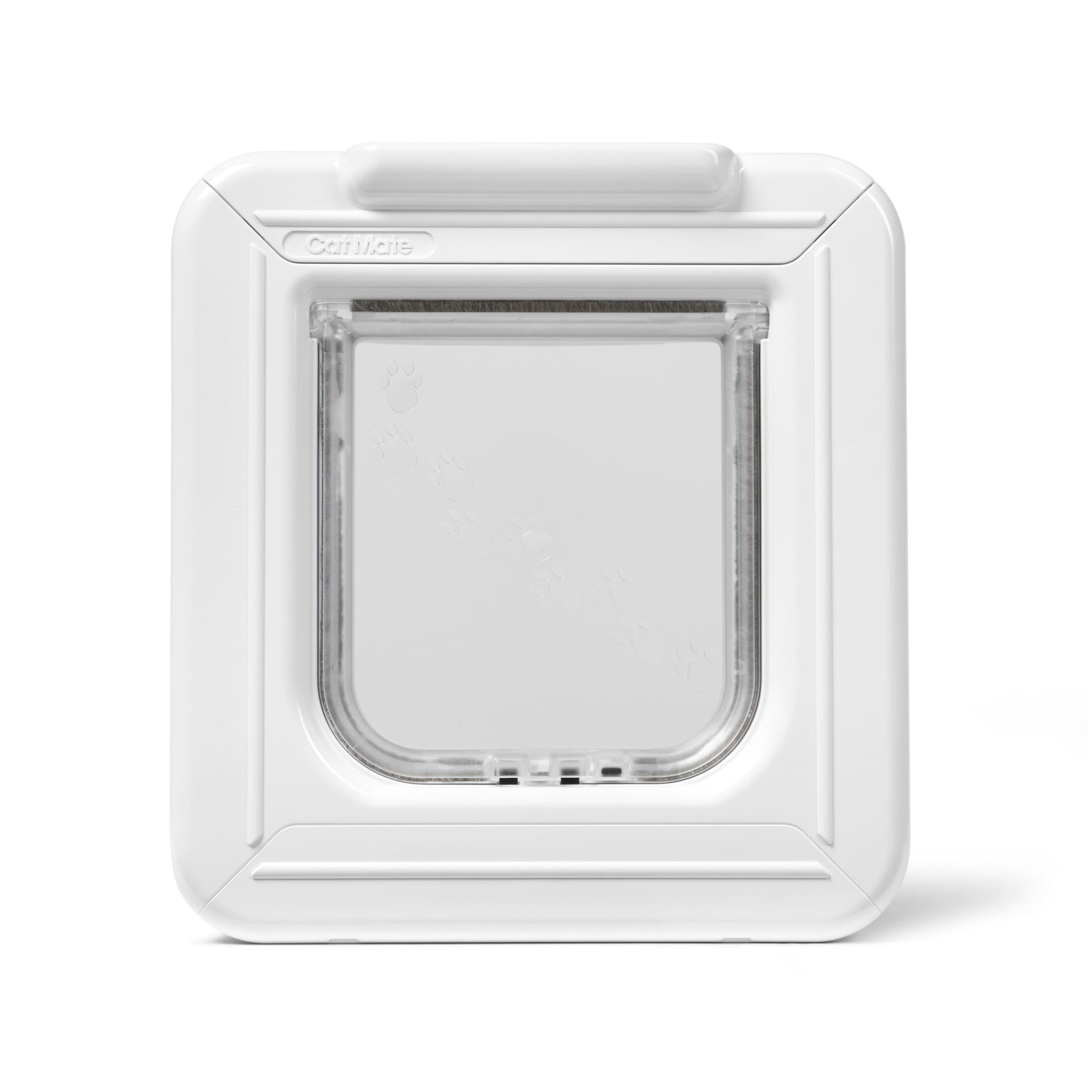
4. Cat Mate Elite Microchip Cat Flap with Digital Timer & LCD Display (355)
The timed microchip door that gives you curfew control and shows your cat’s last exit on an LCD screen.
This Cat Mate Elite has a unique advantage over other doors: a digital timer and LCD display (a small screen) that show lock settings, whether the cat is inside or out, and the time since each of up to 3 selected cats last used the door. The maximum compatible thickness is 4 inches — a 19% larger gap than the 3.35 inches on the standard Cat Mate 360, meaning it fits thicker doors without extra adapters. It is compatible with 15-digit ISO microchips and works with Cat Mate ID Discs for up to 9 cats.
Buyers warn about two significant flaws. One reviewer reports that “batteries drain in a week (should last 6-12 months)” — a severe power issue that makes the door unreliable. Another says the lock mechanism makes a “very loud ratcheting sound (louder than airsoft, not quite a Glock)” that terrifies skittish cats, with the casing amplifying the noise. The training mode is silent but does not lock, so it offers limited protection during the adjustment period.
Where this door shines is the curfew feature — you can set specific hours when the door locks or open up, which some buyers used successfully to keep raccoons out at night. But the reliability and noise tradeoffs are serious. If you need a timed curfew door and your cat is bold, the concept is solid, but the execution has more compromises than the SureFlap alternatives.
Smart Schedule
- LCD shows lock status, cat location, and last use time
- Timer control for curfew settings
- Fits doors up to 4 inches thick
Real Drawbacks
- Batteries reportedly drain in a week for some units
- Very loud ratcheting lock that scares many cats
- Raccoons can pull the door open from outside if set to exit-open up
Pick this if: the curfew timer and LCD tracking are must-haves for your schedule and you have a bold cat unbothered by loud sounds.
Avoid it if: battery reliability or a quiet door are priorities — the drain and noise issues are well-documented by buyers.
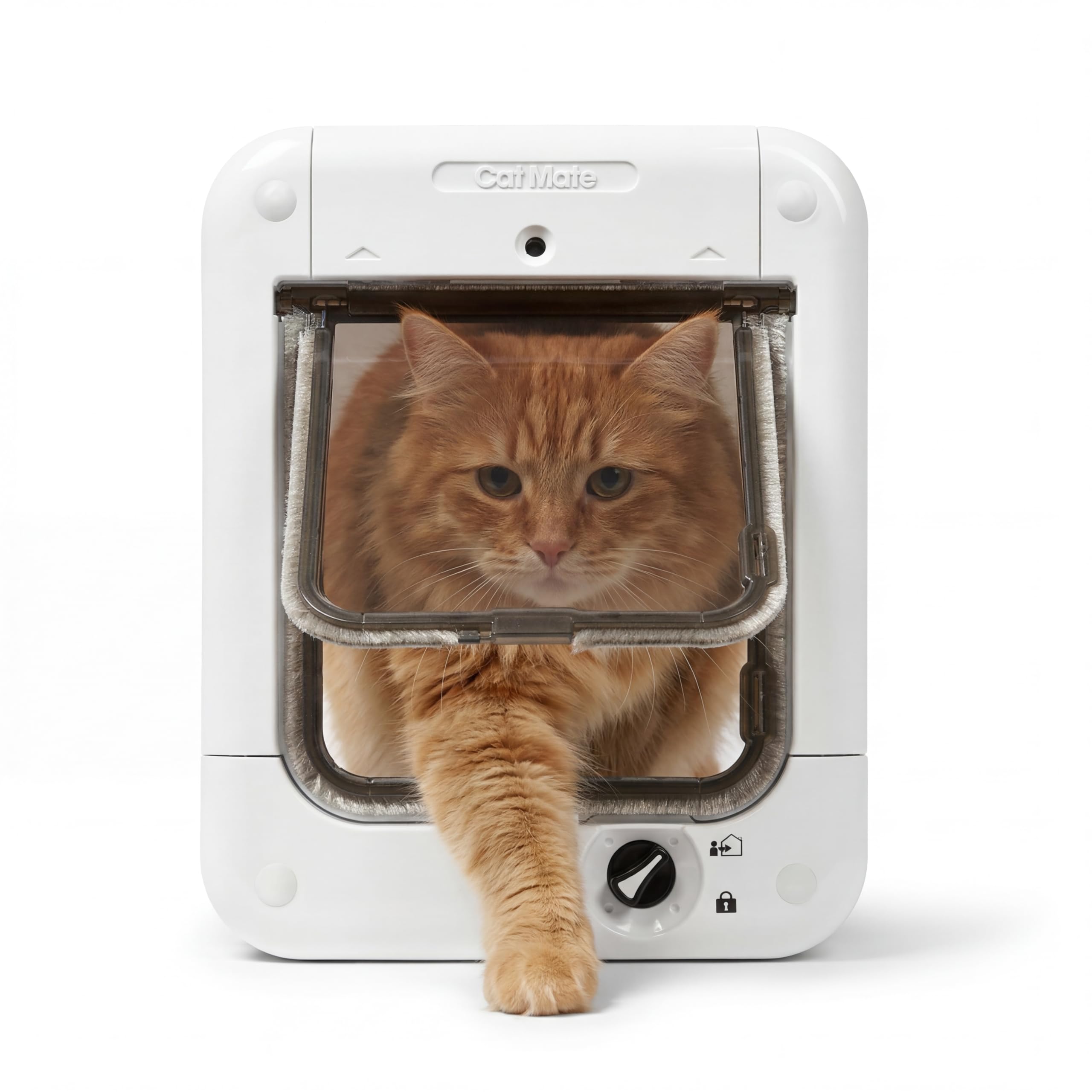
5. Cat Mate Microchip Activated Cat Flap (360)
The workhorse chip door that handles up to 30 pets at a friendlier price point.
This Cat Mate 360 door reads 15-digit ISO and AVID microchips (no 10-digit or alpha chips) and stores up to 30 cat or small dog IDs, making it ideal for multi-pet homes or foster situations. The flap opening is 5 3/4 inches square — adequate for small to medium cats. The maximum compatible thickness is 3.35 inches, which is 19% thinner than the 4 inches the Cat Mate Elite handles, so check your door’s thickness before buying. It features a 4-way rotary lock (in and out, in only, out only, or fully locked).
Buyers report that the door works well for controlling specific cat access and is a “Godsend” for creating food pods. However, one reviewer warns that “the bottom edge of the flap has sharp, rough edges and has gradually worn bare spots on the cat’s back.” The door also has a tight fit that can be noisy, and the flap doesn’t lock behind a slow-moving cat, meaning a quick raccoon might still sneak in. At the same thickness of 3.35 inches, it matches the Closer Pets 360 below, but the sharp edge issue is specific to this model.
For the price, you get the same 30-pet capacity as the Closer Pets 360 and a similar 4-way lock. The catch is the rough flap edge that can irritate your cat’s fur, and the lack of 10-digit chip support. If your cat has a standard 15-digit chip and you need to manage many pets on a budget, this door delivers the core function — just be ready to sand the flap edge or add padding as Closer Pets themselves suggested to one reviewer.
Multi-Pet Ready
- Stores up to 30 pet microchips or ID disc codes
- 4-way lock for flexible access control
- Works well for food pod setups, per buyer reports
Flaw Watch
- Sharp bottom edge can wear bare spots on cat’s back fur
- Doesn’t lock behind a slow-moving cat
- Not compatible with 10-digit or alpha-character chips
Grab this for: a budget-friendly multi-pet door if your cats all have 15-digit chips and you are handy enough to smooth a rough edge.
pass on it if: your cat has a non-ISO chip, a very thick door, or a sensitive back that could get rubbed raw.
6. Closer Pets Microchip Activated Cat Flap (360)

The entry-level chip door that gets the basics right — if your cat’s chip signal is strong enough.
This Closer Pets door operates exclusively with your cat’s microchip or ID disc, has a 4-way rotary lock, and a fully brush-sealed flap with magnetic closure for weather resistance. It fits single and multi-glazing, UPVC, metal doors, walls, and wood up to 3.35 inches thick. Programming is a single-button process, and it stores up to 30 pets. The design is identical in concept to the Cat Mate 360, but at a slightly more budget-friendly tier.
The critical flaw that owners mention consistently: a “delay on picking up signal, cats could not get in or out consistently.” One buyer mentioned that one chip wouldn’t register at all after weeks of trying. This signal lag makes the door unreliable — your cat may sit outside waiting while the door decides to open up. On the positive side, owners who got a working unit say installation was fast (one reviewer did it in 10 minutes in a fiberglass door) and the door keeps critters out effectively.
Compared to the Cat Mate 360 above, this door matches it on 3.35-inch max thickness and 30-pet capacity but has a more consistent complaint about chip reading delays. The magnetic closure and brush seal are solid, and the one-button programming is genuinely simple. But a microchip door that doesn’t reliably read the microchip is hard to recommend unless you are willing to troubleshoot or your cat happens to have a chip with a strong signal.
Simple Setup
- Fast one-button programming
- Weatherproof brush seal with magnetic closure
- Fits multiple door types including glass and UPVC
Signal Problem
- Customers note significant delay picking up chip signal
- Some chips don’t register at all
- Cats can be locked out due to inconsistent reading
Consider this if: you are on a tight budget and are willing to gamble on chip reading reliability for a door that installs easily.
Pass on this if: a consistent, delay-free open up is non-negotiable — the signal lag is a known pattern in buyer reviews.
Understanding the Specs
Microchip Compatibility
This is the most important spec. Your cat’s microchip has a specific number of digits — usually 15 (ISO standard), 10 (FDXA), or 9 (Avid Secure). Not all automatic cat doors read all formats. If your cat has a 10-digit or alpha-numeric chip, check compatibility carefully or plan to buy programmable collar tags. A door that can read a chip from 6 inches to a foot away is far more reliable than one that needs the chip pressed against the sensor.
Weather Sealing and Installation Fit
A fully brush-sealed flap with magnetic closure keeps drafts and rain out, which directly affects your home’s energy efficiency and your cat’s comfort. The maximum compatible thickness tells you the thickest door or wall the door can fit into — standard doors are 1.5 to 2 inches, but exterior walls or French doors can be 3 to 4 inches or more. If your door is thicker than the spec, you will need a separate wall liner or adapter kit.
FAQ
Will a microchip cat door work with any vet-implanted microchip?
How do I know what size flap my cat needs?
Can a raccoon or stray cat force its way through a microchip door?
How long do the batteries usually last in these doors?
Will the locking noise scare my cat?
Can I install a microchip cat door in a glass door or a wall?
What happens if the batteries die while my cat is outside?
Can I set different access rules for different cats?
What is the difference between entry-only scanning and two-way scanning?
Will a stiff flap hurt my cat or discourage them from using the door?
Final Thoughts: The Verdict
For most cat owners, the automatic cat door that balances reliability, battery life, and fit is the SureFlap Microchip Pet Door because it reads chips from a foot away, runs for years on C batteries, and has a large opening that fits most cats and small dogs. If you need app-based remote monitoring, grab the SureFlap Connect and the sold-separately hub. And for a straightforward chip door at a lower entry point that handles up to 30 pets, the Cat Mate 360 delivers the core function if you are willing to smooth a sharp flap edge and check chip compatibility.
How We Picked
We do not accept paid placement. Every pick is matched to a real buyer and a real use-case; we do not hands-on test units.
Sources & Methodology
Specifications: manufacturer listings and product documentation. Review insights: verified customer reviews, as of July 2026. Pricing: not shown on this page (it changes often); check the current price via the retailer link.
As an Amazon Associate, Gadgets Feed earns from qualifying purchases. This does not affect which products we feature.