
Our readers keep the lights on and my morning glass full of iced black tea. As an Amazon Associate, I earn from qualifying purchases.
Specs are compiled from manufacturer listings and verified buyer reviews and can change over time — please confirm the key details on the product page before buying.
The biggest mistake people make when buying a cheap underwater camera is picking one with great specs above water that turns into a blurry mess the moment you dip below the surface. A budget underwater camera needs three things to actually be useful: honest waterproof depth, decent stabilization for moving water, and enough photo resolution so your vacation snaps don’t look like they are from 2005. This guide compares five models that survive at least 30 feet down without breaking your wallet.
I’m Min — the founder and writer behind Gadgets Feed. This guide is built by comparing the manufacturers’ published specifications and the patterns across verified customer reviews, so you get each pick’s real strengths and trade-offs instead of marketing spin.
A good budget underwater camera needs to keep water out, capture memories you will actually share, and not cost more than your airline ticket — and these five picks deliver on all three fronts without the premium price tag.
Quick Picks
- AKASO EK7000 Pro — Best Overall
- Maxmango V08 Pro — Premium Touch
- SiSuSy 8K Underwater Camera (75MP) — WiFi Floater
- SPUNALP UHD 8K Underwater Camera (70MP) — Longest Run
- SiSuSy 5K Underwater Camera (64MP) — Entry-Level
How To Choose The Best Budget Underwater Camera
Picking an underwater camera on a budget means focusing on the specs that actually keep you shooting — waterproof depth, image stabilization, and battery life — rather than marketing numbers like max digital zoom. This section walks you through the three most important features to check before you buy.
Waterproof Depth Rating — The Real Number You Need
Ignore vague claims like “waterproof for adventures.” Look for a specific depth in feet or meters — every camera on this list is rated for at least 30 feet down, but the actual depth varies from 33 feet to 131 feet. That difference matters: a 33-foot camera works for surface snorkeling and pool dives, while a 131-foot camera lets you go deeper without needing a separate waterproof housing. Check whether the rating includes the camera alone or requires the included case — the AKASO EK7000 Pro needs its case to reach 131 feet, while the floatable models are sealed without one.
Photo Resolution vs. Video Quality
Higher megapixel counts (the number of millions of tiny sensors on the camera) sound impressive on paper but only help if the camera handles motion well underwater. A 70MP or 90MP sensor is great for still shots on a sunny day, but video resolution (4K or 8K) plus stabilization matters more for clips where fish are moving and you are drifting. Electronic Image Stabilization (EIS) uses software to smooth out your shaky hands — without it, even 8K video looks like a rollercoaster recording.
Battery Capacity and Memory Cards
Battery life is measured in milliamp-hours (mAh), and a higher number means more shooting time before you need to recharge. Cameras in this list range from 1350mAh to 2500mAh, which translates to roughly 90 minutes to 5 hours of actual recording. Most budget cameras include a memory card (typically 32GB), but you should check if it supports microSD or TF cards (a different standard of small memory card often used in older cameras) and whether you can upgrade to 128GB later. Always carry a spare battery if you plan a full day of snorkeling — reviewers mention that continuous 4K or 8K recording drains even big batteries faster than you expect.
Quick Comparison
| Model | Best For | Waterproof Depth | Photo Resolution | Battery Capacity | Amazon |
|---|---|---|---|---|---|
| AKASO EK7000 Pro | Deep dives (131ft) + action sports | 131 FT | 20 MP | 1350mAh (2 included) | Amazon |
| Maxmango V08 Pro | Touchscreen + selfies at 49ft | 49 FT | 90 MP | — | Amazon |
| SiSuSy 8K (75MP) | 50ft depth + WiFi transfer | 50 FT | 75 MP | 1800mAh | Amazon |
| SPUNALP UHD 8K | Long battery life (5 hours) | 33 FT | 70 MP | 2500mAh | Amazon |
| SiSuSy 5K (64MP) | Entry-level + kids/family | 33 FT | 64 MP | 1500mAh | Amazon |
In‑Depth Reviews
1. AKASO EK7000 Pro

The action camera that dives four times deeper than snorkel cams without costing four times more.
This is the outlier in the budget category — a 4K action camera rated for 131 feet when you put it inside the included waterproof case. The AKASO is rated for 131 feet versus the SiSuSy 5K’s 33 feet, which means you can actually scuba-dive with it, not just snorkel. The trade-off is style: the AKASO is a traditional bullet-shaped action camera, not a compact point-and-shoot, so it clips to a mount or floating handle rather than slipping into a pocket. Reviewers report it handles well even in poor visibility — one experienced diver noted they “used in Gulf of Mexico; good images despite poor visibility,” which is a strong test for any budget camera.
The bundle is generous: two 1350mAh rechargeable batteries (each recording up to 140 minutes), a waterproof floating hand grip, a carrying case, and a remote control wristband. Electronic Image Stabilization (software-based stabilization that smooths out shakiness) keeps video from looking like a seasick recording even when you are bouncing on waves. The catch is the 20MP photo resolution — compared to the 70MP and 90MP competitors here, the stills are lower resolution, so if you want gallery-quality underwater photos rather than video, one of the higher-megapixel picks below suits you better. The 5X digital zoom also falls short of the 18X zoom on the SiSuSy and SPUNALP models. But for depth and versatility, nothing on this list beats it.
Why The Depth Matters
- 131FT depth rating (waterproof case included) — deeper than any other camera on this list (the next deepest are 50FT and 49FT)
- Electronic Image Stabilization (EIS) delivers smooth underwater video without a gimbal
- Two batteries included, each lasting 140 minutes — no midday recharge needed
- Full accessory bundle: floating handle, remote, carrying case, dual charger
Where It Comes Up Short
- 20MP photo resolution is low compared to the 70-90MP competitors — stills look softer in good light
- 5X digital zoom is much weaker than the 18X zoom on other picks
- Requires the case for 131FT — not a bare camera in deep water
Reach for this if: you actually dive or want a camera that survives serious depth, and you care more about video smoothness than photo megapixels
Look elsewhere if: you want the highest-resolution still photos for printing or social media — the 20MP sensor is limiting compared to the 70/90MP options
2. Maxmango V08 Pro
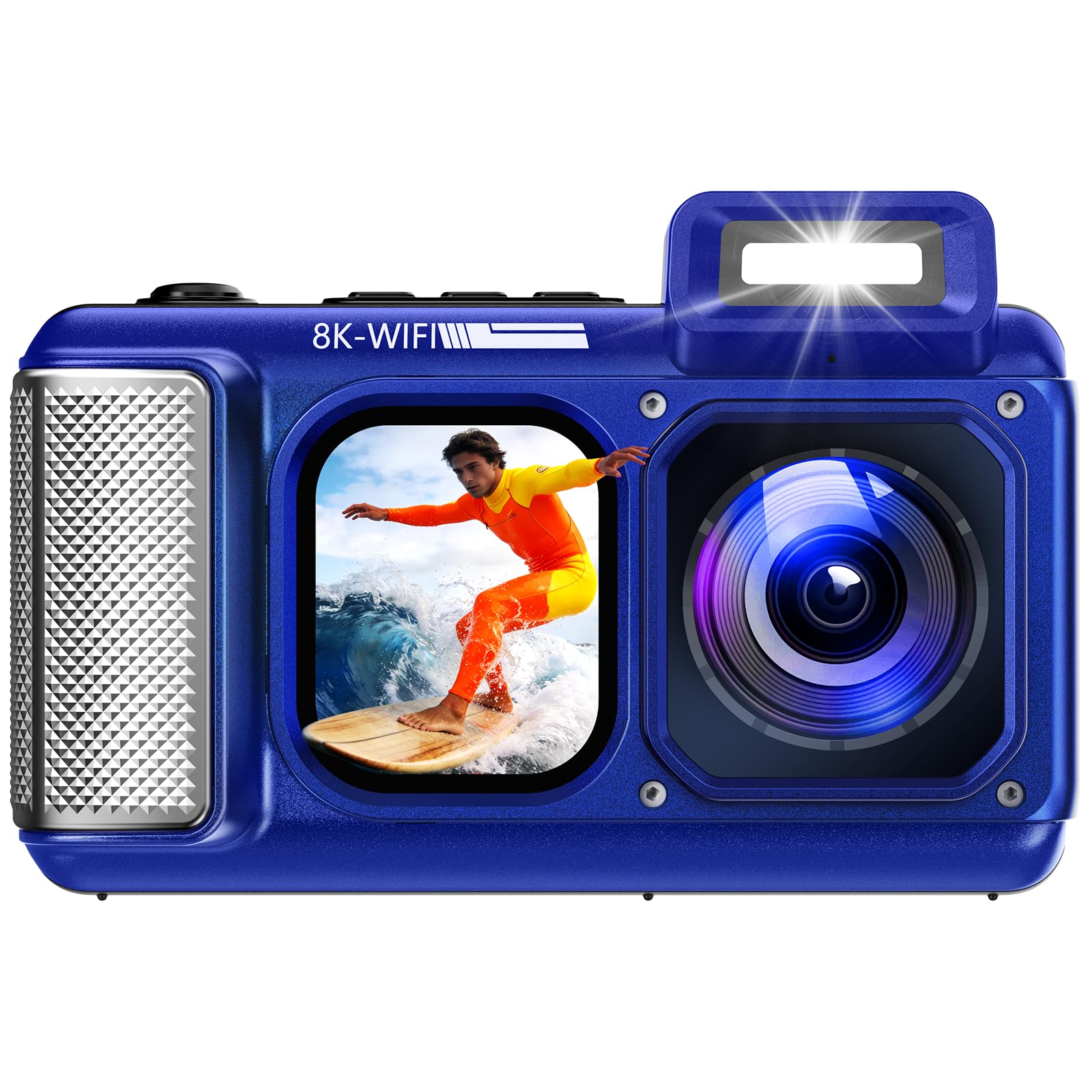
The first budget underwater camera with a proper touchscreen that also captures 90MP stills.
If you are tired of fumbling with tiny buttons while wearing swim goggles, the Maxmango V08 Pro is a relief. Its 2.88-inch front screen uses icon-based touch controls (you tap to preview, play back, and switch modes), and the 2.01-inch rear screen helps you frame selfies or group shots while snorkeling. At 49 feet waterproof, it goes deeper than the entry-level 33-foot cameras but stays well within snorkeling and recreational diving range — you are not missing the 131-foot AKASO unless you plan to scuba well below 50 feet.
The photo resolution hits 90MP, which is the highest on this list alongside the SiSuSy 8K — so coral reefs and tropical fish print at poster size without visible grain. The rugged build includes a double-lock battery door (two-step locking to prevent water leaks if you accidentally leave it loose) and the camera feels solid in hand, not plasticky. One reviewer noted it feels “more like an outdoor adventure camera than a casual underwater digital camera.” The trade-off: the battery capacity is not listed in the spec data, and the camera lacks a built-in flash (the specs say “no flash”), so low-light shots without sunlight will be grainy. WiFi transfer works within about 5 meters (16 feet) above water, but like all WiFi cameras here, it stops working the moment you submerge it.
Touchscreen Advantage
- 2.88″ touchscreen makes navigating menus easy even with wet fingers
- 90MP photo resolution — sharpest stills on this list, good for prints and cropping
- Dual screens (2.88″ + 2.01″) for selfie framing without guesswork
- Double-lock battery door reduces water leak risk if not closed perfectly
Trade-Offs To Know
- No built-in flash — low-light or night shots will be dark and grainy
- Battery capacity is not listed in the specs — unknown runtime for long outings
- 49FT depth is good for snorkeling but not for serious scuba diving compared to the AKASO at 131FT
Best suited for: swimmers and snorkelers who want the easiest controls underwater and the highest-resolution photos without spending more than
The single caveat: the missing flash and unknown battery capacity mean you should buy a spare battery if you plan all-day trips, and avoid this camera for night snorkeling
3. SiSuSy 8K Underwater Camera (75MP)
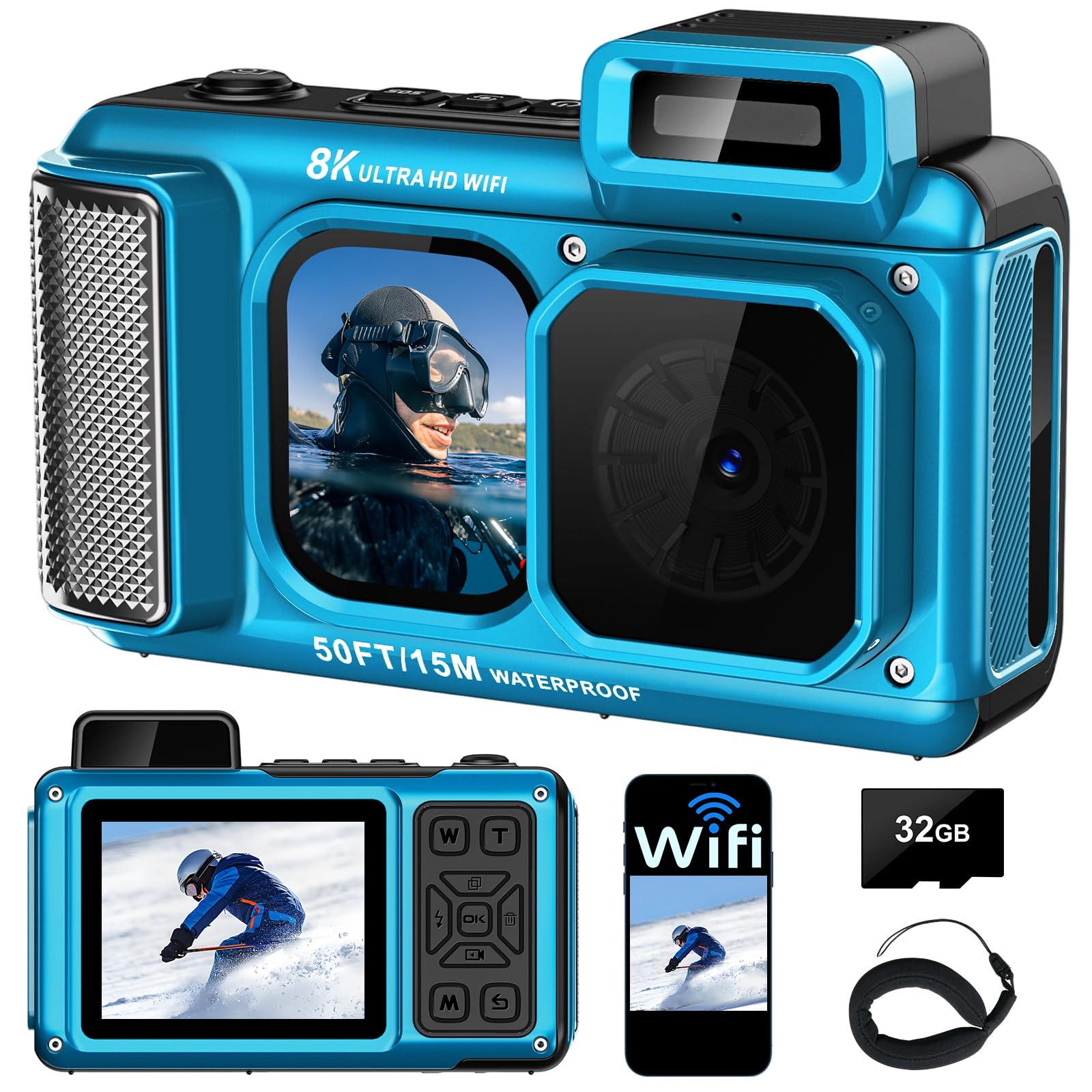
An 8K camera that floats to the surface, so you never lose it to the ocean floor.
Rated to 50 feet with an IP68 rating (the standard scale for solid and liquid ingress protection — “6” means fully dustproof and “8” means it survives submersion beyond 1 meter), this SiSuSy camera is the deepest of the floatable models on this list. The buoyancy strap keeps it from sinking if you drop it while snorkeling, and the shockproof body absorbs knocks against rocks or boat decks. The photo resolution is 75MP — sharper than the AKASO’s 20MP but a step below the Maxmango’s 90MP — and the 8K video at 7680×4320 pixels delivers crisp footage that stays detailed even when you zoom in during editing.
The 1800mAh battery claims 90+ minutes of continuous recording, which is shorter than the SPUNALP’s 2500mAh battery at 5 hours, so you will likely need midday charging on a full-day trip. WiFi transfer lets you move photos to your phone in under a minute above water, and you can control the camera remotely through the app. One reviewer tested the waterproof case in a sink and said “it held up perfectly without a single drop of water getting through.” The rear 3.0-inch touchscreen is the biggest on this list, making it easier to tap through settings while standing on the beach. The digital zoom is 18X, matching the SPUNALP and beating the AKASO’s 5X by a wide margin — useful for getting closer to fish without swimming into them.
Floating Features
- 50FT depth plus IP68 rating — fully dustproof and shockproof for beach, rafting, and drops
- Buoyancy strap means the camera floats if you drop it — no lost gear on the ocean floor
- 8K video (7680×4320) for sharp footage even when you crop later
- Big 3.0″ rear touchscreen plus 2.0″ front selfie screen — best screen size on this list
Battery Reality
- 1800mAh battery delivers only 90+ minutes of recording — you will need to recharge on a long day
- 75MP is good but not the highest — the Maxmango (90MP) and SPUNALP (70MP but longer battery) edge it in different ways
- WiFi works above water only, and the range is limited compared to dedicated action cameras
Grab this one for: beach trips where you might drop the camera — the floatable strap is a practical lifesaver — and for anyone who wants 8K video without moving into premium pricing
The one thing to plan for: carry a portable charger or spare battery if you are out all day; 90 minutes of recording does not cover a full snorkeling session
4. SPUNALP UHD 8K Underwater Camera (70MP)
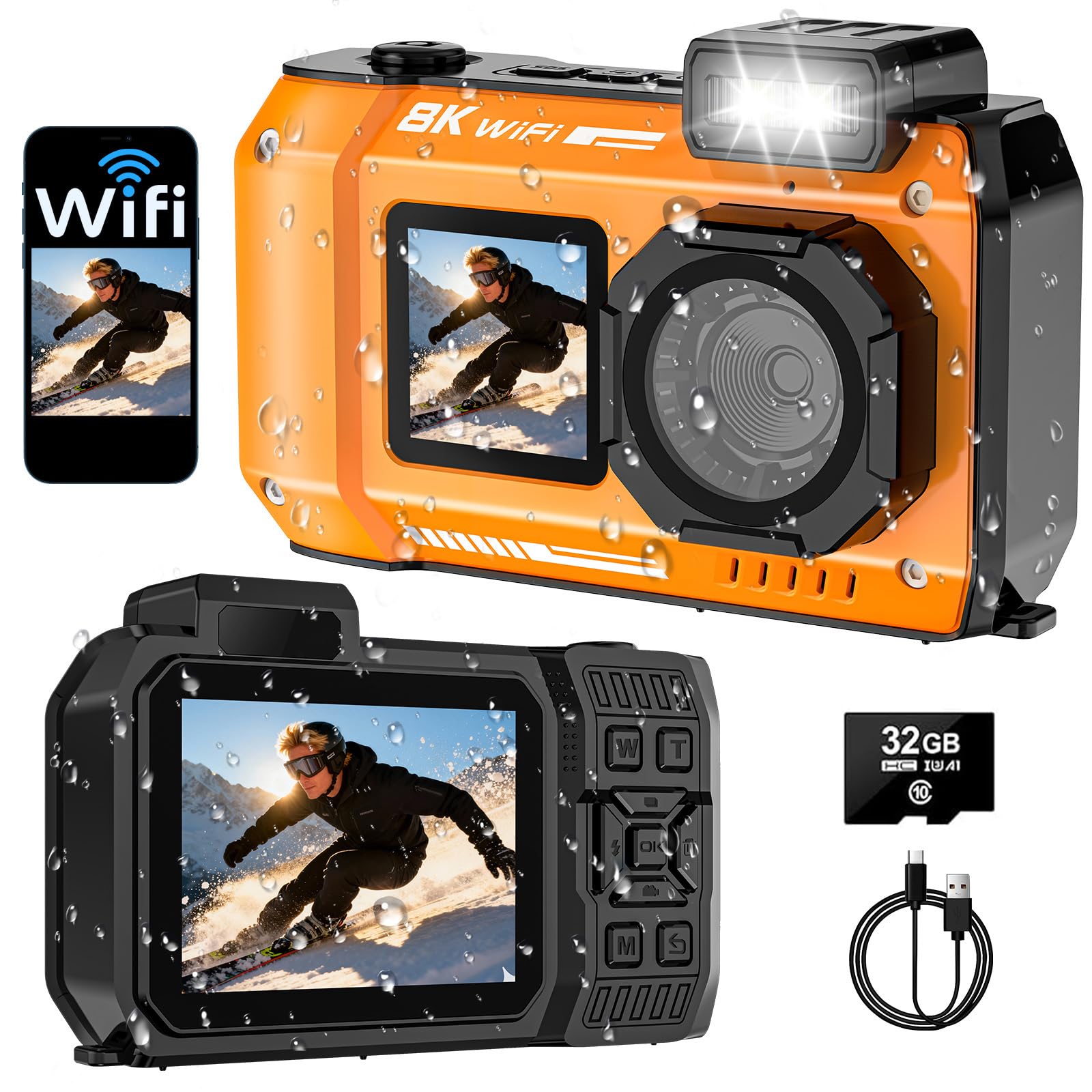
A 2500mAh battery that shoots 8K video for up to 5 hours — no spare battery needed.
You get 4.5 to 5 hours of continuous operation, which covers a full day of snorkeling, boat trips, and beach lounging on a single charge. The 70MP photos and 8K video at 7680×4320 pixel resolution produce crisp images that look good on a big screen, though one buyer mentioned in Spanish that the photos were not as strong as their phone’s output — a realistic expectation check for budget cameras.
At 33 feet waterproof, it matches the entry-level pick (the SiSuSy 5K) but adds dual screens (2.88-inch front, 1.44-inch rear), autofocus, and an 18X digital zoom that reaches 3.6x further than the AKASO’s 5X zoom. The body is designed to be floatable, dustproof, sandproof, and freeze-resistant, and it can survive drops from up to 4 feet — useful if you are handing it to kids on a rocky beach. It also includes an SOS emergency signaling system (a button that activates a flashing or loud signal in critical situations). However, the 33-foot depth is the shallowest of any camera here besides the SiSuSy 5K, so it is strictly for surface swimming and pool use — do not take it scuba diving.
Battery Champion
- 2500mAh battery delivers 4.5-5 hours of recording — longest runtime on this list by a wide margin
- 18X digital zoom beats the AKASO’s 5X zoom by 3.6x — get closer to fish without moving
- 8K video (7680×4320) at a price that undercuts most 4K-only competitors
- SOS emergency button adds safety for remote beach or hiking scenarios
Depth Limitation
- 33FT depth rating matches the cheapest camera — not deep enough for scuba; strictly snorkeling and pool depth
- 70MP photos are high-res but one owner reported they are not as good as a modern smartphone
- WiFi works only above water; the signal cuts off as soon as the camera submerges
Choose this for: full-day family outings where you do not want to swap batteries — the 5-hour runtime is genuinely different from the 90-minute cameras above
skip it if: you need to dive deeper than 33 feet — the AKASO at 131FT is the clear upgrade for depth
5. SiSuSy 5K Underwater Camera (64MP)
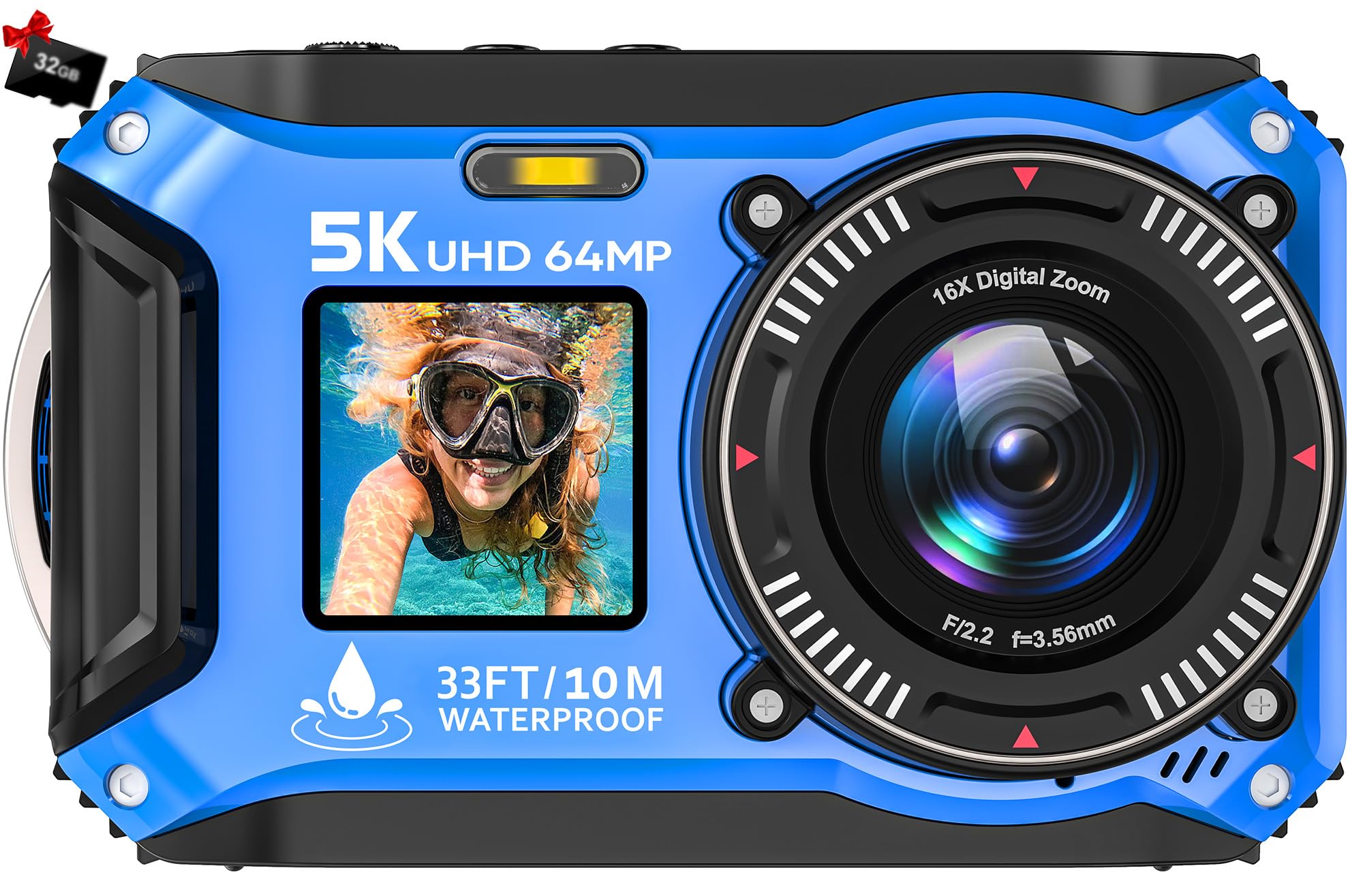
The cheapest waterproof camera that still takes clear 5K video and floats for easy retrieval.
At an entry-level price, the SiSuSy 5K is the most affordable way to get a dedicated underwater camera that actually works. It is rated to 33 feet — the same as the SPUNALP above — and floats on the surface, so if a kid drops it in the pool or a wave knocks it off your hand, it bobs up rather than sinking. The 64MP photos and 5K video (which is higher resolution than standard 4K but lower than the 8K models above) produce clear, colorful images that one reviewer described as “surprisingly clear and colorful” for the price. The 1500mAh battery records up to 100 minutes of 4K video, which is solid for a half-day outing but noticeably shorter than the SPUNALP’s 5-hour runtime.
The dual-screen setup (2.8-inch plus 1.4-inch IPS screens) covers selfie framing, and the camera includes autofocus with a half-press shutter for quick focusing — a feature usually missing at this price tier. The 16X digital zoom provides decent reach, though the 1500mAh battery is half the capacity of the SPUNALP’s 2500mAh. One caveat from a buyer: the USB-C port does not support C-to-C cables (USB-C to USB-C), so you must use the included USB-A to USB-C cable. The camera also requires two lock toggles (LOCK1 and LOCK2) to seal the battery door — a smaller step that catches new owners off guard if they skip reading the manual.
Budget-Friendly Perks
- Floatable design means it bobs to the surface if dropped — safe for pool and beach with kids
- 5K video at this price outperforms cheaper action cameras that only do 1080p or 4K
- Autofocus with half-press shutter — a rare feature at this price point that helps sharp shots
- 32GB memory card included, so it is ready to use from the start
Small Annoyances
- 1500mAh battery gets 100 minutes of 4K recording — shorter than the 5-hour SPUNALP or 140-minute AKASO
- USB-C port does not support C-C cables; you must use the included USB-A to USB-C cable
- 33FT depth is the shallowest on this list — strictly for surface swimming and snorkeling
Ideal first camera for: families, kids, or travelers who want a disposable-priced solution that takes better underwater shots than a phone in a plastic bag — the 5K video and 64MP photos are genuinely sharp for the category
Not for you if: you want deep diving capability (the 33ft cap is real) or need all-day battery without carrying extras — the 100-minute runtime runs out by lunchtime on a full day trip
Understanding the Specs
Waterproof Depth (Feet vs. Meters)
The biggest spec in this category is the actual depth rating — how far down the camera can go without water leaking in. Measured in feet or meters, it tells you the maximum depth you can reach while the camera stays sealed. A 33-foot (10-meter) rating works for surface snorkeling, pool dives, and floating in waves, but you cannot take it on scuba dives. A 131-foot (40-meter) rating, like the AKASO EK7000 Pro, lets you dive seriously without needing a separate housing. Never confuse “waterproof with case” vs. “waterproof without case” — the AKASO needs its included case to reach 131 feet, while floatable cameras like the SiSuSy models achieve their rating without one. Check whether the rating applies to the bare camera or with the housing attached.
Photo Resolution (Megapixels)
Measured in megapixels (MP), this number tells you how much detail each still photo contains — more megapixels means you can crop, zoom, or print larger without the image looking pixelated or blurry. In this category, the range goes from 20MP (AKASO EK7000 Pro) up to 90MP (Maxmango V08 Pro and the SiSuSy 8K). However, a higher MP count does not automatically mean better photos — the camera’s image processing, lens quality, and stabilization software matter just as much. A 20MP camera with good Electronic Image Stabilization (EIS) underwater might produce sharper-looking shots than a 90MP camera that shakes with every wave. For sharing on social media, 20MP is plenty. For printing large posters, go with 70MP or more.
FAQ
What does the waterproof depth rating really mean for an underwater camera?
Does WiFi work underwater on these cameras?
How long does the battery actually last when recording underwater video?
Are these cameras ready to use from the start, or do I need to buy extra accessories?
Can I use these cameras as a webcam for video calls?
What type of memory card do these cameras use, and can I upgrade it?
Is an 8K underwater camera worth it at this budget price?
How do I properly seal the battery door to avoid water damage?
Will these cameras handle saltwater without corroding?
Which camera is the best choice for a child or teenager to use?
Final Thoughts: The Verdict
For most people, the budget underwater camera winner is the AKASO EK7000 Pro because its 131-foot depth rating lets you dive, snorkel, and shoot action sports with stabilized 4K video at a price that undercuts every serious underwater camera by hundreds of dollars. If you want the highest-resolution still photos and a touchscreen interface that makes operation easy, grab the Maxmango V08 Pro. And for families or beginners who need a camera that floats, survives drops, and runs for five hours without recharging, the standout is the SPUNALP UHD 8K.
How We Picked
We do not accept paid placement. Every pick is matched to a real buyer and a real use-case; we do not hands-on test units.
Sources & Methodology
Specifications: manufacturer listings and product documentation. Review insights: verified customer reviews, as of July 2026. Pricing: not shown on this page (it changes often); check the current price via the retailer link.
As an Amazon Associate, Gadgets Feed earns from qualifying purchases. This does not affect which products we feature.