
Our readers keep the lights on and my morning glass full of iced black tea. As an Amazon Associate, I earn from qualifying purchases.
Specs are compiled from manufacturer listings and verified buyer reviews and can change over time — please confirm the key details on the product page before buying.
A weak jacket on 16/4 wire can crack or corrode months after you bury it or run it through a wall. The result is a short circuit that means pulling everything apart and doing the job twice. You need a cable that does not quit when you are wiring a trailer, landscape lights, or in-wall speakers.
I’m Min — the founder and writer behind Gadgets Feed. This guide is built by comparing the manufacturers’ published specifications and the patterns across verified customer reviews, so you get each pick’s real strengths and trade-offs instead of marketing spin.
I broke down four different 16/4 wires to find the ones actually worth buying and those that cut corners. This is your practical rundown of the best 16/4 wire for real-world jobs.
Quick Picks
- ENERJOUR 16 Gauge 4 Conductor Electrical Wire — Best Overall
- NAOEVO 16 Gauge Wire 4 Conductor Electrical — Tight-Space Specialist
- Custom Cable Connection 16/4 SOOW 25 Foot — Toughest Build
- Elite 16/4 Speaker Wire 100ft — Best for In-Wall Audio
How To Choose The Best 16/4 Wire
Every 16/4 cable has four 16-gauge conductors inside, but the jacket thickness, copper quality, and voltage rating separate a cable that lasts a decade from one that fails in a season. Here are the three things to check before you buy.
Outside Diameter and Jacket Quality
The overall diameter of the cable tells you how much physical protection the inner wires get. A thicker jacket means better abrasion resistance and more durability when pulling through tight spaces or running under a vehicle. The cables in this roundup range from roughly 3.1 mm up to 7.3 mm — from 3.1 mm to 7.3 mm in diameter that translates directly into ruggedness.
Voltage Rating and Safety
Most 16/4 wire is rated at 300V or 600V. For low-voltage landscape lighting, 12V DC automotive circuits, and basic speaker runs, 300V is plenty. If you are wiring a piece of portable power equipment or running a cable through a commercial space where the line voltage could hit 600V, you need a cable with the higher rating. UL listing is the mark that the cable has passed formal safety testing — a big deal for in-wall installations and insurance compliance.
Copper Type — Tinned vs. Bare
Tinned copper has a thin coating of solder over the strands, which resists corrosion and oxidation much better than bare copper. That makes tinned wire the right choice for outdoor, marine, and direct-burial applications where moisture is a constant threat. Bare copper (often sold as “oxygen-free” or OFC) gives slightly better conductivity in dry indoor runs, but it will corrode faster when exposed to the elements.
Quick Comparison
| Model | Best For | Jacket Diameter | Voltage Rating | Copper Type | Amazon |
|---|---|---|---|---|---|
| ENERJOUR 25ft | Outdoor & Trailer Wiring | 7.3 mm | 300 V | Tinned Copper | Amazon |
| NAOEVO 30ft | Tight-Space & Budget Runs | 3.1 mm | 600 V | Tinned Copper | Amazon |
| Custom Cable Connection SOOW 25ft | Heavy-Duty Portable Power | 0.420 in (10.7 mm) | 600 V | Bare Copper | Amazon |
| Elite Speaker Wire 100ft | In-Wall & Direct Burial Audio | — | 600 V | Bare Copper (OFC) | Amazon |
In‑Depth Reviews
1. ENERJOUR 16 Gauge 4 Conductor Electrical Wire 25FT
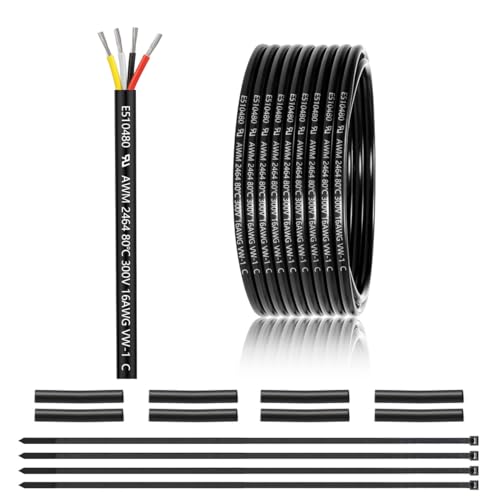
The trailer-rewiring workhorse with a 7.3 mm jacket versus the 3.1 mm of the budget NAOEVO.
This ENERJOUR cable has a massive 7.3 mm outer diameter — at 7.3 mm versus the NAOEVO cable at 3.1 mm. That thick PVC jacket pulls through a boat trailer frame or a landscape trench without nicks reaching the inner conductors. It uses tinned copper strands (27 strands of 0.254 mm wire per conductor) to block corrosion. Buyers report using it successfully after “cheaper wire let me down” on a trailer rewire. The voltage rating is 300 V, which works for most 12V and 24V outdoor lighting and automotive applications. It falls short of the 600 V you want for portable power equipment.
The kit comes with 8 heat-shrink tubes and 4 cable ties — small extras that save a trip to the hardware store mid-job. The wire is UL 2464 listed with VW-1 and FT1 flame retardant ratings, so it meets basic safety standards for low-voltage use in exposed or semi-exposed locations.
One trade-off: the 25-foot length is short for larger projects, and there is no 100-foot spool option from this line, so you might need multiple rolls for a full landscape system.
Why It Earns the Top Spot
- Oversized 7.3 mm jacket provides excellent physical protection
- Tinned copper strands resist corrosion in wet environments
- Includes heat-shrink tubes and cable ties
- UL 2464 listed for safety compliance
What to Watch For
- Only available in 25 ft length — not ideal for long runs
- 300 V rating is lower than the 600 V offered by some competitors
Who this fits best: Anyone rewiring a trailer, boat, or outdoor lighting who wants a thick jacket that shrugs off abrasion and a tinned conductor that laughs at moisture.
The honest limit: If your project needs 600 V headroom or a single spool longer than 25 feet, you will need to look at the premium picks further down this list.
2. NAOEVO 16 Gauge Wire 4 Conductor Electrical Wire 30FT

The slim 3.1 mm profile that squeezes through tight spots while still carrying a 600 V rating.
The NAOEVO cable is the thinnest in this lineup at just 3.1 mm outer diameter — a gap of 7.3 mm versus 3.1 mm compared to the ENERJOUR cable above. That slim profile is a real advantage when you are threading wire through a golf cart frame, a boat gunwale, or a tight conduit run where a 7 mm jacket simply will not fit. Despite its thinness, it carries a full 600 V rating, which doubles the 300 V headroom of the ENERJOUR. The trade-off is that the jacket is less armored, so you need to be more careful during installation to avoid cuts. Owners mention the “nice jacket around wire” and mention running it under a golf cart without additional split-loom conduit.
The wire uses 26 strands of 0.24 mm tinned copper per conductor and is rated IP68 (dust-tight and protected against continuous immersion) for waterproofing, making it suitable for exposed outdoor and marine environments. It also comes with 16 heat-shrink tubes and 4 cable ties, which is generous for a cable in this range. The wire is lightweight and very flexible — reviewers call it “easy to work with” and praise the quality for the price.
Where the NAOEVO loses points is physical protection: the thin jacket means it is not the best choice for direct burial or any application where the cable will take repeated abrasion against metal edges. Stick to indoor or protected outdoor runs and it performs beautifully.
The Slim Advantage
- Only 3.1 mm outer diameter — fits where thick cables cannot
- Rated 600 V, double the headroom of some competitors
- IP68 waterproof rating for wet environments
- Generous 16 heat-shrink tubes and 4 cable ties included
The Thin Jacket Catch
- Less physical protection than thicker-jacket 16/4 wire
- Not ideal for direct burial or high-abrasion locations
Reach for it when: You need to snake 16/4 wire through a tight channel, under a vehicle shell, or inside a piece of equipment and you want a full 600 V safety margin packed into a slim profile.
skip it if: Your plan involves burying the wire in the ground or running it along a trailer frame where rocks and road debris will beat on the jacket all day — spend up for the ENERJOUR or the SOOW cable instead.
3. Custom Cable Connection 16/4 SOOW 25 Foot
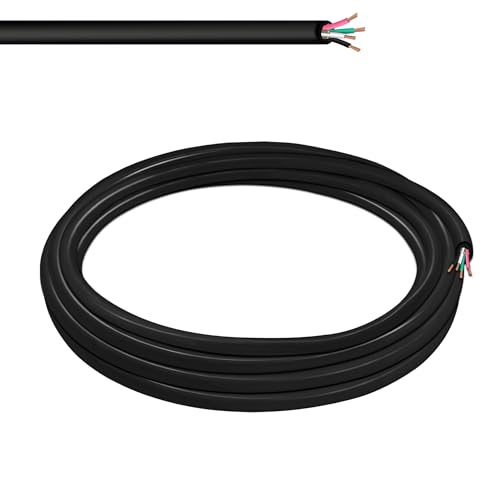
The rubber-jacketed SOOW cable that one reviewer called “absolutely tough and sturdy” like an industrial tool cord.
This is not a PVC-jacketed cable — the Custom Cable Connection SOOW uses a thermoset rubber jacket per UL 62 that is oil-resistant, moisture-resistant, and stands up to sunlight and ozone far better than standard PVC. The outside diameter is roughly 0.420 inches (over 10.5 mm), making it the thickest and most physically sturdy cable in this group. It is rated at a full 600 V with a temperature range of -40°C to 90°C (-40°F to 194°F). One reviewer who bought it for an industrial power tool application said it was “exactly what I would expect (or more) from an industrial power tool cable.” The conductors are fully annealed stranded bare copper per ASTM B-174, not tinned, so the corrosion resistance comes from the heavy rubber jacket rather than the copper itself.
This cable is designed for portable power and permanent installation in demanding environments — think wiring up a mini-split unit, running power to construction equipment, or making a heavy-duty extension cord. The four color-coded conductors (red, black, green, white) include a green ground wire, which is essential for line-voltage applications. Custom Cable Connection has been making cable assemblies in the US since 2002, and the build quality reflects that history.
The catch is the same as its strength: the thick rubber jacket makes it stiffer and harder to route than a slim PVC cable. It is overkill for a simple speaker run or a low-voltage landscape light, and the 25-foot spool is short for anyone trying to cover a long distance.
What Makes It a Beast
- Oil-resistant thermoset rubber jacket — shrugs off chemicals and weather
- Rated 600 V with -40°C to 90°C temperature range
- Includes green ground conductor for line-voltage use
- UL-approved for permanent installation
The Real Trade-Off
- Thick and stiff — harder to route through tight spaces than slim PVC wire
- Overkill and more expensive than needed for low-voltage DC or speaker wire
- Only 25 ft per spool with no longer option shown
Your best bet if: You need a cable that can survive an industrial shop floor, outdoor construction site, or direct burial where oil, sunlight, and physical abuse are daily realities.
Probably not right if: You are just wiring a pair of speakers or a string of landscape lights — this cable is built tougher than those jobs require and you pay for that extra ruggedness.
4. Elite 16/4 Speaker Wire 100ft
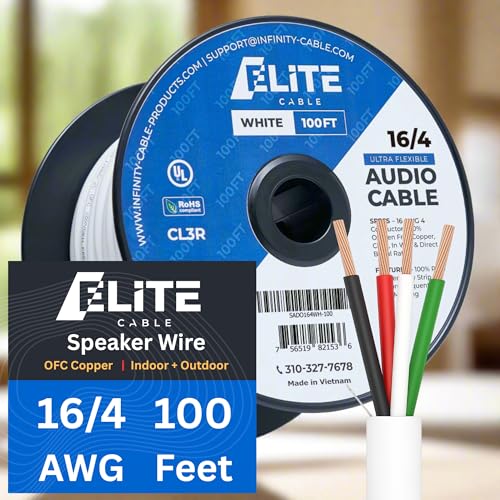
The only UL-listed, CMR/CL3R-rated 100-foot spool ready for in-wall and direct-burial speaker installs.
This Elite cable is the only pick in the roundup that comes with a full 100-foot spool and carries both UL listing and CMR/CL3R riser rating — meaning it has passed flame and smoke tests for in-wall installation inside homes and commercial buildings. That is a critical safety checkbox if you are running speaker wire inside finished walls and need to pass an electrical inspection. The cable uses 100% oxygen-free pure bare copper (OFC) with 65 strands per conductor, and the white PVC jacket is UV-protected for direct-burial outdoor use. The cable also features a paper liner around the conductors, which one reviewer noted “prevents nicking during stripping” — a small but real time-saver.
At 100 feet, this spool is the longest option here, making it ideal for whole-home audio runs where you need to cover the distance from a receiver to a far wall or out to patio speakers. The cable is ultra-flexible despite the thick insulation, so pulling it through studs and joists is manageable. Buyers consistently call it a “good quality” cable that installs easily with clear polarity markings on each conductor.
The honest note from one reviewer: the “oxygen-free copper” label is somewhat overblown marketing, and the cable performs similarly to standard lamp cord in terms of audio quality. However, the mechanical toughness, the easy-strip design, and the formal safety certifications make it a solid choice for anyone who needs a single long run and wants the paperwork to prove the cable is safe inside a wall.
Why It Stands Out
- UL listed and CMR/CL3R rated — safe for in-wall installation
- 100 ft spool is the longest run among the 16/4 options here
- Paper liner between conductors prevents nicks during stripping
- UV-protected jacket suitable for direct burial
What to Keep in Mind
- Bare copper (OFC) corrodes faster than tinned copper in wet environments
- One buyer mentioned the “OFC” benefit is overblown for typical audio use
- Premium price for a 100 ft spool compared to shorter budget options
Buy this if: You are running speaker wire inside walls, through a riser between floors, or burying it in the yard and need a 100-foot continuous run with formal UL safety certification.
Look elsewhere if: You only need 25 feet for a simple outdoor speaker or automotive job — you will get more physical protection from the tinned-copper ENERJOUR or SOOW cable for the same or less money.
Understanding the Specs
Jacket Diameter and Physical Protection
The outside diameter of a 16/4 cable determines how much physical abuse it can take before the inner wires get damaged. A cable like the ENERJOUR at 7.3 mm at 7.3 mm has a jacket compared to the NAOEVO at 3.1 mm. Thicker jackets are better for direct burial, trailer frames, and any location where the wire might rub against metal or rock. Thinner jackets are easier to route but need more care during installation.
The SOOW cable from Custom Cable Connection takes this further with a thermoset rubber jacket that is also oil-resistant and stays flexible in extreme cold, making it the most durable option but also the stiffest to work with.
Voltage Rating — 300V vs 600V
The voltage rating tells you the maximum electrical potential the insulation can safely handle. A 300 V cable like the ENERJOUR is perfectly safe for automotive 12V systems, landscape lighting transformers, and most speaker amplifiers. A 600 V cable like the NAOEVO or the SOOW gives you a safety margin of 600 V compared to 300 V and is necessary if you are wiring portable power equipment, motor leads, or any circuit that connects directly to a 240V or 277V commercial line. UL listing is the independent certification that the cable’s insulation has passed formal testing at that voltage — a real safety differentiator for in-wall installations.
FAQ
Can I use 16/4 wire for direct burial in the ground?
What is the difference between tinned copper and bare copper in 16/4 wire?
Will 16/4 wire work for landscape lighting?
What does CMR/CL3R rating mean for 16/4 wire?
How many amps can 16/4 wire handle?
Can I use 16/4 wire for a car audio amplifier?
What is SOOW cable and why would I choose it over PVC 16/4 wire?
Is 16/4 wire the same as 16/4 speaker wire?
Final Thoughts: The Verdict
For most buyers, the best 16/4 wire to start with is the ENERJOUR 25ft cable because its massive 7.3 mm jacket and tinned copper strands give you real outdoor toughness at a mid-range price. If you need to thread wire through tight spots but still want a 600 V safety margin, grab the NAOEVO 30ft cable. And for heavy-duty portable power or a job site where the cable will get dragged across concrete and soaked in oil, the standout is the Custom Cable Connection SOOW 25ft cable.
How We Picked
We do not accept paid placement. Every pick is matched to a real buyer and a real use-case; we do not hands-on test units.
Sources & Methodology
Specifications: manufacturer listings and product documentation. Review insights: verified customer reviews, as of July 2026. Pricing: not shown on this page (it changes often); check the current price via the retailer link.
As an Amazon Associate, Gadgets Feed earns from qualifying purchases. This does not affect which products we feature.