
Our readers keep the lights on and my morning glass full of iced black tea. As an Amazon Associate, I earn from qualifying purchases.
Specs are compiled from manufacturer listings and verified buyer reviews and can change over time — please confirm the key details on the product page before buying.
Most ant farms for adults treat you like a kid — flimsy plastic, tiny windows, and zero design for a real queen-right colony. A proper ant farm for adult hobbyists needs escape-proof construction, room for a growing colony, a smart hydration system that does not drown your ants, and the ability to expand when that first 25-worker setup turns into a 200-worker obsession. You want to watch the queen lay eggs, the workers dig real tunnels through sand, and the daily drama of a colony, not just a handful of harvester ants marching around a puck.
I’m Min — the founder and writer behind Gadgets Feed. This guide is built by comparing the manufacturers’ published specifications and the patterns across verified customer reviews, so you get each pick’s real strengths and trade-offs instead of marketing spin.
If you are a beginner setting up your first small colony or a seasoned myrmecologist expanding a multi-chamber system, the right ant farm for adults depends on build quality, hydration capacity, modular expandability, and the ability to keep ants safely contained and clearly visible.
Quick Picks
- Rimsunta Formicarium — Ant Farm Habitat — Best Overall
- ELNMLHT Ant Farm Castle — Best Value
- Ants Footsteps Ant Farm Nest Science DIY — Top Performer
- Rimsunta Lumen Hotel Ant Farm Nest — Premium Pick
- Ant Farm Castle (wtsyant) — Large Viewing Area — Great Starter
- Anthouse.ES Natural Sand Ant Farm — European Craft
How To Choose The Best Ant Farm For Adults
Adult ant farming is a different game from the kid-friendly ant farms you remember from childhood. You are not just watching ants walk in a circle — you are managing a living superorganism with its own queen, brood (ant eggs, larvae, and pupae), and environmental needs. Here are the specs that separate a toy from a real formicarium (the scientific name for a human-made ant nest).
Escape-Proof Construction
The number one pain point in ant keeping is ants finding a gap, a corner, or a poorly sealed seam and escaping into your home. Look for acrylic sandwich-style designs with tight fits. Many adult-tier farms use 0.01mm ventilation holes (tiny enough to let air circulate but too small for any ant to squeeze through). Some designs require you to glue side panels yourself — a minor step that makes a huge difference in security.
Hydration System That Works Without You
Ants need moisture for tunneling through sand and for the queen’s egg-laying chamber. The best farms for adults include a water tower (a refillable reservoir) that provides consistent humidity for 3-4 weeks per refill, according to manufacturers. Automatic water systems that only need a top-up every ten days are a step above manual dropper methods. A dedicated watering station keeps the nest hydrated without flooding the living areas.
Modular Expandability
A single-chamber ant farm is fine for a few weeks, but a growing queen-right colony — one with a mated queen producing workers — will quickly outgrow it. Look for farms with 3-6 connection ports (holes with rubber hose fittings) on the front, left, and right sides. This lets you daisy-chain additional chambers, activity arenas, or outworlds (feeding areas) as your colony expands, without having to tear down the existing nest.
Red Cover Plate for Colony Stability
This seems like a minor detail, but it matters. Ants are naturally photophobic (they dislike light). A red transparent acrylic cover plate lets you observe the ants’ daily life without disturbing them. The red light is nearly invisible to ants, so the queen stays calm and continues laying eggs even when you have a desk lamp on. Farms aimed at serious hobbyists almost always include this feature.
Quick Comparison
| Model | Best For | Dimensions | Weight | Hydration Type | Amazon |
|---|---|---|---|---|---|
| Ant Farm Castle (wtsyant) | Beginner with harvester ants | 10.8 x 1.6 x 5.8 in | 0.84 kg | Auto water refill every 10 days | $33.99Amazon |
| ELNMLHT Ant Farm Castle | Larger sand space for digging | 11.8 x 1.85 x 5.9 in | 1.22 kg | Auto water supply every 10 days | from $33.99Amazon |
| Rimsunta Formicarium | Queen-right colony with red cover | 8.27 x 5.91 x 3.54 in | 1.28 kg | Large water tower (3-4 weeks) | $44.99$49.99Amazon |
| Ants Footsteps Ant Farm Nest | Expandable modular system | — | 1.52 kg | Water tower + sunshade | $57.99$61.99Amazon |
| Rimsunta Lumen Hotel | Night viewing with LED lights | 7.48 x 3.94 x 7.09 in | — | Large water tower (3-4 weeks) | $84.99$89.99Amazon |
| Anthouse.ES Natural Sand | Premium European starter kit | 7.87 x 3.94 x 3.94 in | — | Water dispenser + pipette | $109.99Amazon |
In‑Depth Reviews
1. Rimsunta Formicarium — Ant Farm Habitat for Live Ants & Queen
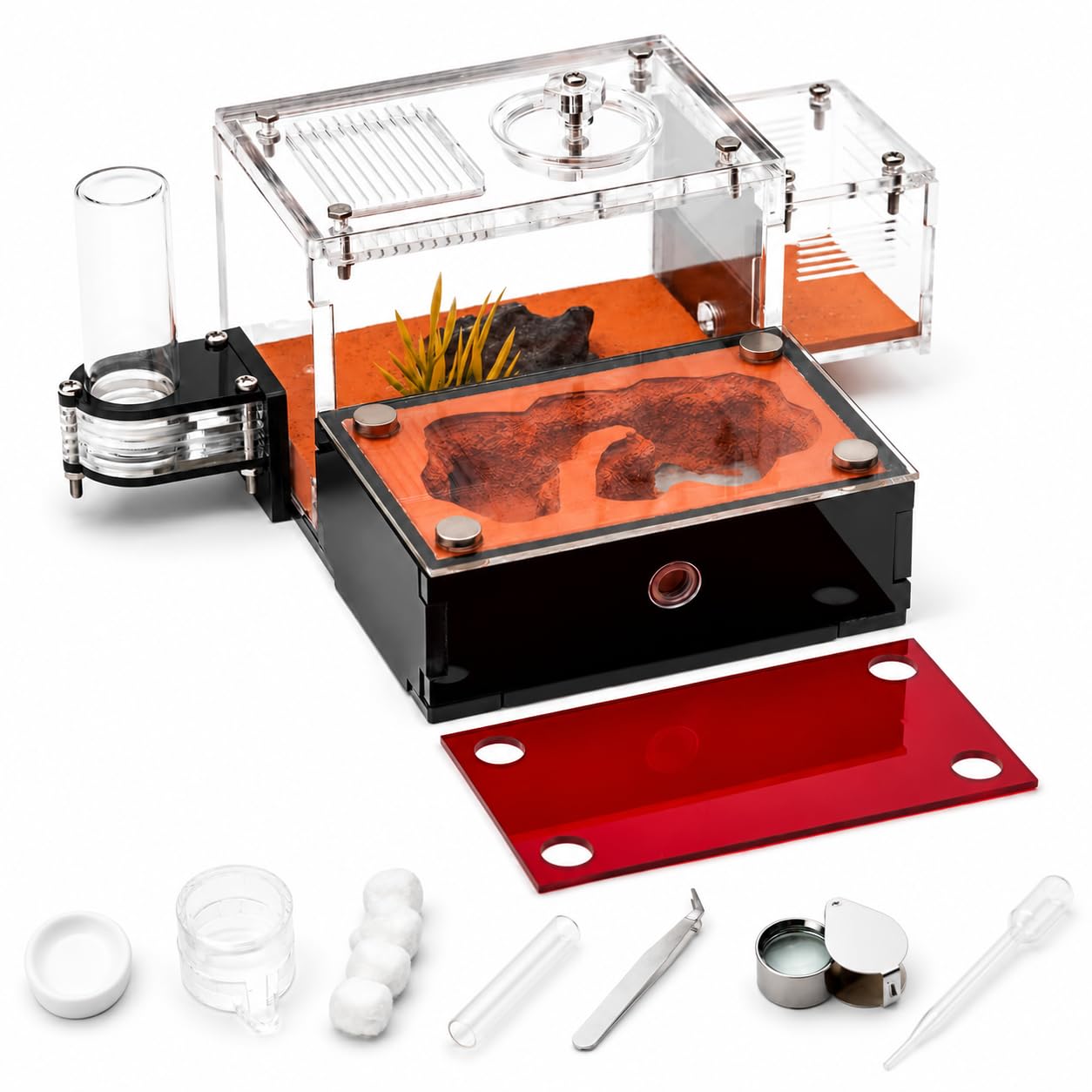
This formicarium is built from the start for a queen-right colony, not just worker entertainment.
This Rimsunta is the first farm on this list that acts as a real nest, not just a sand-filled box. It has two distinct chambers: a living area measuring 4.5 inches long by 2 inches high by 3.5 inches wide, plus a separate activity area at 4.7 inches long by 3.5 inches high by 3 inches wide. The living area comes with rockeries (small decorative rock structures) and plants to mimic a natural underground environment, which keeps the queen calm and encourages normal brood-rearing behavior.
What makes this a true adult-tier farm is the red transparent acrylic cover plate. You slide it over the nesting area and keep a desk lamp on nearby — the red light does not disturb the ants’ photophobic (light-avoiding) instincts, so the queen continues laying eggs. The large-capacity water tower holds enough moisture for 3-4 weeks per refill, according to the manufacturer. That is much longer than the 10-day cycle on the ELNMLHT Farm below. There are 3 expansion holes on the front, left, and right sides, and you get 3 rubber hoses to connect additional chambers when your colony outgrows the starter space. At 1.28 kilograms and 8.27 x 5.91 x 3.54 inches, it is heavier and more compact than the 0.84 kg Ant Farm Castle, which gives it a solid feel on the shelf.
Buyers report that a “small gap in wall allowed outside ants to enter and kill colony,” so inspect the acrylic seams for manufacturing defects upon delivery. Seal any gaps with a dab of glue before introducing your ants, a step several owners recommend based on experience. A dedicated garbage area on the farm makes cleaning straightforward — you unclip the compartment and wash it out.
Why the Queen Approves
- Red cover plate reduces ant stress, supports faster queen reproduction
- Large water tower lasts 3-4 weeks — much longer than the every-10-day refill needed by the ELNMLHT below
- 3 expansion ports + 3 rubber hoses let you grow the colony without tearing down the nest
One Snag to Watch
- Some units arrive with tiny manufacturing gaps between panels that can let outside ants enter or colony ants escape — seal with glue before use
- Smaller than many first-time buyers expect (user error, but worth noting)
Reach for this if: You want a queen-focused starter formicarium with proper hydration, expansion ports, and a red observation plate that respects the colony’s light sensitivity.
Look elsewhere if: You want a farm that is ready to use straight from the box with no modification — this one may need you to glue panel seams for full security.
2. ELNMLHT Ant Farm Castle

The biggest sand compartment in this roundup gives ants maximum tunneling space from day one.
At 11.8 x 1.85 x 5.9 inches, this ELNMLHT farm is the longest and tallest in the lineup — it offers 9% more linear space than the Ant Farm Castle’s 10.8 x 1.6 x 5.8 inches, so a larger colony gets more room to dig and expand before you need upgrades. It comes with two packs of dedicated sand (instead of the usual one), plus a drip bottle, a magnifier, a pair of tweezers, a decorative tree, a food basin, and a pair of tiny flags — the most complete accessory bundle in this price tier.
The automatic water supply system works the same way as the Ant Farm Castle: you fill the water tower every 10 days, and a self-locking device prevents ants from climbing into the water and drowning. The 0.01mm ventilation holes keep the air flowing while blocking escape attempts. The ant farm is designed with separate zones: a loading area where you introduce new ants, a feeding station, an egg-laying chamber, and an excavation dump area where the ants pile the sand they dig out of tunnels. At 1.22 kilograms, it is noticeably heavier than the 0.84 kg Ant Farm Castle, which owners mention gives it a more stable feel on a desk or shelf.
Customers note that “ants built tunnels quickly, thriving 2 months without queen,” which confirms that the sand composition and hydration are adequate for worker-only setups. A few owners mentioned the instructions are “super vague” on water setup and sand moisture levels — you will need some trial and error to get the humidity right, but once dialed in, the farm runs smoothly.
Biggest Drawback: The included instructions are vague on critical steps like how much water to add and how to prime the automatic system. Plan for a little hands-on learning.
Why It Earns the Spot: For a mid-range price, you get the largest tunneling space, the most included accessories, a solid acrylic build, and an auto-hydration system that worked for months in owner-reported setups.
Choose this if: You want the most room for your ants to dig tunnels immediately, without having to buy extra sand or accessories separately.
skip it if: You are a beginner who wants step-by-step instructions — the vague manual will frustrate you, and you may over-wet the sand your first time.
3. Ants Footsteps Ant Farm Nest Science DIY Terrarium Kit

A builder’s farm with flawless acrylic fit and near-infinite expandability for serious hobbyists.
This Ants Footsteps kit is not pre-assembled — you put it together yourself, and the payoff is a formicarium (a human-made ant nest) with exceptionally clear acrylic panels that one reviewer described as “crisp.” The kit includes a farm nest, a separate water tower farm nest, and an activity area. The whole system weighs 1.52 kilograms, making it the heaviest farm in this lineup and a sign of the thick, stable acrylic used throughout.
The design supports “infinite expansion,” according to the manufacturer, because you can connect and attach additional farm nests to the activity area using the included ports. A sunshade (a small cover that blocks light) protects the ants from sunlight, since ants are photophobic (light-averse) and will work harder to find dark places to nest if the habitat is too bright. The instructions are notably poor — reviewers report missing references to a “blue block” that does not exist, and the purpose of several small metal and red plastic pieces is never explained. Assembly itself takes less than 30 minutes once you figure out the layout, and the acrylic pieces fit together “flawlessly,” as one reviewer noted.
Buyers recommend gluing the side panels for full escape-proofing, as the snap-fit design can leave tiny gaps for very small ants. The kit includes cotton balls for the water towers (they create water resistance so ants do not drown), tweezers, a pipette, and plugs for blocking off chambers you do not want to use yet.
What Makes It Premium
- Thick, crisp acrylic with a near-perfect fit when assembled correctly
- Fully modular — you can keep adding farm nests to the activity area as the colony grows
- Built-in hydration system with cotton-ball wicking for safe water access
The Frustration Point
- Instructions are genuinely bad — some pieces are never explained, and the “blue block” reference is a mistake
- No mention of needing substrate (sand or soil) in the manual; you must figure that out yourself
- You need to glue side panels for full escape-proofing, which adds an extra step
Ideal for: A hobbyist who enjoys the assembly process, wants the clearest view possible of the colony, and plans to expand the nest system over time.
Not ideal for: Someone who wants a ready-out-of-the-box ant farm with clear instructions — this kit demands patience and a little DIY problem-solving.
4. Rimsunta Lumen Hotel Ant Farm Nest with Built-in LED Lights
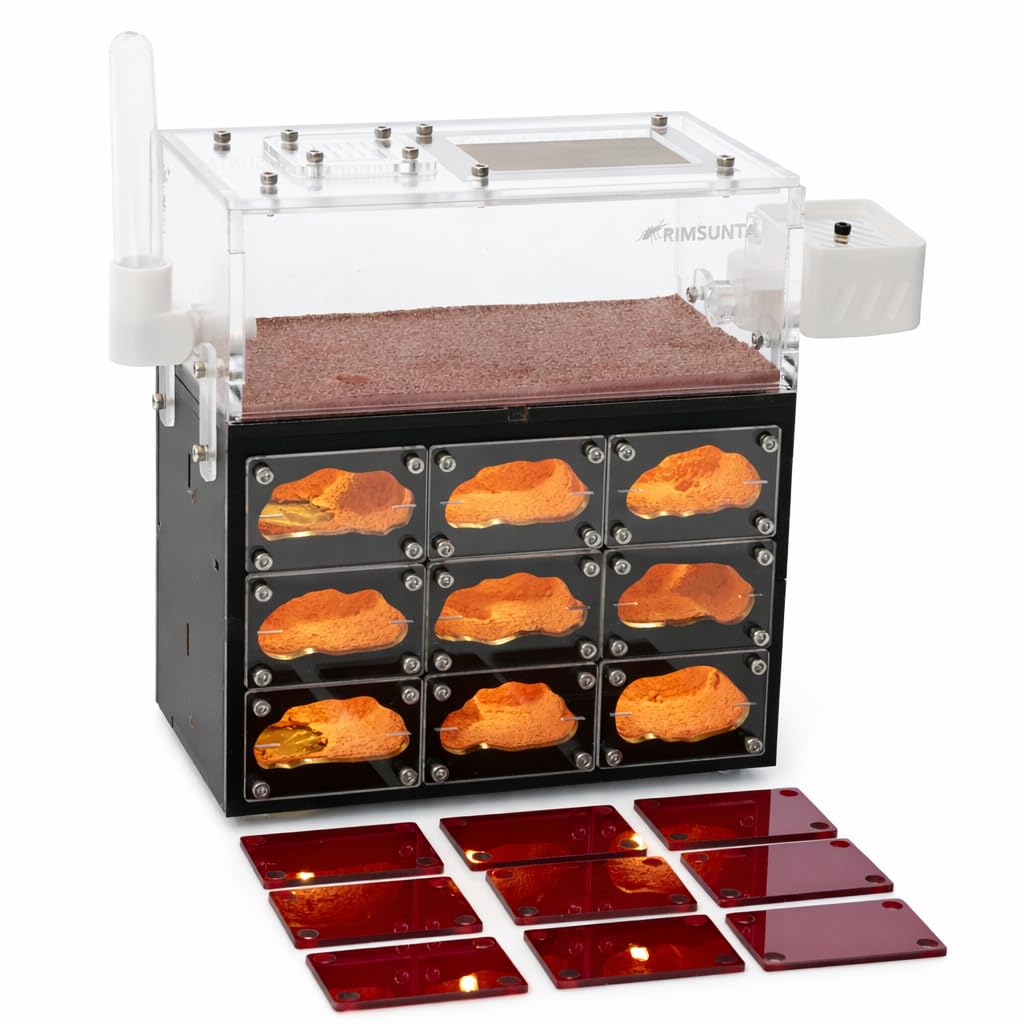
A hotel-like ant farm with built-in LED lights for viewing the colony in the dark.
This Lumen Hotel from Rimsunta is the only ant farm in this roundup with built-in LED lighting, which lets you observe ant activity at night or in a dim room without shining a flashlight directly at the nest (which would stress the colony). The nest itself measures 7.48 x 3.94 x 7.09 inches and is designed to simulate an underground cave system, complete with rockeries for decoration. It includes the same red transparent cover plate found on the Rimsunta Formicarium above, so you can keep the queen calm under normal room lighting.
The large-capacity water tower lasts 3-4 weeks per refill, just like its sibling product. The farm also has a garbage area that you can unclip and clean separately, which keeps the main nest from getting moldy from waste buildup. There are expansion ports on three sides (front, left, right), and the manufacturer lists an expandability feature with rubber hoses for adding additional chambers. This farm is designed for a queen-right colony, with stabilized conditions (consistent temperature and hydration) intended to increase the queen’s reproduction speed.
Reviewers point out a critical reliability issue: several units arrived with “none of the lights on the inside worked,” and one owner had to “fix loose wire/solder” to get the LEDs operational. The kit does not come with written instructions — you assemble it from the product picture, which several buyers found confusing. One owner noted that “ants kept crawling out of the panel cracks,” so gluing seams is strongly recommended here, as with most acrylic snap-fit farms.
Standout Spec: The built-in LED system is unique in this category, offering night viewing without upsetting the ants’ photophobic nature.
The Honest Trade-Off: The LED wiring is prone to defects — review your unit immediately upon delivery and plan to solder or exchange if the lights do not work. The lack of printed instructions also makes this a tricky pick for a first-time adult ant keeper.
Buy it for: The novelty of watching your colony under LED night-lighting — a feature no other farm here offers.
Avoid it if: You are not comfortable troubleshooting electronics (soldering wires, testing connections) or sealing acrylic seams yourself.
5. Ant Farm Castle (wtsyant) — Large Viewing Area
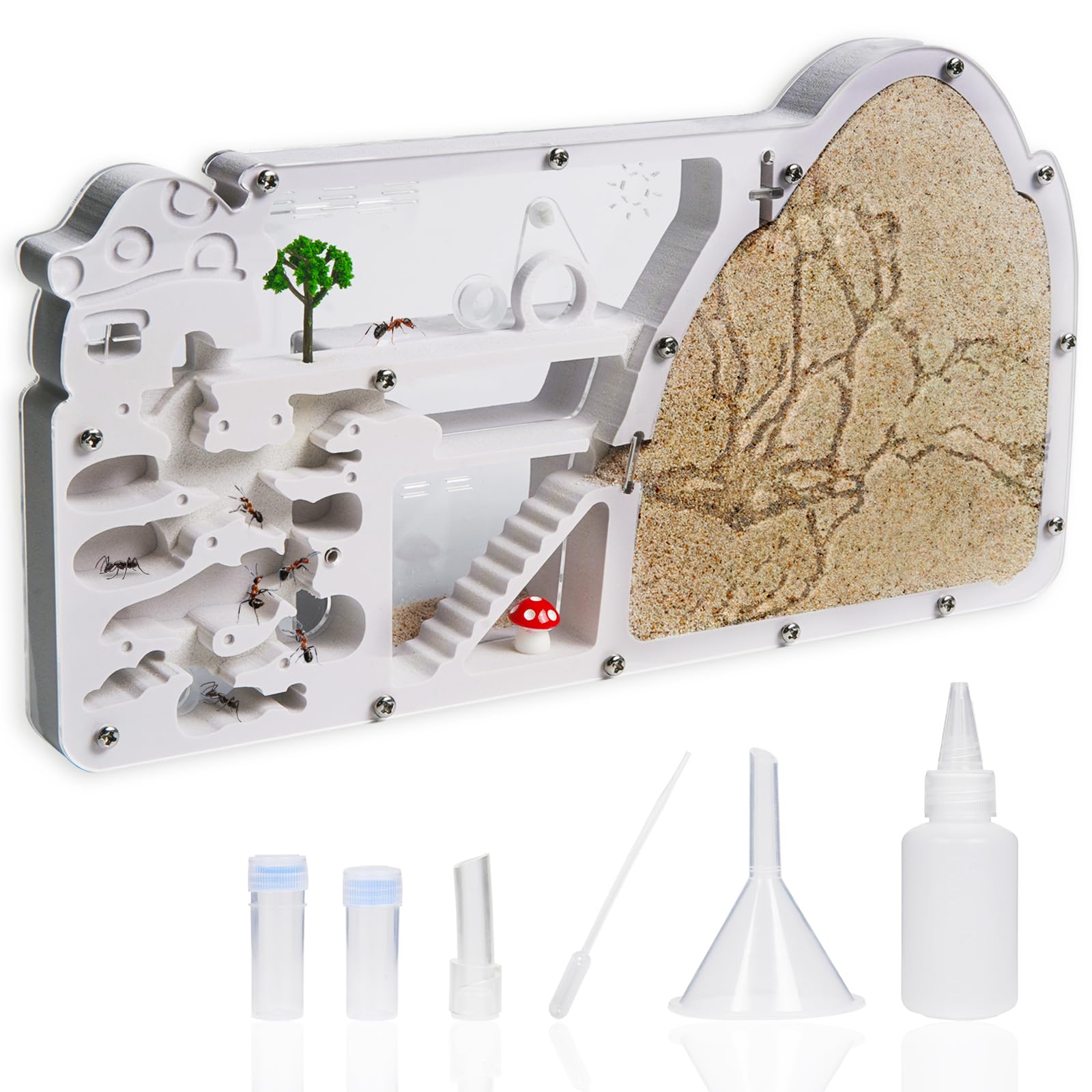
The easiest entry point for an adult who wants to watch harvester ants dig tunnels immediately.
This Ant Farm Castle by wtsyant is the most beginner-friendly farm in the list, and it is the only one with a double-sided viewing design that gives you two full windows — one on each face — into the colony’s activity. At 10.8 x 1.6 x 5.8 inches and 0.84 kilograms, it is the lightest and thinnest farm here, but that makes it easy to move and store. The automatic water system only needs a refill every 10 days; the tiny 0.01mm ventilation holes provide plenty of air while preventing escapes.
The farm has separate zones for digging, feeding, watering, and egg-laying, all clearly labeled in the instruction manual (rare in this category). The included tool kit has a drip bottle, a funnel, a dropper, and a water tower. One buyer’s repeated praise: “After 10 days, ants thriving, no escape issues,” which speaks directly to the two biggest worries for a new ant keeper. The acrylic is durable, and shoppers say that it can be disassembled for cleaning without cracking the panels. The Age Range is rated 3 years and up, but the educational value scales well for teenagers and adults studying basic colony behavior.
The main trade-off is the sand volume — at 1.6 inches of thickness, the tunneling depth is shallower than the ELNMLHT’s 1.85-inch depth, so a large, fast-digging colony may run out of vertical room sooner. Ants are not included, so you will need to order harvester ants separately (local bait shops or online insect suppliers are typical sources).
What Works Well
- Double-sided viewing — two full-size windows for observing ant activity from either side
- Simpler overall than the Rimsunta and Ants Footsteps farms, with clear instructions
- Escape-proof design confirmed by multiple buyer reviews over weeks of use
What Holds It Back
- At 0.84 kg it is noticeably lighter and less stable than the 1.22 kg ELNMLHT — can slide if bumped
- Shallow sand depth (1.6 in) limits tunneling space for larger colonies
Best for: A first-time adult ant keeper who wants the most straightforward, no-surprises setup with proven escape-proofing and clear instructions.
Not the best for: A serious hobbyist planning to keep a queen-right colony long-term — the shallow depth and lack of expansion ports will limit growth.
6. Anthouse.ES Natural Sand Ant Farm — Acrylic Starter Kit

A premium European starter kit that brings a laboratory-grade acrylic sandwich to your desk.
This Anthouse.ES ant farm is made in Spain and comes with everything you need to start a small colony: the acrylic sandwich-style tank, a feeder, a water dispenser (drinker), a plastic pipette, 10 ml of blue sugar (energy food for ants), 250 grams of mixed sand and clay, 50 grams of decorative sand, and 50 stone granules for decoration. The tank itself is 7.87 x 3.94 x 3.94 inches with a 1.5 cm thick sand layer, and its 2000 ml (2-liter) total volume is designed for colonies of over 50 workers in small species, or 25 in larger species.
The design is straightforward: you pour the sand and clay mixture into the acrylic sandwich, moisten it with 5-10 ml of water (not all at once — too much water creates a mud pit that collapses tunnels), and then introduce your ants. Maintenance is as simple as cleaning with soapy water and a cloth, avoiding alcohol or chemicals. The manufacturer, Anthouse.es, was born out of the Lamarabunta ant enthusiast forum and has produced over 80 ant farm models in-house in Spain, which gives this product more pedigree than most generic imports.
Buyers are split: one owner described it as “fantastic habitat” and praised the price for what is included, while another called it “super small, barely any supplies” and was upset about the lack of an ant voucher. The size is genuinely compact — smaller than any other farm in this roundup — so it is a good fit for a desktop starter colony, but not for a large multi-species setup. The kit does not include ants or a queen, and the instructions are minimal (some buyers reported none at all, just items thrown in a cardboard box).
Why It Stands Out
- Complete starter set includes sand, food, pipette, water dispenser, and decorative stones — everything except ants
- Made in Spain by a dedicated ant-farm manufacturer with over 80 models and forum roots
- Simple, clean acrylic sandwich design that is easy to clean and maintain with just soapy water
The Catch
- Compact size is smaller than many buyers expect — definitely not for a large colony or queen-right setup
- Inconsistent packaging — some buyers received no instructions and items looking like they were previously returned
- High price point for the physical volume you get, relative to larger farms like the ELNMLHT
Reach for this if: You want a premium European-made starter kit with all the supplies included, for a small desktop colony of 25-50 workers — and you value the manufacturer’s ant-specialist pedigree.
pass on it if: You need a large colony habitat or expect a queen-right setup — this tank is designed for small species only, and the size is genuinely compact.
Understanding the Specs
Red Cover Plate & Ant Behavior
Ants are photophobic (they avoid light) because their natural habitat is underground. A red transparent acrylic plate allows you to see the colony without the ants detecting the light — red wavelengths are nearly invisible to most ant species. This matters because a queen that feels constantly exposed to light will stop laying eggs, and workers will panic-tunnel instead of building a stable nest. Farms that come with a red cover plate (like the Rimsunta Formicarium and Lumen Hotel) are designed for queen-right colonies where long-term health and reproduction are the priority.
Water Tower Capacity & Refill Cycles
The hydration system is the single most overlooked spec by first-time ant buyers. Automatic water towers on mid-range farms (like the Ant Farm Castle and ELNMLHT) need refilling every 10 days. Larger-capacity towers found on premium farms (like the Rimsunta Formicarium and Lumen Hotel) last 3-4 weeks per refill, according to the manufacturer. This matters because dry sand collapses tunnels and kills ants; oversaturated sand causes mold and drowns the brood (ant eggs and larvae). A water tower with a regulated drip rate keeps the sand consistently moist at the right level.
Expansion Ports & Modular Growth
A single-chamber ant farm works for the first few weeks, but a queen-right colony with a producing queen will triple or quadruple in size within months. Expansion ports (typically 3-6 holes on the front and sides of the nest) let you connect rubber hoses to additional chambers — activity arenas, outworlds (feeding areas), or additional nesting modules. Farms with expansion ports, like the Rimsunta Formicarium and Ants Footsteps kit, are designed to grow with the colony rather than becoming obsolete. Farms without ports, like the Ant Farm Castle and Anthouse.ES, are best for short-term observation or small worker-only groups.
Sand Depth & Tunneling Success
Ants build tunnels by removing sand particles and piling them at the surface (the “excavation dump” zone). Deeper sand layers — 1.85 inches on the ELNMLHT versus 1.6 inches on the Ant Farm Castle — mean more vertical room for complex tunneling systems before the ants hit the bottom and start digging sideways. The composition of the sand also matters: a mix of sand with some clay (like the Anthouse.ES kit’s 250g sand/clay blend) holds tunnel shape better than pure playground sand, which collapses easily when dry.
FAQ
Do I need a queen to start an ant farm, or can I just use worker ants?
Will ants escape from an acrylic ant farm?
Can I connect two ant farms together?
How often do I need to water the ants?
What sand works best for ant tunnels?
The Rimsunta Formicarium and Lumen Hotel look similar — what is different?
How many ants fit in the Anthouse.ES 20x10x10 cm farm?
What species of ant is easiest for a first-time adult keeper?
Can I use any acrylic ant farm for a queen with a large colony?
How do I clean an ant farm without harming the ants?
Final Thoughts: The Verdict
For most adult ant keepers, the ant farm for adults winner is the Rimsunta Formicarium because it balances queen-right design, a red cover plate for stable colony behavior, a 3-4 week large water tower, and expansion ports — all at a price that makes it a viable long-term habitat rather than a disposable toy. If you want the largest sand space for tunneling and the most accessories at a mid-range budget, grab the ELNMLHT Ant Farm Castle. And for a premium European starter kit that includes everything except the ants themselves — from food to pipette to mixed sand and decorative stones — the Anthouse.ES Natural Sand Ant Farm delivers a clean, laboratory-grade setup for a small desktop colony.
How We Picked
We do not accept paid placement. Every pick is matched to a real buyer and a real use-case; we do not hands-on test units.
Sources & Methodology
Specifications: manufacturer listings and product documentation. Review insights: verified customer reviews, as of July 2026. Pricing: not shown on this page (it changes often); check the current price via the retailer link.
As an Amazon Associate, Gadgets Feed earns from qualifying purchases. This does not affect which products we feature.
Related Guides
Product prices and availability are accurate as of the date/time indicated and are subject to change. Any price and availability information displayed on Amazon at the time of purchase will apply to the purchase of this product. As an Amazon Associate I earn from qualifying purchases.
CERTAIN CONTENT THAT APPEARS ON THIS SITE COMES FROM AMAZON. THIS CONTENT IS PROVIDED "AS IS" AND IS SUBJECT TO CHANGE OR REMOVAL AT ANY TIME.
Amazon and the Amazon logo are trademarks of Amazon.com, Inc. or its affiliates.