
Our readers keep the lights on and my morning glass full of iced black tea. As an Amazon Associate, I earn from qualifying purchases.
Specs are compiled from manufacturer listings and verified buyer reviews and can change over time — please confirm the key details on the product page before buying.
If you are wiring a 50-amp EV charger (a device that charges an electric car), a generator transfer switch, or a sub-panel in a basement, the single difference between a safe, reliable circuit and a future fire hazard is the gauge (the thickness of the wire) you buy. 6 AWG (6 gauge, meaning the 6th size in the American Wire Gauge system) is the standard thickness for heavy 50-amp and some 40-amp circuits, but not all 6-gauge wire is the same — the difference between solid bare copper, flexible stranded welding cable, and multi-conductor SOOW cord changes both how hard the wire is to pull and exactly what job it can do.
I’m Min — the founder and writer behind Gadgets Feed. This guide is built by comparing the manufacturers’ published specifications and the patterns across verified customer reviews, so you get each pick’s real strengths and trade-offs instead of marketing spin.
If you need bendable battery cable for a tight engine bay or bare copper for a grounding rod (a metal rod driven into the earth to safely redirect electrical faults), knowing the ideal 6 ga wire starts here.
Quick Picks
- iGreely 6 Gauge 6 AWG Wire 10 Feet Black + 10 — Best Overall
- 6ft 6/4 Wire SOOW Cable,6 Gauge Wire 4 — Pro Grade
- 6 Gauge Battery Cable, 15FT Red + 15FT Black 6 — Value Length
- Southwire 6-Gauge Bare Copper Wire — Pure Material
- NM-B 6/3 Wire with Ground — Indoor Install
- 6 Gauge Battery Cable Copper Wire — Pro Length
- 25FT 6/3 SOOW Portable Power Cable-6 Gauge 3 — Ultra Flex
How To Choose The Best 6 Ga Wire
Grabbing any spool labeled “6 gauge” is a trap if you do not match the wire type to your job. The wrong construction — solid when you need stranded, or unjacketed when you need abrasion resistance — turns a simple install into a frustrating, time-consuming headache.
Strand Count and Flexibility
Single-strand solid wire (like the Southwire bare copper) is stiff and holds its shape, which is perfect for grounding rods or fixed conduit runs (a pipe protecting wires). But if you are snaking wire through a van wall, a boat console, or inside a generator outlet box, you want a high strand count — 423 strands of 0.2mm copper, found on the iGreely and Geosiry cables, bend like a thick rope and make tight turns that solid wire cannot take without kinking.
OFC vs. Standard Copper vs. Copper-Clad Aluminum
Oxygen-free copper (OFC — copper refined to remove oxygen impurities) wire, like the Geosiry welding cable, contains fewer impurities and delivers slightly better conductivity with less internal resistance. Standard pure copper (often labeled “bare copper” or “all copper”) works perfectly for most residential circuits. The real danger is copper-clad aluminum (steel or aluminum with a thin copper coating) — it looks like copper but weighs less and can overheat under heavy loads. Several buyers on these products warn to check with a magnet; if the wire sticks, it is not solid copper.
Jacket Type for the Environment
EPDM-jacketed cables (iGreely, Geosiry) resist solvents, abrasion, and high heat, making them ideal for engine bays and outdoor marine use. PVC-jacketed cables (Kimbluth) offer a slick, shiny surface that slides easily through conduit but can be less flexible in freezing temperatures. SOOW rubber-jacketed cable (CLLOMAGY, energeaster) is rated for oil, water, and continuous outdoor UV exposure, so it is the go-to for generator extension cords and industrial power distribution.
Quick Comparison
| Model | Best For | Stranding | Conductors | Voltage | Amazon |
|---|---|---|---|---|---|
| iGreely 6 AWG Kit + Lugs | Battery / inverter installs | 423 strands | 2 (Red + Black) | 600V | $38.99Amazon |
| 6ft 6/4 SOOW (CLLOMAGY) | 50A generator / EV cable | Stranded | 4 | 600V | from $42.99Amazon |
| Geosiry 15ft+15ft Welding Cable | Long-run solar / battery | 423 strands | 2 (Red + Black) | 600V | $46.99Amazon |
| Southwire Bare Solid Copper | Grounding / bonding | Solid (single) | 1 | — | $54.00Amazon |
| XMK 6/3 NM-B w/ Ground | Indoor branch circuits | 3 strands (insulated) | 4 (3 + ground) | 600V | from $84.99Amazon |
| Kimbluth 25ft+25ft PVC Cable | Solar / professional wiring | Multi-strand | 2 (Red + Black) | 600V | $79.99Amazon |
| Energeaster 25ft 6/3 SOOW | Heavy outdoor extension cord | OFC stranded | 3 | 600V | $95.99Amazon |
In‑Depth Reviews
1. iGreely 6 Gauge 6 AWG Wire 10 Feet Black + 10 Feet Red Ultra Flexible Welding Battery Pure Copper Cable + 5pcs of 5/16″ & 5pcs 3/8″ Copper Cable Lug Terminal Connectors+Heat Shrink Tubing
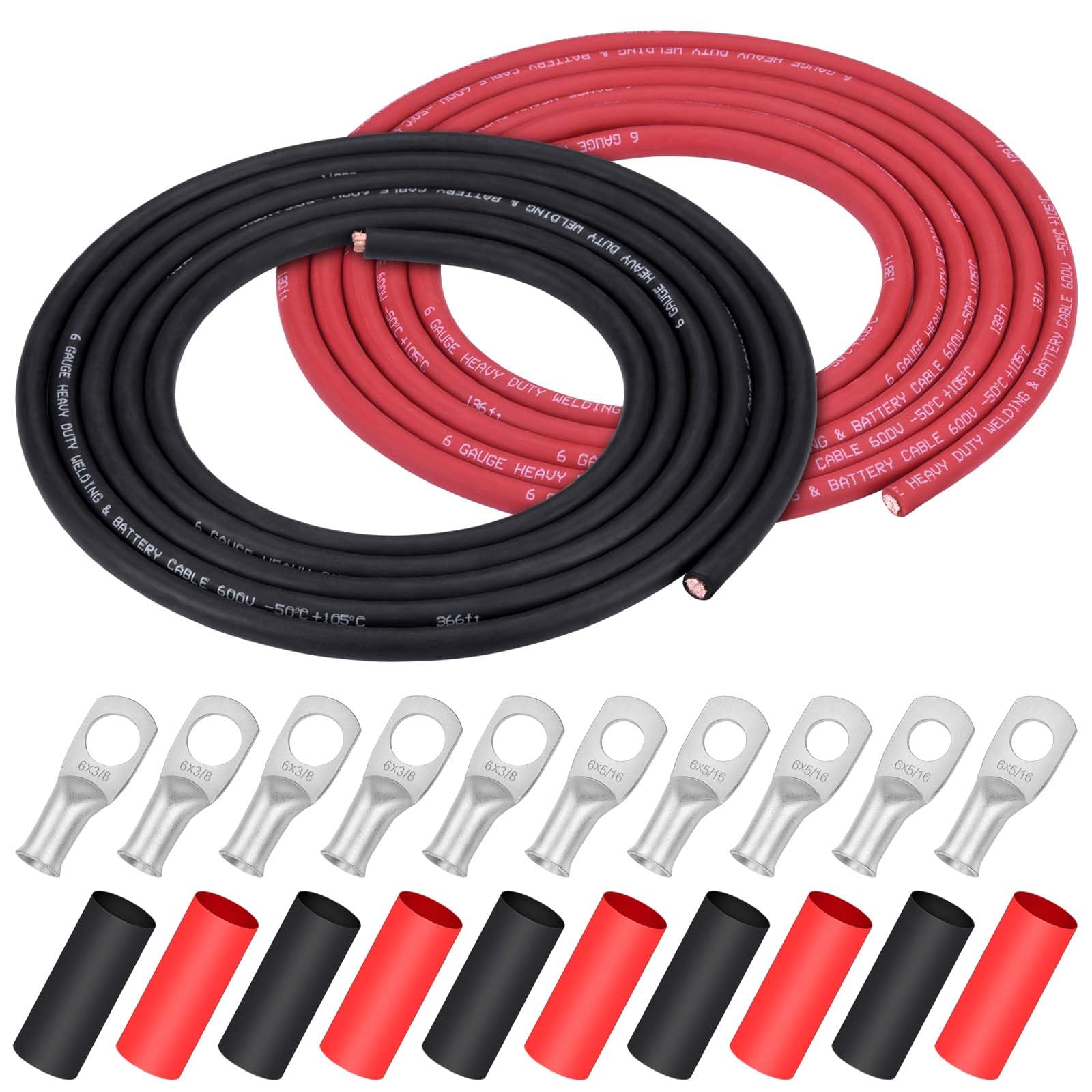
The all-in-one kit that saves a second trip to the hardware store for lugs and shrink tube.
This is the pick if you need to finish a battery, inverter, or marine project in one order. The iGreely comes with two 10-foot lengths of red and black ultra-flexible welding cable (423 strands of 0.2mm copper each), plus five 5/16″ copper lugs, five 3/8″ copper lugs, and five red and five black heat-shrink tubes — every part you need to terminate the ends cleanly. The EPDM insulation jacket is tough and solvent-resistant, so it stands up to the grease and moisture inside a boat console or an engine bay. Buyers report it “works well in my new 12 volt electrical system in my van” and call it “flexible and easy to crimp connectors to it.”
The main trade-off here is length: at 10 feet per color, this is shorter than the Geosiry or Kimbluth cables below. If your run from battery to load is more than 10 feet, you will either need two kits or a longer single spool. But for the price, getting matched lugs and heat shrink included makes this the best value for a contained DC project.
Compared to the bare Southwire solid copper below, this iGreely is dramatically easier to route in tight spaces because of its 423 fine strands — you can bend it 90 degrees around a bracket without fighting the wire.
Kit completeness: Lugs and heat shrink included save you a separate purchase — just crimp and go.
Short-run limitation: At 10 feet per color, longer battery-to-inverter runs may need a second kit.
Reach for this if: You are wiring a van, boat, or solar setup where flexibility and a complete termination kit matter more than extreme length.
Look elsewhere if: Your project needs a single continuous run longer than 10 feet per polarity.
2. 6ft 6/4 Wire SOOW Cable,6 Gauge Wire 4 Conductor 600V Portable Power Cable 6/4 AWG 50amp Electric Wire Extension Cord for Welder,Generator,Industrial Outdoor SOOW Bulk Cord with UL,Outer Dia 27.2mm
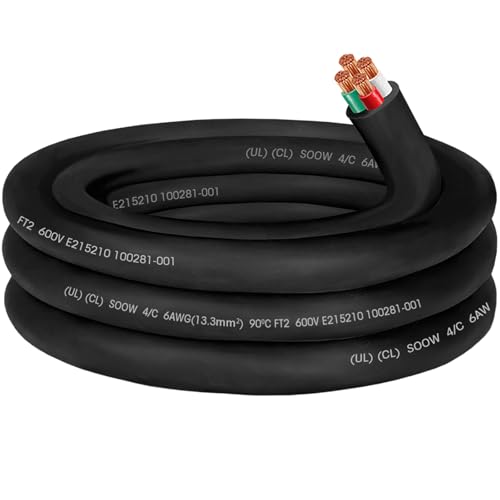
The four-conductor SOOW cable that handles generator, EV charger, and welder duty all at once.
This is a very different animal from the two-conductor battery cables above. The CLLOMAGY SOOW cable packs four separate 6 AWG conductors inside a single tough rubber jacket, rated for 50 amps and 600 volts. That makes it exactly what you need for a NEMA 14-50 outlet, a generator inlet box, or a welder circuit — three conductors (two hot, one neutral) plus a ground. The outer diameter is 27.2mm, so it is a thick, heavy cable, but owners mention it is “very flexible and easy to work with especially when working with the small confines of a 50 amp generator outlet box.” One buyer notes they “have been using it to charge my EV for about a year with no issues and no quality degradation.”
The catch is the jacket-on-jacket construction. Multiple reviewers mention that while the outer rubber is tough, the individual conductor insulation underneath is softer and can nick easily if you are not careful when stripping the main jacket. Use a cable stripper with a depth stop rather than a utility knife to avoid scoring.
This cable has 4x the number of conductors versus the single-conductor Southwire bare copper below, so it replaces an entire spool of individual THHN wires for a multi-wire circuit.
Where it excels
- Four 6 AWG conductors in one jacket — ready for 50A generator or EV circuits.
- SOOW jacket resists oil, water, and outdoor weathering.
- UL listed (E1215210) for code compliance on permanent installs.
One careful point
- Inner conductor insulation is soft — use sharp shears or a depth-marked stripper to avoid accidental nicks.
Grab this for: Any 50-amp, 240-volt project that needs all four conductors in one continuous pull (generator inlet, EV charger, welder outlet).
skip it if: You only need two-conductor battery cable — you pay for two extra conductors you will not use.
3. 6 Gauge Battery Cable, 15FT Red + 15FT Black 6 AWG Welding Cable, Stranded Oxygen-Free Copper Wire for Automotive, Battery, Solar, Marine and Generator
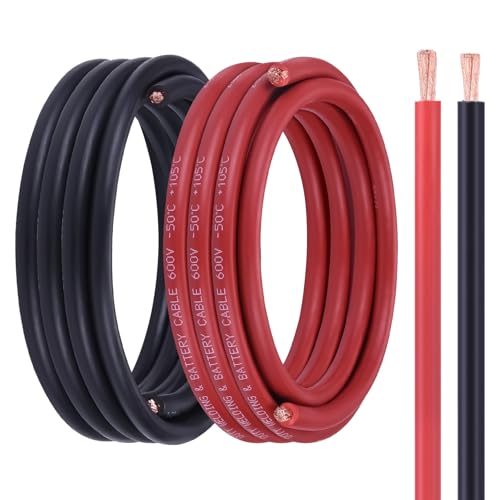
50% more copper per color than the top pick — for when 10 feet is not enough.
If the iGreely kit’s 10-foot lengths leave you a few feet short of your battery bank or inverter, the Geosiry steps up to 15 feet of red and 15 feet of black, all in fully annealed oxygen-free copper (OFC) with the same 423-strand construction. That extra five feet per conductor makes a real difference when you are routing around a wheel well or through a bulkhead in a boat. The EPDM jacket handles temperatures from -50°C to +105°C (-58°F to +221°F) and resists solvents and abrasion, so it can live in the same tough environments as the iGreely.
Compared to the Kimbluth 25-foot cable below, this Geosiry uses an EPDM jacket instead of PVC, which many DIYers prefer for marine or outdoor use because EPDM stays flexible in cold weather and resists ozone cracking. Customers note the wire is “good quality, great price” and that “the wires felt good quality and were easy to work with” for a pure sine wave inverter install.
The only miss compared to the top pick is that the Geosiry does not include lugs or heat shrink — you will need to buy those separately, which adds cost and a second order if you do not already have them.
Longer reach: 15 feet per color gives you the extra slack for runs across a truck bed or boat bilge.
No termination kit: Budget for lugs and heat shrink if you do not already have them in your toolbox.
Go with this if: 10-foot wires are too short for your inverter or battery location, and you want OFC quality without paying for a full 50-foot spool.
Choose something else if: You prefer having lugs and shrink tube in the box to finish the job in one trip.
4. Southwire 6-Gauge Bare Copper Wire – Solid Soft‑Drawn Uninsulated Copper Conductor for Grounding & Electrical Applications, 50ft
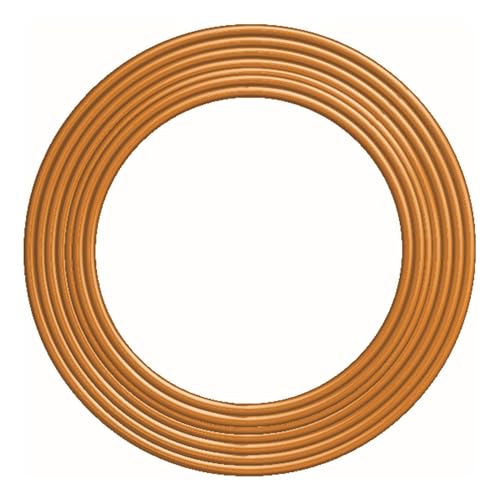
Uninsulated solid copper that serves one purpose perfectly: ground rods and bonding jumpers.
This is not a wire for carrying power inside an appliance. Southwire’s bare solid copper is soft-drawn (meaning it bends more easily than hard-drawn copper but still holds its shape when routed) and measures 0.13 inches in diameter. Its single job is grounding — bonding a residential electrical service to a ground rod, connecting metal enclosures, or making jumper wires in a panel where insulation is not needed. Buyers confirm it is “true 6-gauge solid bare copper, clean and corrosion-free” and warn that if you see a much cheaper spool, “check it with a magnet before using, because it might actually be copper-plated steel.”
The difference compared to the CLLOMAGY SOOW cable above is straightforward: this is a single solid strand, while the SOOW cable bundles four insulated stranded conductors. You buy the Southwire for an entirely different job — grounding, not power distribution.
Because there is no jacket, this wire is not suited for outdoor burial, direct contact with concrete, or any location where it might rub against metal edges. It also takes significant effort to make tight bends; one reviewer notes it “requires effort for tight bends in confined spaces.”
What it does right
- Solid soft-drawn copper — pure material with no plating, verified by buyers.
- Keeps its shape when routed, unlike stranded wire that can sag.
- 50-foot length covers most residential grounding runs in one piece.
Where it does not fit
- No insulation — cannot be used for power-carrying conductors in a circuit.
- Stiff for tight corners — expect to wrestle it into narrow spaces.
Buy this when: You need code-compliant bare copper for grounding electrodes, bonding water pipes, or connecting a sub-panel ground bus.
Pass on it when: You need a flexible, insulated conductor for power runs — reach for a stranded jacketed cable instead.
5. NM-B 6/3 Wire with Ground,15ft 6 AWG Copper Wire 6 Gauge 3 Conductor Nonmetallic Sheathed NM-B Cable,6/3 NM-B W/G Wire Stranded Indoor Residential Electrical Wiring for Branch Circuit Switches,Outlets
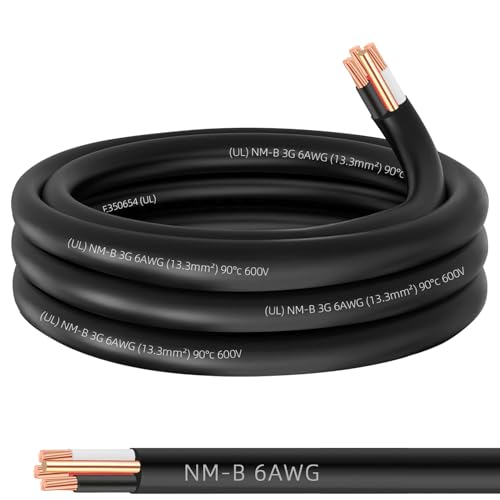
The standard Romex-style cable for a 50-amp indoor circuit — oven, EV charger, sub-panel.
If you are running wire inside a finished garage, basement, or attic, NM-B (nonmetallic sheathed cable — a common type of indoor wiring often called Romex) is what electricians pull through studs and joists. This XMK cable bundles three 6 AWG stranded conductors (black, white, red) plus a 10 AWG bare ground wire inside a gray PVC jacket. It is rated for 600 volts and temperatures from -14°F to 194°F, which covers any indoor dry location. One buyer used it to wire “a 50 amp Car / RV plug” and called it “sturdy 6 gauge wire that installed easily enough for an EV charger.” Another noted it was “73.68% cheaper than buying by foot at major chain stores.”
This cable is stiff compared to SOOW or welding cable. The PVC jacket and individual conductor insulation make it harder to bend into sharp 90-degree turns inside a panel. Do not buy this if you need to make a flexible extension cord — NM-B is intended for fixed, protected wiring inside walls or conduit only, not for portable use.
Unlike the CLLOMAGY SOOW cable that has four conductors (suitable for a NEMA 14-50 with ground), this NM-B has three conductors plus a separate ground, which covers the same 240V circuit but uses the standard electrical code color coding for residential work.
Code-friendly: UL-listed NM-B with bonded ground — meets residential electrical code for fixed indoor branch circuits.
Not portable: Stiff jacket and no oil/water rating mean this stays inside walls, not on the garage floor.
Reach for this if: You are adding a 240V/50A circuit inside a dry location — oven, dryer, EV charger, heat pump.
pass on it if: You need a flexible cord for outdoor use or a portable generator connection; choose SOOW cable instead.
6. 6 Gauge Battery Cable Copper Wire, 25FT Red+25FT Black 6 AWG Welding Cable Standard USA OFC Wire for Automotive, Battery, Solar, Marine and Generator

50 total feet of PVC-jacketed OFC — the long-run option for solar and alternator feeds.
When 15 feet per color still is not enough — say you are connecting a big solar array to a charge controller on the far side of a garage — the Kimbluth gives you 25 feet of red and 25 feet of black 6 AWG wire, all 99% pure OFC copper. The PVC jacket here is a deliberate choice: it has a slick, shiny surface that slides easily through conduit and resists gasoline, battery acid, and abrasion. Reviewers point out it is “flexible PVC cable” with the “slick, shiny surface of PVC but the flexibility of welding cable,” and one reviewer used it between a Victron solar controller and batteries, saying it “looks more professional.”
The working temperature range is -40°C to 105°C and the voltage rating is 600V, identical to the EPDM-jacketed cables. The difference is that PVC can stiffen noticeably in extreme cold (below -20°C) and may crack if flexed repeatedly at those temperatures, which is why marine installers often prefer EPDM. For indoor battery banks, RV compartments, or solar sheds, the PVC jacket works perfectly.
Compared to the iGreely kit, the Kimbluth gives you 2.5x the length per conductor but no included lugs or heat shrink, so factor in the cost of those terminations.
Best feature
- 50 feet total (25ft red + 25ft black) at a mid-range price — most length per dollar in the 2-conductor category.
- PVC jacket glides through conduit and resists battery acid and gasoline.
Trade-off
- PVC stiffens in deep cold compared to EPDM — less ideal for permanent outdoor winter runs.
Choose this for: Long battery or solar runs where you need 50 total feet of 6 AWG and a slick jacket that pulls easily through conduit.
Pass on it for: Arctic-temperature outdoor use — the EPDM-jacketed iGreely or Geosiry stays more flexible in extreme cold.
7. 25FT 6/3 SOOW Portable Power Cable-6 Gauge 3 Conductor-6AWG 600V 50A Bulk Cable Water & Oil Resistant Electric Wire for Welder,Generator,Motor Lead,Circuits,EV Car Charger,Heat Pump,Light(ETL)
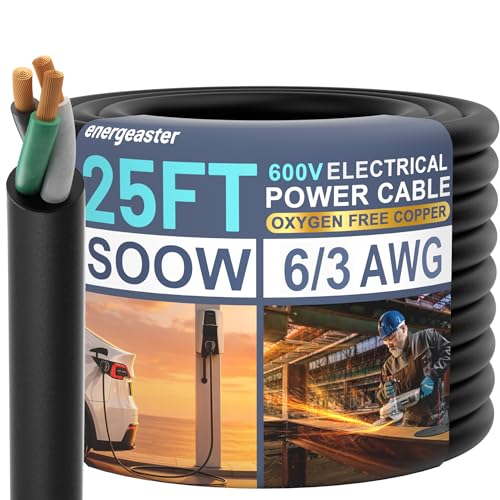
A 25-foot 3-conductor SOOW that is flexible enough to snake through conduit but tough enough for direct outdoor exposure.
This energeaster cable is the 3-conductor cousin of the CLLOMAGY 4-conductor SOOW above. It gives you three 6 AWG stranded OFC conductors inside a flame-retardant (V0 rated) rubber jacket rated for oil, water, UV, and extreme temperatures from -40°C to 90°C. That makes it ideal for a 240V 20A or 30A welder extension cord, a mini-split AC power whip, or a generator-to-house connection where you do not need a separate neutral. Shoppers say it “worked great for my wiring my generator directly to my electric panel” and that “the flexibility allowed this cable to easily go through the conduit.” Another reviewer ran it for holiday lights, noting it is “rated for 120VAC so works with regular lights.”
The critical difference between this and the CLLOMAGY cable: this is 3-conductor (two hots + ground, or hot + neutral + ground for 120V) while the CLLOMAGY is 4-conductor (two hots + neutral + ground for 50A 240V). For a 50-amp NEMA 14-50 outlet, you need the 4-conductor version; for a 30-amp welder or a 240V mini-split, this 3-conductor saves weight and cost.
The jacket is notably thick and durable — buyers call it “heavy duty and well made” — but that also makes it heavier than a standard extension cord. Plan for the extra weight when coiling and storing it.
All-weather build: CPE rubber jacket passes 720 hours of UV aging tests and resists diesel, oil, and battery acid.
Know your circuit: Three conductors mean this works for 240V loads without a neutral (welder, compressor) or 120V loads — not for a 50A RV with separate neutral.
Buy this for: A 240V welder, generator cord, or heat pump where you need oil/water/UV resistance and three conductors are enough.
Get the 4-conductor version instead if: You are wiring a NEMA 14-50 outlet that requires a separate neutral conductor for 120V loads.
Understanding the Specs
Strand Count vs. Solid Core
Solid wire (a single thick strand of copper) is stiff and holds its shape — perfect for grounding rods or fixed conduit where you route the wire once and leave it. Stranded wire bundles many fine copper threads together (423 strands on the iGreely and Geosiry cables) so the cable bends like a thick rope. This matters when you need to snake the wire around engine bays, van walls, or inside tight electrical boxes. The more strands, the more flexible the cable. For anything that moves or gets handled, choose stranded.
SOOW vs. NM-B vs. Welding Cable
SOOW (Service, Oil, and Water resistant — a rubber-jacketed cable for tough conditions) cable uses a thick rubber jacket that is tough enough for direct outdoor sun, moisture, and industrial chemicals — it is what you want for a generator extension cord or a welder lead. NM-B (nonmetallic sheathed, often called Romex) has a PVC jacket meant for indoor dry locations inside walls; it is cheaper but cannot handle water or UV. Welding cable (EPDM or PVC jacket, high-strand count) is the most flexible option for battery and inverter connections, but it usually comes in single-conductor lengths rather than bundled multi-conductor cables.
FAQ
Can I use 6 AWG wire for a 50-amp circuit?
What is the difference between OFC and regular copper wire?
Will solid bare copper work for my car battery cables?
How do I know if a wire is pure copper or copper-plated aluminum?
Can I bury 6 AWG SOOW cable directly in the ground?
What does “6/3” and “6/4” mean on wire labels?
Is EPDM or PVC jacket better for outdoor use?
How many strands should a flexible 6 AWG cable have?
Final Thoughts: The Verdict
For most buyers, the 6 ga wire that covers the widest range of jobs is the iGreely 6 AWG kit because it combines ultra-flexible 423-strand copper with a complete termination set of lugs and heat shrink at a fair price for short battery and inverter projects. If you need a full 50-amp 240V run for an EV charger or generator, the CLLOMAGY 6/4 SOOW cable is the toughest four-conductor choice. And for a long solar or battery bank feed, the Kimbluth 50-foot OFC cable gives you the most length per dollar in a clean PVC jacket.
How We Picked
We do not accept paid placement. Every pick is matched to a real buyer and a real use-case; we do not hands-on test units.
Sources & Methodology
Specifications: manufacturer listings and product documentation. Review insights: verified customer reviews, as of July 2026. Pricing: not shown on this page (it changes often); check the current price via the retailer link.
As an Amazon Associate, Gadgets Feed earns from qualifying purchases. This does not affect which products we feature.
Related Guides
Product prices and availability are accurate as of the date/time indicated and are subject to change. Any price and availability information displayed on Amazon at the time of purchase will apply to the purchase of this product. As an Amazon Associate I earn from qualifying purchases.
CERTAIN CONTENT THAT APPEARS ON THIS SITE COMES FROM AMAZON. THIS CONTENT IS PROVIDED "AS IS" AND IS SUBJECT TO CHANGE OR REMOVAL AT ANY TIME.
Amazon and the Amazon logo are trademarks of Amazon.com, Inc. or its affiliates.