
Our readers keep the lights on and my morning glass full of iced black tea. As an Amazon Associate, I earn from qualifying purchases.
Specs are compiled from manufacturer listings and verified buyer reviews and can change over time — please confirm the key details on the product page before buying.
You bought that big new 4K TV, fired up a live sports game, and the player looked like a blurry blob. That is the ugly reality of non-4K content on a 4K screen — and it is why a television that specializes in upscaling (the art of making lower-resolution video look crisp at 4K) is the real difference between a good movie night and a headache. The trick is picking a set whose processor does the heavy lifting so you stop seeing pixels.
I’m Min — the founder and writer behind Gadgets Feed. This guide is built by comparing the manufacturers’ published specifications and the patterns across verified customer reviews, so you get each pick’s real strengths and trade-offs instead of marketing spin.
Here is exactly what to look for when shopping for a 4k upscaling tv: the processor that powers the upscaling, the real-world brightness and contrast it delivers, and whether the smart platform is snappy enough to keep up with your streaming habits.
Quick Picks
- Samsung 65-Inch Class OLED S90F 4K Smart TV — Top Performer
- LG 77-Inch Class OLED evo AI Super Upscaling 4K — Premium Pick
- Sony BRAVIA 2 II 50 Inch 4K Ultra HD LED Smart — Best Overall
- Sony BRAVIA 2 II 43 Inch 4K Ultra HD LED Smart — Best Value
How To Choose The Best 4K Upscaling TV
The whole point of a 4K upscaling TV is to take your existing HD channels, old DVD collections, and standard streaming video and make them look sharp on a 4K panel. The trick is that the TV itself has to invent the missing pixels — so the brains doing that work matter far more than the screen size.
Start with the Processor
The processor is the single component that determines how good your TV looks on everyday content. Sony uses its 4K Processor X1 or newer XR models, while Samsung packs in NQ4 AI Gen3 processors with 128 neural networks (tiny learning models that recognize textures and edges) that analyze each scene. LG’s Alpha 11 AI Processor Gen2 does similar real-time scene analysis. A faster, more modern processor means less blur and more natural texture in faces and grass during sports.
Panel Type: OLED vs. LED
OLED panels (like those on the Samsung S90F and LG G5) light each pixel individually, giving you perfect black and enormous contrast. LED panels (like the Sony BRAVIA 2 II) use a backlight that is always on, which means blacks appear more gray in a dark room. OLED wins on picture depth, but LED wins on value and resistance to burn-in for long news-channel sessions.
Motion Handling and Gaming Needs
If you watch a lot of sports or play fast console games, look for a high refresh rate (how many times per second the screen redraws, measured in hertz, or Hz) and a motion-smoothing feature. Sony’s Motionflow XR and Samsung’s Motion Xcelerator 144Hz both reduce blur so a soccer ball stays readable across the screen. Gamers should also check for HDMI 2.1 inputs and VRR (variable refresh rate, which syncs the TV’s refresh with the game console to stop screen tearing) — the LG G5 offers four HDMI 2.1 ports.
Quick Comparison
| Model | Best For | Processor | Panel Type | Refresh Rate | Amazon |
|---|---|---|---|---|---|
| Sony BRAVIA 2 II 43″ | Everyday streaming with PS5 | 4K Processor X1 | LED | 60Hz (Motionflow XR) | Amazon |
| Sony BRAVIA 2 II 50″ | Larger living room with PS5 | 4K Processor X1 | LED | 60Hz (Motionflow XR) | Amazon |
| Samsung OLED S90F 65″ | High-end movies and tear-free gaming | NQ4 AI Gen3 | OLED (QD-OLED) | 144Hz | Amazon |
| LG OLED evo G5 77″ | Cinema-level brightness and wall-mount | Alpha 11 AI Processor Gen2 | OLED evo | 120Hz | Amazon |
In‑Depth Reviews
1. Samsung 65-Inch Class OLED S90F 4K Smart TV (2025 Model)

The QD-OLED that turns every channel into a near-HDR experience with 128 neural networks working per scene.
You get cleaner upscaling here than on any other TV in this list because the NQ4 AI Gen3 processor runs 128 neural networks (tiny learning models trained to recognize textures, faces, and edges) to sharpen whatever you feed it — old 720p YouTube videos look impressively sharp at 4K. Brightness is boosted scene-by-scene so the ball in a soccer match stays crisp, and the Motion Xcelerator 144Hz delivers smooth motion for gaming without tearing. That is a 144Hz refresh rate (the screen redraws 144 times per second), versus the 60Hz of the Sony BRAVIA models, so fast action looks noticeably smoother.
Unlike the Sony BRAVIA 2 II, which uses an LED backlight, this Samsung uses QD-OLED (quantum-dot OLED) — each pixel lights itself, delivering the deepest black you have ever seen. The base width is 14.4 Inches, compared to the Sony 50-inch model’s 35-inch base, so the stand footprint is much more compact even though the screen is larger. One major caveat several buyers report: some units arrived repackaged or damaged, with cracked panels and missing parts from the delivery process, so inspect the box thoroughly the moment it lands.
Why It Stands Out
- 128 AI neural networks produce the best upscaling in this lineup
- 144Hz refresh rate eliminates tearing during fast gaming
- QD-OLED delivers perfect black and vivid color without blooming
- Compact 14.4-inch base despite a 65-inch screen
The Real Catch
- Some owners mention poorly packaged units arriving with panel damage
- Built-in speakers are decent but a soundbar is still recommended for serious movie sound
- Premium price near the top of the mid-range tier
Who This Fits: The buyer who wants reference-level movie image quality and silky-smooth 4K gaming — and is ready to unbox carefully and check for damage right away.
Skip If: You are on a tight budget, or you need a simple LED TV that does not require a careful inspection of the packaging on delivery.
2. LG 77-Inch Class OLED evo AI Super Upscaling 4K G5 Series

The 77-inch giant that combines near-3D depth with Brightness Booster Max for vivid daytime viewing.
The LG G5 is built around the Alpha 11 AI Processor Gen2, which handles AI Super Upscaling by analyzing each scene in real time to sharpen faces and textures — it even has AI Director Processing that adjusts tone based on the filmmaker’s intent. Brightness Booster Max amplifies each of the 8.3 million self-lit pixels (each pixel is its own tiny light source, unlike an LED backlight), making it UL-verified Discomfort Glare Free keeps UGR under 22 for comfortable viewing even with windows behind you., so it stays comfortable to watch even with a window behind you.
The The 0.1ms response time eliminates motion blur for fast-paced gaming. and 120Hz refresh rate, paired with four HDMI 2.1 inputs, make this a beast for both console and PC gaming. Unlike the Samsung S90F which uses a 144Hz panel, the LG tops out at 120Hz, but its pixel response is among the fastest available. One important detail for wall-mounters: the box includes a wall bracket but no stand, so if you are placing it on furniture you need to buy a separate VESA mount or a third-party stand. The One Wall Design leaves virtually no gap when hung, and buyers consistently describe the image as near-3D with deep blacks and negligible blooming — though several note the software took hours to disable unwanted features.
What Makes It Special
- Brightness Booster Max pushes HDR peak brightness beyond 2000 nits for vivid daytime viewing.
- 0.1ms response time and four HDMI 2.1 ports for serious gaming
- Perfect Black and Perfect Color on 8.3 million self-lit pixels
- Flush wall-mount design with included bracket
The Trade-Off
- No stand included — you must buy a VESA mount or separate stand
- webOS software takes effort to de-clutter unwanted channels and suggestions
- Remote lacks backlit buttons, making dark-room use harder than it could be
Ideal For: Anyone building a dedicated home theater or bright-room living space who wants the largest screen possible with zero-compromise HDR and gaming performance.
Look Elsewhere If: You do not want to buy a separate stand or mount, or you prefer a simpler smart platform that does not require hours of setup tweaking.
3. Sony BRAVIA 2 II 50 Inch 4K Ultra HD LED Smart TV (K-50S20M2)
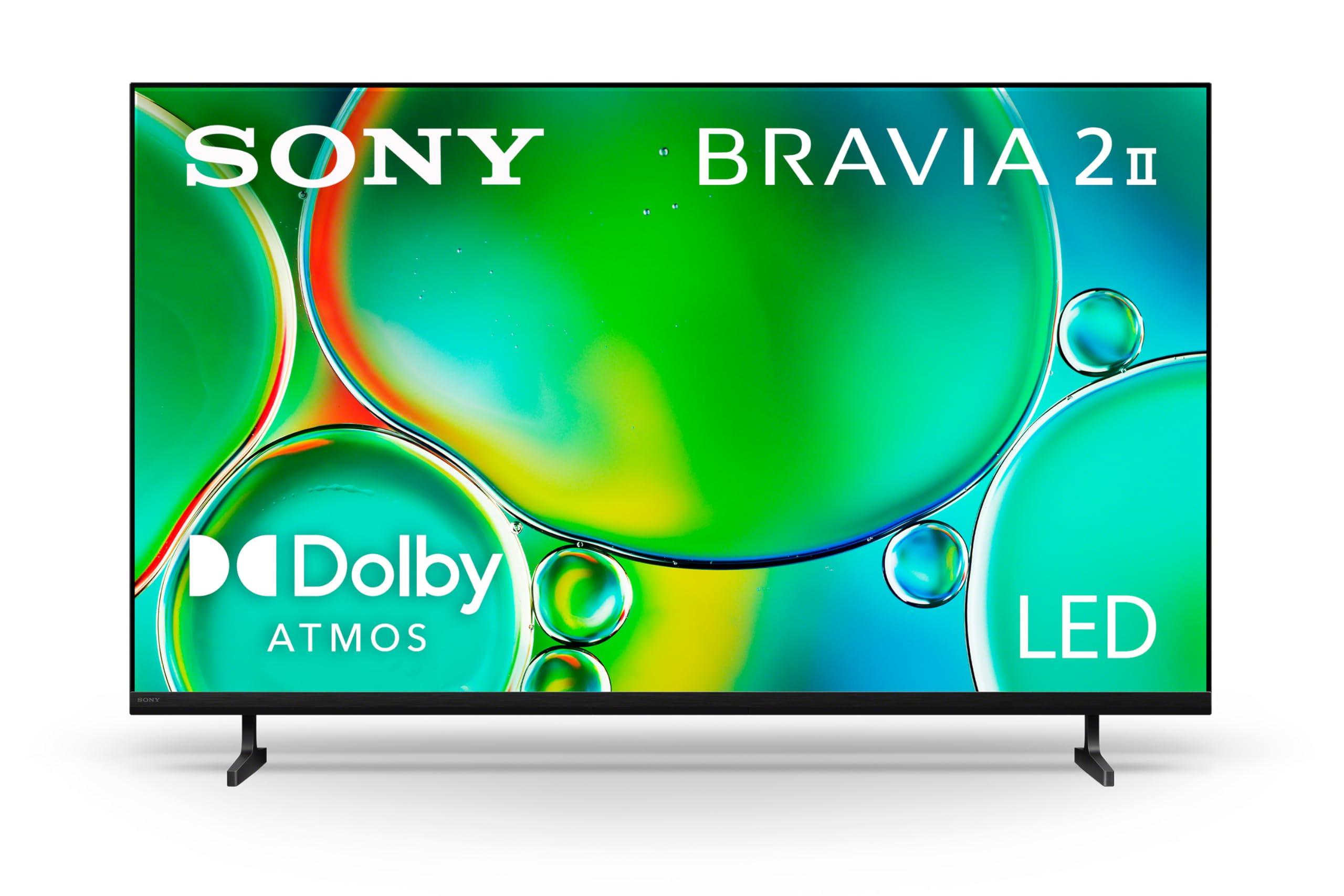
The balanced LED workhorse that makes non-4K content look nearly as sharp as native 4K while staying affordable.
This 50-inch Sony runs the 4K Processor X1 with 4K XR-Reality PRO upscaling, which analyzes every pixel and restores lost texture so streaming HD shows and cable channels look crisp at near-4K resolution. Motionflow XR keeps fast-moving scenes — sports, action movies — blur-free, and the 4K Processor X1 also enhances color and dynamic contrast for a natural image. At 114 Watts annual energy consumption, compared to the 43-inch model’s 95 Watts, but that is still modest for a 50-inch set.
Compared to the Samsung OLED above, the Sony uses a standard LED panel, so blacks in a pitch-dark room look more gray than the OLED’s perfect black — but in a typical lit living room you can barely tell the difference. The base width is 35 Inches, versus the Samsung 65-inch base of 14.4 inches, so you need a very wide TV stand or a wall mount to avoid wobble. The Google TV platform gives access to all major streaming apps plus Apple AirPlay 2 and Google Cast, and exclusive PS5 features (Auto HDR Tone Mapping and Auto Genre Picture Mode) make this the best pick if you own a PlayStation 5. However, customers note frequent freezing that requires unplugging the TV, and WiFi drops even when other devices stay connected — so software reliability is a real concern.
Reasons to Buy
- 4K XR-Reality PRO upscaling brings lost detail back to HD content
- Exclusive PS5 Auto HDR Tone Mapping and Auto Genre Picture Mode
- Google TV with Apple AirPlay 2 and Google Cast built in
- Motionflow XR keeps fast sports and action blur-free
What to Watch For
- Frequent freezing and WiFi drops reported by multiple buyers
- 35-inch base requires a wide TV stand or wall mount
- LED backlight means blacks are not as deep as OLEDs in dark rooms
Best For: PS5 owners and streamers who want solid upscaling and smart features at a mid-range price, and can tolerate occasional software glitches.
Not For: Anyone who wants a rock-solid smart platform that never freezes, or who needs a compact stand footprint on a narrow media console.
4. Sony BRAVIA 2 II 43 Inch 4K Ultra HD LED Smart TV (K-43S20M2)
The smaller, cheaper cousin that packs the same upscaling chip and PS5 features into a 43-inch frame.
This 43-inch model shares the exact same 4K Processor X1 and 4K XR-Reality PRO upscaling as the 50-inch Sony above, so you get the same near-4K clarity from HD sources and the same rich color and dynamic contrast — but at about a lower sticker price and a lower 95 Watts annual energy consumption. The smaller screen makes it a natural fit for a bedroom, a dorm, or a kitchen where the 50-inch would dominate the wall. Motionflow XR still handles fast motion, and Google TV plus AirPlay 2 are fully present.
Compared to the 50-inch model, the lower energy draw (95W vs 114W, a 20% advantage) means it costs less to run over a year, and the smaller footprint fits standard media consoles easily. However, multiple verified reviewers point out the same software freezing issue — one noted the TV constantly freezes and requires unplugging to reset it, calling it the worst television they have owned despite having a 15-year-old Sony that still runs perfectly. If you can tolerate that occasional glitch, you get the same excellent upscaling and PlayStation 5 integration in a compact, budget-friendly package.
Why It Wins On Value
- Same 4K Processor X1 and upscaling as the larger model for less money
- Lower 95W power consumption saves on electricity
- Compact 43-inch size fits bedrooms and small spaces well
- Full PS5 exclusive feature support and Google TV platform
The One Caveat
- Several shoppers say random freezing that requires a full unplug-restart cycle
- LED panel cannot match OLED black levels in a dark room
- Smaller screen means less rich experience for movie lovers
Reach For This If: You need a strong upscaling TV for a secondary room on a budget, and you can live with an occasional software freeze in exchange for saving money and energy.
Consider The 50-Inch Instead If: You want a larger viewing experience for a living room — the freezing reports are similar across both sizes, so size is the real difference.
Understanding the Specs
Processor and AI Neural Networks
The processor is the single most important spec for upscaling. Sony uses the 4K Processor X1, which analyzes each pixel and restores lost texture. Samsung takes it further with the NQ4 AI Gen3, which runs 128 neural networks — tiny self-learning models that recognize specific objects and patterns — to enhance sharpness and brightness scene by scene. LG’s Alpha 11 AI Processor Gen2 does similar real-time analysis and even adjusts the picture’s tone to match what the film director intended. A faster, newer processor with more neural networks produces cleaner upscaling on old, compressed video.
Refresh Rate and Motion Handling
Refresh rate (how many times per second the screen redraws the image, measured in hertz, or Hz) determines how smooth fast motion looks. Standard TVs run at 60Hz, which is fine for news and talk shows. For sports and gaming, 120Hz or 144Hz panels (like the LG G5 at 120Hz and the Samsung S90F at 144Hz) keep a soccer ball readable and eliminate tearing in games. Sony’s Motionflow XR is a motion-smoothing feature that works on a 60Hz panel but inserts extra frames to simulate higher motion clarity — good for sports, but some viewers dislike the “soap opera effect” it creates on movies.
FAQ
Will a 4K upscaling TV make my old DVD collection look as good as 4K Blu-ray?
Is OLED or LED better for upscaling old content?
Do I need a special HDMI cable for 4K upscaling to work?
Can I disable upscaling on a 4K Upscaling TV?
Will a 4K Upscaling TV help with blurry cable TV channels?
What is the difference between 4K upscaling and 4K native resolution?
Does upscaling add input lag for gaming?
Will this TV work with my PlayStation 5 or Xbox Series X?
Final Thoughts: The Verdict
For most buyers, the 4k upscaling tv winner is the Samsung 65-Inch OLED S90F because its 128-neural-network processor delivers visibly cleaner upscaling than any other TV in this lineup and the QD-OLED panel makes every scene look rich and vibrant. If you want a premium 77-inch screen with extreme brightness for a bright living room, grab the LG OLED evo G5. And for a budget-friendly option that still has excellent PS5 integration and solid upscaling, the Sony BRAVIA 2 II 50 Inch offers real value if you can tolerate the software quirkiness that multiple buyers have noted.
How We Picked
We do not accept paid placement. Every pick is matched to a real buyer and a real use-case; we do not hands-on test units.
Sources & Methodology
Specifications: manufacturer listings and product documentation. Review insights: verified customer reviews, as of July 2026. Pricing: not shown on this page (it changes often); check the current price via the retailer link.
As an Amazon Associate, Gadgets Feed earns from qualifying purchases. This does not affect which products we feature.