
Our readers keep the lights on and my morning glass full of iced black tea. As an Amazon Associate, I earn from qualifying purchases.
Specs are compiled from manufacturer listings and verified buyer reviews and can change over time — please confirm the key details on the product page before buying.
Picking an amplifier for your home cinema is the single most important decision for how your movies and games sound. Get it right, and dialogue becomes crisp, explosions hit you in the chest, and the whole setup fades into the background. Get it wrong, and you end up wrestling with remotes while your expensive speakers sound flat.
I’m Min — the founder and writer behind Gadgets Feed. This guide is built by comparing the manufacturers’ published specifications and the patterns across verified customer reviews, so you get each pick’s real strengths and trade-offs instead of marketing spin.
The real challenge is matching channel count, room correction, and HDMI features to your actual space and gear — not paying for more than you can use. These picks represent the full range of what a truly great amplifier for home cinema can deliver, from a slim 5.2-channel unit for a condo to a 9.2-channel powerhouse with pro-grade room calibration.
Quick Picks
- Onkyo TX-NR7100 9.2-Channel AV Receiver — The Room Whisperer
- Denon AVR-S970H 8K Ultra HD 7.2 Channel — Gaming Ready
- Yamaha RX-A2A AVENTAGE 7.2-Channel AV Receiver — Premium Foundation
- Onkyo TX-NR6100 7.2 Channel THX Certified — THX-Certified Power
- Denon AVR-S770H 7.2 Ch Home Theater Receiver — Easiest Path to 7.2
- Yamaha RX-V6A 7.2-Channel AV Receiver — Balanced Performer
- Pioneer VSX-935 7.2 Channel Surround Sound — Compact 7.2
- Yamaha RX-V4A 5.2-Channel AV Receiver — Best Value Starter
- Marantz NR1510 UHD AV Receiver — Slim & Space-Saving
How To Choose The Best Amplifier For Home Cinema
Before you start shopping, you need to understand three things: how many speakers you want to connect, what video sources you own, and whether your room needs help with sound reflections. These three factors will narrow down the field more than any brand name.
Channel Count: Matching the Amp to Your Speaker Layout
The number after the decimal — 5.2, 7.2, 9.2 — tells you how many speakers the amp can drive. The first number is the main speakers around the room; the second is the number of subwoofer channels. A 5.2-channel amp runs a left, center, right, two surrounds, and two subs. A 7.2 adds two rear surround or two height speakers for Dolby Atmos. A 9.2 gives you full 5.1.4 or 7.1.2 Atmos setups. If you plan on adding ceiling speakers later, get a 7.2 or 9.2 now.
Room Correction: The Hidden Hero of Clear Sound
A room full of couches, rugs, and walls can make even great speakers sound boomy or hollow. Room correction software uses a microphone to measure how sound bounces off your walls, then adjusts the audio to compensate. YPAO (Yamaha), Audyssey (Denon), and Dirac Live (Onkyo) are the three main systems. Dirac Live is the most advanced, letting you target specific frequencies on a laptop. YPAO is fast and user-friendly. Audyssey sits in the middle.
HDMI Version: Future-Proofing for 8K and Gaming
HDMI 2.1 is the current standard for passing 4K at 120Hz or 8K at 60Hz from a next-gen console or PC. It also includes VRR (Variable Refresh Rate) to stop screen tearing and ALLM (Auto Low Latency Mode) to keep games responsive. If you are using a standard 4K TV at 60Hz, HDMI 2.0 with HDCP 2.3 still works fine. But for a PS5 or Xbox Series X, look for three or more HDMI 2.1 inputs.
Quick Comparison
| Model | Best For | Channels | Room Correction | HDMI Version | Amazon |
|---|---|---|---|---|---|
| Onkyo TX-NR7100 | Total room tuning | 9.2 | Dirac Live | HDMI 2.1 | Amazon |
| Denon AVR-S970H | Gaming & 8K | 7.2 | Audyssey | HDMI 2.1 | Amazon |
| Yamaha RX-A2A | Premium build & clarity | 7.2 | YPAO R.S.C. | HDMI 2.1 | Amazon |
| Onkyo TX-NR6100 | THX-certified power | 7.2 | AccuEQ | HDMI 2.1 | Amazon |
| Denon AVR-S770H | Easiest setup | 7.2 | Audyssey | HDMI 2.1 | Amazon |
| Yamaha RX-V6A | Balanced features & value | 7.2 | YPAO R.S.C. | HDMI 2.1 | Amazon |
| Pioneer VSX-935 | Compact power | 7.2 | MCACC | HDMI 2.1 | Amazon |
| Yamaha RX-V4A | 5.1 starter system | 5.2 | YPAO | HDMI 2.1 | Amazon |
| Marantz NR1510 | Slim & discreet | 5.2 | Audyssey | HDMI 2.0 | Amazon |
In‑Depth Reviews
1. Onkyo TX-NR7100 9.2-Channel AV Receiver
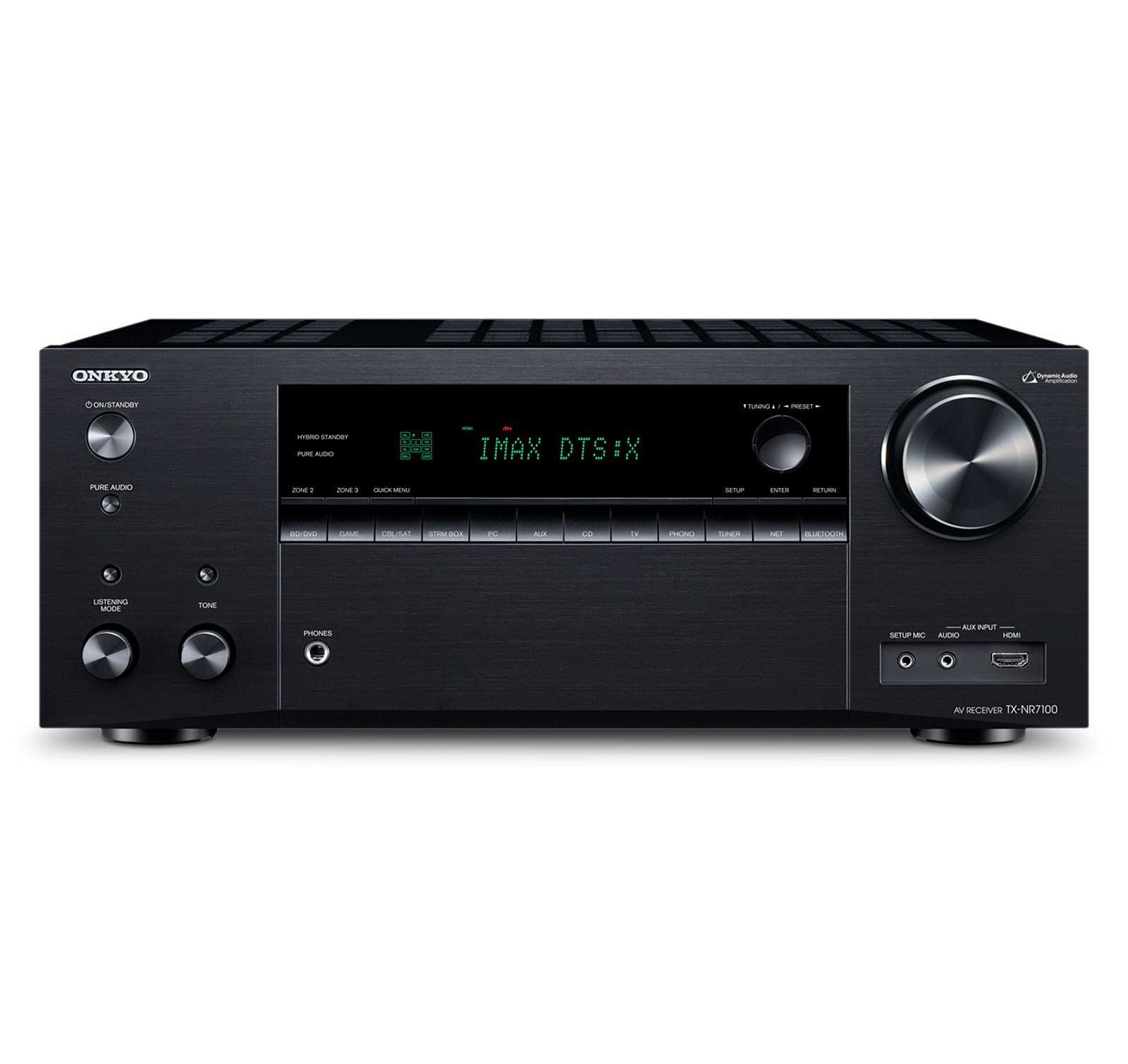
Dirac Live software gives you the most flexible room tuning at this price, so your room’s shape stops ruining your sound.
The single most defining feature here is Dirac Live — the room correction software that uses a microphone and your smartphone or a PC to measure and fix how sound behaves in your room. Unlike simpler systems, Dirac can target specific frequencies, so you get precise, balanced audio instead of the boomy bass or hollow mids that awkward-shaped rooms create. The TX-NR7100 processes nine channels with three HDMI-out options, so you can run a full 5.1.4 Atmos setup while sending a different 8K60 video signal to a second zone.
This receiver runs very hot at high power, as buyers report, and one reviewer noted a crackling static noise after a couple of months. The remote has a poor range, and the menus feel basic compared to the competition. But for a serious home theater with a large Klipsch system, owners mention that the sound quality and ample power justify the install effort.
What makes it a standout
- Dirac Live room correction from the start — the most flexible tuning available at this price
- 9.2 channels with independent zone 2 HDMI switching for different content in two rooms
- HDMI 2.1 supports 4K/120Hz with VRR and ALLM for gaming
The trade-offs
- Runs very hot at high power; needs ample ventilation or a fan
- Bi-amping your front speakers disables the Atmos speakers
- Auto-calibration often sets the subwoofer to -18dB, killing the bass
Reach for this if: You have an acoustically tricky room or a large speaker system and want the most advanced room correction available without spending on separate equipment.
Look elsewhere if: You prefer a simple plug-and-play experience and don’t need 9.2 channels or the time investment Dirac setup requires.
2. Denon AVR-S970H 8K Ultra HD 7.2 Channel

Three 8K HDMI 2.1 inputs with VRR and ALLM mean your PS5 or Xbox runs at 4K/120Hz without screen tearing.
At 90W per channel across seven channels, the AVR-S970H delivers enough headroom to fill a medium-size room with clear, rich sound. Its three 8K HDMI 2.1 inputs support VRR, QFT, and ALLM — so your PS5 or Xbox Series X runs at 4K/120Hz with reduced frame tearing. If you still have a turntable, the built-in phono input (a dedicated connection for a record player) means you can plug it in directly without buying a separate preamp.
One catch: using the Powered Zone 2 feature taps into the back surround speaker connections, limiting your main room to 5.2 instead of 7.2. Customers note that the remote lacks a programmable TV power button, and the HEOS app can’t stream Bluetooth audio to wireless headphones. Still, reviewers point out the sound quality is clear and the setup menus are intuitive, with many saying it sounds better than older Denon models they owned.
Biggest strengths
- Three 8K HDMI 2.1 inputs with VRR, QFT, and ALLM for lag-free gaming
- Built-in phono input for direct turntable connection
- Runs cooler than many competitors — shoppers say 80°F vs 90°F on other units
Things to be aware of
- Zone 2 uses the rear surround speaker connections, limiting your main setup to 5.2
- No physical manual included — setup is entirely on-screen
- HEOS source audio cannot be sent to Bluetooth headphones
Best for: Gamers who want 8K readiness and a phono input in a single box, with enough power for a solid 7.1 speaker system.
skip it if: You need full 7.2 plus a powered second zone at the same time — that forces a trade-off.
3. Yamaha RX-A2A AVENTAGE 7.2-Channel AV Receiver

Surround:AI analyzes each scene and adjusts dialogue, effects, and bass automatically — you never touch a remote.
The AVENTAGE line is Yamaha’s premium series, and the RX-A2A brings its standout feature: Surround:AI. This technology analyzes scenes and dials up dialogue clarity during quiet moments, boosts rear-channel effects during action, and adjusts bass intensity — all without you touching a remote. It drives seven channels at a sturdy power level and uses YPAO R.S.C. with multipoint measurement for room correction, which buyers report makes setup quick, around 10 minutes.
The RX-A2A weighs 25.35 pounds, partly due to the fifth foot on its bottom that reduces vibrations from the chassis — a sign of its sturdy build. It has three HDMI 2.1 inputs supporting 8K60B and 4K120AB, plus eARC. One catch: bi-amping your front speakers disables the Atmos height channels, a common trade-off. Buyers also note an intermittent no-signal issue with some Sony TVs, usually fixed by power cycling the unit.
what separates it
- Surround:AI automatically tune sound in real-time based on scene content
- AVENTAGE build quality with a fifth foot for reduced vibration and a 3-year warranty
- Works with Sonos via a Sonos Port (sold separately)
Limitations to consider
- Bi-amping disables Atmos height speaker channels
- Owners mention it feels overpriced at full MSRP; better value on sale
- One buyer mentioned the unit died 11 days after the return window closed
Choose this if: You want the best build quality Yamaha offers with a smart AI that handles sound adjustments for you, and you are okay paying a premium for that refinement.
Pass on it if: You need full 7.1.2 Atmos with bi-amped fronts — this receiver forces a choice between those two features.
4. Onkyo TX-NR6100 7.2 Channel THX Certified Network AV Receiver
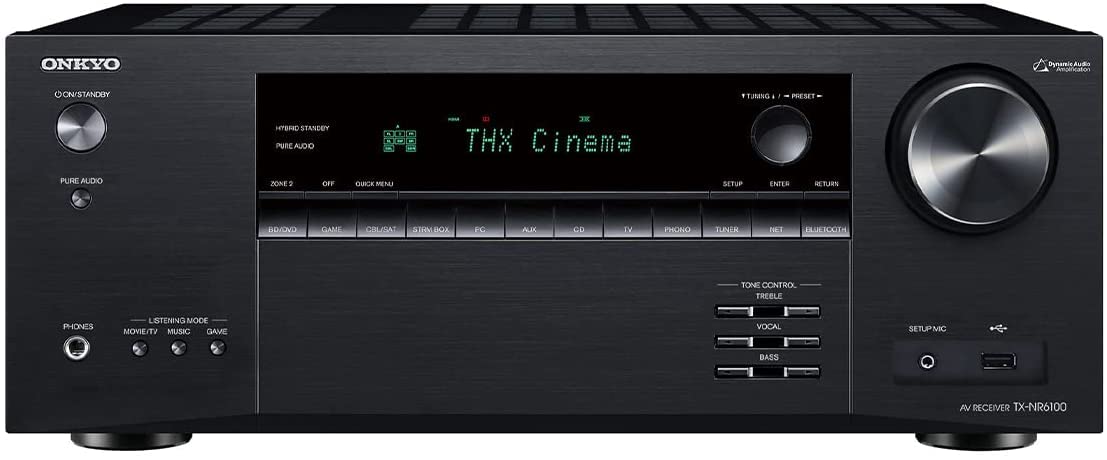
Official THX Select Certification guarantees cinema-reference sound in medium rooms, backed by 210 watts per channel.
At 210 watts per channel, the TX-NR6100 is among the most powerful receivers in its class, with THX Select Certification — a guarantee it can deliver reference-level sound in medium-sized rooms. It processes 7.2 channels with Dolby Atmos and DTS:X and includes three HDMI 2.1 inputs running at 40Gbps for 8K content. The on-board AccuEQ room correction handles basic tuning, but it lacks the advanced calibration of Dirac. At 21 inches deep, it is significantly larger than most receivers — at 21 inches deep versus the Yamaha RX-V6A at 6.25 inches deep — so you will need a deep AV cabinet.
Customers note mixed reliability: one reviewer called it an “awesome avr” that drove a 5.1 Klipsch setup perfectly, while another reported serious HDMI input defects that required a return. Reviewers also note that the on-screen menu loads slowly, and using the bi-amp feature limits you to a 5.1 speaker configuration.
Why it stands out
- THX Select Certification for cinema-reference sound in medium rooms
- 210 watts per channel — among the highest power ratings in this price tier
- HDMI 2.1 at 40Gbps supports the highest video settings on PS5 and Xbox Series X
Downsides
- Very deep chassis (21 inches) requires a large AV cabinet
- AccuEQ room correction is basic compared to Dirac or YPAO R.S.C.
- Some reviewers point out HDMI input and output defects on arrival
Go for it if: You want official THX certification and high power output without jumping to the premium tier, and you have the cabinet depth to fit it.
Think twice if: Cabinet space is tight or you prioritize advanced room correction over raw watts.
5. Denon AVR-S770H 7.2 Ch Home Theater Receiver

Its on-screen setup assistant gets you from unboxing to surround sound in minutes, according to buyers.
The AVR-S770H uses Denon’s on-screen setup assistant, which buyers consistently describe as the easiest in the category — one owner reported they connected a PC, Nintendo Switch, and cable box in minutes. It delivers 75 watts per channel across seven channels and supports 8K/60Hz passthrough with HDR10+, Dolby Vision, and HLG. Dolby Height Virtualization (a software trick that simulates overhead Atmos effects) lets you get a sense of height without installing ceiling speakers, which is a good bridge if you are not ready to cut holes in your ceiling.
Shoppers say the sound quality is excellent for movies, with clear dialogue and rich surround effects. However, a small number of buyers report spontaneous switching between speaker outputs and TV audio, along with the unit turning on the TV in the middle of the night. The Audyssey room calibration is solid but does not offer the fine-grained control of Dirac Live on the Onkyo TX-NR7100 above.
What works well
- On-screen setup assistant is the most beginner-friendly in the category
- Dolby Height Virtualization creates overhead effects without ceiling speakers
- HEOS multi-room streaming works with Pandora, Spotify, TIDAL
What to watch for
- A small number of owners mention spontaneous switching between external and TV speakers
- Only 75W per channel — less headroom than the Onkyo TX-NR6100
- No phono input for a turntable
Ideal for: First-time AVR buyers upgrading from a soundbar who want the simplest setup possible and a clean 7.2 experience.
Not for: Audiophiles who need high per-channel power or advanced room correction with granular control.
6. Yamaha RX-V6A 7.2-Channel AV Receiver with MusicCast

Seven HDMI inputs let you connect a cable box, game console, Blu-ray player, and streamer without an external switcher.
This 7.2-channel receiver packs seven HDMI inputs — three of which support 8K60B and 4K120AB — so you can connect a cable box, game console, Blu-ray player, streamer, and more without an external switcher. YPAO R.S.C. with multipoint measurement tunes the sound to your room using a microphone, and buyers who upgraded from older Yamaha units report spectacular improvements in sound clarity, especially for dialogue in action movies. One reviewer specifically noted it replaces an Onkyo TX-NR6050 with superior audio and a much more vibrant picture.
The RX-V6A is notably shallow: at 6.25 inches deep, it is significantly smaller than the Onkyo TX-NR6100, making it much easier to fit in a standard AV shelf. A few buyers mention the on-screen menu looks dated and the receiver does not auto-power on with the TV, so you have to press a button manually. It supports Dolby Atmos with Height Virtualization and DTS:X for rich audio.
Where it shines
- Seven HDMI inputs — plenty of ports for a full entertainment system
- Shallow chassis (6.25 inches deep) fits in standard AV furniture
- YPAO R.S.C. room correction with multipoint measurement
Trade-offs
- No auto power-on with TV — you must use the remote or button
- On-screen menu interface looks dated
- Requires the latest firmware update to open up all HDMI 2.1 features
Choose this for: A balanced, feature-rich 7.2-channel receiver that fits shallow cabinets and gives you plenty of HDMI ports for a full system.
Look elsewhere if: You want a sleek modern menu interface or auto power-on with your TV.
7. Pioneer VSX-935 7.2 Channel Surround Sound Network Receiver
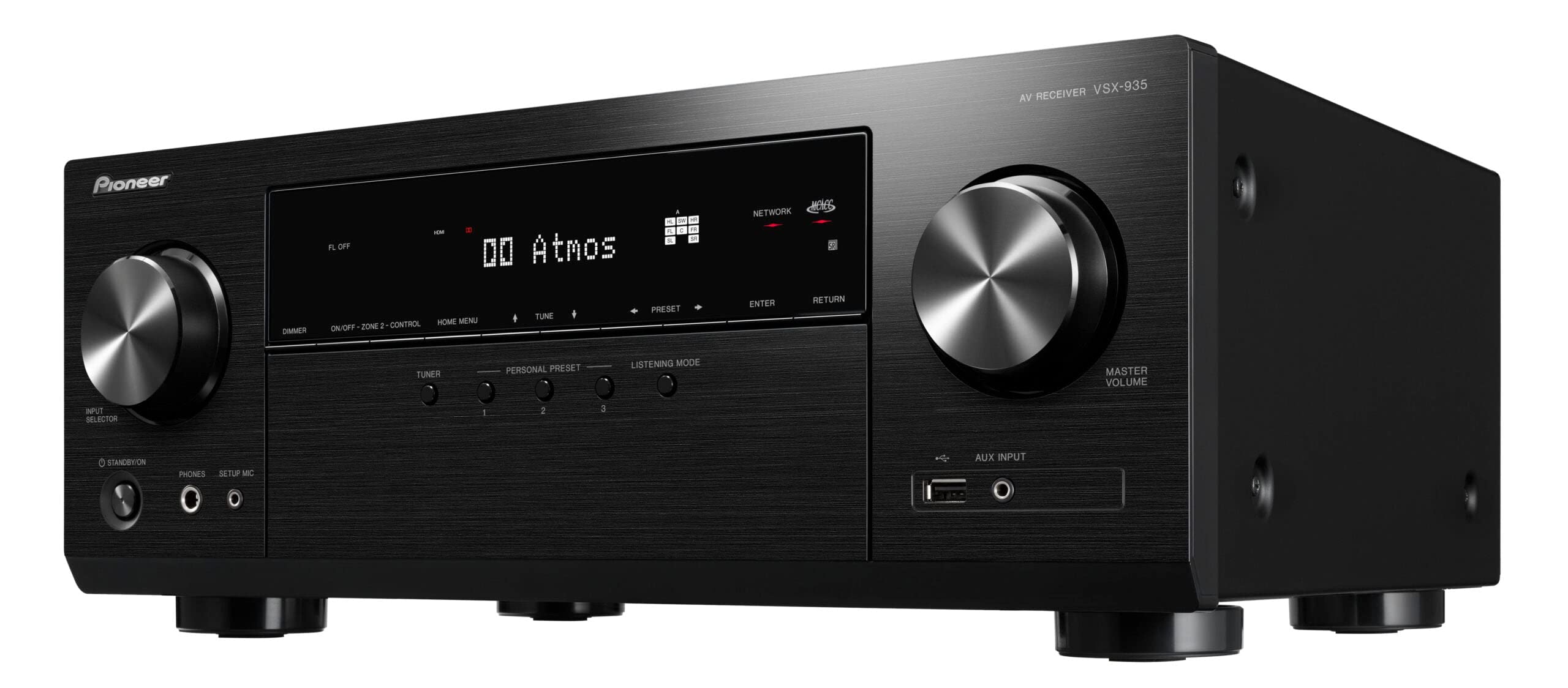
This slim 7.2-channel receiver uses Dolby Atmos Height Virtualization to create overhead effects without ceiling speakers.
The VSX-935 uses Dolby Atmos Height Virtualization to simulate overhead surround effects through your regular speaker layout, so you get a more rich soundstage without cutting holes or running wires to the ceiling. It delivers HDMI 2.1 with 8K support and includes an RF remote that works through cabinets, plus dual-zone output for audio in a second room. The unit is compact at 14.56 inches deep — much easier to fit than the larger Onkyo receivers.
Customers note very mixed experiences on reliability. One customer observed the first unit arrived dead on arrival and the vendor replaced it quickly. Another reported HDMI video failures with a computer, producing a snowy black screen and constant refresh drops, and no sound from rear surround speakers after eight hours of troubleshooting. The firmware update process is USB-only and has failed for multiple owners. When it works, buyers describe crisp, clear audio with great movie-quality sound.
High points
- Dolby Atmos Height Virtualization creates surround height effects without ceiling speakers
- Compact dimensions (14.56 inches deep) fit tight AV shelves
- RF remote works through closed cabinet doors
Concerns from owners
- Multiple reviewers point out DOA units or HDMI failure with computers
- Firmware updates require a USB cable — no built-in Wi-Fi update option; failures noted
- No rear surround sound from some setups after extensive troubleshooting
Best for: Shoppers who need a compact 7.2-channel receiver with virtual height effects and can tolerate the risk of a firmware headache.
Not recommended if: You rely on HDMI connections for a computer gaming setup or want a reliable plug-and-play experience.
8. Yamaha RX-V4A 5.2-Channel AV Receiver with MusicCast

YPAO room calibration is included even at this budget price, so your speaker timing and levels are set automatically.
The RX-V4A is a 5.2-channel receiver, meaning it runs a left, center, right, two surrounds, and two subwoofers — the classic layout for a small- to medium-sized room. Despite the lower price point, it still gets YPAO automatic room calibration, which measures your speaker distances and levels with the included microphone to tune timing and fix reversed speaker wires. Shoppers say clean, detailed power driving 140W tower speakers and a center channel, with mids and highs that make dialogue easier to hear even for those with minor hearing loss.
The biggest caveat here is the HDMI switching. A number of buyers report HDMI handshake issues: the unit cannot pass a 4K signal to a 1080p monitor properly, and the remote code can accidentally change with no way to reset it. One reviewer returned the V4A for the V6A specifically to gain 7.2 channels, noting the V4A is a solid choice for a 5.2 configuration. The MusicCast app is praised as a saving grace for controlling streaming services like Spotify and TIDAL.
Why it works for many
- YPAO room calibration included even at this budget-friendly price
- Clean, detailed sound that makes dialogue clear — one user highlighted it helps with minor hearing loss
- MusicCast app for streaming Spotify, TIDAL, and Amazon Music HD
The catch
- HDMI switching issues reported — cannot pass 4K video to a 1080p monitor reliably
- Only 5.2 channels — no room for rear surrounds or Atmos height speakers
- Remote buttons are small and painful to press, according to buyers
Perfect for: A budget-conscious 5.1 setup in a small room where reliable HDMI 4K switching is not a must — like a bedroom or condo system.
Better options exist if: You need to connect a 4K source to an older 1080p TV or plan to expand to a 7-channel Atmos system later.
9. Marantz NR1510 UHD AV Receiver – Slim 5.2 Channel

At just 4.1 inches tall, this 5.2-channel receiver fits in a shallow media console where full-size amps are too tall.
At just 4.1 inches tall, the Marantz NR1510 is a 5.2-channel receiver that fits where full-size amps cannot — like a shallow media console or open shelving under a TV. Despite its slim profile, it includes an MM phono input for a turntable, six HDMI inputs (all HDCP 2.2), eARC, and HEOS multi-room streaming. It delivers 50 watts per channel, which is plenty for a condo or apartment setup with efficient speakers. One reviewer called it “phenomenal sound at half the size.”
The trade-off is clear: this is a 5.2-channel unit with no support for 8K or 4K/120Hz gaming. It uses HDMI 2.0, not 2.1, so it maxes out at 4K/60Hz. That is fine for a TV with a standard 60Hz panel, but not for a PS5 or Xbox Series X at 120 frames per second. Owners mention it runs hot initially and needs good ventilation. The HEOS app is functional, but many owners prefer Apple AirPlay for simple streaming.
What makes it unique
- Slim 4.1-inch height fits in tight AV cabinets where standard receivers are too tall
- MM phono input for direct turntable connection
- Five-star reviews citing crisp 5.1 audio at all volume levels
Limitations
- HDMI 2.0 only — no 8K or 4K/120Hz support for next-gen gaming
- 50W per channel provides less headroom for large speakers in big rooms
- Runs hot in confined spaces; needs good ventilation
Tailor-made for: A turntable owner with a small living space who wants a discreet, low-profile 5.1 receiver that sounds great and fits on a shelf.
Not your pick if: You game at 4K/120Hz or plan to install ceiling speakers for a full Atmos setup.
Understanding the Specs
Channel Count: The Number That Defines Your Setup
This is the first number before the decimal in the spec label — 5.2, 7.2, or 9.2. The first number is how many main speakers the amp can power. A 5.2 setup drives a left, center, right, and two surrounds. A 7.2 adds either two rear surrounds or two height speakers for Dolby Atmos. A 9.2 gives you the full package: left, center, right, surrounds, rears, and height speakers. The number after the decimal (the “2”) means it has two subwoofer outputs, so you can run a pair of subs for more even bass across the room.
Room Correction Software
Every receiver in this list includes some form of room calibration. This software uses a microphone you place at your listening position. It plays test tones through each speaker, measures how the sound bounces off your walls, and then adjusts the audio to fix issues like boomy bass or hollow-sounding dialogue. Less expensive models do a basic EQ curve. Advanced systems like Dirac Live let you see a graph of your room’s frequency response and make targeted adjustments. YPAO (Yamaha) and Audyssey (Denon) sit between these two extremes — user-friendly with solid results.
HDMI 2.1 vs 2.0: What Your TV Needs
HDMI 2.1 is the latest version. It can pass a video signal at 8K resolution at 60 frames per second, or 4K at 120 frames per second. It also supports VRR (Variable Refresh Rate), which matches the TV’s refresh rate to the game’s frame rate to stop screen tearing, and ALLM (Auto Low Latency Mode), which automatically switches the TV into a low-lag gaming mode. HDMI 2.0 maxes out at 4K/60Hz. If you own a PS5, Xbox Series X, or a new high-refresh TV, you want at least one HDMI 2.1 input. For a standard 4K TV, HDMI 2.0 is still perfectly fine.
Power Output: Watts Per Channel
This number — often listed like “75W x 7” — tells you how much power the receiver can deliver to each speaker. More watts provide more headroom, meaning the sound stays clean and distortion-free during loud action scenes. In a small room, 50 to 75 watts per channel is usually enough. In a large open room or with speakers that are not very efficient (speakers that need more power to get loud), look for 100 watts or more per channel. Also important: the spec is measured with only one or two channels driven; real-world output is lower with all channels active.
FAQ
What is the difference between a stereo amplifier and a home cinema receiver?
How many channels do I really need for a home theater?
Can I use a home cinema receiver with my turntable?
Does a receiver with more watts always sound better?
What does eARC do and do I need it?
Will an 8K receiver work with my older 1080p TV?
What is the difference between Dolby Atmos and DTS:X?
How do I update the firmware on a home cinema receiver?
Can I add wireless speakers to a home cinema receiver?
Final Thoughts: The Verdict
For most people, the amplifier for home cinema winner is the Onkyo TX-NR7100 because Dirac Live room correction gives you the best sound tuning for your specific room without buying extra gear. If you want a simpler setup and 8K gaming features, grab the {“@context”: “https://schema.org”, “@graph”: [{“@type”: “ItemList”, “name”: “9 Best Amplifier For Home Cinema”, “url”: “https://gadgetsfeed.com/best-amplifier-for-home-cinema/”, “numberOfItems”: 9, “itemListElement”: [{“@type”: “ListItem”, “position”: 1, “name”: “Onkyo TX-NR7100 9.2-Channel AV Receiver”, “url”: “https://gadgetsfeed.com/best-amplifier-for-home-cinema/#product-6”}, {“@type”: “ListItem”, “position”: 2, “name”: “Denon AVR-S970H 8K Ultra HD 7.2 Channel”, “url”: “https://gadgetsfeed.com/best-amplifier-for-home-cinema/#product-8”}, {“@type”: “ListItem”, “position”: 3, “name”: “Yamaha RX-A2A AVENTAGE 7.2-Channel AV Receiver”, “url”: “https://gadgetsfeed.com/best-amplifier-for-home-cinema/#product-9”}, {“@type”: “ListItem”, “position”: 4, “name”: “Onkyo TX-NR6100 7.2 Channel THX Certified Network AV Receiver”, “url”: “https://gadgetsfeed.com/best-amplifier-for-home-cinema/#product-4”}, {“@type”: “ListItem”, “position”: 5, “name”: “Denon AVR-S770H 7.2 Ch Home Theater Receiver”, “url”: “https://gadgetsfeed.com/best-amplifier-for-home-cinema/#product-7”}, {“@type”: “ListItem”, “position”: 6, “name”: “Yamaha RX-V6A 7.2-Channel AV Receiver with MusicCast”, “url”: “https://gadgetsfeed.com/best-amplifier-for-home-cinema/#product-3”}, {“@type”: “ListItem”, “position”: 7, “name”: “Pioneer VSX-935 7.2 Channel Surround Sound Network Receiver”, “url”: “https://gadgetsfeed.com/best-amplifier-for-home-cinema/#product-2”}, {“@type”: “ListItem”, “position”: 8, “name”: “Yamaha RX-V4A 5.2-Channel AV Receiver with MusicCast”, “url”: “https://gadgetsfeed.com/best-amplifier-for-home-cinema/#product-1”}, {“@type”: “ListItem”, “position”: 9, “name”: “Marantz NR1510 UHD AV Receiver – Slim 5.2 Channel”, “url”: “https://gadgetsfeed.com/best-amplifier-for-home-cinema/#product-5”}]}, {“@type”: “Product”, “position”: 1, “name”: “Onkyo TX-NR7100 9.2-Channel AV Receiver”, “image”: “https://m.media-amazon.com/images/I/61U0uUr+UcL.jpg”, “brand”: {“@type”: “Brand”, “name”: “Onkyo”}, “url”: “https://www.amazon.com/dp/B09B4J31J5/?tag=gadgetsmin-20”, “offers”: {“@type”: “Offer”, “url”: “https://www.amazon.com/dp/B09B4J31J5/?tag=gadgetsmin-20”}}, {“@type”: “Product”, “position”: 2, “name”: “Denon AVR-S970H 8K Ultra HD 7.2 Channel”, “image”: “https://m.media-amazon.com/images/I/61gugk3H2dL.jpg”, “brand”: {“@type”: “Brand”, “name”: “Denon”}, “url”: “https://www.amazon.com/dp/B0BBZ28LL5/?tag=gadgetsmin-20”, “offers”: {“@type”: “Offer”, “url”: “https://www.amazon.com/dp/B0BBZ28LL5/?tag=gadgetsmin-20”}}, {“@type”: “Product”, “position”: 3, “name”: “Yamaha RX-A2A AVENTAGE 7.2-Channel AV Receiver”, “image”: “https://m.media-amazon.com/images/I/51092O2khfL.jpg”, “brand”: {“@type”: “Brand”, “name”: “Yamaha”}, “url”: “https://www.amazon.com/dp/B08DWKCHH6/?tag=gadgetsmin-20”, “offers”: {“@type”: “Offer”, “url”: “https://www.amazon.com/dp/B08DWKCHH6/?tag=gadgetsmin-20”}}, {“@type”: “Product”, “position”: 4, “name”: “Onkyo TX-NR6100 7.2 Channel THX Certified Network AV Receiver”, “image”: “https://m.media-amazon.com/images/I/51ESW3+PHHL.jpg”, “brand”: {“@type”: “Brand”, “name”: “Onkyo”}, “url”: “https://www.amazon.com/dp/B09LH9XZJ5/?tag=gadgetsmin-20”, “offers”: {“@type”: “Offer”, “url”: “https://www.amazon.com/dp/B09LH9XZJ5/?tag=gadgetsmin-20”}}, {“@type”: “Product”, “position”: 5, “name”: “Denon AVR-S770H 7.2 Ch Home Theater Receiver”, “image”: “https://m.media-amazon.com/images/I/710x47BJrhL.jpg”, “brand”: {“@type”: “Brand”, “name”: “Denon”}, “url”: “https://www.amazon.com/dp/B0CCQ1Q9NT/?tag=gadgetsmin-20”, “offers”: {“@type”: “Offer”, “url”: “https://www.amazon.com/dp/B0CCQ1Q9NT/?tag=gadgetsmin-20”}}, {“@type”: “Product”, “position”: 6, “name”: “Yamaha RX-V6A 7.2-Channel AV Receiver with MusicCast”, “image”: “https://m.media-amazon.com/images/I/715CgIDSyBL.jpg”, “brand”: {“@type”: “Brand”, “name”: “Yamaha”}, “url”: “https://www.amazon.com/dp/B08CKJKKBY/?tag=gadgetsmin-20”, “offers”: {“@type”: “Offer”, “url”: “https://www.amazon.com/dp/B08CKJKKBY/?tag=gadgetsmin-20”}}, {“@type”: “Product”, “position”: 7, “name”: “Pioneer VSX-935 7.2 Channel Surround Sound Network Receiver”, “image”: “https://m.media-amazon.com/images/I/71oqJZP883L.jpg”, “brand”: {“@type”: “Brand”, “name”: “Pioneer”}, “url”: “https://www.amazon.com/dp/B095PXJP7R/?tag=gadgetsmin-20”, “offers”: {“@type”: “Offer”, “url”: “https://www.amazon.com/dp/B095PXJP7R/?tag=gadgetsmin-20”}}, {“@type”: “Product”, “position”: 8, “name”: “Yamaha RX-V4A 5.2-Channel AV Receiver with MusicCast”, “image”: “https://m.media-amazon.com/images/I/51HFd4gjkzL.jpg”, “brand”: {“@type”: “Brand”, “name”: “Yamaha”}, “url”: “https://www.amazon.com/dp/B08CKGYLNS/?tag=gadgetsmin-20”, “offers”: {“@type”: “Offer”, “url”: “https://www.amazon.com/dp/B08CKGYLNS/?tag=gadgetsmin-20”}}, {“@type”: “Product”, “position”: 9, “name”: “Marantz NR1510 UHD AV Receiver – Slim 5.2 Channel”, “image”: “https://m.media-amazon.com/images/I/510DIyal3aL.jpg”, “brand”: {“@type”: “Brand”, “name”: “Marantz”}, “url”: “https://www.amazon.com/dp/B07PVS35R6/?tag=gadgetsmin-20”, “offers”: {“@type”: “Offer”, “url”: “https://www.amazon.com/dp/B07PVS35R6/?tag=gadgetsmin-20”}}, {“@type”: “FAQPage”, “mainEntity”: [{“@type”: “Question”, “name”: “What is the difference between a stereo amplifier and a home cinema receiver?”, “acceptedAnswer”: {“@type”: “Answer”, “text”: “A stereo amplifier powers two speakers for music. A home cinema receiver can power five or more speakers for surround sound, includes a built-in radio tuner, and has multiple HDMI inputs so you can switch between a cable box, game console, and streaming device without swapping cables.”}}, {“@type”: “Question”, “name”: “How many channels do I really need for a home theater?”, “acceptedAnswer”: {“@type”: “Answer”, “text”: “For a standard experience, a 5.1-channel system (five speakers plus a subwoofer) will give you left, center, right, and two surround channels. For Dolby Atmos — where sound seems to come from above you — you need a 7.2 or 9.2 receiver that can add height speakers. If your room is small and you are not installing ceiling speakers, 5.1 is perfectly fine.”}}, {“@type”: “Question”, “name”: “Can I use a home cinema receiver with my turntable?”, “acceptedAnswer”: {“@type”: “Answer”, “text”: “Yes, if the receiver has a built-in phono input (also labeled \”PHONO\” or \”MM\”). The Marantz NR1510 and the Denon AVR-S970H both include a phono stage. If your receiver does not have one, you will need a separate phono preamp between the turntable and any standard RCA input.”}}, {“@type”: “Question”, “name”: “Does a receiver with more watts always sound better?”, “acceptedAnswer”: {“@type”: “Answer”, “text”: “Not automatically. Higher wattage gives you more headroom for clean loud playback, but only if your speakers actually need that power. In a small room with efficient speakers, a 50W-per-channel receiver may sound identical to a 100W-per-channel receiver at normal listening volumes. More watts matter mainly for large rooms or speakers with low sensitivity.”}}, {“@type”: “Question”, “name”: “What does eARC do and do I need it?”, “acceptedAnswer”: {“@type”: “Answer”, “text”: “eARC (Enhanced Audio Return Channel) sends high-quality surround sound from your TV’s built-in apps (like Netflix or Disney+) back to the receiver through a single HDMI cable. If you watch streaming apps on your smart TV, eARC is essential for getting full Dolby Atmos audio. Without it, you would need to connect a separate streaming device directly to the receiver.”}}, {“@type”: “Question”, “name”: “Will an 8K receiver work with my older 1080p TV?”, “acceptedAnswer”: {“@type”: “Answer”, “text”: “Yes, it will work fine. An 8K receiver is backward compatible with all older HDMI displays. It will simply deliver the best quality signal that your TV can accept, usually 1080p or 4K. However, as buyers of the Yamaha RX-V4A noted, some receivers have HDMI handshake issues when converting a 4K signal to a 1080p display, so check recent reviews if you plan to use an older monitor.”}}, {“@type”: “Question”, “name”: “What is the difference between Dolby Atmos and DTS:X?”, “acceptedAnswer”: {“@type”: “Answer”, “text”: “Both are object-based surround sound formats that let audio move around you in three-dimensional space, including above you. Dolby Atmos is more widely used in streaming services and Blu-rays. DTS:X is also common on physical discs. Most modern receivers, including every one in this guide, support both formats, so you do not have to choose.”}}, {“@type”: “Question”, “name”: “How do I update the firmware on a home cinema receiver?”, “acceptedAnswer”: {“@type”: “Answer”, “text”: “Most modern receivers update over Wi-Fi automatically or through a menu option. However, some models like the Pioneer VSX-935 require a USB connection to a computer. Always update the firmware after unboxing, as later versions often fix HDMI bugs and enable full HDMI 2.1 support that was missing at launch.”}}, {“@type”: “Question”, “name”: “Can I add wireless speakers to a home cinema receiver?”, “acceptedAnswer”: {“@type”: “Answer”, “text”: “Most standard receivers are designed for wired speakers only. For wireless rears or subwoofers, you would need an additional wireless speaker kit that connects to your receiver’s speaker outputs. Some newer receivers include support for HEOS (Denon/Marantz) or MusicCast (Yamaha) to play audio on brand-specific wireless speakers, but not as part of the main surround sound system.”}}]}]}