
Our readers keep the lights on and my morning glass full of iced black tea. As an Amazon Associate, I earn from qualifying purchases.
Specs are compiled from manufacturer listings and verified buyer reviews and can change over time — please confirm the key details on the product page before buying.
A baseball batting mat is the difference between tearing up your lawn and building a repeatable swing in the driveway. The right mat lays flat, grips the ground, and shows you exactly where your feet go—so every practice rep counts toward muscle memory instead of fighting a curling, sliding surface.
I’m Min — the founder and writer behind Gadgets Feed. This guide is built by comparing the manufacturers’ published specifications and the patterns across verified customer reviews, so you get each pick’s real strengths and trade-offs instead of marketing spin.
This roundup covers six best baseball batting mat options for every setup — from a portable trainer for travel ball to a full-size turf mat for a backyard cage — and gives you the honest trade-offs for each.
Quick Picks
- ZivPlay 11×4.8 ft Baseball Hitting Mat — Best Overall
- KuiBonu 10×5 ft Baseball Hitting Mat — Unfading Lines
- Stride Right Hitting Mat Training System — Smartest Teacher
- GoSports Baseball and Softball Hitting Mat — Garage Warrior
- TOBWOLF Baseball Batting Mat — Lightweight Runner
- Davison T-Ball, Baseball and Softball Batting — T-Ball Starter
How To Choose The Best Baseball Batting Mat
A batting mat is a simple product with a few make-or-break decisions. Focus on these four areas to avoid wasting money on a mat that slides, curls, or wears out in a season.
Backing Material – The Grip Factor
The most important spec you cannot see at first glance is the backing. A 5mm anti-slip rubber backing keeps the mat planted when you stride and swing, especially on smooth concrete or turf. Thinner felt or EVA backing can shift an inch per swing, which ruins your footwork and forces you to reset the mat constantly.
Turf Quality and Pile Height
Taller turf fibers (around 15mm) and denser stitching (79,000+ roots per square meter) give a realistic field feel and keep the mat from looking flattened after a few weeks. Cheaper mats use recycled or low-pile turf that fades fast and frays at the edges.
Size and Portability
A 10×5 or 11×5 foot mat gives a full batter’s box experience for adult hitters, while a 6×4 or 4×6.5 foot mat is enough for tee work and soft toss. If you travel between facilities, look for a mat under 15 pounds with a carry strap. A heavy 12×6 foot mat stays put but is a pain to move.
Grid Lines and Visual Guides
Patented grid lines or numbered stance markers give a hitter instant self-correction. Instead of a coach yelling “stop stepping in the bucket,” the hitter looks down, sees they landed on the wrong row, and fixes it on the next swing. This builds muscle memory faster than verbal instruction alone.
Quick Comparison
| Model | Best For | Size | Backing | Package Weight | Amazon |
|---|---|---|---|---|---|
| ZivPlay 11×4.8 ft | Full-size backyard cage setup | 11 x 4.8 feet | 5mm rubber | 32.7 lbs | Amazon |
| KuiBonu 10×5 ft | Unfading turf lines | 10 x 5 feet | 5mm EVA | — | Amazon |
| Stride Right 4×6.5 ft | Teaching mechanics via grid | 4 x 6.5 feet | Rubber | 11.9 lbs | Amazon |
| GoSports 6×4 ft | Six-month daily garage use | 6 x 4 feet | Rubber | 14.6 lbs | Amazon |
| TOBWOLF 10×3.8 ft | Lightweight portable practice | 10 x 3.8 feet | 5mm rubber | 11.5 lbs | Amazon |
| Davison Stance Mat | Youth T-ball fundamentals | Standard (approx 2×3 ft, ambidextrous) | Rubber | 1 lb | Amazon |
In‑Depth Reviews
1. ZivPlay 11×4.8 ft Baseball Hitting Mat
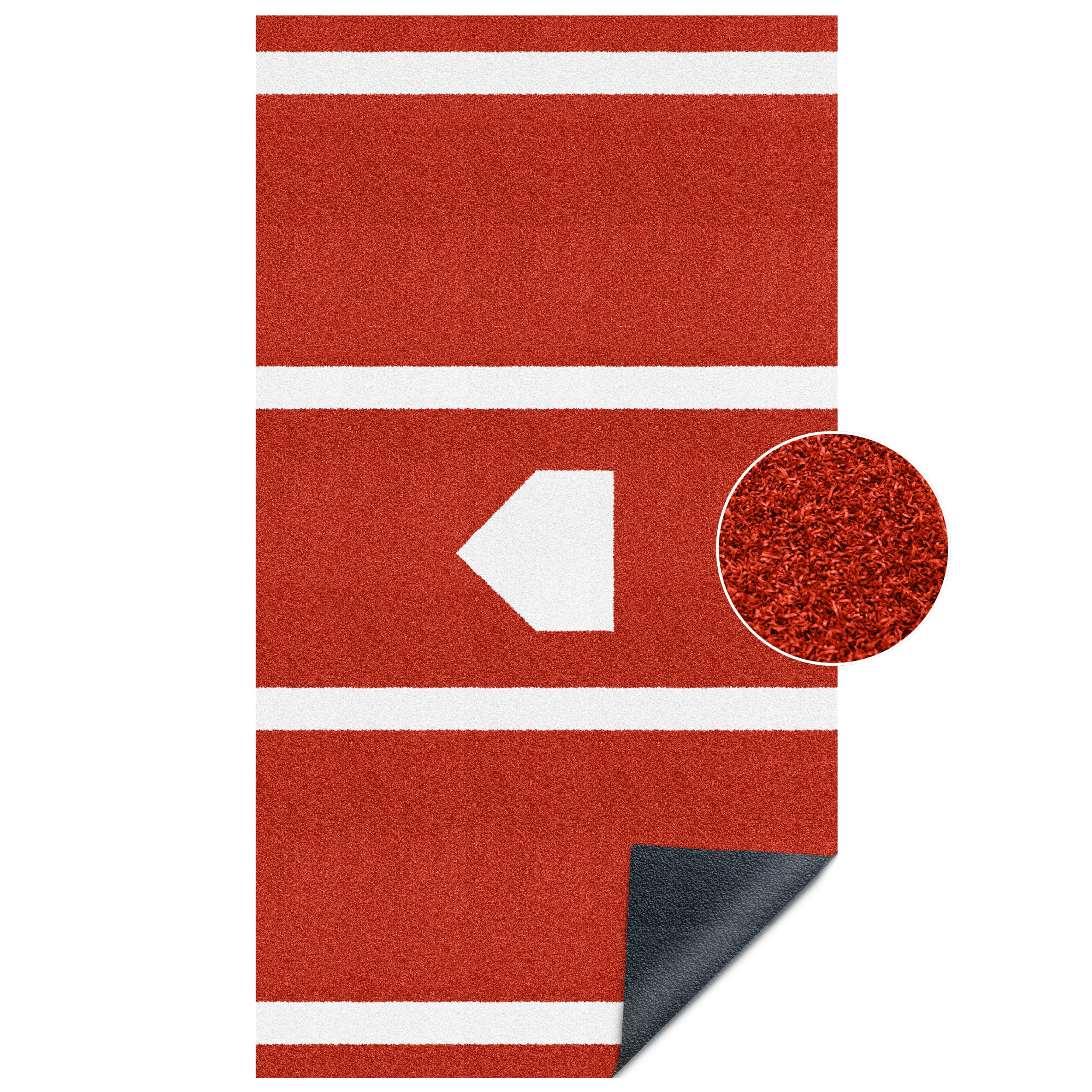
The heavy-duty turf mat that feels like a real field under your spikes.
You get a regulation-style 11 by 4.8 foot surface with a home plate and batters box that works for both righties and lefties. The turf stands 15mm tall with 79,800 roots per square meter — so it looks and feels like actual infield grass rather than a thin carpet. The 5mm anti-slip rubber backing keeps the mat from sliding on both concrete and garage floors, and it protects floors from scratches during indoor practice.
Buyers report the rubber backing bunches up when placed on top of turf rather than concrete — one reviewer noted clear plastic chair mats with teeth underneath to fix the movement. At a package weight of 14.83 kilograms, the ZivPlay is heavier than the TOBWOLF mat (which weighs 5.22 kilograms), which tells you how much more substantial the turf and rubber are. One buyer mentioned it is “the exact same quality” as a mat from a baseball supply website, which puts its value in perspective.
Why It Earns the Top Spot
- Tall, dense 15mm turf with 79,800 roots per sq meter for realistic feel
- 5mm anti-slip rubber backing grips hard surfaces
- Full 11 x 4.8 ft size fits both batters box sides
One Real Limitation
- Rubber backing can bunch on top of turf floors; may need extra grip mats
- At 32.7 lbs, it is heavy to move around daily
The takeaway: Pick this for a permanent or semi-permanent backyard or garage cage where you want a true field feel and a mat that stays put on concrete.
The catch: If your practice surface is already turf, plan on adding grippers or weighted bags to stop the bunching.
2. KuiBonu 10×5 ft Baseball Hitting Mat

Inlaid lines that never fade, flake, or chip — even after a full season.
This 10 by 5 foot mat uses 15mm tall UV-protected turf with 79,000 stitches per cubic meter, and every line — home plate, batters box — is inlaid into the turf rather than painted on. That means no peeling or fading, which is the most common failure you see on cheaper mats. The 5mm anti-slip backing works well on smooth concrete; one buyer who uses it in a garage reports it does not shift at all.
Owners mention the edges can roll up sometimes, and that on top of turf the mat shifts about an inch every time you step on it (one owner solved it with four 50-pound sandbags). The 1-year manufacturer warranty gives confidence that you would not get from a no-name mat. For a similar price to the ZivPlay, the KuiBonu trades a slightly smaller surface for the benefit of inlaid lines that look fresh for years.
Sturdy construction: The 15mm UV-protected turf with inlaid lines means no paint to fade, and the 5mm EVA backing grips concrete well.
Turf limitation: On carpet or turf floors, the mat will slide unless you add heavy sandbags or anchors.
Who it fits: A coach or parent who wants a mat that still looks professional after a full season of outdoor practices, and who has a smooth concrete surface to put it on.
Who should pass: Anyone planning to use it on top of artificial turf — the sliding issue is a real headache.
3. Stride Right Hitting Mat Training System
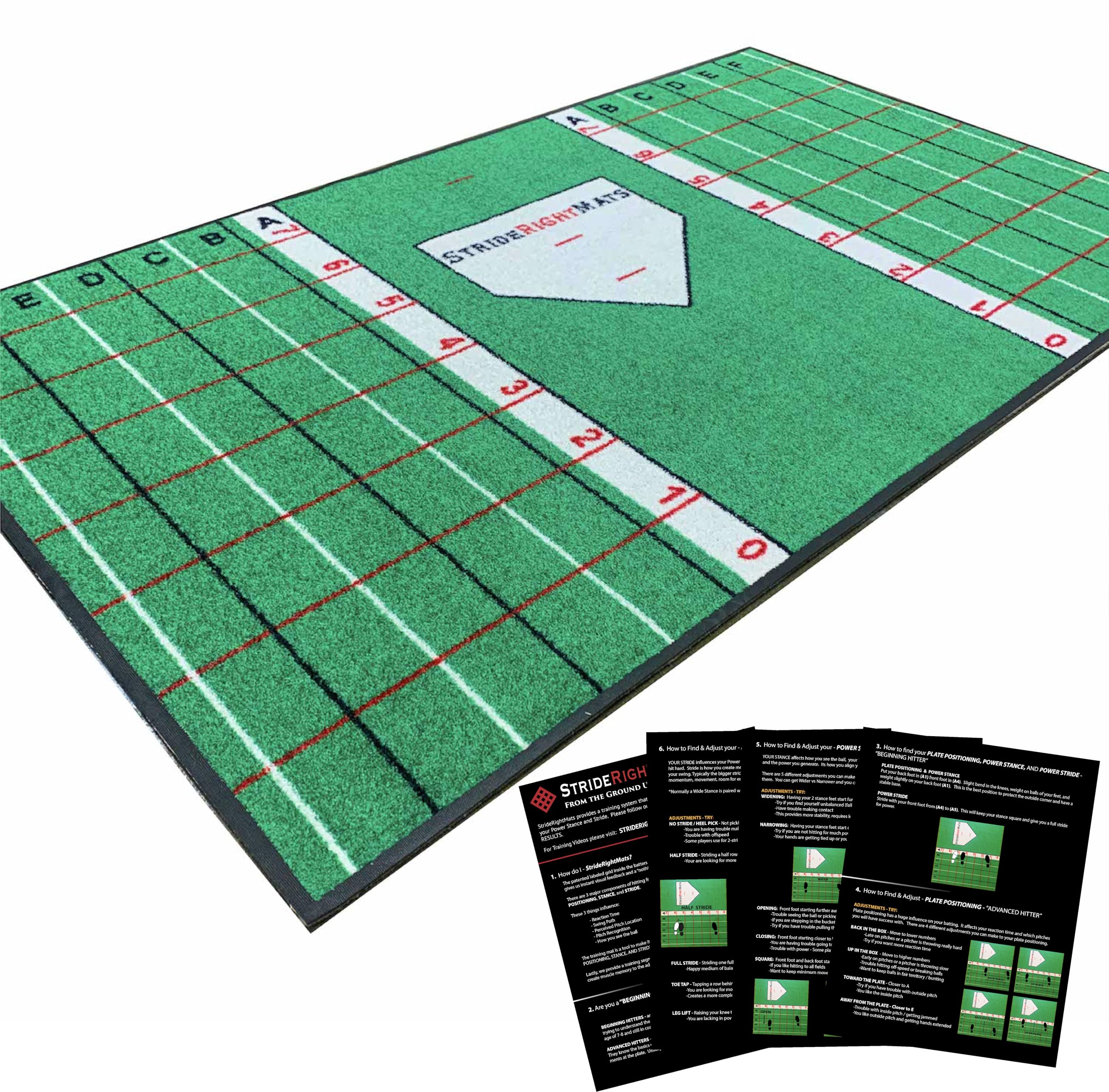
A grid-based hitting system that replaces yelling with visual self-correction.
This is not just a mat — it is a complete training system that includes a 4 by 6.5 foot hitting mat, a visual mechanics guide, and video coaching access. The patented feedback grid uses lettered and numbered rows so a hitter can look down, see they landed on “Row 4” instead of “Row 3,” and self-correct their stride instantly. One hitting coach with 20-plus years of experience called it “one of the best tools” he has used to help kids figure out where to stand consistently. At just 5.4 kilograms (11.9 lbs), it is much lighter than the ZivPlay or KuiBonu mats, making it an easy grab-and-go option for travel ball.
Customers note the mat is on the thin side and tends to curl on the edges, and that cleats will damage it quickly — turf shoes or tennis shoes only. One owner reported it is “grossly overpriced for the quality of the material” but still called it a great training aid. The commercial-grade nylon turf bonded to a thick rubber backing means it lays flat instantly on garage floors and driveways, though the thin construction is a trade-off for portability.
What Makes It Unique
- Patented numbered grid for instant stride correction without a coach
- Includes video coaching access and mechanics guide
- Light at 11.9 lbs with a carry strap for travel ball
What to Know First
- Thin material curls on the edges; not for cleats
- Premium price for the materials you get
Best for: A parent or coach who wants a teaching tool that gives kids instant feedback without a coach standing in the box.
Not for: Someone who needs a thick, heavy mat for outdoor permanent installation — look at the ZivPlay instead.
4. GoSports Baseball and Softball Hitting Mat

The 6×4 mat that survived six months of daily garage swings without a scratch.
This mat is dual-sided to accommodate both right-handed and left-handed batters, and the sturdy rubber backing keeps it planted on concrete and garage floors. among the most convincing reviews came from a buyer who said: “Even after six months of daily use in our garage, it’s holding up perfectly, showing no signs of wear or tear.” That kind of durability is rare in the mid-range. The easy-to-read grid lines give immediate feedback on stance and stride mechanics, and at 13.2 pounds (6.62 kilograms), it is light enough to roll up and take to the batting cage but heavy enough to stay put during a session.
Coaches like that it allows players to drill on instruction by themselves — set the stance, look at the grid, and adjust. The manufacturer recommends using non-spiked shoes to prevent accelerated wear, which is standard for any turf mat. The 77 by 47 by 2.36 inch surface is slightly smaller than the Stride Right mat, but the GoSports feels thicker and more substantial for the same general footprint.
Proven durability: Reviewers point out zero wear after six months of daily use, and the rubber backing stays in place on smooth surfaces.
Size note: At 6×4 ft, it covers the batters box but does not give the full 10-foot experience of the premium mats — fine for tee work and soft toss.
Reach for this if: You want a mid-sized, bombproof mat for daily garage or driveway practice and you do not want to replace it mid-season.
Look elsewhere if: You need a full 10-foot length for live pitching — step up to the ZivPlay or KuiBonu.
5. TOBWOLF Baseball Batting Mat

A 10-foot mat that weighs less than 12 pounds — perfect for coaches on the move.
At just 5.22 kilograms (11.5 lbs), the TOBWOLF is the lightest full-length mat on this list by a wide margin. It gives you a 10 by 3.8 foot surface with a clear printed home plate and stride lines, and the 5mm thickened non-slip rubber backing keeps it from sliding on most surfaces. The polyurethane turf holds up well indoors and outdoors, and shoppers say it “lays flat, holds up indoors/outdoors” with no curling issues from the start. The included carry strap makes it easy to sling over your shoulder and take to the field for pre-game warm-ups.
The trade-off for that portability is a narrower 3.8 foot width — full-sized mats offer 4.8 to 5 feet. One reviewer coaching kids found the spacing “a bit wide” for T-ball ages, so it is better suited to older youth and adult hitters. The 90-day warranty from TOBWOLF is shorter than KuiBonu’s one-year coverage, which matters if you plan on heavy outdoor use.
Why It Stands Out
- Extremely portable at 11.5 lbs — easiest to carry on this list
- 5mm non-slip rubber backing grips well
- Large 10×3.8 ft surface for full batters box reps
Where It Comes Up Short
- Narrower 3.8 ft width compared to 4.8-5 ft on premium mats
- 90-day warranty is shorter than competitors
Best for: A travel-ball coach or parent who drives to practice fields and needs a mat that does not weigh down the bag.
Not ideal for: T-ball players (too wide for small feet) or anyone who wants a heavy, permanent cage mat.
6. Davison T-Ball, Baseball and Softball Batting Stance Training Mat

The rubber footprint that teaches 4-year-olds where to stand without a coach in the box.
This is not a full-size hitting mat — it is a focused stance trainer for young players ages 4 to 12. The ambidextrous rubber mat shows exactly where both feet go, for righties and lefties, so a coach or parent does not have to squat in the swing path to adjust the player. One T-ball coach said it “simplified getting stance situated” and noted other teams wanted to borrow it. Another buyer worried about the mat staying rolled up after shipping, but after rolling it the opposite way it laid flat in the dirt.
At just 16 ounces, the Davison mat is the lightest and smallest option here — you can toss it in a gear bag and bring it to every practice. It is designed for tee work, coach pitch, and pre-game warm-ups, not for a full batting cage setup. The rubber construction is simple, durable, and effective for its narrow job. If you are coaching T-ball or working with a 5-year-old beginner, this mat eliminates the most common frustration: correcting foot placement every single swing.
Focused purpose: It does one thing — teach foot placement — and does it very well for young beginners. The ambidextrous design means one mat works for the whole team.
Limited scope: No stride lines, no grid, no full-length surface — this is purely a stance placement tool for T-ball and Little League ages.
Best for: T-ball and youth softball coaches who want to get 12 kids set up correctly without spending the whole practice adjusting feet.
skip it if: You need a full-length mat for adult batting practice or serious swing mechanics work — grab the Stride Right or GoSports instead.
Understanding the Specs
Turf Pile Height & Density
Pile height (how tall the grass fibers are, measured in millimeters) and density (stitches per square meter) determine how realistic the mat feels and how long it lasts. Taller turf at 15mm with 79,000+ roots per square meter feels like infield grass. Lower-pile turf (under 10mm) looks flat quickly and can mat down after a few sessions. Denser turf also hides footprints and scuffs better during practice.
Backing Material & Thickness
The backing is what keeps the mat from sliding when you stride. A 5mm rubber or EVA (a firm, flexible foam) backing provides enough grip on concrete and garage floors. Thinner felt or no backing at all means the mat shifts an inch or more per swing, which destroys consistency. Rubber is heavier but holds better; EVA is lighter but can slip on smooth turf. If you are putting the mat on artificial turf, plan on adding sandbags or grippers regardless of the backing.
FAQ
What size batting mat do I need for my garage?
Will a batting mat damage my garage floor?
Can I leave a batting mat outside in rain and sun?
How do I stop a batting mat from curling at the edges?
Can I use cleats on a batting mat?
What is the difference between a stance mat and a full hitting mat?
How do I clean a baseball batting mat?
How long does a batting mat typically last?
Can I use a batting mat for softball practice?
Will a mat shift on artificial turf?
Final Thoughts: The Verdict
If you want one dependable pick, the baseball batting mat winner is the ZivPlay 11×4.8 ft because it combines a realistic 15mm turf with a heavy 5mm rubber backing at a price that undercuts the competition. If you want unfading inlaid lines and a 1-year warranty, grab the KuiBonu 10×5 ft. And for a portable teaching system with a patented grid that replaces constant coaching, pick the Stride Right 4×6.5 ft.
How We Picked
We do not accept paid placement. Every pick is matched to a real buyer and a real use-case; we do not hands-on test units.
Sources & Methodology
Specifications: manufacturer listings and product documentation. Review insights: verified customer reviews, as of July 2026. Pricing: not shown on this page (it changes often); check the current price via the retailer link.
As an Amazon Associate, Gadgets Feed earns from qualifying purchases. This does not affect which products we feature.