
Our readers keep the lights on and my morning glass full of iced black tea. As an Amazon Associate, I earn from qualifying purchases.
Specs are compiled from manufacturer listings and verified buyer reviews and can change over time — please confirm the key details on the product page before buying.
Your car’s heater is slow, broken, or missing — and you are stuck shivering on a cold morning. A battery-operated heater for your car solves that. It is a small 12V device that plugs into your cigarette lighter socket or wires directly to your battery. It pushes warm air into the cabin so you can feel comfortable again.
I am Min, the founder of Gadgets Feed. This guide compares each heater’s specs from the manufacturer and what real buyers said in reviews. You get each pick’s honest strengths and trade-offs, not marketing hype.
If you drive a classic truck with a dead heater core, a golf cart, or a work van that never warms up, you need to understand wattage and wiring. A mismatch means you buy a heater that barely blows lukewarm air. Read on to find which battery operated heater for car is actually worth your money and battery power.
Quick Picks
- MASO 12V 800W Car Heater Kit — Top Performer
- CYDZSW 12V 800W Car Heater — Best Value
- Roadpro 12V RPSL-681 12-volt Ceramic Heater/fan — Supplemental Choice
- LLWAN Portable 12V Car Heater — Compact Pick
How To Choose The Best Battery Operated Heater For Car
Picking the right 12V heater for your car is not just about which one looks smallest. You need to match the wattage to your car’s electrical system, decide if you want a simple plug-in or a permanent hardwire, and consider how much actual heat you need. Here are the three factors that matter most.
Wattage: The Heart of the Heat
A heater’s wattage tells you how much electrical power it converts into heat. Higher wattage generally means more warmth, but it also pulls more current from your battery. A 300-watt heater draws about 25 amps, while an 800-watt heater pulls roughly 67 amps. You need a battery with enough amp-hours (Ah) to run an 800W unit without draining your battery flat in minutes.
Installation: Plug and Play vs. Hardwire
Some 12V heaters come with a cigarette lighter plug that works instantly — just push it in and turn the switch. Others require connecting wires directly to your battery terminals, often with an inline fuse. The hardwired kits (like the MASO and CYDZSW) are more powerful but need a few minutes of setup with basic tools. If you just want to defrost a windshield quickly, the plug-in style might be enough. If you want sustained cabin heat, the hardwire route is safer and more reliable.
Airflow and Fan Quality
Hot air is useless if the fan cannot push it out of the heater. A common complaint in this category is “blows warm but barely moves air.” Look for a heater with an adjustable fan speed and a motor large enough to push heat several feet into the cabin. The Roadpro RPSL-681, for example, offers a low and high fan setting, but buyers report that even the high setting produces only weak airflow.
Quick Comparison
| Model | Best For | Wattage | Weight | Installation Type | Amazon |
|---|---|---|---|---|---|
| MASO 12V 800W Car Heater Kit | High-power hardwired cabin heat | 800 watts | — | Hardwire (2-pin) | Amazon |
| CYDZSW 12V 800W Car Heater | Budget hardwired defroster | 800 watts | 2.12 pounds | Hardwire | Amazon |
| Roadpro RPSL-681 Ceramic Heater | Supplemental heat with direct battery hookup | 300 watts | 3.14 pounds | Hardwire (included cable) | Amazon |
| LLWAN Portable 12V Heater | Quick plug-in defrosting | — | 13.1 ounces | Cigarette lighter plug | Amazon |
In‑Depth Reviews
1. MASO 12V 800W Car Heater Kit

The hardwired 800-watt heater that actually demands your battery can handle the draw.
This MASO kit is for the buyer who wants serious heat — the 800-watt PTC ceramic (a self-regulating heating element that resists overheating) element produces the highest wattage in this comparison, matching the CYDZSW but with a more established brand and a slightly more compact design at 7.09 x 4.72 x 3.54 inches. The maker specifies that you need a battery above 45 amp-hours (Ah) to reach peak power — a common car battery is around 50-60 Ah, so this is a realistic requirement, not a sales pitch. At 50 decibels of noise, it is quiet enough to run while driving without bothering you.
There is a real installation commitment here. This is not a plug-and-play device; it uses a 2-pin connector that you must wire directly to your battery with the included hardware. The manufacturer’s wiring instructions are reportedly wrong — one reviewer found that the 50-amp fuse it recommended blew immediately, and a 60-amp fuse plus 4-gauge cable was required to run it safely. Another buyer noted that the white braided wire connected to the breaker switch broke away after two days of use. Unlike the Roadpro 300W unit (which comes with a 15-foot cable and only 300 watts), the MASO delivers 2.7 times the wattage but demands much more careful electrical setup.
The result is a heater that, when correctly wired, produces noticeably warm air for cabin heating and defrosting. One buyer hooked it into the existing defrost tubes of a classic truck and reported it works perfectly without the bulky factory heater. The trade-off is clear: you get more heat than any 300W unit can offer, but you must be comfortable with basic DIY wiring and upgrading the fuse and cable gauge.
Strongest Cabin Heat
- 800W PTC ceramic element produces the highest heat output in this lineup
- Compact enough to fit in tight engine bay or cabin spaces
- Quiet operation at 50 dB
Demanding Setup
- Requires direct battery wiring — no cigarette lighter compatibility
- Factory wiring instructions are inaccurate and fuse/cable gauge upgrades are needed
- Some units have had wiring failures at the breaker switch within days
Reach for this if: you need real cabin-warming heat for a vehicle with a dead heater core or a classic truck and you are comfortable upgrading the electrical connections yourself.
Look elsewhere if: you want a simple plug-and-play defroster or your battery is below 45 Ah.
2. CYDZSW 12V 800W Car Heater

The lightweight hardwired 800W heater that delivered a real temperature rise in a real test.
At just 2.12 pounds, the CYDZSW is significantly lighter than the Roadpro 300W unit (which weighs 3.14 pounds — 48% more) while delivering 800 watts of heating power. That is a massive power-to-weight advantage, making this a strong candidate for anyone looking to add heat without a lot of extra bulk. The package dimensions of 8.86 x 7.05 x 4.72 inches make it about 49% larger in volume than the LLWAN cigar-lighter unit, but that size is a function of the larger PTC ceramic element inside.
Owners mention real results here: one customer used it in a forklift and found that the 800W 12V heater raised the interior temperature 25 to 35 degrees Fahrenheit above the ambient temperature. That is a concrete, measurable improvement. However, the same reviewer noted that the quick-connect plug melted after hours of use and recommended direct wiring instead — a common theme across high-wattage 12V heaters. Another reviewer warned that 800 watts is too much for typical car wiring and could damage the alternator, so this is not a product you simply tap into an existing circuit.
Installation is described as easy — the manufacturer says you can complete it in under 10 minutes by connecting the red wire to positive and black wire to negative. But the disconnect between “easy install” and the real-world need for a heavy-gauge direct battery connection means beginners should budget extra time for a proper setup. Unlike the Roadpro 300W, which one reviewer noted comes with expensive 12-gauge wire and requires adding a 30-amp inline fuse, the CYDZSW does not ship with the same level of cabling, so you may need to source thicker wire yourself.
Real Heat Output
- 800W provides enough power to raise cabin temp 25–35°F above ambient
- Weighs only 2.12 lbs — lighter than the 300W Roadpro
- PTC ceramic element for safe, self-regulated heating
Wiring Concerns
- Quick-connect plug can melt under sustained use — direct wiring is recommended
- No cigarette lighter compatibility, so permanent installation is necessary
- More than one buyer found it unusable from the start because of missing adapter
Best for: those who want a lightweight, powerful hardwired heater for a golf cart, UTV, or work vehicle and are prepared to wire it directly.
Skip if: you want a quick plug-in solution or you lack the tools for a proper direct-wire install.
3. Roadpro 12V RPSL-681 12-volt Ceramic Heater/fan

The direct-battery 300W ceramic heater that includes quality cabling but fights with weak airflow.
The Roadpro RPSL-681 is the only 300-watt option in this roundup, and it fills a specific niche: you do not need to cook the cabin, you just need a little extra warmth in a vehicle with a partially working heater. It comes with a 15-foot 12-gauge wire with battery terminals pre-attached, which customers note is a genuinely expensive, high-quality cable. One buyer mentioned that you absolutely need to add a 30-amp inline fuse (not included) to the red wire before connecting it to the battery positive terminal. Unlike the 800W units that demand heavy-duty wiring, the Roadpro’s 300W draw is gentler on your electrical system.
The biggest complaint across multiple reviews is the weak airflow. Even on the high fan speed setting, one owner reported the fan blows heat only about six inches from the unit — barely enough to warm the driver’s hand held three inches away. Another reviewer bought it for a garden tractor cab and found the airflow too weak to have any effect; they modified the unit by adding a large computer fan to push the air through. This is a stark contrast to the 800W heaters, which at least have enough raw wattage to raise ambient temperature if the fan can move the air. The heater/fan switch is a nice touch — flip it between heat and fan-only mode — but the fan itself is the bottleneck.
On the positive side, the burn-guard material covering the heating element adds a layer of safety that the cheaper wire-and-exposed-element designs lack. And at 3.14 pounds, it is heavier than the CYDZSW 800W unit (by 48%), which is surprising given its lower power — the extra weight comes from the thicker cable and more sturdy housing.
Solid Build, Lower Draw
- Includes high-quality 15-foot 12-gauge cable with battery terminals
- 300W draw is gentler on battery than 800W alternatives
- Burn-guard material on heating element for safety
Airflow is the Flaw
- Fan blows heat only about six inches even on high setting
- Weak airflow makes it ineffective for cabin-wide heating
- Heavier than the more powerful CYDZSW 800W
Grab the Roadpro if: you want a lower-power heater for a small cab or to supplement a weak vehicle heater, and you value the included wiring kit over raw heat output.
Leave it on the shelf if: you need to actually warm a large cabin or defrost a windshield in a vehicle with no heater at all.
4. LLWAN Portable 12V Car Heater
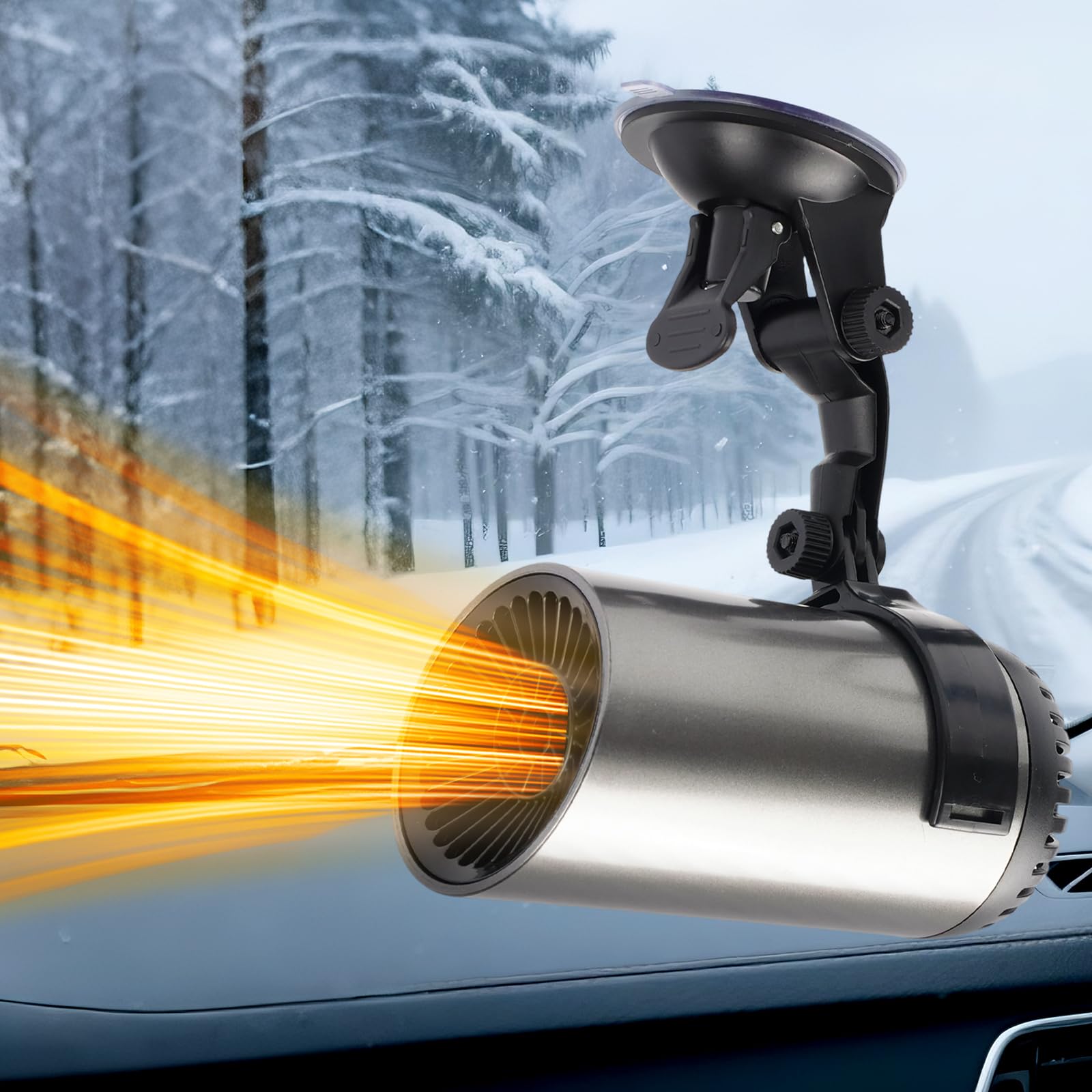
The ultra-light plug-in heater that is convenient until it burns out in 20 minutes.
At just 13.1 ounces and with package dimensions of 5.94 x 5.24 x 3.27 inches, the LLWAN is the smallest and most portable heater here — and it is the only one you can use instantly with a cigarette lighter socket. The 180-degree rotatable suction mount lets you point the warm air directly at your windshield or your face, which is genuinely handy. It also doubles as a fan-only mode, so you can use it in summer to circulate air. On the surface, it is the easiest, most passenger-friendly option in this list.
The catch is reliability. One customer observed that the unit burned out after just 20 minutes of first use. Another described the airflow as significantly weak — so weak that they felt exhaling produces more air pressure. A third reviewer was blunt: “it barely blows any heat; no fan inside of heater.” There are also positive voices: one reviewer whose truck heater core had failed found that this unit was a lifesaver and kept them warm on cold mornings, and another said it “works like a champ” for defrosting. The split in experience suggests quality control is inconsistent. Unlike the Roadpro 300W, which at least produces warmth consistently (even if the fan is weak), the LLWAN seems to vary unit-to-unit in both heat output and fan performance.
If you get a good unit, this is the easiest defroster for a quick 10-minute commute on a frosty morning. But the risk of getting a dud is real, and the lack of a hardwired power connection means the heater cannot pull enough current to produce the kind of sustained heat the 800W hardwire units deliver.
Ultra Convenient
- Plugs into any 12V cigarette lighter socket — no wiring needed
- Weighs only 13.1 ounces and includes a rotatable suction mount
- Can double as a fan in summer
Hits or Misses
- Some units burn out within 20 minutes of use
- Airflow is reported as too weak to effectively defrost a windshield
- Inconsistent quality control makes it a gamble
Choose this if: you need a portable, zero-install defroster for short trips and you are willing to take the quality gamble.
Avoid it if: you need dependable daily heat or you drive longer distances where sustained operation matters.
Understanding the Specs
Wattage and Current Draw
Wattage is the raw measure of how much heat a 12V heater can produce. A 300-watt heater draws roughly 25 amps from your battery, while an 800-watt unit pulls around 67 amps. For reference, a typical car cigarette lighter circuit is fused at 10 to 15 amps — way too low for an 800W heater. That is why the 800W units (like the MASO and CYDZSW) require direct battery connection with thick cables and big fuses, while the lower-wattage Roadpro and the LLWAN can at least theoretically run on a lighter circuit. In real-world driving, running an 800W heater for an hour will drain a 60Ah battery significantly, so these are best used with the engine running to keep the alternator charging.
PTC Ceramic Heating Elements
PTC stands for Positive Temperature Coefficient, a fancy way of saying the heating element self-regulates. As the ceramic element gets hotter, its electrical resistance increases, which naturally limits the temperature without a thermostat. This makes PTC heaters safer than traditional wire-element heaters because they are less likely to overheat and catch fire. All four products in this guide claim to use PTC ceramic elements. The practical benefit is that you can run the heater for longer without constantly worrying about burning something, though the high current draw on 800W units still poses a fire risk if the wiring is undersized.
FAQ
Will a battery operated car heater drain my battery?
Can I plug an 800W heater into my cigarette lighter?
What battery capacity do I need for an 800W 12V heater?
How hot does a 12V car heater actually get?
Is a 300W heater enough to defrost a windshield?
Can I use a battery operated car heater while the car is off?
Why did my 12V car heater burn out after 20 minutes?
What gauge wire should I use for an 800W heater?
Will a 12V car heater work in a golf cart or UTV?
Can I leave a battery operated car heater on overnight?
Final Thoughts: The Verdict
Across the board, the battery operated heater for car winner is the MASO 12V 800W Car Heater Kit because it delivers the highest wattage in a compact package and, when correctly wired with upgraded cable and fuse, produces genuine cabin-warming heat. If you want a lighter, more affordable hardwire option that still pumps out 800W, grab the CYDZSW. And for the driver who wants a simple plug-in defroster for short trips even with the reliability gamble, the LLWAN is the lightest, most convenient option.
How We Picked
We do not accept paid placement. Every pick is matched to a real buyer and a real use-case; we do not hands-on test units.
Sources & Methodology
Specifications: manufacturer listings and product documentation. Review insights: verified customer reviews, as of July 2026. Pricing: not shown on this page (it changes often); check the current price via the retailer link.
As an Amazon Associate, Gadgets Feed earns from qualifying purchases. This does not affect which products we feature.