
Our readers keep the lights on and my morning glass full of iced black tea. As an Amazon Associate, I earn from qualifying purchases.
Specs are compiled from manufacturer listings and verified buyer reviews and can change over time — please confirm the key details on the product page before buying.
Forget the fumes, the pull-cord yanking, and the constant trips to the gas station. A battery powered generator gives you quiet, clean electricity on demand — for camping, home backup, or working off-grid. The difference between a great one and a dud depends on three things: capacity (measured in watt-hours, or Wh — the total energy it holds), output (how many watts it can deliver at once), and how fast it recharges.
I’m Min — the founder and writer behind Gadgets Feed. This guide is built by comparing the manufacturers’ published specifications and the patterns across verified customer reviews, so you get each pick’s real strengths and trade-offs instead of marketing spin.
Whether you are prepping for storm season, kitting out a camper van, or just want an extension cord to the backyard that does not burn fuel, these picks cover the full range of what a modern battery powered generator can do without the noise or exhaust.
Quick Picks
- EF ECOFLOW Portable Power Station DELTA 3 — Best Overall
- Jackery HomePower 3000 — Premium Pick
- GRECELL EB1000 Portable Power Station — Best Value
- BLUETTI Elite 100 V2 — Compact Powerhouse
- Anker SOLIX C2000 Gen 2 — Long-Runtime
- AFERIY P210 Portable Power Station — High-Output
- Jackery Explorer 2000 v2 — Travel-Ready
- BLUETTI AC70 Portable Power Station — Mid-Range
How To Choose The Best Battery Powered Generator
Before you drop money on a big battery box, you need to understand three numbers that define everything this device can and cannot do. Get these right, and you will end up with a generator that fits your life rather than a heavy brick that disappoints you at the worst possible moment.
Capacity (Watt-Hours) — How Long It Will Run
Watt-hours (Wh) is the total energy stored inside the battery. Think of it like the size of your gas tank. A 1,000Wh generator can run a 100-watt lamp for roughly 10 hours. Bigger capacity means longer runtime, but it also means more weight and higher cost. For weekend camping, 700–1,000Wh is often enough. For whole-home backup during a multi-day outage, look for 2,000Wh or more.
Output (Watts) — What It Can Power
The inverter’s (the device that converts battery DC power into AC power) wattage rating tells you the maximum load the generator can handle at once. A 1,800W inverter can run a refrigerator, a microwave, and a few lights simultaneously — but not a large air conditioner or a well pump. Check the “surge” or “peak” rating too, because motors (like a fridge compressor) need extra power for the first second or two to start spinning. If you plan to run power tools or a window A/C, aim for at least 2,000W continuous output.
Recharge Speed & Solar Input
A generator that takes 12 hours to recharge from a wall outlet is painful. The best models now recharge from 0–80% in under an hour. Also check the solar input limit (measured in watts) — a higher limit means you can plug in more solar panels and recharge faster when you are off-grid. Some units also support car charging, which is slower but useful when you are on the road.
Quick Comparison
| Model | Best For | Capacity (Wh) | AC Output (W) | Weight (lbs) | Amazon |
|---|---|---|---|---|---|
| EF ECOFLOW DELTA 3 Classic | All-around home backup and camping | 1024 | 1800 | 15 | Amazon |
| BLUETTI Elite 100 V2 | Compact power for essentials | 1024 | 1800 | 25 | Amazon |
| BLUETTI AC70 | Mid-range portable for trips | 768 | 1000 | 22.5 | Amazon |
| GRECELL EB1000 | Budget-friendly entry-level | 999 | 1000 | — | Amazon |
| AFERIY P210 | Heavy-duty home backup | 2048 | 2400 | 54 | Amazon |
| Jackery Explorer 2000 v2 | Portable 2kWh for travel and backup | 2042 | 2200 | 39.5 | Amazon |
| Anker SOLIX C2000 Gen 2 | Fast-recharging home backup | 2048 | 2400 | 41.7 | Amazon |
| Jackery HomePower 3000 | Whole-home and RV power | 3072 | 3600 | 59.5 | Amazon |
In‑Depth Reviews
1. EF ECOFLOW Portable Power Station DELTA 3 Classic
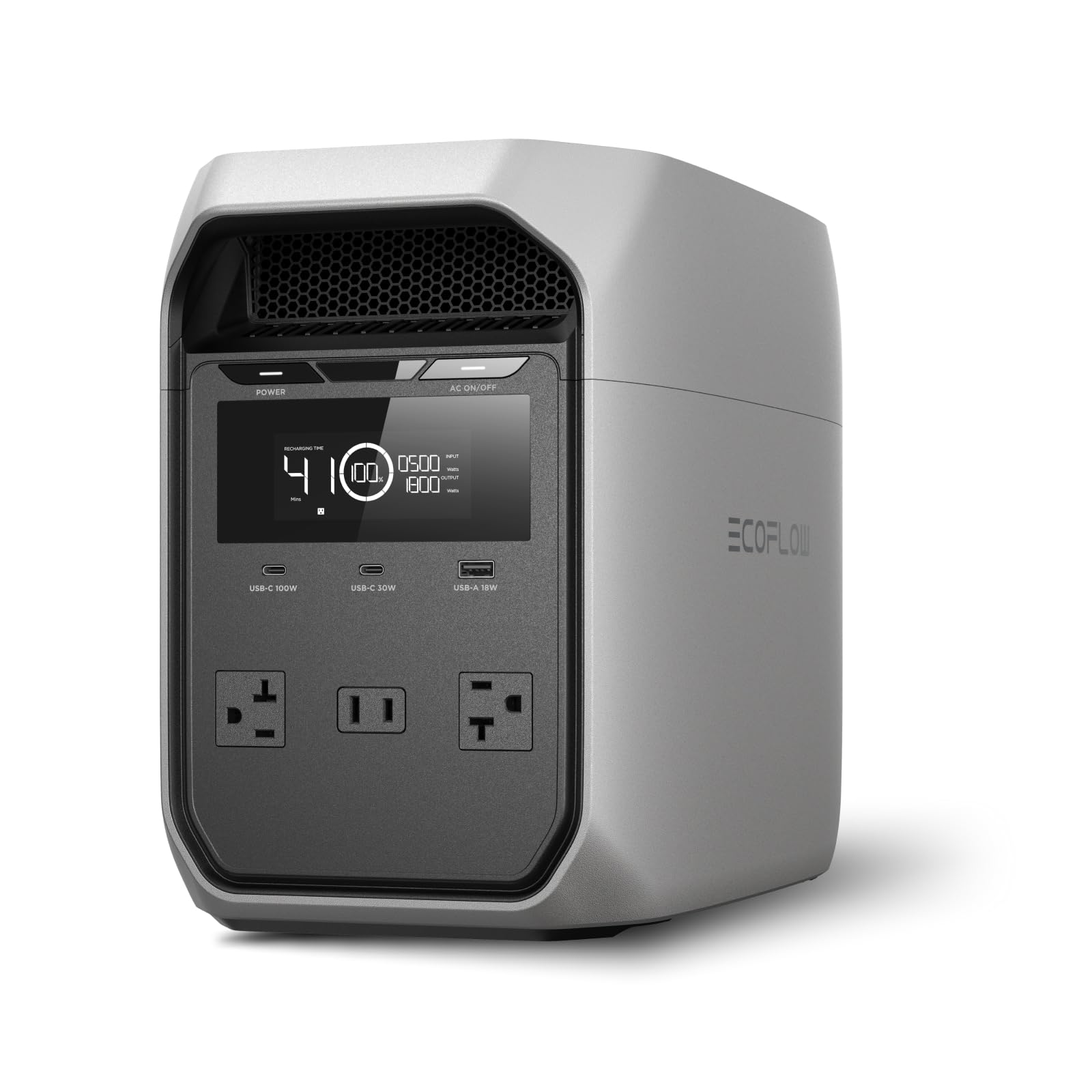
The featherweight that outmuscles units double its size on both capacity and output.
This generator punches well above its weight class. You get a 1024Wh capacity and a beefy 1800W continuous AC output (3600W surge) — enough to run a refrigerator, a microwave, or a power saw — all in a package that weighs just 15 pounds. That is a 33% larger capacity than the BLUETTI AC70 (768Wh) yet it is 50% lighter than that same unit. The USB-C port delivers 100W, which charges a laptop 67% faster than the 60W on the GRECELL EB1000. It also recharges from 0–80% in just 45 minutes via the X-Stream AC input, so you can top it off quickly between uses.
Buyers report one owner calling it “the best power station” and noting the “1024Wh LiFePO4, 1800W AC (3600W surge), 100W USB-C, 1-hour AC recharge” as a standout spec set. Another reviewer said it “powered an electric leaf blower and a KBBQ grill with a fan for 2-3 hours with more than 50% battery left” — giving you a real-world sense of its stamina. The <10ms UPS switchover (uninterruptible power supply — the time it takes to switch from wall power to battery, measured in milliseconds) means connected devices like a PC or medical device won’t blink during an outage. This is the one to pick if you want portability and power in a single unit.
what separates it
- 1800W continuous AC output in a 15 lb frame — the best power-to-weight ratio here
- Recharges from a wall outlet in about 1 hour
- Sub-10ms UPS backup protects sensitive electronics like a computer without a flicker
Honest Limits
- Not compatible with older DELTA 2 expansion batteries
- Capacity is enough for a weekend but may not stretch a full week for heavy users
Reach for it if: You want the lightest generator that can still run a full-size fridge and a microwave without breaking a sweat — the 1800W output in a 15-pound body is the defining stat here.
Look elsewhere if: You need to power a household for multiple days without any solar panels — then a bigger 2kWh+ unit with expansion batteries will serve you better.
2. Jackery HomePower 3000
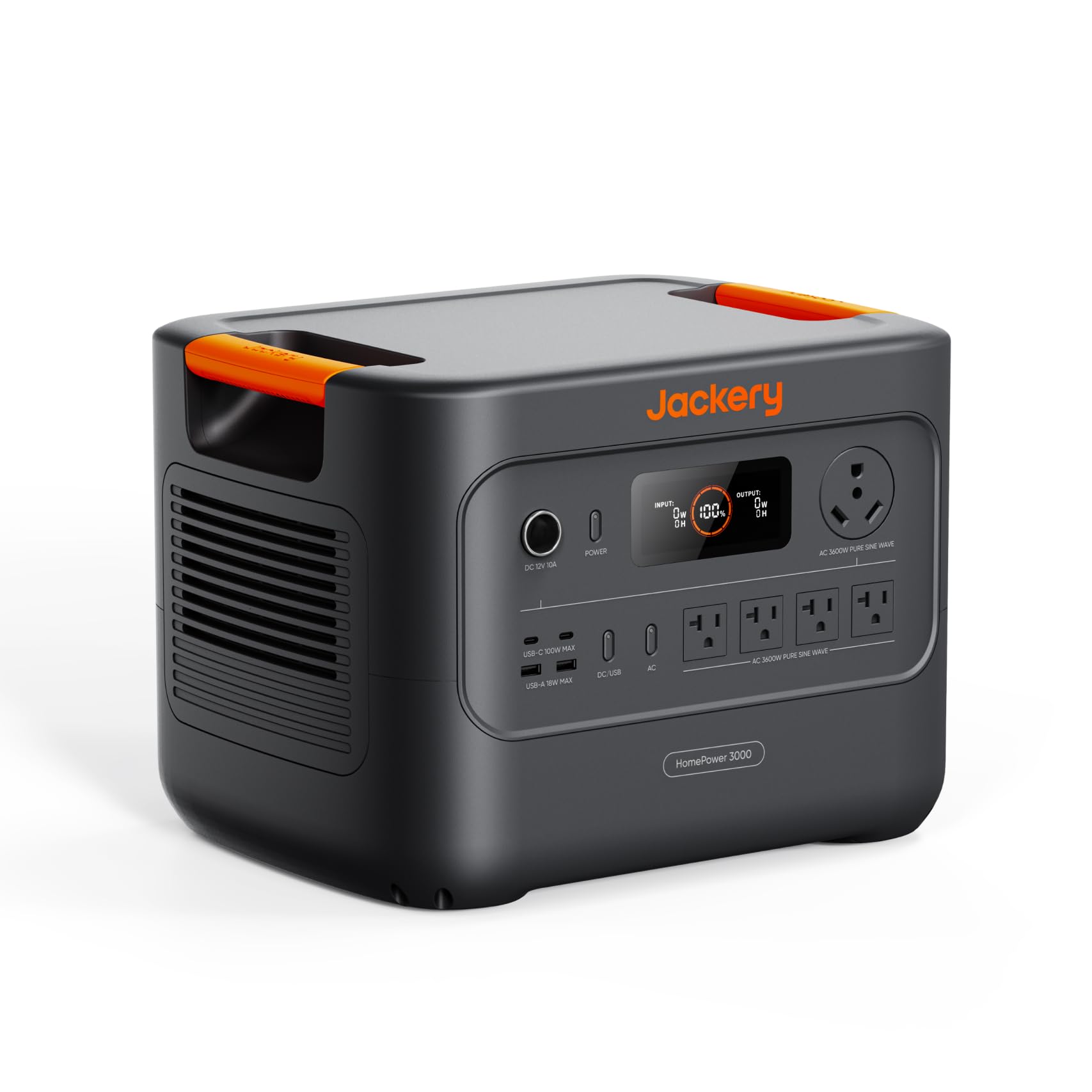
The whole-home backup that laughs at multi-day outages and heavy power tools.
When a standard 2kWh generator is not enough, the Jackery HomePower 3000 steps in with a massive 3072Wh capacity and a 3600W continuous output (7200W surge). That is enough juice to run a household — fridge, lights, WiFi, and even a microwave — for up to 15 hours on a single charge, and it keeps a refrigerator running for 1 to 2 days. It also features a built-in TT-30 RV port (a 30-amp, 120-volt standard plug for travel trailers), so you can plug a travel trailer directly in without a separate adapter. The dual 100W USB-C PD (power delivery) ports charge laptops and drones at full speed.
Buyers specifically note it “dry camps a 30ft travel trailer for 3+ days without A/C” and powers a microwave, TV, stereo, and Starlink internet. Another owner says it “runs office equipment for 2 days” but adds the fan can hit ~60 dB when under load — noisier than smaller units. The ChargeShield 2.0 system, which the brand says uses AI algorithms, is designed to help extend the LiFePO4 battery’s 4,000-cycle lifespan. At 59.5 pounds, it is not something you want to carry up stairs, but the side grips make it manageable to roll on a small dolly or load into a truck bed.
The Heavy Lifter
- 3072Wh capacity and 3600W continuous output are class-leading in this list
- Dual 100W USB-C PD ports and a TT-30 RV port
- UL-certified ≤20ms UPS for smooth backup
The Trade-Offs
- Weighs 59.5 pounds — you will want a cart or help moving it
- Fan can be audible (~60 dB) under a heavy load, less ideal for a quiet camping setup
Best for: Anyone who wants a full-house emergency power source that also powers an RV’s 30A system — the 3072Wh capacity and 30A outlet are the headline specs.
skip it if: You need something you can carry one-handed to the campsite; the 15-pound EF ECOFLOW DELTA 3 Classic or a mid-range 1kWh unit will be far more practical for portable use.
3. GRECELL EB1000 Portable Power Station
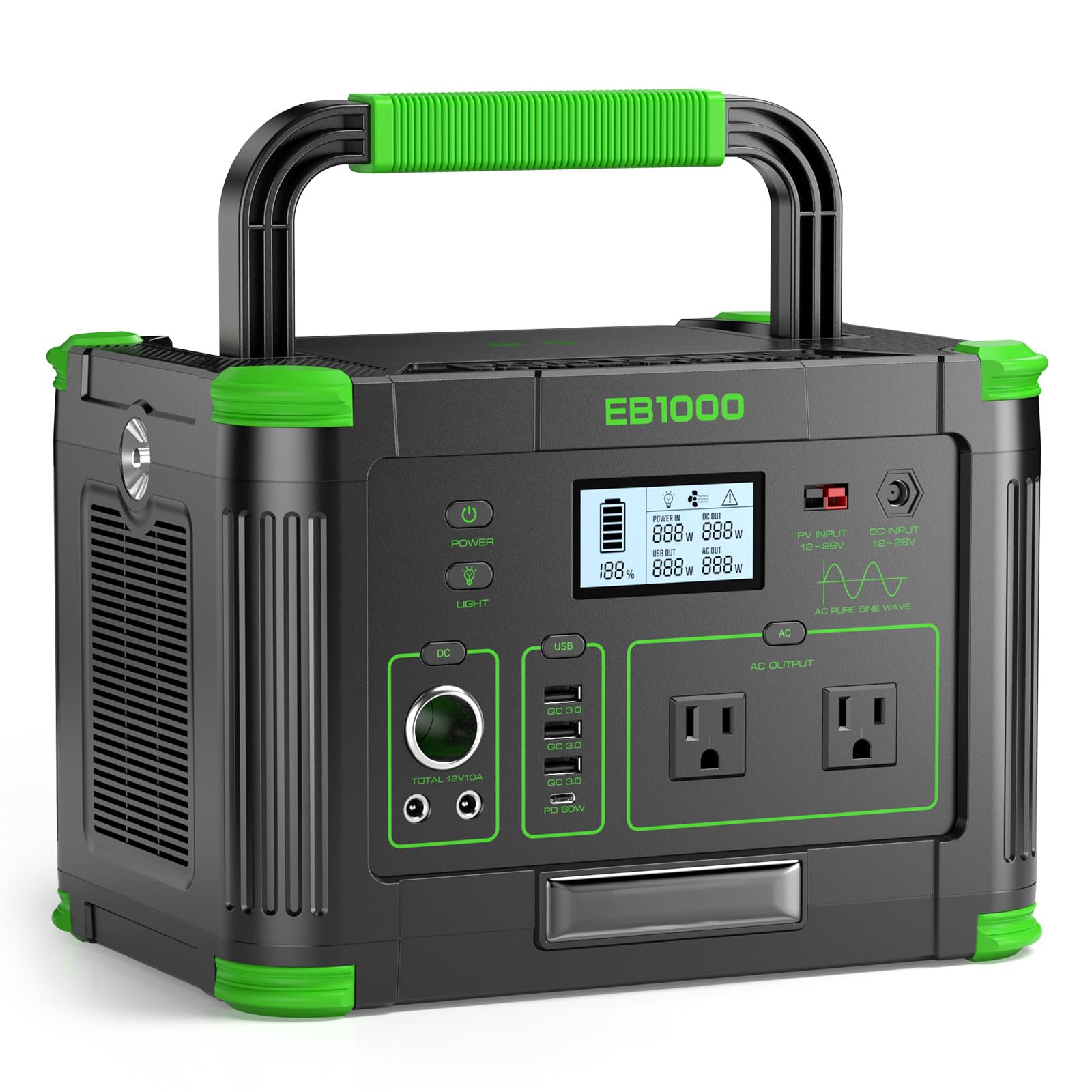
A 999Wh charging station that packs 10 output ports and a wireless charger at an entry-level price.
If you are stepping into battery generators for the first time, the EB1000 gives you a 999Wh capacity and a 1000W pure sine wave AC inverter (a type that produces smooth, clean electricity safe for sensitive electronics like laptops and CPAP machines) — enough to run a CPAP machine all night, charge laptops and phones, and keep a small fridge going. It features 2 AC sockets, a 60W USB-C PD port (power delivery, for fast-charging laptops and tablets), 3 USB-A QC 3.0 ports, a wireless charging pad, a 12V car port, and 2 DC outputs, all controllable with individual switches. The smart LCD displays real-time wattage, battery level, and runtime estimates, so you know exactly where you stand.
One buyer gave a very real-world report: “Used it on a weekend camping trip to power my CPAP. It ran it all night with 5% battery remaining in the morning. It charged back to 100% on a solar charger on a cloudy day, and powered the CPAP again that night.” That is the kind of peace-of-mind experience that matters when you are off-grid. The built-in MPPT solar controller (Maximum Power Point Tracking — it tune the power drawn from your solar panels) squeezes every possible watt from your panels. Note that the AC output is rated at 1000W continuous, so it cannot handle a large microwave or a power saw, but for lights, phones, laptops, and medical devices, it is rock-solid.
Why It Works
- 10 output ports including a wireless charging pad — the most versatile port selection for the price
- 999Wh capacity charges a CPAP all night and recharges via solar the next day
- MPPT solar controller extracts maximum power from your panels
Where It Falters
- 1000W AC output is half what the EF ECOFLOW DELTA 3 Classic delivers — no heavy appliances
- One reviewer noted an AC output failure after 2 months (though most reviews are positive)
Grab it for: Budget-conscious buyers who need a reliable, multi-port generator for camping and emergency CPAP/medical device use — the 999Wh capacity at this price point is tough to top.
Pass on it if: You need to run a refrigerator or a microwave; the 1000W continuous output will trip on startup surges from any motor-driven appliance.
4. BLUETTI Elite 100 V2
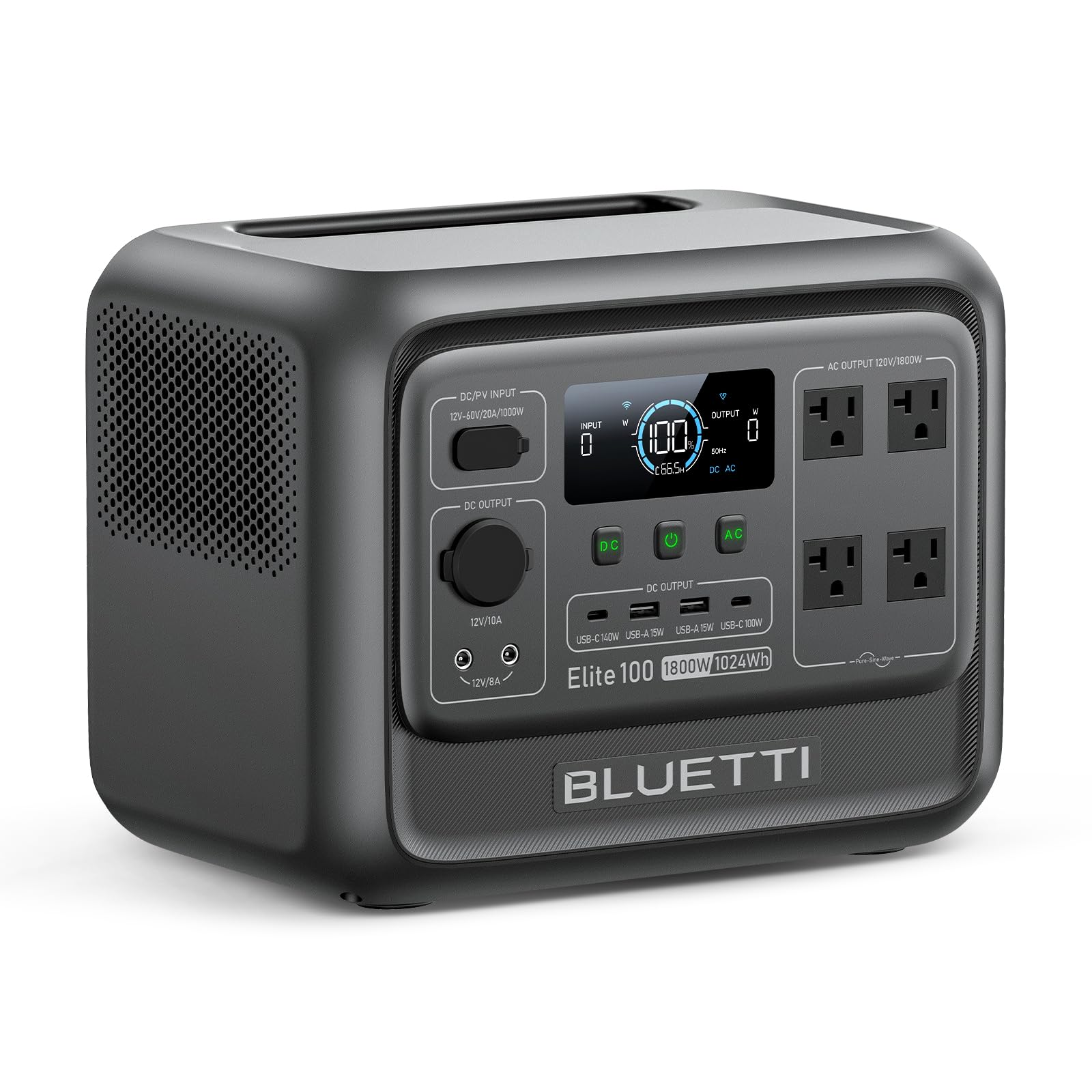
A 1kWh generator that is 35% smaller and 30% lighter than its predecessor without cutting power.
The Elite 100 V2 crams a 1024Wh LiFePO4 battery and an 1800W AC inverter (2700W Power Lifting, which helps start motor-driven appliances) into a compact 17-liter frame that weighs 25 pounds. It has 11 ports including 4 AC outlets, and the 1200W TurboBoost AC charging gets you from zero to 80% in about 45 minutes, with a full charge in roughly 70 minutes. You can also use up to 1000W solar input, which is the fastest solar recharge available for a 1kWh station. In silent mode, it runs at just 30 dB — quieter than a library — making it ideal for overnight camping or indoor use where you do not want fan noise.
Owners mention using it to power laptops, printers, and hotspots for a mobile notary business, and another reviewer called it “compact, powers most appliances” with “1000W solar input and fast AC charging.” One owner upgraded from the EB3A and found it “runs mini fridges, guitar amps, and basic power tools” without issue. The hidden handle makes one-handed transport easy compared to the heavier BLUETTI AC70 (22.5 lbs). However, it does not have a built-in light or a wireless charging pad, which the GRECELL EB1000 includes. Its 10ms UPS switchover keeps WiFi routers and PCs running smoothly during outages.
Space-Saving Star
- 35% smaller and 30% lighter than previous-gen 1kWh units while keeping 1024Wh capacity
- 1200W TurboBoost AC charging reaches full charge in ~70 minutes
- 10ms UPS backup for home reliability
What It Lacks
- No built-in LED light or wireless charging pad
- The BLUETTI app can be clunky and cannot power the unit on via Bluetooth alone
Choose this for: Travelers and mobile workers who need a compact 1kWh station that fits in a car trunk and can be grabbed one-handed — the size reduction is the key advantage here.
pass on it if: You need a built-in light or wireless charging for convenience; the GRECELL EB1000 or the EF ECOFLOW DELTA 3 Classic include those features.
5. Anker SOLIX C2000 Gen 2
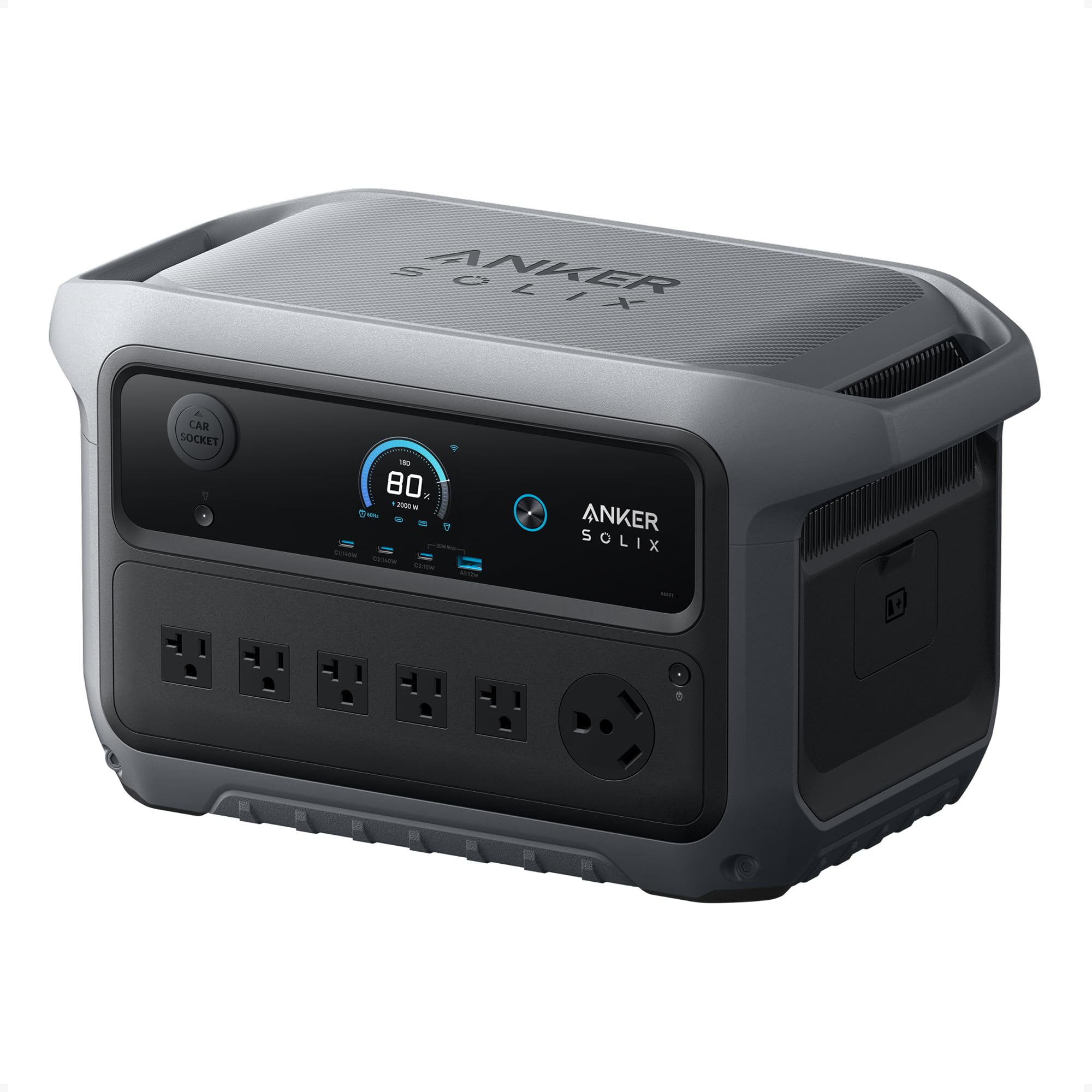
A 2kWh powerhouse that fully recharges in 58 minutes and sips only 9W on standby.
The Anker SOLIX C2000 Gen 2 packs a 2048Wh LiFePO4 battery with a 2400W continuous AC output (4000W peak), which can run a dual-door fridge for up to 32 hours on a single charge. If that is not enough, you can add an expansion battery to reach 4kWh and double that runtime to 64 hours. It recharges fully in just 58 minutes via AC — the fastest recharge rate in this lineup. It also supports 800W ultra-fast alternator charging, so you can go from empty to 100% in 3 hours while driving, which is handy for road trips. At 41.7 pounds and measuring 18.1 x 9.8 x 10.1 inches, it is 25% lighter and 29% smaller than similar 2kWh products according to the brand.
Buyers are impressed with its efficiency: one reviewer says it “powered a dual-door fridge for up to 32 hours” and another calls it “super reliable and built like a tank.” A user who connected four 200W solar panels (800W input) reports it “pulls steady power and tops off quickly even with clouds.” The 9W standby power draw is extremely low, meaning the battery won’t drain itself when sitting idle for weeks between uses. The fan is noticeable under heavy load but quiet at low draw.
Speed Demon
- Full AC recharge in 58 minutes — the fastest in this entire comparison
- 2400W continuous output can run most window and RV A/Cs
- Expandable capacity up to 4kWh for extended off-grid use
Considerations
- Heavier than the Jackery Explorer 2000 v2 (41.7 lbs vs 39.5 lbs)
- No built-in SOS light or wireless charger
Reach for this if: You need the fastest recharge possible — the 58-minute full charge is genuinely useful when you only have a short window between outages or activities.
Look elsewhere if: You prioritize absolute portability in a 2kWh class; the Jackery Explorer 2000 v2 is 2.2 pounds lighter and has a more ergonomic handle.
6. AFERIY P210 Portable Power Station

A 2048Wh battery with a 2400W inverter and an industry-leading 7-year warranty.
For those who need serious capacity and output without stepping into the premium tier, the AFERIY P210 delivers a 2048Wh LiFePO4 battery and a 2400W pure sine wave inverter (4800W surge). It features a 12V/25A XT60 DC output port (a high-current connector often used for portable refrigerators and power tools), useful for high-current DC appliances, and an ultra-fast <10ms UPS switchover for connected equipment. The unit recharges from 0–100% in about 2 hours via AC, and customers note it handles a 290-320W load for around 7 hours — enough for a full night of essentials during a hurricane outage. One hurricane-area buyer said it “provides 10-12 hours overnight at 150-200W” which is impressive runtime for a 2kWh unit.
The standout feature here is the 7-year extended warranty — 2 years longer than the standard coverage on most competitors. That tells you AFERIY is confident in the build quality. At 54 pounds (48.5 lbs claimed as “20% lighter” than comparable units), it is not exactly portable, but the handles make it manageable for loading into a car. The built-in LED light with an SOS mode is a nice bonus that the Anker SOLIX C2000 Gen 2 lacks. One caveat: a reviewer warns that UPS mode is limited to about 1200W (10A), not 1800W as expected, so check your load if you plan to use it as an always-on UPS.
Warranty King
- 7-year extended warranty — the longest coverage in this comparison
- 2400W continuous output can handle heavy appliances and power tools
- Informative display shows input/output wattage and remaining runtime
Watch Out For
- UPS mode is capped at ~1200W, less than the full 2400W output
- At 54 pounds, it is the second-heaviest in this lineup
Best for: Buyers who want a large-capacity generator with the confidence of a long warranty — the 7-year coverage and 2400W output define its appeal.
it’s not for you if: You need a generator that can serve as a full-power UPS for sensitive equipment; the UPS limitation to 1200W may be a dealbreaker for that use case.
7. Jackery Explorer 2000 v2

A 2kWh generator that is 41% lighter and 34% smaller than the average competitor according to the brand.
The Jackery Explorer 2000 v2 is built using the same CTB (Cell-to-Body) technology used in electric vehicles, which eliminates the heavy battery case and makes the whole unit lighter and more compact. At 39.5 pounds with a 2042Wh capacity and a 2200W AC output, it strikes a strong balance between portability and power. It recharges from 0–80% in just 66 minutes via AC, and in Emergency Super Charging mode (via the app) it can hit 100% in 102 minutes. The silent charging mode runs at just 30 dB, so you can recharge overnight in a camper van or bedroom without noise. It also features a 20ms UPS backup (UL1778 certified) for smooth outage protection — slightly slower than the <10ms of the EF ECOFLOW DELTA 3 Classic, but still fast enough for most electronics.
Reviewers point out using it to “power a refrigerator, kitchen appliances, and family room TV for several hours” during an outage, and one remote worker in Belize says it “keeps WiFi and internet running for days” when solar power runs low. Another reviewer notes the “Bluetooth and network control are much better than the comparable Anker.” The side barrel ports for solar input are not anchored on a solid frame — a few users mention the side panel flexes when plugging in solar connectors. If you need a 2kWh-class generator you can actually carry any distance, this is the one.
Portability Champion
- 41% lighter and 34% smaller than typical 2kWh power stations — easily the most portable in class
- Silent charging mode at 30 dB for undisturbed overnight use
- Emergency Super Charging hits full charge in 102 minutes
The Catch
- Solar input barrel ports are mounted on a flexible side panel — can be fragile with repeated plugging/unplugging
- Bluetooth connection is not persistent, so the app may need a few tries to reconnect
Choose this for: Frequent campers, RVers, and anyone who needs to move a 2kWh generator from the car to the campsite — the weight and size reduction is the standout advantage here.
Pass on it if: You plan to hook up solar panels permanently and unplug them frequently; the barrel port’s flexing side panel may become a long-term reliability concern.
8. BLUETTI AC70 Portable Power Station

A 768Wh generator that recharges from 0–80% in 45 minutes — faster than many bigger units.
The BLUETTI AC70 sits in the balance between the budget-friendly GRECELL and the premium 1kWh units. With a 768Wh LiFePO4 battery and a 1000W inverter (2000W Power Lifting, designed to handle startup surges), it handles most camping essentials — lights, laptops, a TV, a small fridge, and even a CPAP machine. It recharges from 0–80% in just 45 minutes via AC (950W input) and 0–100% in 1.5 hours. That is significantly faster than the GRECELL EB1000, which does not advertise a fast-charge spec. The AC70 also supports up to 500W solar input for off-grid recharging. The BLUETTI app lets you monitor battery status and control charging modes from your phone.
One buyer mentioned a very specific and impressive test: “Charged up super fast right from the start on standard mode. From 54% to 100% in about 40 minutes.” Another reviewer tested it with a guitar amp: “Played guitar on my Boss Katana 100 watt 2×12 cab with 5 9v pedals for about 8 hours straight, and it didn’t put a major dent in the charge. Dropped to 59%.” That is a solid real-world data point for musicians or anyone running audio gear. The unit weighs 22.5 pounds, making it heavier than the EF ECOFLOW DELTA 3 Classic (15 lbs) which offers more capacity and output — that is the main trade-off here.
Fast Charger
- 0–80% in 45 minutes via AC — faster than most competitors in this capacity class
- 2000W Power Lifting handles startup surges on refrigerators and pumps
- XT-60 connectors for solar input are more sturdy than the old 7909-style plugs
Compared to Others
- At 22.5 lbs it is 50% heavier than the EF ECOFLOW DELTA 3 Classic, which also offers 33% more capacity
- 768Wh capacity is lower than many mid-range 1kWh units
Grab it for: Campers and musicians who need a fast-recharging mid-size generator — the 45-minute 0–80% charge and 2000W power lifting make it a versatile companion.
Pass on it if: Portability is your top priority; the 15-pound EF ECOFLOW DELTA 3 Classic beats it on weight, capacity, and output for a moderate step up in cost.
Understanding the Specs
Watt-Hours (Wh) — The Capacity
This is the total amount of energy the generator stores. A higher Wh number means it can run your devices for longer. For example, a 1,000Wh generator can run a 100-watt TV for about 10 hours (accounting for some efficiency loss). As a rule of thumb: 500–800Wh for a weekend camping trip, 1,000–2,000Wh for home backup, and 2,000Wh+ for whole-house or RV power.
Inverter (Watts) — The Instant Power
The inverter rating tells you the maximum wattage the generator can output at any given moment. You need enough watts to start your appliances — refrigerators and pumps have a startup surge (a brief spike in power draw to start the motor) that can be 2–3 times their running watts. A 1,800W inverter can run a 700W microwave plus lights and a laptop, but it won’t start a 1,500W window A/C. Always check the surge or peak rating, which covers those brief startup spikes so your generator doesn’t shut off unexpectedly.
FAQ
What is the difference between a battery powered generator and a gas generator?
How long will my battery powered generator run on a full charge?
Can I use a battery powered generator while it is recharging from solar or AC?
What is LiFePO4 battery chemistry and why does it matter?
Can I run a CPAP machine on a battery powered generator?
How fast can I recharge a battery powered generator from a wall outlet?
What does UPS mode mean on a battery generator?
How do I know which battery powered generator is right for my RV?
Is it safe to leave a battery powered generator plugged in all the time?
Can two battery generators be joined together for more power?
Final Thoughts: The Verdict
For the majority of shoppers, the battery powered generator winner is the EF ECOFLOW DELTA 3 Classic because it delivers the best balance of portability (15 lbs), power output (1800W), and capacity (1024Wh) at a mid-range price without any real compromise. If you want the fastest recharge and expandable capacity for home backup, grab the Anker SOLIX C2000 Gen 2. And for whole-house or RV power where size and weight are not the primary concern, the standout is the Jackery HomePower 3000 and its 3072Wh capacity and 3600W output.
{“@context”: “https://schema.org”, “@graph”: [{“@type”: “ItemList”, “name”: “8 Best Battery Powered Generator”, “url”: “https://gadgetsfeed.com/best-battery-powered-generator/”, “numberOfItems”: 8, “itemListElement”: [{“@type”: “ListItem”, “position”: 1, “name”: “EF ECOFLOW Portable Power Station DELTA 3 Classic”, “url”: “https://gadgetsfeed.com/best-battery-powered-generator/#product-1”}, {“@type”: “ListItem”, “position”: 2, “name”: “Jackery HomePower 3000”, “url”: “https://gadgetsfeed.com/best-battery-powered-generator/#product-2”}, {“@type”: “ListItem”, “position”: 3, “name”: “GRECELL EB1000 Portable Power Station”, “url”: “https://gadgetsfeed.com/best-battery-powered-generator/#product-3”}, {“@type”: “ListItem”, “position”: 4, “name”: “BLUETTI Elite 100 V2”, “url”: “https://gadgetsfeed.com/best-battery-powered-generator/#product-4”}, {“@type”: “ListItem”, “position”: 5, “name”: “Anker SOLIX C2000 Gen 2”, “url”: “https://gadgetsfeed.com/best-battery-powered-generator/#product-5”}, {“@type”: “ListItem”, “position”: 6, “name”: “AFERIY P210 Portable Power Station”, “url”: “https://gadgetsfeed.com/best-battery-powered-generator/#product-6”}, {“@type”: “ListItem”, “position”: 7, “name”: “Jackery Explorer 2000 v2”, “url”: “https://gadgetsfeed.com/best-battery-powered-generator/#product-7”}, {“@type”: “ListItem”, “position”: 8, “name”: “BLUETTI AC70 Portable Power Station”, “url”: “https://gadgetsfeed.com/best-battery-powered-generator/#product-8”}]}, {“@type”: “Product”, “position”: 1, “name”: “EF ECOFLOW Portable Power Station DELTA 3 Classic”, “image”: “https://m.media-amazon.com/images/I/61sxGB5iUqL.jpg”, “brand”: {“@type”: “Brand”, “name”: “EF”}, “url”: “https://www.amazon.com/dp/B0FQVC4RF5/?tag=gadgetsmin-20”, “offers”: {“@type”: “Offer”, “url”: “https://www.amazon.com/dp/B0FQVC4RF5/?tag=gadgetsmin-20”}}, {“@type”: “Product”, “position”: 2, “name”: “Jackery HomePower 3000”, “image”: “https://m.media-amazon.com/images/I/61KFDBzsy1L.jpg”, “brand”: {“@type”: “Brand”, “name”: “Jackery”}, “url”: “https://www.amazon.com/dp/B0FFSLG3WZ/?tag=gadgetsmin-20”, “offers”: {“@type”: “Offer”, “url”: “https://www.amazon.com/dp/B0FFSLG3WZ/?tag=gadgetsmin-20”}}, {“@type”: “Product”, “position”: 3, “name”: “GRECELL EB1000 Portable Power Station”, “image”: “https://m.media-amazon.com/images/I/711JuIQmVfL.jpg”, “brand”: {“@type”: “Brand”, “name”: “GRECELL”}, “url”: “https://www.amazon.com/dp/B0BTYJ3VKB/?tag=gadgetsmin-20”, “offers”: {“@type”: “Offer”, “url”: “https://www.amazon.com/dp/B0BTYJ3VKB/?tag=gadgetsmin-20”}}, {“@type”: “Product”, “position”: 4, “name”: “BLUETTI Elite 100 V2”, “image”: “https://m.media-amazon.com/images/I/71t2GNcQZ1L.jpg”, “brand”: {“@type”: “Brand”, “name”: “BLUETTI”}, “url”: “https://www.amazon.com/dp/B0F42CSQWG/?tag=gadgetsmin-20”, “offers”: {“@type”: “Offer”, “url”: “https://www.amazon.com/dp/B0F42CSQWG/?tag=gadgetsmin-20”}}, {“@type”: “Product”, “position”: 5, “name”: “Anker SOLIX C2000 Gen 2”, “image”: “https://m.media-amazon.com/images/I/71O0pCnuK1L.jpg”, “brand”: {“@type”: “Brand”, “name”: “Anker”}, “url”: “https://www.amazon.com/dp/B0FVFGL38H/?tag=gadgetsmin-20”, “offers”: {“@type”: “Offer”, “url”: “https://www.amazon.com/dp/B0FVFGL38H/?tag=gadgetsmin-20”}}, {“@type”: “Product”, “position”: 6, “name”: “AFERIY P210 Portable Power Station”, “image”: “https://m.media-amazon.com/images/I/61X1luzHmKL.jpg”, “brand”: {“@type”: “Brand”, “name”: “AFERIY”}, “url”: “https://www.amazon.com/dp/B0DRYQSXWV/?tag=gadgetsmin-20”, “offers”: {“@type”: “Offer”, “url”: “https://www.amazon.com/dp/B0DRYQSXWV/?tag=gadgetsmin-20”}}, {“@type”: “Product”, “position”: 7, “name”: “Jackery Explorer 2000 v2”, “image”: “https://m.media-amazon.com/images/I/61BnZCjgnQL.jpg”, “brand”: {“@type”: “Brand”, “name”: “Jackery”}, “url”: “https://www.amazon.com/dp/B0DFG2WDQH/?tag=gadgetsmin-20”, “offers”: {“@type”: “Offer”, “url”: “https://www.amazon.com/dp/B0DFG2WDQH/?tag=gadgetsmin-20”}}, {“@type”: “Product”, “position”: 8, “name”: “BLUETTI AC70 Portable Power Station”, “image”: “https://m.media-amazon.com/images/I/71jUi89ML7L.jpg”, “brand”: {“@type”: “Brand”, “name”: “BLUETTI”}, “url”: “https://www.amazon.com/dp/B0CLG6FYLQ/?tag=gadgetsmin-20”, “offers”: {“@type”: “Offer”, “url”: “https://www.amazon.com/dp/B0CLG6FYLQ/?tag=gadgetsmin-20”}}, {“@type”: “FAQPage”, “mainEntity”: [{“@type”: “Question”, “name”: “What is the difference between a battery powered generator and a gas generator?”, “acceptedAnswer”: {“@type”: “Answer”, “text”: “A battery powered generator stores electricity in a rechargeable battery pack (usually LiFePO4 or lithium-ion) and outputs clean, silent, fume-free power. A gas generator burns fuel in an engine to spin an alternator, producing exhaust, noise, and the need for regular fuel runs. Battery generators are safer for indoor use (though you still need ventilation for any electronic device) and require less maintenance, but they have a limited runtime before needing a recharge.”}}, {“@type”: “Question”, “name”: “How long will my battery powered generator run on a full charge?”, “acceptedAnswer”: {“@type”: “Answer”, “text”: “It depends on the total watt-hours (Wh) of the battery and the power draw of your devices. A simple formula: Estimated hours = (Battery Wh × 0.85) ÷ Power draw in watts. The 0.85 accounts for inverter efficiency loss (the energy lost as heat when converting DC to AC power). For example, a 1,000Wh generator running a 100W light will last roughly 8–9 hours. Running a 600W microwave will drain it in about 1.5 hours.”}}, {“@type”: “Question”, “name”: “Can I use a battery powered generator while it is recharging from solar or AC?”, “acceptedAnswer”: {“@type”: “Answer”, “text”: “Most modern battery generators support pass-through charging — you can leave them plugged into AC or solar power and draw power from them at the same time. This effectively turns them into an UPS (uninterruptible power supply — a device that provides backup power instantly when the grid fails) for your home. However, the pass-through charging may be limited to a certain wattage, so check the manufacturer’s specifications. The GRECELL EB1000 specifically mentions pass-through charging works.”}}, {“@type”: “Question”, “name”: “What is LiFePO4 battery chemistry and why does it matter?”, “acceptedAnswer”: {“@type”: “Answer”, “text”: “LiFePO4 (Lithium Iron Phosphate) is a type of lithium battery that is safer and longer-lasting than standard lithium-ion. It typically offers 3,000–4,000 charge cycles (one cycle = a full discharge and recharge) before the capacity drops to 80%, compared to around 500–1,000 cycles for older lithium-ion. It is also thermally stable and less prone to catching fire. Most battery generators at the mid-range and premium level now use LiFePO4, including all the picks in this guide.”}}, {“@type”: “Question”, “name”: “Can I run a CPAP machine on a battery powered generator?”, “acceptedAnswer”: {“@type”: “Answer”, “text”: “Yes, most CPAP machines (Continuous Positive Airway Pressure — a device used to treat sleep apnea) draw between 30–60 watts, so even a 500–1,000Wh generator can run one for one to two nights. The GRECELL EB1000 with its 999Wh capacity was specifically reported by a buyer to run a CPAP machine all night with 5% battery remaining in the morning. Make sure your generator has a pure sine wave inverter to match the clean power your CPAP needs.”}}, {“@type”: “Question”, “name”: “How fast can I recharge a battery powered generator from a wall outlet?”, “acceptedAnswer”: {“@type”: “Answer”, “text”: “It varies widely by model. Budget units may take 6–12 hours. Mid-range units like the BLUETTI AC70 recharge 0–80% in 45 minutes and 0–100% in 1.5 hours. Premium units like the Anker SOLIX C2000 Gen 2 can reach a full charge in 58 minutes. Some units also support \”super charging\” modes via an app that can push even faster recharge times at the cost of slightly more battery wear.”}}, {“@type”: “Question”, “name”: “What does UPS mode mean on a battery generator?”, “acceptedAnswer”: {“@type”: “Answer”, “text”: “UPS (Uninterruptible Power Supply) mode means the generator can sit between your wall outlet and your devices. When the grid power goes out, the generator automatically switches to battery power in microseconds (<10ms for most premium models — that's less than 1/100th of a second — 20ms for some). This is fast enough that computers, routers, and medical devices never lose power or reboot. Not all battery generators have a true UPS mode — some have a slightly slower switchover that may cause electronics to flicker."}}, {"@type": "Question", "name": "How do I know which battery powered generator is right for my RV?", "acceptedAnswer": {"@type": "Answer", "text": "Check your RV's power requirements. A small camper with limited 12V needs can run on a 768Wh unit like the BLUETTI AC70. A larger RV with a 30A (30-amp) shore power connection will benefit from a unit with a TT-30 outlet (like the Jackery HomePower 3000) or a 2,400W+ output inverter. You also want a generator with at least 2,000Wh capacity to run a microwave, TV, and mini-fridge for a full day. The Jackery Explorer 2000 v2 and Anker SOLIX C2000 Gen 2 are both solid mid-range options for RV use."}}, {"@type": "Question", "name": "Is it safe to leave a battery powered generator plugged in all the time?", "acceptedAnswer": {"@type": "Answer", "text": "Yes, most modern units have smart Battery Management Systems (BMS — a circuit that monitors voltage, temperature, and current to prevent damage) that prevent overcharging. When the battery reaches 100%, the BMS stops accepting charge and the unit sits idle. Some generators also include a \"storage mode\" or trickle-charge setting to keep the battery at the ideal 50–80% charge level for long-term storage. Leaving it plugged in as a UPS is the intended use for units like the EF ECOFLOW DELTA 3 Classic and the Anker SOLIX C2000 Gen 2."}}, {"@type": "Question", "name": "Can two battery generators be joined together for more power?", "acceptedAnswer": {"@type": "Answer", "text": "Some brands offer expansion batteries or parallel connection cables that allow you to connect two generators for double the capacity but not necessarily double the output. For example, the Anker SOLIX C2000 Gen 2 supports adding an expansion battery to reach 4kWh capacity. The EF ECOFLOW DELTA 3 Classic is not compatible with older DELTA 2 expansion batteries but may have its own expansion options. Always check the manufacturer's compatibility list before buying a second unit."}}]}]}