
Our readers keep the lights on and my morning glass full of iced black tea. As an Amazon Associate, I earn from qualifying purchases.
Specs are compiled from manufacturer listings and verified buyer reviews and can change over time — please confirm the key details on the product page before buying.
That drip under the sink you ignore for weeks can cost thousands in repairs, but the right automatic leak detector turns a hidden problem into a quiet shout you can hear from anywhere. A broken pipe, a failing water heater, or a slow dishwasher leak often starts with a single drop, and the sensors on this list catch that drop in under 200 milliseconds and send an alert straight to your phone. Your choice depends on range, volume, and how many spots you need to protect.
I’m Min — the founder and writer behind Gadgets Feed. This guide is built by comparing the manufacturers’ published specifications and the patterns across verified customer reviews, so you get each pick’s real strengths and trade-offs instead of marketing spin.
We will break down the six best options, from a nimble single sensor weighing just 0.08 kilograms to a six-sensor system with a 120-decibel alarm, so you can confidently choose the right automatic leak detector for your home.
Quick Picks
- X-Sense Wi-Fi Water Leak Detector Kit — Best Overall
- METAK WiFi Water Leak Detector — Top Performer
- APEC WATER WiFi Water Leak Detector (3-Pack) — Best Value
- YoLink Smart Home Starter Kit — Long Range Champ
- APEC WATER WiFi Water Leak Detector — Compact Pick
- Winees WiFi Water Leak Detector — Smart Kit
How To Choose The Best Automatic Leak Detector
Match the detector to your home’s layout, false-alarm tolerance, and desired alert distance.
Range and connectivity
A sensor in a basement corner that cannot reach your router is useless. Most WiFi-based detectors (like the APEC WATER models) only work on 2.4GHz networks, so if you have a mesh system that merges 2.4 and 5GHz, you may need to isolate the signal. LoRa-based detectors (like the YoLink) can reach up to a quarter mile in open air, making them a better fit for outbuildings or very large homes.
Alarm loudness
You need to hear the alarm from two floors up or from outside the house. A 100dB alarm (like the X-Sense base station) is loud enough for most homes, while a 120dB alarm (like the METAK gateway) is closer to a smoke detector in volume. Also check if the unit can be silenced remotely via the app when you have already seen the notification.
Quick Comparison
| Model | Best For | Max Alarm Volume | Number of Sensors | Max Range | Amazon |
|---|---|---|---|---|---|
| APEC WATER Single | Quick single-point protection | — | 1 | Home WiFi range | Amazon |
| Winees 3-Pack | Value multi-sensor kit | 100dB | 3 | 200 meters hub-to-sensor | Amazon |
| X-Sense 4-Pack | Ultra-slim sensors with massive range | 100dB | 4 | 1,700 ft open area | Amazon |
| YoLink Starter Kit | Long-range LoRa protection | 105dB | 3 | 1/4 mile open-air | Amazon |
| METAK 6-Sensor Kit | Maximum coverage with loudest alarm | 120dB | 6 | 328 ft | Amazon |
| APEC WATER 3-Pack | Hub-free multi-sensor simplicity | — | 3 | Home WiFi range | Amazon |
In‑Depth Reviews
1. X-Sense Wi-Fi Water Leak Detector Kit (4 Sensors + 1 Base Station)

The only leak detector that sends a 100dB alarm from up to 1,700 feet away.
The X-Sense kit balances range, sensor count, and app features better than any other option here. The base station fires a 100dB alert (loud enough to hear from the second floor) while the app sends push notifications anywhere. Each sensor is just 0.7 inches thick and 3 inches wide, so it slides under a washing machine or behind a toilet without sticking out. The connection range of up to 1,700 feet in open areas is the longest of any WiFi-based kit here — unlike the METAK kit at 328 feet, you can place a sensor in a far corner of a workshop and still get alerts.
Buyers report one owner had it “detected sump pump failure during heavy rain, sent immediate phone alert, preventing basement flood.” The app also lets you mute alerts in increments (10 minutes up to 12 hours), so a false alarm from mopping does not drive you crazy. At 0.44 kilograms for the whole kit, compared to the APEC single sensor at 0.08 kilograms, but the included base station is what gives it that long-range punch.
The catch is the sensors use AAA batteries (8 included), and while the base station plugs into power via a USB cable, it cannot survive a blackout on battery alone. If your WiFi goes down, the local alarm still works, but you lose the app notification. Still, for most homes the range and sensor count make this the most complete package.
What stands out
- Sensors only 0.67 inches thick fit tight spaces
- 1,700-foot open-air range beats every WiFi kit here
- Up to 50 sensors per base station for expanding coverage
The tradeoffs
- Base station needs wall power — no battery backup
- Heavier kit at 0.44 kg vs smaller standalone units
Reach for this if: you need to cover multiple rooms with one hub and want the longest WiFi sensor range available.
Look elsewhere if: you need a sensor that works independently of a base station or want the loudest possible 120dB alarm.
2. METAK WiFi Water Leak Detector (6 Sensors + Gateway)
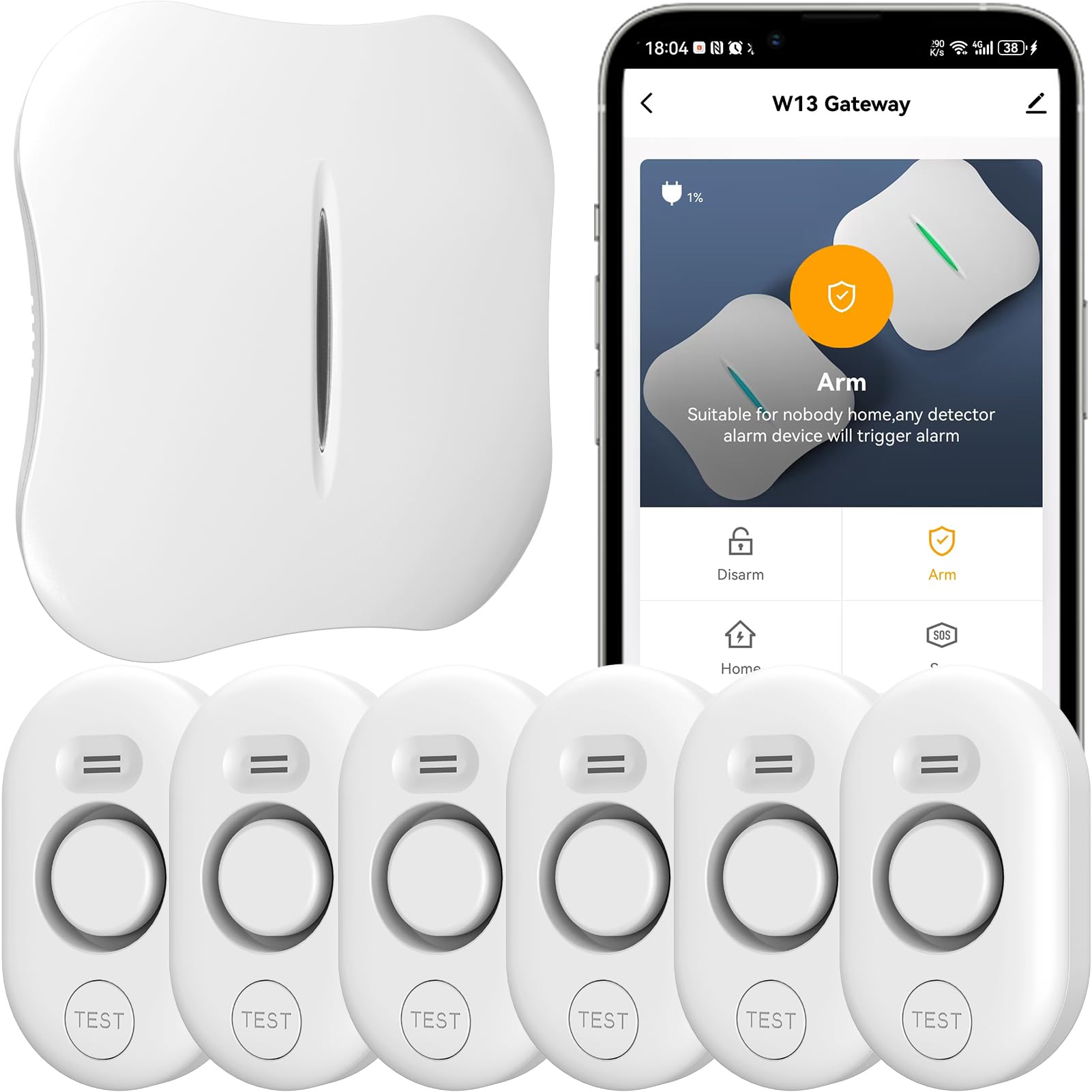
The loudest alarm on the list — 120 decibels — and six sensors in one box.
Where other kits hit 100dB or 105dB, METAK pushes the gateway alarm to 120dB, and the individual sensors themselves can reach the same volume with 4 adjustable levels. That means a sensor under the washing machine can scream loud enough to hear from the driveway even if your phone is inside. The kit includes six WD61 sensors plus a W13 gateway that supports up to 24 total sensors — so you can keep adding to cover every sink, toilet, and basement corner without buying another hub. The gateway uses a USB-C charger, which is more convenient than the barrel connectors on older hubs.
Owners mention the kit “saved me water damage 3 times thus far” since March 2025. One owner noted the sensors trigger on a single drop, but the instructions can be confusing and the pairing indicator light shows pale blue instead of the expected yellow. Each sensor has a top drip probe and four bottom flood probes, so it catches leaks from above (a slow faucet drip) and below (rising water in a basement). At 4.4 inches square and 0.87 inches tall per sensor, they are slimmer than the Winees sensors and easier to hide.
If you have a detached garage or a large property, you may need a second gateway. The app is TUYA-based, which is widely compatible but some users find the interface cluttered.
Why it wins
- 120dB alarm is the loudest on this list
- 6 sensors included, supports up to 24 per gateway
- 32 ringtones to pick from in the app
The downsides
- 328-foot sensor range is short versus the X-Sense
- Instructions and pairing light reported as confusing
The one for loudness lovers: if you want an alarm that can wake the neighborhood and enough sensors to cover every water source, this is the kit.
Not for you if: you have a large property with outbuildings beyond 328 feet or hate fiddling with unclear instructions.
3. APEC WATER WiFi Water Leak Detector (3-Pack)
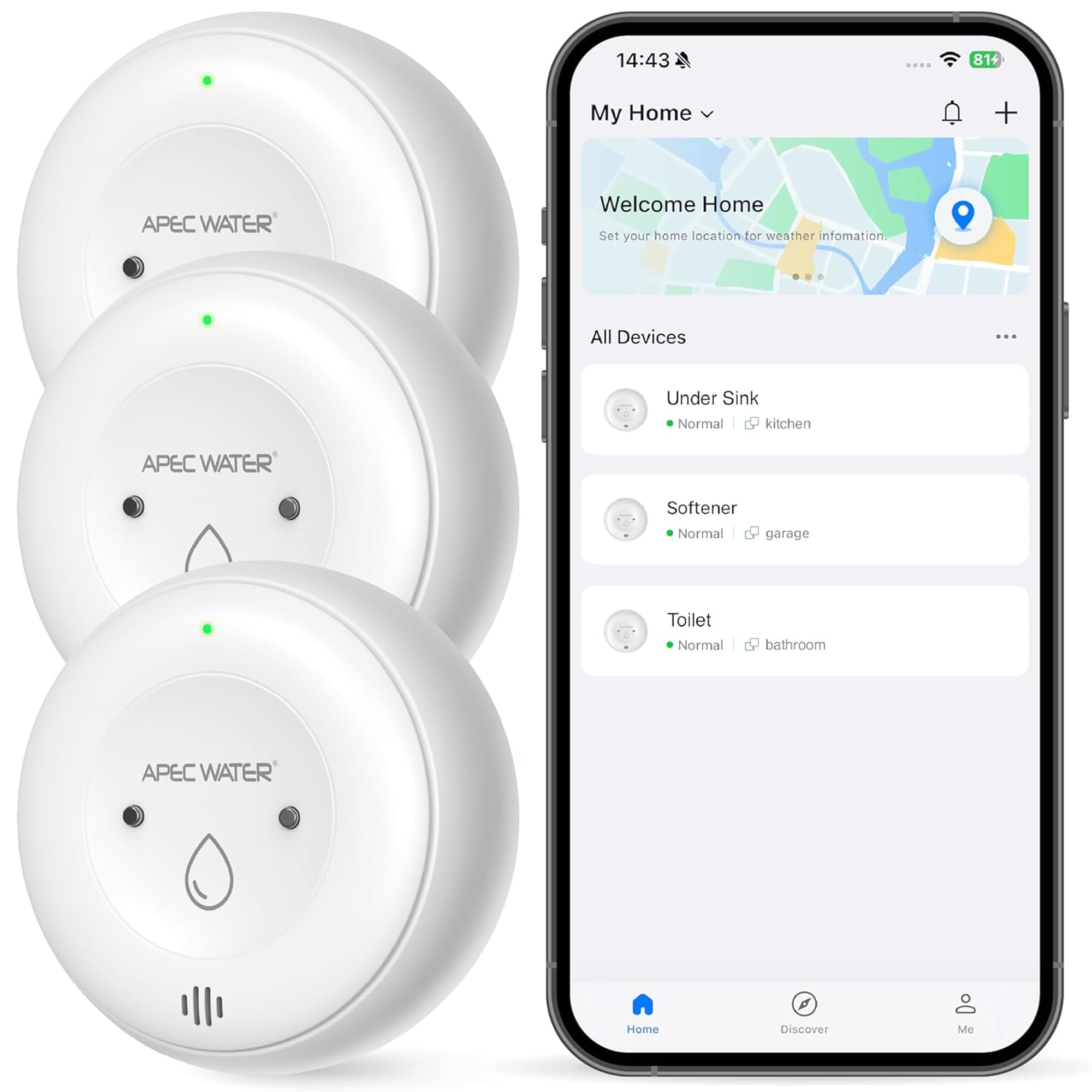
Three independent sensors that talk directly to your phone — no hub, no extra cost.
Each APEC sensor connects straight to your 2.4GHz WiFi without a base station, so you can place one under the kitchen sink, one behind the toilet, and one near the water heater, and each will send an alert to the APEC Smart App independently. That saves you the hassle of pairing multiple sensors to a single hub, and if one sensor dies, the others keep working. Customers note one came home to “a substantial amount of water coming from our cabinet under the sink” and the app alert caught it before the leak spread into the living room.
The IP66 rating means the detector itself will not be damaged if it sits in a puddle, which is essential for a device that lives near plumbing. Each sensor weighs just 0.08 kilograms (the same as the single-pack version), so they are easy to stick onto any tabletop surface. The 3-pack at 0.33 kilograms total is significantly lighter than the X-Sense kit’s 0.44 kilograms. However, the APEC sensors have no built-in local alarm — you rely entirely on your phone for the alert. If you are somewhere without cell service, you will not know there is a leak until you return home.
One reviewer noted the device’s own alarm is quiet compared to a 120dB system, and the battery life is unproven. Still, for the price, three hub-free sensors with app alerts is the most straightforward way to cover multiple leak-prone spots without complex setup.
The winning points
- No hub needed — each sensor is self-contained
- IP66 waterproof housing survives immersion
- Extremely compact at 2.57 x 2.57 x 1.08 inches per sensor
The limitations
- No local loud alarm — phone-only alerts
- Battery life unknown based on early reviews
Best budget-friendly pick: you want a simple multi-sensor setup with no hub to configure and app alerts that reach you anywhere.
skip it if: you need an ear-splitting local alarm or you live in an area with spotty cell reception.
4. YoLink Smart Home Starter Kit (SpeakerHub + 3 Water Leak Sensors)

LoRa radio technology reaches a quarter mile — no WiFi wanted.
While every other detector here relies on WiFi or a dedicated hub-to-sensor link, YoLink uses LoRa technology (a low-power, long-range radio protocol) that can transmit up to a quarter mile in open air. This makes it the only kit that can reliably cover a detached garage, a barn, or a basement that sits far from the router. The SpeakerHub fires a 105dB alarm, and you get SMS, email, and push notifications — with 20 free SMS texts per month included. The Water Leak Sensor 4 also has a built-in low-temperature sensor that sends a freeze warning before pipes burst, a feature none of the other detectors here offer.
Reviewers point out the system “triggers immediately on contact” and one used it at a vacation home where it “caught basement water” while the owner was away. The app is free and supports over 300 YoLink devices, so you can expand into door sensors or motion detectors over time. The hub is a tabletop unit measuring 8 x 3 x 9.5 inches, which is larger than the X-Sense base station. Some shoppers say that the 1/4-mile range requires clear line of sight — in wooded areas it drops to roughly 300 feet.
Your entire leak detection system depends on this one hub. If the hub fails, all three sensors go silent. The setup is steeper than APEC’s, but YoLink’s support team (including engineers) helps close the gap.
Standout strengths
- LoRa range up to 1/4 mile reaches outbuildings
- Freeze warning sensor prevents frozen pipe damage
- 105dB hub alarm with SMS/email/push alerts
What holds it back
- Larger hub at 8x3x9.5 inches takes up more space
- Range drops drastically without clear line of sight
Built for the far reaches: if your leak-prone areas are in the basement, garage, or a detached workshop, YoLink’s LoRa range is the only option that will reliably reach back to your phone.
Not the right fit: you want a simple WiFi sensor that you can set up in under two minutes without learning a new radio protocol.
5. APEC WATER WiFi Water Leak Detector (Single-Pack)
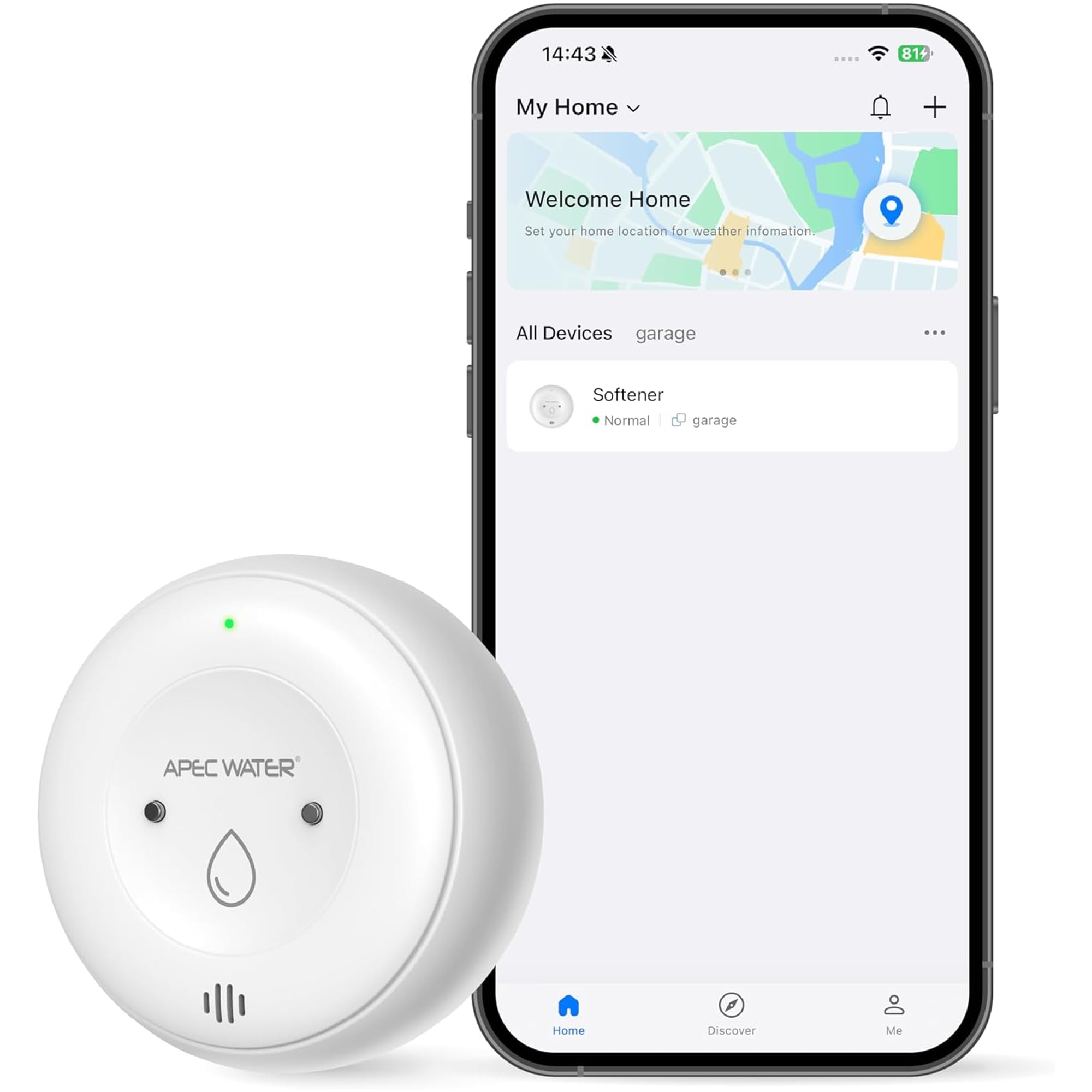
A single tiny sensor that weighs less than a bag of chips and needs no hub.
The same IP66-rated, no-hub design as the 3-pack, in a single unit that fits into the tightest spot — a gap behind the refrigerator, under a pedestal sink, or next to a washing machine drain. At 0.08 kilograms, compared to the X-Sense kit’s 0.44 kilograms, so you can secure it with a dab of adhesive or just set it on the floor. The dual sensors on the top and bottom mean it catches drips from a leaky valve above and water rising from a basement floor below, all under 200 milliseconds. Buyers report the app setup takes about five minutes and the detector works reliably, with one reviewer noting it “delivered an easy setup” compared to hub-based systems they had used before.
For whole-house coverage, choose the 3-pack or X-Sense kit instead. But if all you need is to guard a single high-risk area — say, under the kitchen sink where a filter fitting has sprung a leak once already — this is the cheapest, simplest option. The APEC Smart App gives you push notifications and email alerts, and because each sensor is independent, there is no single point of failure.
Why go small
- 0.08 kg and 2.57 inches across — fits anywhere
- No hub or gateway to manage
- IP66 rated so it survives submersion
What you give up
- Only one sensor in the box
- No loud local alarm — phone alerts only
Perfect for the single worry spot: you have one pipe that makes you nervous and you want the lightest, cheapest, most low-maintenance sensor to put next to it.
pass on it if: you need to monitor multiple rooms or want a local alarm loud enough to wake you from sleep.
6. Winees WiFi Water Leak Detector (3-Pack with Hub)

A pre-paired three-sensor kit with SMS backup so you never miss an alert.
The Winees kit includes a hub and three sensors that come already paired, so you pull them from the start, pop in the batteries, and connect the hub to your 2.4GHz WiFi in about five minutes. The hub has a 100dB adjustable alarm with three volume levels (high, medium, low), and you can set the alert duration to 30 seconds, 1 minute, 10 minutes, or always ring. Where this kit stands out is the SMS and email notification layer added on top of the app alert — something the APEC and METAK kits do not include by default. If your phone’s push notifications go silent, a text message will still come through.
Owners mention one owner said, “My hot water heater sprung a leak today. While I was outside the system alerted the kids in the house and sent me emails to my phone.” The hub-to-sensor range is 200 meters, which is shorter than the X-Sense’s 500 meters but still covers most homes. Each sensor is just 1.8mm thick, so it slides under appliances without lifting them. The hub itself measures 6.14 x 3.27 x 2.17 inches, while the APEC single sensor is 2.57 x 2.57 x 1.08 inches.
This 2.4GHz-only system may require temporarily disabling 5GHz on dual-band routers during setup. Also, the hub depends on one USB power cable with no battery backup, so a power outage kills the bridge between your sensors and your phone. Still, for the price, three sensors plus SMS/email redundancy is strong value.
What makes it stand out
- SMS and email alerts included on top of app notifications
- 3 adjustable volume levels (up to 100dB)
- Sensors only 1.8mm thick for tight spots
Where it falls short
- Hub needs wall power — no battery backup
- 200-meter range lags behind the X-Sense’s 500 meters
Reach for this kit if: you want triple-redundant alerts (app, email, and SMS) and three pre-paired sensors for fast setup.
Look elsewhere if: you need to place a sensor more than 200 meters from the hub or need a battery-backed hub for power outages.
Understanding the Specs
Alarm Decibel Levels
The loudness of the built-in siren is measured in decibels (dB). A 100dB alarm is roughly as loud as a motorcycle engine or a gas lawn mower — loud enough to hear from the next room. A 120dB alarm (like the METAK) is closer to a smoke detector or a rock concert, which you can hear from two floors away or from outside the house. If you are hard of hearing or live in a large home, aim for 105dB or higher.
Sensor Range
This is the maximum distance between the hub and the individual sensor. WiFi-based sensors (like APEC) rely on your home router, so range depends on your router’s strength and building materials. Hub-based systems (X-Sense, Winees, METAK, YoLink) use their own wireless between hub and sensor. A 328-foot range (METAK) covers a typical home; a 1,700-foot range (X-Sense) covers a large home with a detached garage; a 1/4-mile LoRa range (YoLink) covers outbuildings and barns.
IP66 Waterproof Rating
This is a standard that tells you how well the device resists water and dust. The first digit (6) means it is fully dust-tight. The second digit (6) means it can handle powerful water jets or temporary immersion — good enough to survive a slow leak or a small puddle. All the APEC and Winees sensors have IP66 rating, so you do not have to worry about the detector itself shorting out in a wet cabinet.
Hub vs Hub-Free Design
A hub (or base station) connects all your sensors to the internet via WiFi. This lets you have smaller, cheaper sensors that last longer on batteries. The trade-off is single-point failure: if the hub loses power, every sensor goes offline. Hub-free sensors (like APEC) each connect directly to your WiFi, so there is no central device to fail. But they use more battery power to keep a constant WiFi connection and are slightly larger.
FAQ
Will an automatic leak detector work in a basement without WiFi?
How fast does a leak detector alert you?
Can I use these detectors with a 5GHz WiFi network?
Do leak detectors need a subscription?
How long do the batteries last?
What happens if the WiFi goes out?
Can I use a leak detector with my smart home system (Alexa, Google, IFTTT)?
How many sensors can I connect to one hub?
Final Thoughts: The Verdict
For the majority of shoppers, the automatic leak detector winner is the X-Sense Wi-Fi Kit because it offers the longest sensor range (1,700 feet), four sensors in the box, a loud 100dB base station alarm, and a feature-rich app that covers every need from mute scheduling to multi-property management. If you want the loudest possible 120dB alarm and six sensors to cover every room in one go, grab the METAK 6-Sensor Kit. And for a detached garage or a basement with no WiFi signal, the standout is the YoLink LoRa Starter Kit with its quarter-mile range and freeze-warning sensor.
How We Picked
We do not accept paid placement. Every pick is matched to a real buyer and a real use-case; we do not hands-on test units.
Sources & Methodology
Specifications: manufacturer listings and product documentation. Review insights: verified customer reviews, as of July 2026. Pricing: not shown on this page (it changes often); check the current price via the retailer link.
As an Amazon Associate, Gadgets Feed earns from qualifying purchases. This does not affect which products we feature.