
Our readers keep the lights on and my morning glass full of iced black tea. As an Amazon Associate, I earn from qualifying purchases.
Specs are compiled from manufacturer listings and verified buyer reviews and can change over time — please confirm the key details on the product page before buying.
If you hear hiss, hum, or radio interference through your studio monitors or mixer, the weak link is likely a cheap unbalanced cable where a balanced jack cable belongs. A balanced connection uses three conductors to cancel electrical noise picked up along the cable, delivering only clean audio to your speaker. A standard TS guitar cable lacks the third conductor needed for noise cancellation, so you must use a TRS or XLR plug.
I’m Min — the founder and writer behind Gadgets Feed. This guide is built by comparing the manufacturers’ published specifications and the patterns across verified customer reviews, so you get each pick’s real strengths and trade-offs instead of marketing spin.
Whether you are wiring up a home studio, a live performance rig, or a high-fidelity listening setup, this roundup of the best balanced jack cable options will help you find the right length, connector type, and build quality for clear, noise-free audio every time.
Quick Picks
- Mogami GOLD TRS-XLRM-06 — Professional Grade
- Cable Matters Premium Braided Balanced 1/4 Inch — Best Overall
- Hosa HSS-010 Pro Balanced Interconnect — The Studio Workhorse
- KINXIYU XLR Male to 1/4 Inch TRS Cables 3 — Double Shielded
- BIFALE 1/4” TRS to XLR Male Cable – 6 FT 2Pack — Live Ready
- Suanqi 1/4 Inch TRS to XLR Male 6.35mm Balanced — Budget Backup
How To Choose The Best Balanced Jack Cable
Picking the wrong cable type is the most common mistake. Before you look at length or brand, you need to confirm two things: your gear actually uses a balanced output or input (check for a TRS or XLR jack, not just a TS instrument jack), and you get the right connector on each end — either TRS-to-TRS, XLR-to-XLR, or a TRS-to-XLR adapter cable. After that, it is about build quality and length.
Connector Type: TRS vs. XLR
A TRS (Tip-Ring-Sleeve) 1/4-inch plug carries the balanced signal on a single jack. You will see this on audio interfaces, headphone amps, and some monitor speakers. An XLR connector uses three pins and is common on professional microphones, mixers, and high-end studio gear. Many setups need a cable that goes from TRS on one end to XLR on the other — a “TRS-to-XLR” cable — so check what each of your devices requires.
Cable Construction and Shielding
The conductor material and shielding directly affect noise rejection. Oxygen-free copper (OFC) conductors provide lower resistance and cleaner signal transfer. A braided copper shield (or a double-shield with braid plus aluminum foil) physically blocks electromagnetic and radio-frequency interference that would otherwise cause hum, buzz, or static in your audio.
Length and Durability
Balanced cables can run much longer than unbalanced cables without picking up noise — runs of 15 to 20 feet are common in studios. Longer cables need thicker conductors to avoid signal degradation. For stages or frequent plugging and unplugging, look for “easy-grip” metal housings, reinforced strain relief at the connector joints, and braided outer jackets that resist kinking and tangling.
Quick Comparison
| Model | Best For | Connector Type | Length | Conductor | Amazon |
|---|---|---|---|---|---|
| Mogami GOLD TRS-XLRM-06 | Noise-free professional studio | 1/4″ TRS to XLR Male | 6 ft | Neglex Studio Quad (OFC) | from $125.95Amazon |
| Cable Matters Premium Braided 15 ft | Long TRS-to-TRS runs | 1/4″ TRS to 1/4″ TRS | 15 ft | OFC | $14.99$16.99Amazon |
| Hosa HSS-010 Pro REAN | Durable balanced TRS patch | REAN 1/4″ TRS to REAN 1/4″ TRS | 10 ft | — | $14.95Amazon |
| KINXIYU XLR Male to TRS 3 ft 2-Pack | Short TRS-to-XLR adapters | XLR Male to 1/4″ TRS | 3 ft (2-pack) | 22AWG OFC | $14.99Amazon |
| BIFALE TRS to XLR Male 6 ft 2-Pack | Live sound and monitors | 1/4″ TRS to XLR Male | 6 ft (2-pack) | 22AWG OFC | $19.99Amazon |
| Suanqi 1/4″ TRS to XLR Male 2-Pack | Budget backup adapters | 1/4″ TRS to XLR Male | 8 inches (2-pack) | 4N OFC | $12.69Amazon |
In‑Depth Reviews
1. Mogami GOLD TRS-XLRM-06

The studio standard that lowers the noise floor more than any other cable here.
If you have ever plugged a cheap cable between your audio interface and studio monitors only to hear a constant hiss or buzzing static, this 6-foot Mogami is the fix. It uses Neglex Studio Quad cable — a four-conductor design — and gold-plated contacts on both the 1/4-inch TRS plug and the XLR-Male connector to maintain signal integrity across the entire run. One reviewer noted that the braided shielding completely removed RF (radio frequency) interference and hum that cheaper cables could not block, even when the cable sat near other electronics.
This is by far the most expensive cable in this lineup, but buyers report that the build quality justifies the cost. Reviewers specifically mention the Mogami eliminated pops and static from their Scarlett 18i8 interface to Yamaha HS7 monitors, cleaning up a noise issue that had bothered them for years. The cable also carries a lifetime warranty, and the brand’s standard is high enough that some retailers honor exchanges without a receipt. This is the pick for you if a persistent hum has made you swap every other cable already — the Mogami costs 4 to 5 times more than a mid-range option, but it is the one that actually solved reports of long-standing noise problems.
Why It Earns Its Price
- Neglex Studio Quad cable construction is among the best noise-rejection designs available
- Gold-plated contacts resist corrosion and maintain a reliable connection over years of use
- Owners mention it completely removed audible hum and static from their monitoring setups
- Lifetime warranty adds confidence beyond any other cable in this list
The One Real Trade-off
- , it costs 4 to 5 times more than a perfectly functional mid-range cable
- 6-foot length is short for larger studio setups; you may need an extension or a different cable for longer runs
Grab it if: you have a persistent noise problem in your studio or critical monitoring setup that cheaper cables cannot solve — the Mogami is the most reliable noise-killer here.
skip it if: your budget is tight or your gear is not sensitive enough to reveal the difference; a well-made cable will give you clean audio in most everyday setups.
2. Cable Matters Premium Braided Balanced 1/4 Inch TRS Cable 15 ft

A long, well-shielded TRS cable that lays flat and stays tangle-free.
At 15 feet, this is the longest TRS-to-TRS cable in the roundup, making it ideal for wiring a headphone amp across the room or connecting studio monitors that sit far from the audio interface. The cable uses oxygen-free copper (OFC) conductors wrapped in a copper braided shield to block electromagnetic interference, so that long run stays quiet. The braided nylon outer jacket resists kinking and coils up easily when you are done — buyers consistently mention the “great quality and construction” and that the cable delivers clean audio with no noise issues.
One detail that matters in daily use: the metal connectors have a textured easy-grip housing, so you can unplug them from a tight patch bay without pulling on the cable itself. The 15-foot length is the real standout here — it beats the 10-foot Hosa and the 6-foot Mogami in reach. If you need both TRS ends and maximum length at a mid-range price, this is the one to grab. For most users, this Cable Matters cable is the best overall choice because it gives you OFC conductors and braided shielding at a price that won’t sting — just remember it is strictly TRS-to-TRS, so check that both your devices have 1/4-inch TRS jacks.
What Stands Out
- 15-foot length gives you the most reach for routing around furniture or across a room
- OFC conductors with copper braided shielding keep the long run quiet
- Braided jacket resists tangling and feels flexible for daily coiling
- Customers note “solid quality cable with clean audio output — no interference”
What to Note
- No XLR end — this is strictly a TRS-to-TRS cable, so it only works if both devices have 1/4-inch TRS jacks
- Some users may find the braided jacket slightly stiffer than a rubber cable in cold temperatures
Reach for this if: you need a TRS-to-TRS cable longer than 10 feet and want reliable noise rejection without spending pro-audio money.
Look elsewhere if: your gear uses XLR on one end — you will need a TRS-to-XLR cable instead.
3. Hosa HSS-010 Pro Balanced Interconnect, REAN 1/4 Inch TRS to Same, 10 Feet

A reliable 10-foot TRS patch cable with pro-grade REAN connectors that screw open for servicing.
Hosa has been making studio cables for decades, and the HSS-010 uses REAN 1/4-inch TRS connectors — Neutrik’s value brand known for solid metal housings and tight strain relief. Buyers consistently describe this as a “durable, flexible, noise-free pro audio cable” that delivers a clean signal with no interference. The REAN connectors include a small rubber dust and water seal inside the housing, which is uncommon at this price and helps protect the contacts in live-sound environments or damp basements.
A practical advantage you will notice immediately: the connectors are screw-serviceable, so if a wire ever loosens inside the plug you can open the barrel and re-solder it rather than throwing the whole cable away. This is the kind of repairability that makes the HSS-010 last through years of daily plugging and unplugging. At 10 feet, it hits a balance for desktop studio wiring — long enough to reach floor monitors or a rack, short enough not to leave excess cable coiled on your desk.
Built to Last
- REAN connectors are screw-serviceable for easy re-soldering and long life
- Rubber dust seal inside the connector housing protects against dirt and moisture
- Buyers confirm “clean signal, solid build — exactly what you want in audio cables”
- Flexible rubber jacket lays flat and does not tangle easily
One Thing to Know
- The internal wires are smaller than some users expect, though the flexible insulation compensates for it
- Available only in TRS-to-TRS; no XLR variant for this model
Get this for: a repairable, well-reviewed TRS patch cable that will survive years in a studio or live rack without signal degradation.
Consider something else if: you need a longer run — the 10-foot Hosa is shorter than the 15-foot Cable Matters above.
4. KINXIYU XLR Male to 1/4 Inch TRS Cables 3 FT/2Pack

A compact 3-foot TRS-to-XLR adapter pair that fits right behind a pedalboard or rack.
When you need to go from a 1/4-inch TRS output on an audio interface to an XLR input on a microphone preamp or powered monitor, this 2-pack from KINXIYU gives you two short 3-foot cables for a very low per-cable cost. Each cable uses 22AWG oxygen-free copper conductors (thicker-than-average wire for better signal transfer over that short length) and a double-shield construction (a high-density bare copper braid plus an aluminum foil layer) that reviewers point out “eliminated the overflow of background noises in the audio.” That double shielding is a meaningful upgrade over single-braid cables when running near power supplies or wireless gear.
Fit and finish are solid: the metal XLR housing has a sturdy latch, and the TRS plug fits snugly without wobbling. The nylon braided outer jacket is rated for over 10,000 bends, so these short adapters can handle being packed tightly in a cable bag for years. If your monitor speaker or guitar modeler sits right next to your mixer, the 3-foot length is perfect — you do not want a 10-foot cable looped behind a desk when 3 feet does the job cleanly.
Short-Run Specialist
- Double-shielded construction (braid + foil) gives excellent noise rejection in tight spaces
- 22AWG OFC conductors maintain signal purity for critical monitoring
- 2-pack means you get two cables for one low price, ideal for stereo pairs
- Shoppers say it eliminated background noise their previous cables let through
Not for Long Runs
- 3-foot length is very short; you cannot use these across a room or to a floor monitor far from the mixer
- Some buyers report you may need a DI box depending on your specific gear’s output type
Ideal for: connecting a nearby headphone amp, audio interface, or modeler pedal to an XLR input without leaving a tangle of excess cable.
Not ideal if: your TRS output and XLR input are more than a few feet apart — look at the 6-foot BIFALE below.
5. BIFALE 1/4” TRS to XLR Male Cable – 6 FT 2Pack
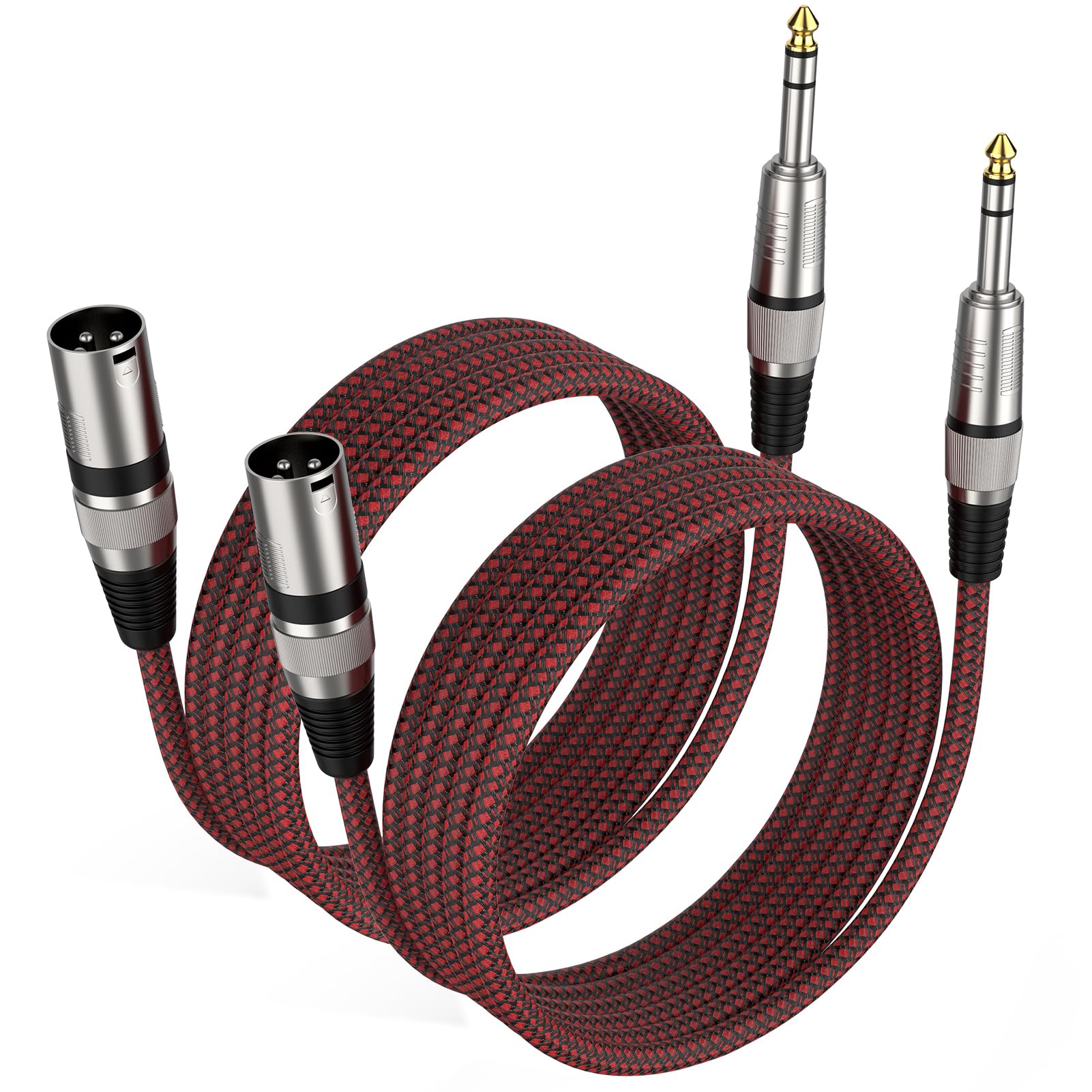
A 6-foot TRS-to-XLR pair built for stage abuse and monitor hookups.
The BIFALE set gives you two 6-foot cables with 22AWG oxygen-free copper conductors and a triple-shield design — a copper braid plus a heavy-duty PET (polyethylene terephthalate) braided outer jacket that the maker says is 10 times more durable than PVC (polyvinyl chloride). The XLR connector uses an alloy metal housing, and the 1/4-inch TRS plug has a 360-degree easy-grip tread so you can get a solid hold even in a dark rack. Buyers confirm these work well with Yamaha HS8 monitors and DJ speaker setups, noting “the cables worked well for me, well made and the quality of the material is solid.”
These cables are rated for over 10,000 plug-and-unplug cycles and a bend test of 26,000+ times, which gives them a real edge for live sound where cables get coiled and packed after every gig. The temperature resistance range of -4℉ to 194℉ means they will survive the back of a van in summer or a cold outdoor stage without the jacket cracking. One reviewer did report a single cable failing after one gig, but the seller offers a refund for defective units — note if you buy them for critical paid performances where a backup is essential.
Stage-Strong Construction
- Triple shielding (copper braid + PET braid) for maximum hum and EMI rejection
- Alloy XLR housing and easy-grip TRS plug designed for frequent plugging and unplugging
- Rated for 26,000+ bend cycles and extreme temperature range (-4℉ to 194℉)
- 2-pack at 6 feet each gives you a spare or a stereo pair at a fair per-cable cost
Small Risk to Know
- A single buyer reported a cable becoming unresponsive after one gig (seller offers refunds)
- Braided outer jacket is slightly thicker and less flexible than a standard rubber cable
Best suited for: live performers or mobile DJs who need rugged, shielded TRS-to-XLR cables that survive the road and pack away without kinking.
Consider carefully if: you only need a single cable for a fixed studio setup — the Cable Matters or Hosa options are simpler and equally reliable for less money.
6. Suanqi 1/4 Inch TRS to XLR Male 6.35mm Balanced Signal Interconnect Microphone Cable 2Pack 8 inches
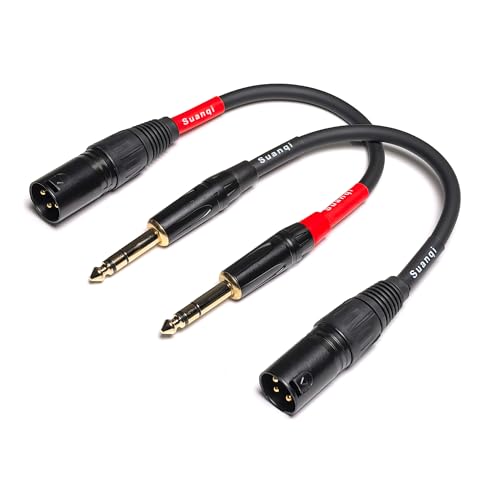
Extremely short 8-inch adapter cables that work as tidy breakout links on a pedalboard.
At 8 inches, these Suanqi cables are adapters more than standard cables — they are meant to bridge a TRS output to an XLR input on a piece of gear sitting right next to it, like connecting a pedalboard output to a direct box or a microphone to a small mixer. They use 4N oxygen-free copper conductors with a flexible PVC jacket, and the connectors have 24K gold plating to resist corrosion. Multiple reviewers confirm they “did exactly what I needed” with no sound quality issues, and one guitarist uses them to switch between a Headrush modeler (TRS output) and a GP-200 unit (XLR input) on their pedalboard.
The obvious limitation is the very short length. You cannot use these to reach a floor monitor across the stage or to run from a desk interface to a speaker on a shelf. They are also the most budget-friendly set in this list, so the PVC jacket is not as tough as the braided cables above, and the connectors lack the heavy-duty strain relief of the Hosa or BIFALE cables. But for their intended job — a short, reliable adapter between nearby balanced ports — they work fine and cost very little per cable.
Perfect for Tight Spaces
- 8-inch length keeps your setup clean with no excess cable loop
- 4N OFC conductors and 24K gold-plated connectors give solid signal transfer for the price
- Owners mention they work perfectly for connecting pedalboards, modelers, and DIs
- 2-pack gives you an extra adapter for a very low per-cable investment
Know the Limits
- Extremely short; useless for any run over about 10 inches
- PVC jacket is less durable than braided nylon and may kink if bent sharply often
- No strain relief at the connectors — avoid yanking on the cable to disconnect it
Good for: a pedalboard adapter or a short TRS-to-XLR bridge on a desktop when every inch of space counts.
Not for: any application where the two devices are more than a foot apart — pick a 3-foot or 6-foot cable instead.
Understanding the Specs
Oxygen-Free Copper (OFC) Conductors
OFC stands for oxygen-free copper, which means the copper wire has had most of its oxygen content removed during refining. This reduces electrical resistance and the risk of corrosion inside the wire over time. For a balanced jack cable, OFC helps preserve the signal’s integrity across longer runs so the audio arriving at your monitor or mixer is as clean as the signal that left the source. The gauge number (like 22AWG) tells you the wire’s thickness — lower numbers mean thicker wire, which generally carries signal better over longer distances.
Balanced vs. Unbalanced Connections
A balanced cable has three internal conductors: a positive signal wire, a negative signal wire (the mirror image of the positive), and a ground wire. When the signal reaches the receiving device, it compares the two signal wires and flips the negative one back, canceling any noise the cable picked up along the way — this is called common-mode rejection. An unbalanced cable (like a standard guitar cable) uses only a single signal wire and a ground, so any electromagnetic interference that sneaks in stays in the audio as hum or hiss. That is why balanced cables are the standard for studio monitors, professional mixers, and any run longer than about 15 to 20 feet.
FAQ
What is the difference between a TRS cable and a TS cable?
Can I use a balanced jack cable for my guitar?
How long can a balanced cable run before it picks up noise?
Do I need an XLR cable or a TRS cable for my studio monitors?
What does “balanced” actually mean in simple terms?
Will a balanced cable make my cheap microphones sound better?
What does oxygen-free copper (OFC) do for a cable?
Can I use a balanced TRS cable for stereo audio?
How do I tell if my gear has a balanced output?
Why do some balanced cables cost so much more than others?
Final Thoughts: The Verdict
For most buyers, the best balanced jack cable is the Cable Matters Premium Braided 15 ft because it gives you a full 15-foot reach with OFC conductors and braided shielding at a mid-range price that works for both studio and live use. If noise is a recurring problem in your setup, the Mogami GOLD TRS-XLRM-06 is the cleanest signal path you can buy, though it costs significantly more. And for a reliable TRS patch cable with repairable connectors, the Hosa HSS-010 REAN is a proven workhorse that reviewers trust for daily studio use.
How We Picked
We do not accept paid placement. Every pick is matched to a real buyer and a real use-case; we do not hands-on test units.
Sources & Methodology
Specifications: manufacturer listings and product documentation. Review insights: verified customer reviews, as of July 2026. Pricing: not shown on this page (it changes often); check the current price via the retailer link.
As an Amazon Associate, Gadgets Feed earns from qualifying purchases. This does not affect which products we feature.
Related Guides
Product prices and availability are accurate as of the date/time indicated and are subject to change. Any price and availability information displayed on Amazon at the time of purchase will apply to the purchase of this product. As an Amazon Associate I earn from qualifying purchases.
CERTAIN CONTENT THAT APPEARS ON THIS SITE COMES FROM AMAZON. THIS CONTENT IS PROVIDED "AS IS" AND IS SUBJECT TO CHANGE OR REMOVAL AT ANY TIME.
Amazon and the Amazon logo are trademarks of Amazon.com, Inc. or its affiliates.