
Our readers keep the lights on and my morning glass full of iced black tea. As an Amazon Associate, I earn from qualifying purchases.
Specs are compiled from manufacturer listings and verified buyer reviews and can change over time — please confirm the key details on the product page before buying.
You have the model, the patience, and the steady hand. But every time you pull the trigger, it spits a blob, or a sputter, or nothing — and another tiny canopy gets wrecked. A true airbrush kit should make fine lines and smooth gradients feel inevitable, not like a constant gamble against clogged nozzles and weak pressure. This guide cuts through the spec sheets to show you which kits actually deliver the control and consistency a model builder needs, and which ones leave you fighting the tool instead of enjoying the build.
I’m Min — the founder and writer behind Gadgets Feed. This guide is built by comparing the manufacturers’ published specifications and the patterns across verified customer reviews, so you get each pick’s real strengths and trade-offs instead of marketing spin.
For priming a 1/72 fuselage, shading a sci-fi mech, or laying down a flawless candy coat, you need consistent airflow, a fine nozzle, and a compressor that does not overheat mid-project. These are the best airbrush kit for models options that focus on those features.
Quick Picks
- Master Airbrush Cool Runner II Deluxe Kit — Precision Pro
- Master Airbrush Cool Runner II System Kit — Multi-Brush
- SprayMagic 55PSI Airbrush Kit — Quiet Power
- TURNRISE 50 PSI Airbrush Kit — Starter Trio
- Casubaris Cordless Airbrush Kit — Cord-Free
- SAGUD Professional Mini Airbrush Kit — Budget Entry
How To Choose The Best Airbrush Kit For Models
Picking an airbrush kit for models depends on a few firm decisions that determine whether your first pull of the trigger is a success or a cleaning session. The kit needs to balance a steady air supply with a brush that can handle both wide primer coats and the hair-thin lines of camo patterns.
Dual-Action vs Single-Action Trigger
A dual-action trigger is non-negotiable for models. Pressing down controls the air, pulling back controls the paint — you can adjust the line width without stopping. A single-action brush only controls air, so you have to stop and swap a needle to change the spray pattern, which is a dealbreaker for shading and fine details.
Compressor: Tank vs Tankless
A compressor with a storage tank holds a reserve of pressurized air, so the flow stays steady even when the piston cycles on. Tankless compressors pulse slightly, which can create a visible wobble in your paint line on a model’s small surface. If you can manage the extra weight and cost, a tank gives you that dead-stable air pressure beginners and pros alike appreciate.
Nozzle Size and Paint Viscosity
For model work, 0.3mm is the balance. It sprays a thin enough line for details but can also lay down a smooth base coat without clogging from slightly thicker primer. A 0.2mm nozzle gives you finer lines but clogs faster, especially with acrylics — you will need to thin your paint to the consistency of milk, as several buyers report.
Quick Comparison
| Model | Best For | Pressure | Nozzle (mm) | Compressor Type | Amazon |
|---|---|---|---|---|---|
| Master Cool Runner II Deluxe (Kit-6) | Zero-pulsation precision | Max 57 PSI | 0.3 | Tank + Dual Fan | Amazon |
| Master Cool Runner II (Kit-5) | Versatile multi-brush setup | Max 57 PSI | 0.3 / 0.35 / 0.8 | Dual Fan (Tankless) | Amazon |
| SprayMagic 55PSI Kit | Quiet adjustable pressure | 25–55 PSI (7-stage) | 0.3 | Tankless | Amazon |
| TURNRISE 50 PSI Kit | Beginner value with 3 nozzles | 50 PSI | 0.2 / 0.3 / 0.5 | Tankless | Amazon |
| Casubaris Cordless Kit | Portable, cord-free work | ~15–20 PSI | 0.3 | Battery Portable | Amazon |
| SAGUD Professional Mini Kit | Budget entry point | 10–25 PSI | 0.3 | Tankless (Auto) | Amazon |
In‑Depth Reviews
1. Master Airbrush Cool Runner II Deluxe Kit (G22 + Tank)

The kit that kills compressor pulses before they reach your paint line.
The biggest reason your paint stream should stay steady is a 3-liter air storage tank. This Master Cool Runner II Deluxe stores pressurized air so the compressor can cycle on and off without pulsing through your brush — unlike the tankless Master Cool Runner II (Kit-5), which turns on immediately when you pull the trigger. That makes a real difference when you try to lay down a soft shadow gradient on a 1/48 wing without a wobble.
The compressor uses two cooling fans as part of the Cool Runner II design (a 1/5 hp single-piston unit) to run cooler for longer sessions. Owners mention the compressor is quiet and reliable, though they note “the regulator drifts slightly” but the overall setup works well for an entry-level system. The included G22 dual-action gravity feed brush uses a 0.3mm tip. Reviewers find it “basic and forgiving” but not as precise as an upgrade brush — they recommend a Badger 105 Patriot later. The kit also bundles a 24-color acrylic paint set (1 oz. bottles each), a cleaning pot, and mixing cups and sticks.
Compared to the 11-pound Kit-5, this deluxe version weighs 19.9 pounds — that is the trade-off for the tank. If you work at a single station and want the smoothest possible airflow, the stability of that 3-liter tank is tough to top at this price tier.
Why the tank wins: The 3-liter air storage tank gives you constant air pressure with zero pulsation — the clearest advantage over any tankless kit in this list. The 24-color paint set saves you from buying separate bottles immediately.
The inevitable upgrade: The G22 brush is a great starter but not a lifetime tool — its paint cup traps paint at the base, and the nozzle is not removable for deep cleaning. Plan on a brush upgrade as your skills grow.
Smooth operator: Best for the modeler who wants a single-box solution with a tank for zero-pulse spray and plans to upgrade the brush later.
skip it if: You need a portable kit to move between rooms or to shows — 19.9 lbs is a dedicated benchtop anchor.
2. Master Airbrush Cool Runner II System Kit (3 Airbrushes)
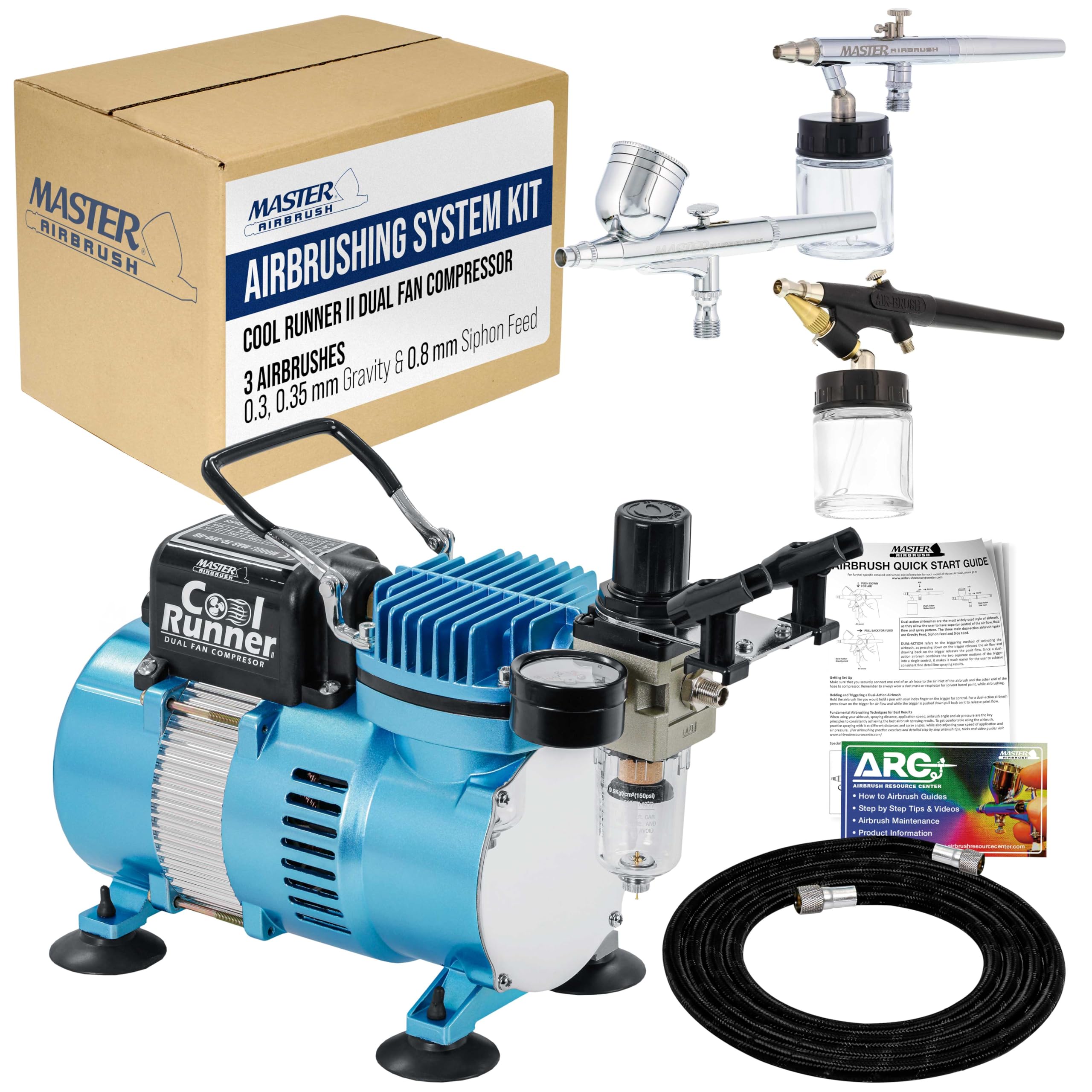
Three brushes in one box, each tuned for a different job.
Instead of a single brush, this kit hands you three: the G22 dual-action gravity feed with a 0.3mm tip, the S68 dual-action siphon feed with a 0.35mm tip and 3/4 oz. bottle, and the E91 single-action siphon feed with a 0.8mm tip and two bottles. You get a brush for fine detail (the G22), one for quick base coats without refilling a tiny cup (the S68), and one for heavy primers or thick materials (the E91). The same dual-fan Cool Runner II compressor runs at 1/5 hp and two cooling fans that keep it from overheating during longer sessions — one reviewer noted it “auto-shuts off, doesn’t overheat.”
Customers note the compressor is quiet and the regulator is accurate, with a maximum of 57 PSI. The compressor has no tank, so one reviewer notes it “only runs when in use” — meaning you hear the piston every time you pull the trigger, unlike the tank-equipped deluxe kit above. The G22 brush is similar to the one in the deluxe kit: its nozzle is not removable, which makes cleaning more involved. Reviewers also found the S68’s trigger “sensitive” but workable. The kit includes a learning guide and resource card, which beginners find helpful.
At 11 pounds it is nearly 9 pounds lighter than the deluxe tank version, so it is easier to stow or move around a hobby space.
Three-tool versatility
- Three brushes let you keep one for primer, one for base, one for details without swapping needles mid-project.
- Dual fans keep the compressor cool during extended use.
- Includes a Quick Start Guide and access card for learning the ropes.
Cleaning challenges
- The G22 gravity-feed brush has a non-removable nozzle, making deep cleaning difficult.
- S68 siphon-feed brush has a sensitive trigger and reported air leaks.
- No tank means the compressor cycles on with every trigger pull — some audible pulse.
Budget multi-tool: Best for the modeler who wants to try gravity and siphon feeds without buying separate compressors, and who values quiet, cool running over a tank-smooth air supply.
pass on it if: You want a single high-precision brush with a tank — the deluxe kit above or a separate premium airbrush paired with its compressor is a better path.
3. SprayMagic 55PSI Airbrush Kit
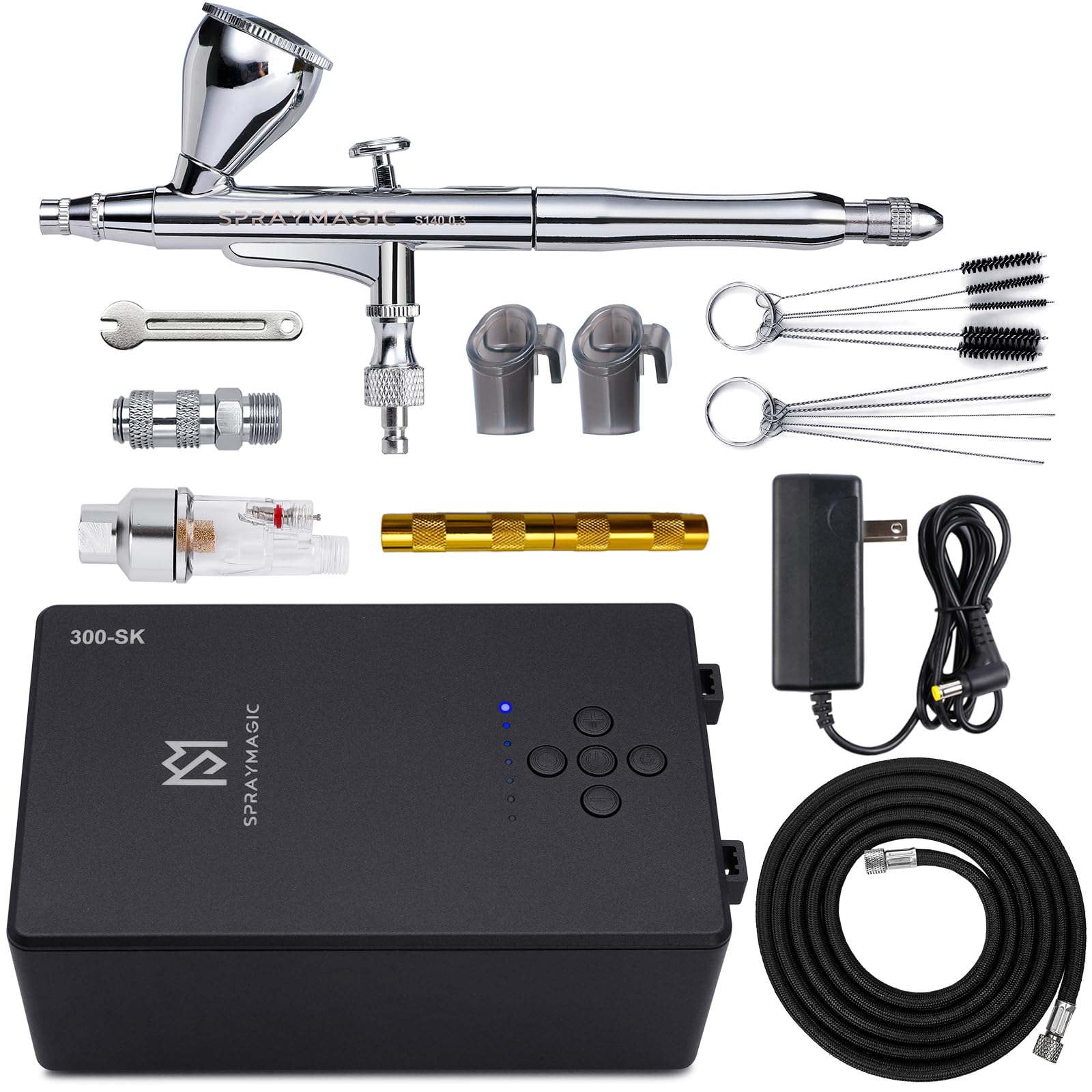
A 7-stage pressure dial so you can match PSI to every paint type.
Most budget compressors give you a single pressure or a vague knob — the SprayMagic kit gives you 7-stage adjustable pressure from 25 up to 55 PSI. That means you can dial down to 25 PSI for thin, runny inks or dial up to 50 PSI for thicker primers and get consistent results without guessing. The compressor runs at under 50 decibels, which buyers confirm is genuinely quiet — one reviewer called it “so far so good” for beginner-level model painting and makeup work. It delivers 7 to 13 L/min of airflow.
The dual-action brush uses a 0.3mm nozzle and can produce a line as thin as 0.5mm, according to the specs. The kit includes a 5cc fluid cup, a quick connector, a filter, and a cleaning tool set. The compressor has an automatic start-stop system and thermal protection, which means it shuts off if it gets too hot during a long session. Reviewers point out it is “easy to use” for model painting and that “the airflow is consistent.”
While the SAGUD kit below only runs between 10 and 25 PSI with no fine adjustment, this SprayMagic gives you precise control over a much wider band — a major advantage for moving between detail lines and broad coverage.
Pressure flexibility: The 7-stage regulator is rare at this level — you can tweak the pressure in real time for different paints and techniques. The sub-50 dB noise rating also means you can paint late without waking the house.
No tank, no pulse dampening: Like most kits without a storage tank, the compressor turns on when you spray. For many modelers this is fine, but if you plan to hold the trigger for longer continuous passes (like shading a whole wing), the slight initial pulse may bother you.
Pressure tuner: Great for the hobbyist who wants to experiment with different paint viscosities and needs real pressure control to match them — all at a quiet volume.
it’s not for you if: You want a tank for absolute zero-pulse flow — the Master Deluxe kit (pick 1) is the better choice.
4. TURNRISE 50 PSI Airbrush Kit
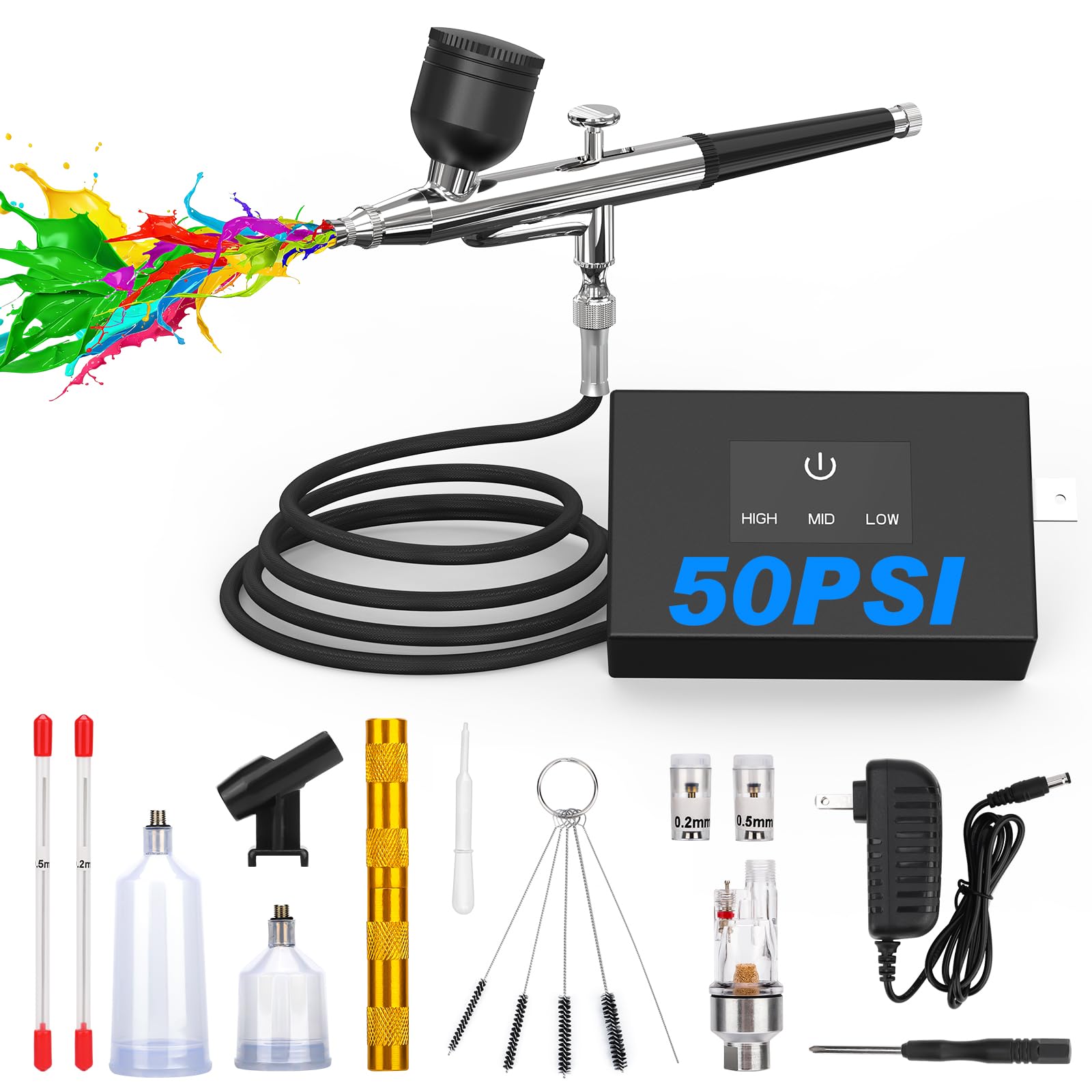
Three nozzle sizes help you switch from detail to base coat without swapping brushes.
This kit gives you 0.2mm, 0.3mm, and 0.5mm nozzles in the box — so you can swap to the 0.2mm for ultra-fine panel lines, the 0.3mm for standard model work, and the 0.5mm for thicker primers or base coats. The dual-action trigger lets you refine the line width within each nozzle, and the 50 PSI compressor delivers steady airflow. Weight is only 1.7 pounds, making it one of the lightest tankless setups here.
Buyers mostly praise it as a good beginner kit. One reviewer described it as having “smooth spray with inks, acrylics” and a “durable metal build.” However, another buyer reported a serious issue: “paint barely sprays; pump stops every two seconds,” and that the brush “exploded, splattering paint everywhere.” That split in experiences suggests quality control varies, so test it immediately upon arrival.
The kit includes replacement needles, paint cups, an air hose, and cleaning tools. A reviewer noted that the 0.2mm nozzle “does not fit the handle,” so you may need to file or adjust the fit if you plan to use the smallest tip regularly.
Triple-nozzle flexibility
- Three nozzle options (0.2, 0.3, 0.5mm) let you fine-tune for specific paint thicknesses and detail levels.
- At only 1.7 pounds, the whole setup is easy to move around a hobby desk.
- Many buyers find the spray smooth and easy to control for 3D print painting and model work.
Inconsistent experiences
- Multiple buyer reports of the pump stopping during use and the brush spattering or leaking.
- The 0.2mm nozzle reportedly does not fit the handle without modification.
- User manual is thin — beginners may struggle with setup and cleaning.
Three-headed starter: Best value for the modeler who wants to try three nozzle sizes in one purchase and values a lightweight compressor.
look elsewhere if: You want a proven, consistent tool from the start — the QC variance is too high to recommend as a main brush right now.
5. Casubaris Cordless Airbrush Kit

Two swappable batteries so you can spray without hunting for a plug.
This is the only cordless kit in the roundup, and it solves a specific problem: you do not have to stay tethered to an outlet. The compressor uses a rechargeable battery that charges in about 1.5 hours and runs for roughly 50 minutes per battery — and the kit includes two batteries, so you can charge one while the other is in use. The auto-stop function (a feature the maker describes as patented) shuts the compressor off when you release the trigger, which saves battery and keeps noise down. The compressor is rated at 75 decibels.
The brush is a 0.3mm dual-action gravity feed. Shoppers say it works well for fine detail work but that the spray is “slightly pixelated” compared to a full-powered corded setup, and paints need to be thinned more than usual. One buyer mentioned “stopped working after 4-5 uses” — the seller replaced the unit, but the replacement also failed quickly, which suggests a reliability concern. Other reviewers praise its portability and say the solid metal build feels good in the hand.
Compared to the SAGUD kit, the Casubaris offers more freedom of movement but lower maximum pressure — it runs around 15-20 PSI, while the SAGUD goes up to 25 PSI. For quick touch-ups and location-independent work (model shows, outdoor painting), cordless is a real advantage, but it cannot match the steady pressure of a tank-based or even a strong tankless corded compressor.
Go-anywhere freedom: Two batteries and an auto-stop function let you paint without an outlet — a rare feature. The 0.3mm dual-action brush handles detail work when paints are properly thinned.
Reliability is a gamble: Multiple reports of units failing after a handful of uses. The maker offers a 1-year warranty and responsive customer service, but the failure rate is higher than the corded kits here.
Portability pick: Best for the modeler who works at a club table, travels to shows, or simply hates being tied to a wall outlet.
steer clear if: You need dependable everyday performance for long sessions — you will get more consistent air from any corded kit in this guide.
6. SAGUD Professional Mini Airbrush Kit

The cheapest way to find out if airbrushing is for you — but thin your paints.
The SAGUD kit is your true entry point. It pairs a SAGUD SD-130 dual-action airbrush (1/3 oz. gravity cup, 0.3mm nozzle) with a tiny AC-100 compressor that puts out up to 25 PSI and has an automatic on-off function that kicks on at 10 PSI and stops at 25 PSI. The entire setup is small and portable, with a 6-foot braided air hose with 1/8” fittings. Note from the data: the compressor runs at 15-20 PSI with no fine adjustment — it is either full blast or nothing. Buyers confirm this, reporting it “requires heavy paint thinning to milk consistency, even for ‘air ready’ paints.”
At 1.7 pounds for the TURNRISE kit and even less for this one, the SAGUD is a lightweight box. It includes cleaning brushes and an air filter. The big catch from the reviews: several buyers report units arriving dead or failing quickly — one reviewer opened the box months later only to find “it doesn’t work.” The plastic construction of the compressor also raises durability questions. However, for the price, multiple buyers also call it a “good entry-level airbrush kit” that works well once you learn proper dilution.
You are not getting fine pressure control or a tank — the SprayMagic and Master Deluxe kits are leagues ahead in adjustability — but if you just need to know whether airbrushing clicks for you without a big investment, this is the cheapest way to find out.
Cheapest real test: At this price you get a working dual-action airbrush and a compressor. The most helpful insight from buyers: you must thin paint to the consistency of milk or you will block the 0.3mm nozzle immediately.
Expect durability limits: Plastic compressor parts and a non-adjustable pressure range mean you will outgrow this kit fast — consider it a trial, not a long-term tool.
Try-before-you-commit: Perfect for the absolute beginner who wants to learn dual-action technique for the lowest possible cost and is willing to master paint thinning.
skip it if: You want a kit that lasts more than a few projects — the failure rate in reviews is too high for a workhorse recommendation.
Understanding the Specs
Dual-Action Trigger
A dual-action trigger means one finger controls both the air and the paint. Press down to start the airflow. Pull back to release paint. The further you pull, the more paint comes out. This lets you feather a thin line or flood a wide area without lifting the brush. A single-action brush only controls air — you have to stop and adjust a separate needle to change the paint flow, which is impractical for model shading.
Gravity Feed vs Siphon Feed
Gravity feed means the paint cup sits on top of the brush, and gravity drops the paint down to the nozzle. It uses less paint for small jobs and cleans faster — the cup holds around 1/3 oz. Siphon feed uses a bottle below the brush, which works better for larger volumes of paint but uses more air pressure and is harder to clean. For a model airbrush kit, gravity feed is usually the right choice.
Compressor Tank (or No Tank)
A compressor with a tank stores compressed air so the pump can cycle on and off without changing the pressure at the brush. The result is a smooth, consistent spray that does not pulse. Without a tank, the compressor runs every time you press the trigger, and some cheap models produce a visible pulse or wobble in the paint stream. For small model parts a tank is nice but not essential; for large surfaces or fine gradients, it makes a real difference.
PSI (Pounds per Square Inch)
PSI is the air pressure the compressor sends to the brush. Higher pressure (think 30–50 PSI) is good for thicker paints like primer and for pushing paint through a smaller 0.2mm nozzle. Lower pressure (10–25 PSI) works better for thin inks and fine detail lines around small parts. A compressor with an adjustable regulator lets you fine-tune the PSI to match the paint you are using.
FAQ
Do I need a compressor with a tank for painting models?
What is the best nozzle size for scale models?
How thin should I make acrylic paint for an airbrush?
Can I use a cordless airbrush kit for serious model work?
Are siphon feed airbrushes worse than gravity feed for models?
How do I clean my airbrush after a painting session?
What PSI should I set for painting models with acrylics?
Is a 50 PSI compressor better than a 25 PSI compressor for models?
Final Thoughts: The Verdict
For most model builders, the best airbrush kit for models is the Master Cool Runner II Deluxe (G22 + Tank) because its 3-liter tank eliminates compressor pulses and the 24-color paint set gets you started immediately. If you want a quieter, pressure-adjustable setup with precise PSI control for different paints, grab the SprayMagic 55PSI Kit. And for the purest entry point on a budget, the SAGUD Professional Mini Kit lets you test the waters — just commit to learning how to thin your paints.
How We Picked
We do not accept paid placement. Every pick is matched to a real buyer and a real use-case; we do not hands-on test units.
Sources & Methodology
Specifications: manufacturer listings and product documentation. Review insights: verified customer reviews, as of July 2026. Pricing: not shown on this page (it changes often); check the current price via the retailer link.
As an Amazon Associate, Gadgets Feed earns from qualifying purchases. This does not affect which products we feature.