
Our readers keep the lights on and my morning glass full of iced black tea. As an Amazon Associate, I earn from qualifying purchases.
Specs are compiled from manufacturer listings and verified buyer reviews and can change over time — please confirm the key details on the product page before buying.
A day at the beach turns sour fast when you are fighting a flapping shelter, getting sunburned through a thin canopy, or squeezing three people into a space meant for two. The right beach sun shelter delivers cool, spacious, wind-resistant shade so you relax instead of wrestling with gear. This guide breaks down seven shelters by floor space, weight, pole strength, and UPF 50+ UV protection so you pick the right fit for your crew and setup tolerance.
I’m Min — the founder and writer behind Gadgets Feed. This guide is built by comparing the manufacturers’ published specifications and the patterns across verified customer reviews, so you get each pick’s real strengths and trade-offs instead of marketing spin.
This roundup gives you the honest trade-offs between shade coverage, portability, and wind toughness so you stop guessing and start packing.
Quick Picks
- Elegear CumbreX™ Beach Tent with Canopy — Most Versatile
- Rhino Valley Beach Tent, 10 x 10 FT — Spacious Fortress
- OutdoorMaster Beach Tent with Blackout Shelter — Dark and Cool
- Old Bahama Bay Pop Up Beach Tent — Quick Setup
- Vibemo Beach Tent, 10x10ft Sun Shelter — Ultra Stable
- easierhike Canopy with Sidewalls 10x10FT — Wind-Tuned
- thereugokinexio Beach Canopy Tent Sun Shade — Budget Starter
How To Choose The Best Beach Sun Shelter
The wrong choice means lugging a heavy tent you never use or a flimsy shade that takes flight in a light breeze.
Floor Area vs. Portability
The most common mistake is buying a tent that looks big but feels cramped once you add chairs and a cooler. Floor area (measured in square feet) tells you the real usable space — 100 square feet fits a whole family plus gear, while 20 square feet is snug for two. The trade-off is weight: a bigger shelter usually needs thicker poles and more sandbags, making it heavier to carry. Look for a weight under 8 pounds if you plan to walk any distance from the car.
Pole Material and Thickness
Fiberglass poles are light and affordable but can snap under sustained wind. Aluminum poles are more rigid and rust-resistant, making them a better bet for beach use where salt and sand are everywhere. Pole thickness matters too — an 8.5mm pole (measuring its diameter) is noticeably sturdier than a standard 6.0mm rod (0.6 cm wide), especially in gusts. If your beach is breezy, prioritize aluminum poles or a reinforced fiberglass rod.
UV Protection and Ventilation
UPF 50+ fabric blocks around 98% of UV rays (ultraviolet, the sun’s skin-damaging radiation). That is the baseline — anything less and you are hiding from the sun in a glorified sheet. But blocking the sun also traps heat, so look for mesh windows (small-hole fabric that lets air through but keeps bugs out), roll-up doors, or a canopy design that lets air flow through. A shelter that seals you in without ventilation turns into an oven within minutes.
Quick Comparison
| Model | Best For | Floor Area | Item Weight | Frame Material | Amazon |
|---|---|---|---|---|---|
| Elegear CumbreX™ Beach Tent | Versatile family shade | 20.47 sq ft | 5.95 lbs | Fiberglass | Amazon |
| Rhino Valley Beach Tent | Large group wind protection | 100 sq ft | 139.33 oz (8.7 lbs) | Aluminum | Amazon |
| OutdoorMaster Beach Tent | Blackout napping comfort | 20.47 sq ft | 8.5 lbs | Alloy Steel | Amazon |
| Old Bahama Bay Pop Up | Instant setup convenience | — | 8.18 lbs | Fiberglass | Amazon |
| Vibemo Beach Tent | Extra-stable 8-person cover | 100 sq ft | 8.3 lbs | Aluminum | Amazon |
| easierhike Canopy with Sidewalls | All-day wind resilience | 100 sq ft | 4.88 kg (10.8 lbs) | Aluminum | Amazon |
| thereugokinexio Beach Canopy | Budget starter shade | 56.25 sq ft | 6 lbs | Aluminum | Amazon |
In‑Depth Reviews
1. Elegear CumbreX™ Beach Tent with Canopy

The award-winning pop-up that shapes itself into five different configurations.
This shelter won the NY Product Design Awards 2026 Silver, the Good Housekeeping 2026 Travel Award, and the MUSE Design Awards 2026 Silver — and the reason is the built-in canopy. You flip it open to get double the usable space for four to five people, or retract it for a smaller footprint when it is just a couple. That canopy feature is a real space multiplier: with the canopy opened you benefit from better airflow and shade coverage, unlike a standard tent that gives you one fixed shape.
Setup uses an external snap-on system that saves about half the time compared to traditional methods. The frame uses thickened 8.5mm fiberglass rods (beefier than the standard 6.0mm), and the brand claims a 50% improvement in wind resistance and more than double the lifespan compared to typical beach tents. At 5.95 pounds, it is the lightest shelter in this roundup that still includes a rear zipper door, two roll-up mesh windows (small-hole fabric that keeps bugs out while letting air circulate), and interior storage pockets. The UPF 50+ rating (blocking about 99% of UV rays) with 190T double-layer silver-coated fabric blocks 99% of UV rays, and the PU2000 waterproof coating (a polyurethane layer rated to 2000mm of water pressure) handles an unexpected drizzle.
Buyers report that the privacy zipper on the extended front floor makes changing clothes or breastfeeding much easier than in open shelters. The main catch is floor space: at 86.61 by 59.06 inches, the internal area measures 20.47 square feet — you get the canopy overhang for extra shade, but the actual tent footprint is on the compact side for a family of four with gear.
Standout Features
- Five-way adjustable canopy doubles usable shade area
- Thickened 8.5mm fiberglass rods for better wind stability
- Privacy zipper on extended front floor
Honest Limits
- Tent floor is 20.47 sq ft (compact for four adults with chairs)
- Fiberglass poles are lighter than aluminum but less rigid in sustained wind
Reach for this if: you want a versatile pop-up that switches between a wide canopy and a closed tent, with award-grade design and easy setup.
Look elsewhere if: you need a massive floor area — the Elegear’s 20.47 sq ft is a fraction of the 100 sq ft you get from pole-style canopies like the Rhino Valley.
2. Rhino Valley Beach Tent, 10 x 10 FT

The 100-square-foot canopy that stands its ground when the beach wind picks up.
If shade is measured in square feet, this Rhino Valley tent is the biggest in the group at 100 square feet — at 100 sq ft versus the Elegear’s 20.47 sq ft. It is 10 by 10 feet with a 90.55-inch peak height, so six to eight people can sit under it with chairs, towels, and a cooler without rubbing elbows. The frame uses aluminum poles (rust-resistant and stiffer than fiberglass) with 8 sandbags and 4 windproof ropes, which is the most aggressive anchoring system here. Rhino Valley’s design puts sandbags at every corner and each side midpoint, burying them into the sand for stability.
Setup involves spreading the Lycra fabric (a stretchy, tear-resistant material), filling the sandbags, and inserting the poles — one person can manage it in a few minutes once the routine clicks. The included sand shovel makes filling bags easier. The UPF 50+ fabric blocks harmful UV rays, and the Lycra material is triple-stitched for tear resistance. At 139.33 ounces (about 8.7 pounds), it is portable but not ultralight.
Owners mention that the vivid sky-blue color stands out on a crowded beach, making your spot easy to find. The trade-off is that at 118.11 inches on each side, this shelter is larger than the Elegear’s 86.61 by 59.06 inches footprint — you need a fairly open stretch of sand to pitch it, and the setup requires more steps than a true pop-up.
The big-picture take: Huge 100 sq ft of shade for large groups or families, with a serious 8-sandbag anchoring system that handles beach wind — but it requires more space and a few more minutes to set up than a pop-up tent.
Grab this for: group beach days where you need shade for six to eight people plus gear, without worrying about the tent tipping over.
Pass if: you want a quick pop-up — this is a pole-and-sandbag canopy that takes a couple extra minutes to anchor properly.
3. OutdoorMaster Beach Tent with Blackout Shelter Technology
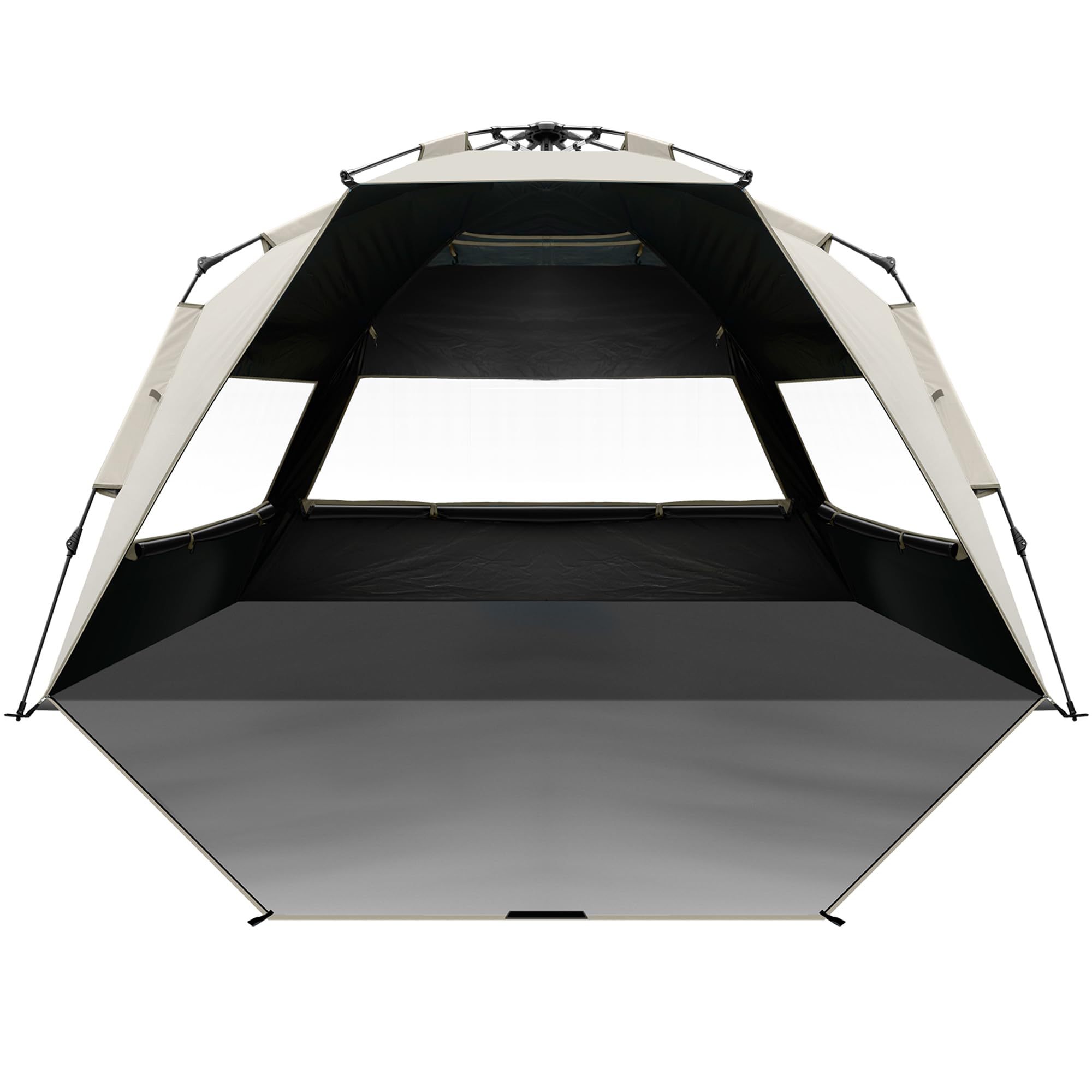
The pop-up tent that blocks 95% of visible light so you can actually nap midday.
Most beach tents just block UV rays; the OutdoorMaster Blackout Shelter goes further by eliminating 95% of sunlight on top of blocking 99.95% of UVA and UVB rays (UPF 50+). That makes it the best pick if your beach day includes a real nap or you have a baby who needs dark space to sleep. The 190T fabric (a polyester material with 190 threads per inch) combined with 9.5mm thickened alloy steel rods (a full 1.5mm thicker than standard 8.0mm rods) gives it a solid feel — the maker claims it handles wind firmly without breaking or tearing. Compared to the Elegear’s 8.5mm fiberglass rods, the OutdoorMaster’s 9.5mm steel is thicker, but the Elegear weighs 5.95 lbs to the OutdoorMaster’s 8.5 lbs.
The interior is 94.4 x 55.1 x 53.1 inches, which comes out to 20.47 square feet of floor area — identical on paper to the Elegear, though the OutdoorMaster is 8.5 pounds compared to the Elegear’s 5.95 pounds . That extra weight comes from the thicker alloy steel frame and the blackout fabric itself. You get three large mesh windows plus a mesh door for ventilation, and the zippered rear door lets you change clothes in privacy.
Customers note that the overhead mesh pockets are handy for stashing sunglasses and phones where sand cannot reach them. The trade-off: at 8.5 pounds it is the heaviest pop-up in the mid-range group, and the 53.1-inch peak height means taller adults will have to crouch or crawl to get to the back corners.
Why It Stands Out
- Blackout fabric eliminates 95% of visible sunlight for true napping comfort
- 9.5mm alloy steel poles are thicker and more wind-resistant than most beach tents
- Three large mesh panels plus a mesh door for excellent cross-ventilation
What to Know
- 53.1-inch peak height is low for tall adults
- At 8.5 lbs, it is heavier than the Elegear (5.95 lbs)
- Floor area is compact at 20.47 sq ft for 4-person rating
Best for: anyone who prioritizes dark, cool interior space for napping or a young child’s sleep on the beach.
skip it if: you need standing room or a bigger floor — this is a low-profile tent that is snug for more than two adults with gear.
4. Old Bahama Bay Pop Up Beach Tent

A true no-assembly pop-up that springs open and folds flat in seconds.
The Old Bahama Bay tent is built for the “arrive and drop” crowd. It pops open without any pole threading — you pull it from the carry bag, let it unfold, and stake it down. The front extension adds extra floor space beyond the main 81 x 54.5-inch footprint, giving three to four people room to spread out on a blanket. The special silver-coated fabric reflects and absorbs sunlight, blocking up to 98% of harmful UV rays with a UPF 50+ rating, and it reduces the internal temperature compared to uncoated polyester.
Ventilation comes from a four-sided design with three large mesh windows that keep airflow moving even on still days. At 8.18 pounds, it is about the same weight as the OutdoorMaster but significantly lighter than the Rhino Valley. The fiberglass frame is paired with included stakes and sandbags for anchoring, and the whole thing folds back into its carry bag.
One buyer aptly noted that the pop-up mechanism is truly tool-free — no poles to connect, no clips to snap. The honest trade-off is that fiberglass poles are less durable than aluminum in constant wind, and the 62-inch peak height means you are sitting or kneeling inside rather than standing. The floor area is also unlisted in square feet, so you are relying on the linear dimensions to judge space.
The setup verdict: If your priority is getting shade up in under 30 seconds without reading a manual, this pop-up delivers — just know the fiberglass frame and moderate height trade some long-term ruggedness for that instant convenience.
Buy this if: you hate assembly and want the fastest possible transition from car to shade, with decent UV protection and ventilation.
Choose something else if: you camp on consistently windy beaches — the fiberglass frame and pop-up hinges are less wind-tolerant than a pole-and-sandbag canopy like the easierhike.
5. Vibemo Beach Tent, 10x10ft Sun Shelter

The 100-square-foot shelter that claims 80% more stability than a standard beach umbrella.
Vibemo’s beach tent is a direct competitor to the Rhino Valley, also offering 100 square feet of shade in a 10×10-foot layout. It uses eight upgraded larger sandbags and four thickened aluminum poles. The brand claims this design makes the shelter 80% more stable than another beach umbrella — a bold number that speaks to the anchoring system’s focus. The 120 by 120 by 78-inch dimensions give an extra two inches of width and six inches of height compared to the Rhino Valley, so taller people have slightly more headroom under the 78-inch peak.
The fabric is high-stretch Lycra with a UPF 50+ rating, and the entire shelter folds down to 8.3 pounds in the included travel bag — roughly the same weight as the Rhino Valley but with a slightly taller profile. Setup is similar: spread the canopy, fill the sandbags, and insert the aluminum poles. The navy-blue color is a practical choice for hiding sand stains.
One thing buyers should note is that at 8.3 pounds and a 120-inch span, the packed size is significant. You will need trunk space or a large carry-on bag. The Lycra fabric is stretchy and durable, but like all pole canopies, it requires a fairly flat, open sandy area to pitch correctly. Reviewers consistently mention that once the sandbags are filled and buried, the shelter stayed put through gusty afternoons where nearby umbrellas took flight.
What Works
- Massive 100 sq ft shade area with 78-inch peak height (tallest in this group)
- Eight sandbags plus thickened aluminum poles for exceptional stability
- High-stretch Lycra fabric resists tearing and stretches taut
What to Consider
- Packed size is large; needs decent trunk or luggage space
- Setup is a few minutes longer than a pop-up; requires filling and burying 8 sandbags
- No sidewalls or privacy enclosure
Go for this if: you want the biggest possible covered area with an anchoring system that inspires confidence in strong beach winds.
Think twice if: you need a quick, grab-and-go shelter — the sandbag setup takes more effort than a pop-up tent.
6. easierhike Canopy with Sidewalls 10x10FT

The 10×10 canopy with a patented pole-top groove and a sidewall that blocks slanting sun.
This easierhike canopy addresses two specific beach frustrations: side-angle sun and pole-top wobble. The sidewall attaches with grippy anti-slip velcro, giving extra shade when the sun is low in the morning or late afternoon — a feature no other canopy in this roundup offers. The pole tops use a patented grooved metal ring that pairs with a bungee lock cord to keep the canopy drum-tight in windy conditions, plus four tension cords for internal balance. The maker says the durable materials resist stretching and tearing.
The floor area is 100 square feet (10×10 feet), matching the Rhino Valley and Vibemo, but the easierhike stands out with its integrated storage pouch on one anchoring strap for holding towels, sunglasses, or small accessories. At 4.88 kilograms (about 10.8 pounds), it is the heaviest shelter here, largely because of the extra sidewall fabric and the comprehensive anchoring hardware. The aluminum frame is rust-resistant, and the canopy provides UPF 50+ UV protection.
Real buyers rave about this one. One reviewer with verified purchase said, “Held up to the winds at the beach… I absolutely LOVED the privacy screen for the rear. Very impressed.” Another called it “lightweight and easy to carry” despite the 10.8-pound spec, noting it fits a large blanket underneath. A third confirmed it “withstands high wind” but found the sand anchor bags needed more sand than expected on the first try. The main caveat is that setup is initially tricky — multiple reviewers mention a learning curve. One noted the sidewall is ineffective in wind (clothespins helped), but that the canopy itself held shape beautifully.
Standout Details
- Detachable sidewall for morning/afternoon slanting sun
- Patented grooved pole-top + bungee cord for wind stability
- Integral storage pouch on anchor strap
- Strong positive reviews: “held shape with changing winds or no wind”
Honest Trade-offs
- Heaviest of the group at 10.8 lbs
- Setup has a learning curve; first-time assembly can be confusing
- Sidewall can flap in strong wind
Choose this for: all-day beach trips where you need shade from morning to late afternoon, plus a privacy option, and you are willing to master a slightly more complex setup for superior wind performance.
Pick a lighter, simpler option if: you want to set up in under two minutes with zero learning curve.
7. thereugokinexio Beach Canopy Tent Sun Shade

The 6-pound, 7.5-foot-square canopy that is light enough for a daypack.
If your beach trips are more spontaneous and you do not want to haul a heavy load, this thereugokinexio canopy makes a strong argument. At 6 pounds with an 18.8-inch shoulder carry bag, it is the lightest aluminum-frame shelter in the lineup , and at 56.25 square feet it is smaller than the 100 sq ft giants. The 7.5 x 7.5-foot footprint and 5.5-foot peak height provide decent shade for two to three people sitting on a blanket.
The frame uses rust-proof aluminum poles, and the canopy is a nylon/Lycra blend with reinforced corners and triple stitching for tear resistance. UPF 50+ protection keeps you covered on sunny days. Extra wind ropes and corner anchor bags improve stability beyond what a basic canopy offers, and the drawstring closure makes packing up simple. The sky-blue color blends nicely with the beach environment.
The obvious trade-off is size: 56.25 square feet is nearly half the shade of the 100 sq ft models, so it is best suited for couples or a small family with minimal gear. The 5.5-foot peak height means most adults will need to stoop at the edges, and the Lycra fabric, while stretchy, is less rigid than the thick 190T polyester used by pricier shelters. Buyers looking for a budget-friendly entry point without sacrificing aluminum pole durability will find this a smart compromise.
A quick take: Lightweight, affordable, and well-anchored for its size, this canopy is a solid starter shelter — just know that 56.25 sq ft means you trade big-group space for easy carrying.
Perfect if: you are a couple or small trio looking for a portable, easy-to-carry shelter that does not break the bank, with aluminum poles for rust resistance.
Not for you if: you need to shade four to six people regularly — step up to one of the 100 sq ft options instead.
Understanding the Specs
UPF 50+ Protection
UPF stands for Ultraviolet Protection Factor. A UPF 50+ fabric blocks about 98% of UV radiation from reaching your skin. This is the industry standard for serious beach shelters — anything less lets through significantly more rays. The “50” means only 1/50th (2%) of the sun’s UV radiation can pass through the fabric, so you stay safe even on an all-day beach trip. Some shelters add a silver coating to also reflect heat and lower the internal temperature by several degrees.
Floor Area vs. Footprint
Floor area (in square feet) is the actual covered space inside the shelter. A 100-square-foot tent like the Rhino Valley or Vibemo is 10 by 10 feet — enough for six to eight people sitting, or a group with chairs and a cooler. A 56-square-foot tent (7.5 x 7.5 feet) fits two to three. A compact 20-square-foot tent is snug for two adults with minimal gear, though some like the Elegear extend shade with a canopy overhang that increases the effective shaded area beyond the floor measurement.
FAQ
What is the difference between a beach tent and a beach canopy?
How do I anchor my beach shelter so it does not blow away?
Can I use a beach shelter on hard-packed sand or grass?
How many people does a 100 square foot beach shelter fit?
What does UPF 50+ actually mean for my skin?
Is a heavier beach shelter always better?
Do I need a separate privacy tent for changing clothes?
How long does a typical beach shelter last?
Can I leave my beach shelter up overnight?
How do I clean salt and sand off my shelter?
Final Thoughts: The Verdict
Across the board, the best beach sun shelter winner is the Elegear CumbreX™ Beach Tent because it combines award-winning versatility, a canopy that doubles usable space, lightweight portability at 5.95 pounds, and the strongest customer accolades in this group. If you want maximum shade area for a large group, grab the Rhino Valley 10×10 FT with its 100 square feet of space and 8-sandbag anchoring. And for true dark-interior napping, the standout is the OutdoorMaster Beach Tent with Blackout Technology that eliminates 95% of visible sunlight.
How We Picked
We do not accept paid placement. Every pick is matched to a real buyer and a real use-case; we do not hands-on test units.
Sources & Methodology
Specifications: manufacturer listings and product documentation. Review insights: verified customer reviews, as of July 2026. Pricing: not shown on this page (it changes often); check the current price via the retailer link.
As an Amazon Associate, Gadgets Feed earns from qualifying purchases. This does not affect which products we feature.