
Our readers keep the lights on and my morning glass full of iced black tea. As an Amazon Associate, I earn from qualifying purchases.
Specs are compiled from manufacturer listings and verified buyer reviews and can change over time — please confirm the key details on the product page before buying.
You have a 3/4-inch pipe — probably copper, maybe an outdoor spigot or an exposed line in the basement — and winter is coming. The real question is which foam sleeve actually stops the freeze before you wake up to a flooded utility room. This guide compares seven practical options so you match the right thickness, length, and material to your exact pipe run.
I’m Min — the founder and writer behind Gadgets Feed. This guide is built by comparing the manufacturers’ published specifications and the patterns across verified customer reviews, so you get each pick’s real strengths and trade-offs instead of marketing spin.
if you need to protect an outdoor faucet, an AC line, or a long hot-water pipe run, the right 3/4 pipe insulation keeps water flowing and your heating bill lower through the coldest months.
Quick Picks
- Duck Brand Insulating Foam Pipe Covers — Best Overall
- HolyMaji 4 Pack Pipe Insulation Foam Tube — Maximum Protection
- FUYITE 8 Pack Pipe Insulation Foam Tube — Versatile Runner-Up
- FUYITE 12 Pack Pipe Insulation Foam Tube — Best Value Per Foot
- UCandy 12pack Pipe Insulation Foam Tube — Well-Balanced 12-Pack
- YUNFOOK Pipe Insulation Foam Tube — Heat & Flame Guard
- PATIKIL 3/4″(19mm) ID x 6Ft x 0.35″ Pipe — Continuous Run Specialist
How To Choose The Best 3/4 Pipe Insulation
Three decisions separate a solid winter fix from a soggy disappointment: foam material, wall thickness, and if you need an outer foil layer for outdoor use.
Foam Material: Neoprene vs EPDM vs Polyethylene
Most bubble-wrap-thin pipe covers use polyethylene — it is cheap but tears easily and offers little insulation. Neoprene rubber (used by several picks here) is denser, more flexible, and resists weather better. EPDM rubber handles extreme temperatures (down to -58°F in one product here) and adds flame retardance. For outdoor spigots exposed to rain and sun, neoprene or EPDM with an aluminum foil facing is your safest bet.
Wall Thickness: The Real Freeze Fighter
A thin 0.35-inch wall slows some heat loss, but a 1.15-inch wall — three times thicker — gives you serious protection against deep freezes. The trade-off is flexibility: thick foam does not bend around tight elbows as easily. For a straight pipe run in an unheated crawlspace, go thicker. For a short outdoor spigot where you just need a barrier, a mid-thickness wrap works fine.
Self-Adhesive vs Tape-Sealed Seams
Some foam tubes come with a pre-applied adhesive strip under a peel-off paper that seals the slit after you wrap it around the pipe. Others rely on you adding duct or foil tape. The self-adhesive seam saves a step and stays cleaner, but a few buyers report the glue is not strong enough for corners — zip ties or extra tape solve that in seconds.
Quick Comparison
| Model | Best For | Wall Thickness | Length per Piece | Count | Material | Amazon |
|---|---|---|---|---|---|---|
| Duck Brand Insulating Foam Pipe Covers | Long straight runs | 0.75 Inches | 3 Feet | 4 Sticks | Polyethylene foam | Amazon |
| HolyMaji 4 Pack | Thickest wall protection | 1.15 Inches | 1.3 Feet | 4 Count | Neoprene | Amazon |
| FUYITE 8 Pack | Outdoor spigots & sprinklers | 0.39 Inches | 1.31 Feet | 8 Count | Neoprene | Amazon |
| FUYITE 12 Pack | Large outdoor coverage | 0.39 Inches | 1.31 Feet | 12 Count | Neoprene | Amazon |
| UCandy 12 Pack | Value per foot for multiple lines | 0.4 Inches | 15.7 Inches | 12 Count | Neoprene | Amazon |
| YUNFOOK 6 Pack | High heat & flame retardance | 9 Millimeters | 1.3 Feet | 6 Count | EPDM rubber | Amazon |
| PATIKIL Single Tube | One long continuous run | 0.35 Inches | 6 Feet | 1 Count | Rubber foam | Amazon |
In‑Depth Reviews
1. Duck Brand Insulating Foam Pipe Covers, 0.75-Inch by 3-Feet, Pack of 4 Sticks

The 3-foot stick that gives you enough continuous coverage to skip seams on a long straight pipe.
The one spec that separates this from the rest is the 3-foot stick length — four sticks give you 12 feet of total coverage in just four segments. That means fewer joints where heat can sneak out compared to covering the same run with short 1.3-foot sections. The 0.75-inch wall splits the difference: thicker than thin budget wraps but less bulky than 1.15-inch foam, so it still bends around corners.
Owners mention that this insulation held up in outdoor temps down to 11°F with no freezing — the key quote is “Only used in temps to 11 degrees F outdoors but pipes did not freeze.” The catch, noted by several owners, is that the self-sealing adhesive on the slit is weak; one reviewer reinforced it with duct tape, another used zip ties around tight bends. At 4.16 ounces per pack, it is light enough to ship without costing you extra.
Why it leads the pack
- 3-foot stick length minimizes seams — only four pieces for 12 feet of coverage
- 0.75-inch wall gives solid freeze protection without being too rigid for elbows
- Weighs only 4.16 ounces per pack, easy to handle overhead
The honest trade-off
- Self-sealing adhesive is weak — several buyers added duct tape or zip ties
- No aluminum foil outer layer, so UV exposure may degrade it outdoors over time
Reach for this if: you have a straight 8-12 foot pipe run in a basement or crawlspace and want the fewest seams possible.
Look elsewhere if: your pipe has multiple tight 90-degree turns where a single long stick is harder to wrap than short segments.
2. HolyMaji 4 Pack Pipe Insulation Foam Tube – 3/4″ ID Pre Slit Foam Pipe Covers with Aluminum Foil
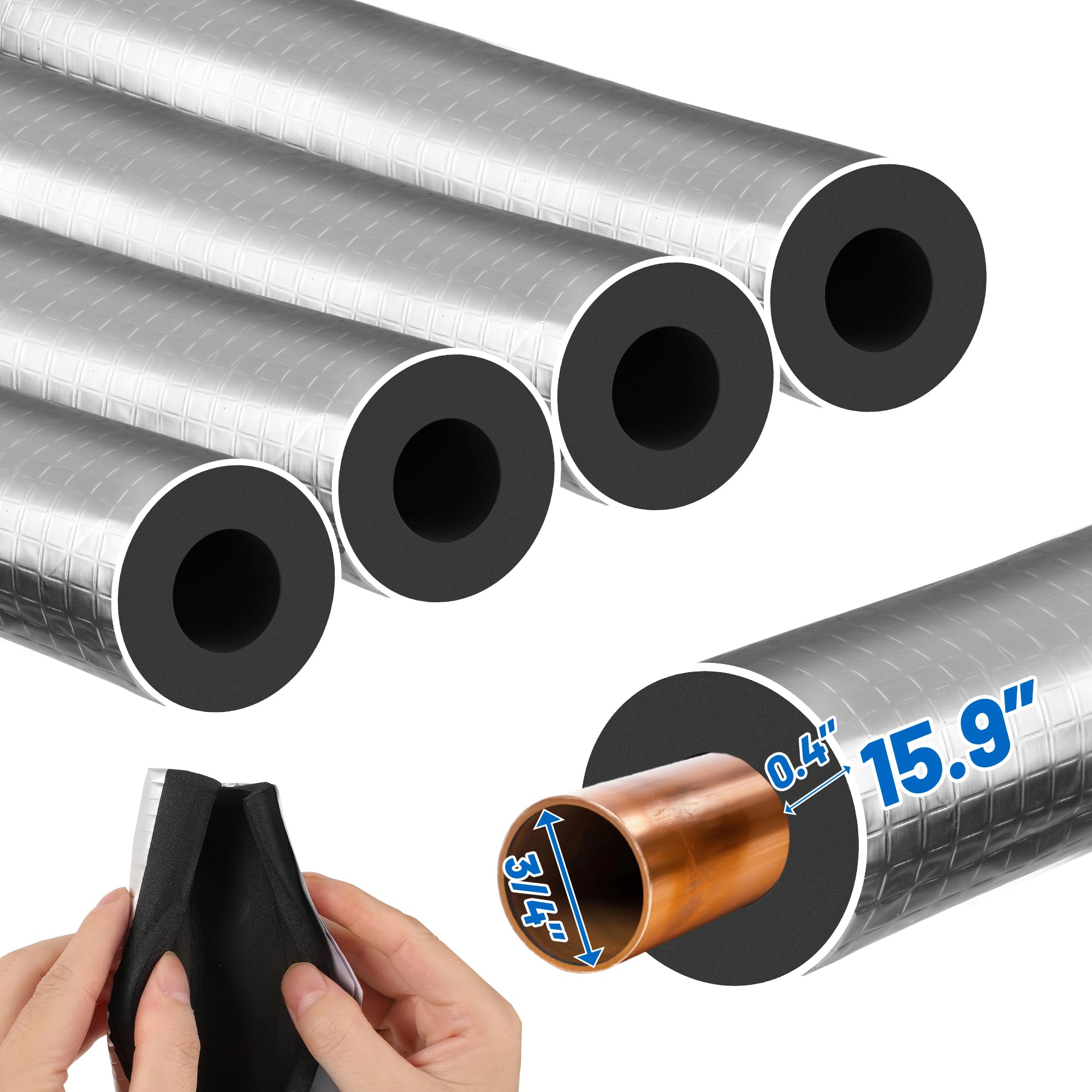
The thickest wall on this list — 1.15 inches — gives you the highest winter freeze buffer.
At 1.15 inches, this foam wall is over three times thicker than the PATIKIL tube’s 0.35-inch wall. That extra material means it takes longer for cold air to soak through to your pipe, which matters when temps drop into the teens. The neoprene core is wrapped in an aluminum foil outer layer, so it also reflects radiant heat back into the pipe instead of letting it radiate away. Builders and homeowners alike use it on AC refrigerant lines, outdoor spigots, and sprinkler valves.
A buyer in Florida says it feels “durable and well made” and hopes it lasts under the Florida sun — the foil helps reflect UV, which is the main killer of uncovered black foam. One reviewer notes a very honest limitation: “Very cheap, wouldn’t count on this to insulate anything very well. Would just go to a hardware store and spend a little more.” That one-star take is a minority opinion against four 5-star reviews, but it is worth knowing the foil layer is thin and some users wanted a denser foam. Each tube is 1.3 feet long, and four tubes give you 5.2 feet total.
What justifies the thicker wall
- 1.15-inch wall — the thickest in this lineup, best for deep-freeze zones
- Neoprene with aluminum foil outer layer reflects heat and blocks UV
- Waterproof and fireproof outer surface handles bad weather
The honest trade-off
- Thick foam does not bend sharply — not ideal for tight elbows or 90s
- One buyer found the build quality disappointing for the price
Best for: a straight outdoor pipe or spigot in a region that sees single-digit temperatures, where thickness matters more than flexibility.
skip it if: you need to wrap a serpentine pipe with multiple bends — thin foam will fit better.
3. FUYITE 8 Pack Pipe Insulation Foam Tube, 3/4” Self Adhesive Pre Slit Foam Pipe Covers Polyethylene with Aluminum Foil

Eight pieces give you 10.48 feet of neoprene-and-foil coverage — enough for most outdoor spigot and sprinkler setups.
This eight-count pack covers 10.48 feet total, each tube measuring 1.31 feet long with a 0.39-inch wall. The neoprene foam is gentle on your skin — unlike old fiberglass wraps — and the self-adhesive aluminum foil on the surface seals the pre-slit seam without needing extra tape. The foil adds a radiant barrier that reflects summer heat away and winter heat back into the pipe. One buyer put it simply: “The temp dropped to 26 one night and nothing froze!” — that is the exact scenario you are buying this for.
Reviewers also mention that installation is fast even in cramped spaces. One reviewer with a bad back said these “went on so fast in the cramped space I had nonissues.” The caveat? Two buyers reported that a few pieces arrived with the slit already partially sealed or needed manual cutting. At 0.39 inches, the wall is thinner than the HolyMaji 1.15-inch foam, so for extreme cold you might want to double-layer it on the most exposed sections.
Why eight pieces hit the balance
- 10.48 feet total — covers multiple spigots, sprinkler valves, and short AC lines
- Aluminum foil outer layer insulates from radiant heat and slows aging
- Self-adhesive seam means no extra tape needed for installation
The honest trade-off
- 0.39-inch wall is mid-range — not as protective as the 1.15-inch HolyMaji in single-digit temps
- Two buyers had pieces arrive without the pre-slit cut
Reach for this if: you need outdoor freeze protection for spigots, sprinkler backflows, and a short AC line — the quantity and foil layer cover all three.
Look elsewhere if: your pipe run is a long uninterrupted straight 10-footer — the 3-foot Duck Brand stick would use fewer pieces.
4. FUYITE 12 Pack Pipe Insulation Foam Tube, 3/4” Self Adhesive Pre Slit Foam Pipe Covers Polyethylene with Aluminum Foil
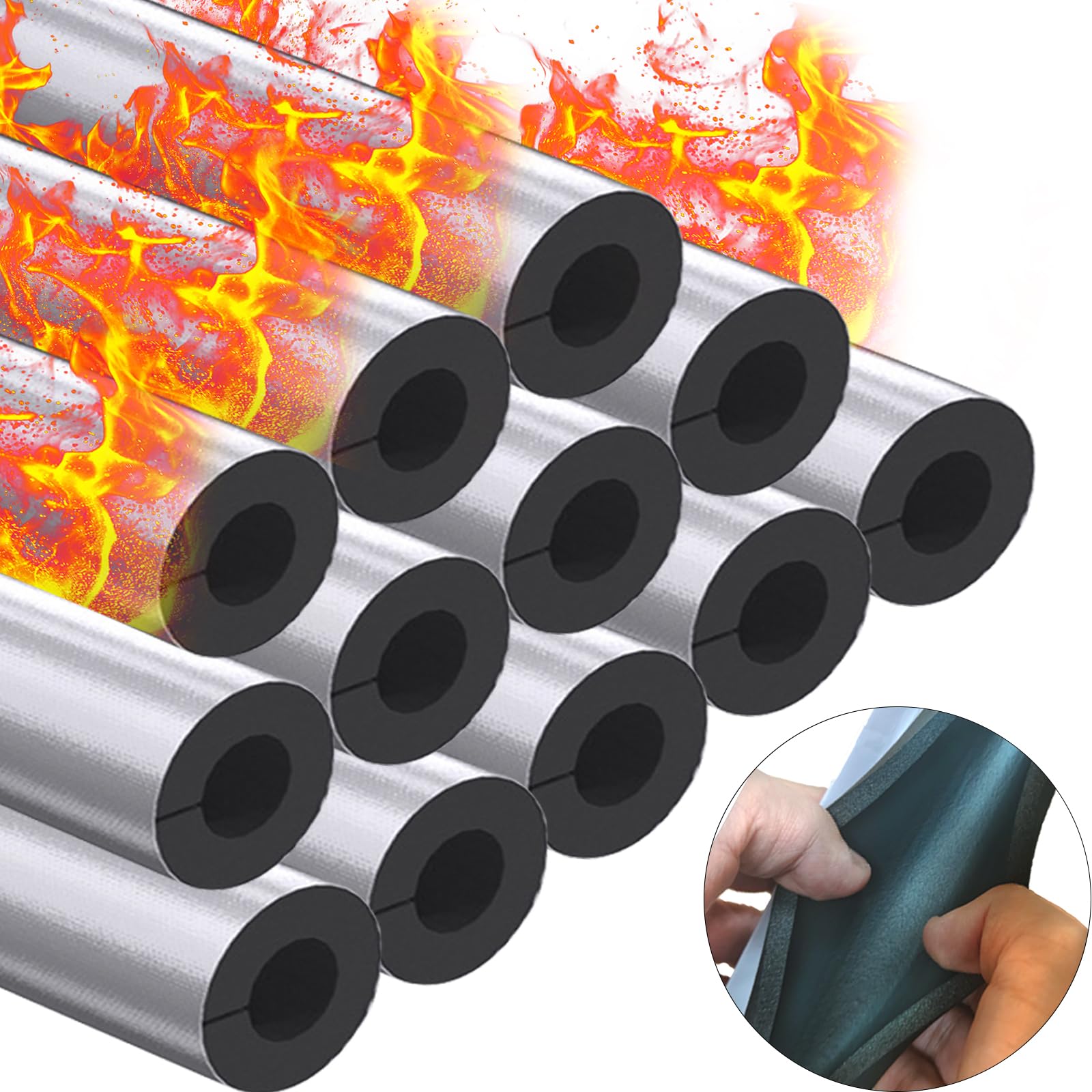
Twelve tubes for 15.74 feet of coverage — the most linear footage in the FUYITE lineup with the same aluminum foil barrier.
This is the same neoprene-and-aluminum-foil design as the 8-pack above, but with four extra pieces to cover longer pipe networks. Each tube is 1.31 feet with a 0.39-inch wall and a 0.8-inch inner diameter that fits snugly over a 3/4-inch copper pipe. The self-adhesive seam on the aluminum foil closes quickly — peel the paper, press the slit, and you are done. Like the 8-pack, the foil works both ways: it reflects winter heat back into the pipe and blocks summer heat from baking the pipe surface.
Reviews mirror the 8-pack’s experience. One buyer used it on hot water pipes in an unfinished basement and ordered more for remaining pipes, noting it was “easy to install.” Another reviewer highlighted the radiant barrier as the best combo for energy efficiency. The same flaw pops up — a couple of tubes arrived requiring a manual slit cut — but that is a minor inconvenience for 15.74 feet of coverage in a single box.
What 12 pieces get you
- 15.74 feet total cover — enough for a long basement run plus outdoor spigots
- Aluminum foil doubles as a radiant barrier for energy efficiency
- Neoprene is skin-safe and cuts easily with scissors
The honest trade-off
- 0.39-inch wall is adequate but not the thickest option for extreme cold
- Some pieces needed manual cutting if the pre-slit machine missed them
Best for: covering a mix of hot-water copper lines and outdoor spigots in one order — the 15.74 feet give you buffer for mistakes and extra runs.
pass on it if: you only need a quick two-spigot fix — the 8-pack saves money and avoids leftover tubes.
5. UCandy 12pack Pipe Insulation Foam Tube for 3/4” Pipes, Pre-Slit Duct Wrap with Aluminum Foil (L 15.7″)
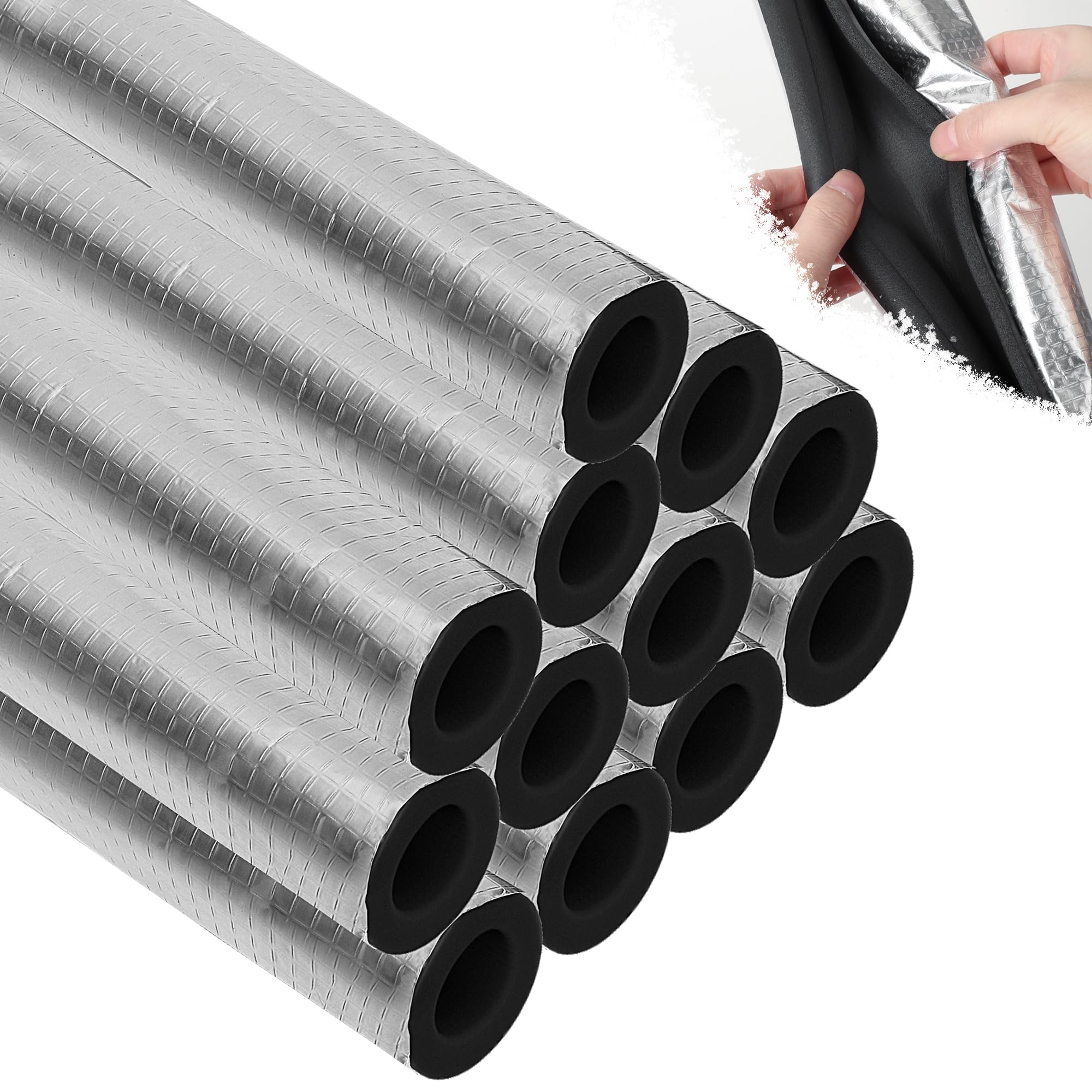
Fifteen-point-seven-inch sticks give you fewer pieces to handle per foot than the 1.3-foot FUYITE tubes.
Each of the 12 pieces measures 15.7 inches long and covers a 0.8-inch inner diameter pipe with a 0.4-inch neoprene wall and an aluminum foil outer layer. The slightly longer stick length means you use 12 pieces for 15.74 feet, while the FUYITE 12-pack uses shorter 1.31-foot sticks for the same total. Fewer seams means fewer spots where the adhesive might gap open.
One resourceful reviewer used these on fuel lines for a diesel truck in freezing temps and said “I live in some freezing temps and I don’t doubt these will help a ton to keep my fuel lines warm and from freezing.” Another buyer called it a product that “hits all the boxes” and praised the foil tape closure. The main criticism is that the 15.7-inch length is shorter than the 3- or 4-foot sticks most people expect for pipe insulation — if you are used to buying at a hardware store, check that you are okay piecing together 12 segments.
Why the extra length per stick helps
- 15.7-inch pieces mean only 12 seams for 15.74 feet of coverage
- 0.4-inch neoprene wall plus aluminum foil gives solid all-season protection
- Pre-slit with self-adhesive foil tape — no extra supplies needed
The honest trade-off
- 15.7 inches is short relative to standard hardware-store 3-foot sticks — more pieces to align
- One buyer measured wall thickness at half the advertised 0.4 inches
Reach for this if: you want a neoprene-and-foil 12-pack with slightly fewer pieces per foot than the 1.3-foot alternatives.
Look elsewhere if: having a single continuous 3-foot stick matters more to you than having the foil radiant barrier.
6. YUNFOOK Pipe Insulation Foam Tube – 6 Pcs 3/4Inch ID Self Adhesive Foam Wrap for AC Unit, Copper Pipe, Outdoor Winter Irrigation
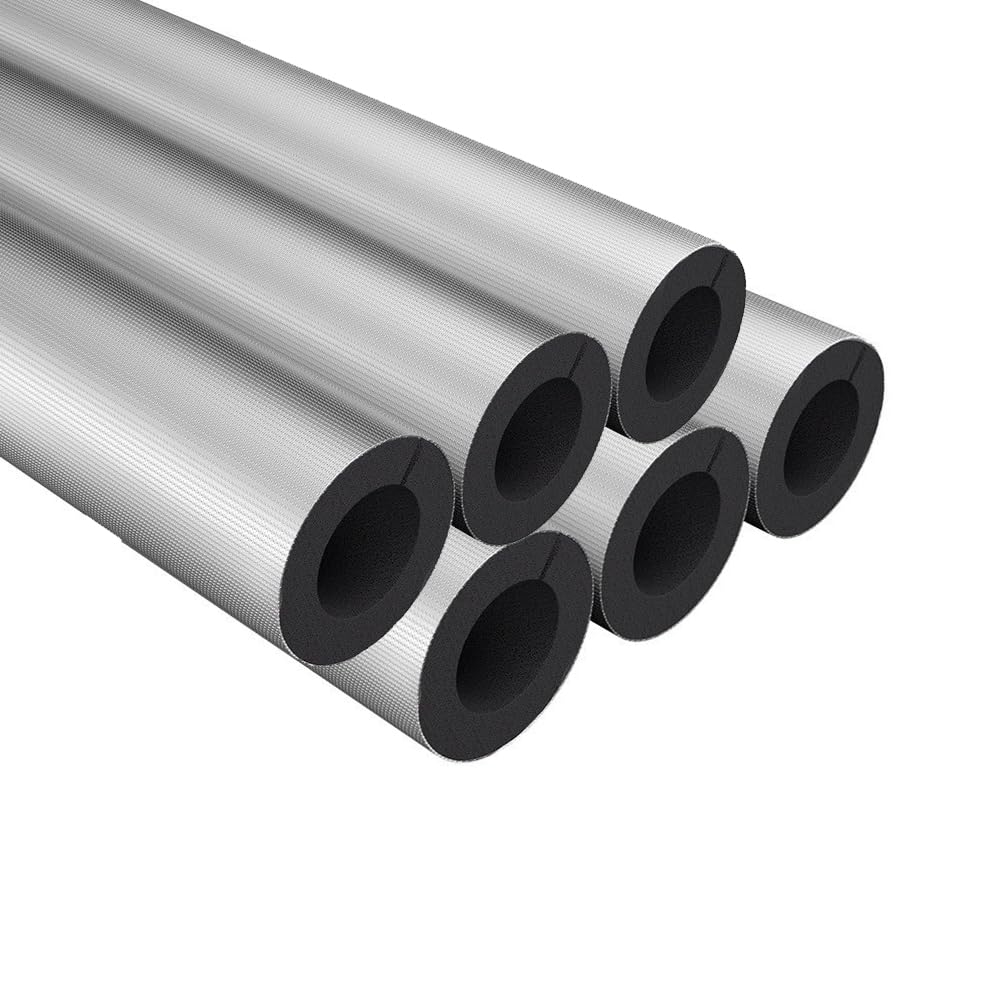
EPDM rubber and fiberglass aluminum film stand up to extreme heat and resist burning better than neoprene or poly foam.
This is the only pick made from EPDM material with a fiberglass aluminum film outer layer rather than plain neoprene. The operating temperature range is -58 to 230°F, and the closed-cell structure is designed so the insulating material does not melt in case of fire. For an AC compressor line or a pipe near a furnace or water heater, that flame retardance is a meaningful safety margin. The 9-millimeter wall (about 0.35 inches) is on the thinner side, but the EPDM chemistry compensates with denser insulation per millimeter.
Buyers confirm it works well in real freezes. One Texas owner wrote: “They protected our copper and other materials pipes during the recent freeze in Texas. They were easy to apply.” Another reviewer called it “a step up from the original black foam without the foil.” The main drawback is the shorter 1.3-foot stick length — six pieces give you 7.8 feet total, and you will need to tape each seam since the self-adhesive strip is on the aluminum film, not on the foam itself.
What EPDM brings to the table
- Heat range from -58°F to 230°F — handles extreme hot and cold
- Fiberglass aluminum film resists fire and does not melt easily
- Closed-cell EPDM blocks moisture vapor better than open-cell foam
The honest trade-off
- 9mm (0.35-inch) wall is the thinnest alongside the PATIKIL tube
- 6 pieces at 1.3 feet each — only 7.8 feet total, less than the bigger packs
Best for: AC compressor lines, furnace-area pipes, or any pipe run near a heat source where flame retardance is a real concern.
it’s not for you if: you need maximum freeze protection for an unheated crawlspace — thicker neoprene wraps offer more cold buffer.
7. PATIKIL 3/4″(19mm) ID x 6Ft x 0.35″ Pipe Insulation Foam Tube, Pipe Cover Wrap Roll Bar Padding Tubing

One 6-foot continuous tube — the longest single piece in this list — with zero seams on a straight pipe run.
Every other pick here uses short segments that you piece together. This PATIKIL tube comes in one 6-foot continuous length with a 0.35-inch wall. That means zero seam gaps on a 6-foot straight pipe, which is the most thermally efficient install because there is no slit joint where cold air can creep in. The rubber foam is flexible enough to follow a slight curve, and the closed-cell structure resists water vapor permeability. It also works as handle grip padding or roof-rack cushion — one buyer wrote “I bought these to use as cushions for roof rack bars when we went on vacation last year” and hauled folded dog crates 1,300 miles.
The big trade-off is that this is a single tube with no pre-slit cut — you must cut your own slit lengthwise to wrap it around an existing pipe. One reviewer noted they could not slip it over a 1.5-inch pipe and had to make a full-length cut themselves. The 0.35-inch wall is also the thinnest alongside the YUNFOOK tube, so for deep-freeze exposure, the HolyMaji or Duck Brand offer more insulation mass. And several buyers caution that the bare black foam deteriorates in direct UV, so outdoor use demands tape or paint on top.
Why a smooth run wins
- Full 6-foot continuous length — zero joints to leak heat on a straight pipe
- Closed-cell rubber foam blocks moisture and provides efficient insulation
- Can be repurposed as furniture leg cushion or handlebar padding
The honest trade-off
- No pre-slit seam — you cut your own slit lengthwise to install
- 0.35-inch wall is the thinnest option; UV light degrades bare black foam quickly
Reach for this if: you have a long straight copper or PVC pipe run with zero elbows and want zero seam interruptions.
Look elsewhere if: you need to wrap a pipe that is already installed against a wall — a pre-slit tube is far easier to put on without removing the pipe.
Understanding the Specs
Wall Thickness
Measured in inches or millimeters, this is the foam layer between cold air and your pipe. A 0.35-inch wall (9mm) is better than bare pipe but offers basic protection. A 1.15-inch wall (about 29mm) gives you a serious thermal buffer that keeps water flowing through a deep freeze. The thicker the wall, the less heat escapes — but thicker foam is harder to bend around elbows.
Aluminum Foil vs Bare Foam
A bare black foam tube absorbs UV light and degrades in direct sunlight within months. An aluminum foil outer layer reflects UV and also adds a radiant barrier — it bounces heat back into the pipe in winter and reflects solar heat away in summer. For any outdoor application, the foil layer extends the insulation’s useful life and improves energy efficiency.
FAQ
Does 3/4 pipe insulation fit a standard copper water pipe?
What is the difference between pre-slit and solid tube pipe insulation?
Can I use 3/4 pipe insulation on hot water pipes?
How long does outdoor pipe insulation last?
What does the R-value mean for pipe insulation?
Can I paint or cover pipe insulation after installation?
How do I cut pipe insulation to the right length?
Will 3/4 pipe insulation work on PVC pipes?
Can I use these foam tubes as handle grips or padding?
Is double-layering 3/4 pipe insulation effective?
Final Thoughts: The Verdict
For most people, the 3/4 pipe insulation winner is the Duck Brand Insulating Foam Pipe Covers because the 3-foot stick length minimizes seams and the 0.75-inch wall gives proven freeze protection down to 11°F. If you need maximum thickness for extreme cold, grab the HolyMaji 4 Pack with its 1.15-inch wall. And for a long straight smooth run, the PATIKIL 6-foot single tube delivers the cleanest install with zero heat-leaking joints.
How We Picked
We do not accept paid placement. Every pick is matched to a real buyer and a real use-case; we do not hands-on test units.
Sources & Methodology
Specifications: manufacturer listings and product documentation. Review insights: verified customer reviews, as of July 2026. Pricing: not shown on this page (it changes often); check the current price via the retailer link.
As an Amazon Associate, Gadgets Feed earns from qualifying purchases. This does not affect which products we feature.