
Our readers keep the lights on and my morning glass full of iced black tea. As an Amazon Associate, I earn from qualifying purchases.
Specs are compiled from manufacturer listings and verified buyer reviews and can change over time — please confirm the key details on the product page before buying.
The hardest part of learning to ride a bike has always been balance — pedaling is the easy part once you get the feel for staying upright. That is why 2-in-1 bikes that start as a balance bike and convert to a pedal bike have changed everything for young riders. Instead of a child fighting wobbles and fear at the same time, they master the glide first and then snap the pedals on when they are ready — which usually happens shockingly fast.
I’m Min — the founder and writer behind Gadgets Feed. This guide is built by comparing the manufacturers’ published specifications and the patterns across verified customer reviews, so you get each pick’s real strengths and trade-offs instead of marketing spin.
We looked at weight, frame materials, conversion ease, and real parent feedback to find the best balance and pedal bike options that actually make learning to ride a smooth, low-stress process.
Quick Picks
- RoyalBaby EZ-Pro Kids Bike — Premium Lightweight
- RoyalBaby EZ Kids Bike — Best Value
- OHIIK 2 in 1 Balance to Pedals Bike — Budget Champion
How To Choose The Best Balance And Pedal Bike
The core idea behind a 2-in-1 bike is simple: your child starts gliding without pedals to master balance, and later you add the pedals when they have the confidence. Not every bike pulls this off with the same ease, so here is what separates a smooth learner from a frustrating one.
Conversion System — Tool-Free vs Bolt-On
The smartest designs let you switch between balance mode and pedal mode without any tools — usually with a quick-release crank or a one-button mechanism. If the bike requires wrenches and bolts to swap modes, you will likely skip switching back and lose the flexibility that makes 2-in-1 bikes valuable.
Frame Material — Steel vs Aluminum
Steel frames are sturdy and durable, but they add noticeable weight that can make a bike harder for a small child to control, lift, or carry. Aluminum frames are significantly lighter, which helps kids maneuver the bike more easily and builds confidence faster. The trade-off is price: aluminum bikes sit at a higher tier.
Weight and Geometry
A lighter bike is easier for a child to handle, especially during the balance phase when they are lifting their feet and gliding. Look for bikes with a low step-through frame so your child can comfortably put both feet flat on the ground. Adjustable seat and handlebar heights let the bike grow with your child through multiple sizes.
Quick Comparison
| Model | Best For | Weight | Frame Material | Brake Style | Amazon |
|---|---|---|---|---|---|
| RoyalBaby EZ-Pro Kids Bike | Lightweight premium pick | 19.4 Pounds | Aluminum | Linear Pull | Amazon |
| RoyalBaby EZ Kids Bike | Best overall value | 20 Pounds | Carbon Steel | Caliper, Drum | Amazon |
| OHIIK 2 in 1 Balance to Pedals Bike | Budget-friendly entry | — | Carbon Steel | Disc | Amazon |
In‑Depth Reviews
1. RoyalBaby EZ-Pro Kids Bike

The aluminum frame cuts weight to 19.4 pounds, making the bike easy for kids to lift and steer.
The aluminum alloy frame keeps the bike at 19.4 pounds, significantly lighter than steel alternatives. That is lighter than the RoyalBaby EZ Kids Bike (20 pounds), and buyers report it helps children control the bike far more easily. One parent noted their daughter learned balance in just 2 days and was pedaling independently within a week thanks to how manageable the bike felt.
The 2-in-1 conversion uses a tool-free one-key switch, so you can go from balance mode to pedal mode in seconds without hunting for a wrench. It comes 98% pre-assembled, and the seat height adjusts without tools as well. The dual hand brake system (linear pull style) gives better stopping control than a single brake — a real safety advantage when kids pick up speed.
One reviewer did point out a minor rear rim wobble (under 0.25 inches) and noted the front reflector cannot be mounted center. For tall children, another parent mentioned that a 7-year-old near the top of the growth range might outgrow this bike sooner than expected. Still, the aluminum frame and responsive brakes make this the smoothest learning experience on the list.
Glide Factor Wins
- Aluminum frame — 6-7 lbs lighter than similar steel bikes
- Tool-free one-key conversion between balance and pedal modes
- Dual hand brakes for safer stopping
- Built to CPSC safety standards with steel fenders
Real-World Catch
- Fit maxes out for tall 7-year-olds; less than half a year of use for some
- Minor cosmetic quality issues (rim wobble, reflector alignment) reported
Who should grab it: Parents willing to spend a bit more for the lightest, easiest-handling bike that accelerates learning — especially for smaller or younger kids who struggle with heavy steel frames.
One thing to know: The size range works best from ages 3 through about 7; a taller child on the upper end may outgrow this bike sooner than ideal.
2. RoyalBaby EZ Kids Bike
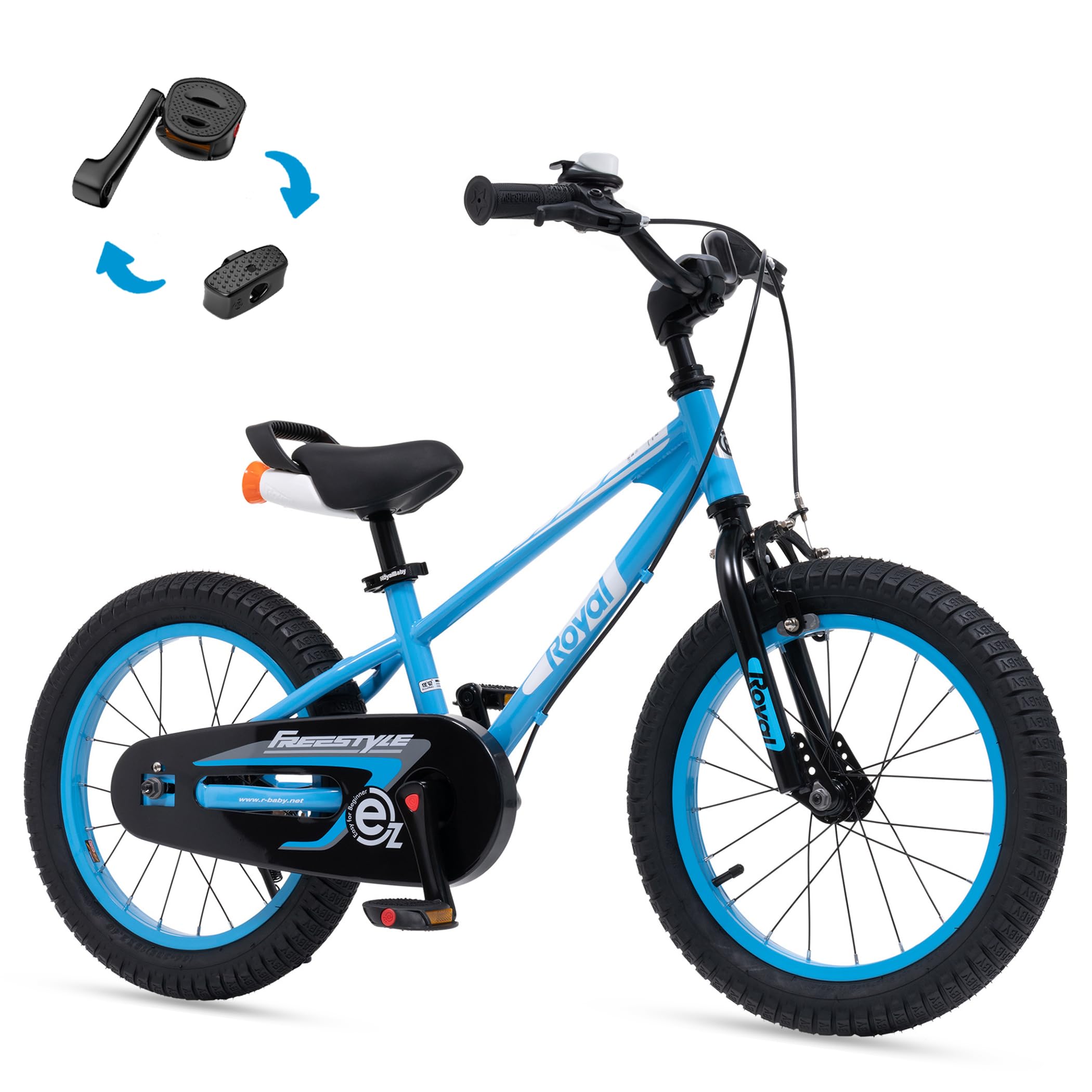
The tool-less quick-release crank and lightweight steel frame help kids learn to pedal in as little as 1.5 weeks.
One reviewer noted a 9-year-old learned to ride in 1.5 weeks using the pedal-off feature. The bike comes with a patented quick-release crank and footrest that switches between balance and pedal mode with a single button click, no tools needed. That tool-less design is the same convenience you find on the pricier EZ-Pro, but here you get it at a more accessible price point.
The steel frame is heavier (20 pounds) than the aluminum EZ-Pro, but RoyalBaby reduced weight by 20% compared to an average kids bike. Combined with a child-friendly geometry and a low step-through frame, young toddlers can easily have their feet flat on the ground. It also comes with fun add-ons like a “jet engine” water bottle and an electric bell that kids love.
One practical trade-off: this bike uses only front brakes (caliper style) plus a drum rear brake, and some buyers feel that a front-only brake can be risky for learners who instinctively grab hard. The seat is adjustable in height but not in distance from the handlebar. Still, with 98% pre-assembly from the start and a design trusted by millions of families, this is the pick that balances value and performance most evenly.
Why Parents Choose It
- Tool-less quick-release crank for instant 2-in-1 switching
- 20% lighter frame than average kids bikes
- Comes with water bottle, bell, and kickstand
- Millions of families from 80 countries trust RoyalBaby
The Honest Catch
- Only front brakes — some parents find this less safe for beginners
- Steel frame is heavier than aluminum alternatives
- Seat height adjustable, but seat-to-handlebar distance is fixed
Best suited for: Parents who want a reliable, well-reviewed 2-in-1 bike with easy conversion and fun accessories for their child.
Look elsewhere if: You prefer a lighter aluminum frame or want dual hand brakes (front and rear) for extra stopping safety.
3. OHIIK 2 in 1 Balance to Pedals Bike

The OHIIK bike includes a full accessory set and disc brakes, but the drivetrain may skip under load.
The OHIIK bike converts between modes in about 60 seconds, and kids over 6 can do it themselves. It comes with a complete accessory set: training wheels, a kickstand, a balance non-slip footrest, a small tire pump, and assembly tools — all included so you do not need to buy anything extra. The bike uses a high carbon steel frame for durability and features a hand brake plus a rear holding brake for two-stop control.
Buyers praise the easy 2-in-1 conversion. However, one reviewer flagged a real drivetrain issue: push hard on the pedals while going up a small hill, and the chain skips — the pedals fly forward with no resistance. This was a consistent complaint, and the same owner noted rust appeared after just one day of rain. That is a significant safety and durability concern for any bike, especially for kids riding on varied terrain.
At this price point, the OHIIK still offers a functional 2-in-1 experience with disc brakes (a step above basic caliper brakes) and a frame that adjusts without tools. The pneumatic rubber tires are wider and advertised as burst-proof. If your child rides mostly on flat pavement and you are watching your budget, this gets the job done — just keep an eye on the drivetrain.
What It Delivers
- Complete set includes pedal kit, training wheels, pump, and tools
- Disc brakes for improved stopping power
- Convert between modes in roughly 60 seconds
- Suitable for ages 2-8 depending on wheel size
Honest Limitations
- Pedal drivetrain skips under load (hills, hard pushes)
- Rust reported after a single day of rain exposure
Go for it if: Your budget is tight and your child will ride mainly on flat, dry pavement — the included accessories and disc brakes offer real value.
skip it if: You need a bike that handles hills reliably or you want durability in wet weather; the drivetrain and rust issues are genuine concerns.
Understanding the Specs
Frame Material — Steel vs Aluminum
Frame material is the biggest factor in how easy a bike is for your child to handle. Steel frames (carbon steel) are strong and affordable, but they add weight — the RoyalBaby EZ Kids Bike weighs 20 pounds. Aluminum frames cut that weight significantly (the RoyalBaby EZ-Pro weighs 19.4 pounds and owners mention it is 6-7 pounds lighter than similar steel bikes), making it far easier for small riders to lift, steer, and balance. Heavier bikes slow down learning because kids struggle with control.
Brake Systems — How They Stop
Kids bikes typically use one of several brake types. Caliper brakes squeeze the wheel rim from both sides; drum brakes use an internal mechanism inside the rear hub for smooth stopping; disc brakes use a rotor and caliper for consistent power in wet conditions; linear pull brakes (on the EZ-Pro) are a type of rim brake with strong leverage. For beginners, a dual hand brake system (front and rear) gives the most control. Some bikes, like the RoyalBaby EZ Kids Bike, use only front brakes plus a drum rear brake, which some parents find less ideal for learners who instinctively grab the brake hard and might flip forward.
FAQ
At what age should my child start on a balance bike?
How long does it take a child to learn with a 2-in-1 bike?
Is a lighter bike really that important for a child?
Can I switch back from pedal mode to balance mode after converting?
What is the difference between a 2-in-1 bike and training wheels?
How do I know which wheel size to pick for my child?
Are hand brakes safe for young children?
How much assembly is typical for these bikes?
Final Thoughts: The Verdict
For most families, the best balance and pedal bike winner is the RoyalBaby EZ Kids Bike because it combines a tool-less quick-release conversion system, a child-friendly lightweight steel frame, and trusted build quality at a balanced price point. If you want the lightest possible bike for a very young or small child, grab the RoyalBaby EZ-Pro Kids Bike with its aluminum frame and dual hand brakes. And for a budget-friendly entry that covers all the basics, the OHIIK 2 in 1 Balance to Pedals Bike gets the job done on flat pavement.
How We Picked
We do not accept paid placement. Every pick is matched to a real buyer and a real use-case; we do not hands-on test units.
Sources & Methodology
Specifications: manufacturer listings and product documentation. Review insights: verified customer reviews, as of July 2026. Pricing: not shown on this page (it changes often); check the current price via the retailer link.
As an Amazon Associate, Gadgets Feed earns from qualifying purchases. This does not affect which products we feature.