
Our readers keep the lights on and my morning glass full of iced black tea. As an Amazon Associate, I earn from qualifying purchases.
Specs are compiled from manufacturer listings and verified buyer reviews and can change over time — please confirm the key details on the product page before buying.
Your car’s bass speaker box is what turns a subwoofer into sound you feel in your chest. A box that is too small, too big, or built wrong can choke the bass, rattle your doors, or even damage the sub you paid for. The right enclosure — matched to the sub’s air space needs — makes the whole car shake with the kick drum. These seven boxes cover the range from a slim behind-the-seat fit in a truck cab to a massive dual 15-inch ported setup for a trunk wall build.
I’m Min — the founder and writer behind Gadgets Feed. This guide is built by comparing the manufacturers’ published specifications and the patterns across verified customer reviews, so you get each pick’s real strengths and trade-offs instead of marketing spin.
if you need a shallow box that fits under a single-cab truck seat or a giant ported chamber for a trunk wall, this roundup of the best options for a bass speaker box breaks down the air space, materials, real-world fitment, and honest durability notes from actual owners.
Quick Picks
- Atrend Bbox 12SVSC Single Vented 12 Inch — Top Performer
- QPower QBOMB, Single 10″ Tough Vented Shallow — Compact Beast
- Q Power Single 15-Inch Vented Unloaded Box — SPL Value
- American Sound Connection Dual 10″ Vented — Dual 10 Threat
- QPower QTW12 Single 12″ Sealed Car Audio — Slim Twin Pack
- Single 10″ Subwoofer Regular Standard Cab Truck — Truck Fit Champ
- Q Power Q Bomb Series Dual 15 Inch Ported Car — Trunk Monster
How To Choose The Best Bass Speaker Box
Every subwoofer needs a specific volume of air inside its enclosure so the cone can move freely. Put a 10-inch sub in a box with 0.8 cubic feet when it wants 1.4 cubic feet, and the bass turns weak or the sub can bottom out (hit the back wall). Match the box’s internal air space and porting style (sealed vs vented) to the subwoofer’s published requirements, and you get clean, hard-hitting low end.
Air Space and Porting
Sealed boxes, like the QPower QTW12, are completely closed. That produces tighter, more accurate bass — punchy rather than boomy — which works best for rock, metal, and fast hip-hop kick drums. Vented boxes, also called ported boxes, like the Q Power Single 15-Inch Vented Box, have a slot or tube that lets air escape. That boosts low-frequency output by about 3–6 decibels (the unit for loudness) at the same power, so the system sounds louder and plays deeper. The trade-off is a slightly looser response. The internal air volume is always measured in cubic feet, and your sub’s manual tells you the range it needs — a mismatch by more than 0.2–0.3 cubic feet usually hurts performance.
Dimensions and Mounting Depth
Before you buy any box, measure the width, height, and depth of the space in your vehicle. For a regular cab truck, the American Sound Connection Single 10-Inch box is 20 inches wide and 15 inches tall — designed to slide under or behind a bench seat. The Atrend Bbox 12SVSC is narrower at 16 inches wide but deeper at 17.375 inches, so it works better in a trunk or SUV. Mounting depth is the maximum distance from the subwoofer’s mounting flange (the outer ring that sits against the box) to the back of its magnet. If the box’s internal mounting depth (like 13.875 inches on the Atrend Bbox) is shallower than your sub requires, the magnet will hit the back wall and the sub will not fit.
Build Materials and Durability
Most enclosures use Medium-Density Fiberboard (MDF) because it is dense and resists unwanted resonance (vibration that colors the sound). The Q Power 15-inch dual ported box uses 0.75-inch MDF, which is thick and stiff. Many entry-level boxes use 5/8-inch MDF, which is 0.625 inches thick — lighter but more prone to flexing at high power levels. Look for reinforced internal joints. Some buyers report that lower-cost boxes may need a bead of silicone caulk on the inside seams to prevent air leaks and rattling. The QPower QBomb series uses a black bedliner spray finish that resists scratches and moisture better than typical grey carpet — good for trunks and truck beds that see temperature swings.
Quick Comparison
| Model | Best For | Air Space | Sub Size | Mounting Depth | Amazon |
|---|---|---|---|---|---|
| Atrend Bbox 12SVSC | Premium SQ / Trunk Builds | Vented (1.25 cu ft est.) | 12-inch | 13.875” | $94.55Amazon |
| QPower QBomb 10 | Hard-Hitting Single 10 | 1.4 cu ft | 10-inch | — | $84.09Amazon |
| Q Power Single 15 Vented | Maximum Output / SPL | 2.7 cu ft | 15-inch | — | $69.99Amazon |
| American Sound Dual 10 Vented | Dual 10 Power / Value | 1.22 cu ft | 10-inch (pair) | 13.75” | $64.95Amazon |
| QPower QTW12 (Pair) | Behind-Seat / Tight Bass | 0.88 cu ft sealed | 12-inch (pair) | — | $69.08Amazon |
| ASC Single 10 Truck Box | Regular Cab Fit | 0.80 cu ft | 10-inch | 5.75” | $43.95Amazon |
| QPower QBomb Dual 15 | Extreme SPL / Trunk Wall | 4.6 cu ft | 15-inch (pair) | 16.5” | $149.99Amazon |
In‑Depth Reviews
1. Atrend Bbox 12SVSC Single Vented 12 Inch Subwoofer Box

The Atrend Bbox brings high-grade build materials into a single 12-inch vented enclosure tuned for sound quality.
This box delivers cleaner bass than most budget ported enclosures because the factory does an extra step on every joint. Atrend applies aliphatic wood glue (a strong resin-based adhesive) to all joints, then reapplies it a second time after final assembly to guarantee an airtight, no-leak seal — that means less panel buzz and more control over the low frequencies. The MDF is 5/8-inch thick (0.625 inches), and the side panels are recessed using a CNC miter cut for a precision fit that minimizes rattling.
At 16 inches wide and 13.625 inches tall, this box is 4 inches narrower than the American Sound Connection Single 10-Inch truck box, so it fits more easily in tight trunk or SUV spaces. The mounting depth is 13.875 inches. Owners mention that an Infinity 1250w sub paired with a Jensen 1000w amp (bridged at 4 ohms — a type of speaker wiring that matches impedance) delivered earth-shaking sound in a 99-04 Mustang convertible. One owner said the box itself is a perfect fit for that car.
The one consistent trade-off: the port tuning frequency is factory-set around 45–50 Hz (the number of sound waves per second), which means the very deepest low notes below about 30-35 Hz are quieter. One fix came from a buyer who partially blocked the port with a pool noodle, dropping the tuning to around 31 Hz for deeper extension. Also, some owners note the included wire terminals are too small for a subwoofer with 500W RMS (Root Mean Square — the continuous power the sub can handle), so you may need to solder in larger-gauge wire if you run high power.
Sound-quality foundation: The aliphatic wood glue and CNC-mitered panels give this vented box an unusually airtight chamber — the low frequencies hit cleaner than most budget ported enclosures, with less panel buzz.
The port tuning catch: The port is tuned a bit high (around 45-50 Hz), which may sacrifice the deepest sub-bass unless you lengthen the port with a simple pool-noodle plug.
Best if you are building a sound-quality-focused 12-inch system in a trunk or SUV and you want airtight construction over raw SPL (Sound Pressure Level — a measure of loudness).
skip it if you want a box that plays the deepest 20–30 Hz notes right from the start with no modification, or if your sub has a huge magnet that exceeds 13.875 inches of mounting depth.
2. QPower QBOMB, Single 10″ Tough Vented Shallow Ported Box

A single 10-inch vented box that packs 1.4 cubic feet of air space into a compact shape with a tough bedliner shell.
Internal air volume is the key spec here. At 1.4 cubic feet, this QPower QBOMB gives a 10-inch subwoofer nearly twice the air space of the American Sound Connection Single 10-Inch truck box (0.80 cubic feet). That extra volume lets the subwoofer cone move further, so you get louder, deeper bass at the same amplifier power. The vented (ported) design then boosts low-frequency output further compared to a sealed enclosure of the same size.
QPower finishes this box with a black bedliner spray instead of standard grey carpet. That finish resists scratches, moisture, and general wear better than fabric — useful for trunks and truck beds. Customers note pairing a 10-inch Rockford Fosgate P3D2 subwoofer with a Zapco 800W amp in a 2016 Impreza created a very loud, hard-hitting system. One reviewer noted the gain only needed to be at 1/4 of its range to rattle the car.
The main downsides reported: the included speaker terminal cup is cheap and may need a bead of silicone to seal it, and the bedliner texture is rough enough that the subwoofer’s gasket may not seal perfectly without foam tape. One owner verified the box fits in an 06 Ram Mega Cab with the subwoofer firing upward. The terminal cup screw stripped on one unit, but that was an easy replacement. If you need a compact 10-inch ported box that handles 600W RMS without flexing, this is a strong pick.
Why it wins for value
- 1.4 cu ft of air space in a compact ported design — beats most 0.8–1.0 cu ft boxes for output
- Bedliner finish is tougher than carpet; resists weather and scrapes
- Handles 600W RMS from a single 10-inch sub with no panel flex reported
Watch for these fit issues
- Terminal cup is cheaply made and may need resealing with silicone
- Rough bedliner surface may mean the subwoofer gasket leaks air without foam tape
- Mounting depth is tight; one buyer mentioned the sub barely fits with a glued seam inside
Grab this if you want a 10-inch ported box that gives your sub the air space to hit hard, wrapped in a rugged shell that handles trunk abuse.
pass on it if you want a plug-and-play install with no sealing work, or if your subwoofer requires a mounting depth deeper than about 6.5-7 inches in this shallow-port chassis.
3. Q Power Single 15-Inch Vented Unloaded Box
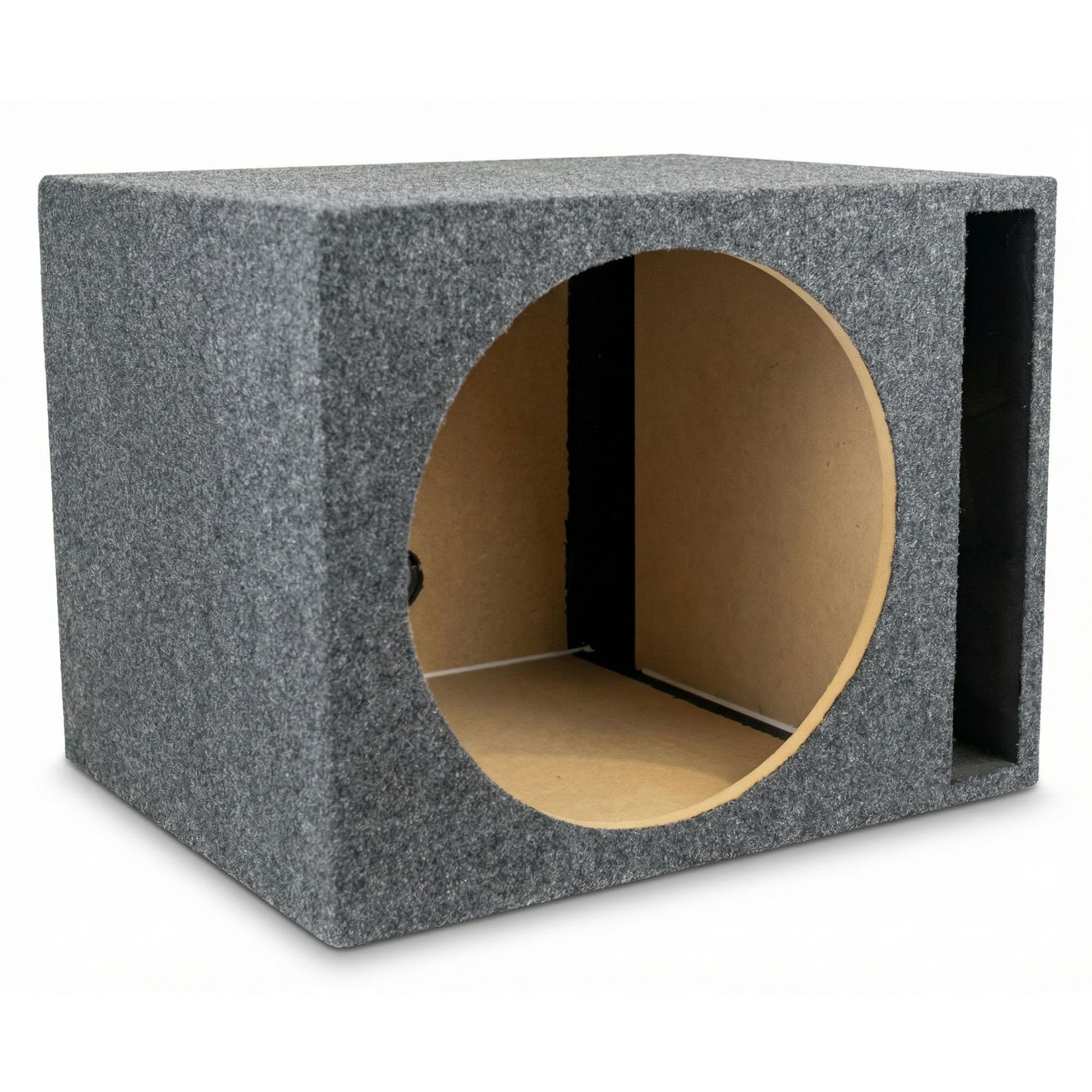
A 15-inch ported box with 2.7 cubic feet of air space that aims for maximum SPL on a budget.
This box gives your subwoofer 2.7 cubic feet of internal volume — more than three times the space of the American Sound Connection Single 10-Inch truck box (0.80 cubic feet). That generous air space lets a 15-inch subwoofer play deep and loud. The vented design further boosts bass output, making it a strong choice for someone who wants to feel the bass in their body without paying for a custom enclosure.
The box uses 5/8-inch MDF (0.625 inches) with a charcoal carpet finish. Reviewers point out the subwoofer shakes the whole car after installation and the wood quality feels good for the price. However, the 5/8-inch MDF is thinner than the 3/4-inch (0.75-inch) MDF that most high-power 15-inch subs need. One owner reported the front baffle (the panel the sub mounts to) should be 3/4 inch because a heavy 15-inch subwoofer can rip the screws out over time. Another owner reported the box started to fall apart after about two weeks of use — which suggests this is best paired with a subwoofer in the moderate power range (under about 400–500W RMS) rather than a competition-level driver.
A strange quirk owners mention: the box can let off a weird fish smell that is hard to get out of the trunk — airing it out before installation is a good idea. The cutout diameter (the hole for the sub) is 14 inches, so measure your subwoofer’s mounting flange before buying.
Output versus durability balance: For a budget-friendly 15-inch ported enclosure, the 2.7 cubic feet of air space gives genuinely deep bass. The 5/8-inch MDF is the main weak point — keep your sub’s RMS power reasonable and reinforce the screw holes with wood glue.
Best for someone who wants a low-cost 15-inch ported box with enough air space to rattle the trunk, but is not running a high-power competition sub that exceeds 500W RMS.
Think twice if you need a box that will survive years of high-power daily driving with a heavy subwoofer — the 5/8-inch MDF and reported durability issues mean it is safer for moderate builds.
4. American Sound Connection Dual 10″ Vented Subwoofer Box

A dual 10-inch ported enclosure with 1.22 cubic feet of shared air space in a wide, low-profile 32.25-inch footprint.
This box is built for two 10-inch subwoofers in a vented design — the ported slot boosts low-end output so you get more bass for the same amplifier power. The total internal air volume is 1.22 cubic feet, shared between both subs. That is a shared chamber design, which means the subs must be identical and wired correctly to avoid cancellation (where one sub’s sound wave cancels the other’s). The mounting depth is 13.75 inches, nearly the same as the Atrend Bbox 12SVSC (13.875 inches), so the same type of moderately deep subwoofer fits in both.
The box is 32.25 inches wide, making it a natural fit across the back seat of a full-size pickup or in an SUV cargo area. Shoppers say it is well built and that a pair of Rockford Fosgate P2 10-inch subwoofers sound great, hitting hard. One owner running both 12-inch and 10-inch subs in their pickup noted both boxes sounded good. A careful owner mentioned re-caulking all inside seams to prevent rattling, because the factory glue is clean but thin — a DIY bead of caulk eliminates air leaks. Speaker wire and mounting hardware are included.
At 32.25 inches wide x 12.25 inches tall x 14.5 inches deep, this box is more than a foot longer than the single 10-inch truck box — so measure your space first. It will not fit behind a standard single-cab truck seat.
Reasons to pick it
- Vented design gives two 10-inch subs boosted low-end output in a low-profile package
- Mounting depth of 13.75 inches fits most standard 10-inch subwoofers
- Buyers confirm it pairs well with Rockford Fosgate P2 subs for hard-hitting bass
Minor setup needs
- Factory glue on internal seams is thin; most owners recommend adding silicone caulk to prevent rattles
- At 32.25 inches wide, it will not fit in a standard single-cab truck behind the seat
Great for a dual 10-inch vented setup in a pickup crew cab, SUV, or trunk where you want boosted bass without spending premium dollars.
Not for tight spaces like a regular cab truck, or if you want a box that is ready to install without sealing the interior seams yourself.
5. QPower QTW12 Single 12″ Sealed Car Audio Subwoofer Sub Box Enclosures (Pair)

Two sealed 12-inch enclosures that are only 7.5 inches deep — built to slide behind a truck seat without eating cargo room.
At just 7.5 inches deep each, these boxes are made for the tight space behind a single-cab or extended-cab truck seat. Each one gives your sub 0.88 cubic feet of sealed air space. That produces tight, accurate bass — not the booming low-end of a ported box, but a punchier sound ideal for rock, metal, and hip-hop with fast kick drums. Because sealed boxes are completely closed, they handle higher amplifier power without the sub bottoming out as easily as in a ported box.
The pair costs less than many single 12-inch ported boxes, making it a strong entry-level option for adding two 12-inch subs to a truck. Buyers report the boxes fit perfectly in a 2001 Ford Ranger Edge behind the seats. The gold-tipped spring-loaded terminals hold the wire securely and resist loosening from road vibration. The main trade-off: sealed boxes naturally produce less total bass output than a vented box. One customer observed they do not give the full bass a vented box would, but they still hit hard for their size.
These are designed for shallow-mount subwoofers. One owner who tried them in a single-cab S-10 noted they do not work unless you are short, because the seat cannot slide all the way back. Measure the clearance behind your seat carefully before ordering.
Best behind-the-seat value on the list: Two 12-inch sealed enclosures that fit in spaces most ported boxes cannot go, at a price that undercuts most single ported 12-inch boxes. The sealed design gives punchy bass that rewards accuracy over boom.
Buy these for a regular cab or extended cab truck where every inch of depth matters and you want tight, accurate bass rather than the deepest sub-bass rumble.
Skip these if you need maximum low-end output for SPL competitions, or if your cab is so small that a 7.5-inch deep box will not let the seat move forward enough.
6. Single 10″ Subwoofer Regular Standard Cab Truck Sub Box Enclosure (American Sound Connection)

A slim 0.80 cubic foot sealed box that fits under the seat of a 2011 F-150 SuperCrew and many other standard cab trucks.
This ASC truck box is 20 inches wide and 15 inches tall, with a top depth of 5 inches that tapers to 7.5 inches at the bottom — proportions made to slide under most full-size pickup bench seats. The mounting depth is 5.75 inches, one of the shallowest on this list, so you need a shallow 10-inch subwoofer with a small magnet. The internal air space of 0.80 cubic feet is appropriate for a shallow 10-inch driver in a sealed setup.
Buyers confirm this box fits under a 2011 F150 FX4 SuperCrew seat (sticking out slightly) and works great with a Pioneer TS-W252R shallow sub. Another owner put it behind the bench seat of a 1990 F-150. Grilles and spring-loaded terminal cups are included. The honest limitation: the speaker terminals are described as cheaply made by some buyers, but the box itself is sturdy and the carpet looks professional. For a budget-friendly truck install where space is the tightest constraint, this box solves the fit problem better than anything else here.
Compared to the Atrend Bbox 12SVSC, this box is 4 inches wider but far shallower in depth — so it fits a completely different set of vehicle spaces: the front of a truck cab, not a trunk or SUV. It also costs less, making it a smart pick when budget and fitment are both tight.
Why truck owners love it
- Dimensions (20″W x 15″H x 7.5″D) are made to fit under or behind full-size truck bench seats
- Shallow 5.75-inch mounting depth works with slim subwoofers that fit in cabs
- Includes grille and terminals; most owners mention sturdy MDF construction
Limitations to know
- Only 0.80 cubic feet of air space — limits deep bass extension compared to larger sealed or ported boxes
- Speaker terminals are described as cheaply made by some owners
Ideal for anyone adding bass to a regular cab or extended cab truck where a low-profile box is the only practical option, paired with a shallow-mount subwoofer.
Not the right pick for someone who wants maximum output or deep sub-bass — the small sealed air space trades extension for fitment.
7. Q Power Q Bomb Series Dual 15 Inch Ported Car Subwoofer Sub Box Enclosure

The biggest box on the list — a dual 15-inch vented monster with 4.6 cubic feet of air space and 0.75-inch MDF walls.
This box gives two 15-inch subwoofers 4.6 cubic feet of internal volume — about 1.7 times the space of the single 15-inch Q Power box (2.7 cubic feet). That means the subs can move serious air and produce substantially higher low-frequency output, so you can be heard from blocks away. The MDF is 0.75 inches thick — the thickest on this list — which resists panel flex much better than 5/8-inch boxes. That matters when two large subwoofers are pushing air inside a shared vented chamber.
The dual vented chamber uses a middle slot port that is 3 inches wide and 15 inches tall, tuned to emphasize mid-bass. Customers note the box fits an Infiniti M37-S with some effort. One owner noted the box held up well for two years and held the subs better than other boxes. The black bedliner spray finish resists weather and corrosion, making it more durable than carpet in a trunk. The mounting depth is 16.5 inches — the deepest spec on this list — so it fits most 15-inch subs with large motors.
The main drawback: port tuning is on the higher side, so the very lowest sub-bass notes (below about 30 Hz) are quieter, but the punchy mid-bass around 40-50 Hz is loud. One owner mentioned the specs do not match the needs of certain 15-inch subwoofers, so check your sub’s recommended enclosure volume against this 4.6-cubic-foot design. A mild chemical smell was noted by a few buyers but faded after airing out. At 30 pounds before subs, this is a heavy box that needs a solid install.
Sheer output king: 4.6 cubic feet of ported air space with 0.75-inch MDF walls is the heaviest-duty combination here. It demands subwoofers that are happy in a medium-to-large vented enclosure and rewards with massive bass pressure.
Tuning compromise: The factory port tuning is on the higher side, so the deepest organ-pipe lows may be traded for mid-bass slam.
This is for the dedicated SPL enthusiast running two 15-inch subwoofers in a large trunk or hatchback who wants a pre-built box with thick MDF and bedliner durability.
Not for smaller vehicles where a 30-pound dual 15-inch box simply will not fit, or for listeners who prioritize sub-30 Hz frequency extension over mid-bass impact.
Understanding the Specs
Air Space (Cubic Feet)
This is the internal volume of the box — the room the subwoofer has to move air. A larger air space generally lets the sub play deeper and louder, but every subwoofer model has a specific range it needs. For example, the QPower QBomb 10-inch box gives the sub 1.4 cubic feet, while the American Sound Connection Single 10-Inch truck box gives only 0.80 cubic feet. If you put a sub that needs 1.2 cubic feet into a 0.80-cubic-foot box, the bass sounds thin and the sub may bottom out (hit the back wall).
Sealed vs Ported (Vented)
A sealed box (like the QPower QTW12) is completely closed and produces tighter, more accurate bass — punchy but not as loud on the lowest frequencies. A ported or vented box (like the QPower QBomb Dual 15) has a slot or tube that lets air escape, which boosts low-end output by about 3–6 dB (decibels — units of loudness) for the same power, making the system sound louder and deeper. The trade-off: ported boxes are larger and the bass is slightly looser. The box must also be tuned to a specific frequency to avoid damaging the subwoofer.
FAQ
Will any 10-inch subwoofer fit in a 10-inch bass speaker box?
What is the difference between 5/8-inch and 3/4-inch MDF in a subwoofer box?
How do I know if a ported box is tuned too high for my music?
Can I put a 12-inch subwoofer in a box made for a 10-inch subwoofer?
How important is the carpet or bedliner finish on the box?
Why does my new subwoofer box smell weird?
Should I add silicone caulk to the inside seams of a new box?
Can a single 15-inch box fit in a standard sedan trunk?
Final Thoughts: The Verdict
For most people, the bass speaker box winner is the Atrend Bbox 12SVSC because its airtight CNC-mitered construction and aliphatic wood glue produce cleaner low-frequency output than any other vented box in this price range — especially for sound-quality-focused 12-inch builds. If you want a compact 10-inch ported box that fits tight spaces and hits hard, grab the QPower QBOMB Single 10. And for all-out SPL with two 15-inch subwoofers in a heavy-duty 0.75-inch MDF enclosure, go with the Q Power Q Bomb Series Dual 15.
How We Picked
We do not accept paid placement. Every pick is matched to a real buyer and a real use-case; we do not hands-on test units.
Sources & Methodology
Specifications: manufacturer listings and product documentation. Review insights: verified customer reviews, as of July 2026. Pricing: not shown on this page (it changes often); check the current price via the retailer link.
As an Amazon Associate, Gadgets Feed earns from qualifying purchases. This does not affect which products we feature.
Related Guides
Product prices and availability are accurate as of the date/time indicated and are subject to change. Any price and availability information displayed on Amazon at the time of purchase will apply to the purchase of this product. As an Amazon Associate I earn from qualifying purchases.
CERTAIN CONTENT THAT APPEARS ON THIS SITE COMES FROM AMAZON. THIS CONTENT IS PROVIDED "AS IS" AND IS SUBJECT TO CHANGE OR REMOVAL AT ANY TIME.
Amazon and the Amazon logo are trademarks of Amazon.com, Inc. or its affiliates.