
Our readers keep the lights on and my morning glass full of iced black tea. As an Amazon Associate, I earn from qualifying purchases.
Specs are compiled from manufacturer listings and verified buyer reviews and can change over time — please confirm the key details on the product page before buying.
Your engine’s hardest moment is that first second of a freezing morning start, when oil has to move from a near-solid puddle to a protective film across metal parts. A 0W-30 oil is designed to flow like a thin 0-weight oil in the cold, then thicken up to a 30-weight at operating temperature — giving you easy cranking in winter and a strong film at highway heat. The confusion comes from the alphabet soup on the bottle: OEM approvals, ACEA grades, API ratings, and whether “full synthetic” actually means a Group IV base stock or just highly refined petroleum.
I’m Min — the founder and writer behind Gadgets Feed. This guide is built by comparing the manufacturers’ published specifications and the patterns across verified customer reviews, so you get each pick’s real strengths and trade-offs instead of marketing spin.
After sorting through the specs and thousands of real-world miles from verified buyers, these picks represent the safest choices for any modern engine requiring 0w-30 car oil — from European turbo saloons to high-mileage Japanese commuters.
Quick Picks
- Castrol EDGE Euro 0W-30 A3/B4 Advanced Full — Best Overall
- TRIAX Synergy SRT 0W-30 Full Synthetic — Long-Drain Champion
- LIQUI MOLY Special Tec V 0W30 Motor Oil, 5 Liter — Volvo & High-Load Spec
- Motul 8100 ECO-clean 0W-30 Motor Oil, 5 Liter — DPF & Catalyst Safe
- Pennzoil Platinum Euro LX Full Synthetic 0W-30 — Gas-to-Liquid Tech
- Mobil 1 Advanced Fuel Economy Full Synthetic — Budget Champion
- RAVENOL J1A1579-001 VSW 0W-30 Fully Synthetic — High-Mileage Specialist
How To Choose The Best 0W-30 Car Oil
Picking the right 0W-30 bottle depends on three things: what your owner’s manual approves, how you drive, and if you want a budget-friendly standard change or a premium oil that can stretch past 10,000 miles. Here is what to look for.
OEM Approvals Are Non-Negotiable
European cars especially are finicky about oil specs. If your BMW needs a Longlife-01 oil and you pour in a generic 0W-30 without that approval, you risk timing chain wear and sludge over time. Look for approvals from BMW, Mercedes-Benz (229.3/229.5), VW (502.00/505.00), or Ford (WSS-M2C950-A) printed right on the bottle. Asian and domestic cars typically follow ILSAC GF-6 or API SP standards, which are easier to find.
Short Trips vs. Long Drains
If you mostly drive short city trips in stop-and-go traffic, you want an oil with strong oxidation control and deposit resistance — every 0W-30 here handles that well because the 30-weight high-temperature rating keeps a stable film. If you routinely do long highway miles (15,000+ per year), a premium oil like the TRIAX Synergy SRT, rated for 20,000 miles, saves you money on extra changes and filters over time.
Group III vs. Group IV Base Oil
The term “full synthetic” legally covers both highly refined petroleum (Group III) and true synthetic stocks (Group IV PAO or Group V esters). For extreme cold or extended drain intervals, a Group IV-based oil (like the Castrol EDGE Euro or Motul 8100) offers better shear stability and oxidation resistance. For normal annual changes, a quality Group III like Mobil 1 delivers everything you need at a lower cost.
Quick Comparison
| Model | Best For | Volume | OEM Approvals | Drain Interval | Amazon |
|---|---|---|---|---|---|
| Castrol EDGE Euro 0W-30 Pack of 6 | European imports (BMW, Mercedes, VW) | 6 Quarts | BMW LL-01, MB 229.5, VW 502.00 | Standard (8K-12K miles) | $49.95Amazon |
| TRIAX Synergy SRT 0W-30 | Extended drain intervals (20K+ miles) | 5 Quarts | API SP, SN Plus | Up to 20,000+ miles | $48.74Amazon |
| LIQUI MOLY Special Tec V 0W30 5L | Volvo and high-load European engines | 169.05 fl oz | Volvo specific, long-life spec | Extended (long interval) | $54.22Amazon |
| Motul 8100 ECO-clean 0W-30 5L | Modern DPF/catalyst-equipped cars | 5 Liters | ACEA C2, Ford WSS-M2C950-A | Standard | $57.23Amazon |
| Pennzoil Platinum Euro LX 0W-30 6-Pack | European gas/diesel (BMW, VW, Porsche) | 1 Quart (6 Pack) | BMW, Mercedes, VW, Porsche approved | Up to 15 years / 500K miles guaranteed | $60.25Amazon |
| Mobil 1 Advanced Fuel Economy 0W-30 5 Quart | Budget-friendly daily driver | 160 fl oz | ILSAC GF-6, API SP | Up to 10,000 miles | $31.97Amazon |
| RAVENOL VSW 0W-30 1 Liter | High-mileage stable performance | 1 Liter | VW, BMW, Mercedes approvals | Extended (10K km intervals) | $28.95Amazon |
In‑Depth Reviews
1. Castrol EDGE Euro 0W-30 A3/B4 Advanced Full Synthetic Motor Oil, 1 Quart, Pack of 6

The German-made full synthetic that keeps European valve trains spotless for 170,000 miles and counting.
This Castrol EDGE Euro 0W-30 is the oil you want when your car demands a true European-spec lubricant — it meets BMW Longlife 01, Mercedes-Benz 229.5, and Volkswagen 502.00/505.00 approvals, which covers most German and Swedish engines. Buyers report that one owner’s X1 reached 170,000 miles on nothing but this oil, and when the valve cover came off for a gasket change, the engine “looked clean as new.” That cleanliness comes from a 42 percent better rating on fighting power-robbing deposits compared to conventional and synthetic blends — a number backed by the manufacturer’s data, not a guess.
Unlike many oils sold in 5-quart jugs, this comes as a 6-quart pack — so you have the exact amount for a BMW or Mercedes that takes 6.9 liters without buying an extra bottle. The 160 fluid ounces in the Mobil 1 5-quart contain 32 fewer ounces than the Castrol 6-quart’s 192 ounces, so the Castrol pack gives you more oil by volume for those European sumps that need every drop. If your engine calls for an ACEA A3/B4 oil (common in BMW N-series and Mercedes M271 engines), this is the safe, proven choice.
what separates it
- True Group IV synthetic (PAO/ester base stock) — resists shear better than Group III oils
- Meets BMW LL-01, MB 229.5, VW 502.00 — covers most modern European engines
- 6-quart pack matches the sump capacity of many German cars exactly
One Thing to Know
- Rated for standard intervals (8,000-12,000 miles) — not as extreme as the 20,000-mile TRIAX below
Reach for this if: You drive a BMW, Mercedes, or VW that needs a BMW LL-01 or MB 229.5 oil — this is the gold standard for long-term cleanliness.
Look elsewhere if: Your car only needs a basic API SP oil and you want to pay less per quart — the Mobil 1 below will do the same job for less.
2. TRIAX Synergy SRT 0W-30 Full Synthetic, Friction Modified Engine Oil, 5 Quart
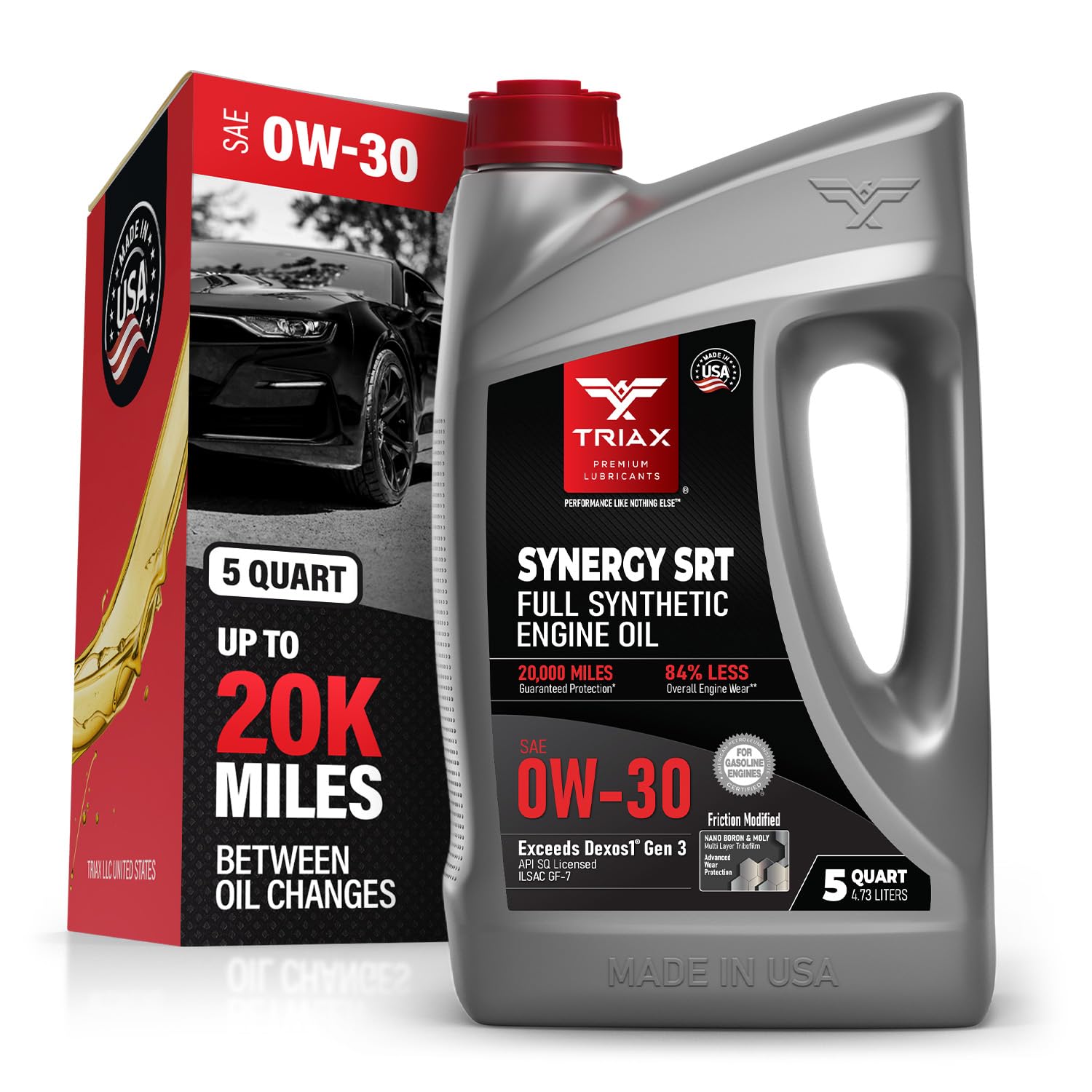
The PAO-based oil that promises 84% less wear than industry standards and backs it with Nano Boron and Moly friction modifiers.
TRIAX Synergy SRT is not your typical off-the-shelf 0W-30. It is a true synthetic (PAO-based, not Group III) packed with Nano Boron and Moly friction modifiers that reduce metal-on-metal contact at startup. The manufacturer claims this oil delivers up to 84 percent less wear than API and OEM performance standards — a spec that matters most during that first second of a cold start. A reviewer running this in a 2018 Nissan Maxima (300 horsepower) reports that the TRIAX improves throttle response and smoothness and that the engine “runs slightly faster” — a subjective but consistent pattern across multiple user reports.
The biggest practical advantage here is the extended drain interval: up to 20,000+ miles or 2 years between changes. That alone saves you the cost of two extra oil changes and two filters over the same period, so the higher upfront price per 5-quart jug starts to look like a value play for high-mileage drivers. Where the Castrol pack above holds 6 quarts, this TRIAX comes as a 5-quart jug, but the extended interval means you change it half as often. If you run a truck or SUV that also needs sludge prevention for up to 250,000 miles, this oil’s 50 percent less deposit formulation than OEM specs gives extra confidence.
The Big Wins
- Up to 20,000+ mile drain interval — change oil half as often as standard synthetics
- True PAO synthetic with Nano Boron and Moly for 84% less wear than API standards
- Sludge prevention rated for 250,000 miles — ideal for long-term ownership
The Trade-Off
- Bottle says API SP and GF-6A — some owners mention it is labeled GF-6A rather than the newer GF-7 they expected
Best suited for: Drivers who pile on 15,000+ highway miles a year and want the lowest per-mile oil cost with maximum wear protection.
Who should skip it: If you change oil annually regardless of miles and prefer a cheaper bottle that meets basic API SP specs — the Mobil 1 is a better fit.
3. LIQUI MOLY Special Tec V 0W30 Motor Oil, 5 Liter

A German-engineered oil for Volvos and high-stress turbos that still looks clean after 5,000 miles.
LIQUI MOLY’s Special Tec V 0W30 was developed primarily for Volvo models with the latest multivalve and turbocharged engines, but it also suits any gasoline or diesel engine that needs a high-quality 0W-30 with long-change capability. One buyer drove 5,000 miles, drained the oil, and noted that it “still looked fairly clean” — a sign of strong oxidation resistance that matters for those who push oil to longer intervals.
This oil handles diesel particle filters (DPF) and intercooling systems thanks to its low-SAPS formulation. If you drive a modern turbocharged car that spends time in stop-and-go traffic or high-load highway cruising, the viscosity stability at operating temperature keeps a protective film even when the engine is working hard. Unlike the Castrol EDGE above, which is a heavier A3/B4 viscosity, the Special Tec V is tune for Volvo’s specific demands — but it works broadly across any European car that accepts a 0W-30 long-life oil.
Why It Stands Out
- Volvo-spec formulation with broad European compatibility
- 5-liter (169.05 fl oz) jug holds more than standard 5-quart bottles (160 fl oz)
- Strong oxidation resistance — buyer reports oil still clean at 5,000 miles
Minor Catch
- Harder to find in US stores compared to Mobil 1 or Castrol — best ordered online
Ideal for: Volvo owners or anyone driving a European turbo that benefits from a long-life, low-SAPS oil with German quality standards.
Not for you if: Your car simply needs a basic ACEA A3/B4 0W-30 without any specific Volvo requirement — the Castrol EDGE is more universally approved.
4. Motul 8100 ECO-clean 0W-30 Motor Oil, 5 Liter

A 100% synthetic ACEA C2 oil that protects your DPF and catalytic converter while reducing internal friction.
If your car has a diesel particulate filter (DPF) or a sensitive catalytic converter, you need a low-SAPS oil — one with reduced Sulfated Ash, Phosphorus, and Sulfur that won’t clog those expensive emissions parts. Motul 8100 ECO-clean is an ACEA C2 oil with Mid SAPS technology, which means it meets the strict emissions-system requirements of modern European engines while still delivering the 0W-30 cold flow you need for winter starts. A buyer who switched to this oil in a Veloster N noted a “smoother ride” immediately after the change — consistent with the low-friction characteristics of a true 100% synthetic base oil.
Motul is among the few brands that advertise this as a “100% synthetic” oil (Group IV/V base) rather than the “full synthetic” label that often masks a Group III petroleum stock. The 5-liter jug gives you 169 fluid ounces, enough for most European engines with a 5-liter sump. It also carries Ford WSS-M2C950-A approval, making it a solid match for Ford EcoBoost engines that need a C2-spec oil. Compared to the Castrol EDGE above (which is an A3/B4 oil), this Motul is a lighter Mid SAPS formulation — so it is better for emissions equipment but slightly less sturdy for extreme high-load conditions.
Key Strengths
- ACEA C2 Mid SAPS — safe for DPF and catalytic converter systems
- 100% synthetic (Group IV/V) — better thermal stability than Group III oils
- Ford WSS-M2C950-A approved — works for EcoBoost and Jaguar/Land Rover engines
Limitation
- Mid SAPS means less sturdy high-load protection compared to a full A3/B4 oil — not for track use
You want this if: Your car has a DPF, a catalytic converter, or requires an ACEA C2 oil — especially Ford EcoBoost, Jaguar, or Peugeot/Citroën diesel engines.
skip it if: Your car needs an ACEA A3/B4 high-SAPS oil for older engines that don’t have DPF systems — the Castrol EDGE is the better match.
5. Pennzoil Platinum Euro LX Full Synthetic 0W-30 Motor Oil, 1 Quart (6 Pack)
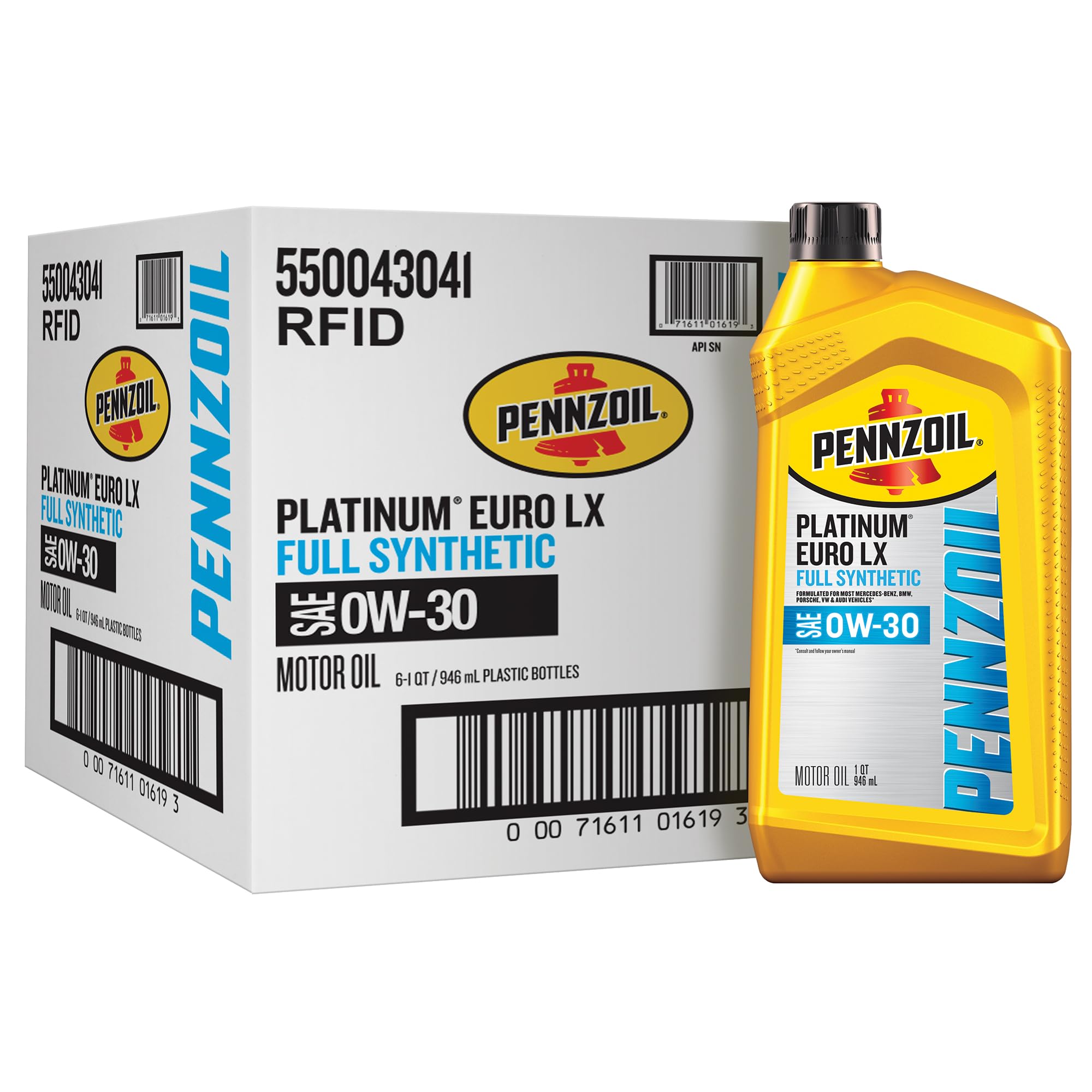
A natural-gas-derived synthetic that guarantees protection for up to 15 years or 500,000 miles.
Pennzoil Platinum Euro LX is made from natural gas using Shell’s Gas-to-Liquid (GTL) process, which produces a base oil that is purer than crude-derived synthetics — fewer impurities, better thermal stability, and a naturally higher viscosity index. This oil is formulated for high-performance diesel and gasoline engines in European vehicles including Fiat, BMW, Mercedes-Benz, Porsche, and VW. One buyer who ran a used-oil analysis after 8,000 miles in a VW Atlas was told the oil “looks great and could be ran even longer” — strong third-party validation for the 15-year/500,000-mile protection guarantee printed on the bottle.
The Euro LX 0W-30 delivers faster low-temperature flow than a typical 5W-30 (meaning less starter strain at -20°F) while maintaining a thick film at extreme heat. The 6-pack of 1-quart bottles lets you measure exactly what your engine needs without pouring from a heavy jug — useful for cars that take an odd number of quarts. Compared to the Castrol EDGE above, which uses a PAO/ester base stock, this Pennzoil relies on the GTL process, which some purists argue is still technically a Group III base oil. In practice, the performance and cleanliness results from thousands of user reports are indistinguishable from a Group IV synthetic for normal driving.
What Impresses
- Made from natural gas (GTL process) — purer base oil with fewer impurities than crude-derived synthetics
- 15-year/500,000-mile protection guarantee — among the longest in the category
- BMW, Mercedes, Porsche, and VW approved — covers almost every major European brand
Fair Warning
- 1-quart bottles mean you pay for packaging — a 5-quart jug would be more convenient for bulk buyers
Choose this for: A European car that needs a trusted, widely available full synthetic with an unbeatable mileage guarantee — especially for VW, BMW, and Porsche owners.
Pass if: You prefer a Group IV PAO synthetic for extreme track use or very long drain intervals beyond 10,000 miles — the TRIAX or Castrol EDGE may suit you better.
6. Mobil 1 Advanced Fuel Economy Full Synthetic Motor Oil 0W-30, 5 Quart

The affordable workhorse that keeps your engine running smoother, quieter, and protected for up to 10,000 miles.
Mobil 1 Advanced Fuel Economy 0W-30 is the entry-level premium choice — priced to compete but still bearing Mobil 1’s “Triple Action Formula” for performance, protection, and cleanliness. It is a low-viscosity oil designed to improve fuel economy while meeting ILSAC GF-6 standards, which means it offers low-speed pre-ignition (LSPI) protection for modern turbocharged engines and timing chain wear protection. One reviewer running it in a 2014 Honda CR-V with 150,000 miles (originally a 0W-20 car) reported a smoother-running engine with better high-temp viscosity protection for a high-mileage Asian engine — a common swap for older Japanese cars that benefit from slightly thicker oil.
Buyers consistently note that this oil makes engines “run smoother and quieter, especially on cold starts” — a claim backed by the 0W winter grade that flows almost like water at freezing temperatures. The flash point of 226 degrees Celsius means it resists burning off even under sustained highway heat. At 160 fluid ounces per 5-quart jug, it offers 32 fewer ounces than the Castrol EDGE 6-quart pack above, so if your engine takes a full 6 quarts, you will need to buy an extra bottle. But for most Japanese and American cars that take exactly 5 quarts, this is the most cost-effective pick on the list.
Why It Works
- Excellent cold-start protection — customers note quieter, smoother starts in winter
- ILSAC GF-6 certified — includes LSPI and timing chain wear protection for modern engines
- 226°C flash point — resists evaporation at high operating temperatures
The Shortfall
- Limited to standard 10,000-mile intervals — not ideal for high-mileage drivers wanting extended drains
Perfect for: Daily drivers of Asian or American cars that need a reliable, affordable 0W-30 for standard 5,000-10,000 mile oil changes.
Not ideal if: Your European car demands a specific OEM approval (BMW LL-01, MB 229.5) — the Castrol EDGE or Pennzoil Euro LX covers those requirements.
7. RAVENOL J1A1579-001 VSW 0W-30 Fully Synthetic Motor Oil, 1 Liter

A shear-resistant German oil that one user ran for 200,000 kilometers with zero oil consumption.
RAVENOL VSW 0W-30 uses USVO technology — a formulation designed to be extremely shear-resistant so the oil maintains its viscosity grade even under high mechanical stress. That matters if you drive a turbocharged car that hammers the oil film every time the boost comes on. One reviewer noted using this RAVENOL for approximately 200,000 kilometers with 10,000 km change intervals, and the engine ran “clean and reliably” with “zero oil consumption” over that whole distance — an extraordinary real-world endurance data point for a single-liter bottle.
The 1-liter size is both an advantage and a limitation. It is perfect for topping off between changes or for engines that take odd volumes (some VW and BMW engines need exactly 4.2 or 5.7 liters, and buying a single liter avoids waste). But if you need a full 5-quart oil change, this means buying five separate bottles. The RAVENOL also extends diesel particulate filter (DPF) life thanks to its low-ash formulation — a spec shared with the Motul 8100 above, but in a smaller, top-up-friendly package. It carries approvals for VW, BMW, and Mercedes engines, making it a versatile spare to keep in the trunk.
Standout Features
- USVO technology — extremely shear-resistant, maintains viscosity under turbo loads
- Proven 200,000 km reliability with zero oil consumption from a real user
- DPF-friendly low-ash formulation — protects diesel particulate filters
Practical Catch
- 1-liter bottle only — you need to buy multiple units for a full oil change, which adds packaging waste
Best used as: A top-up bottle for high-mileage European turbos, or as the main oil if your engine needs exactly 5 liters and you can buy a case of five.
pass on it if: You want a single 5-quart jug for convenience and lower per-quart cost — the Mobil 1 or Castrol is a better value for full changes.
Understanding the Specs
SAE 0W-30 Viscosity — What the Numbers Mean
A 5W-30 oil, in contrast, starts to thicken at a higher temperature, meaning more engine wear during those first seconds of a winter start. The “30” is the hot operating grade: at 100°C (212°F), the oil has a viscosity range of 9.3 to 12.5 centistokes, which is thick enough to protect bearings and camshafts but thin enough to flow through modern variable-valve-timing systems. Most newer European and Asian engines are designed around this 0W-30 balance for fuel economy and cold-start protection.
ACEA A3/B4 vs. ACEA C2 vs. API SP
ACEA A3/B4 is a high-performance, high-SAPS (Sulfated Ash, Phosphorus, Sulfur) oil meant for older European engines without DPF systems — think pre-2010 BMWs and Mercedes. ACEA C2 is a mid-SAPS oil designed for modern engines with diesel particulate filters and catalytic converters; the lower ash content keeps those parts from clogging over time. API SP is the latest American standard and includes low-speed pre-ignition (LSPI) protection for turbocharged gasoline engines. Using an A3/B4 oil in a car that requires C2 can clog the DPF, while using a C2 oil in an older engine that needs A3/B4 may not provide enough high-load protection. Always match the ACEA or API spec to what your owner’s manual states.
FAQ
Can I use 0W-30 instead of 5W-30 in my engine?
Is 0W-30 the same as 0W-20?
How often should I change 0W-30 synthetic oil?
What does BMW Longlife-01 approval mean?
Can I mix 0W-30 with 5W-30 or another viscosity?
Does 0W-30 improve fuel economy compared to thicker oils?
What cars require 0W-30 specifically?
Is more expensive 0W-30 always better?
What does the “5 Quart” or “5 Liter” volume mean for my oil change?
Can I use 0W-30 in a high-mileage car that used 10W-30?
Final Thoughts: The Verdict
Across the board, the 0w-30 car oil winner is the Castrol EDGE Euro 0W-30 Pack of 6 because it delivers a true Group IV synthetic with BMW, Mercedes, and VW approvals in a convenient 6-quart pack that matches European sump capacities exactly. If you drive 15,000+ highway miles a year and want to stretch oil changes to 20,000+ miles, grab the TRIAX Synergy SRT 0W-30 for its advanced Nano Boron friction modifiers and exceptional wear protection. And for a budget-friendly daily driver that keeps your engine quieter on cold starts, the standout is the Mobil 1 Advanced Fuel Economy 0W-30.
How We Picked
We do not accept paid placement. Every pick is matched to a real buyer and a real use-case; we do not hands-on test units.
Sources & Methodology
Specifications: manufacturer listings and product documentation. Review insights: verified customer reviews, as of July 2026. Pricing: not shown on this page (it changes often); check the current price via the retailer link.
As an Amazon Associate, Gadgets Feed earns from qualifying purchases. This does not affect which products we feature.
Related Guides
Product prices and availability are accurate as of the date/time indicated and are subject to change. Any price and availability information displayed on Amazon at the time of purchase will apply to the purchase of this product. As an Amazon Associate I earn from qualifying purchases.
CERTAIN CONTENT THAT APPEARS ON THIS SITE COMES FROM AMAZON. THIS CONTENT IS PROVIDED "AS IS" AND IS SUBJECT TO CHANGE OR REMOVAL AT ANY TIME.
Amazon and the Amazon logo are trademarks of Amazon.com, Inc. or its affiliates.