
Our readers keep the lights on and my morning glass full of iced black tea. As an Amazon Associate, I earn from qualifying purchases.
Specs are compiled from manufacturer listings and verified buyer reviews and can change over time — please confirm the key details on the product page before buying.
The real enemy in a woodshop is the cloud of dust you can see floating in a beam of light after a single cut — not just the mess on the floor. An air dust collector pulls that invisible cloud out of your breathing space, so you can work longer without coughing or sneezing through a mask.
I’m Min — the founder and writer behind Gadgets Feed. This guide is built by comparing the manufacturers’ published specifications and the patterns across verified customer reviews, so you get each pick’s real strengths and trade-offs instead of marketing spin.
To pick the right air dust collector, you need to match airflow, filter efficiency, and shop size. This guide walks you through every spec that actually matters.
Quick Picks
- DeWALT DWXAF101 Air Filtration System — Best Overall
- WEN DC1300 1,300 CFM Dust Collector — Heavy Duty
- ABESTORM DecDust 1350IG Air Filtration System — Overhead Power
- ALORAIR Purecare 1350IG Air Filtration System — Value Scrubber
- PSI Woodworking DC725 Portable Tabletop Dust — Tabletop
- SHOP FOX W1727 1 HP Portable Dust Collector — Shop Classic
- WEN DC3474 7.4-Amp Induction Motor Dust — Quiet Runner
- WEN DC3401 5.7-Amp Portable Dust Collector — Compact Starter
How To Choose The Best Air Dust Collector
Picking an air dust collector is less about the price tag and more about the size of your space and how fine the dust is that you create. A collector that recirculates the air in a small garage four times an hour will feel underpowered in a large workshop. A unit with a coarse filter bag might still let dangerous microscopic particles float right back into your lungs.
Match Airflow (CFM) to Your Shop’s Square Footage
CFM (cubic feet per minute) is how much air the unit moves. A rough rule: you want the collector to cycle your shop’s total air volume at least four times per hour. For a 20-by-20-foot garage with 10-foot ceilings (4,000 cubic feet), that is about 267 CFM minimum. But most buyers report that a unit pushing 1,000 CFM or more clears the visible haze much faster.
Filter Type: The Difference Between Clean Air and Clean-Looking Air
A standard 5-micron collection bag catches larger chips and coarse dust you can see on the floor, but it lets fine particulate pass through — the stuff that floats in the air and irritates your lungs. A MERV-11 filter (which captures 90% of particles 3 to 10 microns) or a HEPA filter (which grabs 95% of particles as small as 0.3 microns) does the real breathing protection work. Many units let you upgrade the filter later, but some come ready with a two-stage system.
Portability vs. Permanence
Portable collectors on casters let you roll the unit to the tool and hook a 4-inch hose directly to the dust port. Hanging air filtration systems mount to the ceiling and work as ambient air scrubbers — they clean the whole-room air rather than capturing dust at the source. A small shop with a single table saw might prefer the portable approach, while a larger shop running multiple tools often combines a ceiling-mounted unit with a separate dust collector connected via ductwork.
Quick Comparison
| Model | Best For | Airflow (CFM) | Filtration | Capacity | Amazon |
|---|---|---|---|---|---|
| DeWALT DWXAF101 | Smart auto-mode ceiling filtering | — | 2-stage + HEPA H11 | — | Amazon |
| WEN DC1300 | High-volume 2-tool direct collection | 1,300 CFM | 5-micron bag | 50 gallons | Amazon |
| ABESTORM 1350IG | Large-shop overhead hanging scrubber | 1,350 CFM | MERV-11 | — | Amazon |
| ALORAIR Purecare 1350IG | Ionizer-equipped whole-room cleaning | 1,350 CFM | MERV-11 | — | Amazon |
| PSI Woodworking DC725 | Tabletop close-to-the-work collection | 725 CFM | 2x10x20 filter | — | Amazon |
| SHOP FOX W1727 | Mid-size portable dust collection | 800 CFM | 2.5-micron bag | — | Amazon |
| WEN DC3474 | Quiet rolling collector with big bag | 600 CFM | 5-micron bag | 15 gallons | Amazon |
| WEN DC3401 | Compact portable collector | 660 CFM | 5-micron bag | 12 gallons | Amazon |
In‑Depth Reviews
1. DeWALT DWXAF101 Air Filtration System

This ceiling-mounted air scrubber uses a built-in sensor to ramp up its fan automatically when the air gets dirty — you never have to touch a switch mid-project.
The DeWALT DWXAF101 takes the guesswork out of air cleaning with four working modes, including an AUTO mode that uses a sensor to detect air quality and automatically switch between fan speeds. This means you do not have to flip a switch every time you fire up a sander. It hangs from the ceiling using the included hooks and chains, saving every inch of valuable floor space.
Owners mention that it drastically reduces fine dust in their garage, and one owner mentioned it even eliminated rabbit hay dust, stopping his sneezing. The 2-stage filtration pairs a washable pre-filter with an H11 HEPA filter, capturing over 95% of particles as small as 0.3 microns — a level of fine-particle protection that beats most 5-micron bag-only systems. The built-in timer lets you set it for 1, 2, 4, or 8 hours so it keeps cleaning after you walk away.
A few users note that the IR remote (infrared remote control, which needs a direct line of sight) can be unresponsive from across the room. At 20.9 pounds and a noise rating of 64 decibels, it is light enough for one person to install and quieter than a typical conversation.
Why It Stands Out
- Auto mode senses air quality and adjusts fan speed automatically
- HEPA H11 captures over 95% of 0.3-micron particles
- Timer settings (1H / 2H / 4H / 8H) for post-work cleaning
- Washable pre-filter reduces long-term costs
A Few Drawbacks
- IR remote needs direct line of sight to work
- No floor stand included for non-ceiling setups
Ideal for: Woodworkers who want a set-and-forget ceiling filter that reacts to air quality in real time, especially those with dust-sensitive household members.
Heads-up: If your shop has no ceiling mounting option, you will need to build or buy a floor stand.
2. WEN DC1300 1,300 CFM Dust Collector

This high-volume portable collector hooks two tools at once and holds 50 gallons of dust — far more than the smaller WEN DC3401’s 12-gallon bag before you empty it.
When your shop has a planer and a table saw running in the same session, the WEN DC1300 makes it easy with dual 4-inch air inlets that let you attach up to two tools simultaneously. Airflow reaches 1,300 CFM (cubic feet per minute) thanks to a 14-amp motor spinning a 10-inch steel impeller at 3,450 RPM — enough to reach farthest corners of a mid-sized shop. The 50-gallon collection bag means fewer trips to the trash can than the 15- or 12-gallon bags on smaller WEN units.
Customers note that it captures 99% of table saw dust and 85% of bandsaw dust in practice, and one reviewer noted it connected to his existing dust collection network without issue. The wheeled mobile base makes it easy to roll out of the way, though some owners note the vertical support arms feel slightly flimsy and the upper bag arm is not adjustable. Noise is moderate — manageable with standard ear protection.
Volume champion: The 50-gallon bag dwarfs nearly every other portable in this guide, so you can run heavy production without stopping to empty the bag. A few users mention the instruction manual is poor, so expect some trial-and-error assembly.
Best suited for: Serious woodworkers running multiple tools in a dedicated shop who want high CFM and huge collection capacity without upgrading to a permanent ducted system.
Trade-off: The 5-micron bag catches chips well but lets fine dust through; a canister filter upgrade is a common owner mod.
3. ABESTORM DecDust 1350IG Air Filtration System
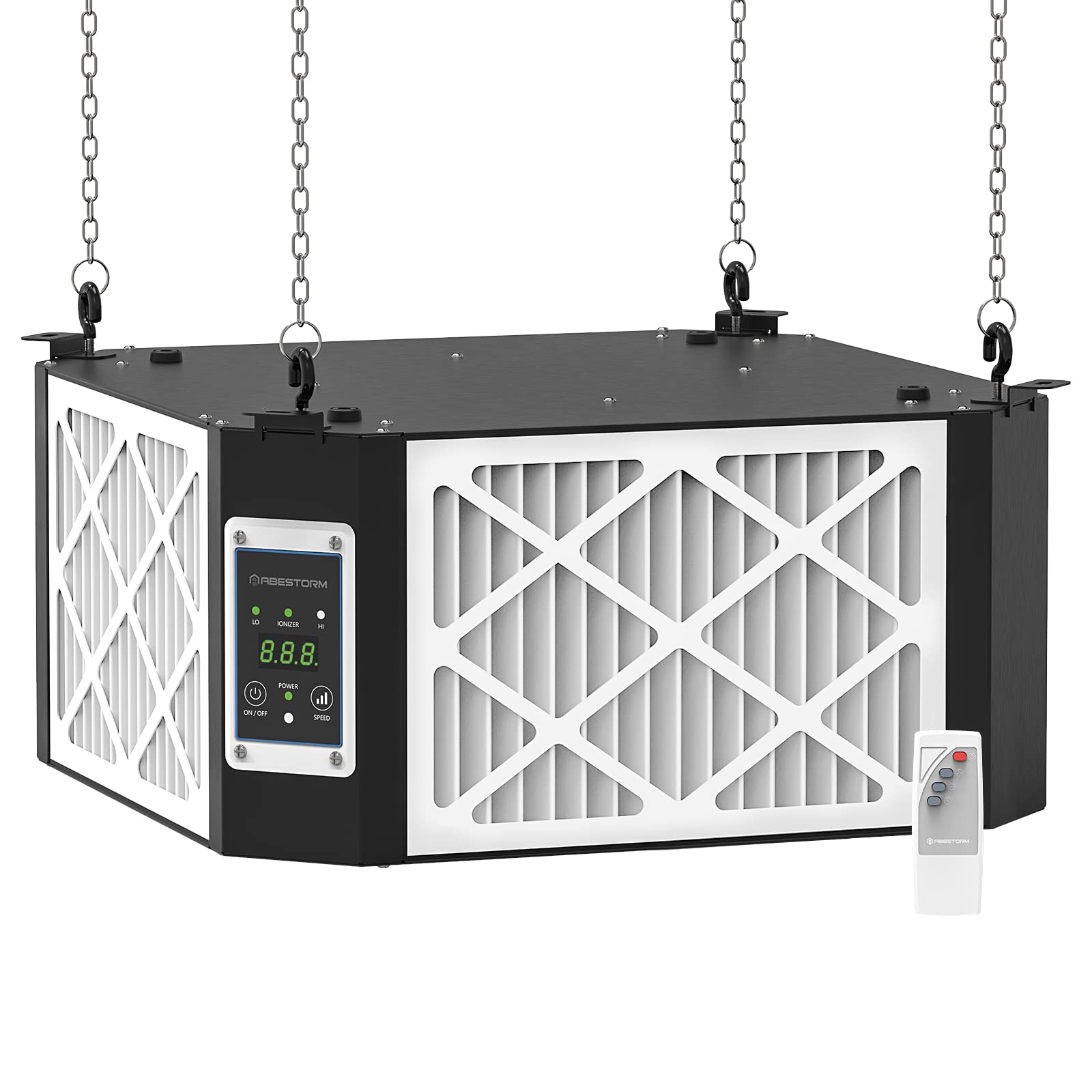
This ceiling-hung air scrubber moves 1,350 CFM through a 360-degree intake and a built-in ionizer — and comes with 4 replacement MERV-11 filters from the start.
It hangs from the ceiling using the included mounting hardware, pulling air from every direction through its 360-degree intake design. The built-in ionizer generates positive and negative ions to help clump tiny particles together so the MERV-11 filter can catch them more effectively.
Reviewers point out that it does a great job cleaning a 22×24 shop of sawdust, though several mention the noise rating of 60 to 69 dB is noticeable — one reviewer rated it 7 out of 10 for loudness. The remote control works from up to 27 feet away, and the unit comes with 4 replacement MERV-11 filters that the manufacturer says should last 2-4 months each. One owner had a defective first unit, but the customer service team sent a replacement part with an instructional video and later swapped the entire unit with a prepaid return.
Room-filling airflow: At 1350 CFM it cycles the air in a standard two-car garage in minutes, and the MERV-11 filter catches 90% of particles between 3 and 10 microns. Some buyers on a budget note they could have bought a smaller unit for their space, so measure your shop before pulling the trigger.
Ideal for: Owners of large garages or workshops up to 1,700 square feet who want a ceiling-mounted system that moves serious air volume.
Keep in mind: It is louder than some smaller units, and it cannot be shipped to California due to state regulations.
4. ALORAIR Purecare 1350IG Air Filtration System

This hanging air cleaner uses a strong vortex fan to keep suction up as the filter catches dust, plus a timer that shuts itself off after up to 9 hours.
The ALORAIR 1350IG uses the same 360-degree intake concept and 1350 CFM peak airflow as the ABESTORM above, but it comes in a slightly more budget-friendly package. The strong vortex fan (a fan design that keeps high static pressure even when the filter traps a lot of fine dust) ensures airflow does not drop off as the filter loads up. The timer cycle controller lets you set the fan to run for 1 to 9 hours and shut down automatically — useful for clearing the air after you leave the shop.
Shoppers say it cleans a two-car garage woodshop great, and one owner mentioned it even removed garbage odors as an unexpected bonus. The noise level (60 to 69 dB) gets mixed feedback: some call it acceptable, while others find a high-pitched frequency annoying enough to discourage frequent use. The built-in ionizer and MEVR 11 filter (equivalent to MERV-11) catch 90% of 3-10 micron particles, a solid step up from a basic 5-micron bag.
Timer convenience: The 1-9 hour auto shut-off is rare at this price, letting you walk away and return to clean air without wasting electricity. A few buyers noted the remote signal can be finicky if you are not pointing directly at the unit.
Best for: Budget-conscious woodworkers who want a ceiling-mount air scrubber with enough CFM for a two-car garage and the convenience of a programmable timer.
Watch out for: The high-pitched hum bothers some users more than the volume itself — try to hear it running before buying if possible.
5. PSI Woodworking DC725 Portable Tabletop Dust Collector
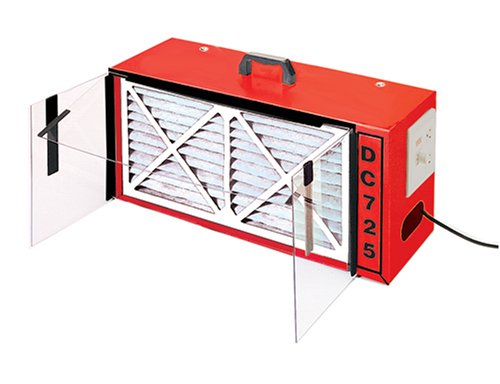
This compact bench-top unit uses three computer-grade fans to pull dust directly away from small carving projects, at a maximum 725 CFM.
The PSI Woodworking DC725 is different from rolling bag collectors — it sits on your workbench and pulls dust right from the source using three quiet, maintenance-free fans. Maximum airflow hits 725 CFM, and a variable-speed knob lets you dial the suction up or down depending on whether you are carving, sanding, or woodburning. The adjustable clear polycarbonate top hood and side doors let you direct the airflow exactly where the dust is flying.
Buyers report it works great with Dremel carving tools and a Ram BP50 power carver, with noise comparable to an air vent in the next room. One owner had a different experience: the unit arrived with a detached blade and required disassembly and repair before it worked. The filter included is an odd-sized 2-by-10-by-20-inch unit that some reviewers describe as cheap and easily crushed, with replacements costing more than you might expect.
What Works Well
- Variable speed control adjusts airflow to the task
- Quiet enough to use next to you without earplugs
- Includes two grounded 115V outlets on the side panel for your tools
What to Check
- Some units arrive with assembly defects (blade detachment reported)
- Proprietary filter size is expensive to replace
Perfect for: Detail woodworkers, carvers, and turners who work close to the bench and want a compact, quiet, variable-speed unit that sits right next to their project.
Consider first: Inspect the unit immediately on arrival and test all fans — out-of-box defects are a recurring theme in buyer reviews.
6. SHOP FOX W1727 1 HP Portable Dust Collector

This time-tested portable collector runs on standard 120V power and uses 2.5-micron bags — finer than the 5-micron bags on the WEN portable units, so it catches more fine airborne dust.
The SHOP FOX W1727 has been a staple in small shops for years — one buyer mentioned still running strong after five years and about 100 hours of use. It pushes 800 CFM through a 1 HP motor that draws 9 amps at 120 volts (or 4.5 amps at 240V), so it is happy on a standard 20-amp household circuit without special wiring. The 2.5-micron top filter bag is significantly finer than the 5-micron bags on the WEN units, meaning it catches more of the fine airborne dust that settles into your lungs.
Owners mention it captures roughly 99% of heavy and fine dust from cabinet and miter saws, and one owner measured it at 82.5 dB compared to his 102.5 dB shop vac — a meaningful noise drop. The mobile base is sized at 15-3/4 by 39-3/4 inches and rolls easily, and the floor-level vacuum port lets you suck up debris without swapping hoses. A few owners note that if you feed larger debris into it, the fan can clog and requires removing 12 screws to open for cleaning.
Long-Term Value
- Durable build with owners reporting years of reliable service
- 2.5-micron filtration catches finer dust than 5-micron bags
- Runs on standard 120V household power
Power Limits
- 800 CFM may be low for a CNC router or large planer (some customers note 70% chip pickup)
- Fan access requires removing 12 screws for cleaning clogs
Ideal for: Small-shop owners who want a reliable entry-level portable collector with better-than-basic bag filtration and a proven track record.
The catch: At 800 CFM it is on the lower end for bigger tools; consider adding a chip separator (a mesh screen or vortex bucket) to keep the fan from clogging.
7. WEN DC3474 7.4-Amp Induction Motor Dust Collector

A rolling collector with a quiet 7.4-amp induction motor that reviewers point out is quieter than their planer at 72 dB — but its stock 5-micron bag leaks fine dust.
The WEN DC3474 is the bigger sibling of the DC3401 — it has a 7.4-amp induction motor (at 7.4 amps versus the DC3401’s 5.7 amps) driving a 9-inch impeller for 600 CFM of airflow. The 15-gallon collection bag holds 3 more gallons than the 12-gallon DC3401, though the unit itself weighs 41.1 pounds (at 41.1 pounds versus the DC3401’s 17 pounds) and occupies a larger footprint at 43.3 x 17.7 x 20.1 inches. Buyers praise the quiet operation: one reviewer measured it at 72 dB and said it had good suction with no clogging from hardwood chips.
Some shoppers say a real shortcoming — the stock 5-micron collection bag leaks fine dust that becomes visible under a flashlight beam. Several buyers upgraded to a DustRight 5-micron bag (thicker material, no visible dust leakage) or a canister filter. The handle attaches to sheet metal that flexes, and a few users found the suction weaker than a Craftsman 16-gallon shop vac for chip pickup, though fine dust collection was acceptable.
Quiet vs. clean: At 72 dB it is genuinely less intrusive than a shop vac, but the stock bag’s fine-dust leakage is a known issue. Owners who swapped the bag give it a 5-star review; those who did not call it a 4-star or lower.
Best suited for: Small-shop woodworkers who prioritize quiet operation and are willing to spend a little extra on a better filter bag immediately.
Plan for: Budget for a 5-micron or finer replacement bag right away — the stock bag lets visible fine dust escape during use.
8. WEN DC3401 5.7-Amp Portable Dust Collector

This lightweight 17-pound collector rolls to the tool and draws 660 CFM through a 4-inch dust port — the smallest and most portable rolling unit in this guide.
The WEN DC3401 is the entry-level rolling collector here, weighing just 17 pounds and measuring 34.25 x 13 x 14.2 inches — compact enough to tuck under a workbench. The 5.7-amp brushed motor moves 660 CFM through a 4-inch port, and the 12-gallon 5-micron zippered collection bag handles the chips. The lockable swivel casters and onboard carrying handle make it easy to move, and the optional wall mount saves floor space entirely.
Buyer reviews are genuinely split. Several owners say it worked great on their planer and table saw for two weeks, then stopped working — one had a faulty switch that the company replaced under warranty, another reported a motor bearing failing after 9 months. On the positive side, owners who paired it with an Oneida cyclone separator and a proper 4-inch hose say the suction beats popular shop vac brands. The wall-mountable design is a space saver, and one owner reported it works well with a dust separator when you avoid right-angle connectors.
High Points
- Lightest rolling collector at 17 pounds with carrying handle
- Wall-mountable to free up floor space
- 660 CFM is strong enough for a planer and table saw with proper hose
Reliability Concerns
- Multiple reports of motor or switch failure within weeks to months
- Suction drops noticeably with smaller hoses (e.g., orbital sander)
- 5-micron bag lets fine dust through, similar to the DC3474
Great for: Beginners or small-shop users on a tight budget who need a compact, portable, wall-mountable collector for occasional use with a single tool.
Be ready for: Reliability is a roll of the dice — a few units fail early, so check the warranty (2 years) and test it immediately on arrival.
Understanding the Specs
CFM — How Much Air Gets Moved
CFM stands for cubic feet per minute, and it is the single most important number for an air dust collector. It tells you how much air the unit can pull through the filter every 60 seconds. A unit with 1,350 CFM (like the ABESTORM or ALORAIR) will cycle the air in a 400-square-foot garage roughly every 2 minutes, while a 660 CFM unit like the WEN DC3401 takes longer (at 660 CFM versus 1,350 CFM). Higher CFM clears the visible dust haze faster, but it also tends to mean a louder fan and a larger filter surface area.
Filter Micron Rating and MERV Classes
The micron rating tells you the smallest particle size the filter is designed to trap. A 5-micron bag (common on entry-level portable collectors) catches sawdust chips and coarse dust, but it lets particles smaller than 5 microns — the ones you cannot see but can inhale deep into your lungs — pass straight through. MERV-11 filters capture 90% of particles between 3 and 10 microns, and HEPA H11 filters go further, trapping over 95% of particles as small as 0.3 microns. If you do frequent sanding or work with MDF (which creates very fine dust), a MERV-11 or HEPA filter is a meaningful upgrade for your breathing health.
Motor Amps vs. Actual Airflow
More amps does not always mean more airflow. A 14-amp motor on the WEN DC1300 moves 1,300 CFM, while a 7.4-amp motor on the WEN DC3474 moves only 600 CFM — but the real comparison is between impeller design and motor efficiency. The SHOP FOX W1727 uses a 1 HP motor drawing 9 amps to produce 800 CFM, which is less efficient than the PSI DC725’s 1.29 total amps producing 725 CFM through three separate fans. Look at the CFM number, not the amp rating, when comparing raw suction strength.
Ceiling-Mount vs. Portable Rolling
Ceiling-mounted air filtration systems (like the DeWALT DWXAF101, ABESTORM, and ALORAIR) hang overhead and act as ambient air scrubbers — they clean the whole-room air but do not connect directly to your tools. Portable rolling collectors (like the WEN and SHOP FOX models) attach via a 4-inch hose directly to a tool’s dust port, capturing the dust at the source before it enters the room air. Many serious woodshops use both: a portable collector on the tool for primary chip capture and a ceiling unit running during and after work to catch the airborne fine dust.
FAQ
How many CFM do I need for my woodshop?
What is the difference between a 5-micron bag and a MERV-11 filter?
Can I use a portable dust collector without connecting it to a tool?
Will a 5-micron bag protect my lungs from fine dust?
How loud are hanging air filtration systems compared to portable collectors?
Can I mount a rolling collector on the wall?
How often should I replace the filter on an air dust collector?
Is a built-in ionizer helpful or just a gimmick?
Can I run two tools at once with these collectors?
Will a portable dust collector work with a 2.5-inch hose from a sander?
Final Thoughts: The Verdict
For most people, the air dust collector winner is the DeWALT DWXAF101 because it combines a HEPA-grade filter, an auto-mode sensor that adjusts to real-time air quality, and a ceiling-mounted design that keeps your floor clear. If you want a high-volume portable collector that hooks two tools at once, grab the WEN DC1300 with its 1,300 CFM and 50-gallon bag. And for the tightest budget with a wall-mountable compact footprint, the standout is the WEN DC3401 at a starter-friendly price.
How We Picked
We do not accept paid placement. Every pick is matched to a real buyer and a real use-case; we do not hands-on test units.
Sources & Methodology
Specifications: manufacturer listings and product documentation. Review insights: verified customer reviews, as of July 2026. Pricing: not shown on this page (it changes often); check the current price via the retailer link.
As an Amazon Associate, Gadgets Feed earns from qualifying purchases. This does not affect which products we feature.