
Our readers keep the lights on and my morning glass full of iced black tea. As an Amazon Associate, I earn from qualifying purchases.
Specs are compiled from manufacturer listings and verified buyer reviews and can change over time — please confirm the key details on the product page before buying.
Water in your compressed air lines ruins paint jobs, rusts tools from the inside, and makes air-powered equipment sputter and fail. An air compressor water separator sits between your compressor tank and your tools, pulling out moisture and debris before they cause damage. The right pick keeps your gear running smoothly and your finishes flawless.
This guide is built from comparing the manufacturers’ published specifications and the patterns across verified customer reviews, so you get each pick’s real strengths and trade-offs instead of marketing spin.
From a simple inline moisture trap for a DIY garage to a multi-stage system for professional painting, these reviews cover the best air compressor water separator models available right now.
Quick Picks
- THB Heavy Duty Industrial Rated High Flow — Best Overall
- THB 3 Stage Desiccant Dryer System — Pro Combo
- AIRZOE 3/8″ NPT Double Filter Regulator — Compact Power
- THB 3/4″ High Flow Particulate Filter — High Volume
- LNCHKA Double Air Filter Dryer with Auto Drain — Versatile Combo
- THB 1/2″ Particulate Filter Water Trap — Budget Champion
- DeVilbiss QC3 Air Filter and Dryer — Pro Precision
How To Choose The Best Air Compressor Water Separator
Picking the right water separator means matching its airflow rating in CFM (Cubic Feet per Minute — how much air it can pass each minute) and its maximum pressure in PSI (Pounds per Square Inch — the highest air pressure it can safely handle) to your system and tools. Also check the port size or NPT (National Pipe Thread, the standard tapered thread for air fittings) to make sure it fits your pipes.
Flow Rate and Pressure: Don’t Bottleneck Your System
Every water separator has a maximum flow capacity (CFM) and a maximum pressure rating (PSI). Your tools have a combined CFM demand. If the filter’s CFM rating is lower than what your tools need, you starve your equipment of air. Similarly, the separator’s PSI rating must be at least as high as your compressor’s output — otherwise, it becomes a pressure hazard. A common mistake is grabbing a filter rated for 106 CFM when your sandblaster needs 140 CFM.
Quick Comparison
| Model | Best For | Flow (CFM) | Max PSI | Port Size | Amazon |
|---|---|---|---|---|---|
| THB 1/2″ Particulate Filter | Budget-friendly basic protection | 106 | 175 | 1/2″ NPT | Amazon |
| THB Heavy Duty Industrial | Mid-range flow and pressure | 140 | 225 | 1/2″ NPT | Amazon |
| AIRZOE AC3110-03 | Compact integrated regulator combo | — | 145 | 3/8″ NPT | Amazon |
| THB 3/4″ High Flow | High-volume systems | 140 | 250 | 3/4″ NPT | Amazon |
| LNCHKA Double Filter Dryer | Dual drain flexibility | — | 145 | 3/8″ NPT | Amazon |
| THB 3 Stage Desiccant System | Full clean-and-dry for painting | 100 | 175 | 1/2″ NPT | Amazon |
| DeVilbiss QC3 | Pro-grade paint booth quality | — | — | Universal | Amazon |
In-Depth Reviews
1. THB Heavy Duty Industrial Rated High Flow Particulate Filter

The metal-bowl workhorse that outflows and out-pressures most 1/2″ filters.
This filter delivers a 140 CFM airflow at a 225 PSI maximum input pressure — a 32% higher flow than the 106 CFM on the budget THB 1/2″ model, and a 23% higher pressure ceiling. That extra headroom means it keeps up with hungry tools like die grinders and HVLP spray guns without choking your supply. The 5-ounce metal bowl has a sight glass so you can see the water level at a glance, and the manual push drain on the bottom makes emptying it a one-second job.
Buyers report installing it on compressor lines with after-coolers and dead drop tubes, and one noted that their desiccant dryer stayed dry for “extremely long periods” after adding this unit. A wall mounting bracket comes included, which is a nice touch — the entry-level THB model does not include one according to customer reviews. At 0.31 pounds, the unit itself is light, but the all-metal construction feels solid.
Why you will like it
- 140 CFM flow keeps high-draw tools fed
- 225 PSI max input handles any standard home compressor
- Visible sight glass lets you monitor water level without disassembly
One honest catch
- Manual drain requires you to empty it — no automatic operation
Reach for this if: you have a mid-sized compressor and a mix of air tools, and want a durable metal unit with a high flow ceiling.
Look elsewhere if: you need automatic draining (this is a push-button manual drain).
2. THB 3 Stage Desiccant Dryer System

Three stages of filtration for painting-grade air that leaves nothing behind.
This system goes far beyond a simple water trap. Stage 1 uses a 5-micron element (a filter that catches particles 5 millionths of a meter in size) to pull 95% of moisture and debris out, and it doubles as a pressure regulator adjustable from 7 to 175 PSI. Stage 2 hits the air with a 0.01-micron coalescing element — 100 times finer than the Stage 1 filter — that removes 99.98% of moisture, vapor, and oil. Stage 3 finishes the job with a desiccant chamber (beads that chemically absorb remaining humidity) to deliver bone-dry air. Buyers using it for tractor and auto painting report dramatically improved paint finishes.
One owner mentioned that the unit itself weighs 6 pounds, making it a solidly built piece of gear. However, reviewers also flagged that the desiccant beads can turn to mush after several months if a pre-filter does not catch all the moisture, and some units arrived with seal leaks that needed gasket oiling. The built-in float drain (auto drain) in Stage 1 helps — it purges automatically without you remembering to do it. Unlike the manual-drain THB Industrial filter above, this one handles draining on its own.
Who it suits: DIY painters, body shop owners, and anyone who needs air dry enough that moisture will not ruin a clear coat finish.
The trade-off: the desiccant chamber has durability concerns; reviewers recommend using a high-quality pre-filter to extend its life.
Best for: serious paint work where zero moisture is mandatory.
Skip if: you only use impact wrenches and blow guns — a simpler 2-stage or single filter will spare you the desiccant maintenance.
3. AIRZOE 3/8″ NPT Double Filter Regulator
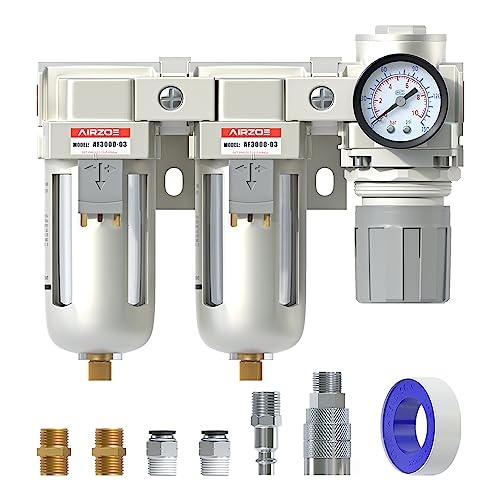
A small-form regulator and dual filter that fits tight wall spaces.
The AIRZOE AC3110-03 combines a double air filter and a pressure regulator into one compact package with 3/8″ NPT ports (National Pipe Thread, a standard tapered fitting for air lines). It operates between 0 and 145 PSI, though the recommended adjustment range sits between 0 and 120 PSI for stable output. The core filter element is brass alloy, filtering down to 5 microns, which catches most water and particles before they reach your tool. A semi-automatic drain empties the bowl whenever the air pressure drops — so if you shut off the compressor at night, it drains itself automatically.
One reviewer noted it is “a lot smaller than what the images look to be online,” so measure your mounting space before ordering. The kit arrives with a 0-150 PSI gauge, a bracket, and multiple fittings including two 3/8″ NPT connectors and thread-sealing tape. Unlike the THB Heavy Duty model above, this unit cannot handle high flow rates — the manufacturer does not publish a CFM rating, suggesting it is best suited for lighter-duty tools like brad nailers and small spray guns rather than high-consumption sanders.
Reasons to pick it
- Integrated regulator saves you from buying a separate part
- Semi-auto drain empties the bowl when the system depressurizes
- Includes a full set of fittings and a bracket from the start
Things to watch
- No published CFM rating — avoid it for high-air-demand setups
- One buyer mentioned a pressure regulator failure after brief use
Reach for this if: you have a 3/8″ airline system and want a filter and regulator in one tidy unit.
Look elsewhere if: your tools demand over 10 CFM — this unit’s flow capacity is unclear and likely limited.
4. THB 3/4″ High Flow Particulate Filter

Oversized ports for the biggest compressors and the hungriest tools.
With 3/4″ NPT female ports and a 250 PSI maximum input pressure, this filter sits atop the pressure rating chart — it beats the 1/2″ THB Industrial model’s 225 PSI ceiling. The flow capacity matches the 1/2″ Industrial model at 140 CFM, but the larger 3/4″ threading makes it a direct fit for heavy-duty copper or iron pipe installations where reducing down to 1/2″ would create a bottleneck. The 5-ounce metal bowl includes a visible sight glass, and the manual drain uses a quick-release push mechanism.
Buyers have used this between 60-gallon compressor outlets and tank inlets, reporting “almost no water reaches tank input” after installing it. One owner pointed out that clear tubing on the bottom drain nipple prevents messy spray during purges. Despite the higher pressure rating, the drain mechanism is still manual — you have to push the button yourself. Unlike the 3-stage THB system, this is a single-stage filter only, so it does not handle oil vapor or fine aerosol moisture; it is strictly for liquid water and particles.
Ideal for: workshops with 3/4″ hard-piped air systems that need maximum pressure capacity.
Not for: giving you dry air for painting — you will still need a coalescing or desiccant stage downstream.
Best for: commercial-grade compressors where 250 PSI input safety is non-negotiable.
Skip if: your system uses 1/2″ pipe — the heavy-duty THB Industrial model gives you the same CFM with a smaller fitting.
5. LNCHKA Double Air Filter Dryer with Auto Drain

Two drain types in one box — automatic when running, semi-automatic when shut off.
This 3/8″ NPT unit from LNCHKA is unusual because it gives you both an auto drain and a semi-auto drain in a single assembly. The auto drain purges water continuously while the system is under pressure, and the semi-auto drain handles the rest when pressure drops. The pressure regulator uses a simple pull-up-to-adjust, push-down-to-lock knob that lets you dial in between 0 and 145 PSI, with a recommended adjustment range of 0 to 120 PSI. The transparent polycarbonate bowl is impact-resistant and lets you see the water level. A brass filter element handles the 5-micron filtration.
Reviewers noted that this unit is compact and works well for garage compressors, though one said it “doesn’t trap water very well” and another described the build quality as “a bit low.” The flow rate is rated at 60 SCFM (standard cubic feet per minute) or 1700 L/min, which matches the AIRZOE’s territory — fine for light tools but not for continuous high-draw applications. For context, the THB Industrial model moves 140 CFM, more than double this unit’s capacity, so if you regularly run an orbital sander or a blasting cabinet, step up to a higher-flow model.
What stands out
- Auto drain for automatic water purging while compressor is running
- Compact footprint fits tight spaces on a wall or bench
- Brass filter element resists corrosion better than standard steel
What to consider
- 60 SCFM limits it to lower-demand tools
- Some reviewers felt the overall build quality was underwhelming
Reach for this if: you want the convenience of an auto drain without stepping up to a much more expensive three-stage system.
Look elsewhere if: your tools need over 5 CFM continuously — this unit may not keep pace.
6. THB 1/2″ Particulate Filter Water Trap
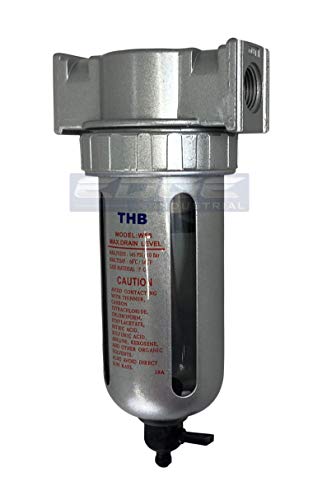
The no-frills entry point that gets the job done for light workshop use.
This is the most affordable 1/2″ NPT water separator on the list, and it handles the basics well. It flows 106 CFM at a 175 PSI maximum input pressure, which is enough for a single air tool like a nail gun or a blow gun. The 5-ounce polycarbonate bowl has a metal guard, so the plastic is protected from accidental impacts. The 5-micron filter element removes 95% of moisture and debris — identical filtration efficiency to the pricier THB industrial model, though at a lower flow rate and pressure ceiling.
Owners mention that it “works well, no problems after a few months” and that it works great for belly-dump systems under 125 PSI. However, the semi-automatic drain is the weaker point. One owner reported that the “auto drain thing is kind of crappy” — this unit’s drain only opens when pressure is completely removed, so you cannot purge water while the compressor is running without manually triggering it. It also lacks a mounting bracket; a customer pointed out that “I was hoping this would come with some type of mounting bracket. It doesn’t.” The THB Industrial model at the top of this list includes that bracket.
Good points
- Budget-friendly cost gets you into a 5-micron filter without overspending
- Metal bowl guard protects the polycarbonate from cracking
- Replacement filters are available on Amazon (ASIN B01MTC8AAH)
Shortcomings
- No mounting bracket included — you will need to rig your own
- Semi-auto drain does not purge under pressure, only when fully depressurized
Best for: getting air drying on the cheap for one tool at a time, like a brad nailer or air duster.
Skip if: you run multiple tools or need to drain the bowl without shutting the whole system down.
7. DeVilbiss QC3 Air Filter and Dryer

The paint-shop standard that gives you show-car-ready air without guesswork.
DeVilbiss is a well-known name in professional spray-painting equipment, and the QC3 reflects that pedigree. This is a three-stage filtration and drying system designed to strip oil, water, and humidity from compressed air before it reaches your spray gun. The unit includes a regulator, a pressure gauge, and a shutoff valve. The desiccant (a moisture-absorbing chemical in bead form) changes color from blue to pink when it is saturated, so you know exactly when to swap it out without guessing. One reviewer who uses it for auto paint work said it “eliminates craters and specks in paint” and stopped the need for wet sanding.
At 1.4 pounds and with dimensions of 8.5″ x 4.7″ x 13″, this is a compact unit compared to the THB three-stage system (which weighs 6 pounds). The fit is universal, so it adapts to most air line setups. One catch: customers note that the desiccant cartridge may arrive detached inside the housing and must be secured with the supplied butterfly nut before use.
Who it serves: serious automotive painters, furniture finishers, and anyone who cannot afford a single dust nib in their clear coat.
The catch: the initial setup requires you to tighten the desiccant cartridge yourself or it will not function properly.
Reach for this if: your work demands absolutely contaminant-free air for a flawless paint finish.
Look elsewhere if: you just need to keep your impact wrench from rusting inside — a simpler moisture trap will do that for a fraction of the investment.
Understanding the Specs
CFM (Cubic Feet per Minute)
This is the airflow volume a filter can pass without slowing your tools down. A higher CFM rating means the filter handles more air-hungry equipment like orbital sanders, die grinders, or sandblasters without starving them. A good rule is to add up the CFM requirements of the tools you run at the same time, then pick a filter that meets or exceeds that total. For example, a simple brad nailer may need only 2 CFM, but a DA sander can pull 15 CFM or more.
PSI (Pounds per Square Inch)
The pressure rating tells you the maximum air pressure the filter can safely handle before it risks bursting. Your compressor’s output pressure must be lower than or equal to the filter’s max PSI. Common home compressors run between 90 and 175 PSI, while industrial compressors can go up to 250 PSI or more. Using a filter with a too-low PSI rating on a high-pressure compressor is a safety hazard — always match or exceed your system’s maximum pressure.
FAQ
Do I need a water separator for my air compressor?
What is the difference between a particulate filter and a coalescing filter?
What does the micron rating mean on a filter?
How often should I drain the water from my separator?
Can I use a water separator with a smaller 1/4″ air hose?
Is a metal bowl better than a polycarbonate bowl?
Will a water separator reduce my air pressure?
What size NPT should I get for my compressor?
Can I run two filters in series for better drying?
Does a water separator help with air tool longevity?
Final Thoughts: The Verdict
For most people, the air compressor water separator winner is the THB Heavy Duty Industrial Filter because it delivers a strong 140 CFM flow and 225 PSI ceiling in a durable metal housing with a sight glass. If you need paint-ready air with zero moisture, grab the THB 3 Stage Desiccant System. And for the most affordable entry point to protect a single tool, the standout is the THB 1/2″ Particulate Filter.
How We Picked
We do not accept paid placement. Every pick is matched to a real buyer and a real use-case; we do not hands-on test units.
Sources & Methodology
Specifications: manufacturer listings and product documentation. Review insights: verified customer reviews, as of July 2026. Pricing: not shown on this page (it changes often); check the current price via the retailer link.
As an Amazon Associate, Gadgets Feed earns from qualifying purchases. This does not affect which products we feature.