
Our readers keep the lights on and my morning glass full of iced black tea. As an Amazon Associate, I earn from qualifying purchases.
Specs are compiled from manufacturer listings and verified buyer reviews and can change over time — please confirm the key details on the product page before buying.
Your battery isn’t a brick you can just strap down with a bungee cord. A proper 12V battery box does more than hide the terminals — it keeps your battery from sliding into metal, stops corrosion from road spray, and gives you real ports to plug into. The trick is finding one that actually fits your battery group, your mounting space, and your need for power access without becoming its own headache.
I’m Min — the founder and writer behind Gadgets Feed. This guide is built by comparing the manufacturers’ published specifications and the patterns across verified customer reviews, so you get each pick’s real strengths and trade-offs instead of marketing spin.
After pulling the dimensions, materials, and real-world buyer feedback on five different models, you will have a clear picture of which 12v battery box fits your setup — plastic or steel, basic or loaded with ports — and which trade-offs come with each one.
Quick Picks
- Trolling Motor Power Center Station — Most Versatile
- Peastorm Trailer RV Marine Battery Box — Steel Armor
- SeaSense Deluxe Power Station Battery Box — Smart Monitor
- Attwood 9069-1 Standard Non-Vented Battery Box — Bombproof Strap
- Seachoice USCG-Approved Marine Group 24 — Budget Essential
How To Choose The Best 12V Battery Box
A 12V battery box is a simple accessory, but picking the wrong one means you either can’t close the lid or you are fighting with a battery that slides sideways on every turn. Focus on these three things to get it right the first time.
Battery Group Size Is Everything
Your battery has a group size — 24, 27, or 31 — that defines its physical footprint. A box made for Group 24 will not fit a Group 27 battery horizontally, and a box for Group 27 leaves a Group 24 rattling around. Before you add anything to your cart, measure your battery’s length, width, and height, then compare it to the box’s interior dimensions. A few buyers report that side handles or corner posts on certain batteries add a fraction of an inch that makes the fit impossible, so that real measurement step can save you a return.
Material: Plastic vs. Steel
Most boxes are either acid-resistant polyethylene or polypropylene (lightweight, never rusts, decent impact resistance) or steel with a spray coating (heavier, fireproof, stronger against crushing). Plastic boxes are the standard for marine and general RV use because they are non-conductive and corrosion-proof. Steel boxes add security and weather toughness, especially if you want to lock your battery in place on a trailer tongue, but many steel designs have tighter internal tolerances that can cause fit issues with certain batteries.
Venting, Ports, and Certifications
A non-vented box (sealed lid) is fine for AGM or lithium batteries that don’t release gas. If you use a wet-cell (flooded) lead-acid battery, you need a vented box so hydrogen gas can escape safely — otherwise pressure builds up inside. Beyond that, look at what ports you actually want: a simple box with a strap is fine for a secondary battery, but a power-station style box with a voltmeter, USB ports, and a 12V socket turns the box into a mini distribution hub. Also check for USCG compliance if you are installing it on a boat — it means the box and strap meet specific hold-down force standards.
Quick Comparison
| Model | Best For | Material | Fits Group | Ports/Features | Amazon |
|---|---|---|---|---|---|
| GEARMEISTER Power Center | Full feature set with USB & Anderson plugs | Polypropylene | 24 / 27 / 31 | USB-A QC 3.0, USB-C PD, 12V socket, 2x 50A Anderson, LCD voltmeter | Amazon |
| Peastorm Steel Box | Lockable, heavy-duty security | Steel (coated) | 27 | Lock, rubber grommets, mounting screws | Amazon |
| SeaSense Deluxe Power Station | Built-in battery tester + 12V socket | Plastic | 24 / 27 | One-touch tester, 12V accessory socket, built-in LED light, 10A breaker | Amazon |
| Attwood 9069-1 | Ultra-secure strap for rough marine use | Polypropylene | 24 | 40″ strap rated to 350 lbs, USCG compliant | Amazon |
| Seachoice Group 24 | Budget-friendly basic containment | Polyethylene | 24 | Hold-down strap, mounting hardware, snap lid | Amazon |
In‑Depth Reviews
1. Trolling Motor Power Center Station (GEARMEISTER)
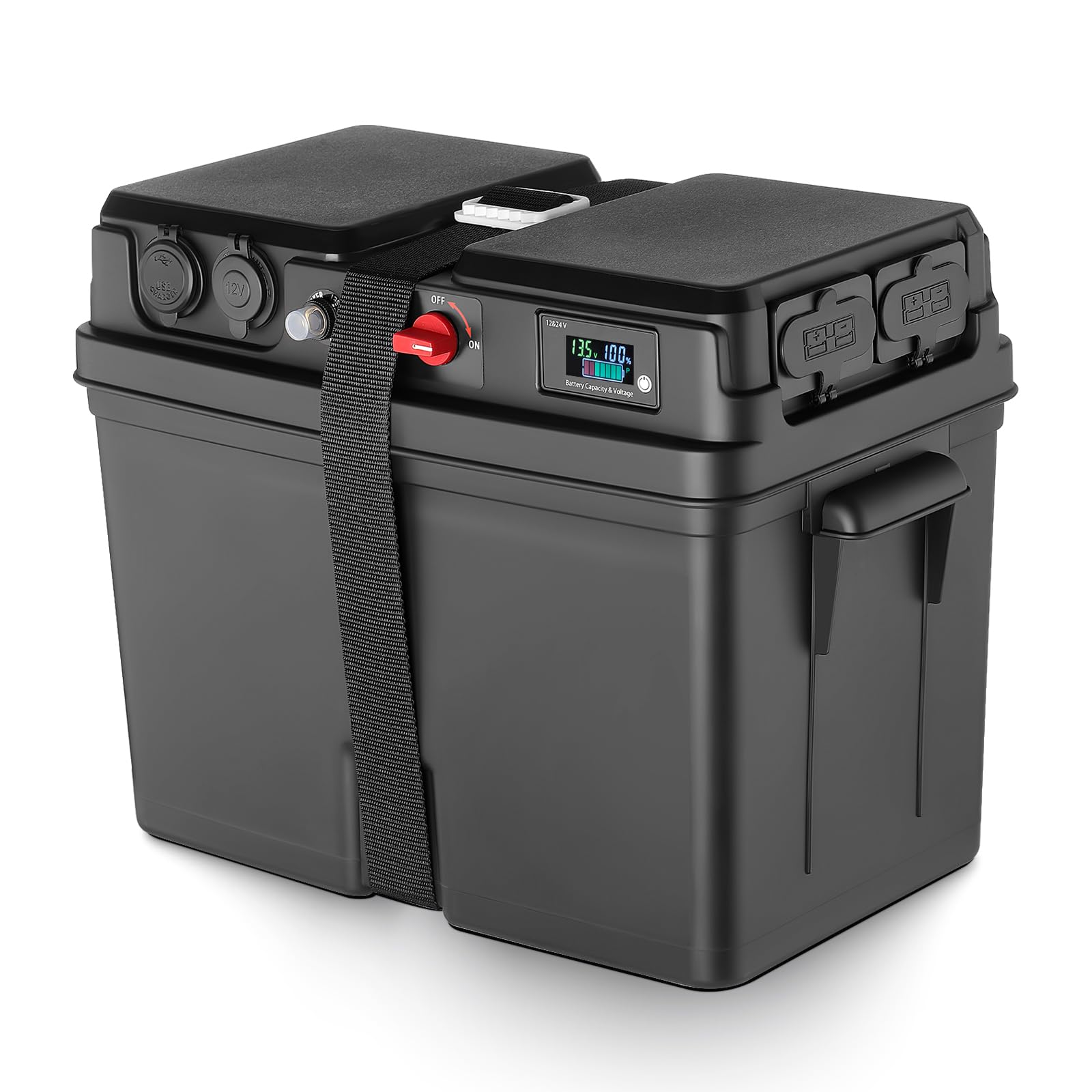
The turn-key power hub that turns any 12V battery into a portable charging station.
This box does not just hold your battery — it pre-wires everything with a built-in LCD voltmeter, two 50A Anderson power plugs, a 12V cigarette lighter socket, a USB Type-A QC 3.0 port, and a USB Type-C PD port. You drop in a Group 24, 27, or 31 battery (the internal dimensions are 13.3 x 7.6 x 8.8 inches), and you get real-time battery level monitoring on the LED voltmeter without opening the lid. A resettable circuit breaker protects against shorts, so you don’t blow a fuse mid-trip.
Owners mention the case itself feels flimsy and is only light-rain resistant, not fully waterproof — and the PowerPole (Anderson) plugs arrived loose on some units. One reviewer noted the voltmeter was accurate within a hundredth of a volt compared to a Fluke meter. The switch must be on for the USB ports to charge, which is a simple detail to remember. The box also lacks internal foam or fillers to keep the battery from shifting around during transport.
Pre-Wired Power Hub
- Includes USB-C PD and USB-A QC 3.0 ports for device charging
- 2x 50A Anderson plugs handle heavy loads like a trolling motor or Starlink
- LCD voltmeter displays voltage and battery percentage
Build Concerns
- Housing feels thin compared to premium boxes; no internal padding for battery shift
- Not waterproof — only light-rain resistant; not suited for deck exposure
- PowerPole connectors reported as loose on some units
Reach for this if: you want a complete portable power station that accepts three battery group sizes and gives you real power ports for devices, radios, and small appliances.
Look elsewhere if: you need a tough, waterproof box for a marine deck or outdoor mounting where rain hits directly.
2. Peastorm Trailer RV Marine Battery Box (Steel, Group 27)
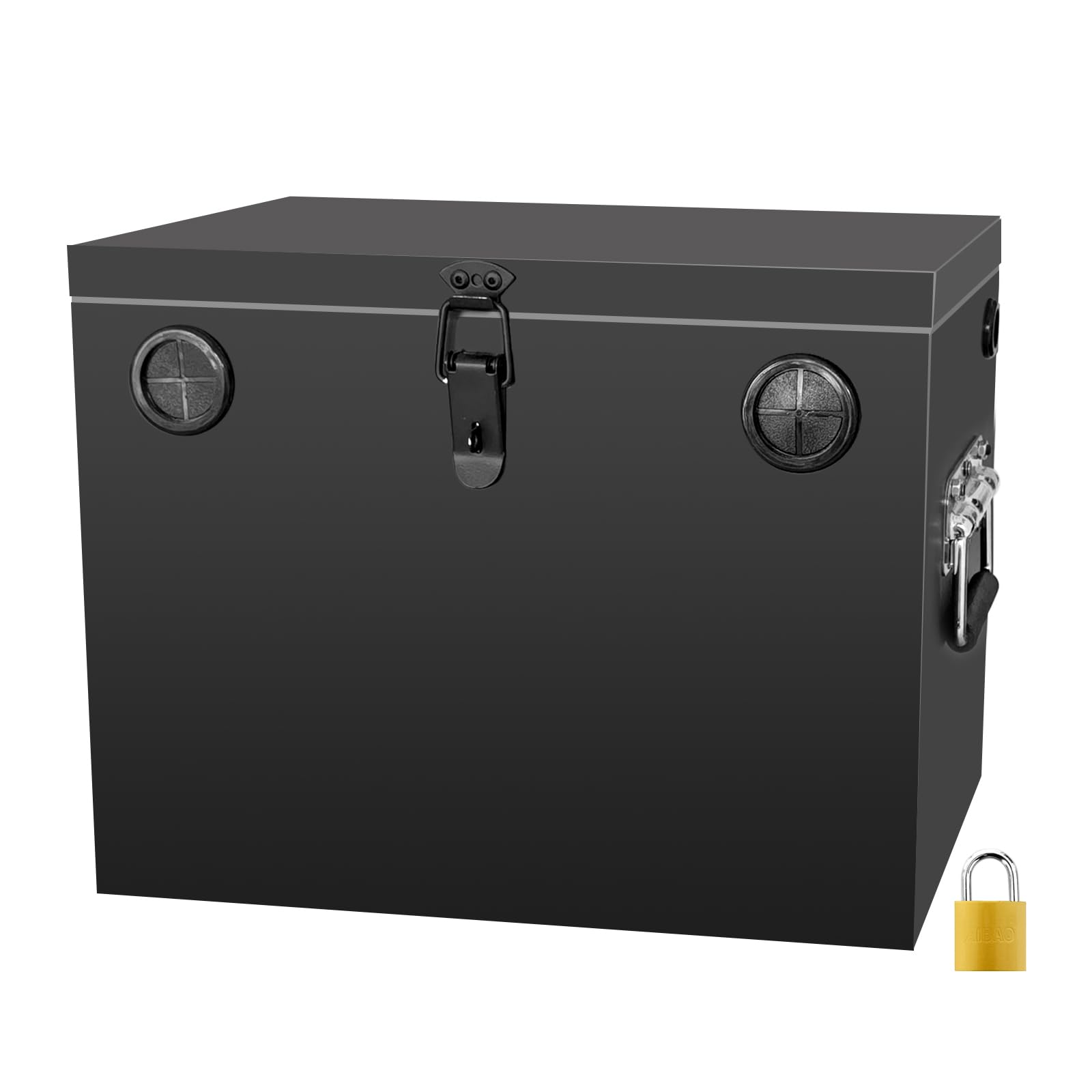
The steel vault that locks your battery down — if the fit is right.
If you want more than plastic protection, this steel box offers a heavy-duty housing for a Group 27 battery. The exterior dimensions are 14.9″W x 11.2″H x 9.45″D, and the maximum interior capacity is 13.78″L x 7.8″W x 11″H. It comes with a lock, four rubber grommets for the pre-drilled holes, mounting screws, and a textured black finish that customers note matches a trailer tongue well. The bottom has four predrilled fixing holes so you can bolt it down permanently.
Reviewers point out a specific catch: the internal dimensions are about 1/16 inch tight on each side, so if your Group 27 battery has side handles or cables that stick out, it may not fit. One buyer mentioned the metal is extremely thin and deducted a star for that. On the flip side, reviewers love that the box comes with everything — lock, grommets, bolts — and the spring latch works well. The Peastorm is noticeably heavier than the plastic options at 4.79 kg (about 10.5 lbs) versus the 2-pound Attwood box, which is a 4.79 kg vs 0.9 kg difference.
Security Build
- Lockable lid prevents battery theft on trailer or job site
- Steel construction is waterproof, sunscreen, and fireproof — not just weather-resistant
- Comes with rubber grommets, mounting screws, and a lock in the box
Fit Warning
- Interior is ~1/16″ smaller than spec in each direction; batteries with side handles may not fit
- Steel is thin enough that plastic boxes feel more impact-resistant
- Weighs 4.79 kg — heavy for portable use
Grab this for: a trailer tongue or truck bed where you need locking security and steel fire protection, and you can verify your battery fits without side handles.
Pass if: your Group 27 battery has bulky side handles or you need something lightweight to carry between locations.
3. SeaSense Deluxe Power Station Battery Box (Group 24/27)

The deluxe box that checks your battery health at a single button press.
This box from SeaSense steps up from basic containment by adding external terminals for a one-touch battery tester — connect the device, turn everything off, wait a minute, push the button, and the built-in voltmeter reads your charge level without opening the lid. It fits both Group 24 and Group 27 batteries, which is rare among mid-range boxes. There is also a built-in 12V accessory socket (cigarette lighter port) and an integrated LED light for checking connections at night. A 10-amp circuit breaker protects against short circuits, and the box uses vinyl-coated steel wing nuts that resist corrosion better than bare metal.
One buyer’s review sums up the honest trade-offs neatly: “Roomy but battery slides; charge indicator works only when motor off; cigarette port nonfunctional; weatherproof for rain but not submersion; adequate.” The box does not include padding or straps to hold the battery in place internally, so your battery can shift on rough water or turns. And the cigarette-style 12V socket was reported as nonfunctional by some reviewers. The tester works best when nothing else is drawing power — turn off your motor first for an accurate reading.
Built-In Diagnostics
- One-touch battery tester reads charge level without opening the lid
- Fits both Group 24 and Group 27 batteries for flexible swapping
- Includes LED light and 10A circuit breaker for safe day/night use
Room to Slide
- No internal strap or foam padding to stop the battery from moving inside
- 12V accessory socket reported as nonfunctional by some buyers
- Charge indicator works reliably only with all loads switched off
Pick this if: you want a quick battery health check on a small boat or kayak without carrying a multimeter, and you can add foam to stop internal sliding.
skip it if: you need a reliable 12V socket for powering devices — that port is hit-or-miss according to reviews.
4. Attwood 9069-1 Standard Non-Vented Battery Box (Group 24)
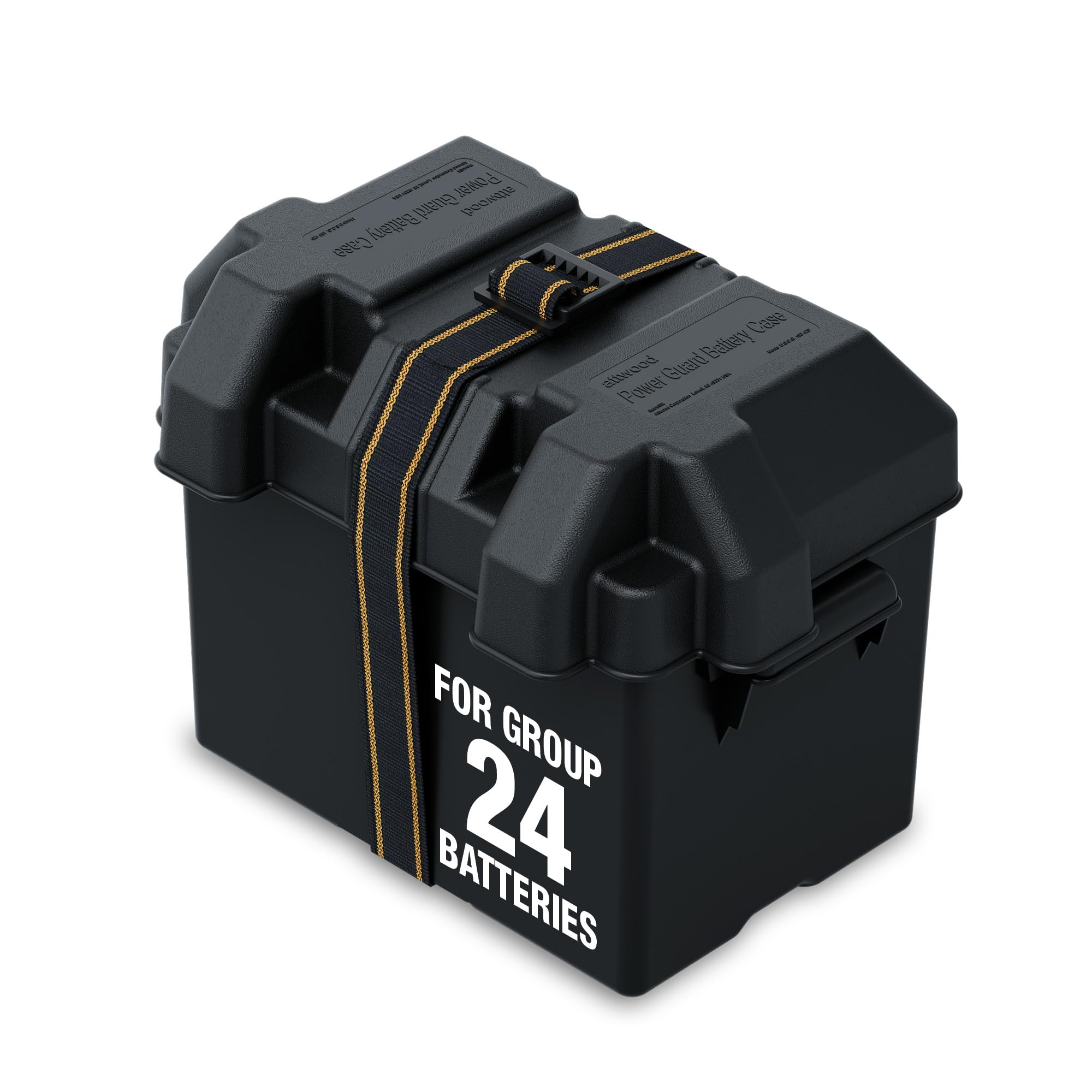
The marine box that over-engineers its strap so your battery never budges.
The stand-out feature here is the 40-inch hold-down strap rated for 350 pounds of force — nearly 4 times what the USCG requires for boat installations. That kind of margin means your Group 24 battery is locked in place even through rough chop or hard turns. The interior measures 10.6 x 7 x 10.125 inches, so it accommodates batteries up to 10.125 inches tall. The box is molded from acid-resistant polypropylene and has been impact-tested from -20°F to 120°F, which covers the extremes you will encounter in an outdoor compartment. The lid is non-vented, which is correct for AGM or lithium batteries but not for wet-cell lead-acid that releases hydrogen gas.
The Attwood is compact and lightweight at just 2 pounds — the same weight range as the Seachoice box but with a significantly stronger strap. The box’s external dimensions are 9.63″D x 14″W x 10.63″H, making it a snug fit for battery trays in small boat consoles or RV compartments. Shoppers say it “works like a champ” for straightforward containment. The drawback is the non-vented lid: if you are using a flooded lead-acid battery, you need a vented box to let gas escape, so this one is best paired with sealed batteries.
Strap Power
- 350-lb rated strap is almost 4x the USCG requirement for marine hold-downs
- Polypropylene is acid-resistant and impact-tested from -20°F to 120°F
- Lightweight at 2 pounds — easy to mount in tight compartments
Vent Limitation
- Non-vented lid unsuitable for wet-cell (flooded) lead-acid batteries that off-gas hydrogen
- Fits Group 24 only — no room for larger Group 27 or 31 batteries
Best for: boaters with a sealed (AGM or lithium) Group 24 battery who want the most secure strap on the market in a compact, temperature-tested box.
Not for: anyone running a flooded lead-acid battery that needs venting, or anyone who needs to fit a larger battery group.
5. Seachoice USCG-Approved Marine Group 24 Standard Battery Box

The simple, approved box that fixes a dangerous battery setup for a very low cost.
If your only problem is “my battery is strapped to the deck with a rope,” this Seachoice box solves it. The polyethylene construction resists acid corrosion, it meets both ABYC standard E-10 and USCG spec 183,420 for marine safety, and the lid snaps shut with a simple snap opening mechanism. The box holds a single Group 24 battery with internal dimensions of 10.5 x 7.25 x 10 inches. It weighs 2.2 pounds, and comes with a hold-down strap and stainless steel mounting hardware included.
One reviewer put it bluntly: “The prior owner simply had the battery strapped to the aft deck exposed to the elements!” This box turns that situation into a proper, safe installation for about the same cost as a tank of gas. Other buyers call it “sturdy and durable” with strong woven straps and a buckle that stays tight. The catch is you get exactly zero additional features — no ports, no tester, no voltmeter. The box arrived with one reviewer after about a month due to shipping delays. It is purely a containment and safety upgrade, so if you need power outlets or battery monitoring, you will need to add those separately.
Safety on a Budget
- Meets ABYC and USCG marine safety standards for battery containment
- Complete with stainless steel mounting hardware and woven hold-down strap
- Acid-resistant polyethylene protects the compartment from spills
Bare-Bones Design
- No power ports, battery tester, or voltmeter — it is a plain safety box
- Some buyers reported long shipping delays (up to a month)
- Fits Group 24 only; no room for larger batteries
This one is for: the budget-conscious boat or trailer owner who just needs USCG-compliant containment and a strap that works, with no extra electronics to fail.
pass on it if: you want on-box voltmeter, USB ports, or the ability to fit a larger battery group — you will outgrow this box quickly.
Understanding the Specs
Battery Group Numbers (24, 27, 31)
A battery group number is a standard set of dimensions defined by the Battery Council International. Group 24 is roughly 10.25 x 6.8 x 8.9 inches — common in marine and small RV applications. Group 27 is larger at around 12 x 6.8 x 9.4 inches, fitting many trolling motor and travel trailer setups. Group 31 is the largest here, typically 13 x 6.8 x 9.4 inches, used in heavy-duty trucks, larger boats, and high-capacity solar installations. When a box says “Fits Group 24/27/31,” the internal size is usually big enough for the largest of those, but you still need to check height — battery terminals or side posts can add an extra inch.
Vented vs. Non-Vented Lids
A vented lid has small openings or channels that let hydrogen gas escape if you use a flooded (wet-cell) lead-acid battery. That gas is potentially explosive if it builds up in a sealed box. A non-vented lid is safe only for sealed batteries like AGM (absorbent glass mat) or lithium iron phosphate (LiFePO4), which do not off-gas during normal charging. If you are not sure which battery type you have, choose a vented box or one with a grommet that allows a vent tube — it is the safer option for wet cells.
FAQ
Will a Group 27 battery fit in a box made for Group 24?
Can I use a non-vented battery box with a flooded lead-acid battery?
How do I stop my battery from sliding around inside the box?
What does USCG approval mean for a battery box?
Can I use a 12V battery box for lithium (LiFePO4) batteries?
How do I connect external devices to a battery box?
Does a heavier battery box provide better protection?
What is the difference between a battery box and a battery relocation kit?
Final Thoughts: The Verdict
If you want one dependable pick, the 12v battery box winner is the GEARMEISTER Power Center Station because it transforms any Group 24 to 31 battery into a full power hub with USB-C, Anderson plugs, and a voltmeter — all pre-wired with no drilling. If you want a bombproof marine box with the strongest strap in the test, grab the Attwood 9069-1. And for a lockable steel enclosure that can live on a trailer tongue, the standout is the Peastorm steel box — just measure your battery’s side-handle clearance first.
How We Picked
We do not accept paid placement. Every pick is matched to a real buyer and a real use-case; we do not hands-on test units.
Sources & Methodology
Specifications: manufacturer listings and product documentation. Review insights: verified customer reviews, as of July 2026. Pricing: not shown on this page (it changes often); check the current price via the retailer link.
As an Amazon Associate, Gadgets Feed earns from qualifying purchases. This does not affect which products we feature.