
Our readers keep the lights on and my morning glass full of iced black tea. As an Amazon Associate, I earn from qualifying purchases.
Specs are compiled from manufacturer listings and verified buyer reviews and can change over time — please confirm the key details on the product page before buying.
You want a board that lets you practice linking turns without catching an edge on every other run, and you need bindings that stay comfortable all day. That means one thing matters more than any other: a forgiving flex and a profile that won’t punish your heels. This guide focuses entirely on all-mountain boards built with beginners in mind—soft enough to pardon mistakes, stiff enough to give you a real platform to learn on.
I’m Min — the founder and writer behind Gadgets Feed. This guide is built by comparing the manufacturers’ published specifications and the patterns across verified customer reviews, so you get each pick’s real strengths and trade-offs instead of marketing spin.
Here are the three best boards for riders just getting started, each chosen for its specific flex rating, rocker profile, and solid beginner-friendly construction. That is the real test behind every all-mountain snowboard for beginners.
Quick Picks
- Redwood and Summit Men’s Snowboard Package — Best Overall
- Symbolic Knotty 2025 Snowboard — Best Value
- STAUBER Matte Summit Snowboard & Binding — Most Versatile
How To Choose The Best All-Mountain Snowboard For Beginners
Buying your first snowboard package is different from renting. You own the setup, so it needs to match your height, weight, boot size, and riding style. Here are the most important things to consider as a beginner.
Flex Rating and What It Feels Like
The flex rating (usually a number from 1 to 10) tells you how stiff the board is. A softer board (around 3-5) bends more easily, so you can steer with less effort and recover from small mistakes. A stiffer board (6+) gives more stability at speed but makes it harder to initiate turns. For a beginner, a medium flex (around 5-7) is a solid place to start—it is forgiving enough to learn on but supportive enough that you won’t outgrow it in one season.
Rocker vs. Camber vs. Hybrid Profiles
Every snowboard has a slight bend in its shape along the length. A traditional camber profile (a gentle arch) gives you aggressive edge hold but catches easily when you are still learning. Pure rocker (banana curve) reduces catches but slides out on ice. A hybrid rocker (rocker at the tip and tail, camber underfoot) is the best of both worlds for beginners—you get the catch-free feel of rocker in the flats and the edge security of camber when you need to hold a carve.
Quick Comparison
| Model | Best For | Flex Rating | Core Material | Rocker Profile | Amazon |
|---|---|---|---|---|---|
| Symbolic Knotty 2025 Package | Budget-friendly all-mountain entry | Soft (5/10 est.) | — | Hybrid Rocker | Amazon |
| Redwood and Summit Package | Intermediate-ready all-mountain groomers | Medium (6/10 est.) | Poplar Wood | RCRX Rocker Camber Rocker | Amazon |
| STAUBER Matte Summit Package | Versatile progression for all terrains | Medium (6.7) | Poplar Wood | Hybrid Rocker | Amazon |
In‑Depth Reviews
1. Redwood and Summit Men’s Snowboard Package
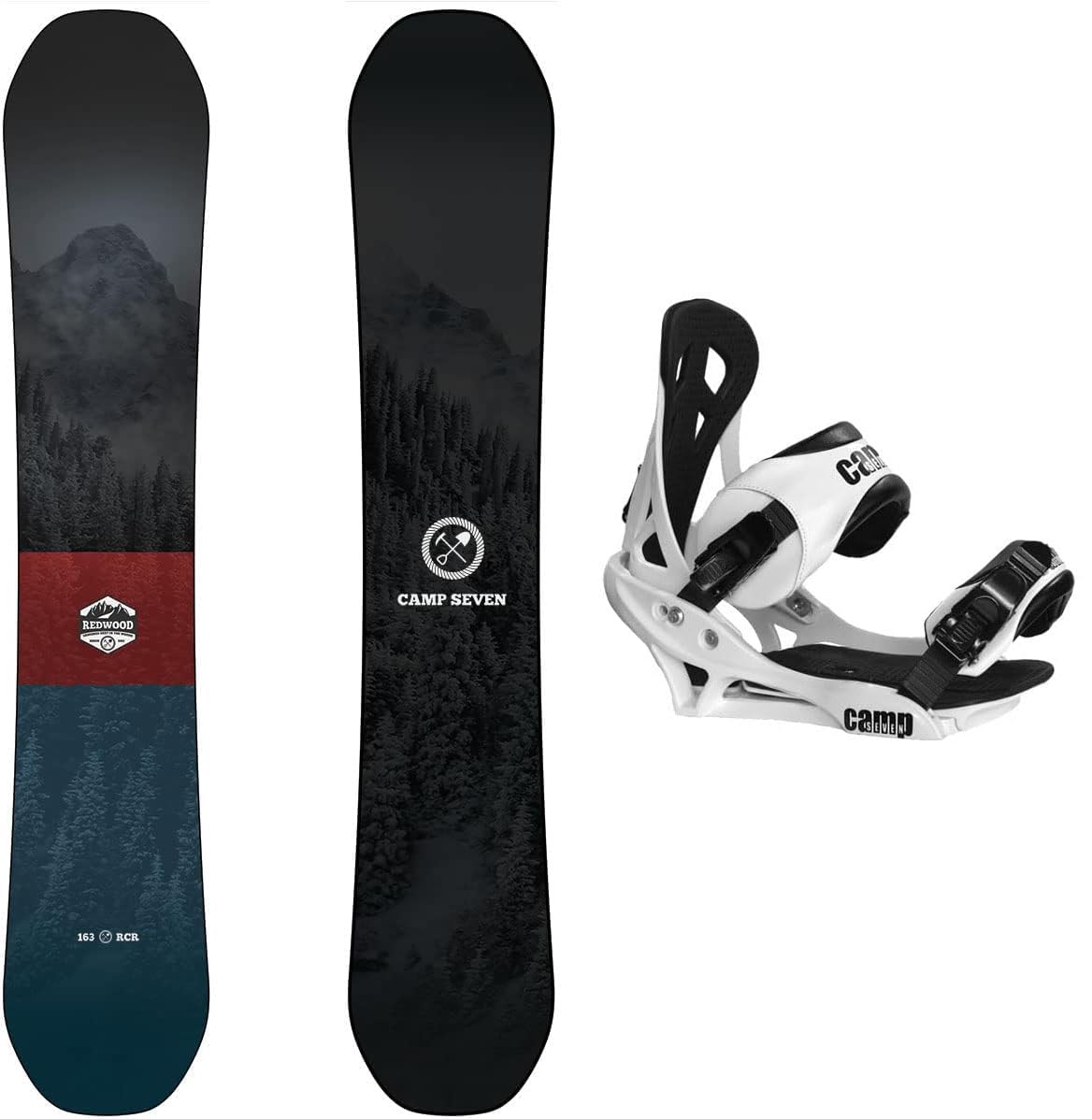
The complete redesign that prevents edge catches while giving you real grip underfoot.
You get a real poplar wood core (no particle board or wafers) that flexes consistently as you learn to carve. The RCRX profile (rocker at the tip and tail, camber underfoot) is exactly what a beginner needs: the rocker zones prevent those pesky edge catches on flat sections, while the elongated camber section under foot gives you responsive edge hold when conditions get icy. Buyers report “achieved consistent slope runs after 1.5 hours,” which matches the forgiving ride feel.
The Summit bindings add full-length EVA base padding (like a plush cushioned footbed) to soak up chatter on choppy terrain, plus aluminum 4-tooth ratchets that make tightening easy even with gloves on. Unlike the Symbolic Knotty below, this package runs a medium flex (estimated 6/10) that gives you more stability as you pick up speed, so you will not outgrow it after a few trips. At 156cm, it suits riders from beginner through intermediate skill levels as stated in the specs.
One experienced buyer (15 years of riding) noted this board outperforms some boards costing hundreds more, calling it better than a Burton for the price. The trade-off is that the board is heavier (the poplar core and dual-density construction add substance), so if you plan to spend hours hiking or doing terrain park laps, you might prefer a lighter build. Still, for hard-charging groomers and learning carves, this gets the nod.
Edge hold advantage: The elongated camber underfoot gives you stronger grip on ice than a pure rocker board, while the tip/tail rocker keeps you catch-free in the flats.
Binding comfort: The Either-Or toe strap lets you switch between toe-cap and over-the-forefoot fit, so you can dial in the exact feel for your boot.
Reach for this pick if: you want a board that grows with you from first run to confident carves, with a real wood core and reliable edge hold on icy days.
Look elsewhere if: you prefer a super-light board for park riding or want a softer flex for absolute first-timer forgiveness.
2. Symbolic Knotty 2025 Snowboard and Black Bindings, Leash, Stomp Pad Package

The complete starter bundle that includes everything except boots—board, bindings, leash, and stomp pad.
This package is the most wallet-friendly way to replace a rental without hunting for separate components. The 155cm board (available in regular and wides) uses a hybrid rocker profile, which means rocker at the nose and tail keeps you from catching edges as you learn to swing your hips through turns. It weighs 20 pounds total (board plus bindings), which is average for a beginner setup—not too heavy to lug to the mountain, not so light that it feels flimsy underfoot.
Owners mention this is a solid upgrade from an older board, with one reviewer switching from a K2 Eldorado and noting the bindings were comfortable and allowed better riding. The included L/XL bindings fit men’s boots size 9-15, so taller heavier riders get a secure connection. The stomp pad (the textured sticker on the board surface) helps you keep the board under control while unstrapping one foot on the lift.
Compared to the Redwood package above, this board runs a softer flex (estimated 5/10) that is more forgiving for absolute beginners—but one reviewer warned it lacks a pronounced edge catch on hard snow, calling it “dangerous” for carving on ice. That is a fair trade-off: a super-soft board that eliminates edge catches in powder and slush might feel vague when you try to dig a carve on a frozen morning. If you mostly ride resort groomers, the Redwood’s RCRX profile gives you better edge security.
What you get in the box
- Board + bindings + leash + stomp pad all included
- Hybrid rocker tip and tail reduces catches in soft snow
- Wide binding size fits boot 9-15
Where it’s limited
- One reviewer says the board has no edge bite on ice
- Board color in the photo is black but actual is brown
- Soft flex limits stability at speed compared to a medium-flex board
Pick this one for: the lowest upfront cost to own a complete setup, especially if you ride mostly powder and soft snow rather than hardpack.
A real limitation: the lack of a defined edge can make ice-carving feel unstable, so if your mountain stays icy skip it.
3. STAUBER Matte Summit Snowboard & Binding Package
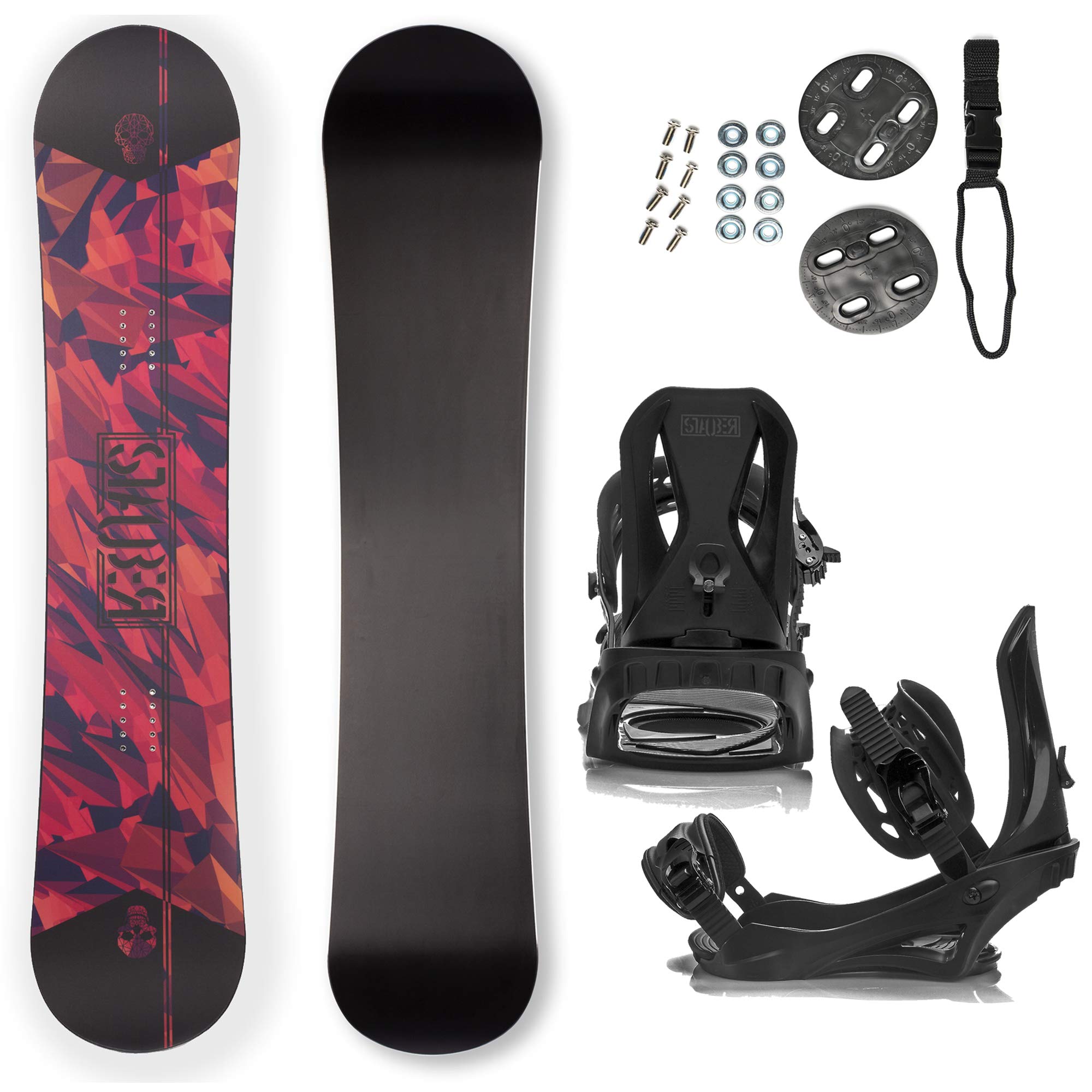
The medium-flex board with a hybrid rocker profile built for riders who want one setup to learn on and keep progressing.
STAUBER puts a lot of thought into this package, starting with a 100% poplar wood core (rated a medium flex of 6.7) and a triaxial layer of fiberglass on both top and bottom for smoother torsional flex—meaning the board twists evenly as you lean into a turn, which beginners feel as stability, not wobble. The hybrid rocker profile has three main contact points on the surface, with two individual camber zones underfoot for pop and edge security. The result is a board that is “super smooth and buttery” for learning (as the manufacturer states) but still energetic enough for an intermediate rider to hit small jumps.
One buyer (5 ft 4 in, 100 lbs) bought the 143cm size and said the board was perfect—it was easy to set up and control. That size comes with medium bindings (kids size 6 to adult size 9 US boot), so lighter riders don’t get swamped in a big package. The binding system uses a durable injection-molded polyurethane chassis with an aluminum buckle that flexes under tension while staying rigid to the board, which reviewers confirm as sturdy. The matte topsheet and black ABS sidewall finish also gets compliments for looking premium on the mountain.
Unlike the Redwood’s RCRX profile (rocker-camber-rocker), the STAUBER uses a twin-directional shape plus hybrid rocker, which means you can ride it switch (backward) more naturally if you start learning halfpipe or park basics. One downside: the bindings are designed for boot sizes 6-9 (medium) or 9-12 (large), and a reviewer with size 6 boots found the medium bindings too big. Check your boot size against the binding chart before ordering. Also note that the board package does not include a stomp pad—one buyer reminded others to grab one separately.
Construction details that matter
- 100% poplar wood core tip to tail—no particle board or wafers
- Triaxial fiberglass on both top and bottom sheets for consistent flex
- Two individual camber zones underfoot give you pop for jumps and edge security on ice
Watch out for
- Bindings may run large for smaller boot sizes—measure first
- No leash or stomp pad included in the package
- Medium flex (6.7) is less forgiving than a soft beginner board
Choose this for: a board that stays with you through your entire first season and into intermediate riding, with real poplar core quality and a smooth hybrid rocker.
A true beginner caveat: the medium flex is stiffer than a pure beginner board, so if you bruise easily or want absolute forgiveness, look at a softer-flex option.
Understanding the Specs
Flex Rating (1-10)
Flex rating tells you how much the board bends when you lean into a turn. A lower number (3-5) means the board is softer and easier to steer—perfect for beginners who are still building leg strength. A higher number (6-8) gives you stability at speed but requires more force to initiate turns. The boards in this guide range from soft (Symbolic Knotty, ~5) to medium-flex (STAUBER Summit, 6.7; Redwood, ~6). For your first season, aim between 5 and 7—forgiving enough to learn on but supportive enough that you won’t feel the board fighting you when you get comfortable.
Rocker Profile and Shape
The profile (the way the board bends along its length) determines how it feels on different snow conditions. A hybrid rocker puts rocker (a curved-up nose and tail) where you are most likely to catch an edge and camber (a slight arch) under your feet where you need grip for carving. All three boards in this guide use a hybrid rocker: the Symbolic Knotty and STAUBER Summit use a standard hybrid rocker, while the Redwood uses a specific RCRX layout (rocker at tip and tail, elongated camber under foot). This profile is the gold standard for beginners because it eliminates the most common catch situations while still letting you carve on harder snow.
FAQ
What length snowboard should a beginner get?
Is a hybrid rocker better for a beginner than a pure camber board?
How do I know which binding size fits my boot?
Is a stomp pad included with these packages?
How much does a beginner snowboard package weigh?
Should I buy a wide board for big feet?
How long does a beginner snowboard last before I need to upgrade?
Do these packages include snowboard boots?
Final Thoughts: The Verdict
For most first-time riders, the best all-mountain snowboard for beginners is the Redwood and Summit Package because its RCRX profile gives you catch-free rocker zones paired with real camber edges for learning carves. If you want a complete starter bundle at the lowest cost with all accessories included, grab the Symbolic Knotty 2025 Package. And for a board that stays with you from first run to park jumps with a poplar wood core and smooth hybrid rocker, the STAUBER Matte Summit Package is your one-and-done setup.
How We Picked
We do not accept paid placement. Every pick is matched to a real buyer and a real use-case; we do not hands-on test units.
Sources & Methodology
Specifications: manufacturer listings and product documentation. Review insights: verified customer reviews, as of July 2026. Pricing: not shown on this page (it changes often); check the current price via the retailer link.
As an Amazon Associate, Gadgets Feed earns from qualifying purchases. This does not affect which products we feature.