
Our readers keep the lights on and my morning glass full of iced black tea. As an Amazon Associate, I earn from qualifying purchases.
Specs are compiled from manufacturer listings and verified buyer reviews and can change over time — please confirm the key details on the product page before buying.
Too many cheap camping pads let you wake up with a cold hip and a sore back because they are just a thin layer of fabric between you and the hard ground. A good budget pad holds you off the dirt all night, and a bad one leaves you tossing until dawn. This guide compares six affordable pads by thickness, weight, inflation method, and real buyer feedback, so you see exactly which one fits your camping style.
I’m Min — the founder and writer behind Gadgets Feed. This guide is built by comparing the manufacturers’ published specifications and the patterns across verified customer reviews, so you get each pick’s real strengths and trade-offs instead of marketing spin.
A budget camping pad can save your sleep whether you drive to a site or hike 10 miles — and this guide shows you which model delivers and which might leave you flat before dawn.
Our Picks at a Glance


How To Choose The Best Budget Camping Pad
The cheapest pad is not always the best value — a pad that fails mid-trip costs you sleep and your whole next day. Focus on three things: how thick it is (thickness is the single biggest predictor of comfort), how heavy it is (every ounce matters when you carry it), and how you inflate it (foot pumps can save your lungs or drive you crazy).
Thickness and insulation — the ground is a heat thief
A pad under 2 inches thick will not fully lift your hips off the ground if you sleep on your side. Thicker pads, around 4 inches, create a real air gap that keeps your body away from the cold ground. If you camp in spring or fall, look for an R-value rating (a measure of how well the pad blocks heat loss). An R-value around 2.1 works for mild to cool weather, while foam pads rely on a closed-cell structure to block ground chill without inflation.
Inflation method — foot pump or your own breath
Built-in foot pumps let you inflate a pad by stepping on it, which takes about 30 to 60 seconds. That saves you from puffing 10 to 15 breaths into a tiny valve, but some foot pumps on budget models can jam or stop working. Always check recent buyer reviews on that specific product’s pump reliability. If you choose a breath-inflated pad, count on about 10 to 15 breaths and a valve that traps the air as you go.
Weight and packed size — meant for your trunk or your backpack
Car campers can ignore weight within reason — a 1.9-pound pad is fine. Backpackers should aim for pads under 1.5 pounds that pack down to roughly the size of a water bottle (around 4 inches by 9 inches). Closed-cell foam pads are the lightest and most durable option for thru-hikers, but they are thin (around 0.7 inches) and take some getting used to.
Quick Comparison
| Model | Best For | Thickness | Weight | Inflation Type | Amazon |
|---|---|---|---|---|---|
| Oramoose 4in Ultralight★ Best Overall | Side sleepers on a budget | 4 Inches | 1.9 Pounds | Built-in foot pump | Amazon |
| Featherstone El CordionBest for Thru-Hikers | Ultralight thru-hikers | 0.7 Inches | 1.0 Pounds | None (closed-cell foam) | Amazon |
| Myxslop 4.5″ Heavy-Duty | Heavy-duty car camping | 6.5 Inches | 1.5 Pounds | Built-in foot pump | Amazon |
| Sleepingo Ultralight Mat | Backpackers wanting lightweight | 2 Inches | 0.87 Pounds | Breath inflation | Amazon |
| Amazon Basics Camping Pad | Budget-conscious travelers | 2.2 Inches | 1.4 Pounds | Built-in foot pump | Amazon |
| THINTON Foam Camping Pad | Closed-cell foam budget pick | 0.7 Inches | 1.0 Pounds | None (closed-cell foam) | Amazon |
In‑Depth Reviews
1. Oramoose Camping Sleeping Pad, 4in Thick
You get a true 4-inch air layer that keeps your hips off the ground for far less than premium pads cost.
Side sleepers, this is the budget pad for you. The 4-inch thickness stops your shoulders and hips from bottoming out, unlike the 2-inch Sleepingo pad, where side sleepers may touch the ground. The built-in foot pump fills the pad in about 30 seconds (the brand claims 5x faster than by mouth). Multiple buyers report no noticeable deflation overnight, so you stay comfortable until morning. At 79 inches long and 27.5 inches wide versus the Amazon Basics 75 by 22.4 inches — real extra room if you are tall or move around. The 1.9-pound weight is heavier than the 0.87-pound Sleepingo, so strict ultralight backpackers should check the Sleepingo instead. The 40D nylon bottom is designed to handle rocky gravel, and the pad snaps together with a second one for a double bed.
One reviewer noted the foot pump felt “slow” and they ended up blowing it up by mouth, but most found it easy after a few tries. The Oramoose includes a repair sticker in the box.
Why it works
- Genuine 4-inch thickness keeps side sleepers off the ground
- Built-in foot pump inflates in roughly 30 seconds
- Spacious at 79″ x 27.5″ — roomy for taller campers
- Connects to a second pad for a double-bed setup
Trade-offs
- At 1.9 pounds it is heavy for ultralight backpacking
- Foot pump technique takes a few tries to get right
- No R-value rating given, so cold-weather insulation is unknown
Reach for this if: you are a side sleeper or a larger person who needs real thickness and room.
Look elsewhere if: you need to keep pack weight under 1.5 pounds or you plan to camp in freezing conditions where a rated R-value matters.
2. Featherstone Outdoor El Cordion Insulated Sleeping Pad
This pad never leaks, never deflates, and its ASTM-tested R-value of 2.1 blocks ground cold — all without a single breath needed.
Thru-hikers, this is your pick. The Featherstone El Cordion is a closed-cell foam pad, so there is no air to lose, no pump to break, and no risk of waking up on the ground. The trade-off is thickness — at 0.7 inches it is much thinner than any inflatable pad — but the hexagonal nodes provide 40% more coverage and height than traditional egg-shell foam, according to the manufacturer. Its R-value is ASTM-tested at 2.1, meaning it stops heat loss to the ground on mild to cool nights. That insulation matches the Sleepingo pad, but this one never needs inflating. Buyers praise its durability after 8 miles on the trail and its versatility as a sit pad or a protective layer under an inflatable pad. One reviewer used it as “added insulation on cold alpine nights” in the Sierra. It weighs 455 grams (about 1.0 pound), which is lighter than the Oramoose pad by 0.9 pounds, and folds into a compact accordion shape that straps to a backpack. Featherstone backs it with a limited lifetime warranty — rare at this price. Side sleepers may need extra cushioning, as 0.7 inches of foam is firm.
Strengths
- No inflation needed — unroll and sleep instantly
- ASTM-tested R-value of 2.1 blocks ground cold
- Extremely durable closed-cell foam, no leak risk
- Limited lifetime warranty from a U.S. company
Limitations
- Only 0.7 inches thick — firm for side sleepers
- Not as comfortable as inflatable pads for car camping
- Bulkier when attached to the outside of a pack
Grab this for: thru-hiking, alpine trips, or any scenario where pump failure or a leak would ruin your night.
skip it if: you need cushy support for side sleeping — pair it with a thin inflatable pad for the best of both worlds.
3. Myxslop 4.5″ Extra Thick Heavy-Duty Camping Sleeping Pad
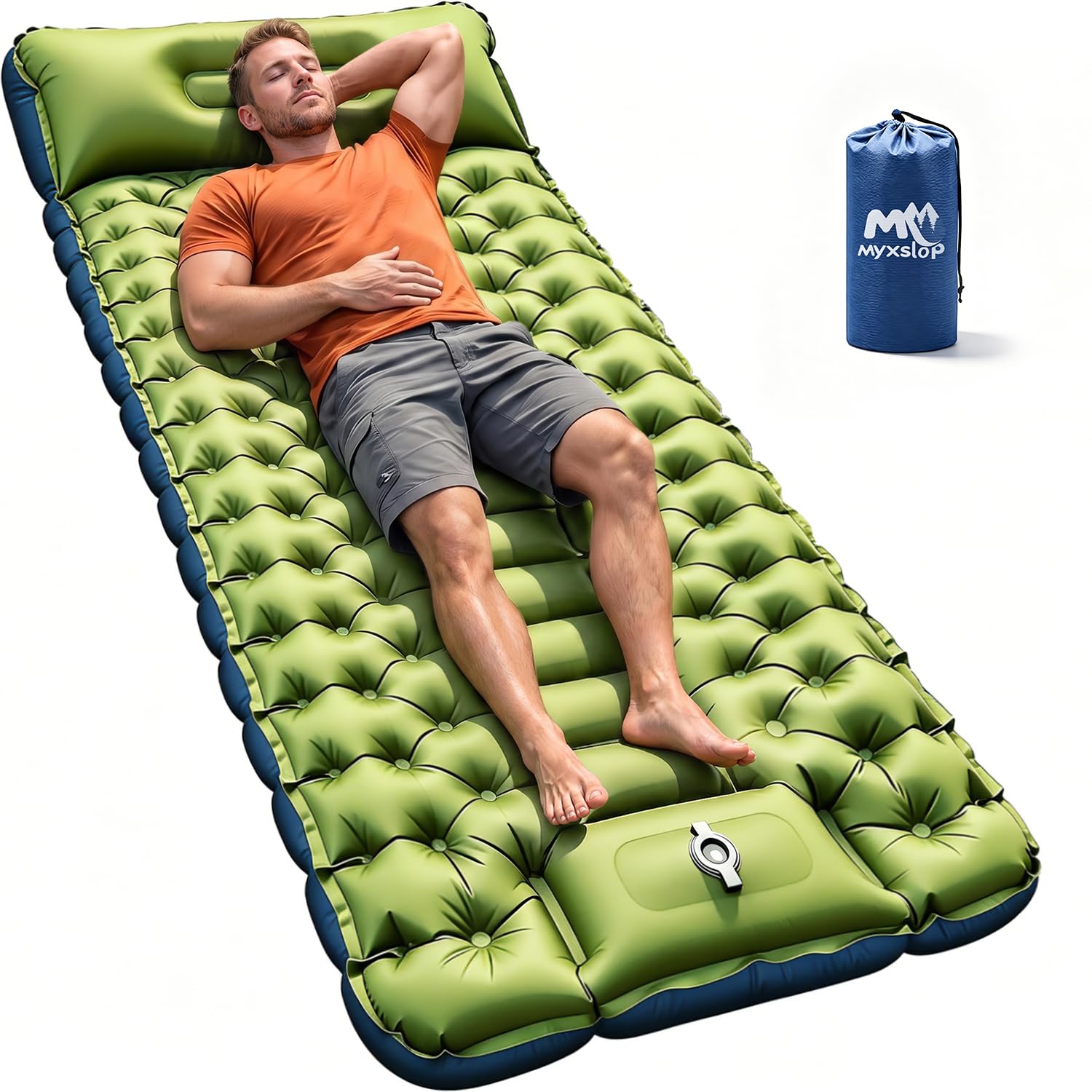
A 6.5-inch total height that rivals home mattresses, at 6.5 inches versus the Amazon Basics 2.2 inches.
The Myxslop pad combines a 4.5-inch air pad with a 2-inch integrated pillow to reach 6.5 inches off the ground. The honeycomb-shaped air chambers designed to keep your spine aligned whether you sleep on your side or your back. Buyers call it “more comfortable and thicker than expected” and praise the built-in foot pump that inflates in roughly 30 to 60 seconds. The 50D nylon outer layer is tougher than the 40D nylon used on the Oramoose pad, and the reinforced TPU coating adds puncture resistance. The weight is 1.5 pounds — only 0.1 pounds heavier than the Amazon Basics pad, at 6.5 inches versus the Amazon Basics 2.2 inches. The capacity is rated at 450 pounds, making it the highest weight limit here, at 450 pounds versus the Amazon Basics 220 pounds. One reviewer at 250 pounds noted it was “not great not terrible” and suggested it works best under 200 pounds. The side-snap fasteners let you connect two pads for a double bed.
What stands out
- Extreme 6.5-inch total height with built-in pillow
- 450-pound capacity — highest in this guide
- Rugged 50D nylon with TPU coating for puncture resistance
- Only 1.5 pounds despite the massive thickness
Watch out
- Not all users over 200 pounds find it supportive enough
- No R-value rating provided for cold-weather insulation
- Pillow height may feel too tall for stomach sleepers
Best suited for: car campers, large-framed sleepers, and anyone who wants maximum ground clearance at a budget price.
Not the best fit: backpackers counting every ounce (though 1.5 pounds is manageable) or side sleepers over 250 pounds who need extra firmness.
4. Sleepingo Ultralight Sleeping Mat

At just 0.87 pounds, this pad is lighter than the 1.9-pound Oramoose — a massive weight saving for backpackers.
Backpackers counting every gram should start here. The Sleepingo pad weighs 396 grams (0.87 pounds) and inflates in about 10 to 15 breaths using a smart one-way flap valve that seals shut between breaths — no air escapes. Multiple buyers confirm the inflation claim and report zero deflation overnight, even when sitting on the edge. Its R-value is 2.1, matching the Featherstone foam pad for comparable insulation against ground cold. The trade-off for this weight is thickness: at 2 inches versus the 4-inch Oramoose, so side sleepers may find their hips touch the ground with heavy shifting. The packed size is roughly that of a water bottle (8 inches by 3.5 inches). The ripstop nylon with TPU coating is water-resistant. One reviewer with a bad back slept in a car and called it a “life saver.” The narrow width of 21.5 inches feels snug compared to the 27.5-inch Oramoose — you may roll off if you move a lot.
Why backpackers love it
- Weighs just 0.87 pounds — ultralight for its class
- 10-15 breaths to inflate with a self-sealing valve
- R-value of 2.1 provides genuine cold-ground insulation
- Packs down smaller than a water bottle
Consider these
- 2-inch thickness means side sleepers may bottom out
- Narrow at 21.5 inches — less room to spread out
- Requires breath inflation (no foot pump option)
Ideal for: backpackers, hikers, and anyone who prioritizes low pack weight above all else.
Less ideal for: side sleepers who need thick cushioning or restless sleepers who need a wider surface.
5. Amazon Basics Camping Sleeping Pad with Foot Pump

It is the cheapest pad here at 1.4 pounds with a foot pump, but buyer reviews warn that the pump may fail and the pad may deflate overnight.
The Amazon Basics pad has a built-in foot pump that claims inflation in under 60 seconds. It weighs 1.4 pounds, packs to 12 inches by 4 inches, and uses 190T polyester fabric that is water-resistant. When inflated, it measures 75 inches by 22.4 inches with a 2.2-inch thickness — middle-of-the-pack comfort. Buyers are split: many love it for travel, calling it “compact, lightweight, inflates/deflates quickly” and noting it holds air all night. But a significant number report pump failure — one buyer mentioned the “built-in pump non-functional” and resorted to mouth inflation. More critically, one buyer called it “garbage” after it “failed on a 5-night trip” and “deflates noticeably by morning.” The capacity is 220 pounds, half the 450-pound limit of the Myxslop pad. The 190T polyester feels less rugged than the 50D nylon of the Myxslop. This durability risk steers most buyers toward the Oramoose pad instead.
If it works, it works
- Very lightweight at 1.4 pounds
- Built-in foot pump for no-hands inflation
- Packs small and fits easily in a backpack
- Lowest price point in this guide
Risks to know
- Multiple Amazon owners mention pump failure
- 220-pound weight limit — half of some competitors
- Buyers cite slow overnight deflation on extended trips
- Thinner than the Oramoose pad at 2.2 inches vs 4 inches
Consider this if: you are on the tightest possible budget, weigh under 220 pounds, and use it for short weekend trips where a failure is inconvenient but not catastrophic.
Be cautious if: you need a pad for multi-night backpacking trips or you are heavier than 220 pounds — the leak risk is real based on buyer feedback.
6. THINTON Foam Camping Pad

This 0.7-inch closed-cell foam pad never leaks, weighs 1.0 pound, and costs less than most inflatables — an unbeatable base layer.
The THINTON pad is the simplest product here: a sheet of IXPE closed-cell foam with an aluminum film on the back that reflects body heat. There is nothing to inflate, puncture, or fail. It weighs 455 grams (1.0 pound) and folds into a 23.6 by 5.5 by 5.5-inch block. Its R-value is rated at 2.1, matching the Featherstone pad for cold-ground insulation. One buyer calls it “wider than name brands” at 23.6 inches, keeping your arms off the ground — a common complaint with narrower closed-cell pads. However, the foam is less dense than premium brands, and side sleepers may find it too thin alone. One owner reported it is “thin so placed it under a blow-up mat” to keep a kid off rocks. Another noted the “bumps” on the foam were uncomfortable for one grandchild. The 1-year warranty is shorter than Featherstone’s limited lifetime warranty, but the price is lower. This pad works best as a base layer under an inflatable pad for extra insulation and puncture protection, or as a standalone pad for ultralight hikers used to firm surfaces. It is waterproof and moisture-proof.
Simple and effective
- No inflation or pump needed — instant setup
- Lightweight at 1.0 pound
- R-value 2.1 for cold-ground insulation
- Waterproof and moisture-proof construction
Know the limits
- Only 0.7 inches thick — firm for side sleepers
- Less dense foam than premium closed-cell pads
- Best used as a base layer, not a standalone comfort pad
Perfect for: ultralight hikers who want reliable insulation and zero maintenance, or as a budget-friendly base layer under an inflatable pad.
Not for: side sleepers needing cushioning or anyone expecting foam density equal to premium brands like Therm-a-Rest.
Understanding the Specs
Thickness (Inches)
This is the single most important spec for comfort. A pad that is 2 inches or thinner will not fully lift your hips off the ground if you sleep on your side. Pads at 4 inches or more create a real air gap that keeps your weight suspended. The Myxslop pad reaches 6.5 inches total with its pillow, while foam pads stay around 0.7 inches — adequate for insulation but not cushioning.
R-Value (Insulation Rating)
This number measures how well the pad stops your body heat from escaping into the cold ground. A rating of 1.0 to 1.9 is for warm-weather use only; 2.0 to 3.9 covers three-season camping (spring through fall); 4.0 and above is for winter. In this guide, the Sleepingo, Featherstone, and THINTON pads all have an R-value of 2.1, which is decent for mild to cool nights but not freezing conditions.
FAQ
How thick does a budget camping pad need to be for side sleepers?
What is the difference between a closed-cell foam pad and an inflatable pad?
Will a camping pad with a built-in foot pump last?
How do I pack a camping pad for backpacking?
Can I use a budget camping pad for winter camping?
How much weight can a budget camping pad hold?
Is a foam pad warmer than an inflatable pad?
How do I repair a leak in an inflatable camping pad?
Can I connect two budget camping pads together?
Final Thoughts: The Verdict
The budget camping pad winner for most people is the Oramoose 4in Ultralight pad — it gives you a genuine 4-inch thickness that side sleepers need, a roomy 79-by-27.5-inch surface, and a foot pump that works, all for less than most competitors. If you want ultralight performance for backpacking, grab the Sleepingo Ultralight Mat at under a pound. And if you need absolute durability with no inflation hassle for thru-hiking, the Featherstone El Cordion foam pad is the one that will never leave you flat.
How We Picked
We do not accept paid placement. Every pick is matched to a real buyer and a real use-case; we do not hands-on test units.
Sources & Methodology
Specifications: manufacturer listings and product documentation. Review insights: verified customer reviews, as of July 2026. Pricing: not shown on this page (it changes often); check the current price via the retailer link.
As an Amazon Associate, Gadgets Feed earns from qualifying purchases. This does not affect which products we feature.