
Our readers keep the lights on and my morning glass full of iced black tea. As an Amazon Associate, I earn from qualifying purchases.
Specs are compiled from manufacturer listings and verified buyer reviews and can change over time — please confirm the key details on the product page before buying.
Keeping an RV battery topped up, powering a small off-grid shed, or just running lights and a phone charger during a power outage — a 50W solar panel is the balance to start. But not all panels deliver what they promise. Some barely hit 35 watts in real sun, while others regularly push 60W or more. This guide is built around the handful of 50W panels that actually deliver their rating and survive being left outside.
I’m Min — the founder and writer behind Gadgets Feed. This guide is built by comparing the manufacturers’ published specifications and the patterns across verified customer reviews, so you get each pick’s real strengths and trade-offs instead of marketing spin.
If you need a rugged permanent roof panel or a portable kickstand model for weekend camping, we have sorted through technical specs and real owner experiences to find the 50W solar panels that earn their place on your setup.
Our Picks at a Glance
How To Choose The Best 50W Solar Panels
A 50W panel is small enough to be portable but powerful enough to keep a 12V battery healthy. The key is matching the panel type to where and how you will use it. Here is what actually matters.
Rigid vs Flexible vs Foldable — Pick the Right Build
A rigid panel with an aluminum frame and tempered glass is the most durable and efficient option for permanent mounting on an RV roof, shed, or boat. Flexible panels are ultra-thin and lightweight — they can bend around a curved surface like a camper top, but they run hotter and typically have a shorter lifespan. Foldable panels are designed for camping and portable power stations — they include built-in USB ports and a carry case, but their efficiency usually lags behind a rigid panel of the same rated wattage.
Cell Type and Efficiency — It Determines Real-World Output
Standard monocrystalline cells hit around 20-22% efficiency. N-type monocrystalline cells reach 24-25% efficiency. Higher efficiency means more power from the same physical size. If space is tight on your roof, an N-type panel will squeeze out noticeably more wattage per square inch than a standard panel. Low-light performance also varies — panels with bypass diodes and higher efficiency cells will still push 10-15 watts on a cloudy day, while cheaper ones may drop to near zero.
Connectors and Compatibility — You Need the Right Hookup
Most rigid panels use MC4 connectors (standard two-pin solar connectors) and need a separate charge controller to safely charge a 12V battery. Some portable panels come with a built-in PWM (Pulse Width Modulation) controller and alligator clips for direct battery connection. If you are pairing a panel with a portable power station like a Jackery or EcoFlow, look for a panel that includes an SAE (Society of Automotive Engineers) or Anderson adapter cable. An IP65 or higher rated junction box (the box at the back where cables connect) is important for any panel that will live outdoors permanently.
Quick Comparison
| Model | Best For | Efficiency | Weight | Dimensions | Amazon |
|---|---|---|---|---|---|
| Renogy 50W Rigid★ Best Overall | Trusted brand, rugged build | 22% | 7.3 lbs | 22.8″x19.8″x1.2″ | $53.69Amazon |
| Callsun 50W N-TypeAlso Great | Highest output per square foot | 25% | — | 23.9″x22.7″x1.1″ | $45.99Amazon |
| Goal Zero Boulder 50 | Goal Zero power station pairing | 22.6% | 12.4 lbs | 26.75″x21.75″x1.75″ | $249.95Amazon |
| SOLPERK 50W Kit | All-in-one kit with controller | 21%-30% | — | 21.3″x21.3″x4.45″ | $108.99Amazon |
| Renogy 50W Flexible | Curved roof surfaces | 22% | 3 lbs | 28.03″x18.11″x0.16″ | $76.99Amazon |
| SOKIOVOLA 50W Foldable (v2) | Lightweight camping / portable use | 24.8% | 2.1 lbs | 14.69″x7.88″x1.19″ | $59.99Amazon |
| SOKIOVOLA 50W Foldable (v1) | Budget portable / USB charging | 25% | 3.37 lbs | 13.08″x8.94″x1.19″ | $54.99Amazon |
In‑Depth Reviews
1. Renogy 50W 12V Monocrystalline Panel
Our pick — over 4.5★ from 650+ verified ratings; the strongest balance of quality and price.
The reliable workhorse with over 600 reviews and a proven track record in partial shade.
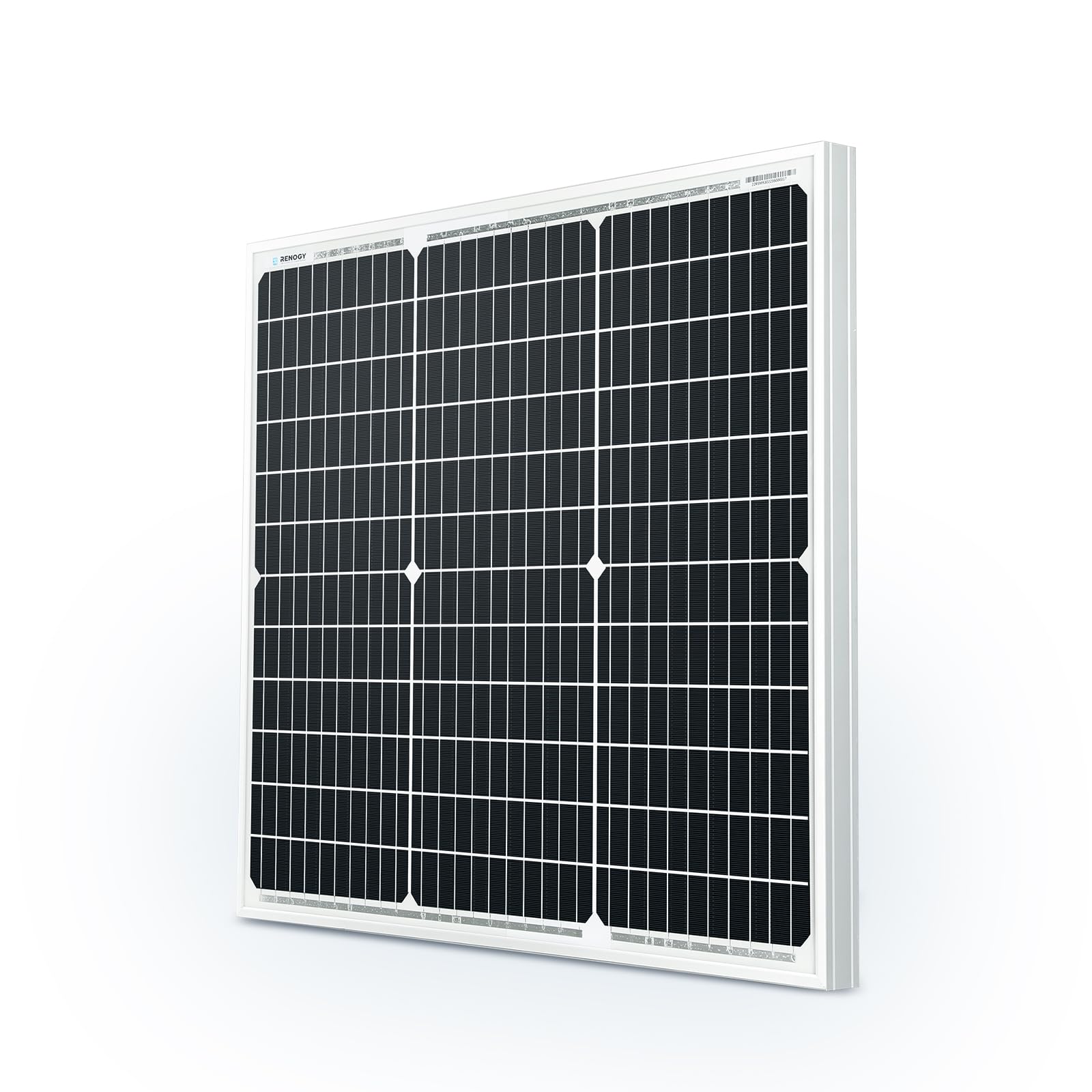
Renogy is among the most trusted names in the small-panel world, and this 50W rigid panel is a huge reason why. The monocrystalline cells reach an efficiency of 22% — several points behind the Callsun N-type panel above, but still solid for the category. The panel is EL-tested (electroluminescence tested, a process that checks for micro-cracks and defects invisible to the eye) to ensure no hot-spot heating, and it includes bypass diodes that minimize power loss when part of the panel is shaded.
Buyers confirm this panel performs well in less-than-ideal light. One reviewer noted the “50W panel delivers 40-42W under partial clouds, 12-15W fully overcast” — real numbers that prove its low-light chops. The panel weighs 7.3 pounds and measures 22.8″ x 19.8″ x 1.2″, making it slightly more compact than the Callsun panel (which is 23.9″ x 22.7″ x 1.1″). It features an anti-reflective, high-transparency tempered glass top and a corrosion-resistant aluminum frame. Build quality is excellent, and Renogy backs it with a 5-year material and workmanship warranty — a shorter coverage period than the Callsun’s 10-year tech support and 20-year performance guarantee.
Shade champion: If your panel will face partial cloud cover or some tree shadow, this Renogy panel’s bypass diodes keep producing while cheaper panels stop dead.
Coverage gap: The 5-year warranty is shorter than some competitors, but the panel’s construction quality and huge user base speak for themselves.
The right fit for: RV owners and off-grid beginners who want a proven, affordable panel that still works hard when the sun hides.
Consider something else if: you need the absolute highest efficiency from a small footprint — the Callsun N-type panel beats it there.
2. Callsun 50W N-Type 16BB Monocrystalline Panel
The rigid panel that routinely pushes 60W-plus, outpacing its own 50W rating by a wide margin.
If maximum real-world wattage per square inch is your priority, this Callsun panel is the standout. The advanced 16BB (16-busbar) cell design reduces micro-cracks and hot spots, so the panel holds up better over time compared to older 9BB or 10BB designs.
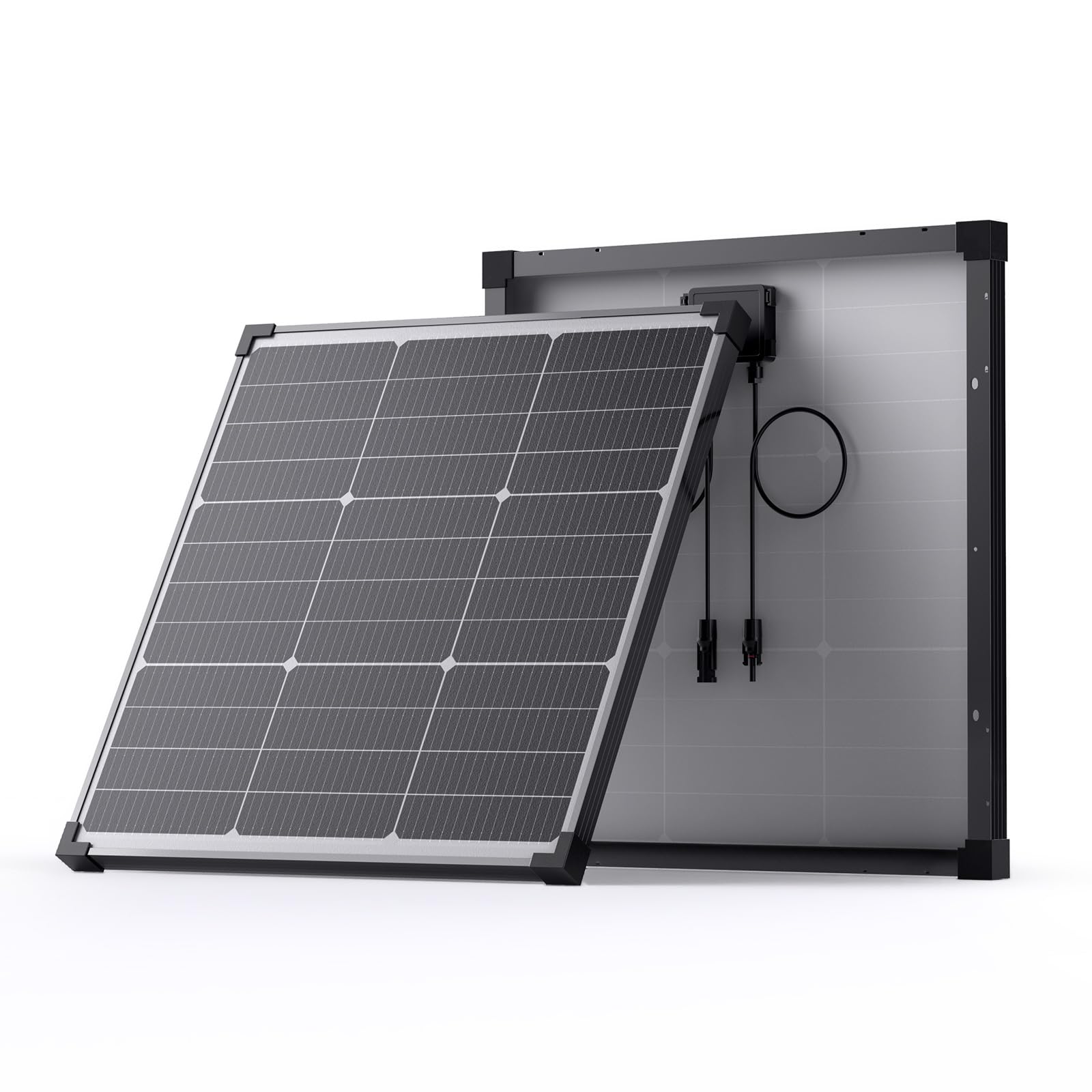
Buyers report absolutely stunning results: one owner measured 57 watts at 10 o’clock in the morning, while another saw peaks of 68 watts each in California March sun. A third reviewer tested theirs at 78W and 82W, well exceeding the 50W advertised rating. The panel is built with 3.8mm tempered glass and an aluminum alloy frame with IP67 waterproof protection (it can survive being submerged in 1 meter of water for 30 minutes, so driving rain and washing are no issue). The maker backs it with a 20-year performance guarantee to maintain 84.5% output, plus a 10-year tech support warranty for materials and workmanship. The trade-off is that it is a rigid frame panel — unlike the Renogy 50W Flexible panel, it cannot conform to a curved roof.
Output champion: If you want the 50W panel most likely to over-deliver and charge your battery faster than expected, this is the one.
Shape limitation: It is a rigid, glass-covered panel — it needs a flat mounting surface and is not for curved roofs or backpacking.
Reach for this if: you value maximum real-world power and higher efficiency from a durable, glass-covered rigid panel.
Look elsewhere if: you need a flexible panel for a curved RV roof or a portable kit with a charge controller included.
3. Goal Zero Boulder 50

The monocrystalline panel that pairs perfectly with Goal Zero Yeti power stations, no adapter hunting needed.
If you already own or plan to buy a Goal Zero Yeti power station, this Boulder 50 panel is the obvious pairing — it is field-tested and designed to integrate smoothly with the Goal Zero ecosystem. The monocrystalline cells deliver 22.6% efficiency, putting it between the Renogy rigid (22%) and the Callsun N-type (25%) on efficiency. It features a built-in kickstand for easy positioning and can be chained with multiple Boulder panels for higher capacity. At 12.4 pounds, it is noticeably heavier than the Renogy rigid (7.3 lbs) — a full 5.1 pounds more — so it is less portable for carrying by hand.
Buyers consistently report strong results with Yeti power stations. One owner said it “topped Yeti 150 from 60% to 100% in 3 hours (direct sun, 90°F, 10% clouds).” Another reviewer used it to keep their CPAP machine, cable modem, and phones charged during a 48-hour power outage. The panel is built with an anodized aluminum frame with corner protection and tempered glass. Goal Zero offers a 2-year warranty, which is notably shorter than the Callsun panel’s coverage. The Boulder 75 could be a better choice for significantly more capacity, but at a much higher price.
Ecosystem perfect: This is the best panel if you are already in the Goal Zero Yeti family — no adapter hunting, just plug and charge.
Weight penalty: At 12.4 pounds, it is 5.1 lbs heavier than the Renogy rigid panel and much heavier than any flexible or foldable option.
Pick this when: you own a Goal Zero Yeti power station and want one panel that is guaranteed to work right from the start.
skip it if: you are on a tight budget or need a lightweight panel for portable use — the SOKIOVOLA foldable panels are better for that.
4. SOLPERK 50W 12V Solar Panel Kit

The all-in-one kit that comes with a charge controller and adjustable mount, ready to install from the start.
Most 50W panels force you to buy a charge controller and mounting hardware separately — not this SOLPERK kit. You get the 50W monocrystalline panel, a 10-amp IP65 waterproof charge controller that prevents overcharging, a 60-degree angle adjustable mounting bracket (with settings at 0°, 15°, 30°, 45°, and 60°), alligator clips, an SAE extension cable, and mounting screws. The only thing you need is a 12V battery. This makes it the best choice for a solar newbie who just wants one box, no extra trips to the hardware store.
Owners mention strong charging performance in winter conditions. One reviewer in New England used it to charge a battery that powered a water pump, saying “It’s in the middle of winter right now here in New England. And it’s out there collecting sun and charging the battery. No complaints.” The panel itself uses low-iron tempered glass and a corrosion-resistant aluminum frame, rated to withstand 2400Pa wind pressure and 5400Pa snow loads. The catch, noted by multiple reviewers, is that the included charge controller sometimes fails after a few months. One owner reported “Controller failed at about 3 months,” while another praised it for “easy installation with all needed parts.”
Complete package: You get a panel, mount, and controller in one box — perfect for first-time buyers who do not want to piece together components.
Controller weak spot: The charge controller quality is inconsistent — you may eventually want to swap it for a better standalone unit.
Best for: beginners who want a turnkey setup for trickle-charging a camper, boat, or tractor battery without researching components.
Not ideal if: you already have a good charge controller or need a panel for a portable power station — buy a bare panel instead.
5. Renogy 50W Flexible Monocrystalline Panel

The ultra-thin, 3-pound panel that bends around a curved RV roof or boat cabin top.
Standard rigid panels like the Callsun or Renogy above are a problem if your mounting surface is curved. Renogy’s 50W flexible panel is the solution. At only 0.16 inches thick — compared to rigid panels that are about 1.2 inches thick — and weighing just 3 pounds compared to the Renogy rigid’s 7.3 pounds, it can be attached directly to a curved Airstream top or a sailboat bimini using adhesive or snaps. The polymer material and advanced lamination make it flexible enough to follow a gentle curve while still being durable. It uses monocrystalline cells with 22% efficiency and produces 2.75 amps at 12 volts.
Buyers confirm it holds up over the long term outdoors. One owner reported after “a full year under Florida sun the panels still looking great, and putting same amps as when I first installed them.” Another reviewer noted the panel is “a little stiffer than expected” — which was actually a good thing because it kept the panel from flapping in the wind on a boat cabin top. The trade-off is that flexible panels generally run hotter than glass-covered panels, which can reduce efficiency on very hot days. Additionally, several owners noted the eyelet rivets can come loose over time, and the panel is not as bendable as you might expect — it can handle a gentle curve, not a sharp fold.
Shape saver: If your mounting surface is curved, this is the panel you need — it conforms where a rigid panel simply cannot sit.
Heat and rivet caution: Flexible panels run hotter than glass panels, and the mounting eyelets may wear out before the panel itself.
Who it serves: Van-lifers, sailboat owners, and anyone who needs solar on a curved roof without drilling into the surface.
Not for you if: you have a flat mounting surface — a rigid panel will be more efficient per dollar and last longer.
6. SOKIOVOLA [Upgraded] 50W Foldable Solar Panel (v2)
The featherweight folding panel that packs down to the size of a small tablet bag.
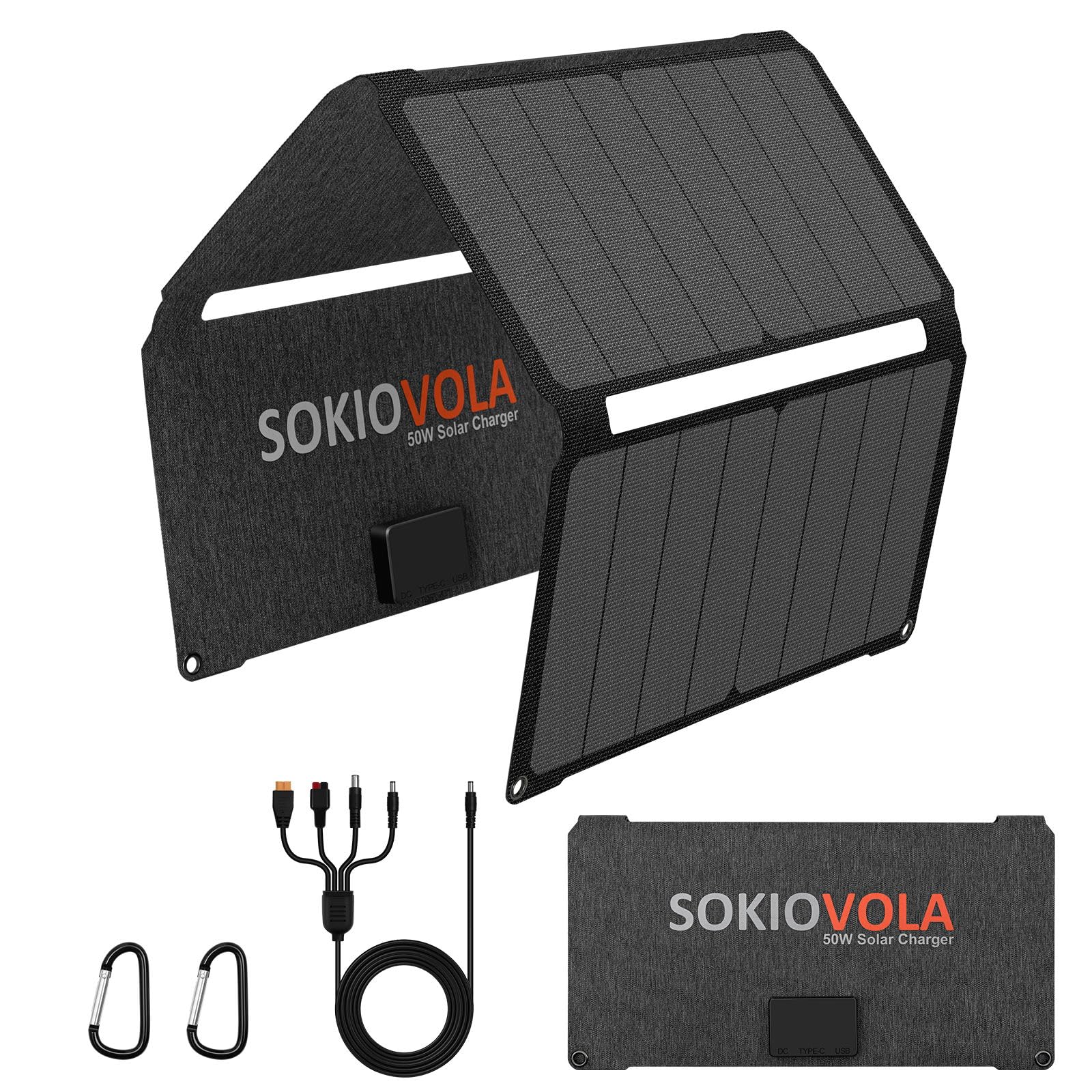
Weighing just 2.1 pounds and folding down to 14.69″ x 7.88″ x 1.19″, this SOKIOVOLA panel is the clear choice for backpackers and campers who count every ounce. It uses high-efficiency monocrystalline cells with a claimed conversion rate up to 24.8%, and it comes with three output ports: a QC3.0 USB-A (standard 18W max), a USB-C PD (30W max, enough to fast-charge a laptop in good sun), and a DC 18V/2.78A barrel port for charging portable power stations. The ETFE (ethylene tetrafluoroethylene, a tough plastic coating) coating improves light transmission to 95% and makes the panel more durable than PET-based panels. It also carries an IP68 waterproof rating for the panel itself (higher than IP65 or IP67, meaning submersion deeper than 1 meter is safe).
Buyers are impressed with the power this lightweight panel can deliver. One reviewer tested it and got 104 watts out of it just by placing it on a curved windshield in the late afternoon. Another owner, a senior citizen living van life, praised it as “light weight solar panel is extremely important, cause space in a van is extremely limited.” The kit includes a DC5521 cable with adapters for XT60, DC7909 (8mm), and Anderson connectors, making it compatible with most small power stations from Anker, Jackery, and EcoFlow. The built-in pocket and carrying case are convenient, though one buyer mentioned there is “nothing to hold them up” — you will need to prop the panel at an angle yourself, unlike the Goal Zero Boulder 50 which has a built-in kickstand.
Weight king: At 2.1 pounds, it is the lightest 50W panel here by a wide margin — ideal for carrying into a campsite.
No stand included: Unlike the Goal Zero Boulder 50, this panel has no kickstand, so you need a backpack or tree branch to angle it.
Reach for this when: you are hiking, camping, or van-living and need a panel that is genuinely easy to pack and carry.
pass on it if: you need a permanent roof-mounted solution or want a built-in stand for easy positioning.
7. SOKIOVOLA 50W Portable Foldable Solar Panel (v1)

The budget-friendly foldable that includes USB-A and USB-C ports for direct device charging.
If you are looking for a low-cost entry into portable solar that can charge your phone and power station without any extra adapters, this is the panel. It uses A+ Grade 16BB N-type mono cells with a conversion efficiency claimed up to 25%, the same N-type tech as the premium Callsun rigid panel above but in a foldable format. It weighs 3.37 pounds and folds down to 8.94″ x 13.08″ x 1.19″. The panel is built with IP68 waterproof ETFE lamination and dragon dance cloth, and includes a 39.37-inch DC5521 cable, Anderson connector, 10 adapters, and two mountaineering buckles for hanging.
Mixed real-world results separate this panel from the v2 model above. One buyer was disappointed, reporting: “Disappointing 35W via DC plug in ideal sun. Only 10W more than 30W panel but much larger.” Another owner had a more positive experience, using it to “charge from 90% to 99% in 18 minutes” on a Daran power station. The USB-A port outputs QC3.0 at up to 24W, and the USB-C port delivers up to 30W PD, which is enough to fast-charge a laptop in good sun. The junction box is not waterproof, so you cannot leave the controller end of the panel in the rain. Despite the mixed output reports, the panel has a 12-month warranty and the maker promises a 12-hour reply time to questions.
Low-cost entry: If your budget is tight but you still want N-type cell efficiency and USB ports, this panel gets you in the game.
Inconsistent wattage: Some owners see only 35W in full sun, which is far below the rated 50W — the v2 model above seems more consistent.
Best for: someone on a strict budget who needs a foldable panel with USB ports for charging phones and small power banks.
Not recommended if: you need reliable 50W output — the v2 SOKIOVOLA foldable delivers more consistent power for a modest step up in price.
Understanding the Specs
Efficiency — Not All 50W Is Equal
A panel’s efficiency rating tells you how much of the sunlight hitting it gets turned into electricity. Higher efficiency means a smaller panel can produce the same power. Entry-level panels hover around 20-22%, while premium N-type cells reach 24-25%. The Callsun N-type panel’s 25% efficiency vs the Renogy rigid’s 22% means you get more wattage per square inch — useful when roof space is tight. In practice, efficiency also affects low-light performance: higher-efficiency panels still produce 10-15W on an overcast day, while lower-efficiency panels may drop closer to zero.
Cell Type — N-Type vs P-Type Monocrystalline
Traditional P-type monocrystalline cells top out around 21-23% efficiency. Newer N-type monocrystalline cells reach 24-25% and degrade slower over time. The “16BB” in the Callsun and SOKIOVOLA panels refers to 16 busbars — the thin silver lines on the cell surface that collect electricity. More busbars reduce the distance electricity has to travel, which lowers resistance and improves efficiency. N-type cells also handle heat better than P-type cells, which matters if your panel sits on a dark RV roof in summer.
Waterproof Rating — IP65 vs IP67 vs IP68
These numbers tell you how well the panel resists dust and water. IP65 means the panel is dust-tight and can handle low-pressure water jets (rain). IP67 adds protection against immersion in up to 1 meter of water for 30 minutes. IP68 is the highest common rating, meaning the panel can be submerged deeper than 1 meter. Most rigid panels are IP65, while the Callsun panel uses IP67 and the SOKIOVOLA foldable panels claim IP68. Note that the junction box (where cables plug in) may have a lower rating than the panel itself.
Charge Controller — PWM vs MPPT
A charge controller sits between the panel and the battery to prevent overcharging. PWM (Pulse Width Modulation) controllers are simpler and cheaper — they work fine for small 50W systems but waste some power, especially in cold weather. MPPT (Maximum Power Point Tracking) controllers are more efficient and can extract 15-30% more power from the same panel, but they cost more. The SOLPERK kit includes a PWM controller. The Callsun and Renogy panels are compatible with both controller types. If you pair a 50W panel with an MPPT controller, you will typically see better real-world charging speeds when the sun is low.
FAQ
Can a 50W solar panel run a refrigerator?
How many amps does a 50W 12V solar panel produce?
Will a 50W solar panel charge a 12V battery?
What is the difference between 50W and 100W solar panels for my RV?
How long does a 50W solar panel last?
Do I need a charge controller for a 50W solar panel?
Can I connect multiple 50W solar panels together?
What does N-type solar cell mean and is it better?
Can I leave a 50W solar panel out in the rain?
How much space does a 50W solar panel need on my RV roof?
Final Thoughts: The Verdict
For the majority of shoppers, the 50w solar panels winner is the Callsun N-Type 16BB 50W Panel because it consistently exceeds its 50W rating in real-world use, hits 25% efficiency with N-type cell technology, and comes with a strong 20-year performance guarantee. If you want a trusted brand with proven shade performance, grab the Renogy 50W Rigid Panel. And for portable camping use where every pound matters, the standout is the SOKIOVOLA [Upgraded] 50W Foldable Panel at just 2.1 pounds.
How We Picked
We do not accept paid placement. Every pick is matched to a real buyer and a real use-case; we do not hands-on test units.
Sources & Methodology
Specifications: manufacturer listings and product documentation. Review insights: verified customer reviews, as of July 2026. Pricing: not shown on this page (it changes often); check the current price via the retailer link.
As an Amazon Associate, Gadgets Feed earns from qualifying purchases. This does not affect which products we feature.
Related Guides
Product prices and availability are accurate as of the date/time indicated and are subject to change. Any price and availability information displayed on Amazon at the time of purchase will apply to the purchase of this product. As an Amazon Associate I earn from qualifying purchases.
CERTAIN CONTENT THAT APPEARS ON THIS SITE COMES FROM AMAZON. THIS CONTENT IS PROVIDED "AS IS" AND IS SUBJECT TO CHANGE OR REMOVAL AT ANY TIME.
Amazon and the Amazon logo are trademarks of Amazon.com, Inc. or its affiliates.