
Our readers keep the lights on and my morning glass full of iced black tea. As an Amazon Associate, I earn from qualifying purchases.
Specs are compiled from manufacturer listings and verified buyer reviews and can change over time — please confirm the key details on the product page before buying.
To get deep, clean bass into your car or truck, you need the right box. An 8-inch sub enclosure gives you punchy low end without swallowing your whole trunk. Pick the wrong one, and your subwoofer will not fit or will sound thin. The three things that matter are the type of box (sealed or ported), the space you have to install it, and how well the box’s airspace matches your subwoofer.
I’m Min, founder of Gadgets Feed. This guide uses published specs and patterns from verified buyer reviews to give you real strengths and trade-offs, not marketing spin.
From a slim sealed wedge that fits behind a pickup seat to a powerful ported chamber for a trunk, your options cover every need.
Our Picks at a Glance

How To Choose The Best 8-Inch Sub Enclosure
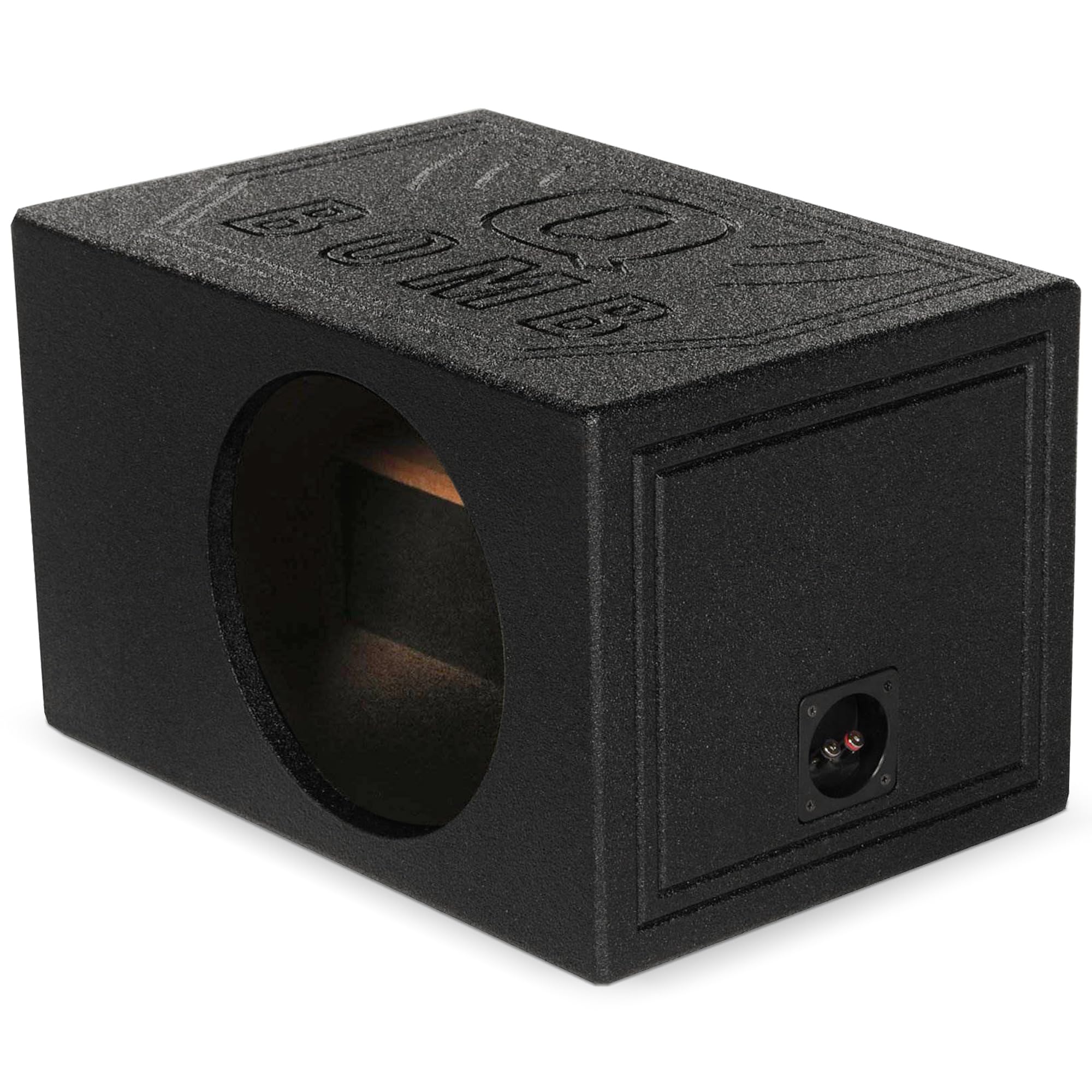
An 8-inch sub enclosure is a box that holds your 8-inch subwoofer and shapes its sound. Your choice depends on three things: box style (sealed vs. ported), the space you have in your vehicle, and build quality. Get those right, and your sub will sound clean and hit hard.
Sealed vs. Ported: What does the box type do to the bass?
A sealed enclosure is an airtight box. It gives you tight, accurate bass that is punchy and musical — good for rock, jazz, and anything where you want notes to start and stop quickly. A ported enclosure has a vent or tube (the port) that lets air move in and out. This boosts low-frequency output, making bass louder and deeper — great for hip-hop and EDM. The trade-off is that ported boxes are physically bigger, and the bass can feel a little looser. If you want to feel the bass more than hear every detail, go ported.
Enclosure volume and tuning: Does the box size match your sub?
Every 8-inch subwoofer is made to work best in a specific internal airspace, measured in cubic feet. If the box is too small, the sub sounds tight and won’t play low notes. If the box is too big, the sub can bottom out or sound sloppy. Ported boxes also have a tuning frequency (measured in Hz) — this is the frequency where the port is most efficient. It determines where the bass peaks. A common, good tuning for an 8-inch ported box is around 34 Hz to 39 Hz — this gives you deep low end without sacrificing punch.
Vehicle fit: Will the box actually fit in your car or truck?
This is where most people get tripped up. Measure the height, width, and depth of the space where the box will go — trunk, back seat, or behind a truck seat. Slanted or wedge-shaped boxes are made to fit behind seats in pickups and coupes. A slim, shallow box (like under 6 inches deep) can slide under a seat. A standard rectangular box is better for a trunk. Always check the mounting depth too: that is how deep the magnet of your subwoofer goes into the box. If it is deeper than the box allows, the sub simply will not fit.
Quick Comparison
| Model | Best For | Type | Airspace | Dimensions (H x W x D) | Amazon |
|---|---|---|---|---|---|
| Atrend 8 inch Vented★ Best Overall | Deep bass on a budget | Ported | Not specified | 10.5″ x 12.5″ x 16.5″ | Amazon |
| QPower Single 8-InchAlso Great | Ported, precision-tuned, durable | Ported | 1.0 cubic feet | 15″ x 18″ x 13″ | Amazon |
| Goldwood TR8F | Tight spaces / trucks | Sealed | 0.4 cubic feet | 11.25″ x 15.25″ x 5″–7.25″ | Amazon |
| OnlyFactoryDirect Wedge 8F | Budget-priced sealed wedge | Sealed | Not specified | Not specified | Amazon |
| Nippon 8″ Tube Box | Unique tubular ported design | Ported (Tube) | Not specified | Not specified | Amazon |
| CT Sounds CT1X8 | High-end audio / kerf port | Ported (Kerf) | Not specified | Not specified | Amazon |
| Pioneer TS-A2000LB | Shallow mount, all-in-one | Sealed (Pre-loaded) | Not specified | 9.875″ x 13.75″ x 5.125″ | Amazon |
In‑Depth Reviews
1. Atrend 8 inch Vented Enclosure Carpeted Car Subwoofer Speaker Box
Our pick — 4.5★ from 900+ verified ratings; the strongest balance of quality and price.
This value-priced ported box brings the low end for about the cost of dinner out.
The Atrend enclosure is built with 3/4-inch MDF and uses aliphatic wood glue with brad nails for an airtight seal that prevents rattles. The mounting depth is 14.5 inches (deep enough for most 8-inch subs), with a sub cutout of 7 inches, and outer dimensions of 10.5 inches tall by 12.5 inches wide by 16.5 inches deep. That width is 44% wider than the Goldwood box, making it a snug fit for smaller spaces, but the 16.5-inch depth gives it the biggest internal volume for deep bass in this price range — it is 27% deeper than the QPower’s 13-inch depth. One buyer hooked it up with an Infinity 1250w sub and a Jensen 1000w amp and reported it “amplifies low ends, transforms sound” in a 99-04 Mustang convertible. Another reviewer noted that the box uses mostly 3/4-inch MDF but has some 1/2-inch MDF panels, and that the port tuning feels high at around 45–50 Hz, potentially cancelling very low notes. They fixed it by partially blocking the port with a pool noodle, dropping tuning to about 31 Hz.
Smart value call: You get a large ported box for a great price, but be ready to modify the port if you want sub-40 Hz extension (deeper bass), or just aim the port at a wall.
Best for: buyers on a tight budget who want a ported box and are comfortable doing a minor mod to tune the port lower.
Not ideal for: anyone who wants the highest build consistency — mixed MDF thickness and potential shipping damage are real risks.
2. QPower Single 8-Inch Vented Chamber Subwoofer Box
This ported box delivers deep, punchy bass with a rugged coating that survives any trunk.
You get low-end extension that most budget 8-inch boxes miss, thanks to 1.0 cubic foot of airspace tuned to 34 Hz (the frequency where the port works best). This spec gives you powerful, accurate low frequencies without boomy muddiness. The 3/4-inch MDF (a dense, vibration-resistant wood composite) keeps sound clean, and the bed liner coating on the outside protects against scratches and moisture — so it holds up in a trunk or truck bed. Buyers report pairing it with a Sundown E8 for surprising low-end performance, and one owner said it fit a single 8-inch Solobaric Kicker perfectly. The box measures 18 inches wide, 13 inches deep, and 15 inches tall. One reviewer measured actual airspace at 0.94 cubic feet — slightly less than advertised, but still within range for most subs. Compared to the Atrend 8 inch Vented below, the QPower is wider (18 inches vs 12.5 inches) and taller (15 inches vs 10.5 inches), offering more internal volume for deeper bass at the cost of a larger footprint. The side-ported design keeps the port from getting blocked in tight corners.
Why it wins
- 1.0 cubic foot airspace tuned at 34 Hz for solid low-end
- Rugged bed liner coating resists wear and moisture
- Spring-loaded terminals for easy wiring
What to keep in mind
- Actual airspace may measure slightly less than 1.0 cubic foot
- Packaging can be minimal, so check for shipping damage
Reach for it if: you want a ported box that hits low frequencies cleanly and is built to last through years of daily driving.
Look elsewhere if: you need a box that is less than 12 inches wide to fit a tight trunk or behind a seat.
3. CT Sounds CT1X8 Single 8” Kerf Port Universal-Fit Car Subwoofer Box

A kerf-style port and dado joints make this box the choice for serious sound quality on a budget.
Unlike a standard square port that creates turbulence and whistling noise, the kerf port (a smooth, rounded port opening) on this CT Sounds enclosure reduces air resistance — which means deeper, more accurate bass with less port noise. The 3/4-inch MDF is joined with dado and miter joints (precision interlocking cuts) for an airtight seal that stays vibration-free. Internal walls are lined with poly-fill, a padding that absorbs standing waves inside the box, smoothing out the frequency response. The enclosure has a 7.37-inch cutout diameter and is tuned at 39 Hz, a frequency that works well for most music genres. The pre-soldered 12-gauge speaker wires (thick enough for good power flow) are better than the thin wires found on budget boxes, so you do not need to open the box to upgrade them. One reviewer paired it with a Sundown Audio X8 v4 and reported it sounded awesome behind the seats of a Subaru BRZ.
Build quality edge: Dado and kerf construction plus poly-fill and thick pre-soldered wiring makes this the best-built box on this list for the money, and buyers with high-excursion subs (subs designed for large movement) like the meso-8 report a perfect fit.
Go with this pick if: you care about port noise and build precision and are willing to pay a little more for a box that sounds cleaner than a typical budget ported enclosure.
skip it if: you need a box smaller than standard size — owners mention it is a little bigger than expected for some trunk setups.
4. Single Car Truck Wedge Black Subwoofer Box Sealed Enclosure for 8-Inch Woofer 8F

A simple sealed wedge that fits behind a seat and gives you clean, tight bass without taking up trunk space.
This box is a sealed wedge design made in the USA, which means it fits the slanted space behind a pickup or coupe seat where a regular rectangular box won’t work. The sealed design gives you accurate, punchy bass that starts and stops fast — perfect for rock, metal, or any music where you want each bass note to be distinct. The MDF construction is sturdy, and multiple reviewers commented on the clean finish and airtight seal. One owner fit an Infinity 860w sub into this box on the rear shelf of a Nissan 370z and reported it “sounds amazing with 300w RMS” (a continuous power rating). A common note from buyers is that the internal speaker wires are thin 18-gauge wire, which you will likely want to replace with 12-gauge for better power transfer. The pre-cut hole can also be slightly small, needing a minute of filing to fit some speakers perfectly.
Why it works
- Wedge shape fits tight behind seats in trucks and coupes
- Sealed design gives tight, accurate bass response
Small fixes needed
- Thin 18-gauge internal wires should be upgraded
- Cutout may need slight filing for certain subs
Reach for it if: you need a wedge-shaped sealed box for a tight fit behind a seat or on a shelf and are okay swapping the included wires.
Look elsewhere if: you want a ported box for deeper low-end extension or need a rectangular box for a trunk.
5. Pioneer A-Series TS-A2000LB 8” Subwoofer with Enclosure

An all-in-one shallow-mount sub and enclosure for under-seat or tight-cab installs.
The Pioneer TS-A2000LB is a pre-loaded sealed enclosure — the subwoofer is already installed and wired, so you just connect it to an amplifier and drop it into place. The box is extremely shallow at 5.125 inches deep, with a height of 9.875 inches and width of 13.75 inches — this lets it fit under the seat of most trucks or extended-cab vehicles. The sub has 700W max power and 250W nominal power (continuous handling), with a 2-ohm single voice coil (a type of electrical connection) that makes wiring simple. The enclosure includes adhesive feet and threaded feet so you can install it down-firing (facing the floor) for even more flexibility in tight spaces. One reviewer noted it adds “solid low bass thump” in small vehicles with just a 150W rear-channel amp. The Glass-Fiber & Mica Reinforced IMPP cone (a stiff composite material) keeps the woofer rigid for clean sound at higher volume. On the downside, a single buyer reported poor output and popping when gain was increased, though that is an outlier among 564 ratings that average a solid 4.2 stars.
What you get for the price: A compact, ready-to-run sub system with premium Pioneer engineering that fits where standard boxes do not, but at 83 dB efficiency (a measure of loudness per watt) it needs decent amplifier power to really wake up.
Best for: pickup owners or anyone needing an 8-inch sub enclosure that slides under a seat without any extra assembly.
Not for: competition-level bass or big vehicles — this is a solid low-end supplement, not a window-shaker.
6. Goldwood TR8F 8″ Single Truck Box Speaker Cabinet

This slim, sealed wedge slides behind the seats of a single-cab truck without a fight.
The Goldwood TR8F gives you a sealed enclosure volume of 0.4 cubic feet (internal airspace) in a truck-friendly shape. The front (where the woofer mounts) is slanted, and the back is flat, with dimensions of 11.25 inches high, 15.25 inches wide, and a top depth of just 5 inches that widens to 7.25 inches at the bottom. The mounting depth is 4.75 inches — tight, so you need a shallow sub to fit here. One buyer mentioned it fit perfectly “under back seat of Maverick” after trimming a plastic bin and mounting to the chassis. This sealed box delivers tight, accurate bass rather than booming. It works great with an 8-inch Kicker CompR, and another reviewer paired it with a Dayton Audio 8-inch sub and a TPA3116 amp for a home system that produced deep bass in classical organ and piano concertos. The terminal is a bulkhead style with gold screw posts — some customers note it feels a bit cheap, but nobody reported it failing. The 0.4 cubic feet of airspace is small, so avoid subs that need a larger sealed volume.
Why it fits
- Slim slanted profile fits under seats and behind truck cabs
- Sealed box gives tight, musical bass
- High quality MDF hardwood construction
What to watch
- Small 0.4 cubic foot volume limits sub choice
- Bulkhead terminals feel a little flimsy
Reach for this if: you drive a small pickup or coupe and need a box that tucks behind the seat with a shallow sub.
pass on it if: your sub has a mounting depth over 4.5 inches or needs more than 0.4 cubic feet of airspace.
7. Nippon 8″ Subwoofer Tube Box

This cylindrical ported box fits odd spaces and wrings surprising output from an 8-inch sub.
The Nippon tube box is shaped like a cylinder instead of a rectangle, so it fits into round or narrow spaces where a square box would not go — think the corner of a trunk, or behind a seat in a convertible. The ported tube design is naturally efficient at producing volume from a small sub, and the maker says it works well with high-excursion subs for maximum power. One owner reported it worked “well for my convertible” and paired it with a 10-inch tube from the same company for more output. The internal wiring uses 22-gauge wire soldered to the terminals — several reviewers point out this feels small and should be upgraded for better power delivery. One reviewer needed to use a spacer because the 8-inch hole was slightly too big for their sub. Another buyer was harsh on the build quality, comparing it to a cardboard tube with poor silicone work. However, the overall average of 4.1 stars across 201 ratings suggests that most buyers get a functional, decent-sounding tube for the low entry price.
The real deal: You get a ported enclosure shape that fits where nothing else does, but the build quality is a gamble, and you will likely want to replace the internal wiring.
Best for: a unique installation where a round ported tube is the only shape that works, or anyone curious about tube-loaded bass on a tight budget.
Look elsewhere if: you want predictable fit and finish or a box that is ready to go with no modifications.
Understanding the Specs
Airspace (Cubic Feet)
Airspace is the internal volume of the box measured in cubic feet. Your subwoofer has a recommended airspace range from the manufacturer — usually printed in the manual or online. If the box has too little airspace, the sub sounds tight and can’t play low notes. Too much airspace, and the sub may bottom out or sound boomy. A ported box also includes the port volume as part of the airspace. Always check the sub’s spec sheet and match the box’s internal volume as closely as possible.
Tuning Frequency (Hz)
On a ported enclosure, tuning frequency is the frequency where the port is most efficient — it determines where your bass peaks. A lower tuning (like 34 Hz) gives you deeper, more rumbling bass for hip-hop and electronic. A higher tuning (around 45 Hz or above) gives you punchier bass that is louder but not as deep. Most 8-inch ported boxes are tuned between 34 Hz and 39 Hz for a good balance. Sealed boxes do not have a tuning frequency; their response is naturally smoother.
FAQ
Will an 8-inch sub enclosure fit under the seat of my pickup truck?
What is the difference between a sealed and ported 8-inch box for bass quality?
How do I know if my 8-inch subwoofer fits the enclosure?
Can I use a ported box for a sub that is designed for a sealed enclosure?
What does “kerf port” mean on an 8-inch sub box?
Why does my 8-inch sub enclosure smell like chemical fumes when I open the box?
Should I upgrade the internal speaker wires in my 8-inch sub enclosure?
Can I use an 8-inch sub enclosure for a home audio system?
What mounting depth do most 8-inch sub enclosures allow?
How do I mount my 8-inch sub enclosure in a trunk to prevent sliding?
Final Thoughts: The Verdict
For most people, the 8-inch sub enclosure winner is the QPower Single 8-Inch Vented Chamber. It packs 1.0 cubic foot of airspace with precise 34 Hz tuning and a rugged bed liner at a fair price. If you want a cleaner sound from a kerf port and poly-fill interior, pick the CT Sounds CT1X8. And if you need a pre-loaded, shallow-mount setup that slides under a truck seat ready to go, the Pioneer TS-A2000LB is the one.
How We Picked
We do not accept paid placement. Every pick is matched to a real buyer and a real use-case; we do not hands-on test units.
Sources & Methodology
Specifications: manufacturer listings and product documentation. Review insights: verified customer reviews, as of July 2026. Pricing: not shown on this page (it changes often); check the current price via the retailer link.
As an Amazon Associate, Gadgets Feed earns from qualifying purchases. This does not affect which products we feature.