
Our readers keep the lights on and my morning glass full of iced black tea. As an Amazon Associate, I earn from qualifying purchases.
Specs are compiled from manufacturer listings and verified buyer reviews and can change over time — please confirm the key details on the product page before buying.
Dialing in an air-fuel mixture by ear or by plug color leaves too much to chance — one lean surge under load can cost you a motor. A wideband oxygen sensor gauge replaces guesswork with a live number, showing exactly whether your engine is running rich, lean, or right at the stoichiometric (the chemically ideal 14.7:1 air-to-fuel ratio) balance. Whether you are tuning a carbureted classic, a boosted track build, or a daily driver with a piggyback programmer, the right kit turns a black-box process into a readout you can trust.
I’m Min — the founder and writer behind Gadgets Feed. This guide is built by comparing the manufacturers’ published specifications and the patterns across verified customer reviews, so you get each pick’s real strengths and trade-offs instead of marketing spin.
The six picks below cover the realistic spectrum of budgets and features, from no-frills tune-up helpers to pro-level dual-bank logging tools — and together they represent the strongest choices in the air fuel gauge category you will find today.
Our Picks at a Glance


How To Choose The Best Air Fuel Gauge
Picking the right wideband gauge is mostly about matching the sensor generation, the output type, and the display style to your car and your tuning goals. Start with these three filters.
Sensor Generation: LSU 4.2 vs. LSU 4.9
The oxygen sensor is the heart of the kit. The older Bosch LSU 4.2 sensor is widely used and proven, but the newer LSU 4.9 sensor delivers a typical response time of 20 milliseconds — a real advantage when you are hunting for quick AFR changes at high RPM. Several of the mid-range kits now come with the 4.9, giving you faster data without a premium price tag.
Output and Connectivity: Analog vs. OBD-II
If you plan to log data with software like HP Tuners or a stand-alone ECU (Engine Control Unit — your car’s main computer), you need the right output. Most budget and mid-range gauges offer a 0-5V analog output that any ECU or data logger can read. The premium tier adds OBD-II pass-through, letting the gauge talk directly over the CAN bus (Controller Area Network — the modern communication backbone most vehicles use) — no extra wiring for the logging signal.
Display and Form Factor
The standard housing size across nearly all gauges is 52mm (2-1/16 inches), so fitting into a gauge pod or dash hole is straightforward. Pay attention to whether the faceplate is reversible or interchangeable — several kits include black and silver bezels or dual-side faceplates, which makes the final install look custom rather than slapped in.
Quick Comparison
| Model | Best For | Sensor Type | Display Style | Weight | Amazon |
|---|---|---|---|---|---|
| Auto Meter 4379 Ultra-Lite★ Best Overall | Reliable tuning with data output | Bosch LSU 4.2 | Digital segment + LED bar graph | 1.08 Pounds | Amazon |
| AEM X-Series 30-0333Also Great | OBD-II logging & modern CAN bus builds | Bosch LSU 4.2 | Digital LED with sweep | 1.1 lbs (0.5 kg) | Amazon |
| Innovate DLG-1 Dual Lambda | Monitoring both exhaust banks on V-engines | Dual wideband | Single gauge, dual readout | 3.2 Pounds | Amazon |
| Gledewen 30-0300 | Best value with LSU 4.9 speed | Bosch LSU 4.9 | 24-color LED sweep + 4-digit central readout | 1.2 Pounds | Amazon |
| FHRHRY Wideband UEGO 30-4110 | Customizable look & budget-minded install | LSU 4.9 | Digital LED with color-change needle | 1.27 Pounds | Amazon |
| ZHSYMX Universal AFR Kit | Entry-level price for basic carb tuning | Generic wideband | Digital readout | 1.48 Pounds | Amazon |
In‑Depth Reviews
1. Auto Meter 4379 Ultra-Lite Wide Band Air Fuel Ratio Kit
Our pick — over 4.5★ from 200+ verified ratings; the strongest balance of quality and price.
The tuning benchmark that pairs a Bosch LSU 4.2 sensor with a 0-4V data output for ECU logging.
Auto Meter is a household name in dash gauges, and the 4379 Ultra-Lite reinforces that reputation with a kit that includes a custom-tuned Bosch LSU 4.2 sensor, an 8-foot wiring harness, a 304 stainless steel weld-in bung (a threaded fitting welded into the exhaust pipe for the sensor), and all mounting hardware. At 1.08 pounds it is lighter than the Universal ZHSYMX at 1.48 pounds. The 0-4V linear output feed means you can send AFR data straight to your ECU, data logger, or laptop during tuning sessions. The display is a digital segment readout paired with an LED radial bar graph — a classic look that is easy to read at a glance.
Reviewers point out that the kit comes with two wires providing 4V linear output for your ECU or data logging port, which makes the install straightforward for anyone who has run a few gauges before. One reviewer built a portable tuning unit using a Harbor Freight case and a tailpipe adapter for the O2 sensor, letting them tune multiple older vehicles with no permanent install. The 3.94 x 3.94 x 3.94-inch housing is wider than the typical 52mm (2-1/16 inch) gauge, so it will require a larger dash opening or a dedicated mounting cup — the maker suggests the Auto Meter 2204 mounting cup if you want to column-mount it.
At 224 reviews and a 4.7 average, this kit has the largest and most consistent owner base in this roundup. If you want a proven, battle-tested wideband that works on nearly any 12 or 16-volt street or race car, this is the safe bet.
Proven Package
- Includes stainless steel weld-in bung, wiring harness, and mounting hardware
- 0-4V linear output for ECU, data logger, or laptop
- Highest owner satisfaction rate in the roundup at 4.7/5 across 224 reviews
Fitment & Size
- 2.3125-inch housing is larger than the standard 52mm — will not fit a standard gauge pod without modification
- Uses the older Bosch LSU 4.2 sensor, not the faster 4.9
- Premium price compared to mid-range kits
Best for: the builder who values brand reliability and needs a complete kit with a data output — the included bung and harness make it a one-box solution.
Look elsewhere if: you need a standard 52mm gauge to drop into an existing pod, or you prefer the faster response of the LSU 4.9 sensor.
2. AEM X-Series Wideband UEGO AFR Sensor Controller Gauge with OBDII Connectivity
The fastest-responding wideband controller that speaks directly to your ECU without extra wiring.
If your car is a 2013 or newer and runs on a CAN bus network (Controller Area Network — the modern communication backbone most vehicles use), this gauge changes the game. The AEM X-Series sends your AFR data straight through the OBD-II port, so you can log wideband readings with HP Tuners or any open-source tuning software without splicing a separate analog line. AEM claims this is the fastest responding wideband AFR controller, and buyers report the digital connection eliminates ground offset errors that plague analog setups. The gauge body is a mix of metal and plastic and weighs 0.5 Kilograms (1.1 pounds), about the same as the Auto Meter 4379 at 1.08 pounds.
For older cars (pre-2013 serial data vehicles), the OBD-II pass-through feature will not work without rewiring, so check your year before buying. But for a modern build where you want clean integration and sub-second response, owners mention the install could not be easier — hook up power to the battery, plug the OBD splice into your port, and you are logging. This is the pick for anyone serious about professional-grade tuning data.
Customers note that the analog 0-5V output pins are not pre-installed, but they cost pennies to add if you need that secondary output. Multiple owners running turbo builds say they keep coming back to this model for its reliability.
The CAN Bus Advantage
- OBD-II pass-through feeds AFR data directly into the factory CAN bus network
- Fastest-responding wideband controller claimed by AEM
- Eliminates ground-offset errors common with analog-only gauges
The Compatibility Catch
- Only works with CAN bus vehicles (generally 2013 and newer)
- 0-5V analog output pins are not included in the factory harness
- Higher price than mid-range kits
Reach for this if: you own a modern CAN bus vehicle and want to log AFR through HP Tuners without splicing extra wires.
Consider something else if: your car is older than 2012 or uses a serial data protocol — the OBD-II feature will not work for you.
3. Innovate Motorsports Dlg-1 Dual Lambda Oxygen Gauge Kit

Monitors left and right exhaust banks on a single gauge — built for V-engine tuners who need both sides.
If you are tuning a V-configured engine — a V8, V6, or even a boxer — the left and right banks rarely run identical AFR numbers. The Innovate Dlg-1 solves that by packing two wideband channels into one gauge, showing both banks at the same time. It is compatible with leaded fuel, unleaded, diesel, E85, and more, so it is not limited to gasoline builds. The kit weighs 3.2 pounds, significantly heavier than single-gauge kits, because it includes a controller module for the second channel. Shoppers say the gauge is clear and responsive, and several owners have built portable tuning boxes by mounting the whole kit inside a steel ammo can.
The dual-channel power comes with a wiring complexity trade-off — there are more connections to manage, and one reviewer noted that Channel B, running through an LC2 module, initially read incorrectly. The same owner later confirmed that Auto Meter (which now owns Innovate) replaced the defective module. Another buyer points out that the supplied 1-inch O2 bung can cause erratic readings; they recommend using a standard 1/4-inch bung instead. These are manageable hurdles for an experienced fabricator, but first-time installers may find a single-channel kit simpler.
This is the only kit in the roundup that can read both exhaust banks simultaneously, and for that reason it is the right tool for anyone who needs balanced tuning across a V-engine.
Twin-Sensor Power
- Dual wideband O2 sensors monitor left and right banks on one gauge
- Compatible with leaded, unleaded, diesel, E85, and more fuel types
- Responsive readout; buyers report instant response to AFR changes
Setup & Support
- More complex wiring than a single-channel kit
- Some owners received a defective second-channel module, requiring warranty replacement
- Heavy at 3.2 pounds
Perfect for: V-engine tune-ups where left-to-right bank balance matters and you want both readings on one screen.
skip it if: you just need a single-bank gauge or you prefer a simpler plug-and-wire install.
4. Gledewen 30-0300 Wideband UGEO Air Fuel Ratio Gauge 52mm

A 24-color sweeping LED paired with the fast LSU 4.9 sensor at a price that undercuts the big names.
The Gledewen 30-0300 delivers the newer Bosch LSU 4.9 sensor with a typical response time of 20 milliseconds — that is fast enough to catch every 0.1 AFR change as it happens. The gauge face is two-sided and reversible, and the display switches between three modes: air-fuel ratio, lambda (the ratio of actual AFR to stoichiometric), and oxygen percentage. So whether you think in AFR numbers or lambda values, this gauge shows what you need. At 1.2 pounds and 5.32 x 5.32 x 5.32 inches, it is slightly heavier and deeper than the Auto Meter 4379 at 1.08 pounds, but the standard 52mm housing means it fits nearly any gauge pod.
Owners mention the sensor seems accurate and reliable, and one reviewer specifically noted using it on a 1996 Honda Civic with good results. The kit offers two calibration methods — resistor trim mode and free-air mode — and the manufacturer says most users will not need to calibrate at all because the sensor comes pre-calibrated via a trim resistor in the connector. One reviewer compared it directly against an AEM-brand gauge and called it just as responsive. A user tuning a kid’s four-wheeler said it gave accurate AFR readings, calling it a great buy.
The measurement accuracy is ±1% and the measuring range spans 0.55 to 2.00 lambda, covering everything from full-rich to full-lean conditions. If you want LSU 4.9 speed without paying the premium for a household brand, this is the pick.
Sensor & Display
- LSU 4.9 sensor with 20ms typical response time for quick AFR detection
- 24-color coded LED sweep with a four-digit central readout
- Two calibration modes (resistor trim and free air) for flexibility
Build & Aesthetics
- Plastic housing feels less premium than metal-bodied competitors
- Some owners find the mounting bracket flimsy
- Faceplate design is not to everyone’s taste
Grab this if: you want the fastest sensor response (20ms) and a bright, color-coded display at a mid-range price.
Pass on it if: you want a metal gauge body or the proven owner base of a brand like Auto Meter or AEM.
5. FHRHRY Wideband UEGO Air/Fuel Ratio Gauge 52mm (2-1/16”) with 4.9 LSU Sensor

A simple 52mm gauge with a color-changing LED needle and interchangeable bezels to match your dash.
The FHRHRY kit is straightforward: an LSU 4.9 sensor, a 0-5V analog output that works with nearly any data logger or ECU, and a digital LED display whose needle changes color as the AFR shifts from rich to lean. The gauge comes with both black and silver bezels and both black and white faceplates, so you can match your interior without painting or modifying anything. At 5.31 x 5.12 x 4.53 inches and 1.27 pounds, it is slightly larger than the Gledewen 30-0300 (5.32 x 5.32 x 5.32 inches) but still fits the standard 52mm hole. The 2-year warranty is the longest of any kit in this roundup.
Customers note that the 4.9 LSU sensor provides speed and accuracy for the controller, reacting quickly even for every 0.1 air-fuel ratio change, which gives you more time to respond and protect engine safety. Another reviewer used the removable trim ring and lens to install the gauge directly into his original gauge cluster — a nice trick that is harder with fixed-bezel gauges.
The catch, mentioned by several owners, is that the included O2 sensor sometimes causes the reading to jump around randomly, and some buyers replaced it with a better sensor for more stable data. If you are the kind of builder who plans ahead and upgrades the sensor, the gauge itself works fine.
Flexible Fit
- Interchangeable black/silver bezels and black/white faceplates
- 0-5V analog output works with most data loggers and ECUs
- LED needle changes color as AFR shifts from rich to lean
Sensor Quality
- Included O2 sensor can produce jumpy readings; some owners swap it out
- Slower response than premium AEM gauges, per owner reports
- Mixed reliability reviews — some units failed immediately
Best for: DIY dash integrators who want the look to match their interior and can tolerate tinkering with the sensor.
Look elsewhere if: you want a set-and-forget kit with a proven sensor right from the start.
6. ZHSYMX Universal Digital Wideband Air/Fuel Ratio AFR Gauge
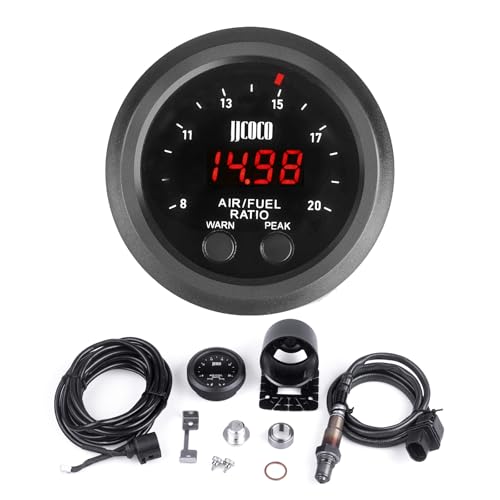
The entry-level wideband that gets you a live AFR number for less than most single sensors cost.
If your budget is tight and you just need a functional AFR reading to dial in a carburetor or check base mixture, the ZHSYMX Universal kit is the cheapest path into wideband tuning. It uses a standard 52mm housing, so it fits most instrument pods, and the maker says it never requires free-air calibration when used with their wideband. The gauge body is made from ABS plastic and weighs 1.48 pounds — the heaviest in this roundup and noticeably heavier than the Auto Meter 4379 at 1.08 pounds. The included wiring loom has quality connectors and a new O2 sensor, according to buyers, though one reviewer identified the sensor as a generic Chinese knock-off, not a Bosch unit.
One buyer who paid said even if it is remotely accurate, it is a great deal — he noted the only cheap-looking piece is the included gauge pod. Another owner mounted the gauge permanently in his dash and said the plastic casing looks cheesy, but it does not affect function. He used it to successfully dial in his carburetor. A reviewer tuning a 300cc track bike said it helped him dial in his single carb and made the bike run much better.
The risk with a budget kit is reliability: one owner reported the gauge never gave a meaningful reading after installation, and another said mounting hardware is flimsy with no instructions. If you are comfortable working through possible QC issues, this is a low-cost way to get wideband data. If you want a more predictable experience, stepping up to the Gledewen 30-0300 is worth the extra money.
Low-Cost Entry
- Lowest price point in the roundup — accessible for casual tuners
- Standard 52mm housing fits common gauge pods
- No free-air calibration needed, per the manufacturer
Quality Concerns
- Generic O2 sensor (not Bosch) may be less accurate or durable
- Flimsy mounting hardware and unclear instructions
- Mixed owner reports — some units failed after installation
Reach for this if: you need a temporary or occasional-use tuning tool and you are willing to accept variable quality for the low price.
pass on it if: a sensor failure during a tune session could cost you time or engine health — step up to a kit with a Bosch sensor.
Understanding the Specs
LSU 4.9 vs. LSU 4.2 Sensor
The oxygen sensor is what does the actual measuring. The Bosch LSU 4.2 is the older standard — it works reliably but has a slower response time. The newer LSU 4.9 cuts the typical response to 20 milliseconds, meaning it catches quick changes in the air-fuel mixture that the 4.2 might miss. If you are tuning at high RPM or chasing transient throttle response, the 4.9 gives you a sharper picture. Most new mid-range and premium kits now use the 4.9, making it the default choice unless you are buying a proven kit like the Auto Meter 4379 that still runs the 4.2.
Lambda vs. AFR vs. Oxygen Percentage
The gauge can display the same data in different units. AFR (air-fuel ratio) is the number most gasoline tuners use — 14.7:1 is stoichiometric (perfect combustion), lower numbers are rich, higher are lean. Lambda is a normalized scale where 1.0 equals stoichiometric regardless of fuel type, so it works equally well for gasoline, E85, or diesel. A lambda of 0.85 is richer, and 1.15 is leaner. Oxygen percentage shows the literal O2 content in the exhaust. Kits like the Gledewen 30-0300 let you switch between all three on the fly.
FAQ
Do I need a wideband or narrowband gauge for tuning?
Will a 52mm gauge fit my existing gauge pod?
Can I use an air fuel gauge with E85 or diesel fuel?
What does the 0-5V analog output do?
How do I calibrate a wideband O2 sensor?
Can I install an air fuel gauge myself, or do I need a mechanic?
What is the difference between OBD-II connectivity and analog output?
How long do wideband O2 sensors last?
Final Thoughts: The Verdict
Across the board, the air fuel gauge winner is the Gledewen 30-0300 because it gives you the fast LSU 4.9 sensor, a brilliant 24-color LED display, and a reversible face all at a price that undercuts the legacy brands. If you want direct OBD-II logging on a modern CAN bus car, grab the AEM X-Series. And for a V-engine build where left-to-right bank balance matters, the standout is the Innovate Dlg-1 Dual Lambda.
How We Picked
We do not accept paid placement. Every pick is matched to a real buyer and a real use-case; we do not hands-on test units.
Sources & Methodology
Specifications: manufacturer listings and product documentation. Review insights: verified customer reviews, as of July 2026. Pricing: not shown on this page (it changes often); check the current price via the retailer link.
As an Amazon Associate, Gadgets Feed earns from qualifying purchases. This does not affect which products we feature.