
Our readers keep the lights on and my morning glass full of iced black tea. As an Amazon Associate, I earn from qualifying purchases.
Specs are compiled from manufacturer listings and verified buyer reviews and can change over time — please confirm the key details on the product page before buying.
An adjustable power supply that drifts or buzzes under load is worse than no supply at all — you can’t trust your readings, and you risk cooking a sensitive circuit. The real test is which ones hold stable voltage when you need to power a motor, charge a battery, or bench-test a board.
I’m Min — the founder and writer behind Gadgets Feed. This guide is built by comparing the manufacturers’ published specifications and the patterns across verified customer reviews, so you get each pick’s real strengths and trade-offs instead of marketing spin.
Whether you are repairing electronics, balancing LiFePO4 cells, or running a continuous test at 10 amps, the right adjustable power supply keeps your output clean and your project on track without surprises.
Our Picks at a Glance

How To Choose The Best Adjustable Power Supply
An adjustable power supply powers circuits, charges batteries, and tests repairs — but only if it holds stable voltage under load. But a few key specs separate a reliable tool from a frustrating one. Here is what matters most.
Voltage and Current Range
Think about your typical projects. A 0-30V, 0-10A unit covers most hobbyist work — Arduino, Raspberry Pi, battery charging, and general repair. If you work with automotive systems or higher-voltage LEDs, a 0-50V model (like the HYELEC) gives you more headroom. The amp rating (5A vs 10A) matters if you plan to run motors or charge large batteries at full tilt.
Adjustment Control (Knobs Matter)
Older supplies use a single potentiometer knob that can drift over time. Encoder knobs (coarse and fine) let you dial in 0.01V and 0.001A steps with a satisfying detent feel — you land on the exact value without overshooting. A supply with a dedicated output ON/OFF button lets you adjust voltage before connecting your load, which prevents accidental short circuits.
Protection and Safety Features
Over-current protection (OCP), over-voltage protection, and short-circuit protection are non-negotiable — they automatically cut power if something goes wrong. A constant-voltage (CV) and constant-current (CC) mode that auto-switches based on the load is essential for charging batteries safely. If you plan to work with sensitive electronics, a low ripple spec (like <20mV on the FNIRSI) means cleaner DC output.
Quick Comparison
| Model | Best For | Voltage / Current | Display | Special Feature | Amazon |
|---|---|---|---|---|---|
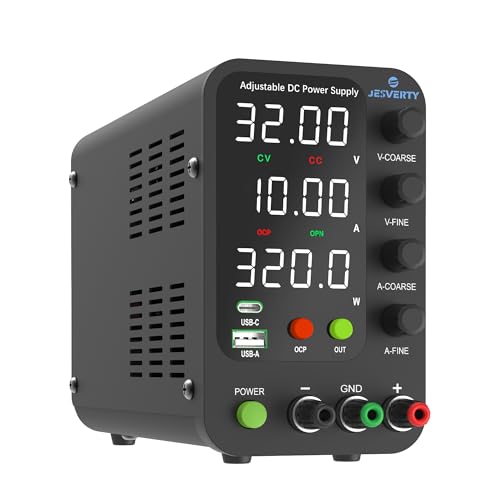
| Jesverty SPS-3010V★ Best Overall | Space-saving bench work | 0–32V / 0–10A | 4-Digit LED | USB-A USB-C 20W, encoder knobs | Amazon |
| FNIRSI DPS-150Compact Powerhouse | Ultra-portable testing | 0–30V / 0–5A | 2.8″ IPS color | PC programmable, PD/QC input, <20mV ripple | Amazon |
| NICE-POWER SPS-C3010 | Budget-friendly all-rounder | 0–30V / 0–10A | 4-Digit LED | 5V/2A USB, auto CV/CC switch | Amazon |
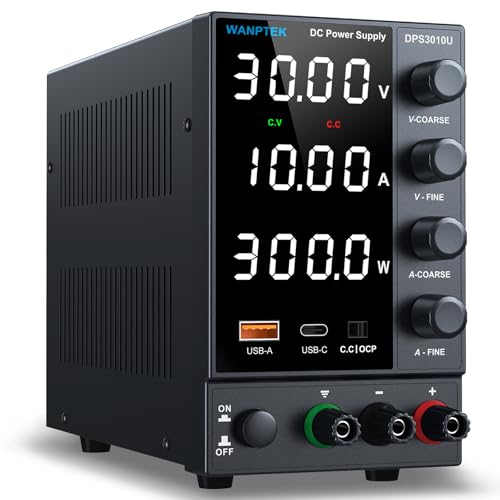
| WANPTEK DPS3010U | Auto-voltage global use | 0–30V / 0–10A | 4-Digit LED | USB + Type-C 3.6A, auto 110/220V | Amazon |
| WANPTEK TPS-C3010 | Repetitive lab workflows | 0–30V / 0–10A | 4-Digit LED | 3 memory presets, key lock | Amazon |
| HYELEC HY50-06A | Higher-voltage projects | 0–50V / 0–6A | 4-Digit LED | 3 memory presets, 5V/2A USB | Amazon |
| KORAD KA3005P | Lab-grade precision & programmability | 0–30V / 0–5A | 4-Digit LED | USB & RS232, 4 presets, linear design | Amazon |
In‑Depth Reviews
1. DC Power Supply Variable, 0-32V 0-10A with USB-C (Jesverty SPS-3010V)
Our pick — over 4.5★ from 700+ verified ratings; the strongest balance of quality and price.
The benchtop supply that delivers 32V and 10A in a footprint smaller than a lunchbox.
You get a voltage range that actually hits 0–32V (buyers report the unit pushes past the printed “30V” label) with a current up to 10 Amps. The coarse encoder knob sets values before the decimal point, and the fine knob sets values after it, giving you a setting resolution of 0.01V and 0.001A — so you can match voltage to a Fluke 87 to the second decimal, according to buyers. At 7.09 x 3.35 x 6.1 inches, this is 2.1 inches deeper than the NICE-POWER unit but stays compact for crowded desks.
The USB-A and USB-C ports both support 20W fast charging, which means you can power an Arduino Uno or top off a phone without hunting for a separate wall wart. An output ON/OFF button lets you adjust settings without removing the load, and the temperature-regulated fan stays quiet during typical use. Owners mention a strong chemical smell initially, but note it fades over time.
Why it beats the competition: The combination of encoder-based precision, dual fast-charge USB ports, and an output switch makes this the most versatile mid-range value on the list — it runs a full ampere more than the KORAD and costs roughly a third as much.
Reach for this if: you want a compact, accurate bench supply with modern charging ports and a clean digital readout that hobbyists and light-lab users will appreciate.
One real trade-off: the initial chemical odor reported by several buyers can be off-putting during the first days of use, and the test leads it ships with are best treated as placeholders for higher-current work.
2. FNIRSI DPS-150 DC Power Supply Variable, 30V 5A
A pocket-sized supply that tucks into a tech bag and runs off a laptop charger.
This unit shines in a different way than the Jesverty — whereas the Jesverty is a full bench supply, the FNIRSI DPS-150 is a portable module that accepts Power Delivery, Quick Charge, or standard DC input. It delivers up to 30V and 5A with a power ripple of less than 20mV, which customers note protects sensitive electronics from voltage fluctuations. The 2.8-inch IPS color screen supports a 90-degree flip, so you can read the curve or numerical display from any angle.
One reviewer called it “tiny but mighty,” noting it ran perfectly cool off a standard laptop charger brick. Because there is no power adapter included, the maximum voltage depends on your external source — a USB-C PD brick typically limits you to 20V, while a beefier DC adapter open up the full 30V. Buyers also praise the short protection and PC programmable output, which lets you save 6 groups of output parameters.
Where it wins
- Ultra-portable at 6.24 ounces and 4.06 x 3.07 x 1.18 inches — fits in a laptop bag.
- Low ripple (<20mV) protects sensitive circuits during testing.
- PC programmable with 6 preset groups for repeatable work.
Where it trails
- Limited to 5A max — not for big battery charging or high-current loads.
- Requires a separate PD/QC power adapter; voltage is capped by your source.
- Reverse-current protection is not built in; adding a Schottky diode is recommended for battery charging.
Grab this for: on-the-go electronics testing, console repair, or any scenario where a full-size bench supply is overkill and portability is the priority.
Consider something else if: you consistently need 6–10 amps for motors or high-drain batteries — the Jesverty or NICE-POWER units have twice the current capacity.
3. NICE-POWER DC Power Supply Variable 30V 10A (SPS-C3010)

A no-frills 30V/10A supply that buyers trust for DIY battery balancing.
At 3.3 x 8.4 x 5.5 inches, this unit is noticeably taller than the Jesverty but squeezes the same 10A output into a vertical design with shock-absorbing rubber feet. The 4-digit LED display shows voltage, current, and power in real-time, and the constant-voltage/constant-current mode auto-switches depending on the load. One reviewer used it to balance and charge 2016 Prius C-type battery modules and said it exceeded expectations, noting the automatic CV/CC transition.
The front power switch means you do not reach around the back to turn it on, and the built-in 5V/2A USB port charges phones or powers small devices. Reviewers point out stable output at 8 amps continuous without overheating, though some mention early failures. This is a pure 110V unit — it does not support 220V input, so if you travel internationally, look at the auto-voltage WANPTEK instead.
What stands out: The constant-voltage/constant-current auto-switch is a practical safety net for battery charging — you set the current limit and the supply handles the transition without manual intervention.
Best for: beginners and hobbyists who want a reliable 10A supply at a low entry cost, especially for battery charging and general repair work.
Watch out for: the 110V-only input restricts use to US-standard outlets, and a small number of shoppers say early failures after a few months.
4. KORAD KA3005P Programmable Precision 30V 5A DC Linear Power Supply

The linear supply that micro-controller enthusiasts trust for rock-steady 5A output.
Unlike the switching supplies above, the KORAD KA3005P uses a linear regulation design that inherently produces lower noise — ideal for analog circuits and sensitive audio gear. It delivers 0–30V and 0–5A with a 4-digit back-lit LED display reading down to 0.001V and 0.001A. Buyers report the voltage is accurate to within 10mV across the full range and that the programming via USB and RS232 works well for automated testing.
There are 4 memory recall buttons for storing common settings (one buyer uses 3.3V, 5V, 12V, and 24V presets), a dedicated output ON/OFF switch, and a lock button to prevent accidental changes. It supports both 110V and 220V input via a rear switch. The trade-off is weight — at 9 pounds and 14 x 10 x 10 inches, it is the heaviest and bulkiest pick here, and several owners mention the cooling fan is loud enough to be annoying in a quiet lab.
Strengths
- Linear topology delivers low ripple and stable output for precision work.
- USB and RS232 ports with included software for remote control and data logging.
- 4 memory presets speed up repetitive test setups.
Weaknesses
- Only 5A max — less than half the current of the Jesverty or NICE-POWER units.
- Very heavy at 9 pounds and takes up significant bench space.
- Fan noise is a frequent complaint; some buyers consider replacing the fan.
Choose this for: programmable testing, university labs, or any situation where clean linear output and remote control matter more than raw current.
skip it if: you need more than 5A for battery charging or motor testing, or if bench space and quiet operation are high priorities.
5. HYELEC HY50-06A Variable DC Power Supply 0-50V 0-6A max 150W

The only supply here that pushes to 50V — enough for automotive subsystem testing.
Most adjustable supplies stop at 30V, but the HYELEC goes up to 50V at 6A (150W max), which is useful for testing higher-voltage DC motors, LED arrays, or battery packs. It uses a high-precision encoder adjustment knob (coarse and fine on the same knob) and a 4-digit LED display that customers note does not jump around. There are 3 group memory slots (M1/M2/M3) to save and recall voltage/current pairs, plus a 5V/2A USB port for powering small devices.
Buyers praise the output enable/disable button — you can dial in voltage before powering the load — and the constant-voltage/constant-current auto-switch. One reviewer noted a slight 20–40mV residual on the output even when disabled, but called it “very good” in practice. At roughly 2.71 pounds and a compact benchtop form factor, it is lighter than the KORAD and takes up less space, though the plastic enclosure feels less premium than metal-shell alternatives.
What reviewers point out: “I love this power supply. Wish I would have bought one earlier” — the output button and memory slots make it a favorite for anyone who routinely switches between multiple project voltages.
Ideal for: electronics tinkerers and battery enthusiasts who need 50V for LED strips, multi-cell LiPo balancing, or testing circuits above the usual 30V ceiling.
Keep in mind: the current is capped at 6A, so it cannot match the 10A units for high-current loads, and some users report a small voltage leak even with output off.
6. WANPTEK TPS-C3010 DC Bench Power Supply 30V 10A with Memory Presets

A 30-volt, 10-amp bench supply that remembers your most-used settings.
If you regularly switch between, say, 5V for digital logic and 12V for automotive relays, the WANPTEK TPS-C3010 saves you time. It has 3 memory storage keys (M1/M2/M3) that lock in voltage and current pairs so you recall them instantly without re-dialing. The encoder knob allows digit-by-digit fine tuning, and the output ON/OFF switch prevents sparks when wiring up a load. OCP (over-current protection) automatically cuts power during a short and resumes after the fault clears.
The unit measures 8.27 x 5.71 x 3.15 inches — a horizontal design that buyers find space-efficient — and includes a built-in USB port for powering small devices. One buyer restoring vintage stereo receivers from the mid-70s called it “great” for that purpose. A key lock prevents accidental setting changes during long tests. Note that for US use, you must set the rear 115V/230V switch to 115V before first power-up; the included test leads are fine for light use but should be upgraded for sustained high current.
Smart detail: The three memory presets turn a 30-second setup into a one-button recall — a real time-saver for repair technicians who test the same voltages day in and day out.
Best for: technicians and hobbyists who run repetitive tests and want to store common voltage/current combos without rewriting them each time.
One catch: The beep is very loud and cannot be fully disabled — the power-on beep stays even after you mute the rest, which some buyers find annoying.
7. WANPTEK POWER DPS3010U DC Power Supply Variable 0-30V 0-10A
A 10A supply that auto-detects mains voltage — no toggle switch to forget.
Unlike the NICE-POWER unit (which is 110V-only) or the rear-switch models, the WANPTEK DPS3010U uses automatic voltage detection that adapts to 110V and 220V ±10% AC inputs without any manual intervention. This makes it a natural pick for international travelers or anyone who frequently mains-power projects in different regions. It delivers 0–30V and 0–10A with the same encoder coarse/fine knob system found on the Jesverty, offering 0.01V and 0.001A resolution.
A standout feature is the Type-C fast charging port with 5V/3.6A output — that is nearly double the USB current of most competitors, which means faster charging for phones and tablets while you work. The short-circuit alarm triggers a buzzer and automatically stops output. Shoppers say the built-in 30V/10A ran overnight at full load without issues, though several mention the beep is annoyingly loud (you can turn it off by holding the voltage knob). The lack of a dedicated output ON/OFF button means you must connect or disconnect the load cable while the unit is powered, which can cause small sparks.
Standout specs
- Auto-detects 110V and 220V — no switch, no confusion.
- Type-C port delivers 3.6A, the fastest USB charging on this list.
- Tested at full 30V 10A overnight with no stability issues.
Limitations
- No physical output ON/OFF button — you adjust live, risking small arcs.
- Beep is very loud by default; mute by holding the voltage knob.
- Fan runs audibly under high load; not silent.
Pick this if: you need a versatile 10A supply that works on both US and international mains without a switch, and you want the fastest Type-C charging port for your phone.
Look elsewhere if: the lack of an output enable/disable button bothers you — the Jesverty and WANPTEK TPS-C3010 both have one and are safer for live-circuit wiring.
Understanding the Specs
Encoder vs Potentiometer Knobs
Encoder knobs (found on the Jesverty, WANPTEK DPS3010U, and HYELEC) use a digital rotary encoder that clicks through discrete steps — you dial in 0.01V at a time with no drift. Old-style potentiometer knobs (on the NICE-POWER and KORAD) use a physical resistive track that can wear or shift over time. Encoders are more repeatable for precision work.
Switching vs Linear Regulation
Most supplies here are switching regulators — they are compact, efficient, and cheaper, but they introduce a small amount of electrical noise (ripple) on the output. The KORAD KA3005P uses a linear regulator, which produces much cleaner DC but is heavier and generates more heat. For audio gear or sensitive analog circuits, linear wins; for general-purpose battery charging and digital circuits, switching is perfectly fine.
FAQ
Can I use an adjustable power supply to charge a car battery?
What does CV/CC mode mean and when do I use it?
Do I need an adjustable power supply with memory presets?
What is OCP over-current protection and why does it matter?
Can I hook two adjustable power supplies in series for higher voltage?
How do I know if a supply works with 220V international power?
What is ripple and why does a low number matter?
What does the output ON/OFF button do that makes a difference?
Final Thoughts: The Verdict
For most buyers, the adjustable power supply winner is the Jesverty SPS-3010V because it packs encoder precision, 10A output, and modern USB-C charging into a compact metal case at a mid-range price. If you want the ultra-portability of a pocket-sized unit that runs off a laptop brick, grab the FNIRSI DPS-150. And for higher-voltage 50V projects with memory storage, the standout is the HYELEC HY50-06A.
How We Picked
We do not accept paid placement. Every pick is matched to a real buyer and a real use-case; we do not hands-on test units.
Sources & Methodology
Specifications: manufacturer listings and product documentation. Review insights: verified customer reviews, as of July 2026. Pricing: not shown on this page (it changes often); check the current price via the retailer link.
As an Amazon Associate, Gadgets Feed earns from qualifying purchases. This does not affect which products we feature.