
Our readers keep the lights on and my morning glass full of iced black tea. As an Amazon Associate, I earn from qualifying purchases.
Specs are compiled from manufacturer listings and verified buyer reviews and can change over time — please confirm the key details on the product page before buying.
A weak or shaky 18V power supply can make your LED strip flicker, a 3D printer skip layers, or a security camera go offline at the worst moment. You need one that delivers steady voltage without drifting, overheating, or changing output if you bump the knob.
I’m Min — the founder and writer behind Gadgets Feed. This guide is built by comparing the manufacturers’ published specifications and the patterns across verified customer reviews, so you get each pick’s real strengths and trade-offs instead of marketing spin.
Choosing an 18v power supply depends on three specs: output current (measured in amps), cable length, and the number of included tips (the barrel connectors that plug into your device).
Our Picks at a Glance

How To Choose The Best 18V Power Supply
Every 18V power supply looks similar from the outside, but the real differences live inside the specs. Focus on these three factors to get the right match for your gear.
Match the Current, Don’t Guess
Your device needs a minimum number of amps (current) to run. If you buy a 2A supply and your LED strip pulls 3A, the adapter will overheat or shut down. Always get a supply rated at or above your device’s current draw — a 3A or 6A unit gives you headroom for future projects.
Check the Connector Tip Size
The most common barrel plug is 5.5×2.1mm (also compatible with 5.5×2.5mm). But routers, cameras, and soundbars often use odd sizes like 4.0×1.7mm or 6.5×4.4mm. Look for a kit with at least 10-14 tips so you aren’t scrambling for an adapter later.
Decide Between Fixed vs. Adjustable Voltage
If you only ever power one 18V device, a fixed 18V 2A adapter is simpler and cheaper. But if you tinker with 5V Arduinos, 12V fans, and 24V LED strips, an adjustable 3-24V unit with a voltage display saves you from owning a box of separate adapters.
Quick Comparison
| Model | Best For | Max Current | Max Power | Cable Length | Amazon |
|---|---|---|---|---|---|
| Wefomey Universal 3V~24V★ Best Overall | Multi-device hobbyist | 3A | 72W | 6 ft | Amazon |
| SHNITPWR Adjustable 3.5V~24VAlso Great | Bench tinkering | 3A | 72W | 8.36 ft | Amazon |
| LitStar 18V 2A Fixed | Simple replacement | 2A | 36W | 3.3 ft | Amazon |
| KFD 18V Universal 2.69A | Cricut & soundbar owners | 2.69A | — | — | Amazon |
| Meiyue Adjustable 3V~24V 5A | High-power LED strips | 5A | 120W | — | Amazon |
| SHNITPWR Adjustable 4V~24V 6A | Upgraded bench supply | 6A | 144W | 6 ft | Amazon |
| Meiyue 3V~24V 6A 144W | Max power & test leads | 6A | 144W | — | Amazon |
In‑Depth Reviews
1. Wefomey Universal Power Supply 3V~24V 3A 72W Adjustable
Our pick — 4.5★ from 600+ verified ratings; the strongest balance of quality and price.
14 tips, a polarity converter, alligator clips, and a four-way splitter — the box that keeps on giving.
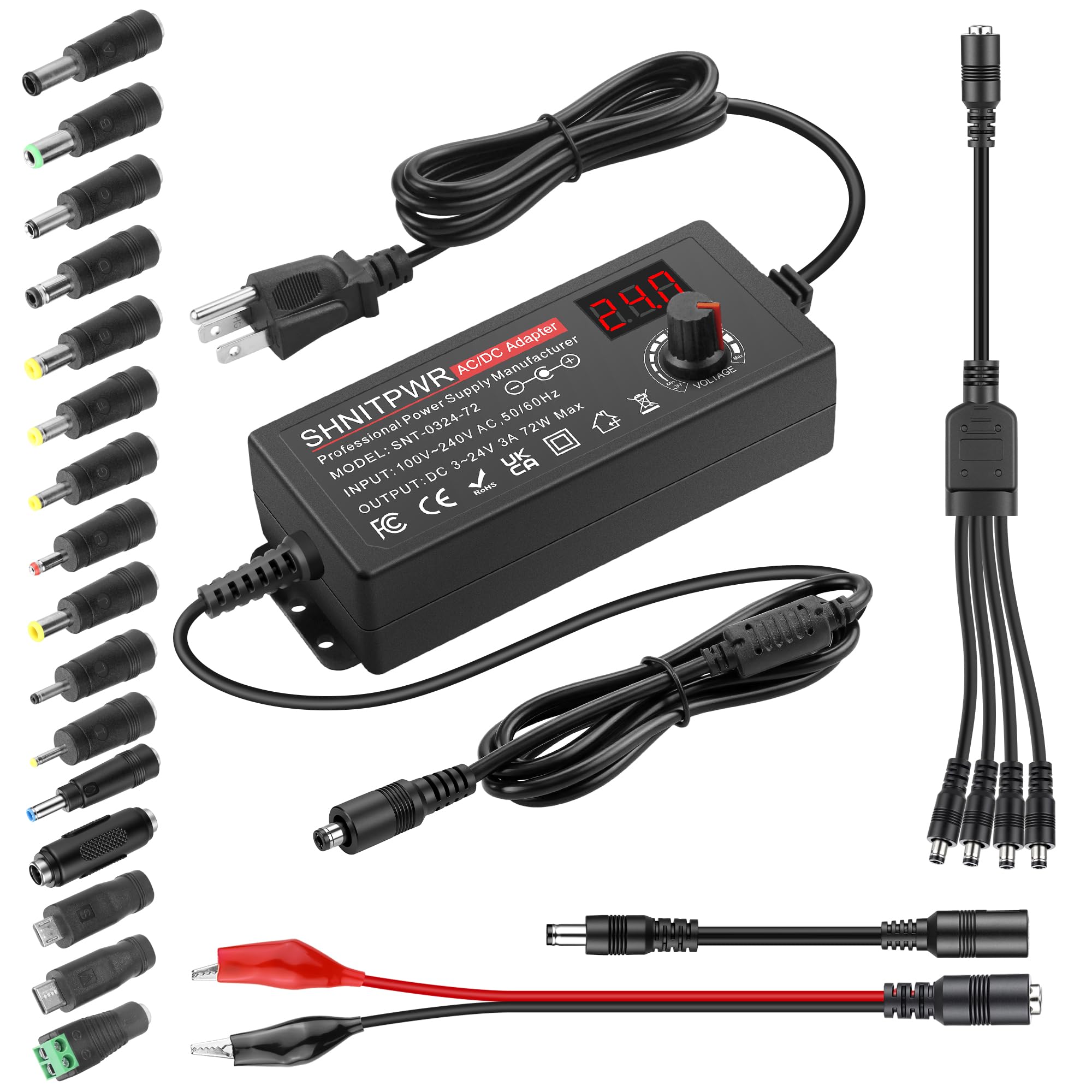
For the buyer who wants everything in one box, the Wefomey packs 14 DC tips, a reverse polarity converter, a set of alligator clip test leads (clamps for grabbing wires temporarily), and a 4-way power splitter cable that lets one supply run up to four cameras or LED strips at once. Output is 3A / 72W maximum, and the LCD display shows the voltage so you know what you are sending. Reviewers point out the “voltage display reads ~0.1V high” and that the actual output measured between 2.82V and 24.29V — close enough for most hobby gear but worth knowing.
The 6ft cable is standard, and the knob is sensitive at low voltages, just like most competitors. One reviewer noted running one of these outdoors in heat for a year with no issues. The 5.5×2.1mm barrel tip also fits 5.5×2.5mm jacks, covering most consumer electronics. For powering several low-current devices from one brick — say a handful of IP cameras — the Wefomey’s splitter makes it more useful than the single-tip LitStar.
Kit highlights
- Includes 4-way splitter to power four devices simultaneously
- Alligator clip test leads for breadboard work
- Reverse polarity converter doubles compatibility
Minor trade-offs
- 24 AWG output cable drops 0.57V at full 3A load
- Knob can jump 5-10V with a tiny nudge
Get this for: Powering multiple low-current devices (like several IP cameras) from one brick.
Note: With all four splitter ports active, each device is limited to 0.75A max — keep the total under 3A.
2. SHNITPWR Universal Power Supply Adjustable 3.5V~24V 3A 72W
The longest cable in its class — 8.36 feet — and a connector that stays put without wobbling make this the top pick.
You dial in any voltage from 3.5V up to 24V, and the built-in LCD screen (a small digital display) shows the real-time output so you never accidentally fry a device. The max current is 3A (amps, the measure of electrical flow) and the max power is 72W (watts, the total power it can deliver), which means it runs most routers, LED strips, and small pumps. The 8.36ft cable is over two feet longer than the typical 6ft cord — you can reach a distant outlet without an extension bar.
The output tip has a concave head and extended rubber wrap so the 16 included connectors click on securely without wobbling — a fix for the loose-connection problem many adjustable supplies have. Buyers report the voltage knob is “finicky and moves easily” and that the unit “gets hot at high loads,” so keep it in a ventilated spot. For the shopper who wants do-everything flexibility, this SHNITPWR trumps the fixed-voltage LitStar 18V 2A because you can adjust it later for 5V or 12V projects.
Standout feature: The 8.36ft cable is 39% longer than the 6ft cable on the Wefomey 3V~24V, and the 3A output offers 50% more current than the 2A fixed LitStar adapter.
Reach for this if: You tinker with multiple voltage devices and want a long tether to your outlet.
Watch out: The exposed knob can shift if bumped — tape it in place after setting your voltage.
3. SHNITPWR Universal Power Supply DC 24V 12V 5V 4V~24V 6A 144W

6A output and an off-gear (a physical switch) let you kill power without yanking the plug — a step up from the 3A model above.
This second SHNITPWR pushes output to 6A and 144W. That is double the current of the 3A version — enough to run a soundbar, a laptop at 19.5V, and a phone charger all at once. The voltage range starts at 4V and goes to 24V, and the knob reaches the critical 13V-14V zone (common for many laptops) at a 50% rotation for easier fine-tuning. The added physical off-gear stops output without unplugging, a feature missing from the 3A SHNITPWR and the Wefomey.
Owners mention they “replaced 4 D-cell batteries in a paper towel dispenser” and “powered a laptop without battery 24/7 at 13.6V.” The built-in voltage display reads slightly off — buyers suggest using a multimeter (a tool that precisely measures voltage) for accuracy. This is an AC-to-DC adapter only, not a battery charger. The 14 tips, polarity converter (a gizmo that swaps center-positive to center-negative), and 6ft cable give it serious reach, though at 6A it is bulkier than the 3A units. For high-draw gear like portable speakers or CCTV DVRs, this SHNITPWR has the headroom the Wefomey 3A cannot reach.
Power edge: At 144W this supply doubles the 72W capacity of the standard 3A models, so you can run hungry devices like portable speakers or CCTV DVRs without hitting the ceiling.
Grab it for: High-draw projects or bench testing where you need 6A headroom and an off switch.
But note: Do not use this to charge devices with built-in batteries — it is a fixed-voltage adapter, not a charger.
4. Meiyue Adjustable Power Supply 3V~24V 5A 120W with 14 Tips

120W means no voltage sag on long LED strips — a big jump from the 72W supplies above.
If your project pulls more than 3A, the Meiyue 5A / 120W adapter keeps things running where the standard supplies would trip. It covers 3V to 24V and accepts any current below 5A (including 2.5A, 3.5A, and 4.5A draws). The LED display shows exact voltage live, and the protruding knob lets you turn it without hunting for a tiny dial. Customers note it is “accurate with multimeter” and “adjustable to 0.01V,” though they caution the “large knob easily bumped” — a piece of tape over the dial solves it.
The voltage display can be off, so users recommend “setting voltage slightly above required” and confirming with a multimeter before connecting sensitive gear. This unit includes 14 tips plus a polarity-reversal cable, making it compatible with everything from a 5V Arduino (a small 5-volt microcontroller board) to a 24V under-cabinet light strip. At 120W it delivers 67% more wattage than the 72W SHNITPWR 3A, so for a subwoofer amp or a pump needing 5A continuous, this Meiyue beats the lower-current options.
Load test: At 5A / 120W, this Meiyue delivers roughly 67% more power than the 3A / 72W SHNITPWR, though at the cost of a slightly larger body.
Best for: High-power LED runs, subwoofer amps, or pumps that need 5A continuous.
One trade-off: The sensitive knob and the display inaccuracy mean you should tape the dial and double-check with a meter.
5. Meiyue 3V~24V 6A 144W Adjustable Power Supply with 3 Test Leads
An off-gear that safely discharges after shutdown plus test leads for soldering — the go-to for breadboard builders.
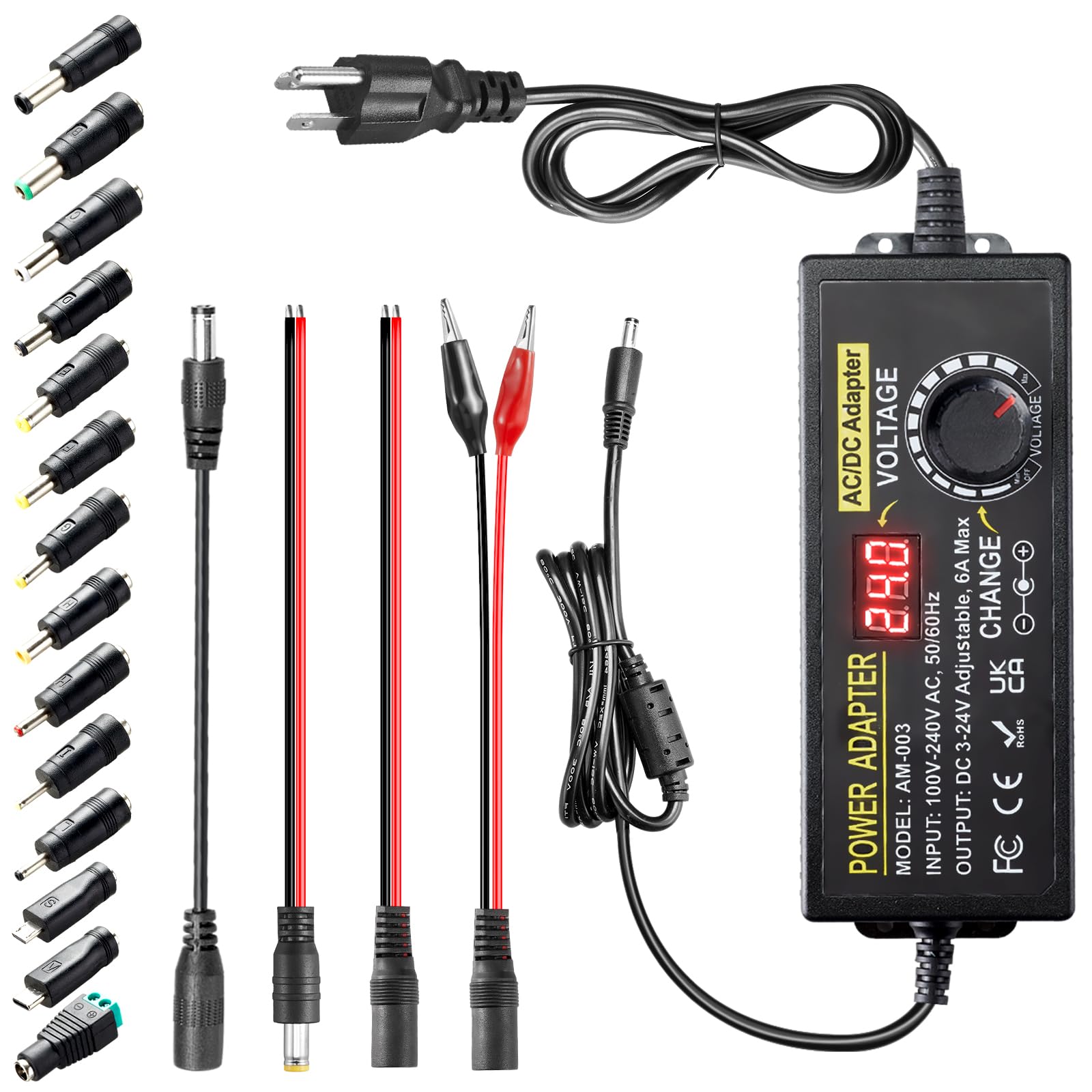
This Meiyue unit matches the 6A / 144W ceiling of the upgraded SHNITPWR but adds three test leads: alligator clips, a male DC pigtail (a bare-wire connector you can solder), and a female DC pigtail. The alligator clips are nickel-plated steel with a strong spring, and the pigtails let you solder directly into a project without cutting anything up. Shoppers say it “replaced a lost 18V 6A monitor adapter” and “includes all major connector sizes.” A couple of buyers report the knob is “too sensitive” and that after turning the off-gear, the unit “stays on ~45s after Off, driving ~3.5V during discharge” — something to be aware of when swapping devices.
The input and output range is 3V to 24V. It is FCC/UL/cUL certified, weighs 0.61 kg, and caps out at 144W with 14 tips, a polarity cable, and the test leads included right in the box. For prototype work, having the pigtails ready saves a trip to the electronics store — a benefit over the 5A Meiyue which lacks test leads. The off-gear discharge delay means you should wait about a minute before swapping sensitive gear.
Prototyping advantage: The included female DC pigtail lets you plug into a breadboard directly — a feature neither the 3A Wefomey nor the 5A Meiyue offers.
Choose this for: A full bench setup where you need test leads, high current, and a voltage display.
Keep in mind: The off-gear discharge delay means you should wait about a minute before swapping sensitive devices.
6. LitStar 18V 2A AC Adapter Power Supply Charger
A fixed 18V at 2A that cost one reviewer less than a quarter of the original replacement — a straight swap, no dials.
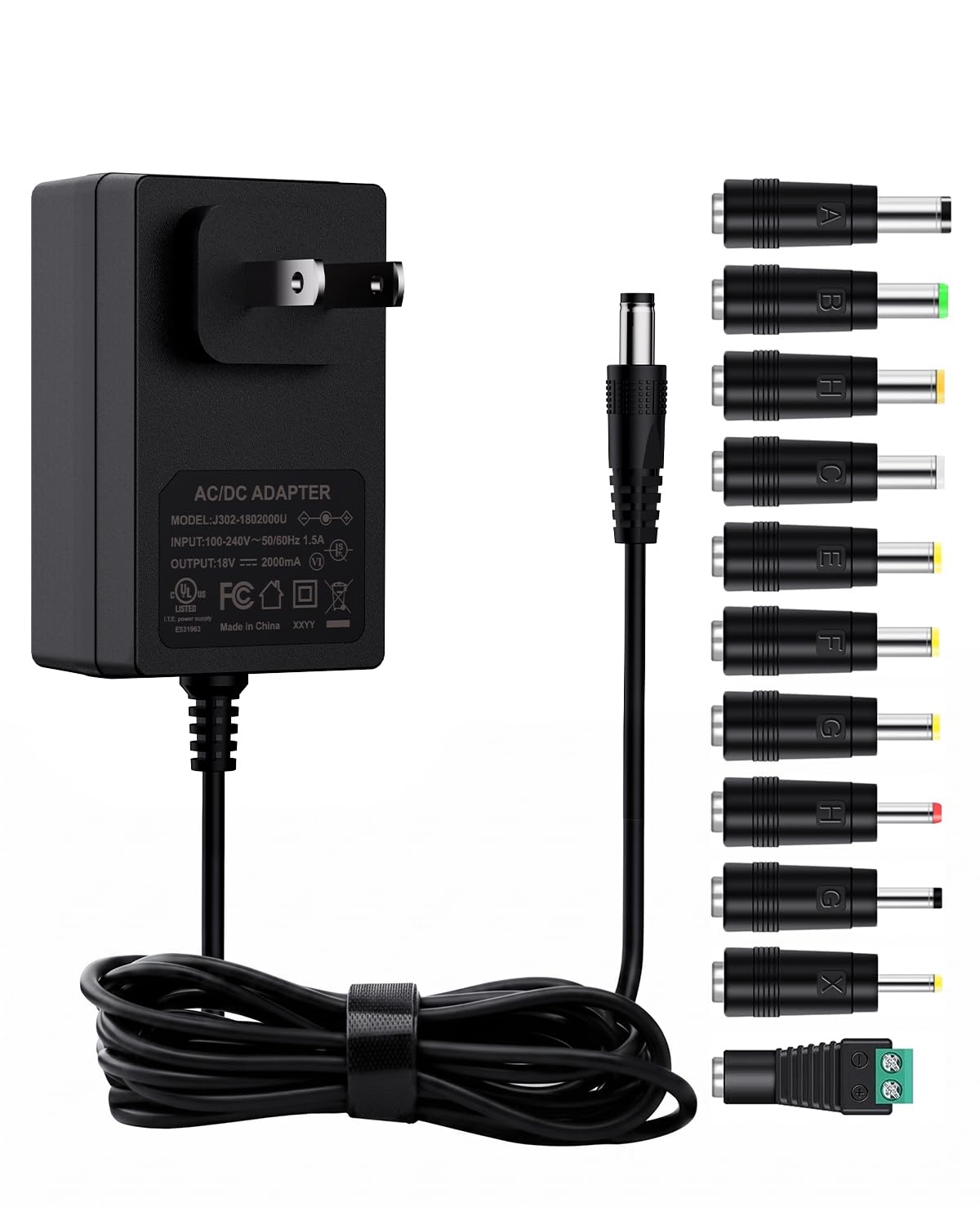
If your device takes a straight 18V input and you do not need variable voltage, the LitStar is a drop-in replacement at 2A / 36W. It accepts any load from 0.1A to 2A (100mA through 2000mA) and includes 11 interchangeable DC plugs. One buyer mentioned replacing a ground lighting adapter that “cost less than 25% than replacing with original equipment,” then plugged it into an outdoor timer for automatic on/off. The main barrel size is 5.5×2.1mm, which fits most 18V home gadgets.
At 3.3 feet, the cable is shorter than the adjustable units — fine for a shelf but limiting for floor-mounted gear. One review says it “did not work on a normal 18V drill,” likely because power tools need a battery charger, not a plain adapter. Keep this to low-current electronics (WiFi routers, LED strips, small speakers) where you want a cheap, known voltage. For a no-fuss replacement, the LitStar beats the adjustable units on cost, but its 2A limit means the SHNITPWR 3A handles bigger loads.
Smart limit: The LitStar’s 2A max is half the 3A capacity of the SHNITPWR or Wefomey supplies, so do not plug in anything that draws more than 2A continuous.
Pick this for: A direct 18V replacement for a router, soundbar, or security camera at the lowest possible cost.
skip it if: You need adjustable voltage, high current (over 2A), or a long cable.
7. KFD 18V Universal AC Power Charger DC 2.69A with 7 Tips

UL certification and a 36-month warranty — the safest bet for gear you cannot afford to fry.
The KFD is a fixed 18V supply rated at 2.69A, and it carries UL, CE, FCC, and RoHS certifications — safety standards that the adjustable units here do not all meet. It is specifically listed as compatible with PetSafe cat litter boxes, Cricut cutting machines, Hyperice Hypervolt GO massage guns, and several Insignia and Klipsch soundbars — a niche but loyal following. The kit includes 7 extra tips (6.5×4.4mm, 5.5×3.0mm, 4.8×1.7mm, and others) plus a 5.5×2.5mm tip, and the main barrel is 5.5×2.1mm. Owners mention it is “plug and play” and “worked great for mine,” though one notes the “connection between the adapter and optical power connectors is rather unstable” and “kind of wiggly.”
The warranty is 30 days free exchange plus 36 months on the adapter itself. The V-0 flame-retardant casing plus OVP/OCP/SCP protection (over-voltage, over-current, and short-circuit cut-offs that automatically shut down the supply) give extra confidence that the LitStar does not explicitly claim. Just check the compatibility list before ordering — it does not cover every 18V gadget, and the 2.69A limit and wiggly connector mean it is not ideal for high-current or mobile setups.
Safety edge: The KFD is the only supply here explicitly UL listed, with OVP/OCP/SCP triple protection and a 3-year warranty backing it up.
Great for: Replacing a lost power adapter for a PetSafe litter box, Cricut, or Hyperice massager with a certified unit.
Downside: The 2.69A limit and wiggly connector mean it is not ideal for high-current or mobile setups.
Understanding the Specs
Current (Amps / A)
The current rating tells you how much power the adapter can safely push to your device. If your router draws 1.5A and you buy a 2A supply, you have headroom. But if the supply is rated lower than the device needs — say 2A supply on a 3A LED strip — the adapter will overheat or trigger its cut-off protection. Always match or exceed the device’s current draw.
Connector Tips (Barrel Sizes)
Most 18V devices use a 5.5×2.1mm barrel plug (which also fits 5.5×2.5mm jacks). But many brands — routers, soundbars, cameras — use odd sizes like 4.0×1.7mm or 6.5×4.4mm. A kit with 10-14 tips plus a polarity converter covers the bulk of household electronics. If you only need one device, a fixed adapter with a single known tip saves hassle.
FAQ
Can I use an 18V 3A supply on a device that only needs 1A?
What happens if I use a 12V supply on an 18V device?
Will an adjustable power supply charge my 18V power tool battery?
How do I know which barrel tip to use?
Can I cut and reuse the cable if the tip breaks?
What does the polarity converter do?
How important is a voltage display on the adapter?
Is it safe to leave an adjustable power supply plugged in 24/7?
What size cable is long enough for a desk setup?
Can I daisy-chain multiple 18V devices off one supply?
Final Thoughts: The Verdict
Across the board, the best 18v power supply is the SHNITPWR Adjustable 3.5V~24V 3A because it balances the longest cable, 16 included tips, a clear LCD display, and enough current for 90% of household electronics. If you need max power for high-draw gear, grab the Meiyue 5A 120W for its 5A output. And for a simple, cheap, fixed-voltage drop-in replacement, the LitStar 18V 2A is tough to top on cost.
How We Picked
We do not accept paid placement. Every pick is matched to a real buyer and a real use-case; we do not hands-on test units.
Sources & Methodology
Specifications: manufacturer listings and product documentation. Review insights: verified customer reviews, as of July 2026. Pricing: not shown on this page (it changes often); check the current price via the retailer link.
As an Amazon Associate, Gadgets Feed earns from qualifying purchases. This does not affect which products we feature.