
Our readers keep the lights on and my morning glass full of iced black tea. As an Amazon Associate, I earn from qualifying purchases.
Specs are compiled from manufacturer listings and verified buyer reviews and can change over time — please confirm the key details on the product page before buying.
You are shopping for a 3-way speaker because you know that a tweeter, a midrange driver, and a woofer each doing their own job beats a single driver trying to do everything. The problem is that “3-way” on the box does not tell you much about how clean the vocals will sound, how deep the bass will dig, or how loud you can push them before they break up. Your real question is which set of three drivers actually works together like a real musical instrument, not like three strangers shouting over each other.
I’m Min — the founder and writer behind Gadgets Feed. This guide is built by comparing the manufacturers’ published specifications and the patterns across verified customer reviews, so you get each pick’s real strengths and trade-offs instead of marketing spin.
After looking at the numbers and what real buyers report, here is what matters most when sorting through the best 3 way speaker options today for your home, studio, or desk setup.
Our Picks at a Glance


How To Choose The Best 3 Way Speaker
A 3-way speaker splits the audio into three frequency bands and hands each one to a specialized driver. That means the tweeter handles only the high treble, the midrange driver handles only the vocals and the body of instruments, and the woofer handles only the low bass. Getting that split right depends on the crossover design — the electronic circuit that decides which frequencies go where. A sloppy crossover can make the drivers fight each other, while a good one makes the sound feel like it is coming from a single source.
Power Handling and Sensitivity
Power handling tells you how much electrical power the speaker can take without damage, usually shown as RMS (continuous) and Peak (short burst). Sensitivity, measured in decibels (dB), tells you how loud the speaker gets with a given amount of power — a higher dB number means you get more volume from a smaller amplifier. If your receiver or amplifier is on the weaker side, look for a speaker with higher sensitivity (88 dB or more) so you are not left wanting more headroom. If you have a powerful amplifier, you can drive lower-sensitivity speakers harder, but you still need to match the impedance (measured in ohms) to avoid overloading your amp.
Passive vs Active
A passive speaker needs an external amplifier or receiver to power it — you connect it with standard speaker wire. An active speaker has the amplifier built in, which means you plug it into the wall and connect your source directly. Active speakers often include built-in crossovers tuned specifically to those drivers, which can give you cleaner sound. The trade-off is that you cannot swap out the amplifier later. Passive speakers offer more flexibility for upgrading your system piece by piece.
Quick Comparison
| Model | Best For | Driver Config | Power (RMS/Peak) | Frequency Response | Amazon |
|---|---|---|---|---|---|
| Sony SS-CS3★ Best Overall | Home Theater with Extra Tweeter | 4-Driver (Woofer + Mid + 2 Tweeters) | 145W Peak | — | Amazon |
| Edifier R2750DB MKIIBest Value Active | Active All-In-One System | 3-Way (7″ Woofer + 4.5″ Mid + 1″ Tweeter) | 144W RMS | — | Amazon |
| Fluance XL8FBuilt-In Bass | Deep Built-In Bass | 3-Way with Down-Firing 8″ Sub | — | 35Hz – 25KHz | Amazon |
| ELAC Debut 2.0 F5.2 | Neutral Audiophile Sound | 4-Driver (Tweeter + 3x Woofers) | — | Up to 35,000 Hz | Amazon |
| Edifier MR5 | Studio Monitoring | 3-Way Active (5″ Woofer + 3.75″ Mid + 1″ Tweeter) | 110W RMS | 46Hz–40kHz | Amazon |
| Sony SS-CS5M2 | Compact Bookshelf | 3-Way (5.12″ Woofer + Tweeter + Super Tweeter) | — | 53-50,000 Hz | Amazon |
| Rockville RockTower 68C | Budget Tower Power | 3-Way (Dual 6.5″ Woofers + 6.5″ Mid + 1″ Tweeter) | 125W RMS / 500W Peak | 30Hz-20kHz | Amazon |
| KEF Q Concerto Meta | Reference-Grade Clarity | 3-Way Bookshelf (Uni-Q Driver + Woofer) | — | — | Amazon |
In‑Depth Reviews
1. Sony SS-CS3 3-Way 4-Driver Floor-Standing Speaker – Pair (Black)
Our pick — 4.5★ from 300+ verified ratings; the strongest balance of quality and price.
A tower pair with a dedicated super tweeter for airy highs beyond typical hearing.
While most 3-way designs give you one tweeter, the Sony SS-CS3 splits the high frequencies into two drivers: a 1-inch polyester tweeter handles the main treble, while a separate 0.75-inch super tweeter stretches the high frequencies up to 50 kHz. Humans do not hear above 20 kHz, but the idea is that the super tweeter creates a more open, spacious soundstage by extending the response well beyond what your ear can perceive. The pair is rated for 145W peak power at 6 ohms impedance, and the cabinet includes a subwoofer output for adding a separate powered sub.
Reviewers point out that they “had resisted these for years because of their price point thinking no way can pair of speakers sound as good as everyone says” — and they were pleasantly surprised. The clarity and treble detail are what owners keep coming back to. The Sony SS-CS3’s 6-ohm impedance demands 33% more current than the Rockville’s 8 ohms, so pair them with a receiver rated for 6-ohm loads. They are a strong value for a full tower pair from a major brand, but the peak power (145W) is relatively modest compared to the 500W peak of the Rockville option.
Twin-Tweeter Sound
- 1-inch main tweeter plus 0.75-inch super tweeter for extended high-frequency response up to 50 kHz
- Pair of floor-standing speakers included for full stereo coverage
- Classic Sony build quality with Bluetooth connectivity
Power Considerations
- 6-ohm impedance needs a receiver rated for lower-impedance loads
- 145W peak is lower than some competing towers at similar prices
Who it suits: Listeners who prioritize airy, extended treble and want a complete floor-standing pair from a trusted brand in one box.
The trade-off: If you push high volumes regularly, check that your amplifier handles 6-ohm speakers well.
2. Edifier R2750DB MKII Powered Bookshelf Speakers
The all-in-one bookshelf that does not need a subwoofer or separate amplifier.
This active speaker system packs a 7-inch woofer, a 4.5-inch midrange driver, and a 1-inch silk dome tweeter into a single walnut cabinet — meaning you get deep bass, clear vocals, and crisp highs right from the start without buying extra gear. The built-in quad Class-D amplifiers deliver 144W RMS total, and the active crossover is tuned specifically for these drivers so the handoff between them is smooth. You connect your TV via HDMI eARC, your turntable via line-in, or your phone via Bluetooth 6.0 with LDAC for high-resolution wireless streaming.
Owners mention that the sound is “crisp, analytical yet engaging” and that the built-in bass is so substantial you might not need a separate subwoofer. The app lets you choose between four presets (Classic, Monitor, Dynamic, Vocal) or dial in your own with a 9-band EQ. The catch is that the rear-facing ports can muddy the sound if you place the speakers too close to a corner — one reviewer noted plugging the ports tightened the bass significantly. At this price, you get a complete powered system that simply works, but you cannot upgrade the amplifier separately later.
Built-In Advantages
- 144W RMS quad-amped system with active crossover for clean driver integration
- HDMI eARC, optical, coaxial, and LDAC Bluetooth 6.0 for wide device compatibility
- App-based 9-band EQ and 4 preset sound profiles
Consider Before Buying
- Rear ports require careful placement away from walls
- Cannot swap amplifier separately as they are built-in
Perfect for: Anyone who wants a clean, powered bookshelf system for TV, music, or desktop use without separate components.
Keep in mind: If you prefer to pick your own amplifier later, a passive speaker gives you more flexibility.
3. Fluance Reference High Performance 3-Way Floorstanding Loudspeakers (XL8F)
Floorstanding towers that hide an 8-inch subwoofer firing into the floor.
Instead of forcing you to buy a separate subwoofer, each Fluance XL8F cabinet contains a down-firing 8-inch subwoofer that pushes air downward against the floor. The idea is that the floor acts like a boundary, reinforcing the low bass so you feel it in your chest without a separate box taking up floor space. The woven fiber midrange drivers and silk dome neodymium tweeters handle the vocals and highs, giving you a frequency range of 35Hz to 25KHz. These are passive speakers, so you need a receiver or amplifier to drive them.
Customers note that the down-firing design reduces room resonance compared to front-firing towers, and one buyer mentioned retiring their bass traps after switching to these. The speakers come with isolation floor spikes and magnetic grilles. They are not the tallest tower speakers around, but the 8-inch sub integrated into each one is a real space-saver for people who want full-range sound without a separate sub box.
Space-Saving Bass
- Integrated down-firing 8-inch subwoofer in each tower for deep bass without a separate sub box
- Woven fiber midrange and silk dome tweeter for clean mid and high frequencies
- Magnetic grilles and isolation floor spikes included
Setup Notes
- Want at least 120 WPC from your receiver for best performance
- May need tweaking with port plugs and placement on hardwood vs carpet
Reach for these if: You want deep, physical bass from floorstanding towers without a separate subwoofer taking up space.
Look elsewhere if: You already own a good subwoofer and prefer separate components for more placement flexibility.
4. ELAC Debut 2.0 F5.2 Floorstanding Speaker, Black (Each)
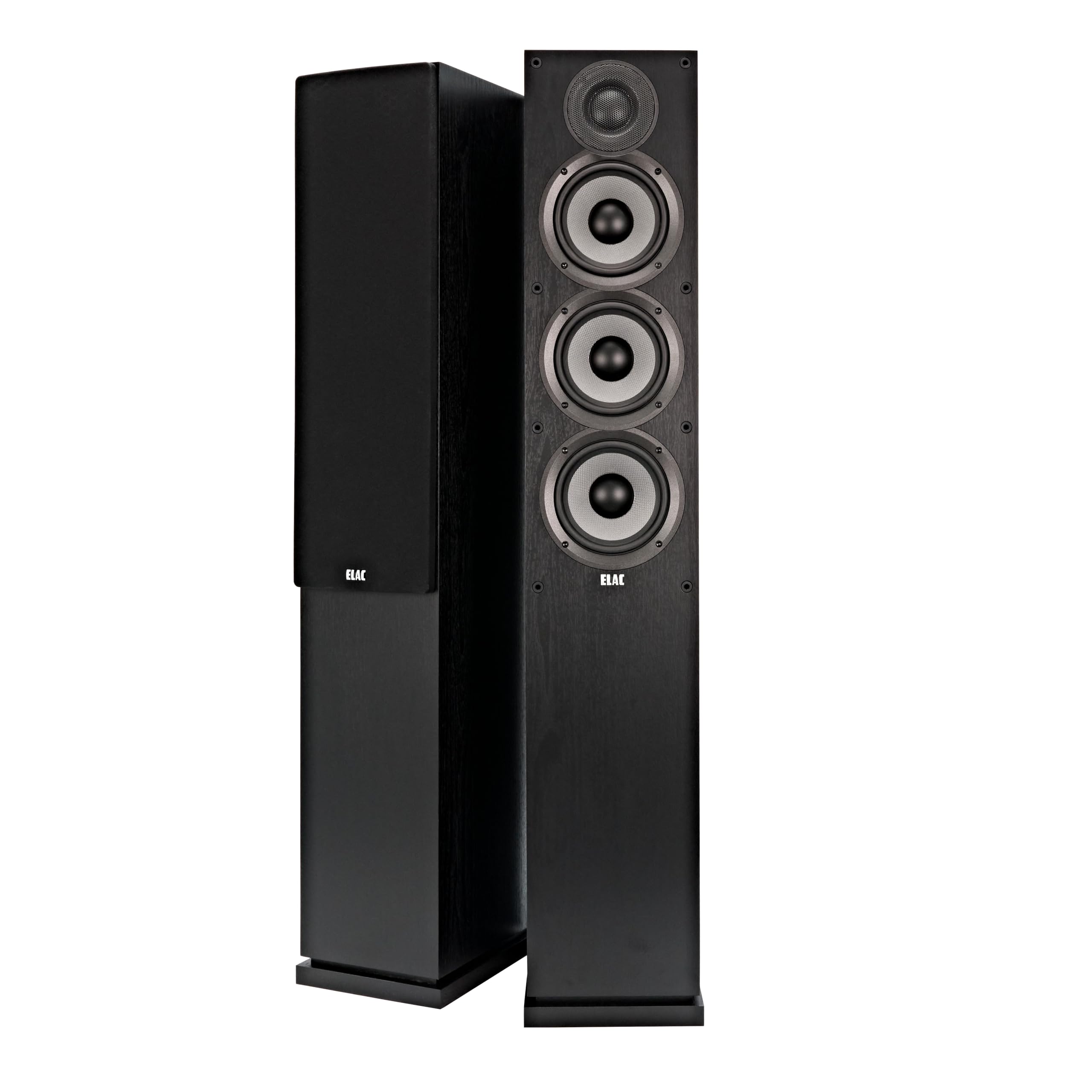
A tower that measures every detail and does not flatter bad recordings.
Each ELAC Debut 2.0 F5.2 uses three 5.25-inch aramid fiber woofers flanking a 1-inch cloth dome tweeter in a 3-way bass-reflex design. Aramid fiber is the same material used in bulletproof vests — it is stiffer and better damped than polypropylene or paper cones, which means the woofer stops moving the instant the signal stops, reducing distortion. The tweeter uses a wide-roll surround and a waveguide to control how sound spreads across the room, and its response goes up to 35,000 Hz. This is a passive speaker sold individually, so buy one for a center channel or two for stereo.
Buyers with decades in the hobby call it “the perfect speakers” for its balance of bass, midrange, and treble, noting that it reveals poor source quality instead of hiding it — meaning you hear the flaws in low-bitrate MP3s. One reviewer compared them directly against the Klipsch RP-8000F and found the ELAC won for music listening thanks to its neutral, non-fatiguing character. The catch is that they need 30-50 hours of break-in time before the drivers settle, and they lack deep low bass without a subwoofer. They are not the cheapest tower here, but for a dedicated music listener who values accuracy over hype, they are a standout.
What Makes It Special
- Three 5.25-inch aramid fiber woofers for stiff, low-distortion bass
- Wide-roll cloth dome tweeter with waveguide for controlled dispersion up to 35 kHz
- Thick MDF cabinet with internal bracing to reduce unwanted resonance
What to Expect
- Requires 30-50 hour break-in period and benefits from room EQ calibration
- Lacks deep sub-bass; a separate subwoofer is recommended for full-range output
For the critical listener: If you value neutral, detailed sound over boosted bass and do not mind taking time to dial in your system, these reward the effort.
Not for casual setups: If you want instant bass impact or listen mainly to low-bitrate audio, these will highlight the flaws rather than hide them.
5. Edifier MR5 2.0 Studio Monitor Bookshelf Speakers

Active studio monitors that let you tune the sound to the room you are in.
The Edifier MR5 uses a 3-way active crossover to split frequencies among a 5-inch long-throw woofer, a 3.75-inch midrange driver, and a 1-inch silk dome tweeter, with a total of 110W RMS of Class D amplification. The real selling point is the room compensation system — you can use physical knobs on the rear for high and low frequency adjustments, or use the EDIFIER ConneX App for deeper settings like Low Cut-Off, Desktop Control, and Acoustic Space presets. That means you can fix a boomy desk resonance or a bright room without buying acoustic treatment. Input options include XLR, TRS, RCA, and AUX, plus a front-panel headphone jack.
The MR5 delivers 110W RMS, matching the spec sheet of its sibling models. Shoppers say that they are “excellent for home theater PC” with “very loud with amazing bass and clear instrument separation.” The Bluetooth 6.0 with LDAC supports high-res wireless streaming up to 24-bit/96kHz. The catch is that the treble and bass knobs are on the rear panel, which can be hard to reach if the speakers are tucked against a wall. They are compact enough for a desktop but still produce a 101dB peak SPL, which fills a mid-sized room easily.
Studio-Ready Features
- 110W RMS with 3-way active crossover for accurate driver integration
- Room compensation via rear knobs and app (Desktop Control, Acoustic Space presets)
- XLR, TRS, RCA, AUX, and front headphone output for versatile connectivity
Consider
- Rear-mounted tone knobs are awkward to adjust after placement
- Some buyers wish for a bit more maximum volume headroom
Ideal for: Desktop musicians, gamers, and TV viewers who want active studio-grade sound with room-tuning tools built in.
Think twice if: You need a passive setup to upgrade amplifiers later, or you prefer a traditional AV receiver system.
6. Sony CS Speakers, SS-CS5M2 3-Way 3-Driver Hi-res Bookshelf Speakers (Pair)

A compact bookshelf that squeezes three dedicated drivers into a small footprint.
The Sony SS-CS5M2 puts a 5.12-inch woofer, a high-precision tweeter, and a wide-dispersion super tweeter into a compact bookshelf cabinet that fits on a desk or shelf without dominating the room. The woofer uses a reinforced cellular cone to stay rigid under pressure, and the bass-reflex enclosure (a ported box) helps the low frequencies come through without distortion. The frequency response stretches from 53 Hz to 50,000 Hz, and the speakers are rated at 6 ohms impedance. They are a perfect match for Sony AV receivers, but they work with any standard amplifier.
Buyers report that they “punch above their weight and there is no distortion even when you start pushing them hard.” One buyer picked them up specifically for a computer desk because the 3-way design gives you the driver separation of larger towers in a narrow footprint. The catch is that the list price is higher than what many buyers consider fair — one reviewer wrote “I bought these at during OCT prime and not the listed,” and multiple reviews urge waiting for a sale. At the right price, these are a strong compact 3-way option, but at full price you can step up to larger towers with deeper bass.
Small Cabinet, Big Sound
- 3-way design with dedicated woofer, tweeter, and super tweeter in a compact bookshelf form
- Reinforced cellular woofer cone and bass-reflex enclosure for clean low-end
- Hi-Res Audio certified with 53-50,000 Hz frequency response
Pricing Note
- Best bought on sale; reviewers consistently recommend waiting for a discount
- 6-ohm impedance may limit compatibility with some budget receivers
Best for: Desk setups, small rooms, or anyone who wants 3-way separation without the footprint of towers.
skip it if: You are paying full price — wait for a sale or consider larger options for similar money.
7. Rockville RockTower 68C Classic Passive Home Audio Tower Speaker 8 Ohm

An entry-level tower that packs dual 6.5-inch woofers and a separate midrange driver.
The Rockville RockTower 68C uses a 3-way configuration that is unusual at this price level: dual 6.5-inch woofers handle the lows, a separate 6.5-inch midrange driver handles the vocals, and a 1-inch silk dome tweeter takes the highs. The result is a frequency response from 30Hz to 20kHz with 125W RMS and 500W peak power handling. The cabinet is vent-tuned MDF with a classic wood grain finish and a detachable grille. At 8 ohms impedance, they are easy on most receivers — much friendlier than the 6-ohm Sony SS-CS3 towers, which demand more current from your amplifier.
Owners mention that “I purchased two of these speakers to replace an ancient pair of Yamaha bookshelf speakers from the 1980’s” and found them to be a “vast improvement” with clear highs and lows even at low volume levels. The Rockville’s 500W peak power offers 3.4x more headroom than the Sony SS-CS3’s 145W for loud movie scenes or parties. The catch is that the cabinet is not the heaviest, and some customers note that while they sound good for the money, they lack the refinement and imaging of more expensive options. For a tight budget, this is a solid entry point into true 3-way towers.
Budget-Friendly Power
- Dual 6.5-inch woofers plus dedicated 6.5-inch midrange driver for full-range coverage
- 125W RMS / 500W peak power handling gives plenty of headroom
- 8-ohm impedance is easy on most receivers
Honest Limits
- Cabinet build is not as heavy or refined as premium options
- Soundstage and imaging lag behind higher-end 3-way designs
Grab these if: You want a true 3-way tower on a tight budget and have a receiver that can drive them.
Consider upgrading if: You are a critical listener looking for precise imaging and build quality that matches the driver count.
8. KEF Q Concerto Meta Three-Way Bookshelf Speaker (Walnut, Pair)

A bookshelf that uses a single-point driver array and noise-absorbing material to disappear acoustically.
The KEF Q Concerto Meta is built around KEF’s 12th generation Uni-Q driver, which places the tweeter at the acoustic center of the midrange cone so that both high and mid frequencies radiate from the same physical point. This single-point source design means the sound reaches your ears at the exact same time from both drivers, creating a more coherent and rich soundstage. The “Meta” part refers to a proprietary material in the tweeter housing that absorbs 99% of the unwanted rear-wave noise that normally colors the sound. The cabinet available in Satin Black, Satin White, or Walnut has a contemporary minimalist look.
One buyer called them “unconscionably good speakers” and described the sound quality as “like alien technology,” noting that the phantom center channel effect is so convincing they did not need a dedicated center speaker. Another reviewer mentioned the “amazing clarity and powerful” output even in a large ballroom. The KEFs come with a 5-year manufacturer’s warranty, and the recommendation from an owner who compared them to KEF LS50 Meta, Wharfedale Dentons, and B&W 607 S3 was that the Concerto Metas won for having clarity without being fatiguing. The catch is they need space from the wall, and one reviewer found the Arendal 1961 Monitors suited their taste better after an in-person audition. These are an investment, but for a reference-level 3-way bookshelf that can fill a room, they deliver.
Engineering Highlights
- 12th gen Uni-Q driver array with tweeter at the center of the midrange for coherent soundstage
- MAT (Metamaterial Absorption Technology) absorbs 99% of unwanted rear-wave noise
- 5-year manufacturer warranty and premium satin finish options
Setup Considerations
- Requires space from rear wall for optimal bass and imaging performance
- Premium price means they compete against other high-end bookshelf options
For the discerning listener: If you want a bookshelf that can serve as a high-end reference for music and home theater and you have the room to place them properly, these are a serious contender.
Not for casual setups: If you cannot give them breathing room from the wall or you are on a tight budget, a simpler option will serve you better.
Understanding the Specs
Impedance (Ohms)
Ohms measure how much electrical resistance the speaker presents to your amplifier. An 8-ohm speaker is an easier load — most receivers handle it without strain. A 6-ohm or 4-ohm speaker demands more current, which can stress a cheap receiver and cause it to overheat or distort at high volumes. If you see a 6-ohm rating on a 3-way speaker, make sure your amplifier is rated for that load. The Rockville RockTower 68C runs at 8 ohms, making it a safer match for older or budget receivers.
RMS vs Peak Power
RMS (Root Mean Square) is the continuous power a speaker can handle for hours without damage — this is the number that matters for real-world listening. Peak power is the maximum short burst the speaker can survive without blowing. A speaker rated at 125W RMS and 500W peak (like the Rockville) can play at 125W all day and handle sudden drum hits up to 500W for a split second. The Sony SS-CS3’s 145W peak rating lacks an RMS figure, making sustained listening comparisons difficult. For normal listening levels, even 50W RMS per channel is plenty for most rooms, but having more RMS headroom means cleaner sound at higher volumes.
FAQ
What exactly makes a speaker a 3-way design?
Can I use 3-way bookshelf speakers as front speakers in a home theater?
Do active 3-way speakers sound better than passive ones?
What size amplifier do I need for a 3-way floorstanding speaker?
Can I use 3-way passive speakers with a regular home theater receiver?
Do I need a subwoofer with 3-way bookshelf speakers?
How do I position 3-way tower speakers for the best sound?
Is a higher frequency response always better in a 3-way speaker?
Final Thoughts: The Verdict
For most buyers, the best 3 way speaker winner is the Edifier R2750DB MKII because it packages a large 7-inch woofer, dedicated midrange, silk dome tweeter, and 144W RMS of amplification into an active system that works immediately with your TV, turntable, or phone — no separate amplifier or subwoofer needed. If you want built-in deep bass from floorstanding towers, grab the Fluance XL8F with its down-firing 8-inch subwoofers. And for the purest reference-level sound from a bookshelf, the standout is the KEF Q Concerto Meta with its Uni-Q driver array and noise-absorbing Meta technology.
How We Picked
We do not accept paid placement. Every pick is matched to a real buyer and a real use-case; we do not hands-on test units.
Sources & Methodology
Specifications: manufacturer listings and product documentation. Review insights: verified customer reviews, as of July 2026. Pricing: not shown on this page (it changes often); check the current price via the retailer link.
As an Amazon Associate, Gadgets Feed earns from qualifying purchases. This does not affect which products we feature.