
Our readers keep the lights on and my morning glass full of iced black tea. As an Amazon Associate, I earn from qualifying purchases.
Specs are compiled from manufacturer listings and verified buyer reviews and can change over time — please confirm the key details on the product page before buying.
If you are juggling a microphone, a guitar, backing tracks, and a Zoom call, you have already learned the hard lesson: plugging everything into one computer jack gives you noise, feedback, and a mess of cables. A dedicated mixer solves that by letting you control each sound source independently before it hits your speakers or recording.
I’m Min — the founder and writer behind Gadgets Feed. This guide is built by comparing the manufacturers’ published specifications and the patterns across verified customer reviews, so you get each pick’s real strengths and trade-offs instead of marketing spin.
You want a 4 channel mixer that gives you clean sound, the right connections, and solid build for your setup — without paying for features you will not use.
Our Picks at a Glance


How To Choose The Best 4 Channel Mixer
Picking the right mixer means matching its features to your hardware and use case. Here is what to focus on before you buy.
Phantom Power and Your Microphone
If you own a condenser microphone (the kind used in most studios and podcasts), your mixer must supply +48V phantom power. Dynamic mics, often used for live vocals, do not need it. Check that your mixer has a dedicated button for phantom power so you can toggle it only for the channels that need it.
Powered or Unpowered
A powered mixer, like the Rockville RPM45, has a built-in amplifier so you can plug passive speakers directly into it. An unpowered mixer, like the Mackie 402VLZ4, sends a line-level signal to external powered speakers or an amp. Powered is simpler for a small venue or band setup; unpowered gives you more flexibility to choose your own amp and speakers.
Built-in Effects
Many mixers now include DSP (Digital Signal Processing) effects like reverb, echo, and delay. If you want to add polish to a vocal without buying an external effects unit, look for at least a reverb that sounds natural. Some budget mixers pack in 99 effects, but reviewers often find only a few are usable.
Connectivity: Bluetooth and USB
Bluetooth lets you stream music from a phone or laptop wirelessly into your mix — handy for background music or backing tracks. A USB interface lets you plug the mixer directly into a computer for recording or live streaming. Make sure the Bluetooth range works for your room and that the USB connection is plug-and-play on your operating system.
Quick Comparison
| Model | Best For | Inputs | Weight | Phantom Power | Amazon |
|---|---|---|---|---|---|
| Mackie 402VLZ4★ Best Overall | Pro-grade studio & broadcast | 2 XLR + 4 line | 2.5 lbs | Yes | $149.99Amazon |
| Rockville RPM45Best Powered | Live small-venue performance | 4 XLR + 4 TRS | 19 lbs | Yes | $139.95Amazon |
| Pyle PMXU46BT | Multi-mic studio & churches | 2 XLR/TRS combo + line | 6.84 lbs | Yes | $175.99Amazon |
| TKLBLS TDS-4DSP | Value-packed home recording | 2 XLR + 2 line | 3.96 lbs (1.8 kg) | Yes | $85.99Amazon |
| Rolls MX51S | Simple desk-based line mixing | 1 XLR + 3 RCA | 1.1 lbs (0.5 kg) | Yes | $79.00Amazon |
| KENBAIDIO F-4A | Budget-conscious portable rig | 2 XLR/TRS combo + line | — | Yes | Amazon |
| Pyle PAD43MXUBT | Ultra-compact podcasting | 2 XLR/TRS combo + line | Under 3 lbs | Yes | $71.99Amazon |
In‑Depth Reviews
1. Mackie 402VLZ4
Our pick — over 4.5★ from 800+ verified ratings; the strongest balance of quality and price.
The studio standard that fits on a cramped desk without sacrificing a single professional feature.
You get the cleanest signal path in this lineup thanks to Mackie’s Onyx mic preamps. That means your vocals come through without added hiss or distortion, even when you push the gain. The 402VLZ4 has 2 Onyx preamps (the kind found on Mackie’s much larger consoles) and 4 high-headroom line inputs, so it handles a mic and a couple of instruments at once without breaking a sweat. The XLR balanced outputs and 3-bus capability give you separate routing for recording, monitoring, and the main mix — a feature you normally only get on bigger boards.
Buyers report the all-metal body feels solid, though one noted “my only issue was that I received a slightly different revision than what was pictured.” The external power supply (a brick that plugs into the wall) keeps the mixer body small, and the color-coded knobs let you make quick changes during a live set. Compared to the Rolls MX51S, which is a line mixer only 1.25 inches deep, the Mackie is 5 inches deep and built for much heavier use.
What stands out
- Boutique-quality Onyx preamps deliver clean, low-noise performance
- Improved RF rejection keeps interference out during broadcast or gigs
- 3-bus design offers routing flexibility beyond basic mixers
The trade-offs
- No built-in effects or Bluetooth
- Headphone volume is not independent of the main mix
- Knobs lack a center detent, making flat EQ harder to find
Reach for this if: you want pro-grade preamps and routing in a compact desk mixer — perfect for home studios, broadcast, and serious podcasters.
Look elsewhere if: you need built-in effects or wireless streaming; this is a pure analog workhorse with no frills.
2. KENBAIDIO F-4A
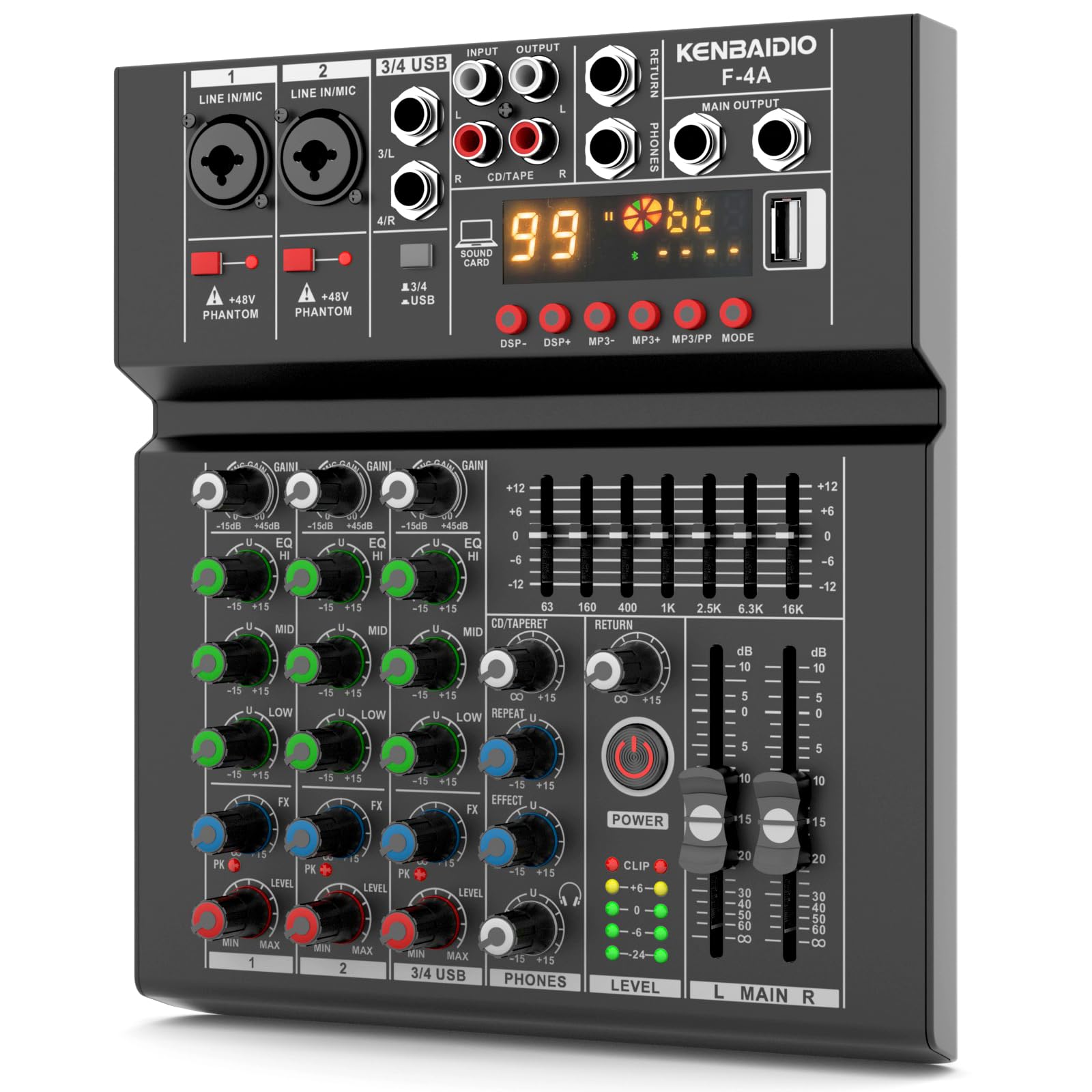
An affordable travel mixer that runs on USB-C battery power and fits in a backpack.
You can power this little board via USB-C at 5V 2A, which means you can run it off a portable battery pack for outdoor gigs or mobile recording. It has a metal housing, Bluetooth input, and 99 built-in DSP effects. The 4-channel layout includes 2 XLR/6.35mm combo jacks with independent 48V phantom power for condenser mics, plus RCA and TRS line inputs. The main output has a 7-band EQ for fine-tuning your final mix, and each channel gets its own 3-band EQ.
Owners mention “good clean sound” and note that the Bluetooth works well up to 33 feet. One reviewer pointed out that the effects are mostly terrible — “only 3 usable reverb patches” — so treat the DSP as a bonus rather than a core feature. The wobbly faders and lack of XLR main outputs (you will need a DI box for balanced connections to pro speakers) are the main trade-offs at this price bracket.
What works well
- USB-C power (5V 2A) lets you run on a battery pack for portable use
- Compact all-metal body survives transport in a backpack
- Bluetooth input with up to 33 feet range
Where it cuts corners
- Faders feel wobbly and not as durable
- No XLR main output — requires external DI for balanced speakers
- Most DSP effects are poor; stick to the reverb patches
Grab it if: you need a battery-powered mixer for mobile use, busking, or outdoor events where AC power is scarce.
Avoid it if: you need faders (sliding volume controls) and balanced XLR outputs (the three-pin connector that rejects noise over long cable runs) for a permanent studio setup.
3. Pyle PMXU46BT

The feature-packed workhorse that streams Bluetooth straight into your mix while you record.
You get Bluetooth wireless streaming, a USB soundcard for computer recording, and a 4-channel layout with XLR/TRS combo inputs. The +48V phantom power powers condenser mics on the XLR channels, and the 12-segment stereo output meter (-30 to CLIP) gives you precise visual feedback so you never hit distortion. Customers note it handles a multi-mic live call setup with “crisp, clear audio with zero preamp noise” and that previous Pyle mixers in the family have lasted for years of weekly gigging.
The mixer includes 2-band EQ and pan control on each channel plus a main 7-band EQ on the final output. It weighs 6.84 pounds, so it is portable enough to move between home and a rehearsal space. Compared to the Mackie 402VLZ4, the PMXU46BT adds Bluetooth and on-board effects, though it does not have the same boutique-quality preamps. The USB interface works as a plug-and-play audio device on Mac and PC, making it easy to record directly into your DAW.
The strong points
- Bluetooth wireless input for streaming background music or backing tracks
- USB audio interface for direct recording to Mac or PC
- 12-segment meter gives accurate level monitoring across the mix
The weak spots
- Bluetooth range is just 15 feet
- Recording outputs a single stereo track only, no multitrack
Choose this when: you want Bluetooth streaming plus USB recording in one box — great for churches, small studios, and musicians who need a versatile all-rounder.
skip it if: you insist on boutique preamps or need independent control room outputs for live monitoring.
4. TKLBLS TDS-4DSP

A budget-friendly board that packs 99 effects and Bluetooth without cutting essential features.
This mixer brings DSP effects, Bluetooth streaming, USB recording, and a 7-band output EQ at an entry-level price point. It has 2 XLR mic inputs with independent 48V phantom power for condenser mics, plus 2 stereo line inputs for instruments or media players. Each channel has a 3-band EQ for high, mid, and low adjustments, and the main output gets the 7-band EQ for fine-tuning your final mix. Bluetooth works within a 15-foot range for wireless music playback from your phone.
Reviewers point out it has “great EQ control for price, half cost of Mackie/Yamaha” and that the phantom power is sufficient for a professional condenser microphone. The 99 built-in DSP effects include reverb, echo, and pitch effects, though shoppers say that only the reverb patches are really usable. The USB recording feature saves audio directly to a USB drive, while the computer interface works with Mac and PC. At 1.8 kilograms (about 4 pounds), it is easy to slot into a home studio or bring to a small event.
What you gain
- 99 DSP effects including reverb and echo for vocal polish
- 7-band EQ on the main output for detailed tone shaping
- Bluetooth and USB recording in one compact unit
Where it compromises
- Plastic knobs feel less durable than metal alternatives
- Some effects are weak or unusable — stick to reverb
- Must power on before speakers to avoid a pop
Best for: beginners and solo performers who want effects and EQ control on a tight budget — gives you a ton of features for the money.
Not for: touring musicians who need a road-ready build; the plastic components may not survive heavy transport.
5. Rolls MX51S Mini Mix 2
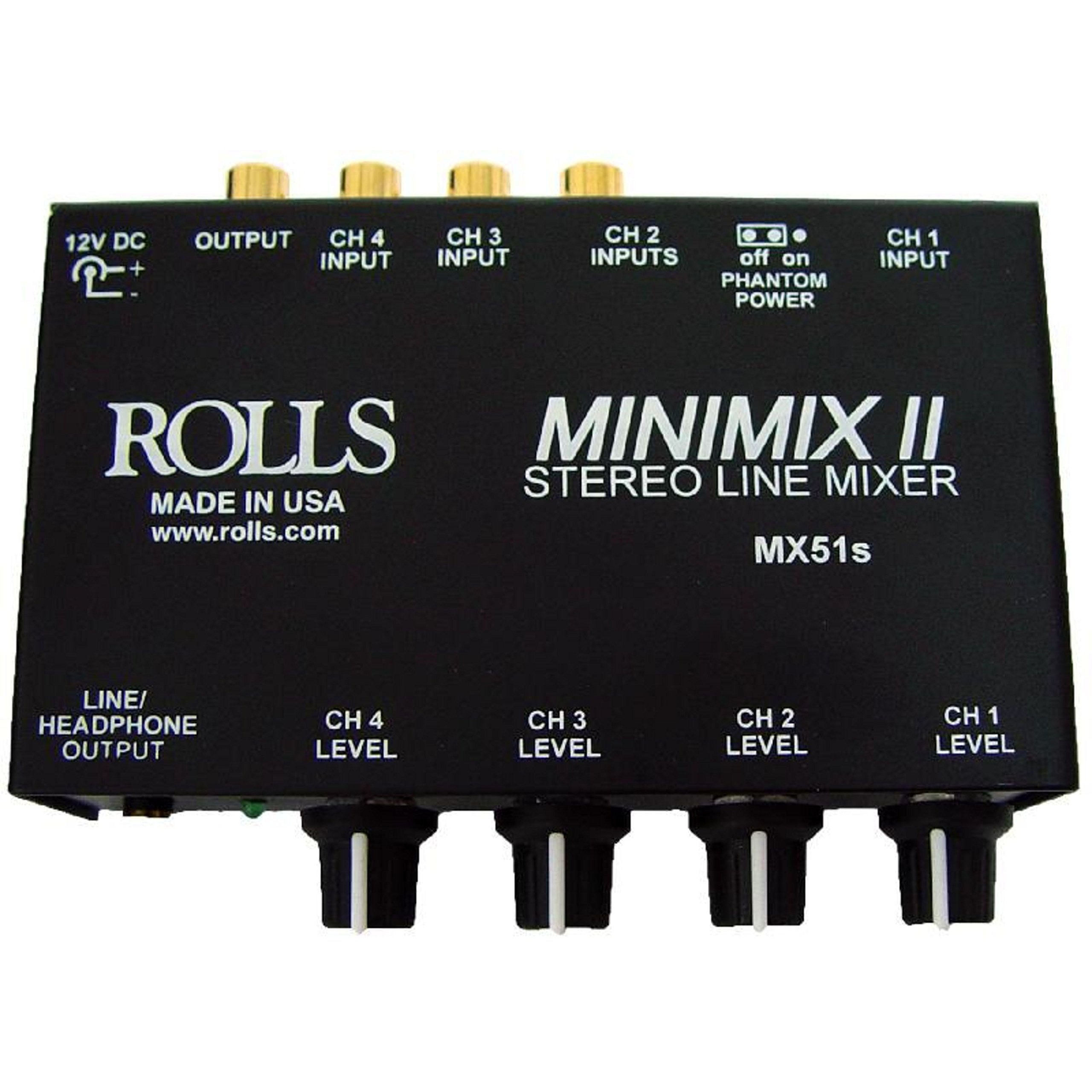
A tiny, powered line mixer that solves the “too many audio sources, one set of speakers” problem.
The MX51S is barely bigger than a deck of cards at 1.25 inches deep by 3.5 inches wide by 4.5 inches high — that is a 4.3x depth advantage over the Pyle PAD43MXUBT. It combines 1 XLR microphone input with phantom power and 3 RCA stereo inputs, giving you 4 channels total. The compact, powder-coated metal case sits unobtrusively on a desk, and the smooth knobs have a detent at 12:00 so you can easily find the unity gain position.
Buyers report it is “ideal for combining PC, console audio to single output” and that it solves the delayed mic monitoring problem from software. Unlike the larger Mackie 402VLZ4, the Rolls is designed purely for line-level mixing — it blends signals rather than amplifying them. It is the right pick if you need to merge a computer, game console, and microphone into one headphone output without hassle.
The highlights
- Ultra-compact size fits anywhere — 1.25″ deep, 3.5″ wide
- Powered design stops signal loss from passive splitters
- Independent volume control for each input channel
The downsides
- No master volume knob — you control each input individually
- Only 1 XLR input; most channels are RCA line-level only
Reach for this if: you need to combine multiple line-level sources (PC, console, phone) into one output for desktop listening or streaming.
pass on it if: you need to amplify microphones or instruments — this is a line mixer, not a full-featured console.
6. Rockville RPM45
A self-contained PA system that brings its own amp, so you show up with speakers and nothing else.
This is a different beast from the unpowered mixers above. The RPM45 delivers 1800w peak power (225w x 2 RMS @ 8 Ohm) through its built-in amplifier, so you can plug passive speakers straight in and fill a small to medium venue. It has 4 XLR and 4 TRS inputs, a USB port, and an AUX input — giving you room for multiple mics and instruments. The rugged wooden enclosure and 19-pound weight make it a proper piece of gear that stays put on stage.
Owners mention it handled a 5-piece band with 5 instruments and 3 singers for a 6-hour gig without overheating, thanks to the fan cooling system. The built-in echo, delay, and reverb effects are adjustable per channel, along with individual bass and treble controls. Unlike unpowered mixers that need an external amp, this one lets you build a small PA with just the mixer and two speakers — a major convenience for bands and karaoke hosts.
Where it delivers
- Built-in amp delivers 1800w peak — no separate amplifier needed
- Wooden enclosure and fan cooling handle extended live use
- USB input and MP3 player for easy backing track playback
Keep in mind
- At 19 pounds, it is heavy — not a portable podcast rig
- No Bluetooth streaming for wireless music input
Grab it for: live band practice or small gigs where you need a powered solution — skip the separate amp and run passive speakers directly.
Pass on it if: you mostly record at a desk; this is built for volume and live reinforcement, not quiet studio fidelity.
7. Pyle PAD43MXUBT

A palm-sized mixer that fits in a laptop bag and turns any desk into a mini studio.
The PAD43MXUBT measures just 5.35 x 5.13 x 1.38 inches — smaller than a paperback book — and weighs under 3 pounds. It has a rugged metal chassis, Bluetooth 5.0 with a 50-foot range, and a USB audio interface for plug-and-play PC recording. The 4-channel layout includes 2 XLR/6.35mm combo jacks for mic or guitar, plus RCA and 3.5mm AUX inputs. A +48V phantom power button with an LED indicator activates pro condenser mics instantly.
Each channel gets its own 2-band EQ and pan control, plus a built-in echo effect. Customers note it is “an awesome audio mixer… very excellent performance when using it with our karaoke.” One buyer experienced “occasional static crackle in voice memo app (first few minutes),” but found a workaround using external connectors instead of USB. This is the most portable full-featured mixer here, designed for podcasters, karaoke hosts, and mobile DJs who need a complete setup in a small footprint.
Standout features
- Ultra-compact at 5.35″ x 5.13″ x 1.38″ — fits any desktop or bag
- Bluetooth 5.0 with 50-foot range for wireless streaming
- Rugged metal chassis built for daily transport
Considerations
- Only 2-band EQ per channel — less precise than 3-band options
- Some iOS users report static crackle over USB connections
Pick this for: ultra-portable podcasting, karaoke, or mobile DJ work where every inch of desk space counts.
Look elsewhere if: you need per-channel EQ (equalization, to adjust bass and treble on each input) or a reliable USB recording interface for iOS devices like an iPad.
Understanding the Specs
Phantom Power
This is a +48V DC current sent through the XLR cable to power condenser microphones, which need electricity to operate their internal electronics. Dynamic mics do not need it and are unaffected when it is on. A good mixer has a dedicated button for phantom power so you can toggle it only for the channels with condenser mics.
DSP Effects
Digital Signal Processing effects are built-in audio processors that add reverb, echo, delay, or pitch shift to your sound. They save you from buying an external effects pedal or rack unit. The quality varies widely — some mixers have 99 effects but only 2-3 usable ones. Focus on whether the reverb sounds natural rather than the total count.
Powered vs Unpowered
A powered mixer has a built-in amplifier so you can connect passive speakers directly without a separate amp. An unpowered mixer sends a line-level signal to powered speakers or an external amplifier. Powered is simpler for small venues; unpowered gives you more flexibility to choose your amp and speakers.
Bluetooth and USB Connectivity
Bluetooth lets you stream music wirelessly from a phone or tablet into your mix. USB connectivity turns the mixer into an audio interface for recording directly to a computer. Check that the Bluetooth range covers your room and that the USB is plug-and-play on your operating system without extra drivers.
FAQ
Do I need a powered or unpowered 4 channel mixer?
What does phantom power do and do I need it?
Can I record directly to my computer with a 4 channel mixer?
How many microphones can I plug into a 4 channel mixer?
Will a 4 channel mixer work with my guitar?
What is the difference between a 2-band and 3-band EQ on a mixer channel?
How do DSP effects sound on budget mixers?
Can I use a 4 channel mixer for live streaming?
What is the best 4 channel mixer for podcasting?
How long do mixer faders and knobs last?
Final Thoughts: The Verdict
For most buyers, the 4 channel mixer winner is the Mackie 402VLZ4 because its Onyx preamps deliver the cleanest signal for studio and broadcast work. If you want a powered all-in-one for live gigs, grab the Rockville RPM45. And for maximum value packed with effects and Bluetooth, the TKLBLS TDS-4DSP gives you the most features for your budget.
How We Picked
We do not accept paid placement. Every pick is matched to a real buyer and a real use-case; we do not hands-on test units.
Sources & Methodology
Specifications: manufacturer listings and product documentation. Review insights: verified customer reviews, as of July 2026. Pricing: not shown on this page (it changes often); check the current price via the retailer link.
As an Amazon Associate, Gadgets Feed earns from qualifying purchases. This does not affect which products we feature.
Related Guides
Product prices and availability are accurate as of the date/time indicated and are subject to change. Any price and availability information displayed on Amazon at the time of purchase will apply to the purchase of this product. As an Amazon Associate I earn from qualifying purchases.
CERTAIN CONTENT THAT APPEARS ON THIS SITE COMES FROM AMAZON. THIS CONTENT IS PROVIDED "AS IS" AND IS SUBJECT TO CHANGE OR REMOVAL AT ANY TIME.
Amazon and the Amazon logo are trademarks of Amazon.com, Inc. or its affiliates.