
Our readers keep the lights on and my morning glass full of iced black tea. As an Amazon Associate, I earn from qualifying purchases.
Specs are compiled from manufacturer listings and verified buyer reviews and can change over time — please confirm the key details on the product page before buying.
Your headphones have more to give if the signal driving them has enough power and clean voltage. A pure analog headphone amp does exactly that — it boosts a line-level signal without adding digital processing, so your headphones sound full, detailed, and controlled. This guide looks at six real-world analog amps (no built-in DACs or digital inputs), from a compact desktop companion to a 57-pound integrated tube monster.
I’m Min — the founder and writer behind Gadgets Feed. This guide is built by comparing the manufacturers’ published specifications and the patterns across verified customer reviews, so you get each pick’s real strengths and trade-offs instead of marketing spin.
Choosing the right analog headphone amp depends on matching power, connectivity, and tonality to your specific headphones and setup. A clean, neutral amp gives you an uncolored window into your music.
Our Picks at a Glance

How To Choose The Best Analog Headphone Amp
Buying an analog headphone amp is about matching three things: how much power your headphones need, what connections your source gear has, and what flavor of sound you prefer. Here are the key factors to consider.
Power Output: Watts and Impedance
Look at the amp’s output power, usually stated in milliwatts (mW) at a given impedance (opposition to current flow) like 50 ohms or 300 ohms. High-impedance headphones (250-600 ohms) need more voltage to sound loud. Low-impedance, high-sensitivity in-ear monitors (IEMs) need clean power with ultra-low noise to avoid hiss. A good analog headphone amp will state power across multiple impedances so you can match it to your headphones.
Balanced vs. Single-Ended Outputs
Balanced connections use separate ground lines for the left and right channels, which cancels out certain types of electrical noise. If your source (like a DAC) has a balanced output, a balanced amp can give you a cleaner background and sometimes more power. The Apos Gremlin and the Rupert Neve Designs RNHP both offer balanced connections, while other picks are single-ended only.
Gain Settings and Noise Floor
Multiple gain settings let you match the amp’s sensitivity to your headphones. A low-gain setting is essential for sensitive IEMs, preventing the left and right channels from sounding imbalanced at low volume and keeping the noise floor (background hiss) inaudible. High gain gives you headroom for demanding headphones. The TOPPING L30II, for instance, offers three gain settings (-9.9dB, 0dB, 9.5dB) to cover both IEMs and power-hungry over-ears.
Quick Comparison
| Model | Best For | Output Power | Topology | Connections | Amazon |
|---|---|---|---|---|---|
| Monolith Liquid Spark★ Best Overall | Best value under | 1.3W @ 50 ohms | DC-coupled Solid-State | RCA, 6.35mm | $131.99$164.99Amazon |
| Apos GremlinAlso Great | Warm balanced tube sound | 1250mW/ch | Class A Hybrid Tube | XLR, 4.4mm, 6.35mm | $135.00Amazon |
| TOPPING L30II | Ultra-clean neutral power | 7 Watts | NFCA Solid-State | 6.35mm, 3.5mm, RCA | $149.00Amazon |
| Samson QH4 | Multi-channel studio splitting | — | Solid-State Distribution | 1/4″ Balanced, 1/8″ Aux | $99.99Amazon |
| Rupert Neve Designs RNHP | Pro-audio reference quality | — | Solid-State | 1/4″, 1/8″, +4dBu | $699.00Amazon |
| Willsenton R8 | Full integrated tube powerhouse | — | Push-Pull Tube (KT88/EL34) | 4/8/16 ohm speaker, 6.35mm | $1,449.38Amazon |
In‑Depth Reviews
1. Monolith 133304 Liquid Spark Headphone Amplifier
Our pick — over 4★ from 350+ verified ratings; the strongest balance of quality and price.
A benchmark-level solid-state amp that punches well above its price tag.
The Liquid Spark uses a DC-coupled topology — meaning no capacitors in the signal path to color the sound — with laser-matched, low-noise audio JFETs (junction field-effect transistors) in the input stage. This design philosophy shows in the sound: reviewers point out it “ties Jotunheim in SE mode” and excels in detail, resolution, soundstage, and punchy bass. With 1.3 Watts at 50 ohms, it drives power-hungry headphones like the HD 600 series and T50 mods with authority, as multiple reviewers confirm. The preamp output RCAs let you connect powered speakers for a simple desktop setup.
Compared to the TOPPING L30II’s 7-watt maximum, the Liquid Spark is less powerful but more affordable, and reviewers consistently rank its sound quality among the best in its class — one buyer called it “the best amp under.” The chassis (11.1 x 7.3 x 2.8 inches) is significantly larger than the L30II, but that extra space houses a smooth volume pot that minimizes the channel imbalance common on cheaper amps.
Shoppers say the channel imbalance below 11:00 on the knob is a known quirk, but it never fully resolves. The amp runs warm during use — that is normal for its class-A-biased output stage.
Top-Tier Value
- DC-coupled (no capacitors in signal path) means no muffled sound
- 1.3W at 50 ohms drives most full-sized headphones well
- Warm, detailed sound with wide soundstage and controlled bass
Known Quirks
- Channel imbalance below 11:00 on volume knob
- Runs warm during extended use
Benchmark on a budget: Grab the Monolith Liquid Spark if you want a clean, powerful solid-state amp that rivals amps costing twice as much — it is the safe, proven choice for under.
Pass it up if: You need a tiny desktop footprint or balanced connections; the TOPPING L30II is smaller and the Apos Gremlin gives you balanced tube sound.
2. Apos Gremlin Headphone Amp (Tube)
Tiny chassis, ferocious bite, and tube warmth that makes solid-state sound clinical.
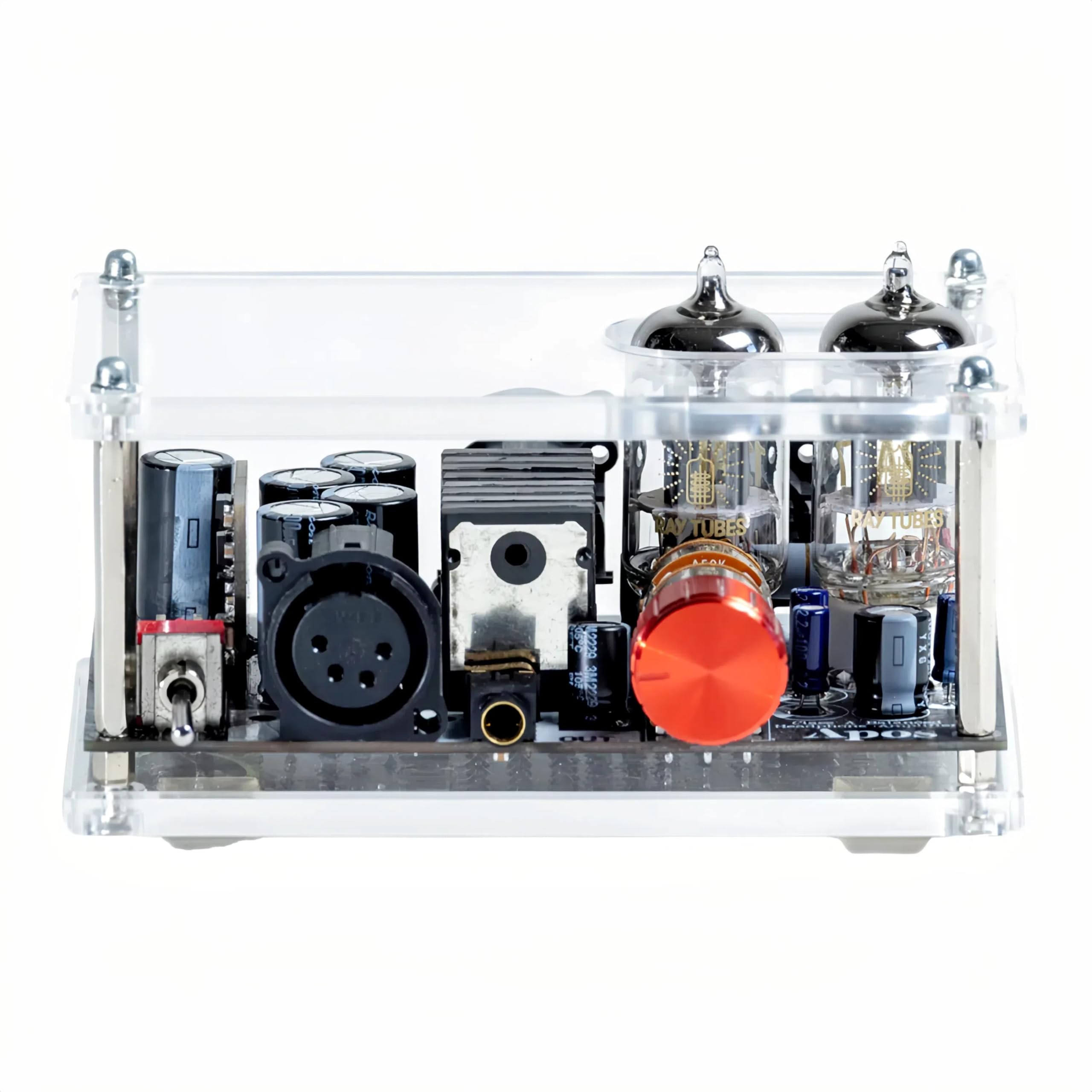
The Gremlin delivers what buyers describe as “stunning sound quality” through a fully-balanced Class A design using a hybrid tube preamp stage — the vacuum tubes in the pre-amp inject rich harmonics and warmth, while solid-state transistors handle the heavy lifting. At 1250mW of output power, it drives planar headphones like the Dan Clark Noire X and Hifiman Sundara with ease, according to reviewers. Balanced XLR inputs and 4-pin XLR / 4.4mm balanced outputs cancel out hum and interference, giving you a dead-quiet background. The included matched pair of CORE 12AU7 tubes from Ray Tubes provides that signature warmth right from the start, but you can roll (swap) any 12AU7 or 6922 tubes to change the voicing — something audiophiles love.
Unlike the TOPPING L30II which is clean and neutral, the Gremlin has what one reviewer called “heart-melting mids” that add body and depth. Buyers report it outperforms the SMSL RAW-MDA-1 and sounds like a K amp for.
Owners mention the amp takes 15-30 minutes to warm up and roughly 6 hours of burn-in before the tubes settle. The hybrid design means you get the precision of transistors with the soul of tubes — a rare combination at this price.
Balanced Tube Magic
- Fully-balanced Class A design delivers clean, wide soundstage
- 1250mW per channel drives planars and high-impedance cans
- Tube rolling (12AU7/6922) lets you customize the sound signature
Warm-Up Required
- Needs 15-30 minute warm-up before sounding its best
- Stock tubes good but upgrading to NOS tubes yields bigger gains
Your gateway to tubes: Pick the Apos Gremlin if you want rich, musical sound with warmth and the ability to fine-tune the voicing through tube rolling — all at an entry-level price.
skip it if: You prefer a perfectly neutral, analytical sound with no tonal coloration; a solid-state amp like the TOPPING L30II is a better match.
3. TOPPING L30II NFCA Linear Headphone Amp

Dead-quiet background that reveals details you never knew were in your recordings.
The L30II uses TOPPING’s NFCA (NFCA stands for a proprietary negative-feedback circuit architecture) modules to deliver what one reviewer called “an absurdly high dynamic range of 141dB” with an ultra-low noise floor of 0.3uV (0.3 microvolts — about 1000 times quieter than a typical laptop headphone jack) — meaning you hear the music, not the amp. This makes it a perfect match for sensitive IEMs that would hiss on lesser amps. With three gain settings (-9.9dB, 0dB, 9.5dB), it adapts from the most delicate IEMs to power-hungry 300-ohm headphones. The compact chassis (3.94 x 5.31 x 1.26 inches) is roughly 2.8x smaller than the Monolith Liquid Spark’s footprint, making it ideal for cramped desk setups.
Customers note it drives the Sennheiser HD650 “dangerously well” without distortion, and the included 6.35mm-to-3.5mm adaptor means you can plug in any headphone. Unlike the Rupert Neve Designs RNHP which costs over 4x as much, the L30II offers comparable noise performance in a much smaller package.
Reviewers mention the glossy plastic front panel feels a bit cheap compared to the all-metal build of competitors, but the audio quality “surpasses UAD Apollo x4 headphone out” according to one owner. The preamp functionality works as a clean signal path for your powered speakers too.
Dead Quiet
- 0.3uV noise floor means total silence with sensitive IEMs
- Three gain settings cover everything from IEMs to 600-ohm cans
- Compact aluminum chassis saves desk space
Build Compromise
- Glossy plastic front panel feels less premium than metal rivals
- Power on/off switch position is unclear at a glance
For the detail obsessive: Choose the TOPPING L30II if you need a perfectly neutral, transparent amp with an inky-black background that lets you hear every recording flaw or studio nuance.
Look elsewhere if: You want a warm, euphonic tube sound or a bigger, more tactile volume knob — the Apos Gremlin or Willsenton R8 are better fits.
4. Willsenton R8 KT88 Integrated Tube Amplifier

A 57-pound integrated tube amp that also works as a headphone amplifier.
The Willsenton R8 is a full-sized integrated amplifier that can also drive headphones via a 6.35mm jack — making it a unique addition to this list. It ships with four KT88 tubes, but you can swap them for EL34 or 6550 tubes with a rear switch to get three different sonic signatures. In triode mode (a simple tube configuration), it delivers a spacious 3D soundstage; in ultralinear mode (a more efficient connection), it provides more power and slam for speakers. Buyers report the stock tubes sound good but upgrading to Gold Lion KT88 and Tung Sol 6SN7 tubes brings out more bass and clarity. The amp weighs roughly 26 kilograms (57 pounds), which reviewers consistently call “heavy” but justified by the build quality with potted transformers (encased in protective material) and hand-wired construction.
Unlike the compact solid-state amps in this list, the R8 requires dedicated space and a burn-in period of 100-300 hours before reaching its best sound. Buyers mention it “punches way above its weight for the money” and compares favorably to amps costing 2-3x as much, like the PrimaLuna Evo 100. The headphone output is an afterthought versus the speaker terminals, but it still provides enough power to drive demanding headphones cleanly.
Owners mention the remote control is all-metal but the volume control is poorly implemented, and the input selector and triode/ultralinear switches produce audible pops when toggled. Tubes last roughly 1,000-2,000 hours, with a full replacement set.
Integrated Power
- Functions as a headphone amp, integrated amp, and power amp
- Swap between KT88, EL34, or 6550 tubes for different tonal flavors
- Triode and ultralinear modes give you two distinct sound signatures
Big and Heavy
- 57-pound weight requires a sturdy dedicated stand or table
- Requires 100-300 hours of burn-in to reach optimal sound quality
- Input and mode switching produces audible pops
For the tube convert: Buy the Willsenton R8 if you want a do-everything tube amp that drives both speakers and headphones with luscious, powerful sound — and you have the space and patience to let it burn in.
Move on if: You need a purely analog headphone amp for a desktop setup — the R8 is overkill and the Apos Gremlin or TOPPING L30II are better suited.
5. Rupert Neve Designs RNHP Stereo Precision Headphone Amplifier

The pro-audio name that brings studio mixing console sound to your headphones.
Rupert Neve’s engineering legacy in professional recording consoles is distilled into this compact desktop amp. Customers note it delivers “clear bass, great soundstage” with crisp vocals that “rivals amps 6x the price” — specifically mentioning it works beautifully with Focal Celestee, Meze 99, and Beyerdynamic DT-770 Pro 250 ohm headphones. The stainless steel chassis houses a dedicated 24V power supply that provides clean, stable voltage to the amplifier circuitry. Unlike the TOPPING L30II which offers three gain settings, the RNHP uses a simpler fixed-gain approach with a +4dBu line input that matches professional studio gear.
Reviewers point out it has a “warm, tube-like sound” without actually using tubes — it is entirely solid-state but voiced to be musical and non-fatiguing. One owner of a McIntosh MVP 861 and a Node 2i source called it “excellent value” that replaced their previous amp. The RNHP defaults to the “A” output on power-up and the green LED lacks a dimmer, minor ergonomic gripes from users.
It sits in a different league from the TOPPING L30II, but buyers consistently say it “sounds like Neve console” — that pro-audio heritage carries real weight for those who know the brand.
Studio Pedigree
- Rupert Neve engineering heritage delivers musical, non-fatiguing sound
- Stainless steel chassis with dedicated 24V power supply
- Drives both sensitive IEMs and high-impedance headphones well
Pricey Package
- No balanced connections — single-ended only
- Green LED lacks a dimmer for dark listening rooms
- Requires near-max volume on some high-impedance headphones at normal line levels
Neve quality, desktop size: Invest in the Rupert Neve Designs RNHP if you want legendary pro-audio sound in a compact form factor and are willing to pay for engineering heritage and build quality.
Save your money if: You are after pure transparency and noise performance — the TOPPING L30II gives you similar clarity for a fraction of the cost.
6. Samson QH4 4-Channel Headphone Amplifier

Four independent headphone channels with individual volume for studio sharing or late-night listening.
The Samson QH4 is the only multi-channel distribution amp in this list, designed to send one audio source to four pairs of headphones with independent volume control for each. Shoppers say it is a “high quality splitter, far better than HA400/Behringer” with no detectable signal degradation — important if you are sharing a mix with others. Each channel has its own 1/4-inch stereo output, and the two balanced 1/4-inch inputs accept both line-level signals from audio interfaces. The unique stereo 1/8-inch aux input and output lets you patch in a second headphone source or daisy-chain multiple units.
Unlike the single-output amps like the Monolith Liquid Spark or TOPPING L30II, the QH4 prioritizes distribution over ultimate sound quality. One reviewer called it “transparent, balanced sound, no volume loss or coloration” — meaning it preserves your source quality while giving you four independent volume knobs. The physical volume knob per channel is something users specifically highlight as “crucial for quick ear protection” when someone pulls off their headphones mid-track.
Reviewers mention there is a bit of audible noise at extremely high (deafening) volume settings, but at normal listening levels it is dead quiet. The unit is sturdy and the knobs feel solid, according to multiple owners.
Studio Utility
- Four independent stereo headphone channels with individual volume control
- Balanced 1/4-inch inputs minimize noise in studio setups
- Aux input lets you patch a second source without adaptors
Targeted Use
- Noise floor rises at ear-splitting volume levels
- Not designed for the ultimate fidelity demand of audiophile listening
Studio multiplexer: Choose the Samson QH4 if you need to send one source to multiple headphone pairs for recording sessions, podcasting, or silent listening with a group — no other amp here can do that.
pass on it if: You need a single dedicated analog headphone amp for critical listening; the Monolith Liquid Spark or Apos Gremlin deliver higher fidelity.
Understanding the Specs
Output Power (mW/Watts)
Output power tells you how loud your headphones can get before distortion creeps in. It is measured in milliwatts (mW) or watts (W) at a specific impedance (opposition to electrical flow) — for example, 1.3W at 50 ohms. Higher power is better for low-sensitivity, high-impedance headphones, but too much power into sensitive IEMs (in-ear monitors) can cause hiss unless the amp has a very low noise floor. Always check power at or near your headphones’ impedance to see if there is enough headroom.
Noise Floor (uV)
This measures how much electrical noise the amp produces when no music is playing, expressed in microvolts (uV). A lower number is better — 0.3uV like the TOPPING L30II means near-total silence. If you own sensitive IEMs, look for an amp with a very low noise floor (under 1uV) and multiple gain settings so you can use low gain to keep background hiss inaudible.
Class A vs. Solid-State vs. Tube
Class A means the output transistors are always on, which gives cleaner sound but generates more heat. Solid-state amps use transistors for accuracy and detail. Tube amps use vacuum tubes (glass-enclosed electronic components that heat up and glow), which add even-order harmonic distortion (a type of sound texture) that many describe as “warm” or “musical.” Hybrid amps like the Apos Gremlin use tubes in the preamp stage and solid-state for output, trying to combine the best of both worlds.
Balanced vs. Single-Ended
Balanced connections use separate signal paths for left and right channels, which cancels electrical noise picked up along the cable. XLR (a 3-pin professional audio connector) and 4.4mm connectors are common on balanced gear. Single-ended (RCA, 6.35mm) connections use a shared ground, which is simpler but more susceptible to ground loops (hum caused by multiple devices sharing a common ground) and interference. A fully-balanced amp (like the Apos Gremlin) keeps noise lower and soundstage wider.
FAQ
Do I need an analog headphone amp if my laptop already has a headphone jack?
What is the difference between a headphone amp and a DAC?
Which analog headphone amp is best for sensitive IEMs?
How much power do I really need for my headphones?
Can I use a tube amp with my gaming headset?
What does “balanced” mean in a headphone amp?
Are more expensive analog headphone amps always better?
How loud can the Samson QH4 get when driving multiple headphones?
Final Thoughts: The Verdict
If you want one dependable pick, the analog headphone amp winner is the Apos Gremlin because it delivers Class A balanced tube warmth, enough power for planars, and tube-rolling flexibility — all for. If you want a perfectly neutral, dead-quiet solid-state amp for sensitive IEMs, grab the TOPPING L30II. And for the tube purist who also needs a speaker amp, the Willsenton R8 is a beautiful beast of an integrated amp.
How We Picked
We do not accept paid placement. Every pick is matched to a real buyer and a real use-case; we do not hands-on test units.
Sources & Methodology
Specifications: manufacturer listings and product documentation. Review insights: verified customer reviews, as of July 2026. Pricing: not shown on this page (it changes often); check the current price via the retailer link.
As an Amazon Associate, Gadgets Feed earns from qualifying purchases. This does not affect which products we feature.
Related Guides
Product prices and availability are accurate as of the date/time indicated and are subject to change. Any price and availability information displayed on Amazon at the time of purchase will apply to the purchase of this product. As an Amazon Associate I earn from qualifying purchases.
CERTAIN CONTENT THAT APPEARS ON THIS SITE COMES FROM AMAZON. THIS CONTENT IS PROVIDED "AS IS" AND IS SUBJECT TO CHANGE OR REMOVAL AT ANY TIME.
Amazon and the Amazon logo are trademarks of Amazon.com, Inc. or its affiliates.