
Our readers keep the lights on and my morning glass full of iced black tea. As an Amazon Associate, I earn from qualifying purchases.
Specs are compiled from manufacturer listings and verified buyer reviews and can change over time — please confirm the key details on the product page before buying.
You know that sinking feeling when the check-engine light comes on and you realize it’s the oxygen sensor again. The right tool here is not a luxury — it is the difference between a thirty-minute driveway fix and caving to a four-hundred-dollar shop quote. A 22mm O2 sensor socket is a specialized tool with a side slot, so the sensor’s wires stay connected while you break the nut loose.
I’m Min — the founder and writer behind Gadgets Feed. This guide is built by comparing the manufacturers’ published specifications and the patterns across verified customer reviews, so you get each pick’s real strengths and trade-offs instead of marketing spin.
You need a socket that reaches into tight exhaust tunnels, transfers high torque without flexing, and slips over the sensor wires without damaging them — and finding the right 22mm o2 sensor socket means matching the drive size to your ratchet and the wall thickness to your car’s clearance.
Our Picks at a Glance

How To Choose The Best 22mm O2 Sensor Socket
A 22mm O2 sensor socket looks simple, but picking the wrong one means rounding off the sensor nut or not reaching the sensor at all. Here is what actually matters.
Drive Size: 3/8-inch vs 1/2-inch
A 1/2-inch drive handles more torque without twisting, which is critical when the sensor is rusted and seized. The trade-off is that a 1/2-inch drive socket is bulkier and may not fit into tight spots on the exhaust manifold. A 3/8-inch drive is more compact and fits in tighter engine bays but can flex or break under high torque on a corroded sensor.
Wall Thickness: Standard vs Thin-Wall
Standard sockets are strong but often too wide to slide into the narrow cavity that surrounds many O2 sensors. Thin-wall sockets — like the CTA Tools 2064 with a 29.80mm tapered outside diameter — fit inside the sensor’s wire cavity and allow removal without removing the entire heat shield.
Material and Coating
Chrome vanadium steel (Cr-V) is the most common alloy for these sockets because it resists rust and holds up under repeated use. Chrome molybdenum steel (Cr-Mo) is tougher and resists cracking under sudden impact, which matters if you must hammer the socket onto a stubborn nut. A black phosphate or electrophoretic coating prevents surface rust, but the coating alone does not prevent the socket from cracking under extreme torque — only the steel quality does.
Quick Comparison
| Model | Best For | Drive Size | Material | Pieces | Amazon |
|---|---|---|---|---|---|
| WORKPRO 7PCS★ Best Overall | Versatile DIY Set | 3/8″ & 1/2″ | Alloy Steel | 7 | $28.99$32.29Amazon |
| Orion Motor Tech 12pcAlso Great | Full-Coverage Kit | 3/8″ & 1/2″ | Cr-Mo Steel | 12 | $52.99Amazon |
| CTA Tools 2064 | Tight Spots | 1/2″ (also 1″ hex) | Metal | 1 | $20.08$21.77Amazon |
| Powerbuilt 648442 | Budget Single Socket | 1/2″ | Cr-V Steel | 1 | $12.99Amazon |
| ATPEAM 3-Piece | Compact Kit | 3/8″ & 1/2″ | Cr-V Steel | 3 | $12.75Amazon |
| BILITOOLS 3-Piece | Extension Reach | 3/8″ & 1/2″ | Cr-Mo Steel | 3 | $12.99Amazon |
In‑Depth Reviews
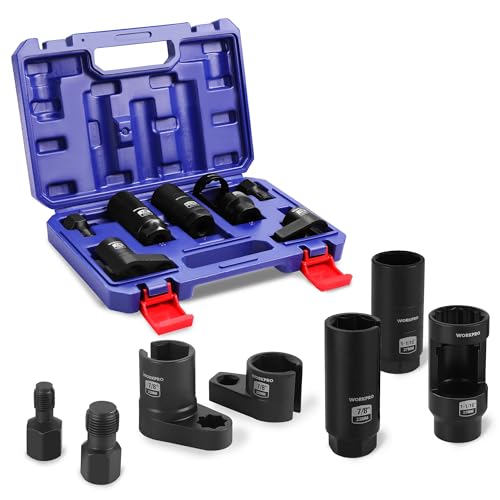
1. WORKPRO 7PCS O2 Oxygen Sensor Socket Set
Our pick — over 4.5★ from 450+ verified ratings; the strongest balance of quality and price.
Seven pieces that handle the sensor and the thread chase in one box.
This WORKPRO set includes 22mm and 27mm sockets plus a thread chaser, giving you both the removal tool and the thread-repair tool for a single job. The black powder-coated alloy steel resists oil and grime, and the set includes both 3/8-inch and 1/2-inch drive sockets so you can pick whichever ratchet gives you the best leverage in your particular engine bay. Owners mention that it works great and saves the cost of paying a shop to swap out the sensor. One reviewer noted that the set fits nicely across different sensor sizes and saved their project. Compared to the single-socket Powerbuilt below, this WORKPRO set delivers a thread chaser and a 27mm socket — if you own European cars or trucks with larger sensors, the 27mm option fits where the 7/8″ (22mm) socket alone will not seat.
The slotted side cutout on each socket lets the sensor wires pass through, so you do not need to unplug the connector before breaking the nut loose. The thread chaser at the end of the job cleans up the bung threads, ensuring the new sensor threads in smoothly and seals against exhaust leaks.
What earns its spot
- Includes both 22mm and 27mm sockets plus a thread chaser
- Dual drive (3/8″ and 1/2″) fits any ratchet in your box
- Powder coating holds up to oil and grime
The honest trade-off
- Alloy steel is not as impact-resistant as Cr-Mo
- You may outgrow it and want the 12-piece Orion set later
Reach for this when: you need a thread chaser alongside the socket to restore corroded threads on a high-mileage car.
Look elsewhere if: you need a single ultra-thin socket for a cramped sensor cavity — the CTA thin-wall model fits tighter spots.
2. Orion Motor Tech 12pc Oxygen Sensor Socket Set
The master kit that covers every sensor size on the garage wall.
This set brings ten sockets across 22mm, 27mm, 29mm, 7/8″, 1″, and 1-1/16″ — plus two thread chasers — so you can handle oxygen sensors, oil pressure sending units, fuel injectors, and vacuum switches on a single job without running back to the toolbox. The heat-treated chrome molybdenum steel (Cr-Mo) resists cracking under the high torque that seizes rusted sensors, and the black electrophoretic coating keeps corrosion off between uses. Buyers report that the two socket styles help in tight spaces and the included storage case keeps everything organized. Compared to the WORKPRO 7PCS below, this Orion Motor Tech set offers five more pieces, including thread chasers and larger socket sizes, and the 8.07-pound weight reflects its heavy-duty build — the WORKPRO set is a lighter alloy steel kit.
The 6- and 12-point openings give you two grip options per socket: use the 6-point for maximum bite on a stubborn nut to avoid rounding, and switch to 12-point when you need faster alignment on a new sensor. The slotted side cutout means you can spin off the sensor without unclipping the wiring harness, saving you from fishing wires back through the engine bay. Clear size markings on each socket speed up selection when you are working under the car with grease on your hands.
Why you will reach for it
- Ten sockets cover 22mm through 1-1/16″ including 27mm and 29mm sizes
- Cr-Mo steel is tougher than standard Cr-V for seized sensors
- Thread chasers clean up damaged threads so the new sensor seats properly
Where you might pause
- 8.07 pounds is heavy for a portable kit
- Overkill if you only need one specific 22mm socket
Buy this if: you work on multiple vehicles and want one set that covers Audi, BMW, Mercedes, and Volkswagen sensors without guesswork.
skip it if: you only need a single 22mm socket for one sensor swap and want to keep the cost low.
3. CTA Tools 2064 Thin Wall Oxygen Sensor Socket

The thin wall that slides into places standard sockets cannot reach.
Standard sockets are too wide to fit inside the narrow metal cavity that surrounds many O2 sensors. This CTA Tools socket tapers down to a 29.80mm outside diameter on its thin wall, so it fits inside the sensor’s wire cavity and engages the nut without needing to clear the heat shield. The total length is 90mm (about 3.5 inches), which gives you the reach for deeper sensor locations without needing an extension. Customers note that it fits inside the O2 sensor wire cavity on a 2006 Toyota Matrix and enabled a removal-and-replacement job in about five minutes. The socket also includes a 1-inch external hex drive on the body, so you can use a standard wrench on it if your ratchet does not fit the space.
The catch here is that this is a single socket, not a set. One buyer mentioned that thin-wall sockets work best for installing a new sensor, and for removing a sensor that has been in place for years, you may still need heat or penetrating oil.
Its best trick
- 29.80mm tapered OD fits tight sensor cavities
- 90mm length reaches deeper sensor positions
- Dual drive (1/2″ square + 1″ hex) gives you a backup wrench option
What might hold you back
- Single socket only — no thread chaser or spare sizes
- Thin wall may flex on high-torque removal of rusted sensors
Choose this if: your sensor sits inside a narrow shield on a Korean or Japanese car where standard sockets will not physically fit.
pass on it if: you are removing a heavily rusted sensor and need a thick Cr-Mo wall socket first, then use this to install the new one.
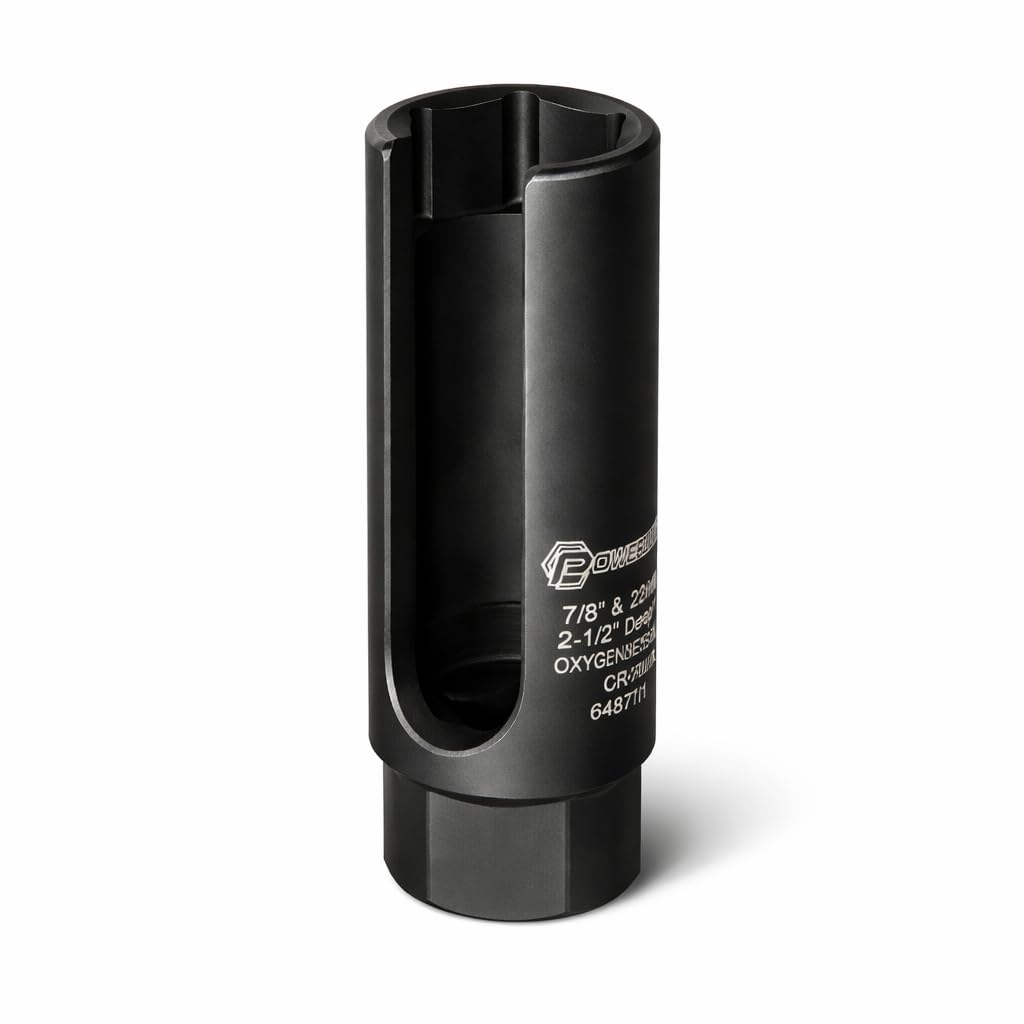
4. Powerbuilt 1/2-Inch Drive x 7/8-Inch (22mm) Oxygen Sensor Socket
A solid 1/2-inch drive socket that does one job well for under twenty bucks.
This single-socket approach keeps things simple: one 1/2-inch drive, one 7/8-inch (22mm) opening, and a 2.5-inch depth that fits over longer sensors without bottoming out. The chrome vanadium steel (Cr-V) construction with heat treatment gives it decent strength for occasional DIY use, and the 0.3-inch-wide by 2.2-inch-long side slot lets the sensor wires pass through without damage. Reviewers point out it is a solid metal socket that saved a shop quote on a 2006 Honda Accord sensor replacement — the job took about 30 minutes. Compared to the ATPEAM 3-Piece set below, this Powerbuilt socket uses a 1/2-inch drive only; the ATPEAM includes both 3/8-inch and 1/2-inch drives, which gives you more ratchet flexibility if your toolbox lacks a 1/2-inch ratchet.
The caveat is that some buyers found the 7/8-inch fit slightly loose on certain O2 sensor nuts, causing the socket to slip and round off the nut under high torque. If your sensor is rusty and seized, a 6-point impact socket or a torx-style removal tool may be a safer first attempt before reaching for this slotted socket.
What works
- Heat-treated Cr-V steel handles occasional use
- 2.5-inch depth covers long-body sensors
- 0.3-inch wire slot passes the harness through
Where it can fail
- 1/2-inch drive only — no flexibility if you own only 3/8-inch ratchets
- Some shoppers say a loose fit that can slip and round the sensor nut
Reach for this if: you need just one 22mm socket for a single sensor swap and already own a 1/2-inch breaker bar.
Look elsewhere if: your sensor is rusted and requires a tighter-fitting 6-point socket — the BILITOOLS 3-Piece set offers Cr-Mo steel for higher torque resistance.
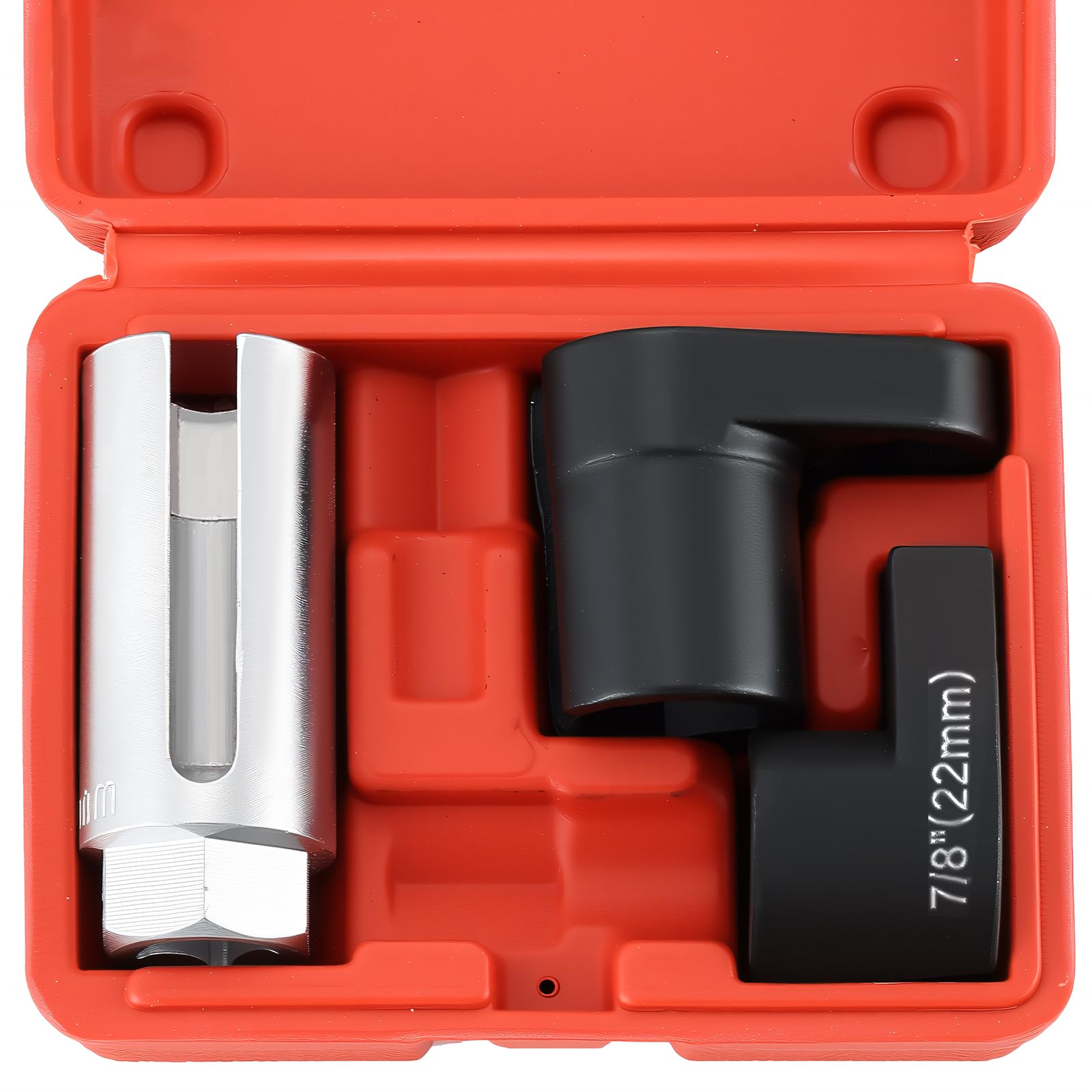
5. ATPEAM Oxygen Sensor Socket Set (3 Piece)
Three socket shapes for the three different access angles your car throws at you.
Not every 22mm O2 sensor sits in the same spot. The ATPEAM set gives you a short socket, a long silver socket, and an odd-shaped (crowfoot-style) socket so you have options when clearance is the enemy. All three are made from heat-treated chrome vanadium steel, which resists bending under normal DIY torque. The set works with both 3/8-inch and 1/2-inch drives, so you can use whichever ratchet fits the space better. Buyers report that three different socket shapes help on many cars, especially when space is tight and you need a short socket with a 3-inch extension to reach an upstream sensor.
One real limitation here: the ATPEAM set is not rated for impact tools. If you need to hammer an impact driver on a seized sensor, the Cr-V steel can chip or crack. Also, the crowfoot-style socket is designed for lighter torque and may round a stubborn nut if you apply sudden force.
What makes it versatile
- Three distinct socket shapes cover short, deep, and offset access
- Compatible with both 3/8″ and 1/2″ drives
- Heat-treated Cr-V steel holds up to moderate torque
The honest limit
- Not impact-rated — use hand tools only
- Crowfoot socket may slip under sudden high torque
Buy this if: you work on different vehicles and need a compact set with three access angles for tight engine bays.
it’s not for you if: you need a heavy-duty socket for removing rusted sensors — the BILITOOLS Cr-Mo set handles higher torque better.
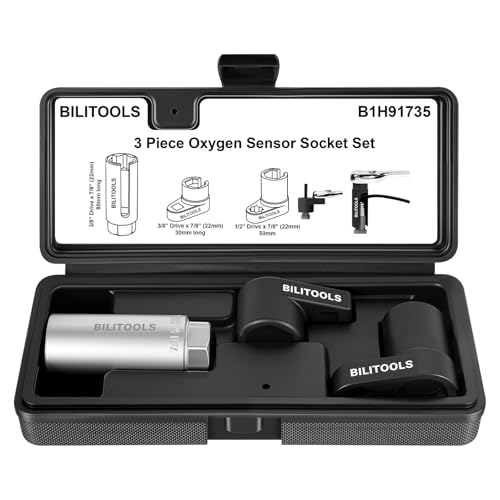
6. BILITOOLS 3PC O2 Oxygen Sensor Socket Set
Chrome molybdenum steel and a 1/2-inch drive offset socket that reaches through heat shields.
This set uses chromium molybdenum steel (Cr-Mo) instead of standard chrome vanadium, which means the socket absorbs higher torque before cracking. The set includes a 3/8-inch drive deep socket, a 3/8-inch drive crowfoot socket, and a 1/2-inch drive deep crowfoot socket — the offset on the 1/2-inch crowfoot is what makes this set stand out. Owners mention that the offset 1/2-inch drive socket reached the O2 sensor through the heat shield on a RAV4 without removing the shield. Another reviewer noted that the deep 3/8-inch socket is chrome vanadium while the other two are unmarked, but none broke during use. The black phosphated coating prevents rust between jobs.
The honest drawback: one owner reported that the socket expanded under torque and risked rounding the nut on a stubborn old sensor. They had to use a grinder, heat, and PB Blaster penetrating oil to get the sensor out. The Cr-Mo steel makes this set durable for installation, but a severely seized sensor may still need extra steps before the socket can grip.
Where it shines
- Cr-Mo steel handles higher torque than Cr-V alternatives
- 1/2-inch drive offset crowfoot fits behind heat shields
- Side cutout keeps wiring harness attached during removal
Where it struggles
- Socket can expand under extreme torque and risk rounding a seized nut
- Mixed steel types — deep socket is Cr-V, not Cr-Mo
Choose this for: reaching sensors blocked by heat shields or tight exhaust bends where a straight socket cannot angle in.
look elsewhere if: your car’s O2 sensors are notoriously rusted — you may need a heavy-duty impact socket plus heat before this crowfoot can grip.
Understanding the Specs
Slotted Side Cutout (Wire Gate)
This is the defining feature of any O2 sensor socket. The slot — typically about 0.3 inches wide and 2.2 inches long on most models — lets you slide the socket over the sensor’s wiring harness so the wires stay connected while you turn the nut. Without this slot, you have to unclip the harness connector first, then spin the sensor out, which twists and damages the wires. When you are working under a car in a cramped space, keeping the wires connected saves you a re-pinning job.
Drive Size: Square Drive vs External Hex
Most O2 sensor sockets use a square drive (1/2-inch or 3/8-inch) that fits your ratchet or breaker bar. A 1/2-inch drive transmits more torque without twisting — important when the sensor is rusted. Some sockets, like the CTA Tools 2064, add an external hex (1-inch) on the socket body, so you can use a regular wrench if space is too tight for a ratchet head. The trade-off is that a 1/2-inch drive socket is physically larger and may not fit into tight engine bays. If your toolbox only has 3/8-inch ratchets, a 1/2-inch-only socket means buying a new ratchet or an adapter.
FAQ
Will a 22mm O2 sensor socket fit my 7/8-inch sensor nut?
Can I use an impact wrench with these sockets?
Which drive size should I choose — 3/8-inch or 1/2-inch?
What is the difference between chrome vanadium and chrome molybdenum steel here?
How deep does the socket need to be for a long O2 sensor?
Can I remove a seized O2 sensor without damaging the threads?
What does “thin wall” mean for an O2 sensor socket?
Do I need a thread chaser with the socket?
Can a crowfoot socket replace a deep socket for O2 sensors?
Final Thoughts: The Verdict
For most people, the 22mm o2 sensor socket winner is the Orion Motor Tech 12pc Set because it gives you ten sockets plus thread chasers in a single case, covering every standard sensor size from 22mm to 1-1/16″ without guesswork. If you want a compact kit for tight engine bays, grab the ATPEAM 3-Piece Set. And for reaching O2 sensors behind heat shields on Korean and Japanese cars, the standout is the CTA Tools 2064 Thin Wall Socket.
How We Picked
We do not accept paid placement. Every pick is matched to a real buyer and a real use-case; we do not hands-on test units.
Sources & Methodology
Specifications: manufacturer listings and product documentation. Review insights: verified customer reviews, as of July 2026. Pricing: not shown on this page (it changes often); check the current price via the retailer link.
As an Amazon Associate, Gadgets Feed earns from qualifying purchases. This does not affect which products we feature.
Related Guides
Product prices and availability are accurate as of the date/time indicated and are subject to change. Any price and availability information displayed on Amazon at the time of purchase will apply to the purchase of this product. As an Amazon Associate I earn from qualifying purchases.
CERTAIN CONTENT THAT APPEARS ON THIS SITE COMES FROM AMAZON. THIS CONTENT IS PROVIDED "AS IS" AND IS SUBJECT TO CHANGE OR REMOVAL AT ANY TIME.
Amazon and the Amazon logo are trademarks of Amazon.com, Inc. or its affiliates.