
Our readers keep the lights on and my morning glass full of iced black tea. As an Amazon Associate, I earn from qualifying purchases.
Specs are compiled from manufacturer listings and verified buyer reviews and can change over time — please confirm the key details on the product page before buying.
Whether you are printing a stack of menus, building a scrapbook that lasts, or scoring and folding invitations by hand — the thin stuff just will not cut it. The weight and finish of your cardstock decide if the final piece feels flimsy or substantial, and with 11×17 pages, you need a sheet that stays flat and feeds cleanly through your printer.
I’m Min — the founder and writer behind Gadgets Feed. This guide is built by comparing the manufacturers’ published specifications and the patterns across verified customer reviews, so you get each pick’s real strengths and trade-offs instead of marketing spin.
With reams and packs ranging from a medium 65lb, through an 80lb mid-weight, up to a hefty 110lb, here is the clearest path to finding the right 11×17 cardstock paper for your printer and project.
Our Picks at a Glance


How To Choose The Best 11×17 Cardstock Paper
To get crisp prints and sturdy projects, you need to match the paper’s thickness, whiteness, and printer compatibility. Here is what each spec means for your actual project.
Weight in Lb vs. Gsm
Cardstock weight is listed two ways. The “lb” number (like 65lb or 110lb) refers to the standard basis weight for a certain stack of that paper type — it tells you relative thickness within the same category. The gsm number (grams per square meter) is an absolute measure of the sheet’s density and is the same across all paper types. A higher gsm means a stiffer, less flexible sheet. For 11×17 projects, 65lb (about 175gsm) is good for flyers and layered crafts, while 110lb (close to 300gsm) is better for postcards, book covers, and standing menu cards.
Brightness and Finish
Brightness is measured on a 0-100 scale and affects how crisp your colors look — higher brightness (92-98) makes white paper look cleaner and makes printed photos pop. Smooth finish is standard for most printers and gives clean results with inkjet or laser, while a vellum or textured finish adds a handmade feel but can affect ink absorption and feed reliability.
Sheet Count and Value
Budgets vary. A 25-sheet pack is fine for one big project like a photo presentation or a set of menus. A 250-sheet ream brings the cost per sheet way down — ideal if you print regularly or plan to cut the 11×17 sheets down into smaller standard sizes for cards and bookmarks.
Quick Comparison
| Model | Best For | Weight | Sheets | Item Weight (ship) | Amazon |
|---|---|---|---|---|---|
| Accent Opaque★ Best Overall | Everyday print & craft ream | 65lb / 175gsm | 250 | 5.3 kg | $45.84Amazon |
| Hamilco WhiteProject Sampler | Sample project or test run | 80 lb / 216gsm | 25 | 1.6 lb | $16.99Amazon |
| OcePor 65lb | Mid-weight accent layers | 65lb / 180gsm | 100 | 2.17 kg | from $9.98Amazon |
| OcePor 92lb | Sturdy greeting cards &covers | 92lb / 250gsm | 100 | — | $26.99Amazon |
| Neenah Exact Index | Bulk index & document stock | 110lb / 298gsm | 250 | 3.3 lb | $31.64Amazon |
| Reskid 110lb | Heavy duty invitations &covers | 110 lb | 100 | — | $46.99Amazon |
In‑Depth Reviews
1. Accent Opaque 11” x 17” White Cardstock, 65lb, 175gsm – 250 Sheets
Our pick — over 4.5★ from 850+ verified ratings; the strongest balance of quality and price.
The ream-sized workhorse that pairs a clean white finish with reliable feed for big volume projects.
At 65lb (175gsm — grams per square meter, a standard paper weight measure), this medium-weight cardstock feels sturdy enough for invitations, hand-scored menus, and layered crafts. Buyers report it is the “thickest paper bought for crafts; sturdy, holds shape, cuts well on electronic cutter, crisp white.” The smooth surface holds ink on top, so your colors stay bold and you see little show-through on the back.
At 250 sheets it is a full ream, putting it ahead of smaller packs like the 25-sheet Hamilco or the 100-sheet OcePor options. The ream is heavier to ship (the total item weight is 5.3 kilograms) but the per-sheet cost is far lower than smaller-count packs. It is also FSC-certified and made in the USA, which matters if sustainable sourcing is a priority for you.
The main trade-off is that 65lb is not stiff enough for a single-layer greeting card base or a freestanding tent card — you would want a 92lb or 110lb pick for self-supporting structures. Also, some buyers noted the packaging can arrive busted open, though the paper itself arrived undamaged.
Why It Is a Great Buy
- 250-sheet pack gives the lowest per-sheet cost in the lineup
- Buyers praise the crisp white shade and electronic cutter compatibility
- FSC certified and made in the USA
Where It Falls Short
- 65lb is too flexible for freestanding cards or book covers
- Packaging can arrive torn even if the paper is fine
Grab this if: you want the biggest bang for your buck in a medium-weight sheet that works for everyday printing, crafting, and die-cutting.
Pass if: you need a stiffer, self-supporting cardstock — in that case move up to a 92lb or 110lb option.
2. Hamilco White Cardstock Thick 11×17 Paper – 80 lb Cover, 25 Pack
A compact 25-sheet pack with a high 98 brightness for a single project or a printer compatibility test.
This is an 80lb cover (216gsm) cardstock with a 98 brightness rating — the brightest white in this collection — so your colors and photos really pop off the page. The 25-sheet count makes it ideal for something like a custom mat for a set of framed photos or a small batch of restaurant menus. One reviewer noted it had the “perfect thickness to make pages of scrapbook” and appreciated the “nice true white color.”
At 1.6 pounds shipped, versus the Accent Opaque at 5.3 kilograms, which means less chance of damage in transit. But that same tiny count means the per-sheet cost is much higher than buying a ream. Also, one buyer found the thickness prevented it from feeding through their small printer, so check your printer’s maximum paper weight before ordering.
Strong Points
- Highest brightness rating (98) for vivid color prints
- Light shipping weight (1.6 lb) reduces damage risk
- Acid-free, made in the USA
Limitations
- 25 sheets runs out fast for recurring projects
- Thick sheet may not feed in compact printers
Ideal for: a one-time project like awards, thick mats, or presentation materials where you want maximum brightness.
Avoid if: you are stocking up for ongoing printing — the 25-sheet count will leave you reordering quickly.
3. OcePor 100 Sheets White Cardstock 11” x 17”, 65lb/180gsm
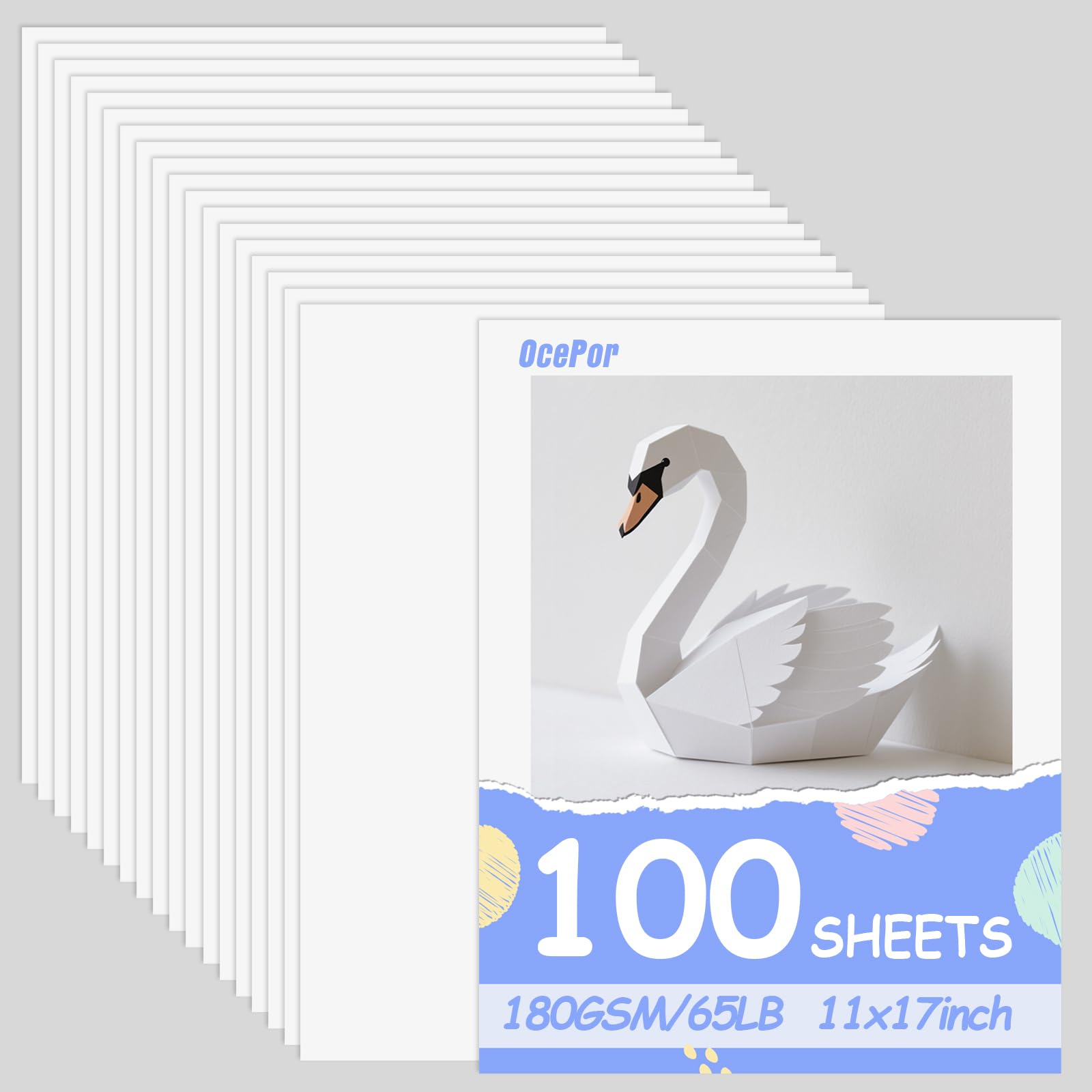
A 65lb sheet at a 2.17 kg shipping weight that die-cuts cleanly on medium passes without jamming.
This OcePor pack lands at 65lb (180gsm), almost identical to the Accent Opaque but in a 100-sheet batch rather than a full ream. The smooth, double-sided surface is acid-free and works with both inkjet and laser printers. Reviewers found it “die-cuts cleanly with embossing folders; shreds under high pressure but works well with 3x medium/low passes.” That makes it a solid pick if you use a Cricut or similar electronic cutter at lower pressure settings.
At 2.17 kilograms shipped, it is noticeably lighter than the Accent Opaque (5.3 kilograms), so shipping damage is less of a worry. One key drawback: some buyers reported the paper curled excessively after being fed through a laser printer, requiring weight to flatten it post-print. And shipping in a loose plastic bag led to bent corners for some packages.
What Works
- 100 sheets give a good middle ground between sample pack and ream
- Buyers confirm clean die-cuts at medium/low passes
- Double-sided, acid-free finish
What Does Not
- Reported curling after laser printing, especially in low humidity
- Plastic bag packaging can cause bent corners
Reach for it if: you need a mid-weight pack for die-cut accents and you plan to use an inkjet or lower-pressure cutter.
Look elsewhere if: you regularly print with a laser printer — the curling issue may be an ongoing annoyance.
4. OcePor 100 Sheets White Cardstock 11” x 17”, 92lb/250gsm
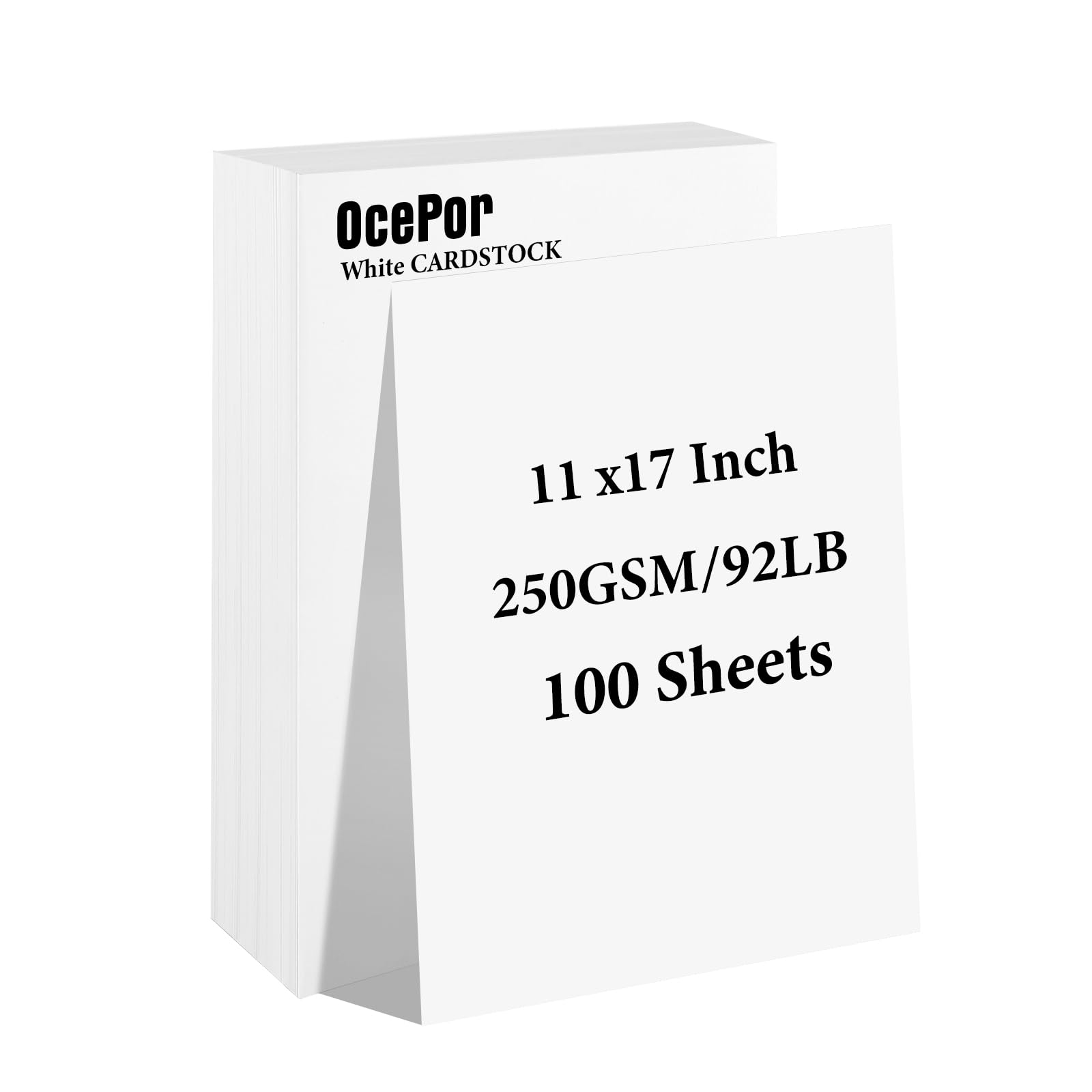
At 92lb (250gsm) this is stiff enough to make standing greeting cards that hold their own.
Where the 65lb sheets above work well for layering, this 92lb (250gsm) OcePor is rigid enough that a folded card stands upright without flopping over. Owners mention it is “thick, bright white cardstock; no yellow/gray tint” and note it survives 3D embossing folders without cracking — a real plus if you use embossing machines that put serious stress on the paper fibers.
The 100-sheet count is solid for a heavy stock — more than enough for a batch of invitations or a mini album. One self-proclaimed “cardstock snob” said the quality is “fantastic” and that at this price it would be their go-to from now on. Just note that at 92lb / 250gsm, you must confirm your printer’s maximum paper weight spec; many standard inkjets top out at around 80lb cover.
Why Buy It
- Stiff 250gsm board perfect for greeting cards and standing projects
- Buyers confirm no cracking with 3D embossing
- True bright white with no yellow cast
Keep in Mind
- Heavy weight may not feed in all standard printers
- No item weight listed for shipping comparison
Choose this if: you need a sturdy card base for greeting cards, bookmarks, or mini albums and your printer handles 250gsm stock.
skip it if: you only need a flexible flyer-weight — the 65lb sheets will save you money and feed more reliably.
5. Neenah Paper 40414 Exact Index Card Stock, 110lb, 92 Bright, 11 x 17, 250 Sheets

A 250-sheet ream of 110lb index stock that buyers cut down for greeting cards and brochures.
At 110lb, this is the heaviest cardstock in the roundup — an index-grade sheet that is stiff enough for file folders, tent cards, and long-lasting documents. The 250-sheet ream gives you serious volume at a lower per-sheet cost than smaller heavy-weight packs. It is also acid and lignin-free, so it holds up for archival projects that need to stay bright for years.
At 3.3 pounds shipped, versus the Accent Opaque at 5.3 kilograms, despite being a much stiffer sheet — less shipping mass means lower damage rates in transit. One buyer who makes lots of greeting cards calls it “the most economical way to buy cardstock” since cutting a single 11×17 sheet yields multiple card blanks. On the downside, some customers note the wrapper can arrive torn with potentially missing sheets, and a few feel the thickness is not quite as high as other Neenah 110lb sheets they have used.
Best Features
- 250-sheet heavy-weight ream with low per-sheet cost
- Acid and lignin-free for archival use
- Light 3.3 lb shipping weight for the sheet count
Potential Issues
- Packaging can arrive torn; missing sheets possible
- Some buyers found thickness inconsistent vs other Neenah stock
Best for: bulk card makers who cut their own blanks from 11×17 sheets and need a heavy, archival-grade base.
Not for: anyone printing at 110lb on a standard home inkjet — check your printer spec carefully before buying.
6. Reskid White Cardstock Thick Paper – Blank Heavy Weight 110 lb Cover, 100 Pack (11×17)

A 100-sheet heavy-weight pack that buyers order again and again for high-end invitations and artwork.
This Reskid pack is 110lb cover stock — matching the Neenah in weight but in a 100-sheet count rather than a 250-sheet ream. The blank white surface absorbs ink extremely well, making it a good match for high-quality invitations, business cards, and even sports card relic projects. One repeat buyer stated the “quality is outstanding and the price is very reasonable” and uses it to create one-of-a-kind artwork cards with cellophane sleeves.
It is acid and lignin-free for archival projects, and the sheer thickness means a folded menu or brochure feels substantial in hand. The main limitation is the 100-sheet count for a premium-tier product: at this weight, 100 sheets go fast if you are printing in volume, and per-sheet cost is higher than the Neenah ream. Also, a few buyer reports mention that watercolor or soft-paper projects show more bleed through than pricier art paper.
Highlights
- 110lb cover stock feels very thick and durable in the hand
- Acid and lignin-free for archival use
- Reviewers point out high ink absorption and good texture
Trade-offs
- Small pack size for a premium product — 100 sheets go fast
- More bleed on wet media than dedicated art paper
Choose this when: you want a premium 110lb sheet for a focused batch of high-end invitations, book covers, or ink-heavy artwork.
Pass if: you need a bulk heavy-weight supply — the Neenah 250-sheet ream works out cheaper per sheet.
Understanding the Specs
Paper Weight – Lb vs. Gsm
The “lb” number (like 65lb or 110lb) is the basis weight for that specific paper type — it tells relative thickness but does not directly compare across types. The gsm (grams per square meter) is a universal measure of density. A higher gsm means a heavier, stiffer sheet. For 11×17 cardstock, 65lb (around 175gsm) works for flyers and craft layers, while 110lb (around 298gsm) gives you a stiff card base that stands on its own.
Brightness Rating
Measured on a 0-100 scale, brightness tells you how much light the paper reflects. A higher number — 92, 94, or 98 — means a cleaner, truer white. That matters most if you print photos or colored graphics: a bright white base makes colors look more vivid, while a lower-brightness sheet can make prints look slightly dull or gray.
Acid-Free and Lignin-Free
These terms mean the paper has no acid or lignin in the pulp. Without them, the paper resists yellowing and becoming brittle over time, so your keepsake projects — scrapbooks, wedding invitations, archival documents — stay looking fresh for years instead of turning brown.
Printer Compatibility
Cardstock weight is the main factor. Laser printers handle thick paper better than most inkjets, and many printers specify a maximum weight, usually around 80lb cover (216gsm) for standard models. Always check your printer’s paper path spec before ordering 92lb or 110lb stock — if the sheet is too stiff, it may jam or curl rather than feed cleanly.
FAQ
Will 65lb cardstock work for a greeting card base?
What is the difference between 65lb and 110lb cardstock?
Can I use 11×17 cardstock in a laser printer?
How many sheets of cardstock do I need for a project?
What does “acid-free” cardstock mean?
Is 11×17 cardstock the same as A3 cardstock?
Can I cut 11×17 cardstock down to smaller sizes?
How is gsm different from lb in cardstock?
Why does my cardstock curl after printing?
How do I store extra cardstock to keep it flat?
Final Thoughts: The Verdict
For the majority of shoppers, the best 11×17 cardstock paper winner is the Accent Opaque 65lb because its 250-sheet ream gives you the best price-per-sheet in a smooth, printer-friendly cartridge that earns a 4.7 rating from 874 buyers. If you want a stiff card base for greeting cards and standing projects, grab the OcePor 92lb. And for an affordable 25-sheet sample pack that tests the waters at 80lb cover with maximum 98 brightness, the Hamilco White is the smart entry point.
How We Picked
We do not accept paid placement. Every pick is matched to a real buyer and a real use-case; we do not hands-on test units.
Sources & Methodology
Specifications: manufacturer listings and product documentation. Review insights: verified customer reviews, as of July 2026. Pricing: not shown on this page (it changes often); check the current price via the retailer link.
As an Amazon Associate, Gadgets Feed earns from qualifying purchases. This does not affect which products we feature.
Related Guides
Product prices and availability are accurate as of the date/time indicated and are subject to change. Any price and availability information displayed on Amazon at the time of purchase will apply to the purchase of this product. As an Amazon Associate I earn from qualifying purchases.
CERTAIN CONTENT THAT APPEARS ON THIS SITE COMES FROM AMAZON. THIS CONTENT IS PROVIDED "AS IS" AND IS SUBJECT TO CHANGE OR REMOVAL AT ANY TIME.
Amazon and the Amazon logo are trademarks of Amazon.com, Inc. or its affiliates.