
Our readers keep the lights on and my morning glass full of iced black tea. As an Amazon Associate, I earn from qualifying purchases.
Specs are compiled from manufacturer listings and verified buyer reviews and can change over time — please confirm the key details on the product page before buying.
You are stuck in traffic, and your temperature gauge is climbing past the middle. That is the moment you realize how much you need a radiator fan that moves real air and fits without a fight. The wrong fan leaves you stranded; the right one keeps the engine cool whether you are idling in a summer backup or pulling a trailer up a grade. This guide shows you which models actually deliver the airflow and fit you need, based on real specs and verified buyer experience.
I’m Min — the founder and writer behind Gadgets Feed. This guide is built by comparing the manufacturers’ published specifications and the patterns across verified customer reviews, so you get each pick’s real strengths and trade-offs instead of marketing spin.
The key to choosing the right auto radiator fan is knowing the difference between a 2,000 RPM slim fan and a 3,000 CFM (cubic feet per minute — the volume of air pushed in one minute) high-output unit, and if you need a direct bolt-in replacement for your specific model or a universal pusher fan (a fan mounted in front of the radiator that pushes air through it) for a custom build.
Our Picks at a Glance


How To Choose The Best Auto Radiator Fan
To pick the right fan, you need to match the airflow your engine needs with the physical clearance you have under the hood. Here is what actually matters.
Fit First: Direct Replacement vs. Universal
A direct-fit fan assembly bolts right into a specific make and model — the mounting points, connector, and shroud (the plastic frame that holds the fan) are pre-matched. A universal fan requires you to fabricate brackets or use zip ties and splice the wiring. If your factory fan died, a direct-fit replacement saves hours of tinkering.
Airflow Capacity (CFM)
CFM stands for cubic feet per minute. It is a measure of how much air the fan pushes in one minute. A stock four-cylinder might need around 800-1,200 CFM, while a hot V8 can demand over 2,500 CFM at idle. Higher CFM means more cooling, but it also draws more electrical current from the battery and alternator.
Physical Dimensions and Clearance
Check the fan’s overall thickness. Slim fans are about 2.5 inches thick and fit tight engine bays without hitting the water pump pulley or the engine itself. Also measure the radiator core (the metal part the fan mounts to); a 16-inch fan is useless if your radiator core is only 14 inches wide.
Quick Comparison
| Model | Best For | Airflow (CFM) | Max RPM | Noise Level | Amazon |
|---|---|---|---|---|---|
| Dorman 620-232 (Honda CRV)★ Best Overall | Direct Honda replacement | — | 3500 RPM | — | Amazon |
| A-Team 16″ KitPremium Pick | High-output universal | 3000 CFM | 2500 RPM | 49 dB | Amazon |
| PartsFlow 620-843 (VW Jetta) | Direct VW replacement | — | — | — | Amazon |
| PartsFlow Versa Note | Direct Nissan replacement | — | — | — | Amazon |
| Auto Dynasty 10″ (2-Pack) | Universal paired fans | 1250 CFM | 2250 RPM | 50 dB | Amazon |
| GESEXI 12″ Slim Fan | Universal slim/quiet | 800 CFM | 2000 RPM | 30 dB | Amazon |
In‑Depth Reviews
1. Dorman 620-232 Engine Cooling Fan Assembly for Select Honda Models
Our pick — over 4.5★ from 550+ verified ratings; the strongest balance of quality and price.
The direct-fit champion that bolts on and disappears under the hood for years.
If your Honda CRV from 2002-2006 has a dead radiator fan, this Dorman assembly is the simplest fix you will find. It is a complete package: shroud (plastic frame), motor, and blade set as one piece, so you swap the whole unit in under an hour using just 10mm bolts. Reviewers confirm it is an exact match to the original part, with one buyer noting “perfect fit on 2002 Honda CRV” and another calling it a “direct fit no problem.”
The assembly weighs 5.8 pounds. That is much sturdier than a universal slim fan. Compare it to the GESEXI 12-inch slim fan: the Dorman spins at 3,500 RPM (revolutions per minute — how fast the blade rotates), which is 1,500 RPM faster than the GESEXI’s 2,000 RPM. That speed gap means the Dorman moves noticeably more air when your engine is idling in traffic. The trade-off is you are locked into a specific vehicle line; it only fits the listed Honda models, not a universal application.
Why it works
- Precision-engineered to match factory fitment — shroud, motor, and fan are one drop-in piece.
- Spins at 3,500 RPM, significantly faster than typical slim universal fans.
- 5.8-pound weight signals sturdy build quality and long-term reliability.
The limits
- Only fits specific 2002-2006 Honda CRV models — no universal application.
- Single-speed design; no variable-speed controller included.
Reach for it if: you own a 2002-2006 Honda CRV and want a fan that bolts in without any wiring guesswork.
Look elsewhere if: you need a universal fan for a custom swap or a non-Honda vehicle.
2. A-Team Performance 16″ Electric Radiator Cooling Fan Kit
A 3,000 CFM beast that turns a hot engine bay into a cool running machine.
When you need maximum airflow — think a swapped V8, a hot-rod build, or a truck that works hard in summer — the A-Team 16-inch kit delivers the biggest punch in this list. Its 10 S-curved blades push 3,000 CFM (cubic feet per minute) at 2,500 RPM. That pushes 3,000 CFM, while the GESEXI slim fan pushes 800 CFM. The kit includes a built-in thermostat (a temperature switch) that turns the fan on at 200 degrees Fahrenheit and shuts it off at 180 degrees, so you do not need to wire a separate controller.
Buyers report it keeps their S10 running at a steady 185 degrees even in Florida traffic. The fan is reversible (you can mount it as a pusher in front of the radiator or a puller behind it), and the mounting kit includes the hardware to get it installed. At 49 decibels (dB — a measure of sound level), it is audible — not silent like the 30-decibel GESEXI fan — but for this kind of airflow, the noise trade-off is expected. One reviewer noted the included temperature sensor does not play well with classic gauge clusters, so check your setup before installing.
Top performance, one caveat: the fan weighs 2.11 kilograms (about 4.65 pounds) with all-metal-and-plastic construction, which is heavy-duty. But measure your radiator core first — a 16-inch fan needs a wide enough radiator to mount against effectively.
This fan is for: performance builds, truck owners, and anyone who needs serious airflow to keep a high-output engine cool at idle.
skip it if: you need a whisper-quiet fan or your vehicle has tight radiator clearance under 16 inches.
3. Auto Dynasty Universal 10 Inches High Performance Electric Slim Radiator (Pack of 2)
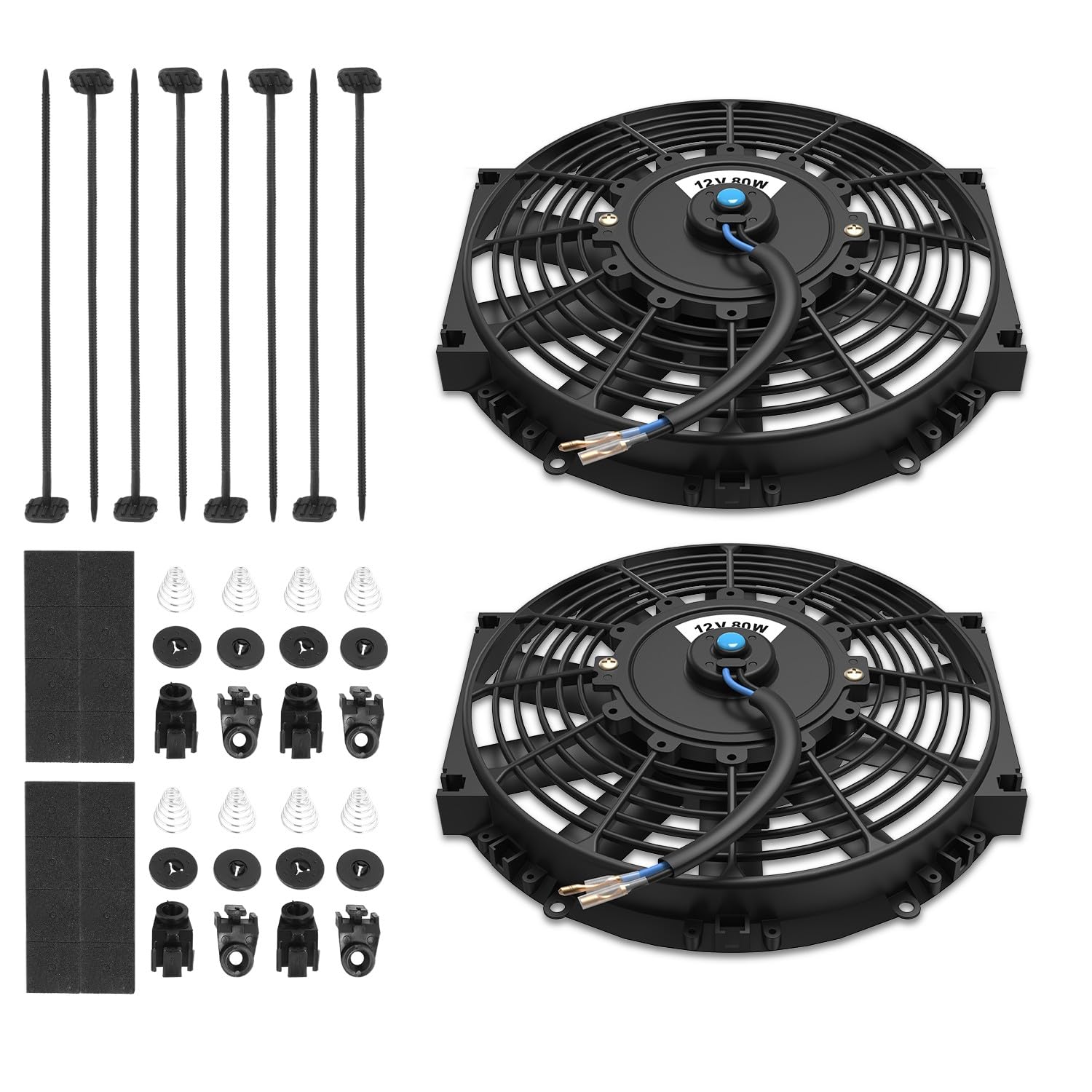
Two fans that deliver 1,250 CFM each and slip into tight engine bays.
The Auto Dynasty pack gives you two 10-inch slim fans for the price some brands charge for one. Each fan is rated at 1,250 CFM and spins at 2,250 RPM, while the GESEXI fan spins at 2,000 RPM, so you get a genuine performance edge. The slim 2.5-inch profile clears tight engine compartments, and the included mounting tabs let you zip-tie them into place without custom brackets.
Reviewers have put these fans through real punishment. One buyer installed them as pusher fans (mounted in front of the radiator to push air through) on a 2013 Ford F150 in Phoenix and said they “work perfectly.” Another uses them on an autocross car after high-rpm runs and 25 minutes of idling in 95-degree heat with no issues. The catch is the noise: 50 decibels is noticeably louder than the 30-decibel GESEXI slim fan. Also, one buyer bench-tested a 12-inch version of this fan and measured around 542 CFM, suggesting the 1,250 CFM claim may be optimistic for real-world conditions.
What stands out
- Two fans in one box with a combined potential airflow over 2,500 CFM for a bargain price.
- Slim 2.5-inch design fits tight engine bays where a thick shroud won’t go.
What to watch
- Measured airflow in a real-world bench test came in lower than the advertised 1,250 CFM.
- At 50 dB, this is one of the louder fans in the comparison.
Best for: hot-weather daily drivers, project cars, and anyone who needs two cooling fans without spending premium money.
Not for: a quiet daily commuter — the noise level is noticeable.
4. GESEXI 12 Inch Slim Fan Push Pull Electric Radiator Cooling Fan

The quietest fan in the lineup at 30 dB — barely a whisper under the hood.
If noise bothers you — or you just do not want a loud fan roaring every time you stop at a light — this GESEXI slim fan is your pick. At 30 decibels, it is quieter than the Auto Dynasty fan (50 dB) and the A-Team Performance unit (49 dB). That is a real difference you notice at idle. The 2.5-inch slim profile fits small spaces, and the reversible design lets you mount it as a pusher on the front of the radiator or a puller behind it.
The rated 800 CFM at 2,000 RPM is modest — good for a four-cylinder or a small radiator, not for a big block V8. Buyers have found it works well off-road too: one reviewer used it as a solar-powered attic vent and said it was “perfect for gable/ridge vent AC to DC motor conversion.” The fan uses a 3-pin connector and draws low current, so wiring is straightforward.
Trade-off clear: you swap raw airflow for silence. This is the right choice for a daily driver that does not overheat easily, but not for a high-performance engine that needs 2,000+ CFM.
Choose this for: a quiet daily commute, a small car, or a custom shed/solar ventilation project.
Pass on it if: your engine runs hot in traffic and needs a 2,500+ CFM fan to stay cool.
5. PartsFlow Radiator Cooling Fan Assembly For 2005-2013 VW Jetta, 2006-2009 Rabbit, 2010-2013 Golf
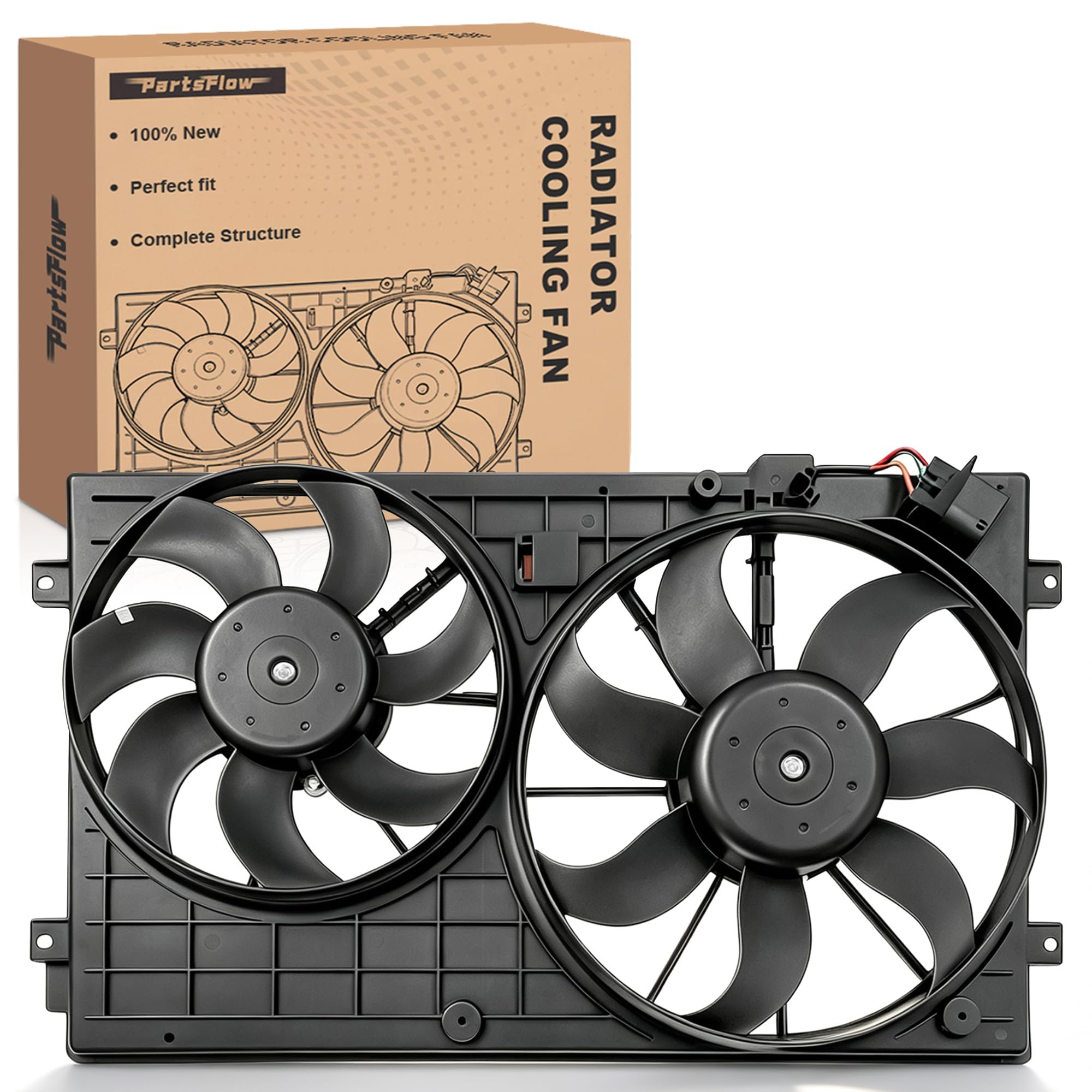
An exact match for VW Jetta and Golf owners who want OEM-like fitment without dealer pricing.
Volkswagen owners face a unique problem. The factory fan assembly often fails at the module (the electronic control unit), and a dealer replacement is expensive. The PartsFlow 620-843 is built to OE (original equipment) specifications for the 2005-2013 Jetta, 2006-2009 Rabbit, 2010-2013 Golf, and 2012-2013 Beetle/Passat. It comes with the fan control module already integrated, so you swap the whole unit without chasing separate electronic parts.
Owners mention it as a perfect fit and a quick install, with one saying “car started running perfect as soon as I put this fan in.” The metal construction feels sturdy, and the 3-pin connector plugs into the factory harness without splicing. The catch is that this fan is model-specific — it will not work on a universal radiator setup or a different vehicle brand.
Why VW owners like it
- Direct replacement for the notoriously failure-prone VW fan module assembly.
- Includes the control module — no extra parts needed.
- Metal construction for durability.
The restriction
- Only fits the listed VW models; no universal application.
Ideal if you drive: a 2005-2013 Jetta, 2006-2009 Rabbit, or 2010-2013 Golf and want a plug-and-play fix.
pass on it if: you need a universal fan for a non-VW vehicle or a custom build.
6. PartsFlow Engine Radiator Cooling Fan Assembly For 2012-2019 Nissan Versa Note 1.6L
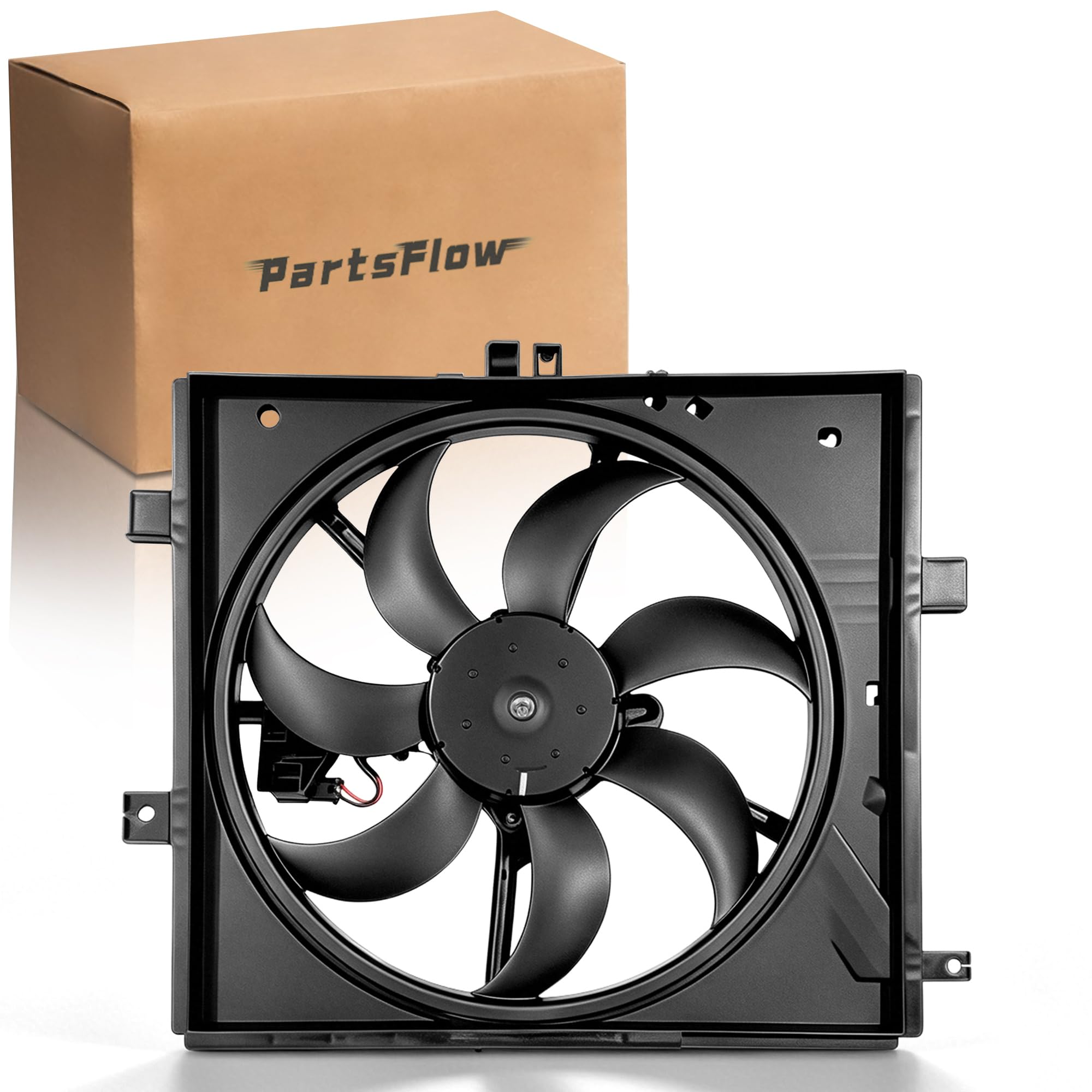
A low-cost, direct-fit fix for the Nissan Versa Note that buyers praise for simple installation.
The Nissan Versa Note from 2012-2019 has a specific fan assembly, and this PartsFlow unit replaces it without any adaptation. It matches the OEM part numbers 21481-3AB3A and 620-467, so you know the mounting points and the electrical connector line up. One buyer mentioned “easy installation, perfect fit for 2012 Toyota Venza,” suggesting the fitment may extend to some Toyota models as well, though the listed compatibility is for the Versa Note only.
Reviewers report consistent results: the fan moves “a tremendous amount of air” and prevents overheating with the AC on in traffic. The one-year warranty gives confidence that a cheap universal fan does not offer. The trade-off is the fan is not silent — one owner reported it is “a little loud” — but for the price and reliable cooling, most owners find that acceptable.
Bottom line: if you drive a 2012-2019 Nissan Versa Note and need a no-headache replacement that works, this is the one. The noise is the only real compromise.
Grab this if: you own a Versa Note and want the cheapest direct-fit fix that still moves serious air.
it’s not for you if: you need a universal fan for a different vehicle or you absolutely cannot tolerate fan noise.
Understanding the Specs
CFM — Cubic Feet per Minute
This number tells you how much air the fan moves in one minute. Higher is better for cooling, but it also means the fan draws more electrical current. A stock four-cylinder often does fine with 800-1,200 CFM, while a modified V8 or a truck that tows may need 2,500+ CFM to keep the engine from creeping up at idle.
RPM — Rotations Per Minute
Fan speed in rpm correlates with airflow, but blade shape also matters. A fan spinning 3,500 RPM with straight blades moves more air than one at 2,250 RPM with curved blades. Higher RPM also tends to mean more noise — the 3,500-RPM Dorman is noticeably louder than the 2,000-RPM GESEXI.
FAQ
Can I install a universal fan on any car?
What is the difference between a pusher and a puller fan?
How do I know what size fan fits my radiator?
Do I need a thermostat switch for an electric fan?
Why is my new fan louder than the factory one?
Can a radiator fan run continuously without damage?
What does CFM mean and how much do I need?
Will a higher CFM fan fix an overheating car?
Final Thoughts: The Verdict
For most buyers, the auto radiator fan that strikes the best balance of fit, performance, and value is the Dorman 620-232 if you drive the compatible Honda CRV — it drops in without fuss and spins at 3,500 RPM. If you need a universal high-output fan, the A-Team Performance 16-inch delivers 3,000 CFM for serious cooling. And for a budget-friendly dual-fan setup, the Auto Dynasty 2-pack gives you two slim fans that slip into tight engine bays and move real air.
How We Picked
We do not accept paid placement. Every pick is matched to a real buyer and a real use-case; we do not hands-on test units.
Sources & Methodology
Specifications: manufacturer listings and product documentation. Review insights: verified customer reviews, as of July 2026. Pricing: not shown on this page (it changes often); check the current price via the retailer link.
As an Amazon Associate, Gadgets Feed earns from qualifying purchases. This does not affect which products we feature.