
Our readers keep the lights on and my morning glass full of iced black tea. As an Amazon Associate, I earn from qualifying purchases.
Specs are compiled from manufacturer listings and verified buyer reviews and can change over time — please confirm the key details on the product page before buying.
Every month, you pay your cable company a fee for that modem-router they gave you — a box that is often years old and lacks the latest Wi-Fi technology. By owning your own cable modem router combo, you stop that rental fee cold and get faster, more reliable internet for every device in your home. The trick is picking the right one for your specific internet plan and home size without getting tangled in tech specs.
I’m Min — the founder and writer behind Gadgets Feed. This guide is built by comparing the manufacturers’ published specifications and the patterns across verified customer reviews, so you get each pick’s real strengths and trade-offs instead of marketing spin.
We break down the top cable modem router combos by speed, coverage, and value, so you can stop renting and start enjoying the best cable modem router combo for your exact needs without the headache.
Our Picks at a Glance


How To Choose The Best Cable Modem Router Combo
Picking the right combo means knowing what your internet provider supports and what your home demands. The three specs that matter most are the modem generation, the Wi-Fi generation, and the port options.
DOCSIS Version — The Engine Under the Hood
DOCSIS stands for Data Over Cable Service Interface Specification (the technical standard your cable modem uses to talk to your provider). DOCSIS 3.1 is the current modern standard — it supports far faster speeds (up to 10 Gbps through some providers) and uses OFDM channels (a technology that splits data across many small frequencies) for lower lag and better security than the older DOCSIS 3.0. If your internet plan is 300 Mbps or higher, you want DOCSIS 3.1 to avoid bottlenecks.
Wi-Fi Generation — How the Signal Spreads Through Your Home
Wi-Fi 6 (also called 802.11ax) is the balance for most homes today — it handles multiple devices at once without slowing down and covers a typical home well. Wi-Fi 7 is the newest and fastest generation, but you only need it if you have multi-gigabit internet (over 1,000 Mbps) and many Wi-Fi 7 devices. Wi-Fi 5 (802.11ac) is still functional for basic browsing but will feel slow with modern streaming and gaming.
Ports — Why the Wired Connection Still Wins
Ethernet ports give you the fastest, most stable connection for devices that don’t move — PCs, game consoles, and smart TVs. A 2.5 Gigabit Ethernet port lets you use faster-than-gigabit internet plans without a speed cap. The number of LAN ports (local area network ports, the jacks that look like oversized phone jacks) matters if you plan to wire multiple devices directly. Some combos also offer a USB port for connecting a printer or external hard drive to the network.
Quick Comparison
| Model | Best For | Max Speed | Wi-Fi Gen | Ethernet Ports | Amazon |
|---|---|---|---|---|---|
| AVM Fritz!Box 6670 Cable★ Best Overall | Feature-rich smart home | 2880 Mbps | Wi-Fi 7 | 5 (1x 2.5 Gigabit) | $395.29Amazon |
| NETGEAR Orbi CBK752Mesh Powerhouse | Whole-home mesh coverage | 4200 Mbps | Wi-Fi 6 | 4 (per unit) | $247.99$299.99Amazon |
| Motorola MG8725Future Ready | Low-latency gaming | 6000 Mbps | Wi-Fi 6 | 4 (1x 2.5 Gigabit) | $290.00Amazon |
| NETGEAR Nighthawk CAX80 | High-speed single-unit power | 6 Gbps | Wi-Fi 6 | 5 (1x 2.5 Gigabit) | $229.98Amazon |
| ARRIS G34-RB | Budget-friendly entry point | 3 Gbps | Wi-Fi 6 | 4 | $122.99Amazon |
| Arris SBG8300-RB | Proven DOCSIS 3.1 upgrade | 1000 Mbps | Wi-Fi 5 | 4 | $129.00Amazon |
In‑Depth Reviews
1. AVM Fritz!Box 6670 Cable
Our pick — 4.5★ from 450+ verified ratings; the strongest balance of quality and price.
The smart-home command center that also happens to be a beast of a modem-router.
This box gives you a DOCSIS-3.1 cable modem (the latest standard for fast internet over coax cables) and a 2 x 2 Wi-Fi 7 router — the newest Wi-Fi generation that can hit up to 2,880 Mbps on the 5 GHz band (the faster, shorter-range frequency) and 720 Mbps on the 2.4 GHz band (the slower, longer-range frequency). That means you get room to stream 4K video in one room while someone games in another, all without hiccups. It also packs five Ethernet ports — four standard Gigabit ports (handy for game consoles and desktop PCs) plus one 2.5 Gigabit LAN port (a faster wired jack for connecting a NAS or a top-tier gaming rig).
Where this combo really stands apart from others is the built-in smart-home hub. It supports Zigbee (3.0 compliant), a low-power wireless standard for smart bulbs and sensors, and DECT ULE, a different wireless standard for cordless phones and home-automation gadgets. So it replaces not just your modem and router but also the separate hub you would otherwise need for smart devices. Buyers report using it for 4+ months with “no issues” and praise the “easy setup.” The Fritz!Box also offers a Mesh Master function, which means you can add extra Fritz!Repeaters around the house and they all act as one single smart Wi-Fi network, not separate networks you have to switch between.
what separates it
- Wi-Fi 7 delivers the fastest available wireless speeds for future-proofing
- Integrated Zigbee and DECT hub eliminates the need for separate smart-home bridges
- Five Ethernet ports including a 2.5 Gigabit LAN port beat the four-port ARRIS G34-RB by 25% more ports
The Trade-Off
- Limited to 2×2 Wi-Fi 7, so it can’t reach the raw multi-stream speeds of the 4×4 Motorola options
- VPN options are limited — it does not support OpenVPN natively
Reach for it if: you want the most feature-rich all-in-one unit that handles both your internet and smart home in one compact white box (9.84″ x 7.24″ x 1.89″H, 657 grams).
Look elsewhere if: your internet provider doesn’t support AVM’s activation process — some US cable ISPs require specific approval, so check compatibility first.
2. NETGEAR Orbi Cable Modem Router Combo Mesh System (CBK752)
The mesh system that wraps your whole house in one fast, smooth Wi-Fi blanket.
Unlike a single-box combo, this is a mesh system — a main modem-router unit plus a satellite you place elsewhere in the house that extends the signal. Together they cover up to 5,000 square feet and support 40-plus devices simultaneously. The main unit has a built-in DOCSIS 3.1 cable modem certified with Xfinity (up to 900 Mbps download), Spectrum (up to 1 Gbps), and Cox (up to 1 Gbps). It uses AX4200 Wi-Fi 6 (the 802.11ax standard that handles lots of devices at once without slowing down) and tri-band mesh technology, meaning it uses three radio bands to talk between the router and satellite, keeping speeds high even when you are far from the main box.
The setup can be finicky — one reviewer noted the Xfinity activation was “extremely difficult” and took “4+ hours” — but once running, the speed and coverage are excellent. One buyer mentioned their garage download speed jumped from 14 Mbps to 162 Mbps after installing this. It also includes NETGEAR Armor software (a security suite that protects your Wi-Fi and connected devices from hackers) with a 30-day trial. Each unit has four Ethernet ports, so you can wire devices at both the main and satellite locations.
What Makes It Unique
- Tri-band mesh gives far better whole-home coverage than any single-router combo — covers 5,000 sq. ft.
- Supports 40+ devices without noticeable slowdown, great for busy households
- Expandable — add optional satellites (sold separately) for another 2,500 sq. ft. each
The Downside
- Setup with some ISPs, especially Xfinity, is known to be a multi-hour headache
- No separate 2.4 GHz and 5 GHz bands — older smart-home gadgets that only work on 2.4 GHz may struggle
Perfect for: large homes (over 2,500 sq. ft.) where a single router just can’t reach the far end.
skip it if: you want a simple plug-and-play setup — be prepared to spend a few hours getting this running, especially with Xfinity.
3. ARRIS (G54) – Cable Modem Router Combo
The first cable modem-router certified for Low Latency DOCSIS — built for gamers who hate lag.
This 2-in-1 pairs a DOCSIS 3.1 cable modem with an AX6000 4×4 Wi-Fi 6 router, meaning it has four internal antennas both sending and receiving, which gives stronger signal and faster speeds than a 2×2 design. It supports up to 6,000 Mbps total wireless throughput and includes one 2.5 Gigabit Ethernet port (for wired connections faster than standard Gigabit) plus three 1 Gigabit Ethernet ports. The headline feature is that this hardware was the first to receive Low Latency DOCSIS (LLD) certification from CableLabs (a technology that reduces the delay between your action and the server’s response), making it LLD-ready for when your cable provider activates support via a firmware update.
Reviewers point out that it solved buffering problems for streaming and cameras, and one reviewer measured 770 Mbps on a 1 Gbps plan. But the real-world ownership experience is split. The motosync app (used for setup and management) is widely criticized as slow and unreliable — several buyers ended up doing a manual setup instead. And the Wi-Fi range is a common complaint: one reviewer switching from a Netgear C7000 found the Motorola’s signal “terrible” even after adjustments, and multiple shoppers say that all devices lose connectivity every 3-4 days, requiring a reboot.
Why It Stands Out
- First to get Low Latency DOCSIS certification — gaming and video calls will feel snappier
- 4×4 antenna array offers stronger, more consistent coverage than 2×2 combos
- 2.5 Gigabit Ethernet port lets you use faster-than-gigabit plans without a wired bottleneck
The Known Pain Points
- Wi-Fi range is disappointing — some buyers report it is worse than older, cheaper routers
- Intermittent connectivity issues (random disconnects every few days) are a recurring theme in reviews
- The app is unreliable; you may need to set it up manually via a web browser
Best suited for: competitive gamers and remote workers who want the lowest possible lag once LLD is active.
Not ideal for: large homes where Wi-Fi range matters more than raw speed — consider a mesh system instead.
4. NETGEAR Nighthawk Cable Modem with Built-in WiFi 6 Router (CAX80)

A powerful standalone that turns your cable plan into a rocket — no satellites needed.
The CAX80 combines a DOCSIS 3.1 modem with an AX6000 dual-band Wi-Fi 6 router (the 6000 in the name means it can theoretically handle up to 6 Gbps of wireless data across both bands). It covers up to 2,500 square feet and handles up to 30 devices simultaneously, which is plenty for most medium to large homes. On the back, you get four 1 Gigabit Ethernet ports for wired devices plus one 2.5 Multi-Gig LAN/internet port (a faster port that can be used either for a wired device or to aggregate two Gigabit ports together for up to 2 Gbps total) and one USB 3.0 port for sharing a printer or external drive across the network.
Reviewers consistently mention the easy setup through the Nighthawk app — one buyer upgraded from an older Netgear C7000V2 and called the CAX80 “a major improvement.” Another noted that their internet speed “tripled from 500mb to 1GB” after switching. The downside? Coverage is 2,500 sq. ft., which is half of what mesh systems like the Orbi CBK752 cover. A few buyers also reported connectivity issues, with one saying the modem disconnects periodically even though the ISP confirmed the signal is fine, and dealing with a replacement requires sending the unit back first before receiving a new one.
The Strong Points
- Easy Nighthawk app setup — most buyers find it easy
- 2.5 Multi-Gig port plus USB 3.0 offers more wired options than the Arris SBG8300
- Compatible with all major providers including Xfinity, Spectrum, and Cox
Consider This
- At 2,500 sq. ft. coverage, it won’t blanket a large home — consider the Orbi for bigger spaces
- Some units have intermittent disconnects, and the replacement process is inconvenient
- Made for US use only — not compatible with international cable networks
Ideal for: a straightforward upgrade in a medium home where you want fast, capable performance without a complex mesh setup.
Skip it for: very large homes (over 2,500 sq. ft.) or multi-story layouts — you will need a mesh system.
5. ARRIS (G34-RB) – Cable Modem Router Combo
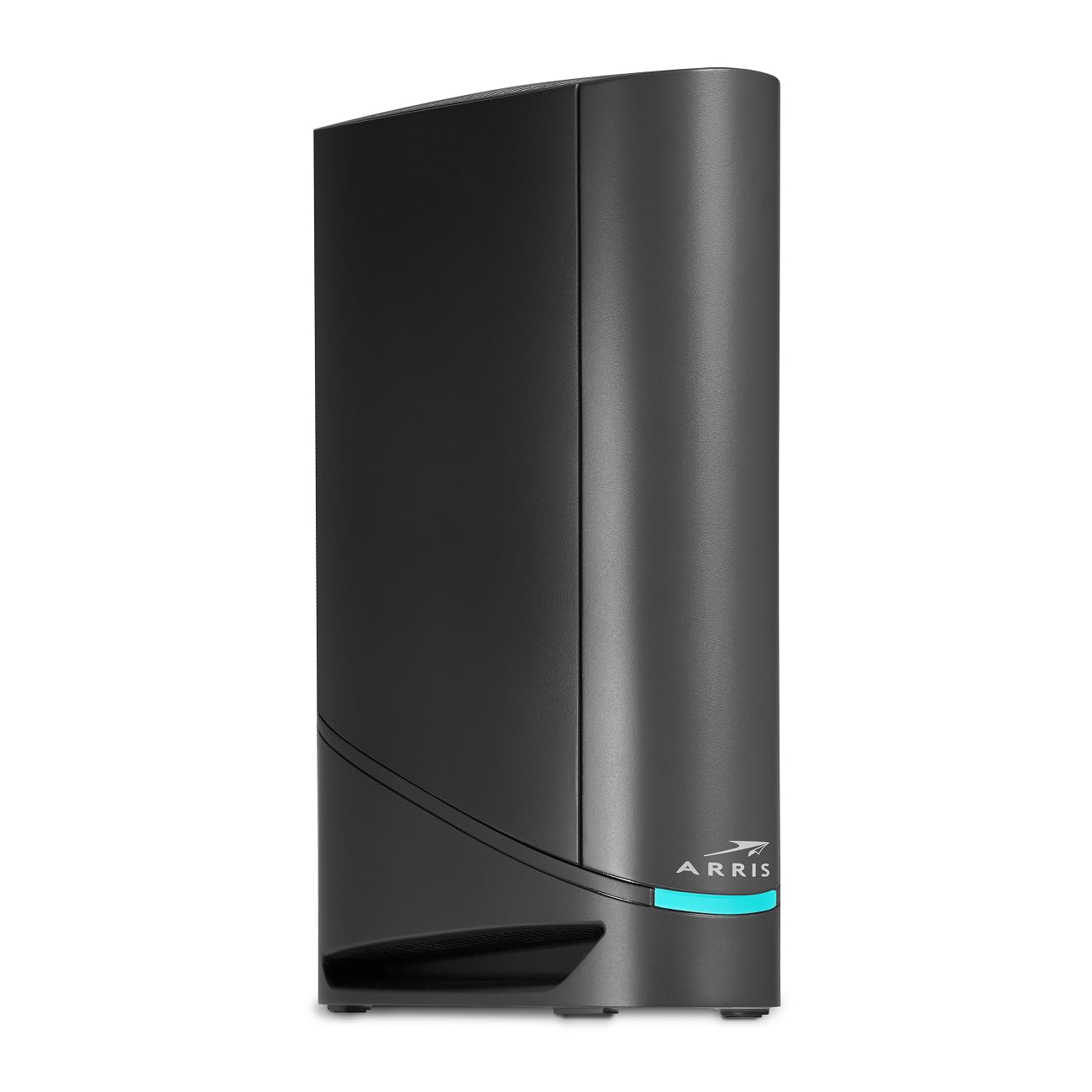
The cheapest way to get DOCSIS 3.1 and Wi-Fi 6 in one box — just be ready for refurbished quirks.
This is the lowest-priced entry in the lineup that still gives you DOCSIS 3.1 (the modern modem standard) and dual-band Wi-Fi 6 (AX3000, so up to 3 Gbps total). It works with Xfinity, Spectrum, and Cox, and has four Gigabit Ethernet ports for wired connections. The real draw is that it stops your rental fee — ARRIS claims you’ll avoid up to per year in rental charges (savings vary by provider), though remember that the RB in the model name means this is a renewed (refurbished) unit.
Real experiences are mixed. Some buyers love it: one called it a “perfect upgrade” from their old Motorola 7550 and found the Surfboard app helpful after ISP activation. Others struggle — one reviewer who “used to have the SBG7400AC2 model” reported that the WiFi signal didn’t appear after setup and required multiple factory resets and a long call to Xfinity support to get it working. Another buyer noted constant WiFi drops and had to restart the unit multiple times to reconnect. The G34 is clearly capable when it works, but as a refurbished unit, consistency varies unit-to-unit.
The Upside
- Lowest cost DOCSIS 3.1 + Wi-Fi 6 combo in this guide — big value for budget-conscious buyers
- Easy activation via the Surfboard app once your ISP is on board
- Four Gigabit Ethernet ports support wired devices
The Caveat
- Refurbished unit means condition and lifespan vary — some units work great, others have constant drops
- Compatibility issues with Xfinity after provider upgrades: one buyer was told they needed to upgrade again
Go for it if: your budget is tight and you are comfortable working through possible oddities from a refurbished unit.
Think twice if: you want a low-maintenance, buy-it-and-forget-it experience — a new unit is safer for long-term confidence.
6. Arris (SBG8300-RB) – Cable Modem Router Combo

A proven DOCSIS 3.1 upgrade for the budget-conscious who can live with Wi-Fi 5.
The SBG8300-RB is one of the oldest combos on this list but still popular for a reason: it uses DOCSIS 3.1 (the same modem engine as the more expensive picks) paired with Wi-Fi 5 (AC2350, which is the previous generation 802.11ac). It supports up to 1,000 Mbps internet plans and has four OFDM channels (a technology that divides data into many small sub-channels for more efficient transmission). It works with most US cable providers including Xfinity, Spectrum, and Cox, but does NOT support fiber optic, DSL, satellite, or digital voice services.
Buyers consistently report that upgrading from DOCSIS 3 to 3.1 “reduced buffering and data delay,” which is the single most common compliment in reviews. The setup is generally smooth — one owner reported it was easy with Xfinity. But as a refurbished unit (RB stands for renewed), there are annoyances: the included instructions have the wrong IP address for the admin panel, the app often requires two separate apps and fails repeatedly, and there is no physical WPS button (a button that lets you connect devices without typing the password) for pairing wireless printers. Bigger-picture, the Wi-Fi 5 standard is noticeably slower than Wi-Fi 6 combos like the G34 or CAX30, especially when multiple devices are streaming or gaming simultaneously.
Where It Still Shines
- DOCSIS 3.1 modem delivers the same buffering-reduction benefits as far more expensive combos
- Proven reliability — 878 ratings and a 4.0/5 average score show consistent buyer satisfaction
- Easy setup with most major ISPs once you have the correct IP address handy
Where It Falls Short
- Wi-Fi 5 (AC2350) is two generations behind Wi-Fi 7 — slower speeds and poor multi-device handling
- No WPS button makes connecting printers and extenders a password-typing hassle
- Bulkier than most — 11″ x 4″ x 12″H is 12% larger than the Fritz!Box 6670 dimensions
Best for: a low-cost DOCSIS 3.1 upgrade if your internet plan is under 500 Mbps and you don’t need the latest Wi-Fi generation.
Look past it if: you have a busy home with many devices streaming, gaming, or video-calling at once — Wi-Fi 5 will struggle to keep up.
Understanding the Specs
DOCSIS 3.1 vs 3.0
DOCSIS (Data Over Cable Service Interface Specification) is the technology that lets your cable modem talk to your internet provider over the coaxial cable coming into your home. DOCSIS 3.1 is the modern standard — it supports internet plans up to 10 Gbps and uses OFDM (Orthogonal Frequency-Division Multiplexing), which splits data across hundreds of small frequencies to reduce buffering and improve reliability. DOCSIS 3.0, the older standard, tops out at about 1 Gbps and uses a simpler data-packing method that gets slower as more neighbors use the internet. If your internet plan is 300 Mbps or higher, you want a DOCSIS 3.1 modem to avoid being the bottleneck.
Wi-Fi Generations (Wi-Fi 5 vs 6 vs 7)
Wi-Fi 5 (802.11ac) was standard from 2014 and works fine for basic browsing on one or two devices. Wi-Fi 6 (802.11ax) arrived around 2019 and handles many devices at once — crucial for modern homes with phones, laptops, smart TVs, and IoT gadgets all connected. Wi-Fi 7 (802.11be) is the newest generation (2024) and supports multi-gigabit speeds and extremely low latency, but you need Wi-Fi 7 devices to see the benefit. For most people today, Wi-Fi 6 is the practical balance — it is widely supported by current phones and laptops and handles 20+ devices without slowing down.
FAQ
Will any cable modem router combo work with my internet provider?
How do I activate a new cable modem router combo with my provider?
How long does a cable modem router combo last?
Is a refurbished (renewed) cable modem router combo worth buying?
Do I need Wi-Fi 7 or is Wi-Fi 6 enough?
What does “multi-gig” mean on a cable modem router combo?
Can I use a cable modem router combo with a separate mesh system?
How much money does owning a cable modem router combo save per year?
What is the difference between the NETGEAR CAX30 and CAX80?
Does the Motorola MG8725 really reduce gaming lag?
Final Thoughts: The Verdict
If you want one dependable pick, the best cable modem router combo winner is the AVM Fritz!Box 6670 Cable because it delivers cutting-edge Wi-Fi 7 speeds, a built-in smart-home hub, and the most Ethernet ports of any pick here, all in a compact package. If you live in a larger home and need whole-house coverage, grab the NETGEAR Orbi CBK752. And for the absolute fastest speeds with a 10-Gigabit wired port, the ARRIS G54 leads on raw capability, though its reliability is less certain.
How We Picked
We do not accept paid placement. Every pick is matched to a real buyer and a real use-case; we do not hands-on test units.
Sources & Methodology
Specifications: manufacturer listings and product documentation. Review insights: verified customer reviews, as of July 2026. Pricing: not shown on this page (it changes often); check the current price via the retailer link.
As an Amazon Associate, Gadgets Feed earns from qualifying purchases. This does not affect which products we feature.
Related Guides
Product prices and availability are accurate as of the date/time indicated and are subject to change. Any price and availability information displayed on Amazon at the time of purchase will apply to the purchase of this product. As an Amazon Associate I earn from qualifying purchases.
CERTAIN CONTENT THAT APPEARS ON THIS SITE COMES FROM AMAZON. THIS CONTENT IS PROVIDED "AS IS" AND IS SUBJECT TO CHANGE OR REMOVAL AT ANY TIME.
Amazon and the Amazon logo are trademarks of Amazon.com, Inc. or its affiliates.