
Our readers keep the lights on and my morning glass full of iced black tea. As an Amazon Associate, I earn from qualifying purchases.
Specs are compiled from manufacturer listings and verified buyer reviews and can change over time — please confirm the key details on the product page before buying.
Finding a pair of tower speakers that deliver real, room-filling sound without emptying your bank account is the challenge. You want clear dialogue in movies, punchy bass in music, and that wide, rich soundstage that makes you feel like you’re at a live show — but the budget speaker market is full of thin, boxy options that miss the mark. This guide cuts through the noise to find the towers that actually deliver where it counts.
I’m Min — the founder and writer behind Gadgets Feed. This guide is built by comparing the manufacturers’ published specifications and the patterns across verified customer reviews, so you get each pick’s real strengths and trade-offs instead of marketing spin.
Whether you are building your first stereo system or upgrading from a soundbar, this analysis of the best budget floorstanding speakers will help you find the pair that fits your room, your receiver, and your ears.
Our Picks at a Glance


How To Choose The Best Budget Floorstanding Speakers
Floorstanding speakers are the backbone of any serious stereo or home theater system. In the budget category, a few key specs separate the gems from the duds. Focus on these three areas to get the best sound for your money.
Sensitivity and Power Handling
Sensitivity, measured in decibels (dB), tells you how loud a speaker will play with a given amount of power. A higher rating, like 94dB, means you get more volume from a low-powered receiver, while a lower rating, like 87dB, demands a beefier amp to sound its best. Pair a low-sensitivity speaker with a weak receiver, and you’ll get quiet, strained sound. Budget speakers often list both continuous (RMS) and peak power handling — the continuous rating is the one that matters for everyday listening.
Driver Configuration and Crossover
A speaker’s drivers (woofers, midrange, tweeter) handle different parts of the frequency range. A 2-way design splits the signal between a woofer and a tweeter, while a 3-way design adds a dedicated midrange driver for clearer vocals and instruments. The crossover is the electronic circuit that divides the signal — a real crossover with quality components sounds more refined than a simple capacitor on a tweeter. In the budget zone, 3-way towers often sound more detailed and less congested at higher volumes.
Cabinet Design and Bass Output
The cabinet is more than a box — it shapes the bass. A bass-reflex (ported) cabinet uses a tuned tube to boost low frequencies, giving you more thump from smaller woofers. A passive radiator design uses a non-powered driver that moves with the air inside the cabinet to produce deeper bass without the “chuffing” noise a port can make. Larger woofers (6.5 inches or bigger) and more cabinet volume generally mean deeper, more easy bass, but they also mean a physically larger speaker that takes up more floor space.
Quick Comparison
| Model | Best For | Sensitivity | Driver Config | Impedance | Amazon |
|---|---|---|---|---|---|
| Polk Monitor XT60★ Best Overall | Small-room definition | — | 2-way, 6.5″ + Dual Rad | 8 Ohm | $229.00Amazon |
| Klipsch R-620FAlso Great | High-volume clarity | — | 2-way, Dual 6.5″ | 8 Ohm | $259.00Amazon |
| Klipsch R-610FBest Value | Sensitive, dynamic sound | 94dB | 2-way, 6.5″ | 8 Ohm | $299.00Amazon |
| ELAC Debut 2.0 F5.2 | Neutral, accurate music | — | 3-way, Triple 5.25″ | 6 Ohm | $319.00$449.00Amazon |
| Polk Monitor XT70 | Punchy bass, home theater | 90dB | 2-way, Dual 6.5″ + 8″ Rad | 8 Ohm | $349.00Amazon |
| Dayton Audio T65 | Power handling, value | — | 2-way, Dual 6.5″ | 8 Ohm | $229.98Amazon |
| Rockville RockTower 68B | 3-way detail on a budget | 87dB | 3-way, Dual 6.5″ | 8 Ohm | $234.90Amazon |
| Sony SS-CS3 | High-res clarity, value | — | 3-way, 4-Driver | 6 Ohm | $498.00Amazon |
In‑Depth Reviews
1. Polk Monitor XT60 Tower Speaker
A small-room specialist that uses passive radiators for clean, articulated bass without a port’s rumble.
The XT60 is essentially a large bookshelf speaker on a stand, but its twin 6.5-inch passive radiators give it real low-end presence without the need for a port. This “enclosed, portless design” creates a unique, clean sound that buyers report works great for techno and rap in a stereo setup. The 1-inch tweeter and 6.5-inch Dynamically Balanced Woofer deliver smooth mid-range and a wide soundstage, making it a solid foundation for a small home theater. It is Hi-Res Audio certified and compatible with Dolby Atmos, DTS:X, and Auro 3D.
One buyer’s note is crucial: “In small rooms, great definition; in large rooms, 6.5″ driver lacks air movement.” This is the defining trade-off. The XT60 sounds precise and detailed in a smaller space, but it cannot fill a large, open living room without sounding strained. Compared to the larger Polk Monitor XT70, the XT60 is more affordable and easier to place, but it gives up the deep bass extension that the XT70’s 8-inch radiators provide. The rubber feet are designed for both carpet and hard floors, adding placement flexibility.
Definition over brute force: Perfect for a dedicated listening room or a smaller living room where you care about clarity over sheer volume. One reviewer called it a “definite upgrade over soundbar.”
The hard limit: Do not buy this for a large, open-plan space. It needs walls nearby to pressurize the room for bass.
Best for: small to medium rooms where accuracy and definition are the goal. it’s not for you if your listening area is large or open.
2. Klipsch R-620F Floorstanding Speaker
The tower that brings live-concert energy to your living room without a live-concert price tag.
If you love to crank it up, the R-620F is built for exactly that. Its 90×90 Square Tractrix Horn delivers crisp, detailed highs that cut through the mix, making dialogue and vocals sound present and clear even in a big room. The dual 6.5-inch Spun-Copper IMG Woofers (woofers made from a rigid, light copper-colored fiberglass material) produce punchy, controlled bass that hits hard without sounding muddy. At 40 inches tall, this tower commands the room visually and sonically.
One reviewer noted that you need a receiver which lets you manually adjust the crossover frequency — a crucial detail for fine-tuning the bass to blend with a subwoofer. Unlike the Klipsch R-610F below, which has a single 6.5-inch woofer, the R-620F uses two, giving it noticeably more authority and low-end weight for music and explosions. The bass-reflex design (a ported cabinet that boosts low frequencies) uses rear-firing Tractrix ports to push air efficiently, so you get deeper bass from a relatively compact footprint.
For the volume lover: A superb choice for anyone who wants clear, dynamic sound at high volume levels. Its sensitivity is high enough to sing with modest receivers.
One caveat: You will want to pair it with a subwoofer for the deepest movie rumbles, and the rear ports mean you need a few inches of space behind the speaker.
Reach for this if: you prioritize clear, loud sound for movies and rock music in a medium to large room.
3. Klipsch Reference R-610F Floorstanding Speaker
The 94dB sensitivity powerhouse that fills a room with sound from a modest amplifier.
This is the speaker that rewards you for having a low-powered receiver. The R-610F’s 94dB sensitivity (a measure of how loud it plays per watt of power) means it gets very loud, very easily — a huge advantage if you are not using a massive separate amplifier. With 85W continuous and 340W peak power handling, it can handle big dynamic swings without distorting, as buyers report enjoying “sturdy and dynamic sound that fills your room without distortion at any volume.”
Its 1-inch Aluminum LTS tweeter (a light, rigid tweeter that resists distortion) with a 90 x 90 Square Tractrix Horn delivers the signature Klipsch clarity — crisp, forward highs that make cymbals and dialogue sparkle. The 6.5-inch IMG woofer provides solid mid-bass punch. Compared to the ELAC Debut 2.0 F5.2, the Klipsch is more sensitive and easier to drive, but the ELAC offers a more neutral, accurate sound signature for critical music listening. At 36 pounds each, these are sturdy, well-built cabinets (MDF — medium-density fiberboard) with magnetic grilles for a clean look.
Ease of use: The 8-ohm impedance (the electrical load the speaker presents to the amplifier) is compatible with most AV receivers, making setup straightforward. Owners mention the cheap leg screws are a minor annoyance.
The standout: You get dramatic, room-filling output without needing a high-end amplifier — a rare combination at this price.
Best for: budget-conscious buyers with modest receivers who want big, dynamic sound for movies and music. skip it if you prefer a laid-back, warm sound profile.
4. ELAC Debut 2.0 F5.2 Floorstanding Speaker
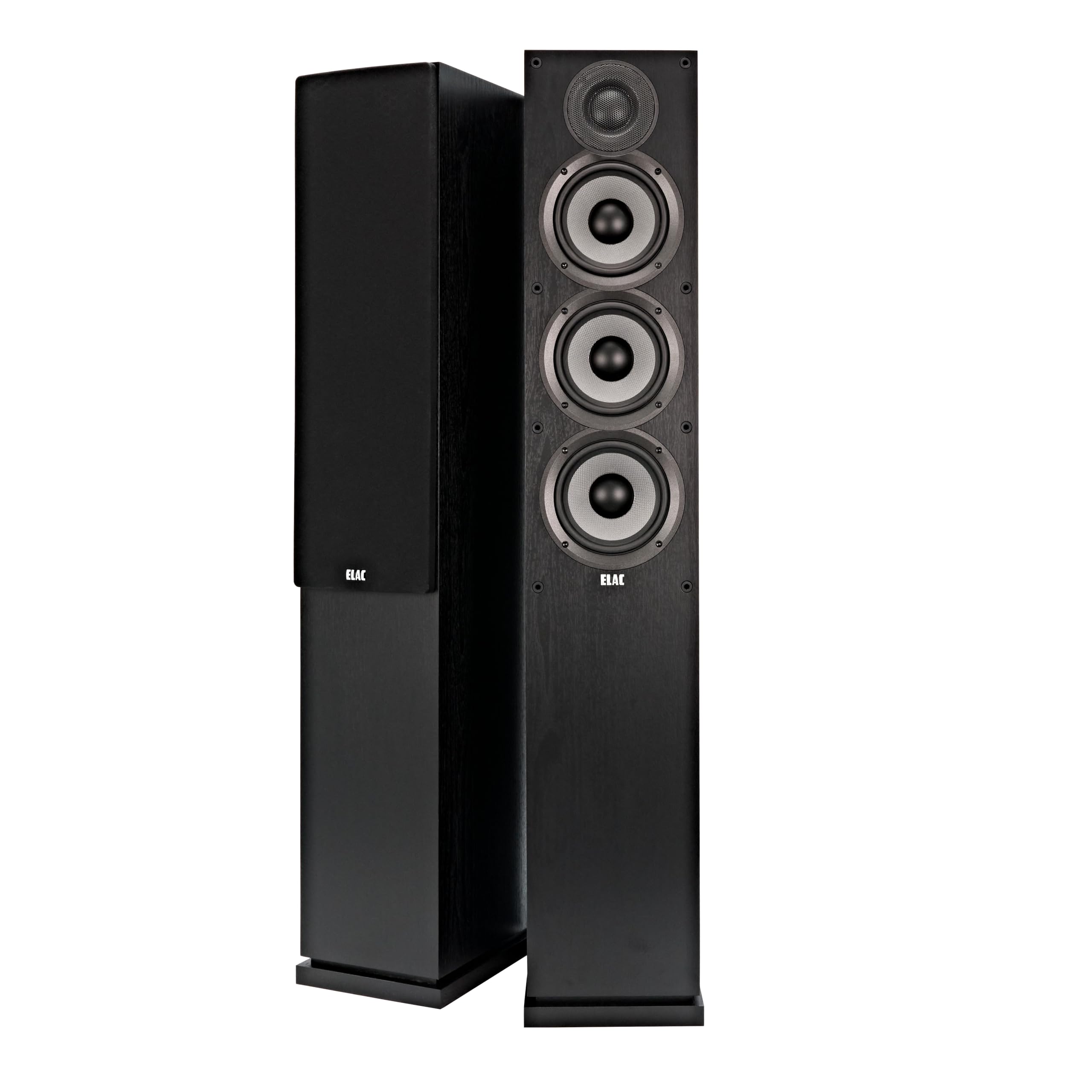
A 3-way design with aramid-fiber woofers that delivers reference-level neutrality for music purists.
If accurate, uncolored sound is your priority, the ELAC Debut 2.0 F5.2 is the clear winner. It uses a 3-way bass-reflex configuration — meaning a dedicated 1-inch cloth dome tweeter, a separate midrange driver, and three 5.25-inch woven aramid-fiber woofers. Aramid fiber (a super-stiff material used in bulletproof vests) gives the cones exceptional rigidity, which translates to clean, low-distortion bass and midrange. The tweeter extends up to 35,000 Hz (far beyond human hearing) for what sounds like airy, open high frequencies.
Reviewers report it competes with speakers costing much more, but with a crucial catch: it needs a subwoofer for truly deep bass, and it benefits from a 30 to 50-hour break-in period and room calibration (like Audyssey) to fix a slight bass dip. Unlike the Polk Monitor XT70’s passive radiator design, which aims for punchy, responsive bass, the ELAC’s goal is accuracy. Its thick MDF cabinets (medium-density fiberboard) are internally braced to reduce vibrations, so the sound stays clean even at higher volumes.
Neutral and musical: Perfect for jazz, classical, and acoustic music where you want to hear every instrument’s true timbre. One long-time hobbyist called it “the perfect speakers” after decades of searching.
The trade-off: You must budget for a subwoofer and spend time with setup and calibration to open up its full potential.
Reach for this if: you value accuracy and musicality over punch and volume. Not for those who want heavy bass straight from the start without a subwoofer.
5. Polk Monitor XT70 Large Tower Speaker

A large tower that uses two 8-inch passive radiators for deep, punchy bass without a port’s noise.
The XT70 is Polk’s biggest Monitor series tower, and it uses that size to its advantage. It pairs two 6.5-inch Dynamically Balanced Woofers with two 8-inch passive radiators — non-powered cones that move with the air pressure inside the cabinet to boost bass output. This design delivers punchy, responsive low end that you can feel, without the “chuffing” sound that a ported speaker can make at high volumes. Its 90dB sensitivity is moderate, so it will play nicely with a decent receiver.
One buyer mentioned the woofer and radiator sizes may be smaller than Polk’s stated measurements, but still noted it is “amazing bang for buck” after a 20 to 30-hour burn-in. It is Dolby Atmos, DTS:X, and Auro 3D compatible, meaning it works smoothly with modern surround sound formats. Compared to the smaller Polk Monitor XT60, the XT70 moves much more air thanks to its larger 8-inch passive radiators, making it the better choice for larger rooms and home theater use. A subwoofer is still recommended for the deepest effects.
Home theater muscle: Ideal for action movies and electronic music where bass impact matters. Customers note it sounds “smooth and full” when paired with a clean amplifier like a Yamaha AS501.
Space needed: This is a large speaker — it needs ample floor space and will dominate a small room visually and sonically.
Best for: home theater enthusiasts who want big, effective bass from the tower itself. pass on it if you have a small room or dislike a forward, punchy sound.
6. Rockville RockTower 68B
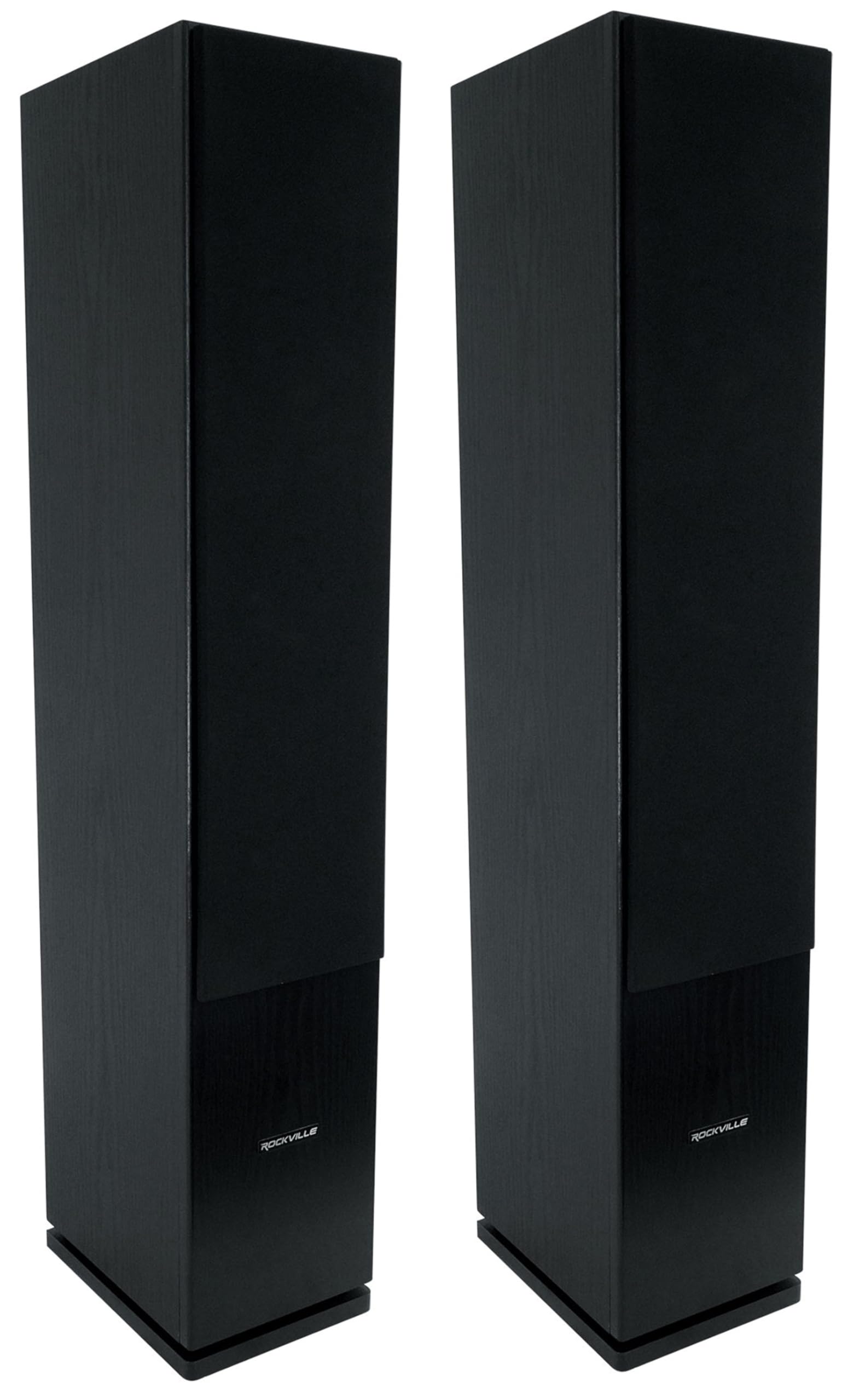
A true 3-way budget tower that gives you dedicated drivers for lows, mids, and highs for clearer detail.
Most budget speakers are 2-way designs, but the RockTower 68B uses a true 3-way configuration: two 6.5-inch woofers for bass, a dedicated 6.5-inch midrange driver for vocals and instruments, and a 1-inch silk dome tweeter for smooth highs. This separation reduces distortion and lets each driver focus on its range, resulting in clearer, more detailed sound than a simple 2-way speaker. Each speaker handles 125W RMS (continuous power) and 500W peak for dynamic bursts, with a frequency response spanning 30Hz to 20kHz.
One buyer replaced his Sony SS-SC5s in the garage with the RockTower 68B, noting “superior bass, volume, and rich sound” — a solid real-world comparison. The 87dB sensitivity is on the lower side, meaning it needs a more powerful receiver to reach high volumes without strain. The cabinet is made from MDF (medium-density fiberboard) with a black grain finish, and the gold-plated 5-way binding posts accept banana plugs or bare wire. Reviewers consistently praise the double-boxed packaging for protecting the speakers during shipping.
Detail on a budget: The 3-way crossover gives it an edge in vocal clarity and instrument separation over many rivals at the same price.
Power requirement: Because of the 87dB sensitivity, you will want a receiver with at least 75-100 watts per channel to drive them properly.
Reach for this if: you want the detail of a 3-way design without moving into premium pricing. look elsewhere if you have a low-powered receiver (under 50W per channel).
7. Dayton Audio Classic T65 Floor-Standing Tower Speaker Pair

A no-nonsense tower pair that delivers powerful bass and 150W power handling for serious listening sessions.
The T65 is all about raw capability. Its bass-reflex cabinet stands over 39 inches tall, housing dual 6.5-inch polypropylene bass drivers and a 1-inch silk dome tweeter. The silk dome tweeter (a soft, woven fabric dome) reproduces treble in “stunning detail without being harsh or abrasive,” according to the manufacturer. With 150W power handling, these speakers can play loud and clean for parties or dynamic movie soundtracks without distorting. The gold-plated binding posts accept high-quality banana plugs for a clean, low-resistance connection.
One buyer’s review is essential: “Requires 30+ hour break-in.” This is common for speakers with stiff suspension — they sound tight and closed initially, then open up after extended play. Another reviewer described their sound as “clear, bright sound with slightly pronounced bass.” Compared to the Rockville RockTower 68B’s 3-way design, the T65 is a simpler 2-way design, but its dual 6.5-inch drivers give it a solid bass foundation that the Rockville’s smaller-dedicated midrange might not match. The wood-grain vinyl finish gives it a classic, furniture-friendly look.
Value first: You get a full pair of substantial towers for a very low entry price. The 150W power handling means you can push them hard without fear.
Patience required: Budget for 30+ hours of playtime before judging the sound. They need break-in to reach their potential.
Best for: budget buyers who want a complete pair of large towers and are willing to wait for the break-in period. steer clear if you want crisp, detailed sound immediately.
8. Sony SS-CS3 3-Way 4-Driver Floor-Standing Speaker

A 3-way, 4-driver design with a dedicated super tweeter that extends high-frequency response to 50kHz.
The Sony SS-CS3 is a unique value proposition. It uses a 3-way, 4-driver configuration: a 1-inch polyester main tweeter, a separate ¾-inch super tweeter, and two dedicated woofers. The super tweeter extends frequency response up to 50kHz (far beyond the 20kHz human hearing limit), which is essential for high-resolution audio formats that contain ultrasonic information. This design is designed to deliver incredibly detailed, airy highs that bring new life to well-recorded music. The 145W peak power handling and 6 Ohm impedance require a reasonably capable receiver.
One reviewer notes it offers “incredible clarity and treble” but “lacks deep bass compared to vintage high-end speakers” — a common trade-off for speakers focused on midrange and high-frequency detail. Another buyer upgrading from a bookshelf speaker said it was a “huge improvement,” revealing “new subtle parts” in familiar music. Compared to the Polk Monitor XT60, which uses passive radiators for bass, the Sony is more about transparency and detail in the mids and highs, making it a better match for acoustic, jazz, and classical music.
Detail oriented: Perfect for listeners who value clarity, soundstage, and high-frequency air over bass impact. One buyer called it “a speaker worth twice what you pay.”
Bass assist needed: For home theater or bass-heavy music, a subwoofer is almost mandatory to round out the sound.
Reach for this if: you listen to a lot of acoustic music or high-resolution audio and prioritize treble detail. skip it if you want heavy bass straight from the tower.
Understanding the Specs
Sensitivity (dB)
Sensitivity measures how loud a speaker plays with one watt of power from one meter away. A higher number (like 94dB) means the speaker gets loud easily with a low-powered receiver. A lower number (like 87dB) means it needs more power to reach the same volume. This is critical for budget buyers because many budget receivers are not very powerful — a speaker with high sensitivity will sound livelier and more dynamic with the same amplifier.
Impedance (Ohms)
Impedance is the electrical resistance the speaker presents to your amplifier. Most budget speakers are 8 Ohms, which is an easy load for almost any receiver. A 6 Ohm or 4 Ohm speaker demands more current from the amplifier, which can cause some budget receivers to overheat or sound strained at high volumes. Always check your receiver’s manual to see if it is rated for lower-impedance speakers.
Crossover Design
The crossover is the electronic circuit inside the speaker that splits the audio signal into frequency bands and sends them to the right driver (woofer, midrange, tweeter). A 2-way crossover sends lows to the woofer and highs to the tweeter. A 3-way crossover adds a dedicated midrange band, which can improve vocal clarity and instrument separation. In budget speakers, a real crossover with quality components makes a big difference in how clean and coherent the sound is.
Cabinet Type
There are two main cabinet types in budget towers: bass-reflex (ported) and passive radiator. A bass-reflex cabinet uses a tuned tube (port) to reinforce low frequencies, giving you more bass from a smaller box. A passive radiator uses a non-powered cone that moves with the air inside the cabinet to produce deeper bass without the “chuffing” noise a port can make. Both designs have their fans, but passive radiators are often preferred for their cleaner, more controlled bass response.
FAQ
Do I need a subwoofer with budget floorstanding speakers?
Can I use budget floorstanding speakers for a surround sound system?
What size amplifier do I need for budget floorstanding speakers?
What is a “break-in” period for speakers?
Should I buy floorstanding speakers or bookshelf speakers?
What does “Hi-Res Audio certified” mean for a speaker?
How much space do I need behind a ported speaker?
What is the difference between 2-way and 3-way speakers?
Can I use floorstanding speakers with a Bluetooth receiver?
How long should budget floorstanding speakers last?
Final Thoughts: The Verdict
For most buyers, the best budget floorstanding speakers are the Klipsch R-620F because they deliver the clearest, most dynamic sound at high volumes for both movies and music, all from a receiver-friendly design. If you want maximum value and easy driving from a modest amplifier, grab the Klipsch Reference R-610F. And for the purest, most accurate sound that audiophiles will love, the standout is the ELAC Debut 2.0 F5.2 — just be ready to pair it with a subwoofer.
How We Picked
We do not accept paid placement. Every pick is matched to a real buyer and a real use-case; we do not hands-on test units.
Sources & Methodology
Specifications: manufacturer listings and product documentation. Review insights: verified customer reviews, as of July 2026. Pricing: not shown on this page (it changes often); check the current price via the retailer link.
As an Amazon Associate, Gadgets Feed earns from qualifying purchases. This does not affect which products we feature.
Related Guides
Product prices and availability are accurate as of the date/time indicated and are subject to change. Any price and availability information displayed on Amazon at the time of purchase will apply to the purchase of this product. As an Amazon Associate I earn from qualifying purchases.
CERTAIN CONTENT THAT APPEARS ON THIS SITE COMES FROM AMAZON. THIS CONTENT IS PROVIDED "AS IS" AND IS SUBJECT TO CHANGE OR REMOVAL AT ANY TIME.
Amazon and the Amazon logo are trademarks of Amazon.com, Inc. or its affiliates.