
Our readers keep the lights on and my morning glass full of iced black tea. As an Amazon Associate, I earn from qualifying purchases.
Specs are compiled from manufacturer listings and verified buyer reviews and can change over time — please confirm the key details on the product page before buying.
You are out camping and suddenly you hear heavy footsteps near your tent. Your food is in a cooler. If a black bear or grizzly can get into it, you face a ruined trip — or a dangerous wildlife encounter. A bear-proof cooler keeps your food secure so you sleep soundly. The best models carry IGBC certification: a stamp from the Interagency Grizzly Bear Committee proving the cooler can survive a bear attack for up to 60 minutes. They also hold ice for days, so you do not have to choose between safety and cold drinks.
I’m Min — the founder and writer behind Gadgets Feed. This guide is built by comparing the manufacturers’ published specifications and the patterns across verified customer reviews, so you get each pick’s real strengths and trade-offs instead of marketing spin.
This roundup of the best bear-proof coolers covers everything from a compact personal cooler for day trips to a huge 110-quart monster for week-long expeditions.
Our Picks at a Glance

How To Choose The Best Bear Proof Cooler
Picking the right bear-proof cooler is not just about which one looks toughest. You need to match the size to your trip, understand the insulation that keeps ice solid for days, and check whether the latches and hinges can survive a determined bear — or just a rough drop off a tailgate. Here are the three things that matter most.
Certification: IGBC is the only stamp that counts
Not every cooler that calls itself “bear-proof” has actually been tested. The Interagency Grizzly Bear Committee (IGBC) runs a standardized test. A bear has up to 60 minutes to try to break into a cooler to get at a food reward inside. If the cooler survives without the bear accessing the bait, it earns IGBC certification. That is the gold standard. Some coolers also meet the similar standards for grizzly bear resistance set by the Living with Predators program. If you are heading into bear country where regulations require a bear-resistant food container, IGBC-certified coolers are the ones that satisfy those rules. Coolers without that certification are just marketing claims.
Construction and insulation: rotomolded plus thick foam
Bear-proof coolers are built with rotomolded construction — a process where plastic is rotated in a mold to create a single, smooth body with even wall thickness. That is what makes them nearly indestructible compared to cheaper injection-molded coolers that can crack. Inside, the best coolers use pressure-injected polyurethane foam insulation. Look for at least 2 to 3 inches of insulation in the walls and lid. Thicker foam means better ice retention — the difference between having cold drinks on day three versus day seven. A rubber gasket around the lid seal is also critical because cold air escaping through a bad seal melts ice much faster.
Size, weight, and real-world use
Bear-proof coolers are heavy because the materials that make them tough also add pounds. A 75-quart model can weigh 34 pounds empty. That is fine if you are loading it onto a raft or into a truck bed, but a challenge if you need to carry it any distance. Think about the type of trips you actually take. A 15-quart cooler is great for a solo day of fishing or as a personal lunch box. A 50- to 65-quart size works for a couple of days of camping for two people. The huge models — 75 to 110 quarts — are for group trips of a week or more, but you will need help moving them when they are fully loaded. Also consider the cooler’s dimensions (d x w x h) to make sure it fits in your vehicle or on your raft frame.
Quick Comparison
| Model | Best For | Capacity | Weight | Ice Retention | Amazon |
|---|---|---|---|---|---|
| YETI Tundra 75★ Best Overall | All-around group camping | 75 quarts | 34 Pounds | Up to 3″ PermaFrost Insulation | $475.00Amazon |
| Lifetime 65 QuartBest Value | Best value for 3-day trips | 65 quarts | 25.5 Pounds | Up to 8-Day Ice Retention | $159.33$209.00Amazon |
| Grizzly 15 Quart | Compact personal cooler | 15 quarts | 14.6 Pounds | Pressure-injected 2″ insulation | $189.99Amazon |
| BISON COOLERS 50 Quart | Maximum ice retention for week-long trips | 50 quarts | 32 Pounds | Pressure-injected 2″ thick lid | $349.00Amazon |
| YETI Tundra 110 | Group expeditions and rafting | 110 quarts | 37 Pounds | Up to 3″ PermaFrost Insulation | $575.00Amazon |
In‑Depth Reviews
1. YETI Tundra 75 Cooler
Our pick — over 4.5★ from 500+ verified ratings; the strongest balance of quality and price.
The 75-quart balance that balances capacity, ice life, and liveability for most groups.
The YETI Tundra 75 is the cooler you buy when you want one reliable box for everything from a weekend campout to a multi-day lake trip. It holds up to 50 cans with the recommended 2:1 ice-to-contents ratio, along with briskets or a fishing limit. The 34-pound empty weight is hefty, but at 18″D x 33.25″W x 18″H it fits in most SUV trunks without hogging the whole cargo area — a 1% tighter squeeze than the Lifetime 65 Quart, but with a bigger interior.
The real story is the insulation. Up to 3 inches of PermaFrost insulation and an extra thick FatWall design keep ice locked cold. The T-Rex lid latches use heavy-duty rubber with a patented keeper system so you never lose a latch or have one snap on a rocky trail. The rotomolded construction is virtually indestructible, and it carries IGBC certification so you are legal in bear-country campsites.
The trade-off is price and weight. The Tundra 75 costs more than many competitors, and at 34 pounds you will not want to carry it far. But if you need a cooler that serves as a seat, a table, and a fortress for your food without ever worrying about a busted latch, this is the benchmark.
What earns its Keep
- 3″ PermaFrost insulation proven to keep ice over a week outdoors
- IGBC certified bear-resistant — meets backcountry regulations
- Rotomolded body with T-Rex rubber latches that won’t break
The Honest Catch
- 34 pounds empty; moving it loaded is a two-person job
- Premium price — significantly more than the 65-quart Lifetime below
Who it works for: Campers, anglers, and families who want one do-everything cooler that holds ice for a week and survives drops off a tailgate.
Look elsewhere if: You are on a tight budget — the Lifetime 65 Quart delivers similar capacity for less than half the cost, though with a lighter build.
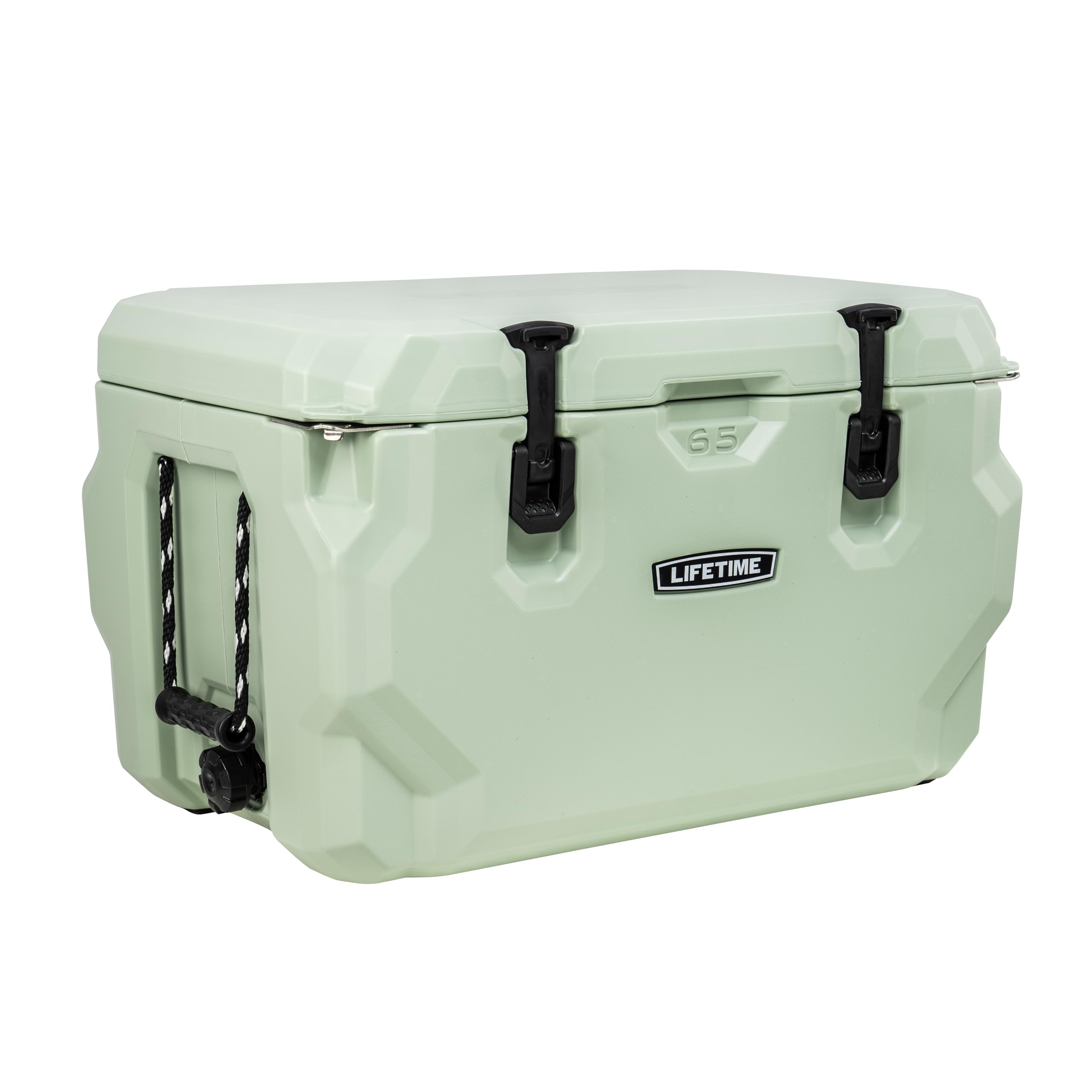
2. Lifetime 65 Quart Hard Cooler
IGBC-certified bear resistance at a price that undercuts every premium cooler on the market.
The Lifetime 65 Quart is what happens when a manufacturer decides to compete head-on with YETI at half the cost. It is certified by the IGBC as bear-resistant — strong enough to withstand a bear for up to an hour when locked — so you are not sacrificing safety to save money. The maker claims ice retention of up to 8 days, which “exceeds most premium priced coolers.” Buyers generally confirm solid performance, though timelines vary: one owner reported it “kept ice for about 3 days with the use of some cooler ice packs.” Another noted in Arizona heat it lasted 3 days before needing a drain.
At 25.5 pounds, it is 8.5 pounds lighter than the YETI Tundra 75, which makes a real difference when you are loading it in and out of a vehicle. The 18.1″D x 28.4″W x 17.5″H dimensions are nearly identical to those of the YETI Tundra 75 — a 1% difference — so it fits the same spaces. The hard cooler is made from heavy-duty polyethylene with urethane and polypropylene components, and features two rope handles with injection-molded grips, two bottle openers, and two latches that secure the lid with holes for your own padlocks.
There is a catch: reviewers mention the rope handles as a potential weak point. One buyer called them “possibly one weak link” and noted they “may break, making transport difficult.” The drain spout is garden-hose compatible, which is a clever touch, but if you plan to drag this cooler over rocks for years, the rope handles may need replacing before the rotomolded body does.
Why it punches up
- IGBC certified bear-resistant at a budget-friendly price
- The maker claims 8-day ice retention, which would beat many premium coolers
- 25.5 pounds is light for a 65-quart rotomolded cooler
Where it takes a shortcut
- Rope handles are less durable than molded rubber or steel handles
- Buyers report ice retention around 3 days, not the claimed 8 days
Reach for this if: You want IGBC certification on a 65-quart cooler without paying YETI-level prices, and you don’t mind replacing a rope handle in a few years.
Pass it up if: You need a cooler that can handle rough dragging over sharp rocks — the rope handles are the weakest link here.
3. Grizzly 15 Quart Cooler

A small, tank-like personal cooler that carries lunch, ice, and IGBC certification all day.
The Grizzly 15 Quart is the cooler you grab when you are heading out solo for a day of fishing or a short work trip. It is small — 15 quarts — which means it holds about 13 cans with the dry container and about 14 without. But do not let the size fool you. This is a rotomolded, IGBC-certified cooler made in the USA with a lifetime warranty. One buyer described it as “an absolute tank” and reported an ice test where “full ice next day in 91°F truck” — meaning even in extreme heat, the insulation held up overnight. That is impressive for a cooler this compact.
The Grizzly uses pressure-injected Ecomate polyurethane foam insulation up to 2 inches thick. Ecomate has no global warming potential, no ozone depletion potential, and no VOCs, so you are getting serious insulation without the environmental baggage. The lid seals with a rubber gasket that keeps cold air trapped, and there are two lock holes for padlocks that keep it secure — and compliant in bear country. The shoulder strap is imported, but the cooler body itself is made in the USA. At 14.6 pounds, it weighs less than half of the YETI Tundra 75 — a 2.3x weight gap — making it genuinely portable for one person to carry with one hand.
The limitation is simply capacity. At 15 quarts, it is 7.3 times smaller than the YETI Tundra 110. This is not a weekend cooler for two people. It is a personal-size unit that fits on an ATV rack, works as a seat, and keeps your lunch cold for a day. If your bear-proof cooler needs are solo and short, this is the most practical option on the list.
What makes it special
- IGBC certified and made in the USA with a lifetime warranty
- 14.6 pounds — light enough to carry easily with the shoulder strap
- Proven ice retention in extreme heat (full ice next day in 91°F truck)
One clear limit
- 15 quarts is too small for a multi-person trip or more than one day’s food
- Dry goods tray sold separately — an extra cost
Best for the solo adventurer: Day trippers, anglers, and workers who need a portable bear-proof cooler that fits on an ATV rack or in a truck cab.
Not for groups: If you need to feed more than one person for multiple days, step up to the 50- or 65-quart options.
4. BISON COOLERS 50 Quart Rotomolded Cooler

A US-made 50-quart fortress that keeps ice packs solid for nearly a week in practice.
The BISON COOLERS 50 Quart is built for people who value ice life above everything else. It features a pressure-injected 2-inch thick lid and double-wall insulated walls with a silicone gasket that creates an airtight seal. The result is ice retention that impressed even experienced outdoor users. One reviewer noted “ice packs didn’t melt after nearly a week” on a family trip, which is a stronger real-world result than many larger coolers deliver. At 50 quarts, it fits somewhere between the compact Grizzly and the full-size YETI models — enough room for a few days of food for a couple or a longer trip for one person.
This cooler is made in the USA and is certified bear-proof by the Interagency Grizzly Bear Committee, so it meets backcountry food-storage rules. The construction is fully rotomolded with rubber latches that use a cantilever hinge system and full-length self-stopping hinges. The open ergonomic grab rails make it easier to carry than a cooler with flush handles — a small design detail that matters when you are wrestling it out of a Jeep Grand Cherokee, which one buyer mentioned it “fits in with the seat down.” The oversized anti-skid rubber feet keep it stable on slippery boat decks or loose gravel.
The catch is weight and cost. At 32 pounds, it is nearly the same weight as the YETI Tundra 75 even though it holds 25 fewer quarts. The price is significantly higher than the Grizzly 15 or the Lifetime 65, landing in premium territory. But if ice retention is your single non-negotiable metric, the BISON cooler’s real-world performance — nearly a week of unmelted ice packs — puts it among the best in class.
what separates it
- Near-week ice pack retention reported by real buyers — class-leading for a 50-quart cooler
- IGBC certified, made in USA, lifetime warranty on the cooler body
- Silicone gasket seal and 2″ thick lid for maximum insulation
Trade-offs to know
- 32 pounds is heavy for a 50-quart cooler — 5.7 pounds heavier than the similar-sized Lifetime
- Premium price tier — expect to pay more than the Grizzly or Lifetime for the ice performance
Ice-obsessed buyers: This is the cooler to pick if your priority is keeping food frozen for the longest possible time, and you are willing to pay for US-made quality.
skip it if: You need a lighter 50-quart cooler or want the cheapest IGBC-certified option — the Lifetime 65 is lighter and less expensive.
5. YETI Tundra 110 Hard Cooler

The 110-quart raft-frame fitter that feeds a crew for more than a week on one load of ice.
The YETI Tundra 110 was designed specifically for the rafting community, sized to fit all major raft frames snugly so it does not end up in the river. But its appeal goes far beyond rafts. At 110 quarts, this is the biggest cooler on the list, capable of holding enough food and drinks for a small group on an extended expedition. Owners mention that after “7 days in 80s°F, plenty of ice remained” — a level of ice retention that matches or beats any cooler in this roundup. One careful owner even shared pro tips: pre-cool the chest, use block ice or frozen gallon water bottles, keep the cooler in the shade, put a wet towel on top, and minimize opening. Follow those steps and you get a solid week-plus of ice.
The construction is the same rotomolded, IGBC-certified build that YETI is known for, with up to 3 inches of PermaFrost insulation and T-Rex lid latches made of heavy-duty rubber. The dimensions are 18.13″D x 37.5″W x 20″H, and it weighs 37 pounds empty. It comes standard with one dry goods basket to keep your bread and snacks above the ice.
The honest reality is that this cooler is enormous and expensive. When full, it is very difficult to move alone. It also costs more than any other cooler here, landing at the very top of the price range. But if you run multi-day river trips, host large gatherings, or simply want the comforting knowledge that your ice will survive the entire trip and then some, the Tundra 110 is the final answer.
Why it dominates
- Proven 7-day ice retention in 80°F conditions according to buyers
- 110 quarts of space — enough for a week-plus of food for a group
- Fits snugly on standard raft frames; IGBC certified bear-resistant
The heavy reality
- 37 pounds empty; extremely heavy when fully loaded
- Premium price — the most expensive cooler in this comparison
Who needs this: River guides, large-family campers, and anyone running group expeditions where a week of reliable ice is the minimum requirement.
Who should pass: Solo campers or anyone who packs light — the 15-quart Grizzly or 50-quart BISON is far more practical for single-person trips.
Understanding the Specs
Rotomolded Construction
Rotational molding (rotomolding) is a process where plastic powder is poured into a metal mold, heated, and rotated at multiple axes at once. The plastic melts and coats the inside of the mold evenly, creating a single, smooth shell with thick, uniform walls. This is what makes bear-proof coolers nearly indestructible — no weak seams, no joints that can crack under impact or from a bear’s claws. Cheaper coolers use injection molding, which creates thinner walls and seams that can split. All five coolers on this list use rotomolded construction.
IGBC Certification
The Interagency Grizzly Bear Committee runs a standardized test where a cooler is baited with food and placed in an enclosure with a bear. The bear has up to 60 minutes to try to break in. If the cooler survives without the bear accessing the bait, it earns IGBC certification. This is the only widely accepted proof that a cooler is genuinely bear-resistant for backcountry use. National parks and bear-management areas often require IGBC-certified coolers for food storage. Coolers without this certification may be tough but do not meet the official standard.
Polyurethane Foam Insulation
Polyurethane foam is the industry standard for high-performance coolers. It is pressure-injected into the walls and lid, where it expands and hardens into a dense, closed-cell foam that traps air and resists heat transfer. The thickness matters — 2 inches is good, 3 inches is excellent. This insulation is the primary factor that determines how many days your ice lasts. Neoprene or basic foam coolers cannot match the ice retention of pressure-injected polyurethane foam.
T-Rex Lid Latches
YETI’s T-Rex latches are made of heavy-duty rubber instead of plastic. They stretch over a molded keeper that holds the lid shut under pressure. The rubber is flexible enough to open and close easily but tough enough not to snap off when a bear tries to pry the lid open. Other coolers use heavy-duty rubber or nylon latches with cantilever hinges. The key is that latches are the first thing to fail on a cooler — look for rubber or metal, never thin plastic.
FAQ
Is IGBC certification the same as bear-proof?
Will every IGBC-certified cooler survive any bear attack?
How many days will a bear proof cooler keep ice?
Do I need a bear proof cooler if I just go weekend camping?
What is the difference between rotomolded and regular coolers?
How heavy are bear proof coolers?
Can I use a bear proof cooler as a seat?
Are bear proof coolers worth the higher price?
What size bear proof cooler should I get?
How do I lock a bear proof cooler?
Final Thoughts: The Verdict
If you want one dependable pick, the bear proof cooler winner is the YETI Tundra 75 because it hits the ideal balance of 75-quart capacity, proven week-long ice retention, and IGBC certification in a package that fits most vehicles without being unmanageably heavy. If you want the best ice retention for the price, grab the BISON COOLERS 50 Quart — real customers note ice packs unmelted after nearly a week. And for compact solo trips where portability and bear-proof certification both matter, the standout is the US-made Grizzly 15 Quart at just 14.6 pounds.
How We Picked
We do not accept paid placement. Every pick is matched to a real buyer and a real use-case; we do not hands-on test units.
Sources & Methodology
Specifications: manufacturer listings and product documentation. Review insights: verified customer reviews, as of July 2026. Pricing: not shown on this page (it changes often); check the current price via the retailer link.
As an Amazon Associate, Gadgets Feed earns from qualifying purchases. This does not affect which products we feature.
Related Guides
Product prices and availability are accurate as of the date/time indicated and are subject to change. Any price and availability information displayed on Amazon at the time of purchase will apply to the purchase of this product. As an Amazon Associate I earn from qualifying purchases.
CERTAIN CONTENT THAT APPEARS ON THIS SITE COMES FROM AMAZON. THIS CONTENT IS PROVIDED "AS IS" AND IS SUBJECT TO CHANGE OR REMOVAL AT ANY TIME.
Amazon and the Amazon logo are trademarks of Amazon.com, Inc. or its affiliates.