
Our readers keep the lights on and my morning glass full of iced black tea. As an Amazon Associate, I earn from qualifying purchases.
Specs are compiled from manufacturer listings and verified buyer reviews and can change over time — please confirm the key details on the product page before buying.
Serious athletes know wrist-based smartwatch heart rate can drift mid-sprint or lock onto cadence instead of pulse. A dedicated chest or arm monitor talks directly to your bike computer, phone, or gym machine. This guide evaluates seven contenders that deliver beat-by-beat data you can trust.
I’m Min — the founder and writer behind Gadgets Feed. This guide is built by comparing the manufacturers’ published specifications and the patterns across verified customer reviews, so you get each pick’s real strengths and trade-offs instead of marketing spin.
The most reliable way to train with precision is to strap on a dedicated accurate heart monitor that pairs directly with your devices, giving you real-time feedback without the lag or drift that plagues wrist-based sensors.
Our Picks at a Glance

How To Choose The Best Accurate Heart Monitor
Your choice depends on your training environment—road, gym, trails, or home—and the devices you already own. Here are the three factors that matter most.
ECG Chest Strap vs. Optical Armband
A chest strap reads your heart’s electrical signal (like a 12-lead ECG), making it the gold standard for high-intensity intervals and weight training. An optical armband uses light through your skin to detect blood volume changes—it is more convenient but can lag during rapid heart rate spikes or be fooled by arm motion. If your goal is absolute beat-by-beat accuracy for structured workouts, lean toward a chest strap. If you value easy on-off and comfort over the slightest edge in precision, an armband is the practical choice.
Bluetooth and ANT+ Compatibility
Most modern monitors offer both Bluetooth and ANT+ signals. Bluetooth connects directly to your phone and apps like Strava or Zwift. ANT+ is the standard protocol for dedicated sports watches (Garmin, Wahoo) and gym equipment (Peloton, Concept2). If you ride with a bike computer or use a smart trainer, verify that your monitor broadcasts in ANT+. Many premium monitors can stream to two devices at once, so you can log your workout on a phone and watch live data on a head unit simultaneously.
Battery Life and Power Method
Chest straps traditionally run on a replaceable coin cell (CR2025 or CR2032) that lasts hundreds of hours but needs a spare when it dies mid-week. Newer rechargeable models—both chest and armband—use a magnetic USB cable and can run 20 to 200 hours per charge. Rechargeable monitors save you the recurring cost of batteries, but you must remember to top them up. If you log very high mileage every week, the longest-lasting straps (1,000 hours on a single coin cell) can go years without attention.
Quick Comparison
| Model | Best For | Sensor Type | Battery Life | Weight | Amazon |
|---|---|---|---|---|---|
| Polar H10★ Best Overall | Gold-standard ECG accuracy for serious athletes | ECG Chest Strap | 400 hours (CR2025) | 60 g | Amazon |
| Wahoo TRACKRPremium Pick | Rechargeable premium chest strap for cyclists and runners | Chest Strap | 200 hours (rechargeable) | — | Amazon |
| Magene H603 | Ultra-lightweight chest strap with longest battery life | Chest Strap | 1000 hours (CR2032) | 16 g | Amazon |
| Scosche Rhythm+ 2.0 | Optical armband with HRV data for recovery tracking | Optical Armband | 24 hours (rechargeable) | — | Amazon |
| COOSPO HW9 | Optical armband with vibration alerts and 35-hour battery | Optical Armband | 35 hours (rechargeable) | 10 g | Amazon |
| CYCPLUS H1 | Budget-friendly armband with 30-min fast charge | Optical Armband | 110 hours (rechargeable) | — | Amazon |
| COOSPO HW807 | Entry-level armband for basic zone tracking | Optical Armband | 20 hours (rechargeable) | 10 g | Amazon |
In‑Depth Reviews
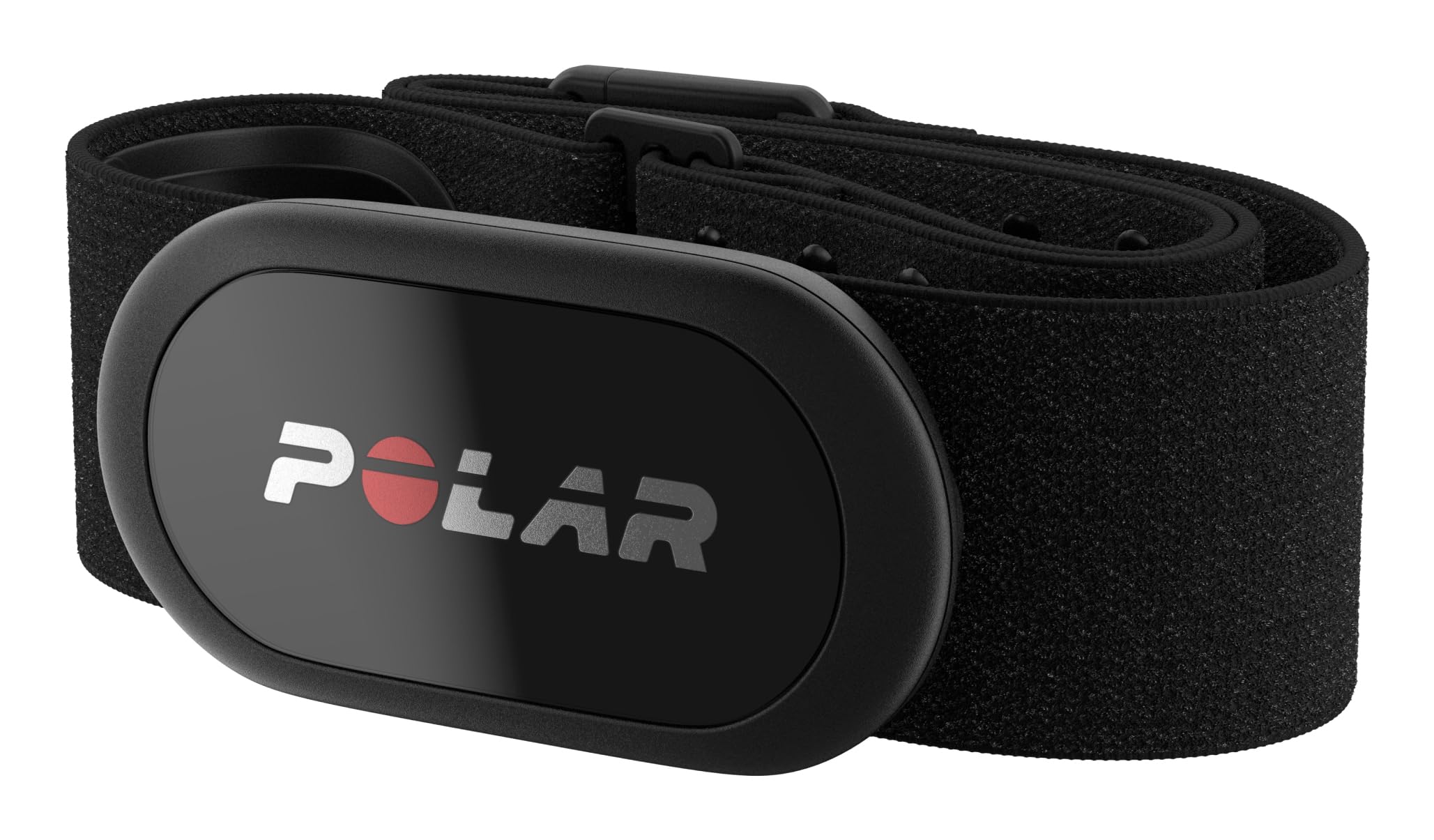
1. Polar H10 Heart Rate Monitor Chest Strap
Our pick — over 4★ from 26,500+ verified ratings; the strongest balance of quality and price.
Researchers and serious athletes trust this clinical-grade benchmark for reference data.
At the heart of the Polar H10 is an electrical ECG sensor that reads your heart’s electrical activity directly, the same method used in medical settings. Verified buyers report 92.9% accuracy running, 99.3% cycling, and 95.3% weight training, making it Polar’s most accurate heart rate sensor. It supports dual Bluetooth connections and ANT+ simultaneously plus a 5 kHz signal (GymLink) for older gym equipment, so you can broadcast to a phone, a bike computer, and a treadmill at the same time.
The 60-gram sensor rides on a pro strap with silicone dots and improved electrodes that keep readings stable even when you are drenched in sweat. A CR2025 battery lasts 400 hours — roughly a year of daily one-hour workouts. The chest strap is waterproof to 30 meters, so you can take it into the pool for swimming sessions. The bulky catch is comfort: one reviewer notes that most men with a chest larger than 42 inches will need the XXXL strap, which is only available directly from Polar.
what separates it
- ECG sensor delivers verified accuracy of 92.9% running, 99.3% cycling, 95.3% weight training
- Dual Bluetooth plus ANT+ and 5 kHz for three simultaneous connections
- Waterproof to 30 meters with internal memory for one workout session
- 400-hour battery life on a standard CR2025 coin cell
What to watch for
- Weighs 60 grams — noticeably heavier than the 16-gram Magene H603
- Strap can be too small for chests over 42 inches; larger strap only from Polar
- Battery drain can sometimes outpace the claimed 400 hours, per some owners
- Customer support is difficult to reach after the 6-month strap warranty ends
Reach for this if: you race or coach off real-time heart rate data and cannot afford guesswork — the H10 is the reference-grade pick for runners, cyclists, and strength athletes who want the same ECG accuracy a lab would use.
Look elsewhere if: you have a larger chest and do not want to hunt down a longer strap, or you prefer a lighter, rechargeable monitor that skips coin-cell swaps.
2. Wahoo TRACKR Heart Rate Monitor
The chest strap that kills the coin-cell hassle with USB-C recharging and 200 hours of runtime.
Wahoo’s TRACKR is a chest strap built around a high-capacity rechargeable battery that delivers over 100 hours of active life — the maker claims up to 200 hours. That means no more digging for a CR2032 at 5 a.m. before a race. Owners mention that the battery lasts six to eight weeks of normal use, and a USB-C charging cable is included. The strap is slim and soft, with an intuitive LED indicator that confirms heart rate detection, battery status, and connectivity at a glance.
It broadcasts via ANT+ and Bluetooth simultaneously, so you can pair it with a Garmin 840 head unit and a phone running Zwift at the same time. Customers note it works with Zwift from the start, unlike some cheaper alternatives that require extra pairing steps. One owner mentioned that after almost a year the monitor is still waterproof and accurate, calling it worth the premium price. The strap hook can be tricky the first few times, and larger users may need a third-party longer strap for a secure fit. For cyclists, runners, and smart-trainer users who want premium connectivity without disposable batteries, the TRACKR is a refined step up.
Why it stands out
- Rechargeable battery with up to 200 hours of active life via USB-C
- Dual ANT+ and Bluetooth for simultaneous device connections
- Intuitive LED indicator for connection and battery status
- Zeros in with Zwift and Wahoo app right from the start
Trade-offs
- Strap may not fit larger chests well; third-party strap may be needed
- Premium price point compared to coin-cell or armband alternatives
- Strap hook is finicky to latch at first
Best for: cyclists and smart-trainer regulars who want a rechargeable chest strap that pairs instantly with Zwift, Garmin, and Wahoo devices.
skip it if: you are on a tight budget or you prefer the featherlight feel of the 16-gram Magene H603.
3. Magene H603 Chest Strap Heart Rate Monitor

A 16-gram chest strap that runs for 1000 hours — essentially a decade of casual workouts.
The Magene H603 is one of the lightest chest straps on the market at just 16 grams, which is nearly four times lighter than the Polar H10 at 60 grams. You barely notice it during a ride or run. But the headline number is the 1000-hour battery life — if you train one hour per day four times a week, a single CR2032 coin cell lasts about 2.5 years. Reviewers point out that the strap is comfortable, shows no corrosion after daily rinses, and is accurate within ±1 bpm compared to an Apple Watch.
It uses a split chest strap design — the sensor pod detaches from the fabric strap so you can wash the band separately. The sensor has a self-research algorithm that filters out movement and sweat noise for stable data. It streams via ANT+ and Bluetooth simultaneously, so you can record to both a Wahoo bike computer and a Zwift app on your phone at the same time. Shoppers say it syncs easily with Peloton bikes, Concept2 rowers, and Nordic treadmills. The catch? A handful of buyers report erratic heart rate jumps after about three months of use, and customer support is slow to respond. Still, at its price point, many see the low cost as making a potential failure acceptable.
Why it wins
- 16 grams — the lightest strap here, 3.8x lighter than the Polar H10
- 1000-hour battery life, the longest of any monitor reviewed
- Split strap design for easy band washing
- Accurate within ±1 bpm vs. an Apple Watch, per verified buyers
Potential issues
- Some units develop erratic HR readings after a few months
- Customer support is reported as unresponsive
- Plastic shell may feel less premium than Polar or Wahoo
Perfect for: budget-minded athletes who want chest-strap accuracy, featherlight weight, and years of battery life without recharging.
Not for: anyone who needs guaranteed long-term reliability or responsive customer service if the unit fails.
4. Scosche Rhythm+ 2.0 Heart Rate Monitor Armband

The armband that captures subtle heartbeat variations for recovery and HRV analysis.
The Scosche Rhythm+ 2.0 is tune not just for workout heart rate but for recovery insights. Its optical sensor captures precise RR interval data (the tiny time gaps between heartbeats) that you can stream to apps like HRV4Training, Morpheus Training, and Welltory to measure training stress, sleep quality, and daily recovery. It connects via Bluetooth and ANT+ to phones, sports watches, and gym equipment, with up to 24 hours of continuous battery on a single charge.
The strap is lightweight, breathable, and adjusts to your forearm, bicep, or tricep. One reviewer on the fairer-skinned side reported that the armband matched his Hammerhead chest strap graph-for-graph during running intervals, with no false peaks or drops. The IP68 rating means it handles sweat, rain, and submersion without issue. A few buyers, however, report random dropouts and wildly inaccurate swings during rowing and paddling compared to a Garmin chest strap. The proprietary charger (not USB-C) is also a minor annoyance. If you want recovery data alongside live HR, this armband is a unique tool in this roundup.
Unique strengths
- Captures RR interval (HRV) data for recovery and stress tracking
- IP68 waterproof — fully submersible
- Comfortable, breathable armband that fits forearm, bicep, or tricep
- Connects to HRV4Training, Morpheus, and Welltory
Limitations
- Some units have random dropouts and inaccurate swings during rowing
- Proprietary charger, not USB-C
- 24-hour battery is shortest of any monitor here; requires weekly charging
Go for this if: you track heart rate variability as part of your recovery routine and want an optical armband that feeds RRi data into advanced training apps.
Pass if: you need a chest strap for absolute ECG precision or you dislike proprietary charging cables.
5. COOSPO HW9 Bluetooth 5.0 ANT+ Heart Rate Monitor Armband

An optical armband that vibrates when your heart rate hits a custom max, keeping you safe without staring at a screen.
The COOSPO HW9 uses an optical heart rate sensor that claims a monitoring error of ±1 BPM. Its key advantage over many armbands is a vibration warning: when your heart rate exceeds your set maximum (default is 200 bpm), the armband buzzes, so you know to ease off without glancing at a phone or computer. A five-color LED indicator changes to show your current heart rate zone at a glance—green, blue, yellow, orange, or red.
The band is made from a soft, breathable nylon and ABS plastic, and it comes with two arm straps for swapping when one gets sweaty. It delivers up to 35 hours of battery with a fast charge via a magnetic cable — notably longer than the 20-hour COOSPO HW807 and the 24-hour Scosche Rhythm+ 2.0. Owners mention that it pairs easily with an Apple Watch and Zwift simultaneously, and that the battery lasts roughly a month of regular use. One reviewer, however, reported that the plastic armband holder broke after a month, though the sensor itself kept working after a DIY repair with superglue. A different owner saw falsely low readings after five weeks. It is a capable armband with useful safety features, but its build quality is not consistent across all units.
Standout features
- Vibration alert when heart rate exceeds your custom max
- Five-color LED for at-a-glance zone tracking
- 35-hour rechargeable battery — better than most armbands
- Two arm straps included; pairs with 200+ apps
Downsides
- Plastic band holder can break within a month of use
- Some units report falsely low HR readings after a few weeks
- Customer service is reportedly poor when issues arise
Choose this for: safety-first training where you want a haptic buzz to warn you of hitting a max heart rate, without looking at a display.
Beware: build quality and reliability are not guaranteed; consider an extended return window.
6. CYCPLUS Heart Rate Monitor Armband (2025 Upgraded Model)

A rechargeable armband that needs only 30 minutes to fill up for 110 hours of training.
The CYCPLUS H1 is an optical armband that uses patented sensor technology to deliver accuracy within ±1 BPM. Its best trick is charging speed: a 30-minute full charge gets you over 110 hours of runtime. That is a massive improvement over the 20-hour COOSPO HW807 and even beats the 35-hour COOSPO HW9 — only the Magene H603’s 1,000-hour coin cell lasts longer, but that is a chest strap, not a rechargeable armband.
It uses Bluetooth 5.1 and ANT+ for stable connections to phones, bike computers, and gym equipment. A three-color LED shows your heart rate zone: green (≤80 BPM), orange (80–140 BPM), or red (≥140 BPM), so you know your intensity without looking at an app. The silicone band is comfortable and adjustable. One reviewer who had owned several prior heart monitors called this rechargeable unit “far superior,” noting he had been spending workout time replacing 2032 batteries. However, the CYCPLUS app only displays real-time data — it does not record or export heart rate files, so you will want a third-party app like Strava or Wahoo for logging.
Why it impresses
- 30-minute full charge provides 110 hours of battery life
- Optical sensor accurate within ±1 BPM
- Three-color LED shows heart rate zone without an app
- Comfortable silicone strap; magnetic charging cable included
Trade-offs
- CYCPLUS app does not record or export heart rate data files
- No vibration alert for max heart rate
- Thin strap may feel less secure during very dynamic movements
Best for: budget-conscious athletes who want a rechargeable armband with lightning-fast charging and 110-hour runtime — ideal for multi-sport training where a chest strap is annoying.
Not for: anyone who needs the CYCPLUS app to log workouts; plan to use a third-party app instead.
7. COOSPO Heart Rate Monitor Armband HW807

A simple, low-cost optical armband that shows your heart rate zone with a colored light.
The COOSPO HW807 is an entry-level optical armband that uses patented optical sensor technology for what the maker claims is ±1 BPM accuracy. It tracks heart rate zones with a multi-color LED — you glance at the armband to see if you are in the green, yellow, or red zone. It supports Bluetooth 5.0 and ANT+ and works with over 200 apps, including Wahoo Fitness, Strava, Polar Beat, and Peloton. It also pairs directly with gym equipment like Concept2 rowers, Nordic treadmills, and Bowflex trainers.
At just 10 grams, it is as light as the COOSPO HW9 and barely noticeable on the arm. The IP67 rating means it handles rain and sweat, though it is not recommended for swimming. Battery life is rated at 20 hours per charge — enough for about a week of daily workouts. Customers note that it interfaces well with the Wahoo app and gives reliable feedback on pulse and calories. One reviewer, however, reported that the readings were insanely inaccurate during a walk, showing 175 BPM while the user felt fine. The same user noted the readings seemed to lock into an aerobic state prematurely. The HW807 is a functional entry point, but you trade some reliability for the low cost.
What works
- Lightweight at 10 grams — barely noticeable during a run or ride
- Multi-color LED shows heart rate zone at a glance
- Pairs with 200+ apps and most gym equipment (Peloton, Concept2)
- IP67 waterproof for rain and sweat
What does not
- 20-hour battery — shortest of any armband here; needs weekly charging
- Reported accuracy issues: some units give falsely high readings
- Thin arm strap may feel less premium than Scosche or CYCPLUS
Good starter pick if: you want to try optical armband tracking with minimal investment and you already use compatible apps like Wahoo or Strava.
pass on it if: you need consistent ±1 BPM accuracy for structured intervals — the Polar H10 or Magene H603 chest straps are more reliable.
Understanding the Specs
Sensor Type: ECG vs. Optical
An ECG (electrocardiogram) chest strap measures the electrical signal your heart produces — the same technique used in a doctor’s office. It captures every single beat with near-zero delay, making it the most precise option for interval training and weightlifting where heart rate changes fast. An optical armband shines a light through your skin and measures changes in blood volume (photoplethysmography, or PPG). It is more comfortable to wear and easier to put on, but it can lag by a few seconds when your heart rate spikes suddenly and may be thrown off by vigorous arm motion. For casual fitness, optical is fine. For structured performance training, an ECG strap is the standard.
Battery Life and Power Method
Heart rate monitors come in two power flavors. Coin-cell (CR2025/CR2032) models like the Magene H603 run for 1,000 hours — years of typical use — without any recharging, but you need to have a spare battery on hand when they die. Rechargeable models like the Wahoo TRACKR or CYCPLUS H1 use a magnetic or USB-C cable and last anywhere from 20 to 200 hours per charge. Rechargeable monitors save you from buying batteries, but you have to remember to plug them in. The best choice depends on your habit: if you hate charging another device, go for a long-life coin-cell strap. If you prefer modern convenience, a rechargeable monitor with fast charging (30 minutes for 110 hours, in the case of the CYCPLUS) is tough to top.
FAQ
Is a chest strap more accurate than an armband?
Can I use an armband heart rate monitor with a Peloton bike?
What is the difference between Bluetooth and ANT+?
How long does a heart rate monitor battery last before needing replacement?
Can I swim with a heart rate monitor?
Do I need to wet a chest strap before using it?
Why does my armband show a different heart rate than my smartwatch?
Are heart rate monitors safe to wear during pregnancy?
Can I connect a heart rate monitor to my treadmill at home?
What does the heart rate zone LED indicator mean?
Final Thoughts: The Verdict
For the majority of shoppers, the accurate heart monitor winner is the Polar H10 because it combines ECG precision, dual Bluetooth and ANT+ connectivity, a 400-hour battery, and proven accuracy figures from verified buyers — the safest bet for anyone training with purpose. If you want a rechargeable premium chest strap, grab the Wahoo TRACKR. And for the best value in a lightweight chest strap with 1,000 hours of battery, the standout is the Magene H603.
How We Picked
We do not accept paid placement. Every pick is matched to a real buyer and a real use-case; we do not hands-on test units.
Sources & Methodology
Specifications: manufacturer listings and product documentation. Review insights: verified customer reviews, as of July 2026. Pricing: not shown on this page (it changes often); check the current price via the retailer link.
As an Amazon Associate, Gadgets Feed earns from qualifying purchases. This does not affect which products we feature.