
Our readers keep the lights on and my morning glass full of iced black tea. As an Amazon Associate, I earn from qualifying purchases.
Specs are compiled from manufacturer listings and verified buyer reviews and can change over time — please confirm the key details on the product page before buying.
A 1/4-inch pipe that leaks, kinks, or adds a plastic taste to your drinking water is worse than no pipe at all. You need a straight answer on which 1/4-inch line actually works for your fridge, drip system, or RO (reverse osmosis) filter without guessing between confusing wall thicknesses and pressure ratings (the water force the pipe can handle without bursting).
I’m Min — the founder and writer behind Gadgets Feed. This guide is built by comparing the manufacturers’ published specifications and the patterns across verified customer reviews, so you get each pick’s real strengths and trade-offs instead of marketing spin.
These are the five best 1/4 inch pvc pipe options for drinkable water, tough drip-irrigation lines, or flexible brewing hoses.
Our Picks at a Glance

How To Choose The Best 1/4 Inch PVC Pipe
Picking the right 1/4-inch pipe depends on three things: what liquid runs through it, how much pressure your system pushes, and if you need the pipe to bend easily or stay rigid. Here is what to check before you buy.
Pressure Rating (PSI)
This number tells you the maximum water force the pipe can handle before bursting (so your line does not blow and flood the floor). A drip irrigation system (a slow watering system for plants) runs at about 70 psi (pounds per square inch, a measure of water force). A reverse osmosis filter (a water purifier) typically needs a line rated to 120 or 150 psi (so it does not burst under the higher pressure). Check your system’s operating pressure and choose a pipe that matches or exceeds that figure.
Inside Diameter vs Outside Diameter
The inside diameter (the hole size inside the tube) determines how much water flows through. The outside diameter (the full width of the tube) determines which fittings and connectors actually fit. Most 1/4-inch pipe has an outside diameter of 0.25 inches (the standard width that fits common push-fit connectors). But some clear tubing for brewing (making beer) has an inside diameter of 0.25 inches with a larger outside diameter of 0.38 inches (so it slips over a barb fitting instead of fitting inside a quick-connector). Always match the outside diameter to your fittings.
Material and Certifications
Polyethylene (PE) (a flexible, food-safe plastic) is the standard for drinking water lines because it is odorless, tasteless, and non-toxic (so your water stays clean). Look for NSF 61 certification (a third-party safety stamp for pipes that carry drinking water) if the water will be consumed. For outdoor drip systems, UV-resistant (sunlight-resistant) and chemical-resistant materials matter more — black tubing usually holds up better against sun damage (so it does not crack in sunlight). Flexible lines are easier to route around corners, but rigid lines hold their shape and keep emitters (drip parts) seated firmly.
Quick Comparison
| Model | Best For | Length | Max Pressure | Material | Amazon |
|---|---|---|---|---|---|
| Rain Bird T22-100S★ Best Overall | Drip irrigation | 100 ft | 70 psi | UV-resistant | Amazon |
| PureSec White 60FTAlso Great | Drinking water & RO | 60 ft | 120 psi | Polyethylene | Amazon |
| John Guest LLDPE 25ft | Refrigerator / RO | 25 ft | 150 psi | Polyethylene | Amazon |
| PURENAT Blue 30ft | Budget RO line | 30 ft | 120 psi | Polyethylene | Amazon |
| Houseables Clear 100FT | Brewing & siphoning | 100 ft | — | Vinyl (PVC) | Amazon |
In‑Depth Reviews
1. Rain Bird T22-100S Drip Irrigation 1/4″ Blank Distribution Tubing
Our pick — 4.5★ from 4,500+ verified ratings; the strongest balance of quality and price.
Rigid, textured 100-foot roll that keeps drip emitters locked in place under pressure — unlike the flexible PureSec line which is too soft for garden emitters.
This is the pick for your garden or flower bed, not your kitchen. The Rain Bird T22-100S is a 100-foot roll of black, UV-resistant (sunlight-resistant) tubing with an outside diameter of 0.25 inches (the standard size) and a thicker wall of 0.04 inches (the material between water and the outside) compared to competitor flexible lines. It is noticeably stiffer than the John Guest or PURENAT lines — buyers report that it “holds shape and emitters well at high pressure, but is very stiff and emitters must be cut off for removal.” That rigidity is actually the feature that makes it superior for spray emitters (small sprayers) and micro-bubblers (tiny water bubblers) because the tube does not go limp in the sun.
The operating pressure is 0 to 70 psi (pounds per square inch), which is fine for drip irrigation (a slow watering system for plants) but lower than what you need for an RO system — do not use this for a refrigerator line. The textured finish makes it easier to push barbed fittings (connectors with ridges) in. It comes with 4929 ratings and a 4.5 average, so it is the most reviewed product in this guide by a wide margin.
If you are running a main line from a 1/2-inch drip tube to individual plants, this is the most cost-effective option at 100 feet compared to the John Guest’s 25 feet for a similar price.
A trade-off you should know: The same stiffness that keeps emitters seated makes it harder to snake around tight corners or tuck into plant bases. You will need to pre-shape it by hand and accept that it fights back a little.
Reach for this if: You are setting up a drip irrigation system where emitters must stay put under pressure, even in hot sun.
Look elsewhere if: You need a flexible line to weave around rocks or tree roots — softer tubing like the PURENAT will make that job much easier.
2. PureSec White 1/4″ RO Tubing (60 Feet)
60 feet of NSF-certified tubing that a buyer reports “works great after two summers outdoors” powering a commercial ice maker.
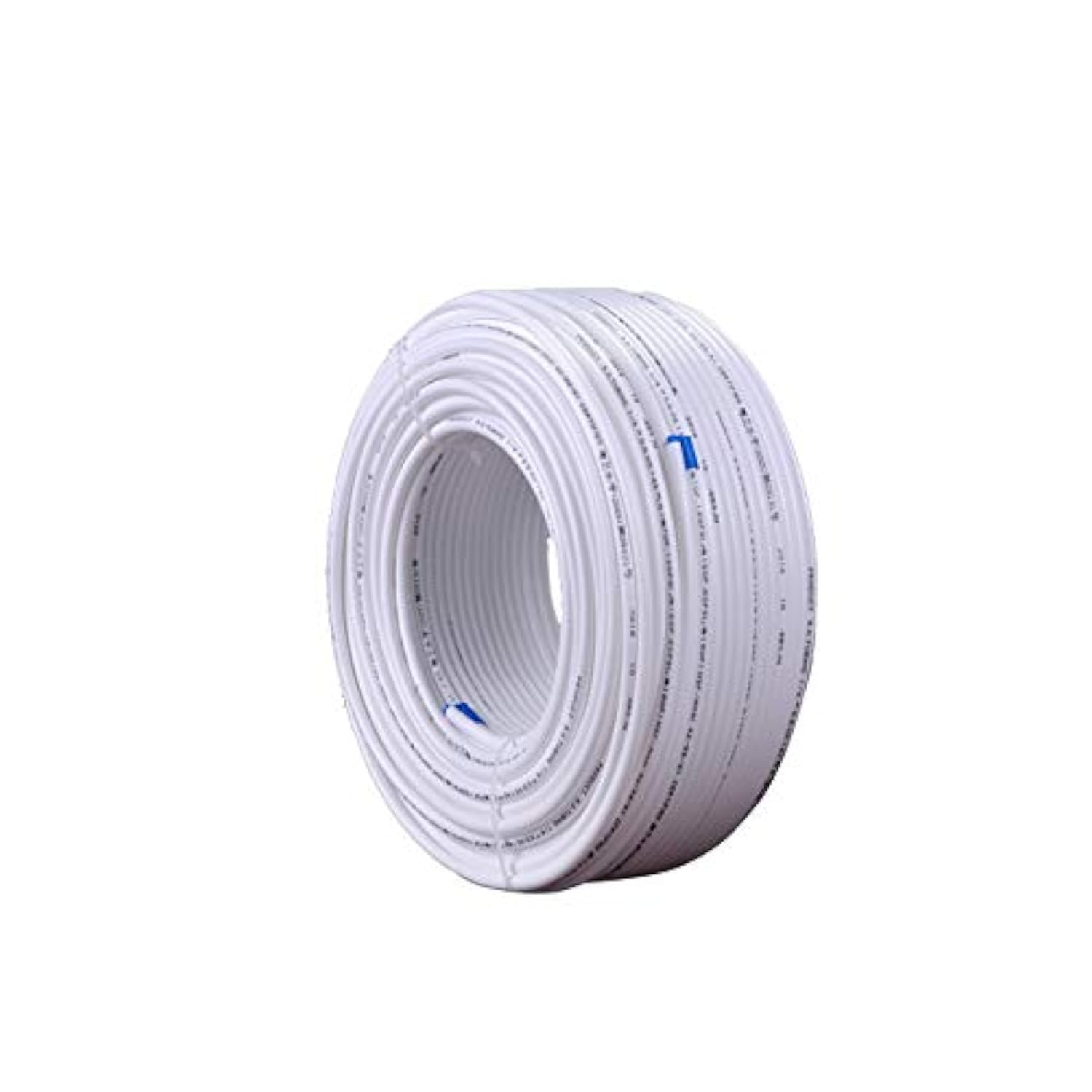
This is the line you want when the water coming out of it goes into your mouth. The PureSec tubing is made of food-grade polyethylene (a safe, non-toxic plastic) and carries NSF certification (a third-party stamp of approval from NSF International for drinking water safety). So you get water without any plastic taste or odor. It handles up to 120 psi (pounds per square inch) at 70°F — enough pressure for most refrigerator and RO systems — and steps up on length at 60 feet. It earns a 4.8 rating from 690 reviews, the highest score in this lineup.
The outside diameter is 0.25 inches (the standard size that fits common push-fit connectors). The wall thickness is roughly 1.46mm (the material between the water and the outside). It works with all standard 1/4-inch push-fit and compression fittings (connectors that grip the tube). One reviewer who runs an outdoor commercial ice maker reported that the line “works great after two summers outdoors,” which suggests the white color’s lower heat absorption helps it resist heat damage over time — unlike darker tubing.
If you are connecting a reverse osmosis system (a water purifier), refrigerator ice maker, or dehumidifier drain pump, this is the most reliable drop-in solution. The only real catch is that at 60 feet you are paying a bit more upfront than shorter RO lines, but for a permanent installation you will not need to replace it.
What makes it the pick
- NSF-certified for drinking water safety — no taste or odor
- Rated to 120 psi, enough for most RO and refrigerator setups
- 60-foot length gives extra reach or material for multiple connections
- Highest customer rating in this guide at 4.8 out of 5
What to keep in mind
- Outside diameter 0.25 inches means it only fits 1/4-inch push-fit fittings — not the larger barb fittings some brewing setups use
- PureSec-brand cutter sold separately for clean cuts
Best for drinking water lines: If you are plumbing an under-sink RO filter, refrigerator ice maker, or a dehumidifier pump-drain, this is the one to grab.
skip it if: You need a rigid tube that holds its shape for drip emitters — the Rain Bird below is stiffer and cheaper per foot for that job.
3. John Guest 1/4 Inch x 25 Feet LLDPE Tubing
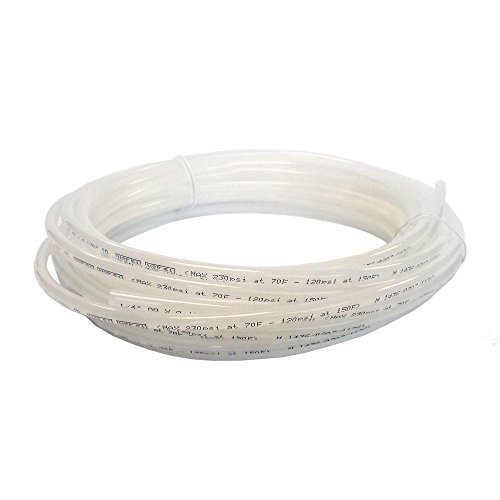
The highest pressure rating in the lineup at 150 psi, compared to the PureSec’s 120 psi and the Rain Bird’s 70 psi.
John Guest is the name you see on professional plumbing fittings, and their LLDPE (linear low-density polyethylene) tubing lives up to that reputation. It is rated to 150 psi (pounds per square inch) at 70°F — that is 25% more headroom than the PureSec and PURENAT lines, which max out at 120 psi. If you have a system that runs at the top end of residential water pressure or you want a safety buffer (extra capacity to prevent bursting) for a refrigerator supply line, this is the one.
The material is FDA-compliant (meets Food and Drug Administration standards for food contact) and certified to both NSF 61 (drinking water safety) and NSF 51 (food equipment safety) — among the safest tubes for drinking water. Buyers describe it as “quality material, works well for refrigerator supply line” and call it “the gold standard of this type of tubing.” The outside diameter is 0.25 inches (the standard size), so it mates perfectly with John Guest’s own push-fit fittings (quick-connect connectors) and most other common quick-connect connectors. It comes in a 25-foot length, compared to the 100-foot Houseables roll.
One reviewer using it on an RO filter (water purifier) system reported zero leaks after a month. The downside is purely the price per foot — it costs the most of any pipe in this guide for the shortest length, so buy it only for the connection that matters most.
Where it shines
- Highest pressure rating at 150 psi — safe for any residential water line
- FDA-compliant, NSF 61 and 51 certified — among the safest tubes for drinking water
- Odorless, tasteless, non-toxic polyethylene
Where it falls short
- 25-foot length means you cannot run a long-distance line like the 100-foot rolls
- Premium price per foot compared to the Rain Bird or Houseables options
Best for a single critical connection: If you are plumbing a refrigerator’s ice maker or the final run from an RO filter to a faucet, the extra pressure rating and certification are worth it.
pass on it if: You are covering a large garden or brewing setup — cheaper per-foot options like the Houseables or Rain Bird will save you money on 100 feet of line.
4. PURENAT 30FT 1/4 Inch O.D. RO Water Tubing

A BPA-free, NSF-tested 30-foot RO line that matches the PureSec’s 120 psi rating but costs less per foot — and includes a cutting tool in the package.
The PURENAT blue tubing is a straightforward, no-nonsense option for anyone connecting a reverse osmosis system (water purifier) or refrigerator filter. It is made from food-grade polyethylene (a safe, non-toxic plastic) that is odorless and tasteless, with a maximum pressure of 120 psi — matching the PureSec line for pressure capacity. The wall thickness is 0.044 inches (the material between the water and the outside), making it slightly thicker-walled than the Rain Bird (0.04 inches) even though both share a 0.25-inch outside diameter (the standard size). So it feels durable enough for indoor plumbing.
Owners mention that “it worked, certainly didn’t need 20ft for an undersink reverse osmosis, so looks like I will have a lot of extra” — meaning the 30-foot length is generous for a typical under-sink job. The blue color makes it easy to distinguish from your other household lines under the sink, and the tube is flexible enough to run through tight cabinet spaces without kinking (bending sharply and blocking water flow).
A couple of reviewers noted the material feels slightly thinner than premium RO tubing, though it still works for its intended purpose. At this price point, it is the best value for a one-time RO install.
Bottom line on quality: One buyer called it “not bad for the price” but admitted “you can tell it is not good quality RO tubing.” It works, but for a permanent drinking water line that you never want to touch again, consider the John Guest or PureSec.
Reach for this if: You need a short RO filter connection and want a spare cutting tool without paying for premium branding.
Look elsewhere if: You need a long run (60+ feet) or a line that feels substantial in the hand — the PureSec White is a better-feeling tube at a similar price per foot.
5. Houseables 1/4 Tubing, Clear Tubing, 1/4” ID x 3/8” OD, 100FT

100 feet of clear vinyl hose with a 0.25-inch inside diameter and a 0.38-inch outside diameter — built for homebrewers, not RO filters, and it will not fit standard quick-connect fittings.
This is the odd one out in this guide, and you need to understand why before you buy it. The Houseables tubing is measured by inside diameter (the hole size: 0.25 inches) with a much larger outside diameter (the full tube width) of 0.38 inches and a wall thickness of 0.0625 inches (the material between the water and the outside) — with a wall thickness of 0.0625 inches compared to the Rain Bird’s 0.04 inches, and an outside diameter of 0.38 inches compared to the standard 0.25-inch fit. It is a vinyl hose (PVC, a flexible plastic), not a polyethylene pipe (the usual material for RO and fridge lines). It is designed to slip over a barb fitting (a connector with ridges) rather than push into a quick-connect fitting (a snap-on connector).
Buyers use it for beer line replacement (the hose that moves beer from keg to tap), homebrew siphoning (moving liquid between containers for beer making), and slow UVC water purification systems (water sterilizers). One reviewer noted they used it “for a slow UVC water purification system in PH” and that it “works great, doesn’t stink really bad after uncoiled.” Another homebrewer noted that rather than cleaning beer lines they just replaced them with this at a “nice price for the quantity.” The material is food-grade and free of phthalates (chemicals used to soften plastic), latex, and BPA (a chemical that can leach into water), so it is safe for beverages.
The catch is that its larger 0.38-inch outside diameter means it will not fit into standard 1/4-inch quick-connect RO fittings (snap-on connectors). A buyer explicitly warned: “tubing is 11/32 OD, not 3/8 OD as advertised” — so measure your fittings if you need a precise 3/8-inch OD match. For brewing and general fluid transfer, it is a solid 100-foot roll at a good value.
Who this is for: Homebrewers, aquarium keepers, anyone moving liquids between containers with a siphon or pump. This is not a drinking-water line for RO filters, even though the material is food-grade.
Grab this for brewing: If you need 100 feet of clear tubing for beer lines, water changes, or chemical fluid transfer, the price per foot is excellent.
Do not buy for RO or fridge: The 0.38-inch outside diameter and vinyl material make it incompatible with standard 1/4-inch push-fit fittings and polyethylene-rated systems.
Understanding the Specs
Inside Diameter vs Outside Diameter
The inside diameter (the hole size) controls how much water can flow through the pipe. The outside diameter (the full tube width) determines which fittings connect to the pipe. For example, the Houseables clear tube has a 0.25-inch inside diameter (so the waterway is the same size as a standard RO tube) — but its 0.38-inch outside diameter means it will not fit into a 1/4-inch push-fit connector (a snap-on fitting). Always match the outside diameter to your fittings, not the inside diameter. Standard RO and drip tubing (for water purifiers and garden watering) uses a 0.25-inch outside diameter and works with all common quick-connect and compression fittings (connectors that grip the tube or snap on).
Maximum Pressure (PSI)
This is the highest water pressure (water force measured in pounds per square inch) the tube can handle before it bursts (so you get no leaks or splits). Drip irrigation systems (garden watering setups) usually run at 0 to 70 psi, as seen on the Rain Bird T22-100S. Reverse osmosis filters (water purifiers) and refrigerator ice makers often push 80 to 100 psi, so you need a tube rated for at least 120 psi — like the PureSec or PURENAT. The John Guest leads this category at 150 psi. If your system runs at 100 psi and you buy a 70 psi tube, the line will expand, leak, and eventually split. Always choose a pressure rating equal to or higher than your system’s operating pressure.
FAQ
Can I use 1/4 inch PVC pipe for drinking water?
What is the difference between 1/4 inch ID and 1/4 inch OD tubing?
Will 1/4 inch RO tubing work with a refrigerator ice maker?
How do I cut 1/4 inch polyethylene tubing cleanly?
Can I bury 1/4 inch drip irrigation tubing underground?
Is 1/4 inch tubing the same as 6mm tubing?
How long does 1/4 inch PVC pipe last outdoors?
Can I connect 1/4 inch tubing to a 1/2 inch drip line?
What does BPA free mean for 1/4 inch tubing?
Why does my 1/4 inch tubing keep kinking at the bend?
Final Thoughts: The Verdict
For the majority of shoppers, the 1/4 inch pvc pipe winner is the PureSec White 60FT because it combines NSF-certified drinking water safety (a third-party stamp for clean water), a 120 psi pressure rating (enough for RO and fridge lines), a generous 60-foot length, and the highest customer rating in the group at 4.8 out of 5. If you need a rigid drip irrigation line that holds emitters under pressure, grab the Rain Bird T22-100S. And for pure pressure headroom and material quality on a single refrigerator or RO connection, the John Guest LLDPE tubing with its 150 psi rating and dual NSF certifications is the safest bet.
How We Picked
We do not accept paid placement. Every pick is matched to a real buyer and a real use-case; we do not hands-on test units.
Sources & Methodology
Specifications: manufacturer listings and product documentation. Review insights: verified customer reviews, as of July 2026. Pricing: not shown on this page (it changes often); check the current price via the retailer link.
As an Amazon Associate, Gadgets Feed earns from qualifying purchases. This does not affect which products we feature.